1
By,
Dr.S.Selvakumar
Subject Name: Mobile Communication
Unit name: Cellular Concepts
2
Aim and Objectives
• To make students familiar with fundamentals of
mobile communication systems
• To understand the concept of frequency reuse
• To identify the limitations of 2G and 2.5G wireless
mobile communication and use design of 3G and
beyond mobile communication systems
• understanding the basic principles of mobile
communication systems
3
Pre Test - MCQ type
1. The advantage of using frequency reuse is
a. Increased capacity
b. Limited spectrum is required
c. Same spectrum may be allocated to other network
d. All of the above
ANSWER: All of the above
2. Co-channel reuse ratio depends upon
a. Radius of the cell
b. Distance between the centers of the co channel cells
c. Frequency allocation of nearest cells
d. Both a and b
e. Both b and c
ANSWER: Both a and b
4
3.Increase in Co- channel reuse ratio indicates
a. Better transmission quality
b. Larger capacity
c. Low co-channel interference
d. Both a and c
e. Both a and b
ANSWER: Both a and c
4. The strategies acquired for channel assignment are
a. Fixed
b. Dynamic
c. Regular
d. Both a and b
e. Both b and c
ANSWER: Both a and b
Pre Test - MCQ type
5
5. In a fixed channel assignment strategy, if all the assigned channels are
occupied, the call
a. Gets transferred to another cell
b. Gets blocked
c. Is kept on waiting
d. All of the above
ANSWER: b.Gets blocked
6. In a fixed channel assignment strategy
a. Each cell is assigned a predetermined set of
frequencies
b. The call is served by unused channels of the cell
c. The call gets blocked if all the channels of the cell are
occupied
d. All of the above
ANSWER: All of the above
Pre Test - MCQ type
6
7. In a dynamic channel assignment strategy,
a. Voice channels are not permanently assigned
b. The serving base station requests for a channel from
MSC
c. MSC allocates the channel according to the
predetermined algorithm
d. All of the above
ANSWER: All of the above
8. Advantage of using Dynamic channel assignment is
a. Blocking is reduced
b. Capacity of the system is increased
c. Both a & b
d. None of the above
ANSWER: Both a & b
Pre Test - MCQ type
7
9. Disadvantage of using Dynamic channel assignment is
a. More storage required
b. Calculations and analysis is increased
c. Both a & b
d. None of the above
ANSWER: Both a & b
10.In Dynamic channel assignment, any channelwhich is being used in one
cell can be reassigned simultaneously to another cell in the system at a
reasonable distance.
a. True
b. False
ANSWER: True
Pre Test - MCQ type
8
Pre-Requisite:
• Basic knowledge of digital communication
• Antenna and wave propagation
• Applied random process
Subject Name: Mobile Communication
Unit – V / Cellular Concepts
9
Syllabus
Frequency Reuse – Channel Assignment
Strategies – Hand off Strategies – Interference &
system capacity- Co-Channel Interference-
Adjacent Channel Interference – Trunking and
Grade of service – Improving coverage &
capacity in cellular systems - Cell Splitting-
Sectoring- Repeaters for Range Extension-
Microcell Zone Concept.
10
Introduction to Cellular System
11
Cellular Systems-Basic Concepts
• Cellular system solves the problem of spectral congestion.
• Offers high capacity in limited spectrum.
• High capacity is achieved by limiting the coverage area of each BS
to a small geographical area called cell.
• Replaces high powered transmitter with several low power
transmitters.
• Each BS is allocated a portion of total channels and nearby cells
are allocated completely different channels.
• All available channels are allocated to small no of neighboring BS.
• Interference between neighboring BS’s is minimized by allocating
different channels.
12
Cellular Systems-Basic Concepts
• Same frequencies are reused by spatially separated
BS’s.
• Interference between co-channels stations is kept
below acceptable level.
• Additional radio capacity is achieved.
• Frequency Reuse-Fix no of channels serve an
arbitrarily large no of subscribers
13
Topic 1
Frequency Re-use
14
Frequency Reuse
• Used by service providers to improve the efficiency of a cellular
network and to serve millions of subscribers using a limited
radio spectrum.
• After covering a certain distance a radio wave gets attenuated
and the signal falls below a point where it can be no longer
used.
• A transmitter transmitting in a specific frequency range will
have only a limited coverage area
• Beyond this coverage area, that frequency can be reused by
another transmitter.
• The entire network coverage area is divided into cells based on
the principle of frequency reuse
15
Frequency Reuse
• A cell = basic geographical unit of a cellular network & the area
around an antenna where a specific frequency range is used.
• When a subscriber moves to another cell, the antenna of the
new cell takes over the signal transmission
• A cluster is a group of adjacent cells, usually 7 cells; no
frequency reuse is done within a cluster
• The frequency spectrum is divided into sub-bands & each sub-
band is used within one cell of the cluster
• In heavy traffic zones cells are smaller, while in isolated zones
cells are larger
16
Frequency Reuse
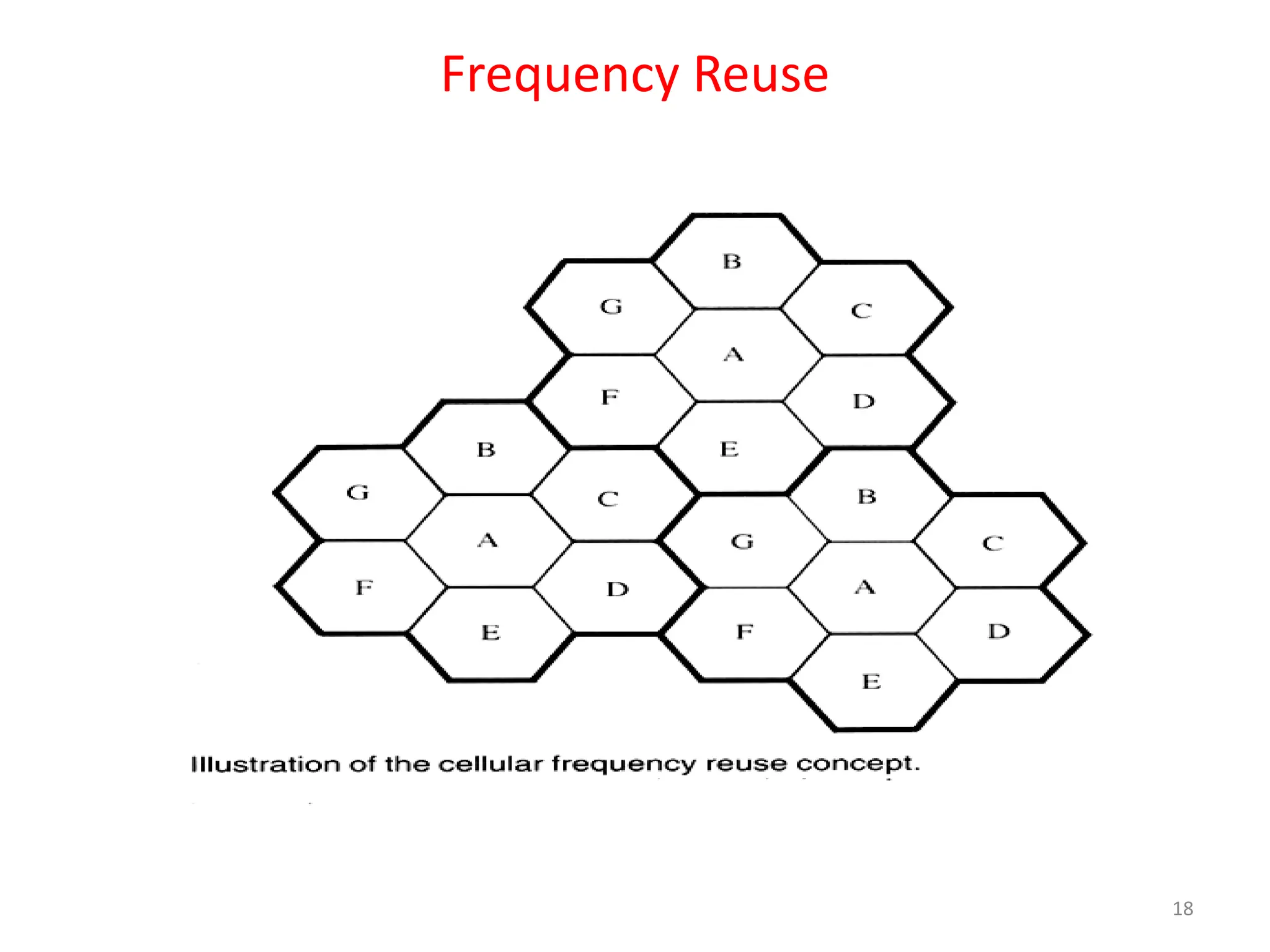
• The design process of selecting and allocating channel
groups for all of the cellular base stations within a
system is called frequency reuse or frequency
planning.
• Cell labeled with same letter use the same set of
frequencies.
• Cell Shapes - Circle, Square, Triangle and Hexagon.
• Hexagonal cell shape is conceptual , in reality it is
irregular in shape
17
Frequency Reuse
18
Frequency Reuse
• In hexagonal cell model, BS transmitter can be in
centre of cell or on its 3 vertices.
• Centered excited cells use omni directional whereas
edge excited cells use directional antennas.
• A cellular system having ‘S’ duplex channels, each cell is
allocated ‘k’ channels (k<S).
• If S channels are allocated to N cells into unique and
disjoint channels, the total no of available channel is
• S = kN.
19
Frequency Reuse
• N cells collectively using all the channels is called a cluster, - a
group of adjacent cells.
• If cluster repeated M times, the capacity C of system is given as
C = MkN = MS
• Capacity of system is directly proportional to the no of times
the cluster repeated.
• Reducing the cluster size N while keeping the cell size constant,
more clusters are required to cover the given area and hence
more capacity.
• Co-channel interference is dependent on cluster size, large
cluster size less interference and vice versa.
20
Frequency Reuse
• The Frequency Reuse factor is given as 1/N & each cell is
assigned 1/N of total channels.
• Lines joining a cell and each of its neighbor are separated by
multiple of 600, certain cluster sizes and cell layout possible
• Geometery of hexagon is such that no of cells per cluster i.e
N, can only have values which satisfy the equation
N = i2 + ij + j2
 N, the cluster size is typically 4, 7 or 12.
 In GSM normally N =7 is used.
• i and j are integers, for i=3 and j=2 N=19.
21
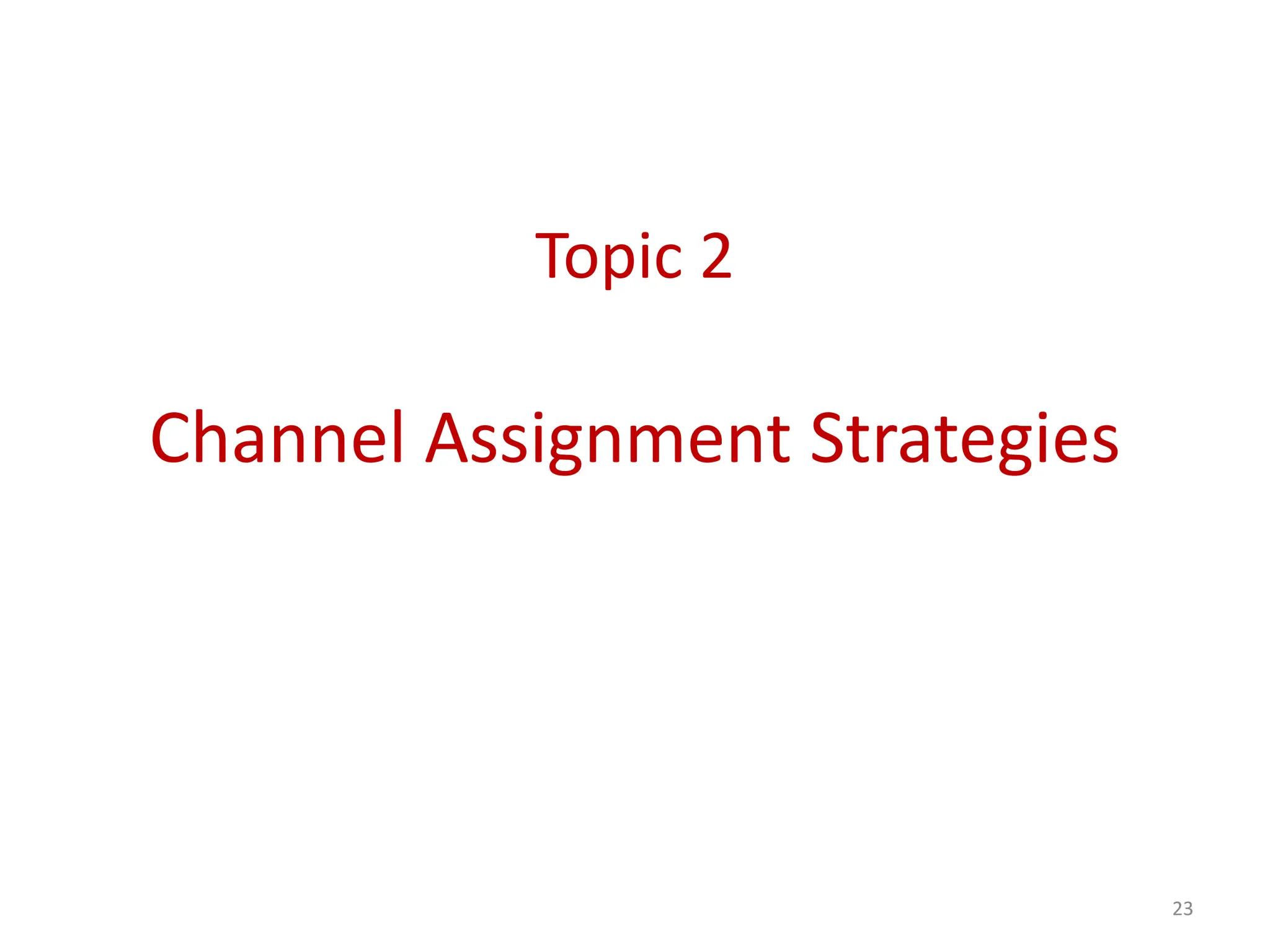
Locating co-channel Cell
22
Topic 2
Channel Assignment Strategies
23
Fixed Assignment Strategy
• A scheme for increasing capacity and minimizing interference is
required for effective utilization of radio spectrum.
• CAS can be classified as either fixed or dynamic
• Choice of CAS impacts the performance of system for call
management.
• In Fixed CA each cell is assigned a predetermined set of voice
channels
• Any call attempt within the cell can only be served by the
unused channel in that particular cell
• If all the channels in the cell are occupied, the call is blocked &
the user does not get service.
• In variation of FCA – called borrowing strategy, a cell can borrow
channels from its neighboring cell if its own channels are full.
24
Dynamic Channel Assignment
• Voice channels are not allocated to different cells permanently.
• Each time a call request is made, the BS request a channel from
the MSC.
• MSC allocates a channel to the requesting cell using an
algorithm that takes into account -
– likelihood of future blocking
– The reuse distance of the channel ( should not cause
interference)
– Other parameters like cost
• To ensure min QoS, MSC only allocates a given frequency, not
currently in use in the cell or any other cell which falls within the
limiting reuse distance.
• DCA reduce the likelihood of blocking and increases capacity
• Requires the MSC to collect realtime data on channel occupancy
and traffic distribution on continous basis.
25
Dynamic Channel Assignment (contd)
• This increases the storage and computational load on
the system
• But provides the advantage of increased channel
utilization and decreased probability of a blocked
call.
26
Topic 3
Hand off Strategies
27
Introduction to Hand-off
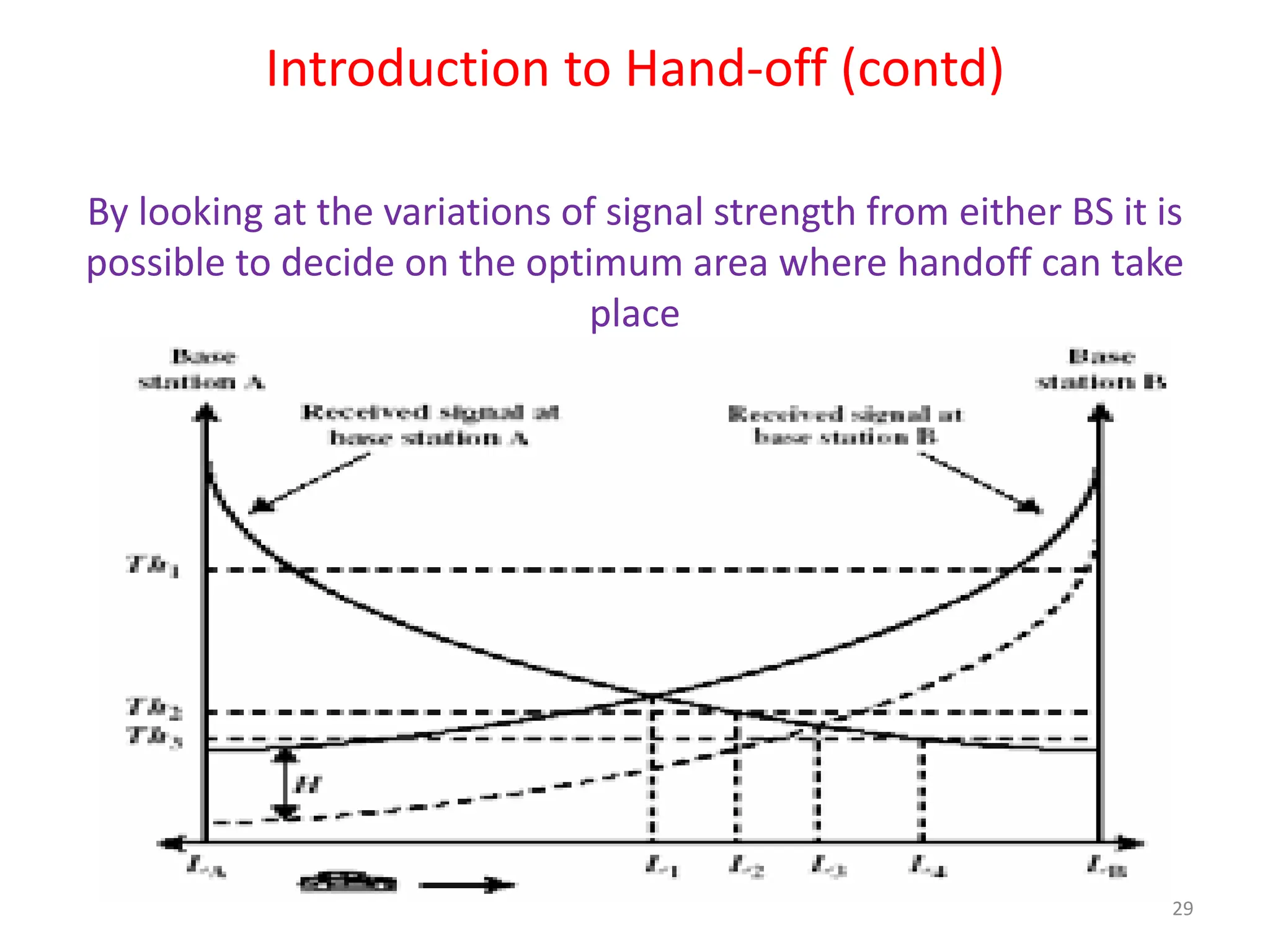
• Mobile moves into a different cell during a conversation, MSC
transfers the call to new channel belonging to new BS
• Handoff operation involves identifying the new BS and
allocation of voice and control signal to channels associated
with new BS
• Must be performed successfully, infrequently and impercitble
to user
• To meet these requirements an optimum signal level must be
defined to initiate a handoff.
• Minimum usuable signal for acceptable voice qualtiy  90 to -
100 dBm
• A slight higher value is used as threshold
28
Introduction to Hand-off (contd)
By looking at the variations of signal strength from either BS it is
possible to decide on the optimum area where handoff can take
place
29
30
Hand-off strategies
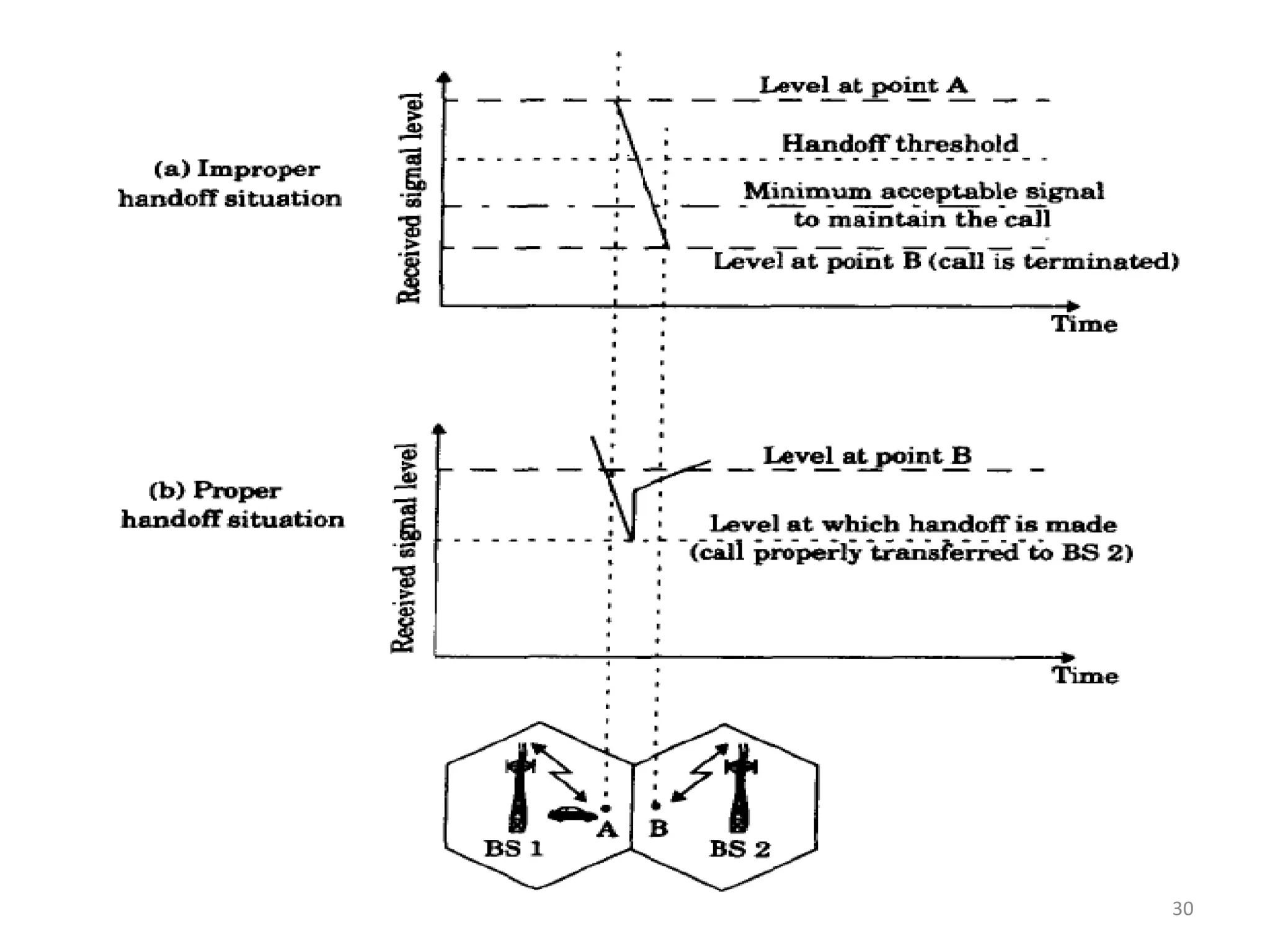
• Handoff is made when received signal at the BS falls below a
certain threshold
• During handoff: to avoid call termination, safety margin should
exist and should not be too large or small
 = Powerhandoff – Powermin usable
• Large  results in unecesarry handoff and for small 
unsufficient time to complete handoff, so carefully chosen to
meet the requirements.
• Figure 2a, handoff not made and signal falls below min
acceptable level to keep the channel active.
• Can happen due to excessive delay by MSC in assigning handoff,
or when threshold  is set to small.
• Excessive delay may occur during high traffic conditions due to
computional loading or non avialablilty of channels in nearby
cells.
31
Hand-off Strategies (contd)
• In deciding when to handoff , it is important to ensure
that the drop in signal level is not due to momentary
fading.
• In order to ensure , the BS monitors the signal for a
certain period of time before initiating a handoff
• The length of time needed to decide if handoff is
necessary depends on the speed at which the mobile
is moving.
32
Hand-off strategies – First Generation
• In 1st generation analog cellular systems, the signal strength
measurements are made by the BS and are supervised by the
MSC.
• A spare Rx in base station monitors RSS of RVC's in neighboring
cells
• Tells Mobile Switching Center about these mobiles and
their channels
• Locator Rx can see if signal to this base station is
significantly better than to host base station
– MSC monitors RSS from all base stations & decides on
handoff
33
Hand-off strategies – 2nd Generation
• In 2nd generation systems, Mobile Assisted Handoffs (MAHO) are
used
• In MAHO, every MS measures the received power from the
surrounding BS & continually reports these values to the
corresponding BS.
• Handoff is initiated if the signal strength of a neighboring BS
exceeds that of current BS
• MSC no longer monitors RSS of all channels
– reduces computational load considerably
– enables much more rapid and efficient handoffs
– imperceptible to user
34
Soft Handoff Vs Inter-system Handoff
• CDMA spread spectrum cellular systems provides a unique
handoff capability
• Unlike channelized wireless systems that assigns different radio
channel during handoff (called hard handoff), the spread
spectrum MS share the same channel in every cell
• The term handoff here implies that a different BS handles the
radio communication task
• The ability to select between the instantaneous received signals
from different BSs is called soft handoff.
• If a mobile moves from one cellular system to another system
controlled by a different MSC, an inter-system handoff is
required.
• MSC engages in intersystem handoff when signal becomes weak
in a given cell.
35
Prioritizing Handoffs
 Perceived Grade of Service (GOS) – service quality as viewed
by users
• “quality” in terms of dropped or blocked calls
• assign higher priority to handoff Vs new call request
• a dropped call more aggravating than an occasional blocked call
 Guard Channels
– % of total available cell channels set aside for handoff requests
– makes fewer channels available for new call requests
– a good strategy for dynamic channel allocation
• Queuing of Handoff Requests
– use time delay between handoff threshold & minimum useable signal level
– a handoff request during that time period, instead of having a single
block/no block decision
– prioritize requests & handoff as required
– calls still be dropped if time period expires
36
Practical Handoff Considerations
• Problems occur because of a large range of mobile velocities
– pedestrian Vs vehicle user
• Small cell sizes or micro-cells → larger # handoffs
• MSC load is heavy when high speed users are passed between
very small cells
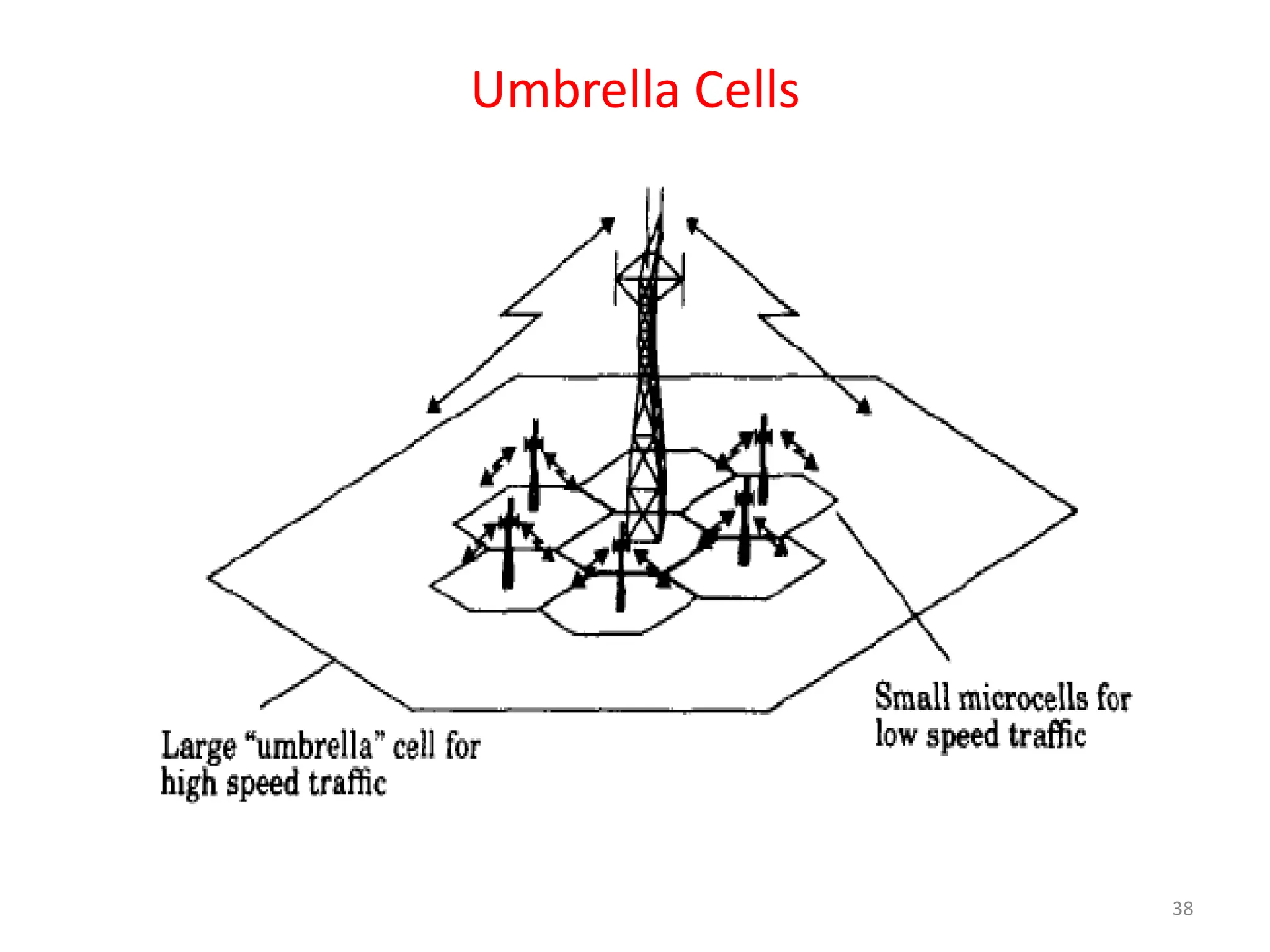
• Umbrella Cells
– use different antenna heights & Tx power levels to provide large and
small cell coverage
– multiple antennas & Tx can be co-located at single location if required
– large cell → high speed traffic → fewer handoffs
– small cell → low speed traffic
– example areas: interstate highway passing through urban center, office
park, or nearby shopping mall
37
Umbrella Cells
38
Topic 4
Interference & System Capacity
39
Interference
• Interference is the major limiting factor in the performance of
cellular radio systems.
• Sources of interference include -
 another mobile in the same cell
 a call in progress in a neighboring cell
 other base stations operating in same frequency band
 any non-cellular system which leaks energy into band
• Interference on voice channels causes cross talk due to an
undesired transmission.
• Interference on control channels, leads to missed & blocked
calls due to errors in digital signaling.
• Interference is more severe in urban areas, due to RF noise floor
& large number of base stations / mobiles.
• Interference is a major bottleneck in increasing capacity &
often responsible for dropped calls
40
Interference (contd)
• The two major types of cellular interference are Co-channel
interference (CCI) & Adjacent channel interference (ACI).
• Even though interfering signals are often generated within the
cellular system, they are difficult to control due to random
propagation effects.
• More difficult to control is interference due to out-of-band
users due to front end overload of subscriber equipments.
• CCI is caused due to the cells that reuse the same frequency set.
• These cells using the same frequency set are called Co-channel
cells.
• ACI is caused due to the signals that are adjacent in frequency.
41
Topic 5
Co-channel Interference
42
Co-channel Interference
• Frequency reuse indicates that in a given coverage area there
are several cells using the same set of frequencies.
• These cells are called co-channel cells & interference between
signals from these cells is called co-channel interference.
• Co-channel interference cannot be combated by simply
increasing the carrier power of a transmitter.
• Because an increase in carrier transmit power increases the
interference to neighboring co-channel cells.
• To reduce co-channel interference, co-channel cells must be
separated by a minimum distance to provide sufficient isolation
due to propagation.
• Co-channel interference is independent of the transmitted
power & depends upon the radius of the cell (R) and the
distance between centers of the nearest co-channel cells (D).
43
Co-channel Interference (contd)
• By increasing D/R ratio, the spatial separation between co-
channel cells relative to the coverage distance of a cell is
increased.
• Thus, interference is reduced from improved isolation of RF
energy from the co-channel cell.
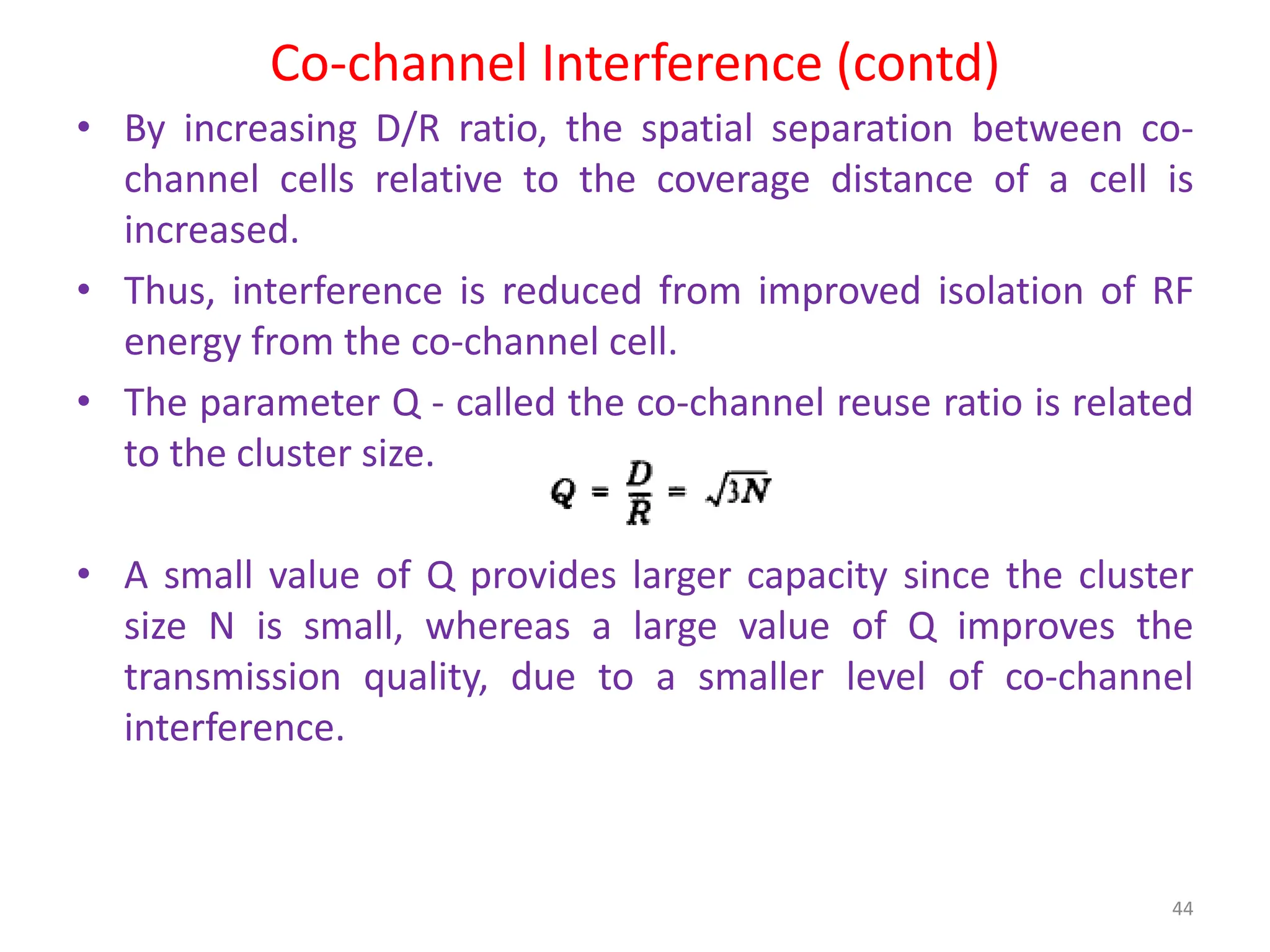
• The parameter Q - called the co-channel reuse ratio is related
to the cluster size.
• A small value of Q provides larger capacity since the cluster
size N is small, whereas a large value of Q improves the
transmission quality, due to a smaller level of co-channel
interference.
44
Signal to Interference Ratio (S/I)
• Let i0 be the number of co-channel interfering cells.
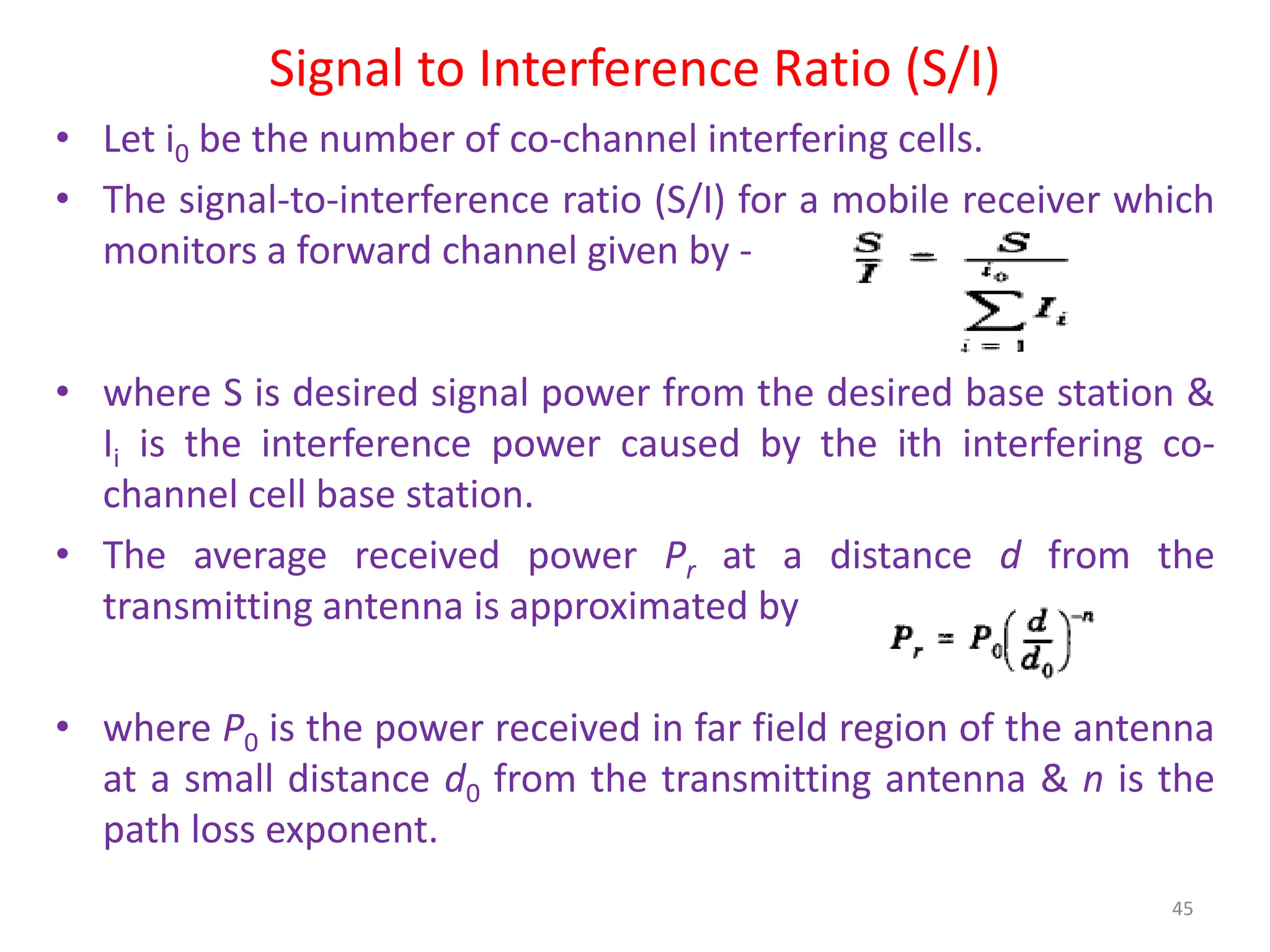
• The signal-to-interference ratio (S/I) for a mobile receiver which
monitors a forward channel given by -
• where S is desired signal power from the desired base station &
Ii is the interference power caused by the ith interfering co-
channel cell base station.
• The average received power Pr at a distance d from the
transmitting antenna is approximated by
• where P0 is the power received in far field region of the antenna
at a small distance d0 from the transmitting antenna & n is the
path loss exponent.
45
Signal to Interference Ratio (contd)
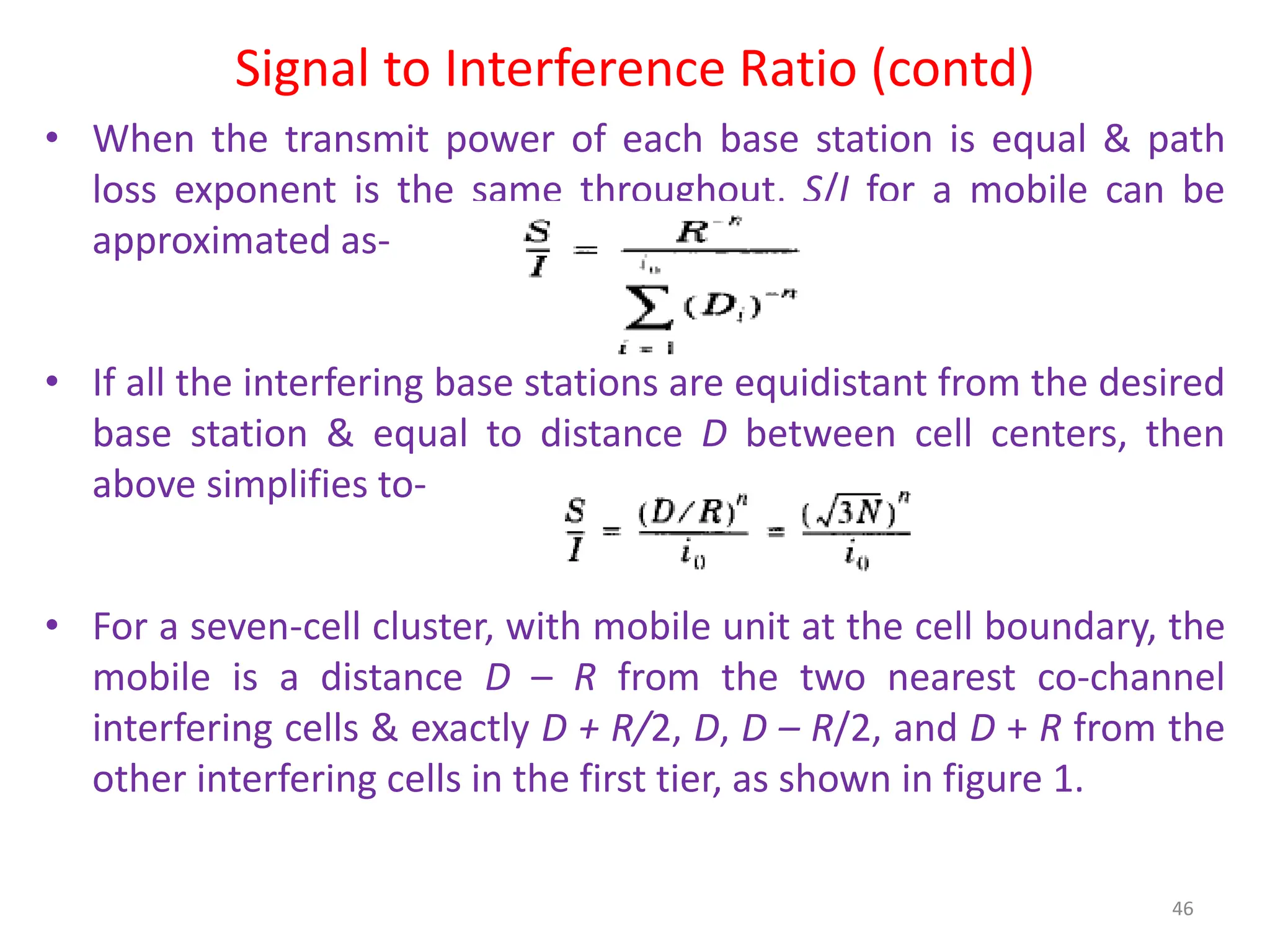
• When the transmit power of each base station is equal & path
loss exponent is the same throughout, S/I for a mobile can be
approximated as-
• If all the interfering base stations are equidistant from the desired
base station & equal to distance D between cell centers, then
above simplifies to-
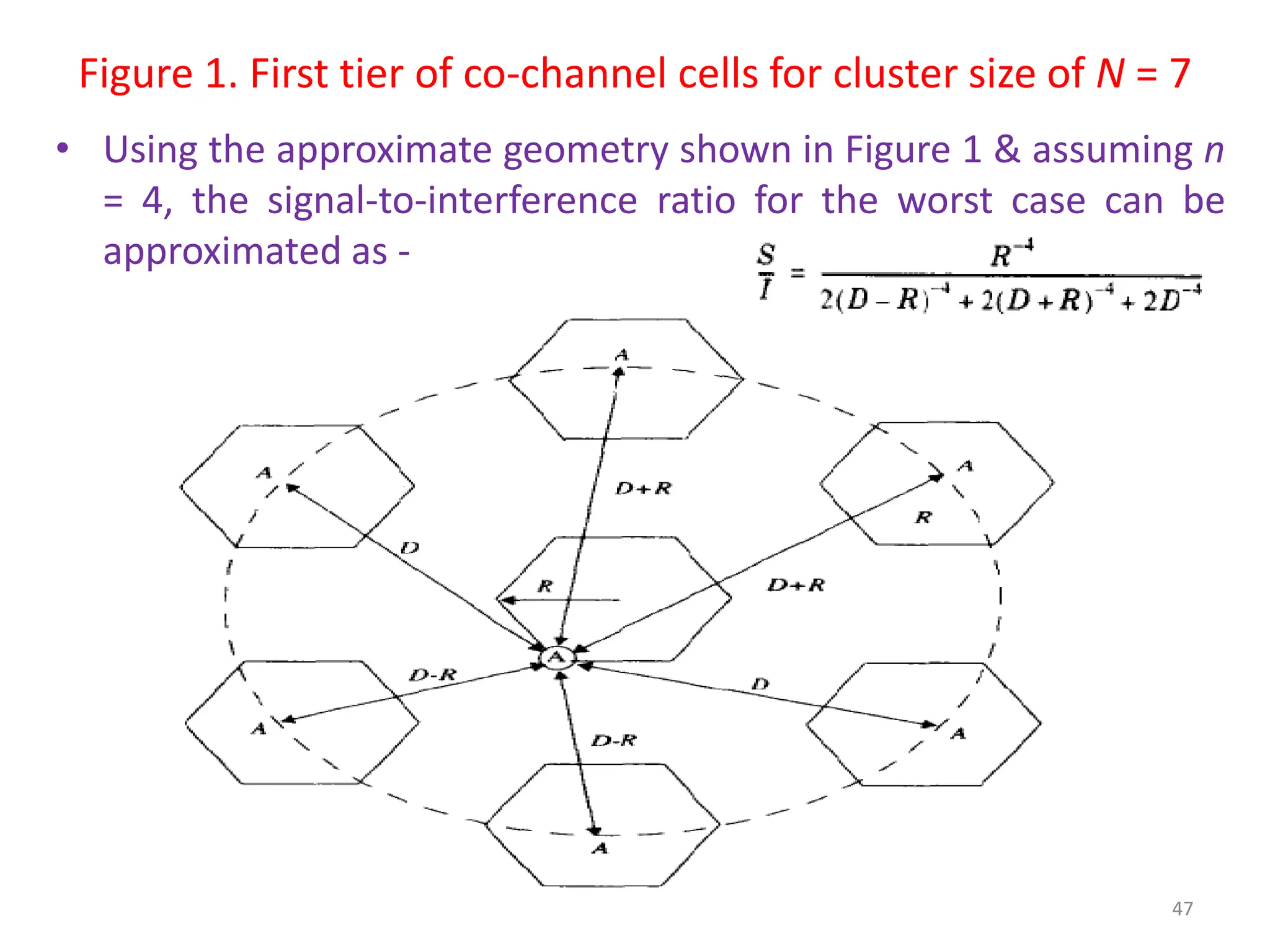
• For a seven-cell cluster, with mobile unit at the cell boundary, the
mobile is a distance D – R from the two nearest co-channel
interfering cells & exactly D + R/2, D, D – R/2, and D + R from the
other interfering cells in the first tier, as shown in figure 1.
46
Figure 1. First tier of co-channel cells for cluster size of N = 7
• Using the approximate geometry shown in Figure 1 & assuming n
= 4, the signal-to-interference ratio for the worst case can be
approximated as -
47
Topic 6
Adjacent Channel Interference
48
Near–Far Effect
49
• Interference resulting from signals adjacent in frequency to the
desired signal is called adjacent channel interference.
• Adjacent channel interference results from imperfect receiver
filters which allow nearby frequencies to leak into the pass-
band.
• The problem can be serious if an adjacent channel user is
transmitting in very close range to a subscriber’s receiver, while
the receiver attempts to receive a base station on the desired
channel.
• This is called as the near–far effect, where a nearby transmitter
captures the receiver of the subscriber.
• It also occurs when a mobile close to a base station transmits on
a channel close to one being used by a weak mobile.
Minimizing Interference
50
• The base station may have difficulty in discriminating the
desired mobile user from the “bleed-over” caused by the close
adjacent channel mobile.
• Adjacent channel interference can be minimized through
careful filtering & channel assignments.
• Since each cell is given only a fraction of the available
channels, a cell need not be assigned channels adjacent in
frequency.
• By keeping the frequency separation between each channel in
a given cell larger, the adjacent channel interference may be
reduced.
• If the frequency reuse factor is large, the separation between
adjacent channels at the base station not sufficient to keep the
adjacent channel interference level within tolerable limits.
Minimizing Interference (contd)
51
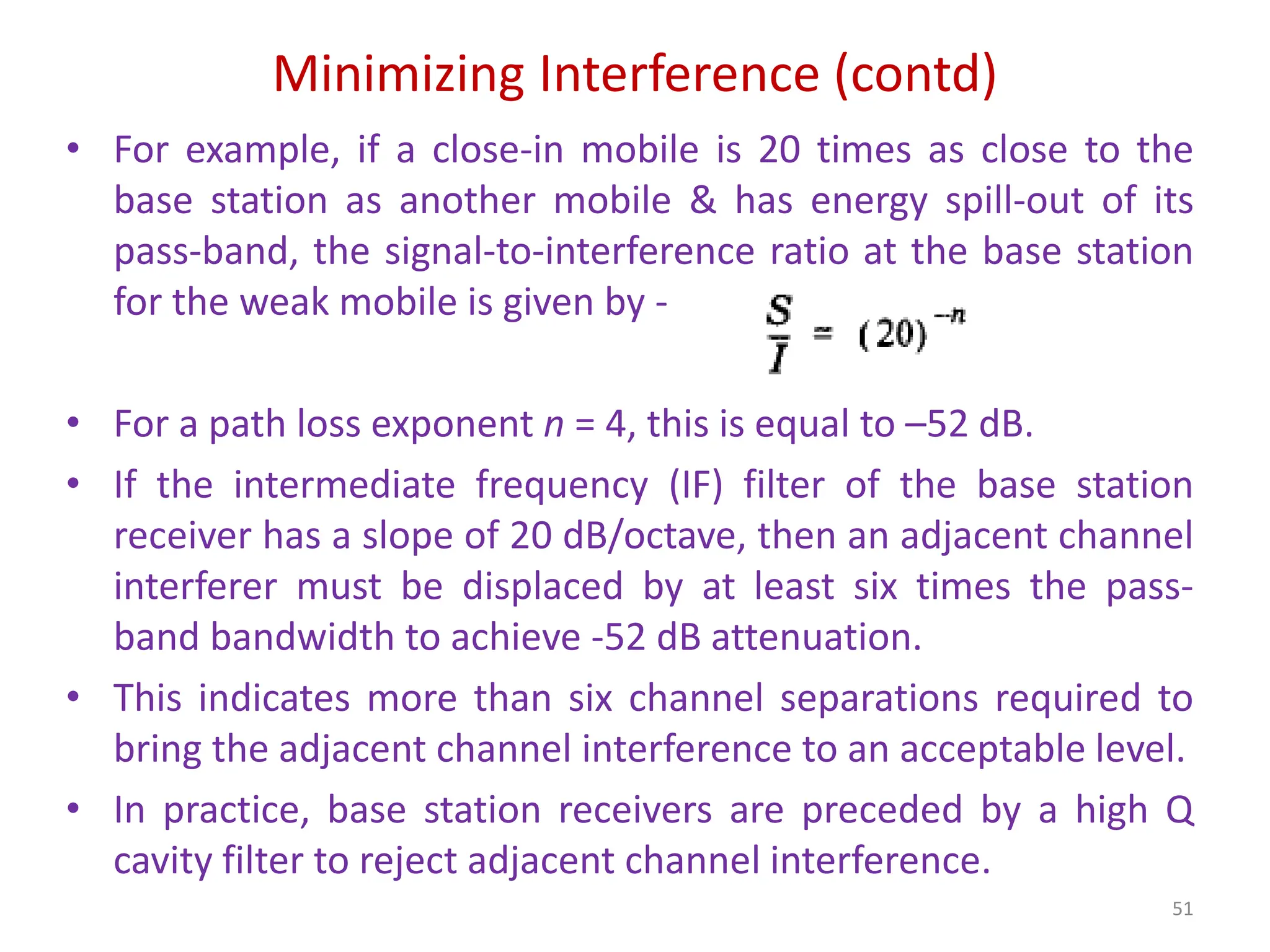
• For example, if a close-in mobile is 20 times as close to the
base station as another mobile & has energy spill-out of its
pass-band, the signal-to-interference ratio at the base station
for the weak mobile is given by -
• For a path loss exponent n = 4, this is equal to –52 dB.
• If the intermediate frequency (IF) filter of the base station
receiver has a slope of 20 dB/octave, then an adjacent channel
interferer must be displaced by at least six times the pass-
band bandwidth to achieve -52 dB attenuation.
• This indicates more than six channel separations required to
bring the adjacent channel interference to an acceptable level.
• In practice, base station receivers are preceded by a high Q
cavity filter to reject adjacent channel interference.
Topic 7
Trunking & Grade of Service
52
Trunking
• Cellular radio systems depend on trunking to
accommodate a large number of users in a limited
radio spectrum.
• Trunking allows a large no of users to share a small
number of channels in a cell by providing access to
each user, on demand, from a pool of available
channels.
• In a trunked radio system (TRS) each user is
allocated a channel on a per call basis, upon
termination of the call, the previously occupied
channel is immediately returned to the pool of
available channels. 53
Key Definitions
• Setup Time: Time required to allocate a radio channel to a
requesting user
• Blocked Call: Call which cannot be completed at the time
of request, due to congestion
• Holding Time: Average duration of a typical call.
• Request Rate: The average number of calls requests per
unit time ( λ)
• Traffic Intensity: Measure of channel time utilization
measured in Erlangs. Dimensionless quantity. Denoted by
A
• Load: Traffic intensity across the entire TRS (Erlangs)
54
Erlang- Unit of Traffic
• The fundamentals of trunking theory were developed by
Erlang, a Danish mathematician, the unit bears his name.
• An Erlang is a unit of telecommunications traffic
measurement.
• Erlang represents the continuous use of one voice path.
• Used to describe the total traffic volume of one hour
• A channel kept busy for one hour is defined as having a load
of one Erlang
• For example, a radio channel that is occupied for thirty
minutes during an hour carries 0.5 Erlangs of traffic
• For 1 channel
– Min load = 0 Erlang (0% time utilization)
– Max load = 1 Erlang (100% time utilization) 55
Erlang- Unit of Traffic (contd)
• For example, if a group of 100 users made 30 calls in
one hour, and each call had an average call
duration(holding time) of 5 minutes, then the
number of Erlangs this represents is worked out as
follows:
• Minutes of traffic in the hour = number of calls x
duration
• Minutes of traffic in the hour = 30 x 5 = 150
• Hours of traffic in the hour = 150 / 60 = 2.5
• Traffic Intensity= 2.5 Erlangs
56
Grade of Service
• In a TRS, when a particular user requests service & all
the available radio channels are already in use , the
user is blocked or denied access to the system.
• In some systems a queue may be used to hold the
requesting users until a channel becomes available.
• Trunking systems must be designed in order to ensure
that there is a low likelihood that a user will be blocked
or denied access.
• The likelihood that a call is blocked, or the likelihood
that a call experiences a delay greater than a certain
queuing time is called “Grade of Service” (GOS)’’.
57
Grade of Service (contd)
• Grade of Service (GOS): Measure of ability of a user to
access a trunked system during the busiest hour.
• Also a Measure of the congestion which is specified as a
probability.
• It is a benchmark to define the desire performance of a
particular trunk system.
• The probability of a call being blocked -
• Blocked calls cleared (BCC) or Erlang B systems.
• The probability of a call being delayed beyond a certain
amount of time before being granted access -
• Blocked call delayed (BCD) or Erlang C systems.
58
Blocked Call Cleared Systems (BCC)
• When a user requests service, there is a minimal call
set-up time & user is given immediate access to a
channel if one is available.
• If channels are already in use and no new channels are
available, call is blocked without access to the system.
• The user does not receive service, but is free to try
again later.
• All blocked calls are instantly returned to the user
pool. 59
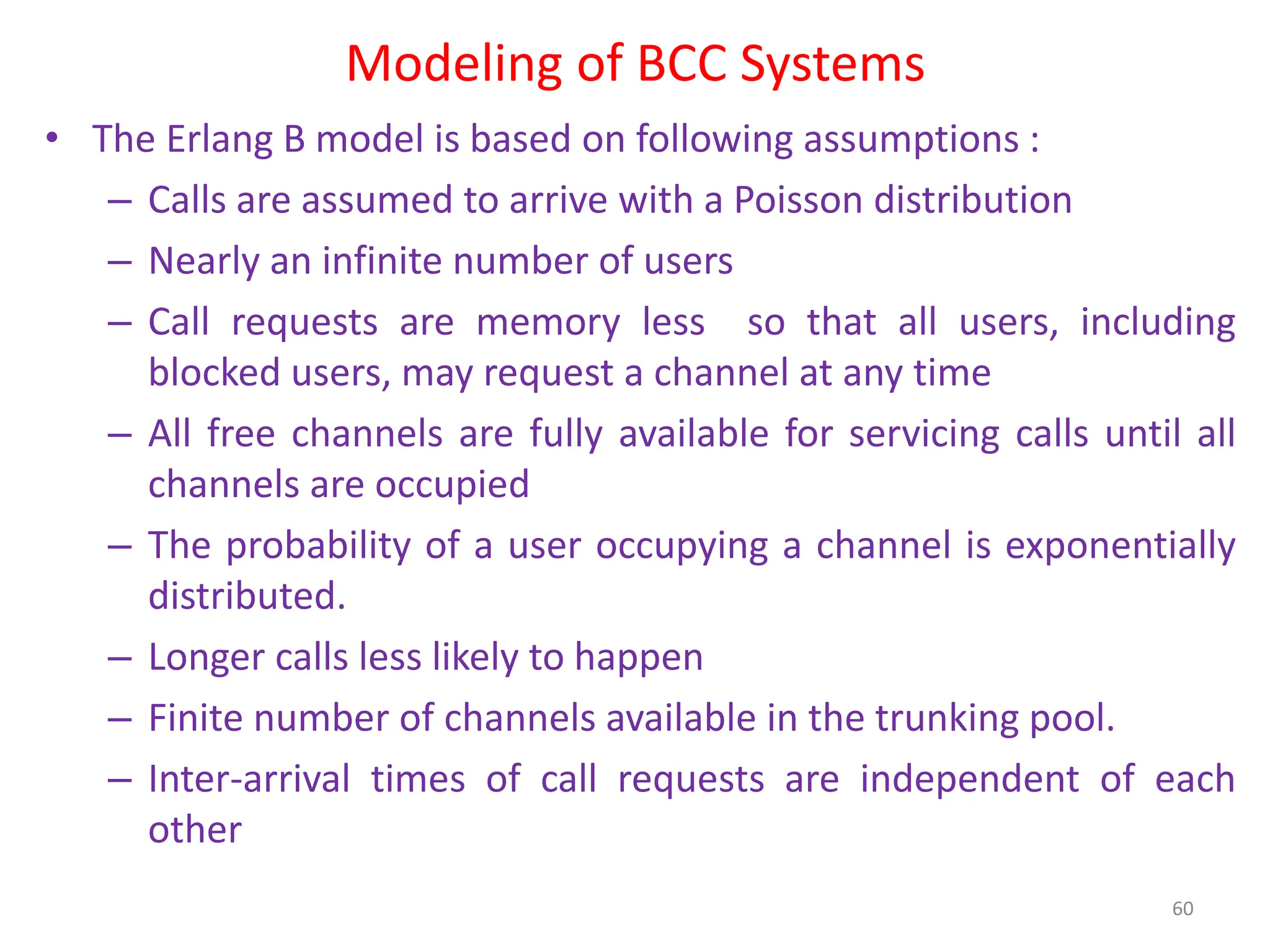
Modeling of BCC Systems
• The Erlang B model is based on following assumptions :
– Calls are assumed to arrive with a Poisson distribution
– Nearly an infinite number of users
– Call requests are memory less so that all users, including
blocked users, may request a channel at any time
– All free channels are fully available for servicing calls until all
channels are occupied
– The probability of a user occupying a channel is exponentially
distributed.
– Longer calls less likely to happen
– Finite number of channels available in the trunking pool.
– Inter-arrival times of call requests are independent of each
other
60
Modeling of BCC Systems (contd)
• Erlang B formula is given by
• where ‘C’ is the number of trunked channels offered by
a trunked radio system.
• ‘A’ is the total offered traffic.
61
Pr [blocking] = (AC/C ! )
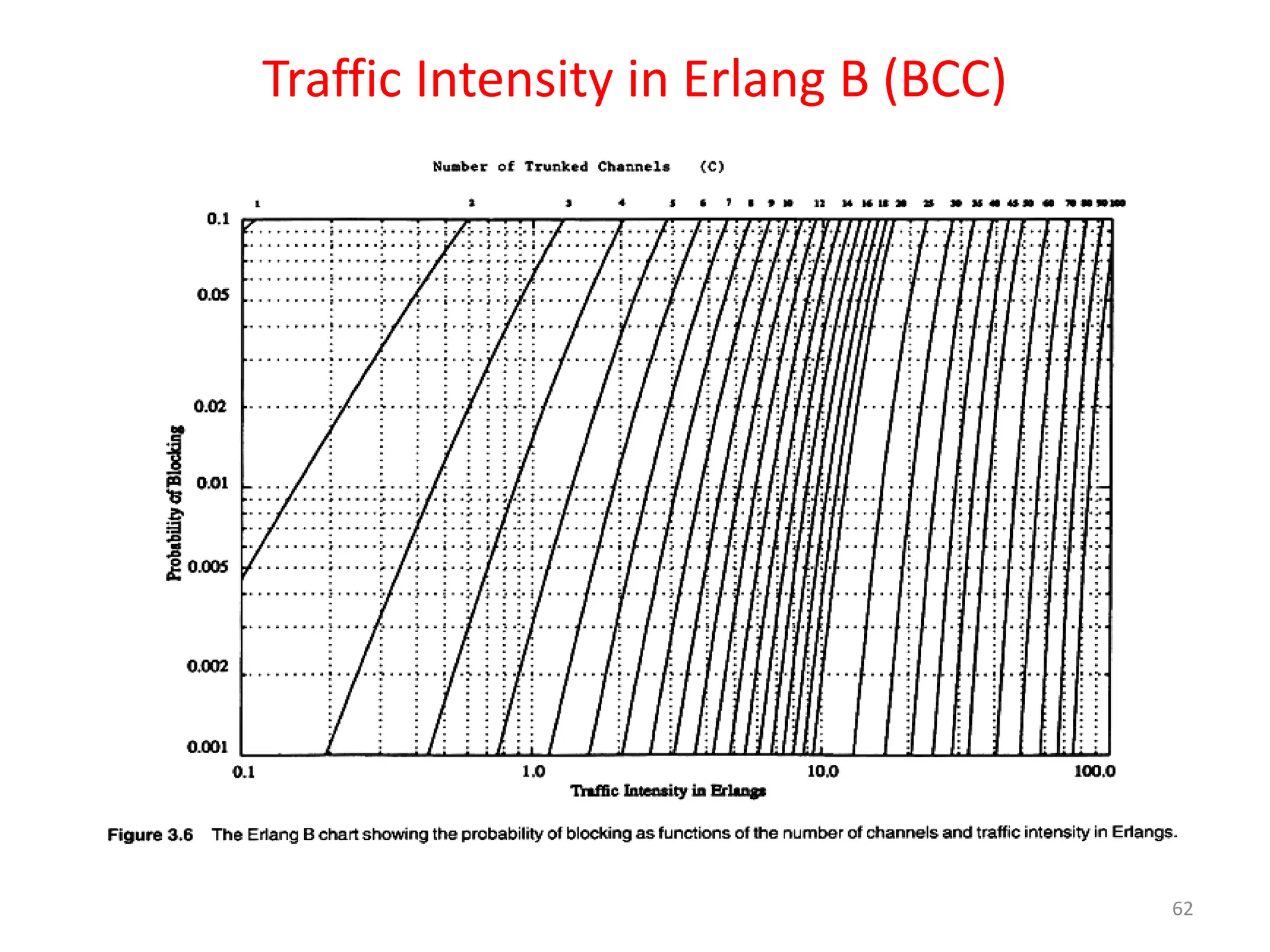
Traffic Intensity in Erlang B (BCC)
62
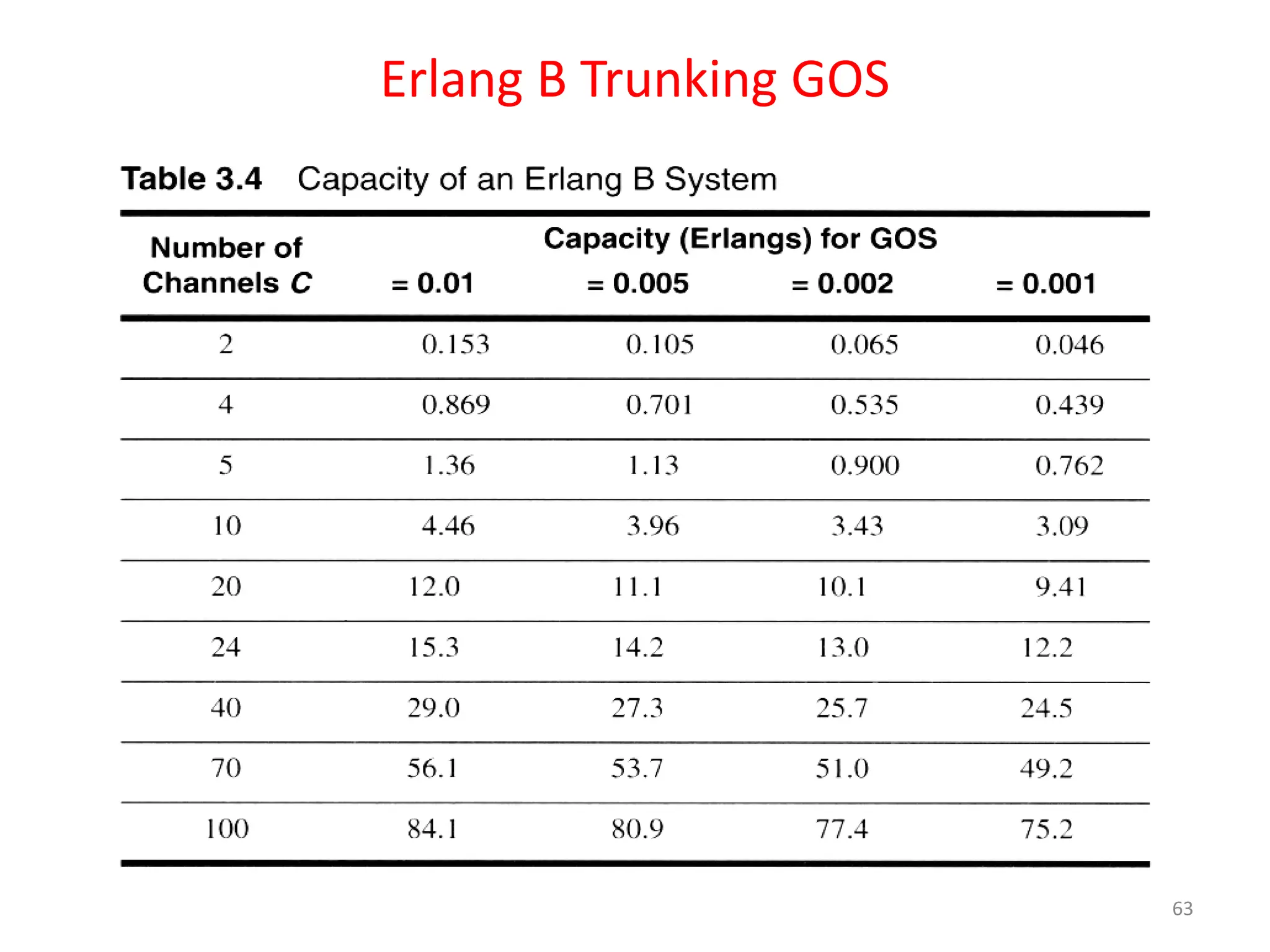
Erlang B Trunking GOS
63
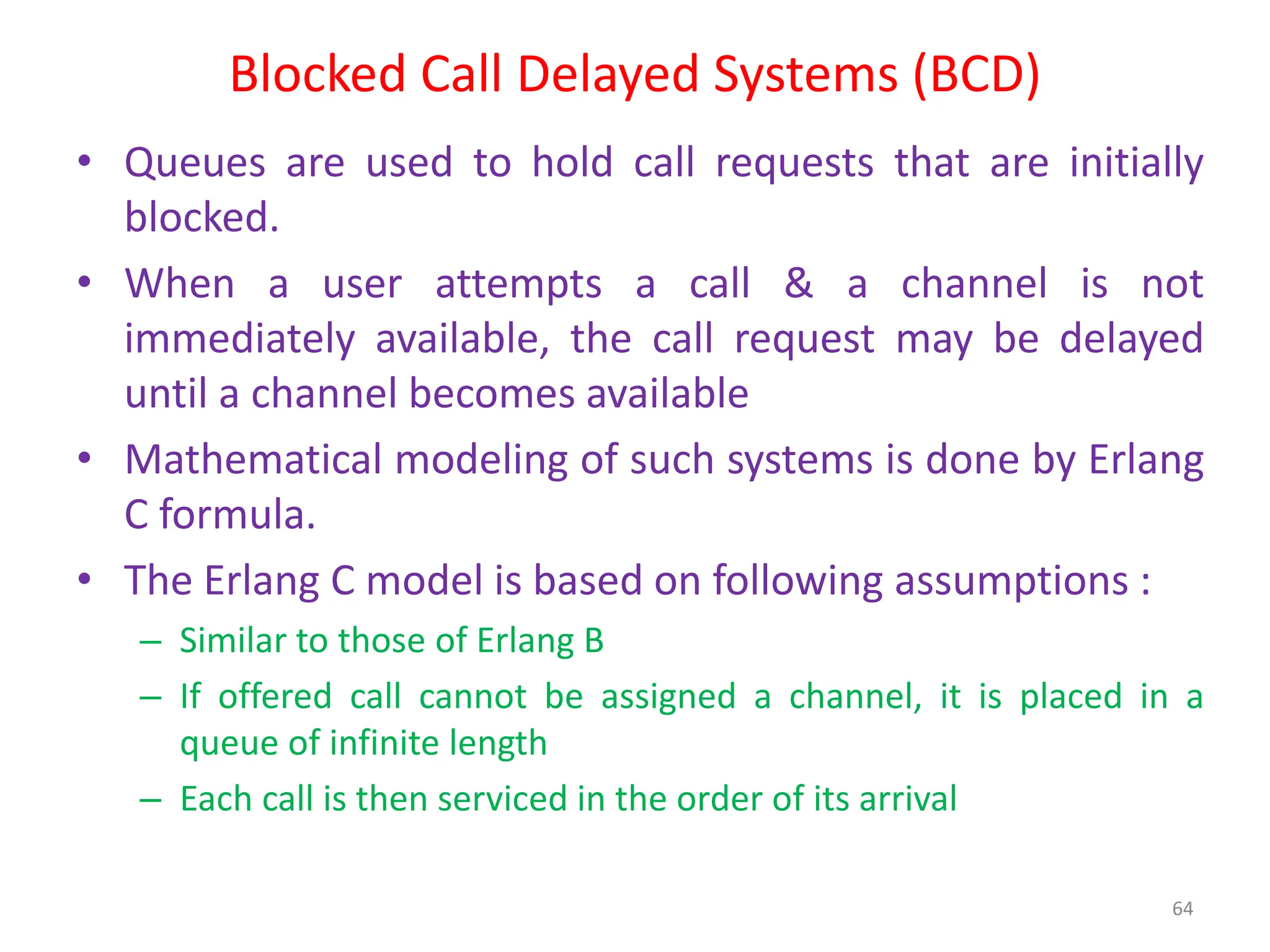
Blocked Call Delayed Systems (BCD)
• Queues are used to hold call requests that are initially
blocked.
• When a user attempts a call & a channel is not
immediately available, the call request may be delayed
until a channel becomes available
• Mathematical modeling of such systems is done by Erlang
C formula.
• The Erlang C model is based on following assumptions :
– Similar to those of Erlang B
– If offered call cannot be assigned a channel, it is placed in a
queue of infinite length
– Each call is then serviced in the order of its arrival
64
Blocked Call Delayed Systems (contd)
65
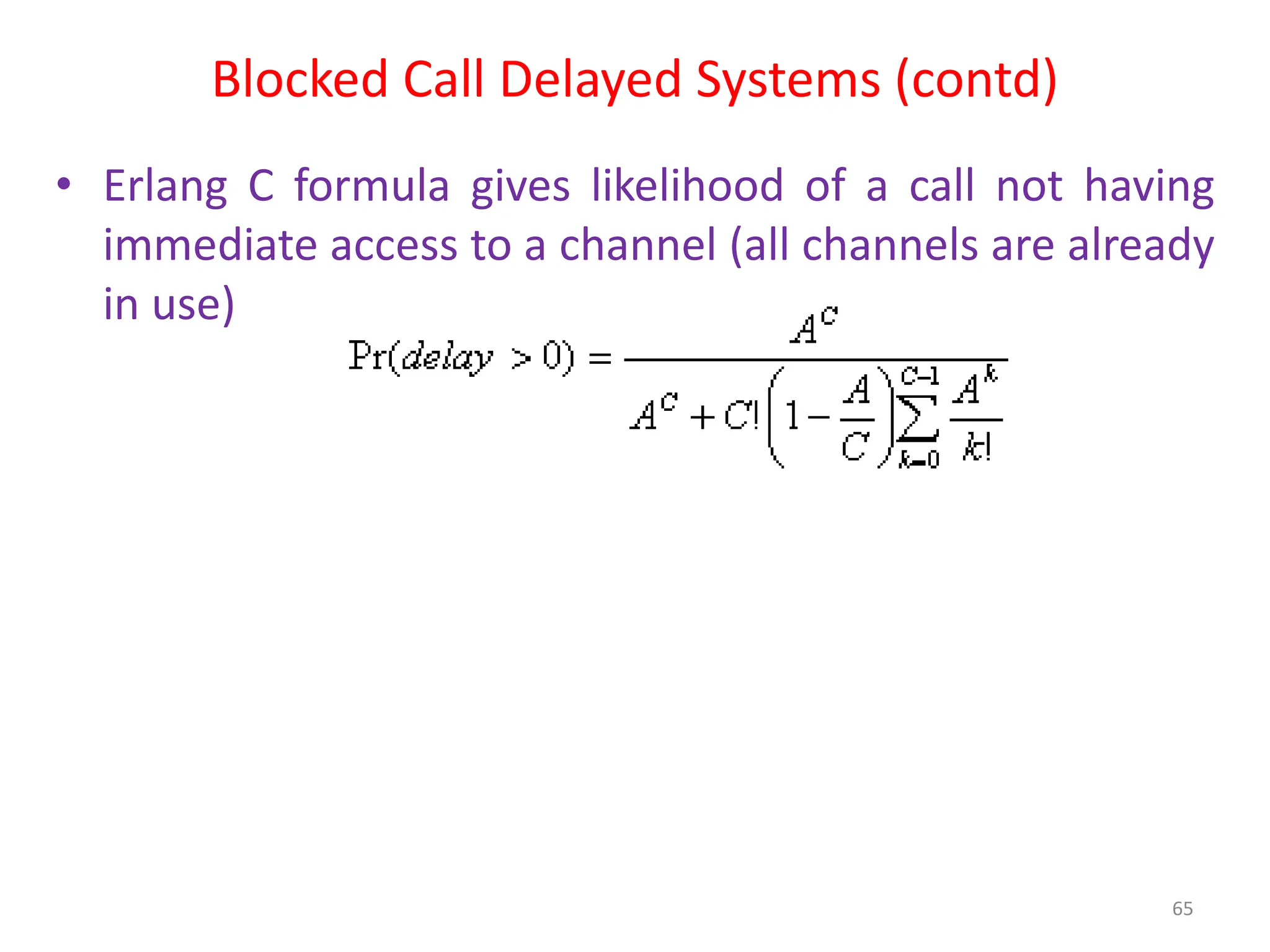
• Erlang C formula gives likelihood of a call not having
immediate access to a channel (all channels are already
in use)
Modeling of BCD Systems
• Probability that any caller is delayed in queue for a wait time
greater than t seconds is given as GOS of a BCD System
• The probability of a call getting delayed for any period of time
greater than zero is -
P[delayed call is forced to wait > t sec]=P[delayed] x Conditional
P[delay is >t sec]
• Mathematically;
Pr [delay>t] = Pr [delay>0] Pr [delay>t | delay>0]
• Where P[delay>t | delay>0]= e(-(C-A)t/H)
Pr[delay>t] = Pr [delay>0] e(-(C-A)t/H)
– where C = total number of channels, t = delay time of
interest, H = average duration of call
66
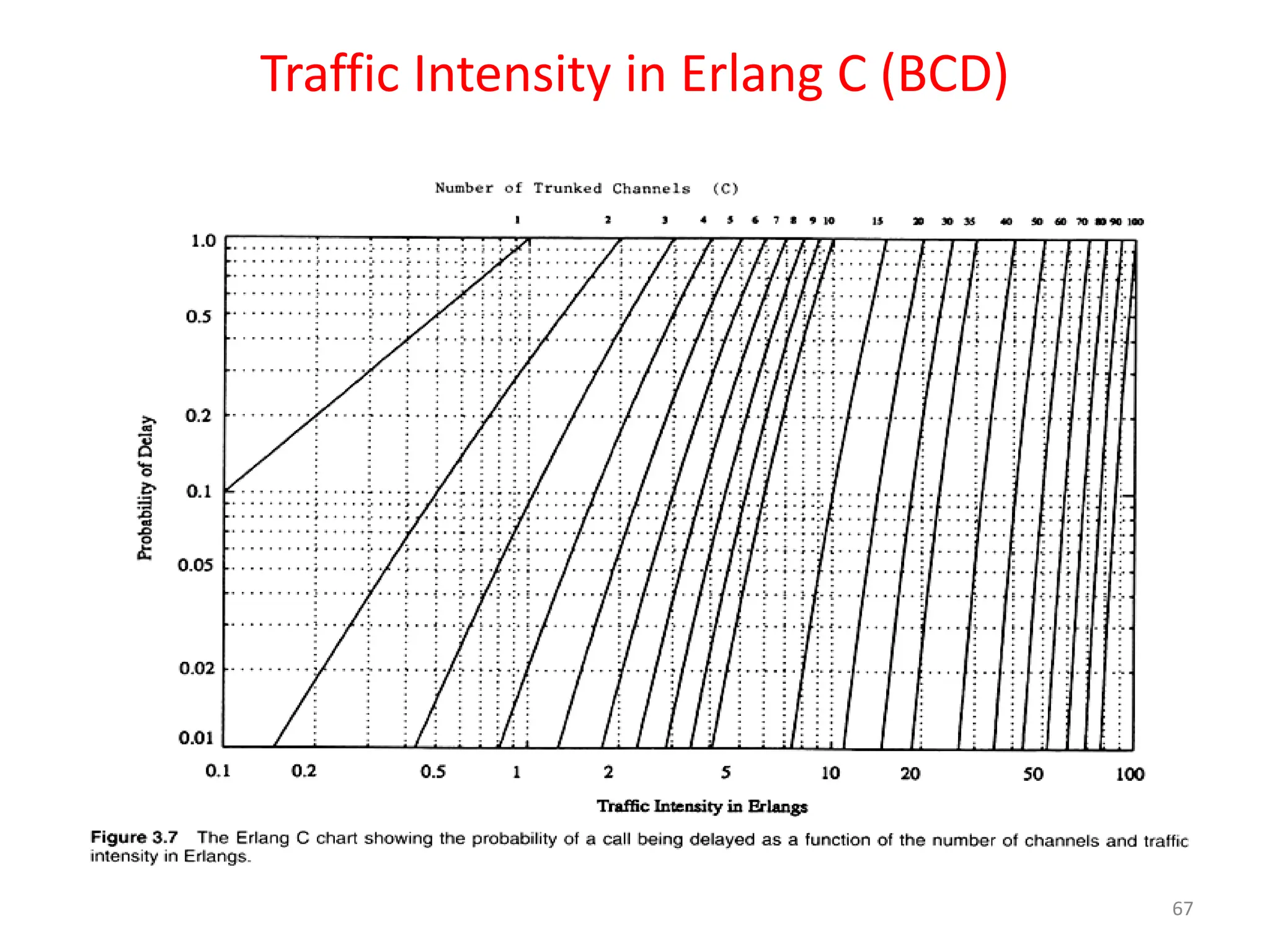
Traffic Intensity in Erlang C (BCD)
67
=
Topic 8
Improving Coverage & Capacity in
Cellular Systems
68
Introduction
69
• As the demand for wireless service increases, the number
of channels assigned to a cell becomes insufficient to
support the required number of users.
• Hence cellular design techniques are needed to provide
more channels per unit coverage area.
• Techniques such as cell splitting, sectoring & coverage zone
approaches are used to expand the capacity of cellular
systems.
• Cell splitting allows an orderly growth of the cellular
system.
• Sectoring uses directional antennas to control the
interference and frequency reuse of channels.
Introduction (contd)
70
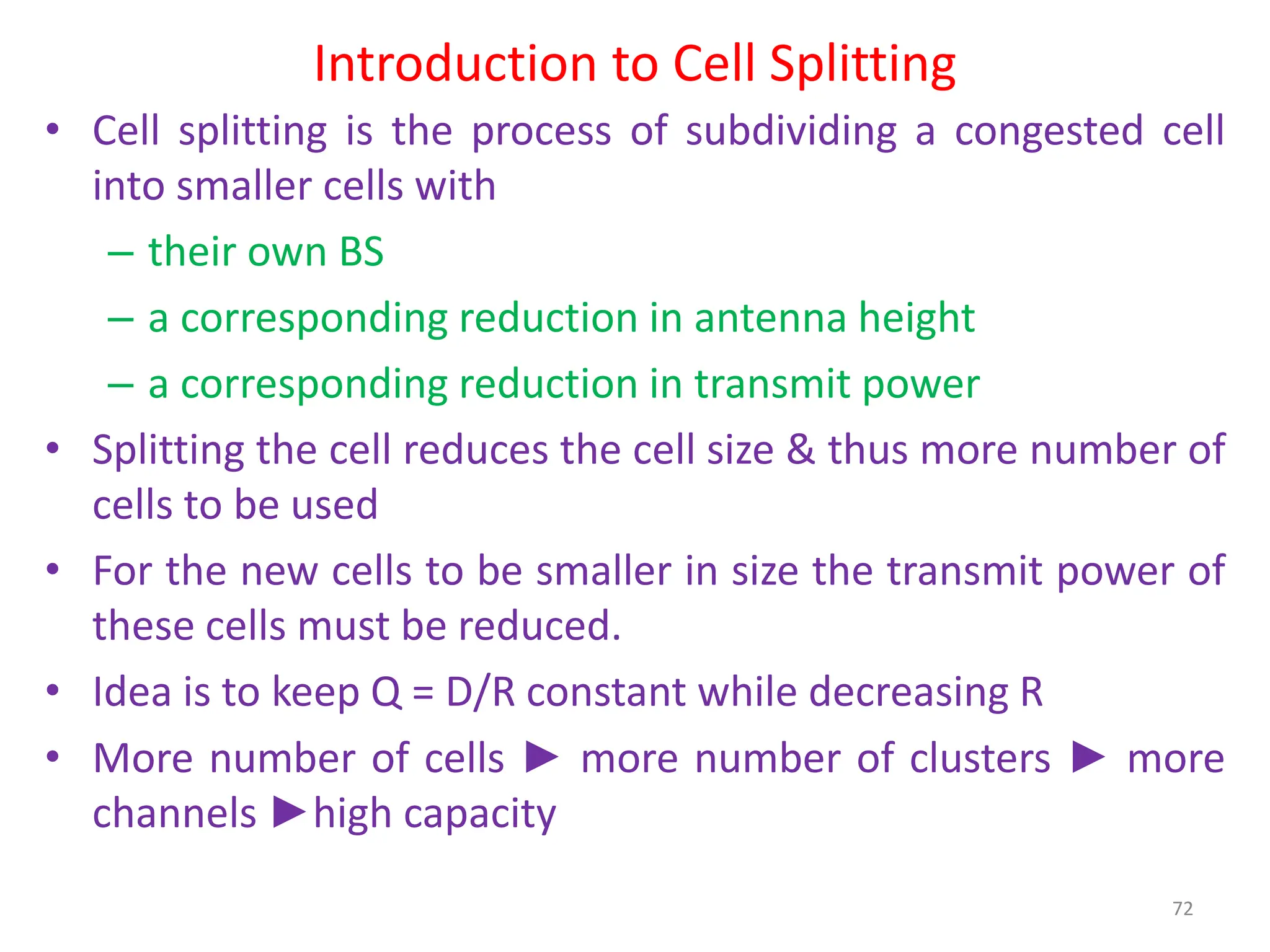
• The zone microcell concept distributes the coverage of a
cell & extends the cell boundary to hard-to-reach places.
• While cell splitting increases the number of base stations to
increase capacity, sectoring & zone microcells depend on
base station antenna placements to improve capacity by
reducing co-channel interference.
• Cell splitting & zone microcell techniques do not suffer
trunking inefficiencies experienced by sectored cells.
• They enable base station to oversee all handoff chores
related to the microcells, thus reducing the computational
load at the MSC.
• These three capacity improvement techniques will be
explained in detail.
Topic 9
Cell Splitting
71
Introduction to Cell Splitting
• Cell splitting is the process of subdividing a congested cell
into smaller cells with
– their own BS
– a corresponding reduction in antenna height
– a corresponding reduction in transmit power
• Splitting the cell reduces the cell size & thus more number of
cells to be used
• For the new cells to be smaller in size the transmit power of
these cells must be reduced.
• Idea is to keep Q = D/R constant while decreasing R
• More number of cells ► more number of clusters ► more
channels ►high capacity
72
Example for Cell Splitting
73
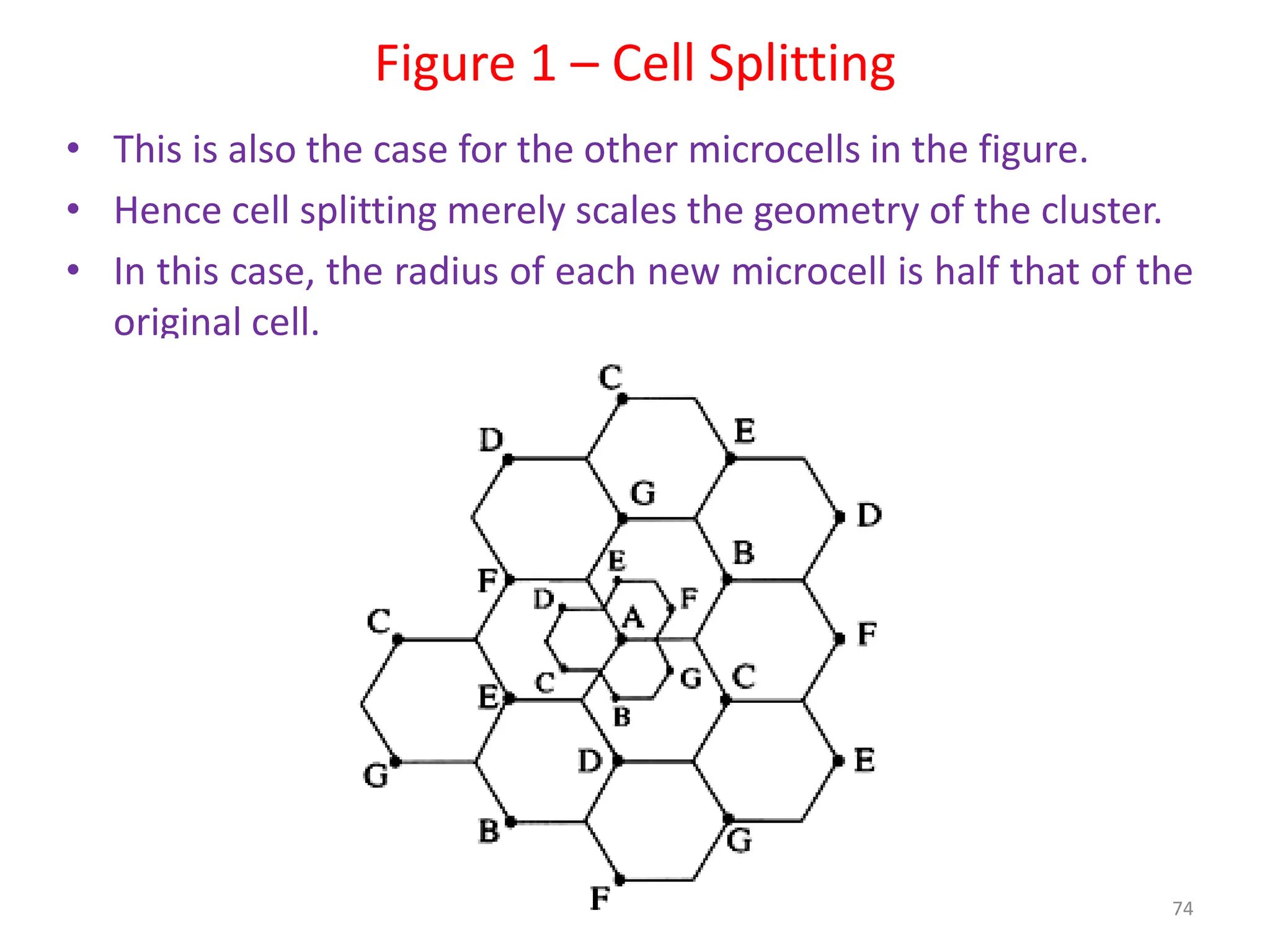
• An example of cell splitting is shown in Figure 1.
• The base stations are placed at corners of the cells & area served
by base station A is assumed to be saturated with traffic.
• New base stations are needed in the region to increase the
number of channels in the area & to reduce the area served by
the single base station.
• In figure 1, the original base station A has been surrounded by
six new microcells.
• The smaller cells were added in such a way to preserve the
frequency reuse plan of the system.
• For example, the microcell base station labeled G was placed
half way between two larger stations utilizing the same channel
set G.
Figure 1 – Cell Splitting
74
• This is also the case for the other microcells in the figure.
• Hence cell splitting merely scales the geometry of the cluster.
• In this case, the radius of each new microcell is half that of the
original cell.
Cell Splitting-Power Issues
• Suppose the cell radius of new cells is reduced by half
• What is the required transmit power for these new cells?
Pr [at old cell boundary] = Pt1 (R)-n
Pr [at new cell boundary] = Pt2 (R/2)–n
• where Pt1 and Pt2 are the transmit powers of the larger and
smaller cell base stations & n is the path loss exponent.
• So, Pt2 = Pt1 / 2n
• If we take n=3 and the received powers equal to each other, then
Pt2 = Pt1 / 8
• In other words, the transmit power must be reduced by 9dB in
order to fill in the original coverage area while maintaining the
S/I requirement.
75
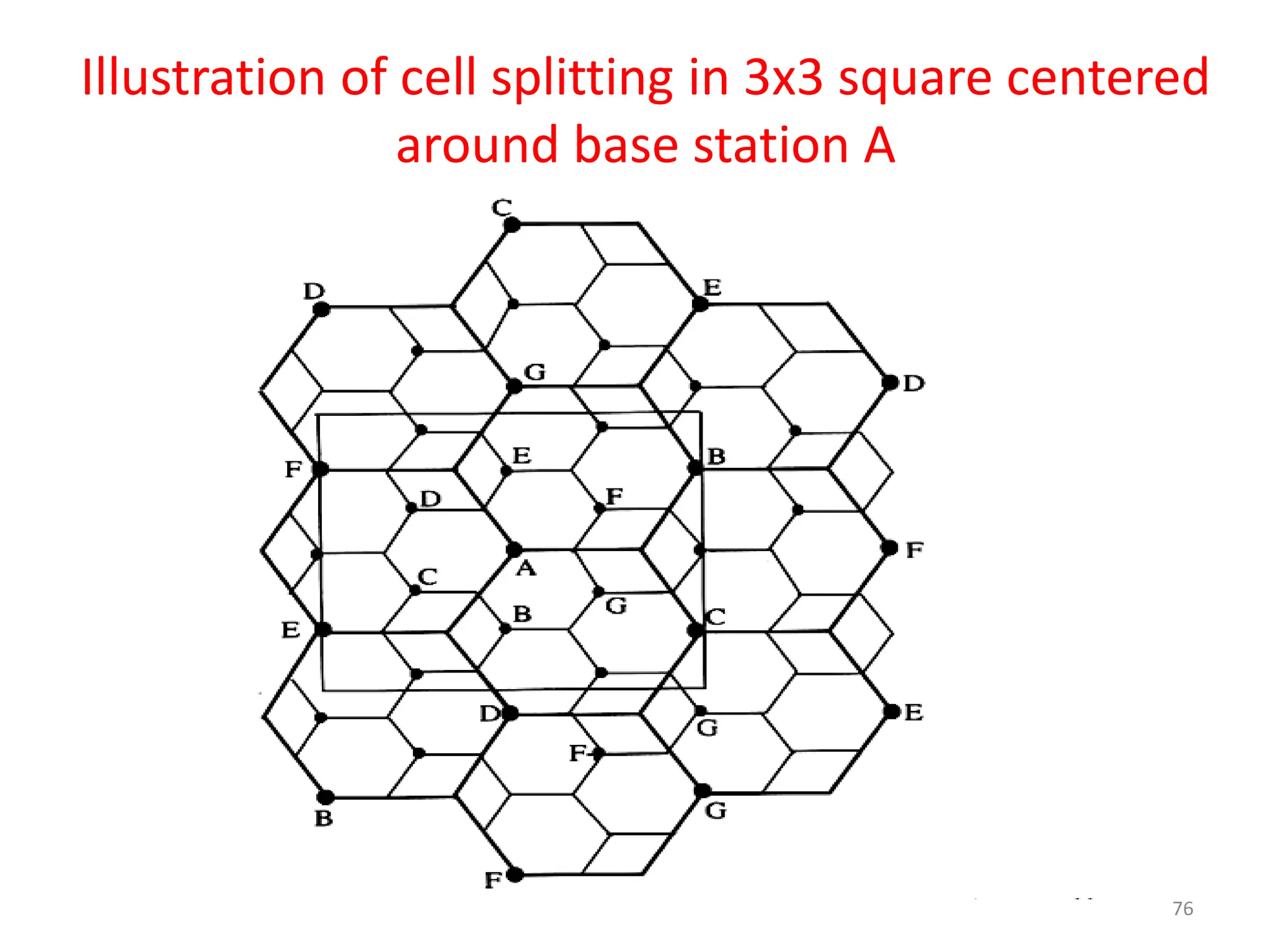
Illustration of cell splitting in 3x3 square centered
around base station A
76
Overcome – Handoff
77
• In practice not all the cells are split at the same time hence
different size cells will exist simultaneously.
• In such situations, special care needs to be taken to keep the
distance between co-channel cells at minimum & hence channel
assignments become more complicated.
• To overcome handoff problem:
– Channels in the old cell must be broken down into two
channel groups - one for smaller cell & other for larger cell
– The larger cell is dedicated to high speed traffic so that
handoffs occur less frequently
– Initially, small power group has less channels & large power
group has large no of channels but at maturity of the system
large power group does not have any channel
Topic 10
Sectoring
78
Introduction
79
• Cell splitting achieves capacity improvement by rescaling the
system.
• By decreasing the cell radius R & keeping the co-channel reuse
ratio D/R unchanged, cell splitting increases the number of
channels per unit area.
• Another way to increase capacity is to keep the cell radius
unchanged & to decrease the D/R ratio.
• Sectoring increases SIR so that cluster size may be reduced.
• First the SIR is improved using directional antennas & then
capacity improvement by reducing the number of cells in a
cluster, thus increasing the frequency reuse.
• However, it is necessary to reduce the relative interference
without decreasing the transmit power.
Reducing Co-channel Interference
80
• The co-channel interference may be decreased by replacing a
single omnidirectional antenna at the base station by several
directional antennas.
• By using directional antennas, a given cell will receive
interference & transmit with only a fraction of the available co-
channel cells.
• The technique for decreasing co-channel interference &
increasing system performance by using directional antennas is
called sectoring.
• The factor by which co-channel interference is reduced depends
on the amount of sectoring used.
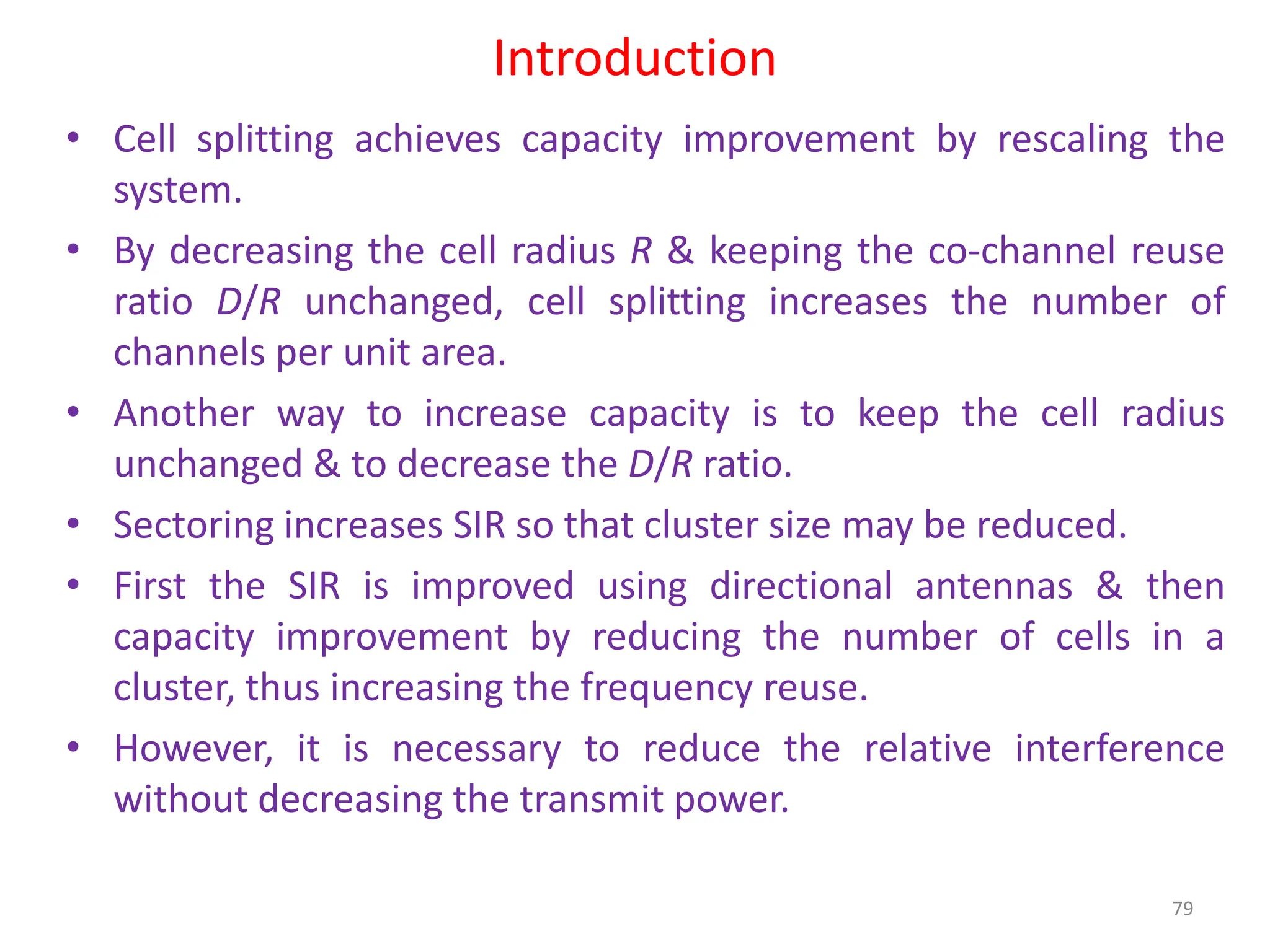
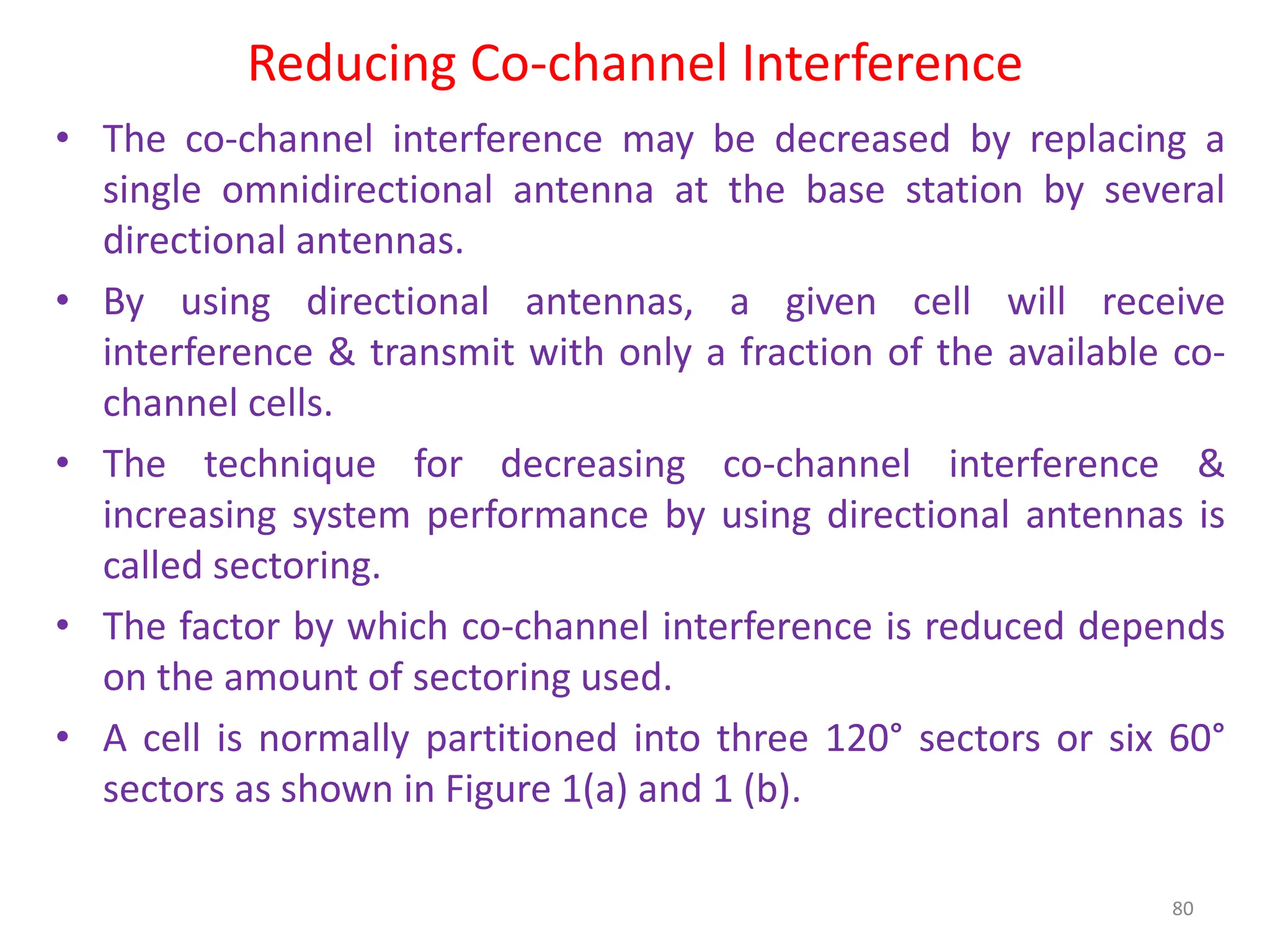
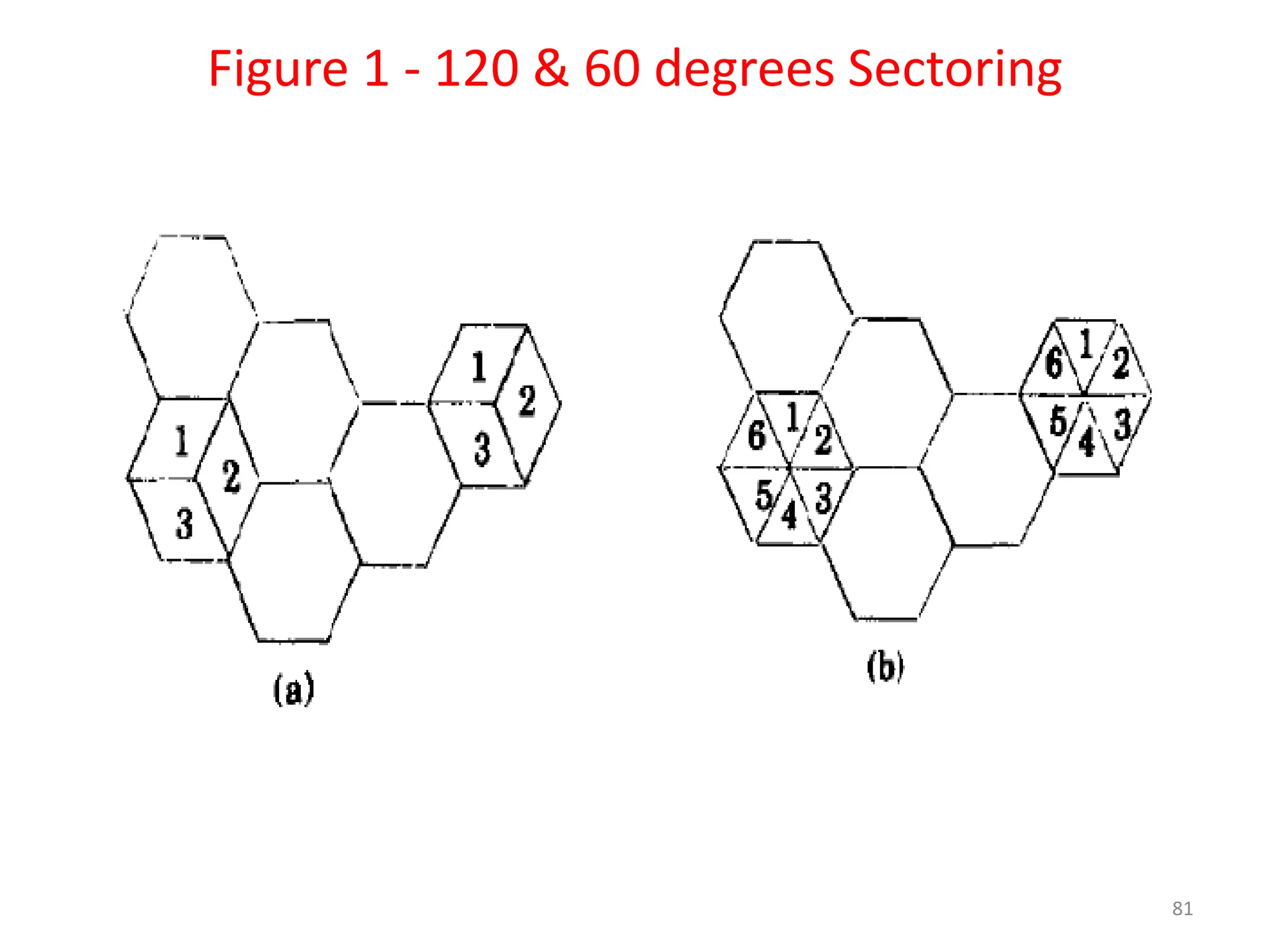
• A cell is normally partitioned into three 120° sectors or six 60°
sectors as shown in Figure 1(a) and 1 (b).
Figure 1 - 120 & 60 degrees Sectoring
81
120 degree Sectoring reducing Interference
82
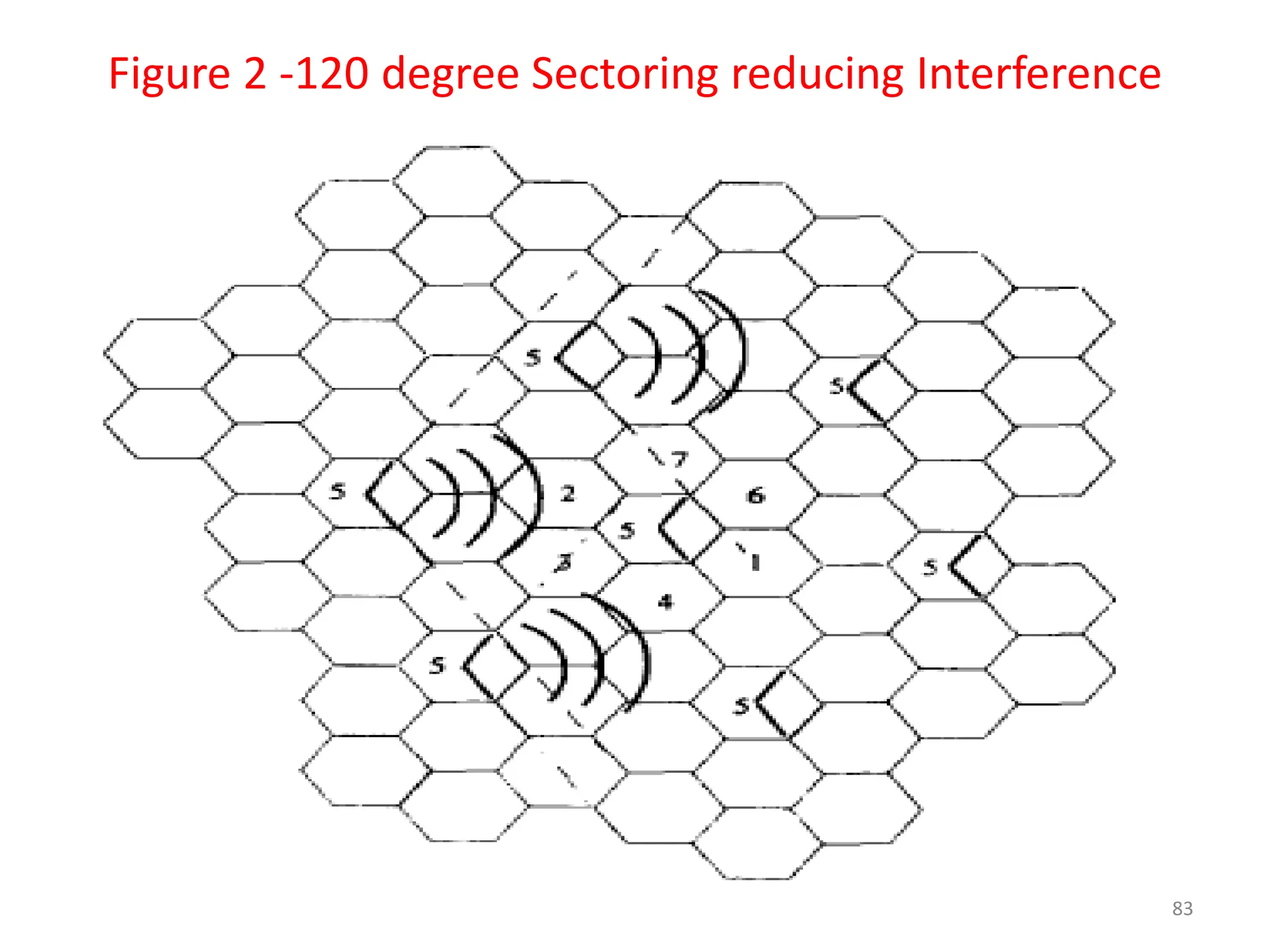
• In Figure 2, consider the interference experienced by a
mobile located in the right-most sector in the center cell
labeled “5”.
• There are three co-channel cell sectors labeled “5” to the
right of the center cell & three to the left of the center cell.
• Out of these six co-channel cells, only two cells have sectors
with antenna patterns which radiate into the center cell.
• Hence a mobile in the center cell will experience
interference on the forward link from only these two
sectors.
• This S/I improvement allows to decrease the cluster size N
in order to improve the frequency reuse & the system
capacity
Figure 2 -120 degree Sectoring reducing Interference
83
Penalty for Improved S/I
84
• The penalty for improved S/I & the resulting capacity
improvement is an increased number of antennas at each
base station & decrease in trunking efficiency due to
channel sectoring at the base station.
• Since sectoring reduces the coverage area of a particular
group of channels, the number of handoffs also increases.
• Because sectoring uses more than one antenna per base
station, the available channels in the cell must be
subdivided & dedicated to a specific antenna.
Topic 11
Repeaters for Range Extension
85
Role of Repeaters
86
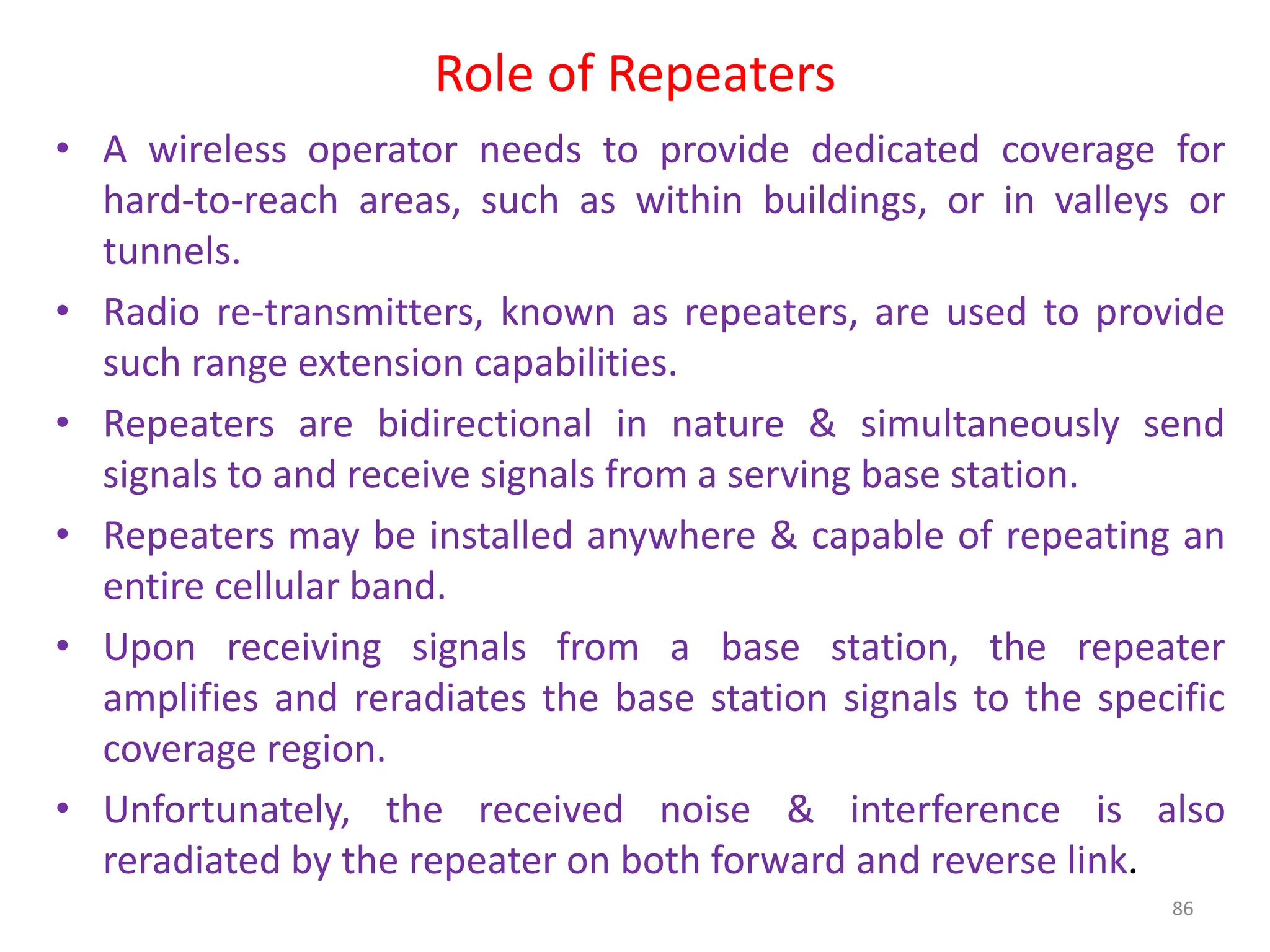
• A wireless operator needs to provide dedicated coverage for
hard-to-reach areas, such as within buildings, or in valleys or
tunnels.
• Radio re-transmitters, known as repeaters, are used to provide
such range extension capabilities.
• Repeaters are bidirectional in nature & simultaneously send
signals to and receive signals from a serving base station.
• Repeaters may be installed anywhere & capable of repeating an
entire cellular band.
• Upon receiving signals from a base station, the repeater
amplifies and reradiates the base station signals to the specific
coverage region.
• Unfortunately, the received noise & interference is also
reradiated by the repeater on both forward and reverse link.
Repeaters Vs System Capacity
87
• Care must be taken to properly place the repeaters & to
adjust the various forward and reverse link amplifier levels
and antenna patterns.
• In practice, directional antennas or distributed antenna
systems (DAS) are connected to the inputs or outputs of
repeaters for spot coverage, particularly in tunnels or
buildings.
• By modifying the coverage of a serving cell, an operator can
dedicate a certain amount of the base station’s traffic for
the areas covered by the repeater.
• However, the repeater does not add capacity to the system.
• Repeaters are being used to provide coverage into and
around buildings, where coverage is weak .
Location of Repeaters
88
• Determining the proper location for repeaters & distributed
antenna systems within buildings requires careful planning,
to avoid re-radiation of interference into the building from
the base station.
• Also, repeaters must be provisioned to match the available
capacity from the serving base station.
• Software products, such as Site-Planner allow engineers to
determine the best placements for repeaters & required DAS
network while simultaneously computing the traffic and
installation cost.
Topic 12
Microcell Zone Concept
89
Introduction
90
• The increased number of handoffs required during sectoring
results in an increased load on the switching and control link
elements of the mobile system.
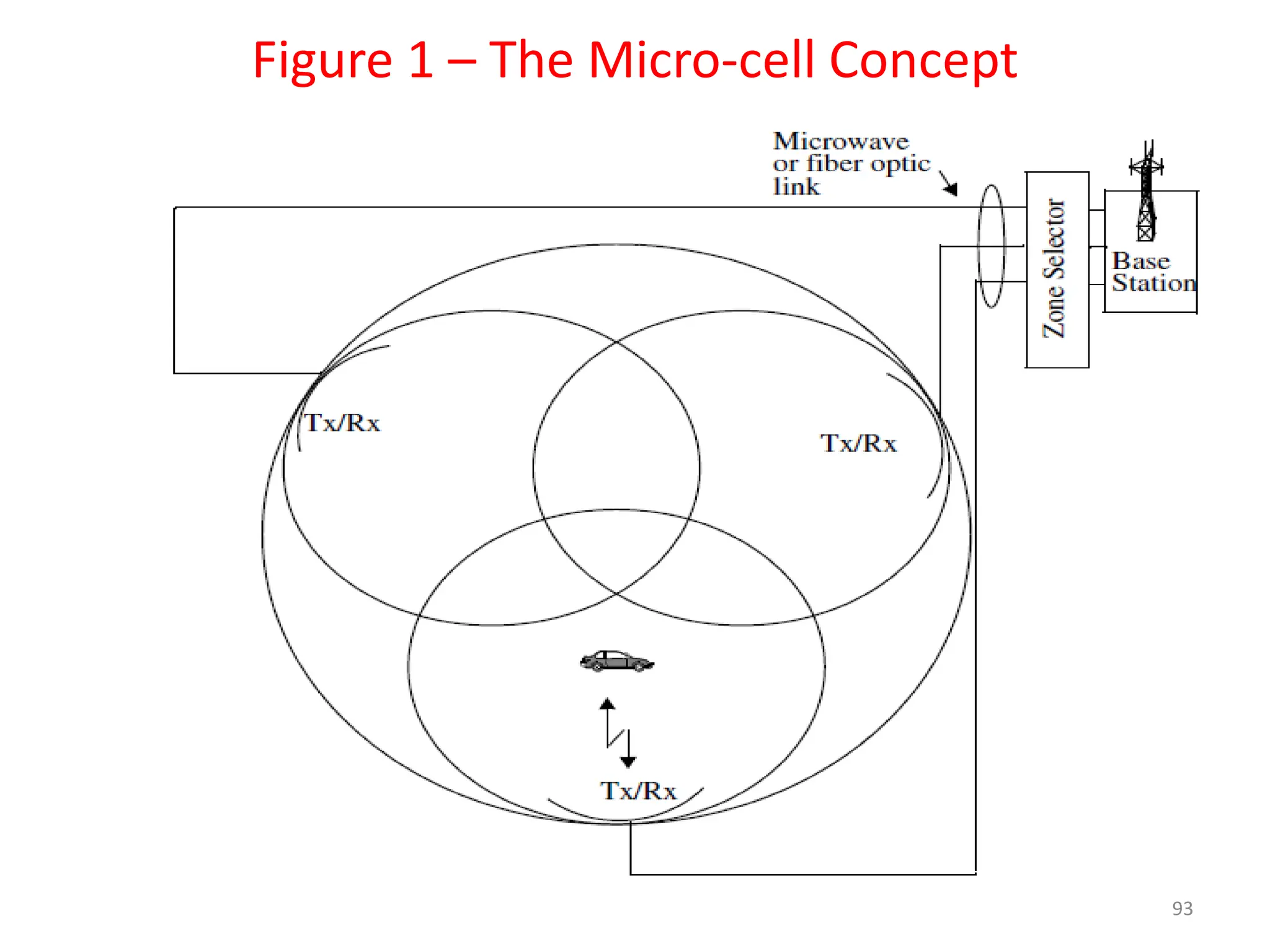
• A solution to this problem is based on a microcell concept for
seven cell reuse, as illustrated in Figure 1.
• In this scheme, each of the three zone sites represented as Tx/Rx
in Figure 1 are connected to a single base station & share the
same radio equipment.
• The zones are connected by coaxial cable, fiber-optic cable, or
microwave link to the base station.
• Multiple zones & a single base station make up a cell.
• As a mobile travels within the cell, it is served by the zone with
the strongest signal.
Time & Space Distribution
91
• As a mobile travels from one zone to another within the cell, it
retains the same channel.
• Unlike in sectoring, a handoff is not required at the MSC when
the mobile travels between zones within the cell.
• The base station simply switches the channel to a different zone
site.
• Thus a given channel is active only in the particular zone in
which the mobile traveling & hence the base station radiation is
localized & interference is reduced.
• The channels are distributed in time & space by all three zones
& reused in co-channel cells in the normal fashion.
• This technique is particularly useful along highways or along
urban traffic corridors.
Advantage of Zone Cell Technique
• The advantage of this zone cell technique - while the cell
maintains a particular coverage radius, the co-channel
interference is reduced.
• And a large central base station is replaced by several
lower powered transmitters.
• Decreased co-channel interference improves the signal
quality & increase in capacity without degradation in
trunking efficiency caused by sectoring.
92
Figure 1 – The Micro-cell Concept
93
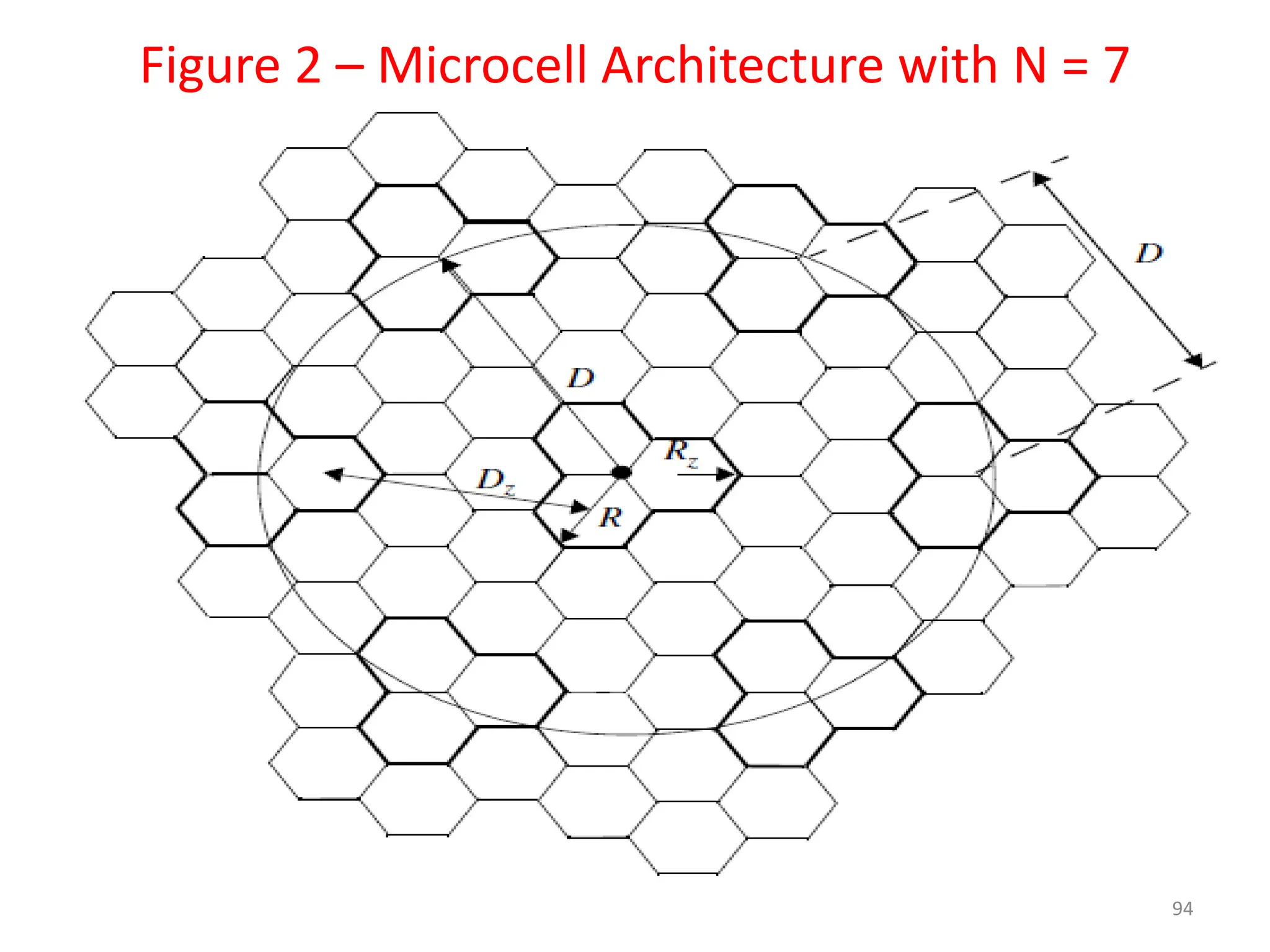
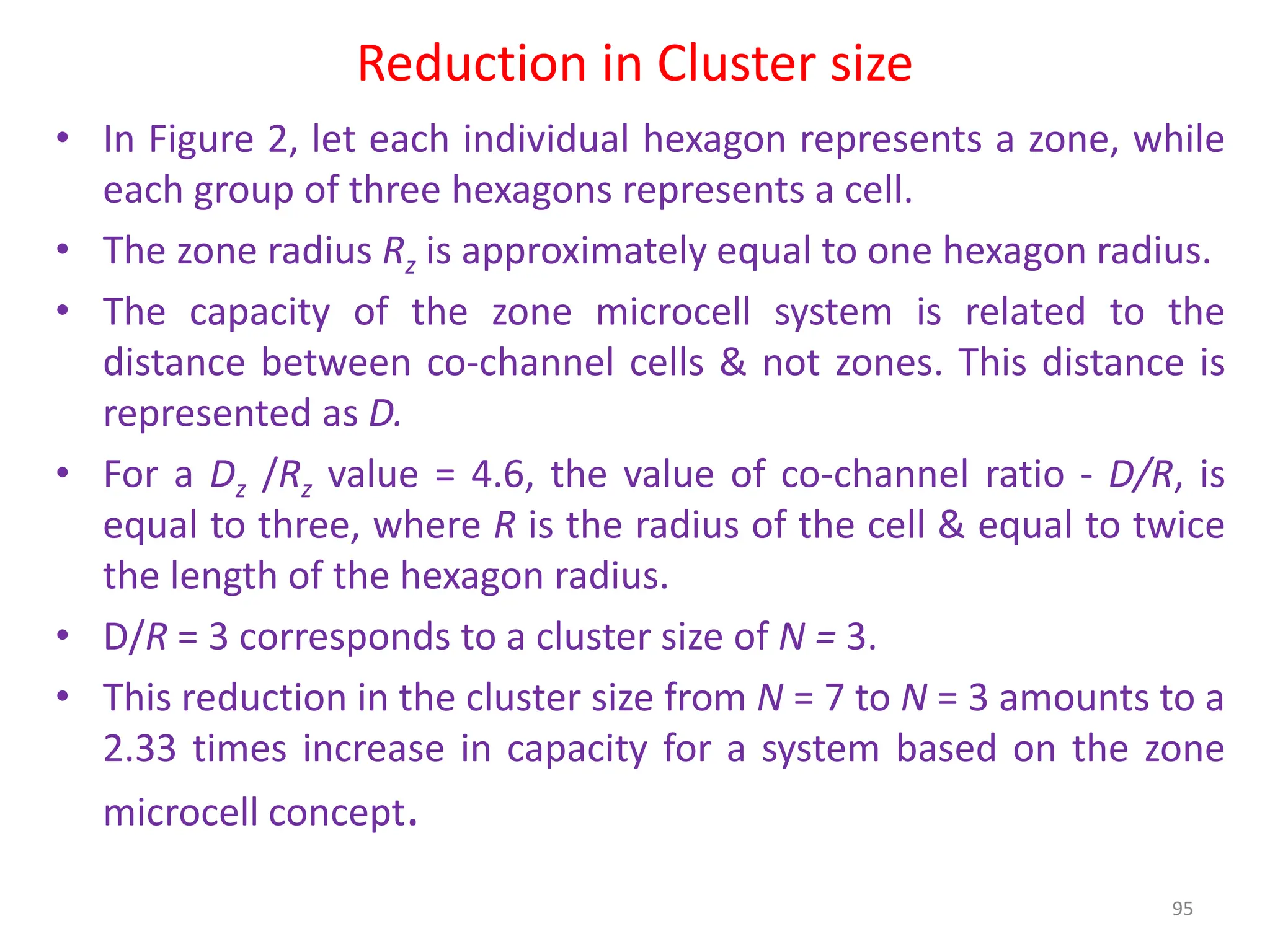
Figure 2 – Microcell Architecture with N = 7
94
Reduction in Cluster size
• In Figure 2, let each individual hexagon represents a zone, while
each group of three hexagons represents a cell.
• The zone radius Rz is approximately equal to one hexagon radius.
• The capacity of the zone microcell system is related to the
distance between co-channel cells & not zones. This distance is
represented as D.
• For a Dz /Rz value = 4.6, the value of co-channel ratio - D/R, is
equal to three, where R is the radius of the cell & equal to twice
the length of the hexagon radius.
• D/R = 3 corresponds to a cluster size of N = 3.
• This reduction in the cluster size from N = 7 to N = 3 amounts to a
2.33 times increase in capacity for a system based on the zone
microcell concept.
95
Applications
• In the worst case, the system provides a margin of 2 dB
over the required signal-to-interference ratio while
increasing the capacity by 2.33 times over a
conventional seven-cell system using omni-directional
antennas.
• No loss in trunking efficiency is experienced.
• Zone cell architectures are being adopted in many
cellular & personal communication systems.
96
SHORT QUESTION ANSWER
97
• 1) What is frequency re-use?
The design process of selecting & allocating channel
groups for all the cellular base stations within a system
is called frequency reuse or frequency planning.
2) Define cell in a wireless network.
A cell is a basic geographical unit of a cellular network &
the area around an antenna where a specific frequency
range is used. When a subscriber moves to another cell,
the antenna of the new cell takes over the signal
transmission.
98
• 3) Mention the factors which influence the co-channel
interference in cellular networks.
Co-channel interference is dependent on cluster size,
large cluster size less interference and vice versa.
4) What is channel assignment strategy?
A scheme for increasing capacity and minimizing
interference is required for effective utilization of radio
spectrum. CAS can be classified as either fixed or
dynamic. Choice of CAS impacts the performance of
system for call management.
99
• 5) What is called fixed channel assignment strategy?
In Fixed CA each cell is assigned a predetermined set of
voice channels. Any call attempt within the cell can
only be served by the unused channel in that particular
cell.
6)What is called dynamic channel assignment strategy?
Voice channels are not allocated to different cells
permanently. MSC only allocates a given frequency, not
currently in use in the cell or any other cell which falls
within the limiting reuse distance.
100
• 7) Mention the advantages & disadvantages of dynamic
channel assignment strategy.
Advantage: Increased channel utilization and decreased
probability of a blocked call.
Disadvantage: Increases the storage and computational
load on the system.
• 8) What is hand-off operation?
Handoff operation involves identifying the new BS and
allocation of voice and control signal to channels
associated with new BS. It must be performed
successfully, infrequently and impercitble to user.
101
• 9) What is the safety margin required for hand-off
operation?
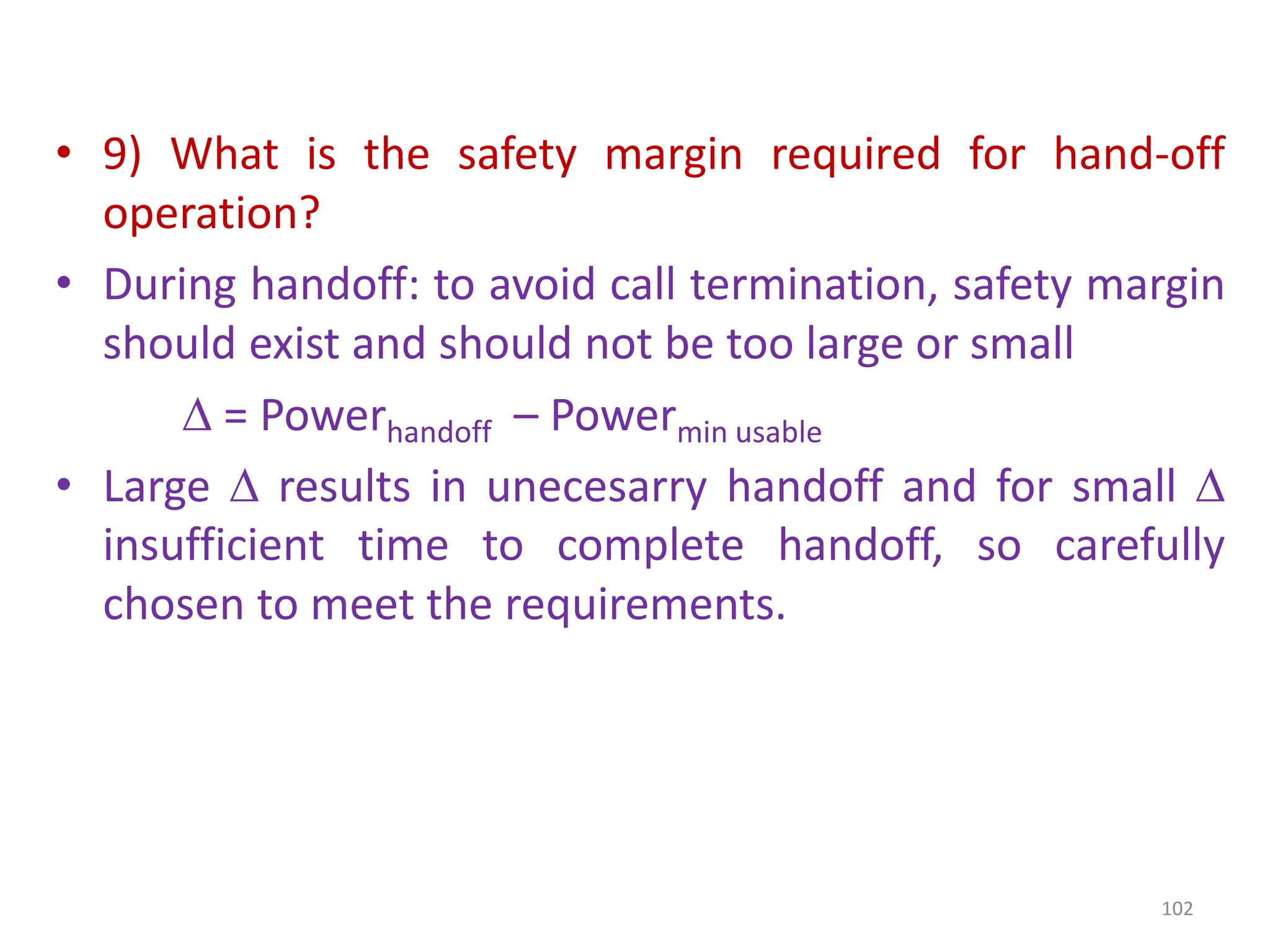
• During handoff: to avoid call termination, safety margin
should exist and should not be too large or small
 = Powerhandoff – Powermin usable
• Large  results in unecesarry handoff and for small 
insufficient time to complete handoff, so carefully
chosen to meet the requirements.
102
• 10) What is the role of a MSC in a cellular network?
• MSC no longer monitors RSS of all channels
– reduces computational load considerably
– enables much more rapid and efficient handoffs
– imperceptible to user
• 11) What is soft-handoff operation?
The ability to select between the instantaneous
received signals from different Base Stations is called
soft handoff.
103
• 12) What is intersystem hand-off?
If a mobile moves from one cellular system to another
system controlled by a different MSC, an inter-system
handoff is required. MSC engages in intersystem handoff
when signal becomes weak in a given cell.
13) Mention the practical considerations for hand-off
operation.
 Problems occur because of a large range of mobile velocities
 Small cell sizes or micro-cells → larger handoffs
 MSC load is heavy when high speed users are passed
between very small cells
 Umbrella Cells
104
• 14) What are called Umbrella Cells?
Cells which are meant to use different antenna heights &
Transmitter power levels to provide large and small area
coverage are called Umbrella cells.
• 15) Mention the sources of interference in a cellular
network.
Sources of interference include -
 another mobile in the same cell
 a call in progress in a neighboring cell
 other base stations operating in same frequency band
 any non-cellular system which leaks energy into band
105
• 16) Mention the major types of cellular interferences.
• The two major types of cellular interference are Co-
channel interference (CCI) & Adjacent channel
interference (ACI).
• 17) Differentiate between CCI and ACI.
• CCI is caused due to the cells that reuse the same
frequency set. These cells using the same frequency set
are called Co-channel cells.
• ACI is caused due to the signals that are adjacent in
frequency.
106
• 18) What are co-channel cells?
• Frequency reuse indicates that in a given coverage area
there are several cells using the same set of
frequencies. These cells are called co-channel cells
• 19) What is called near-far effect?
• If an adjacent channel user is transmitting in very close
range to a subscriber’s receiver, while the receiver
attempts to receive a base station on the desired
channel, then its is called as the near–far effect
107
• 20) What is trunking?
A technique which allows a large no of users to share a
small number of channels in a cell by providing access
to each user, on demand, from a pool of available
channels.
• 21) Define Erlang.
An Erlang is a unit of telecommunications traffic
measurement. Erlang represents the continuous use of
one voice path. It is used to describe the total traffic
volume of one hour
108
• 22) What is grade of service (GOS) ?
• The likelihood that a call is blocked, or the likelihood
that a call experiences a delay greater than a certain
queuing time is called “Grade of Service” (GOS)’’.
• 23) What is Cell splitting?
• Cell splitting is the process of subdividing a congested
cell into smaller cells with -
• their own BS
• a corresponding reduction in antenna height
• a corresponding reduction in transmit power
109
• 24) What is called Sectoring?
• The technique for decreasing co-channel interference &
increasing system performance by using directional
antennas in a cellular network is called sectoring.
• 25) What is microcell concept?
• Base stations are decomposed into three or more zones
connected by coaxial cable or fiber-optic cable to the
base station.
• Multiple zones & a single base station make up a cell.
• The mobile is served by the zone with the strongest
signal within the cell.
110
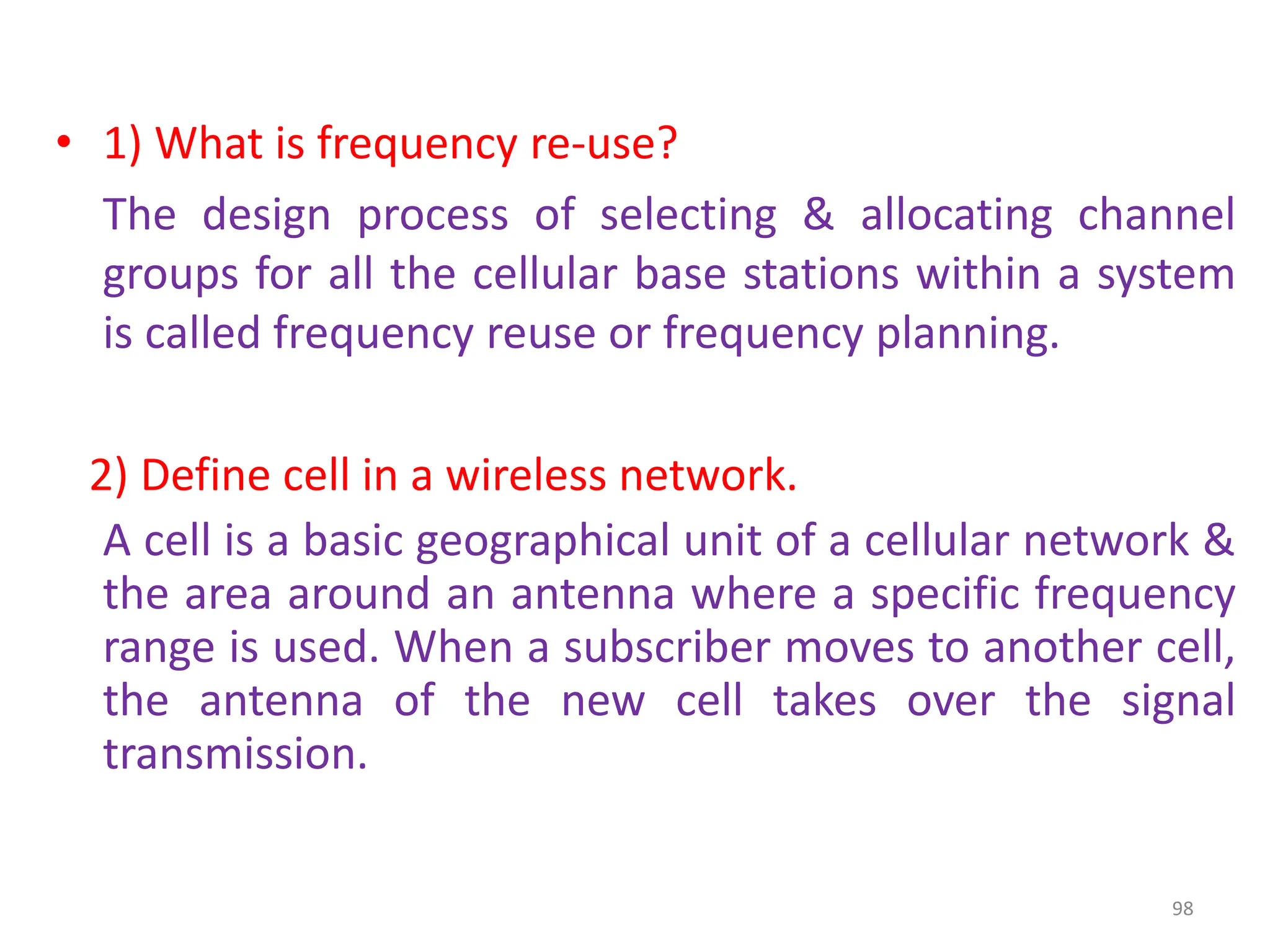
111
Applications:
•Transmission of music, news, road conditions, weather reports, and
other broadcast information are received via digital audio
broadcasting (DAB) with 1.5Mbit/s.
•For personal communication, a universal mobile telecommunications
system (UMTS) phone might be available offering voice and data
connectivity with 384kbit/s.
•For remote areas, satellite communication can be used, while the
current position of the car is determined via the GPS (Global Positioning
System).
•A local ad-hoc network for the fast exchange of
information (information such as distance between two vehicles, traffic
information, road conditions) in emergency situations or to help each
other keep a safe distance. Local ad-hoc network with vehicles close by
to prevent guidance system, accidents, redundancy.
Vehicles -Applications
112
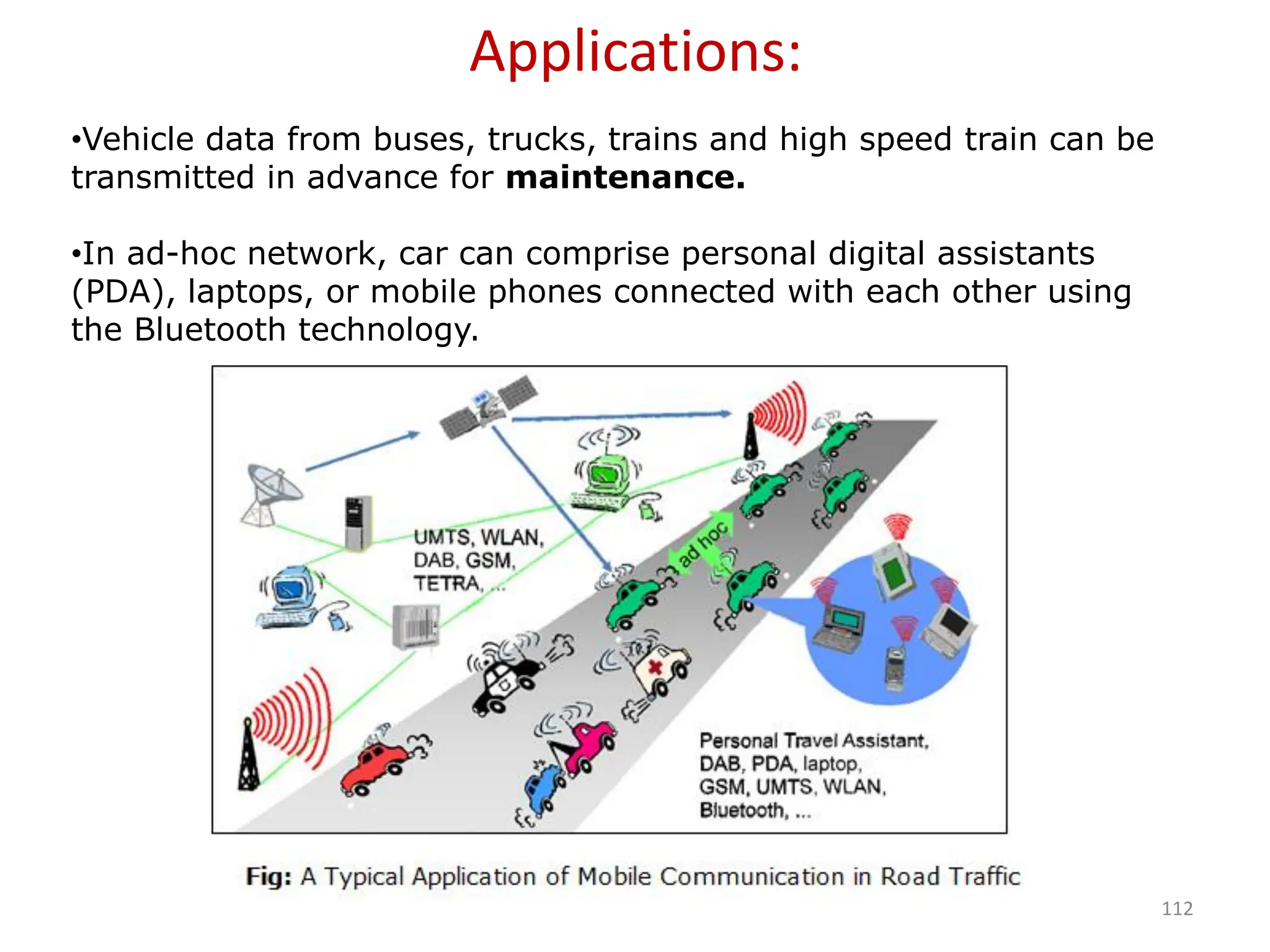
•Vehicle data from buses, trucks, trains and high speed train can be
transmitted in advance for maintenance.
•In ad-hoc network, car can comprise personal digital assistants
(PDA), laptops, or mobile phones connected with each other using
the Bluetooth technology.
Applications:
113
Emergency- Applications
Applications:
•Video communication: Responders often need to share vital
information. The transmission of real time situations of video could be
necessary. A typical scenario includes the transmission of live video footage
from a disaster area to the nearest fire department, to the police station or
to the near NGOs etc.
•Push To Talk (PTT): PTT is a technology which allows half duplex
communication between two users where switching from voice reception
mode to the transmit mode takes place with the use of a dedicated
momentary button. It is similar to walkie-talkie.
•Audio/Voice Communication: This communication service provides full
duplex audio channels unlike PTT. Public safety communication requires
novel full duplex speech transmission services for emergency response.
•Real Time Text Messaging (RTT): Text messaging (RTT) is an effective
and quick solution for sending alerts in case of emergencies. Types of text
messaging can be email, SMS and instant message.
114
Business-Applications:
Travelling Salesman
•Directly access to customer files stored in a central location.
•Consistent databases for all agents
•Mobile office
•To enable the company to keep track of all the activities of their
travelling employees.
In Office
Wi-Fi wireless technology saves businesses or companies a considerable
amount of money on installations costs.
There is no need to physically setup wires throughout an office building,
warehouse or store.
Bluetooth is also a wireless technology especially used for short range that acts
as a complement to Wi-Fi. It is used to transfer data between computers or
cellphones.
Transportation Industries
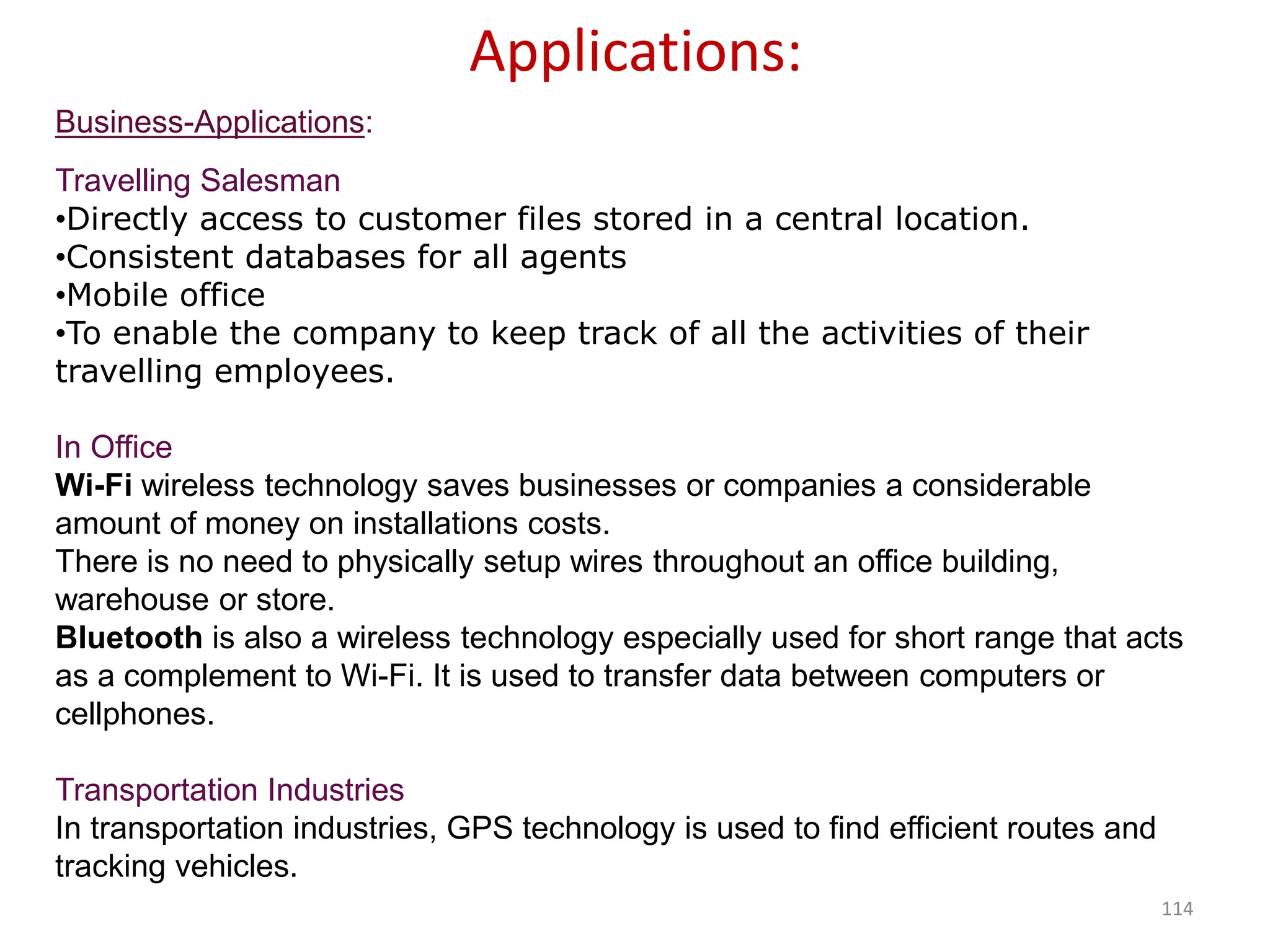
In transportation industries, GPS technology is used to find efficient routes and
tracking vehicles.
Applications:
115
MCQ- post-test
1. The process of transferring a mobile station from one base station to another is
a. MSC
b. Roamer
c. Hand off
d. Forward channel
ANSWER: Hand off
2. Interference in cellular systems is caused by
a. Two base stations operating in same frequency band
b. Two calls in progress in nearby mobile stations
c. Leakage of energy signals by non cellular systems
into cellular frequency band
d. All of the above
ANSWER: All of the above
116
3. Interference in frequency bands may lead to
a. Cross talk
b. Missed calls
c. Blocked calls
d. All of the above
ANSWER: All of the above
4. Advantage of using Spread Spectrum modulationis/are
1. Interference rejection capability
2. Frequency planning is not required
3. Resistance to multipath fading
4. ISI is lesser
a. 1 and 2 are correct
b. 1, 2 and 3 are correct
c. 2 and 3 are correct
d. All the four are correct
ANSWER: All the four are correct
MCQ- post-test
117
5. Guard band is
a. The small unused bandwidth between the frequencychannels to avoid
interference
b. The bandwidth allotted to the signal
c. The channel spectrum
d. The spectrum acquired by the noise between theSignal
ANSWER: The small unused bandwidth between the frequency channels to avoid
interference
6. Radio capacity may be increased in cellular concept by
a. Increase in radio spectrum
b. Increasing the number of base stations & reusing the
channels
c. Both a & b
d. None of the above
ANSWER: Increasing the number of base stations & reusing the channels
MCQ- post-test
118
7. The techniques used to improve the capacity ofcellular systems are
a. Splitting
b. Sectoring
c. Coverage zone approach
d. All of the above
ANSWER: All of the above
8. Trunking in a cellular network refers to
a. Termination of a call
b. Spectrum unavailability
c. Accommodating large number of users in limited spectrum
d. All of the above
ANSWER: Accommodating large number of users inlimited spectrum
MCQ- post-test
119
9. When all of the radio channels are in use in a trunking system
a. The user is blocked
b. The access to the system is denied
c. The queue may be provided
d. All of the above
ANSWER: All of the above
10. Grade of service refers to
a. Accommodating large number of users in limitedspectrum
b. Ability of a user to access trunked system duringbusy hour
c. Two calls in progress in nearby mobile stations
d. High speed users with large coverage area
ANSWER: Ability of a user to access trunked system during busy hour
MCQ- post-test
120
Conclusion
• To make students familiar with various
generations of mobile communications
• To understand the concept of cellular
communication
• To understand the basics of wireless
communication
121
References
1. “Mobile Communications” by Jochen Schiler
2. “Mobile Communications Engineering: Theory and
Applications” by Willim C Y Lee
3. “Introduction to Wireless and Mobile Systems” by Dharma
Prakash Agarwal and Qing An Zeng
4. “Electronic Communications Systems Fundamentals Through
Advanced” by Wayne Tomasi
5. “Mobile Communication Design Fundamentals ” by William C
Y Lee
6. “Principles of Mobile Communication” by B Stuber Gordon L
Assignment:
• 1) Explain the concept of frequency re-use and the
channel assignment strategies in detail.
• 2)Discuss in detail, the hand-off strategies implemented
in a cellular network.
• 3) Explain the co-channel interference and adjacent
channel interference in detail.
• 4) Describe about trunking and grade of service in a
cellular network.
• 5)Write short notes on – (i) Cell Splitting (ii) Sectoring.
• 6) What is the concept of microcell zone? Explain it with
an illustration in detail.
122

MobileCommunication related document.pdf

  • 1.
    1 By, Dr.S.Selvakumar Subject Name: MobileCommunication Unit name: Cellular Concepts
  • 2.
    2 Aim and Objectives •To make students familiar with fundamentals of mobile communication systems • To understand the concept of frequency reuse • To identify the limitations of 2G and 2.5G wireless mobile communication and use design of 3G and beyond mobile communication systems • understanding the basic principles of mobile communication systems
  • 3.
    3 Pre Test -MCQ type 1. The advantage of using frequency reuse is a. Increased capacity b. Limited spectrum is required c. Same spectrum may be allocated to other network d. All of the above ANSWER: All of the above 2. Co-channel reuse ratio depends upon a. Radius of the cell b. Distance between the centers of the co channel cells c. Frequency allocation of nearest cells d. Both a and b e. Both b and c ANSWER: Both a and b
  • 4.
    4 3.Increase in Co-channel reuse ratio indicates a. Better transmission quality b. Larger capacity c. Low co-channel interference d. Both a and c e. Both a and b ANSWER: Both a and c 4. The strategies acquired for channel assignment are a. Fixed b. Dynamic c. Regular d. Both a and b e. Both b and c ANSWER: Both a and b Pre Test - MCQ type
  • 5.
    5 5. In afixed channel assignment strategy, if all the assigned channels are occupied, the call a. Gets transferred to another cell b. Gets blocked c. Is kept on waiting d. All of the above ANSWER: b.Gets blocked 6. In a fixed channel assignment strategy a. Each cell is assigned a predetermined set of frequencies b. The call is served by unused channels of the cell c. The call gets blocked if all the channels of the cell are occupied d. All of the above ANSWER: All of the above Pre Test - MCQ type
  • 6.
    6 7. In adynamic channel assignment strategy, a. Voice channels are not permanently assigned b. The serving base station requests for a channel from MSC c. MSC allocates the channel according to the predetermined algorithm d. All of the above ANSWER: All of the above 8. Advantage of using Dynamic channel assignment is a. Blocking is reduced b. Capacity of the system is increased c. Both a & b d. None of the above ANSWER: Both a & b Pre Test - MCQ type
  • 7.
    7 9. Disadvantage ofusing Dynamic channel assignment is a. More storage required b. Calculations and analysis is increased c. Both a & b d. None of the above ANSWER: Both a & b 10.In Dynamic channel assignment, any channelwhich is being used in one cell can be reassigned simultaneously to another cell in the system at a reasonable distance. a. True b. False ANSWER: True Pre Test - MCQ type
  • 8.
    8 Pre-Requisite: • Basic knowledgeof digital communication • Antenna and wave propagation • Applied random process
  • 9.
    Subject Name: MobileCommunication Unit – V / Cellular Concepts 9
  • 10.
    Syllabus Frequency Reuse –Channel Assignment Strategies – Hand off Strategies – Interference & system capacity- Co-Channel Interference- Adjacent Channel Interference – Trunking and Grade of service – Improving coverage & capacity in cellular systems - Cell Splitting- Sectoring- Repeaters for Range Extension- Microcell Zone Concept. 10
  • 11.
  • 12.
    Cellular Systems-Basic Concepts •Cellular system solves the problem of spectral congestion. • Offers high capacity in limited spectrum. • High capacity is achieved by limiting the coverage area of each BS to a small geographical area called cell. • Replaces high powered transmitter with several low power transmitters. • Each BS is allocated a portion of total channels and nearby cells are allocated completely different channels. • All available channels are allocated to small no of neighboring BS. • Interference between neighboring BS’s is minimized by allocating different channels. 12
  • 13.
    Cellular Systems-Basic Concepts •Same frequencies are reused by spatially separated BS’s. • Interference between co-channels stations is kept below acceptable level. • Additional radio capacity is achieved. • Frequency Reuse-Fix no of channels serve an arbitrarily large no of subscribers 13
  • 14.
  • 15.
    Frequency Reuse • Usedby service providers to improve the efficiency of a cellular network and to serve millions of subscribers using a limited radio spectrum. • After covering a certain distance a radio wave gets attenuated and the signal falls below a point where it can be no longer used. • A transmitter transmitting in a specific frequency range will have only a limited coverage area • Beyond this coverage area, that frequency can be reused by another transmitter. • The entire network coverage area is divided into cells based on the principle of frequency reuse 15
  • 16.
    Frequency Reuse • Acell = basic geographical unit of a cellular network & the area around an antenna where a specific frequency range is used. • When a subscriber moves to another cell, the antenna of the new cell takes over the signal transmission • A cluster is a group of adjacent cells, usually 7 cells; no frequency reuse is done within a cluster • The frequency spectrum is divided into sub-bands & each sub- band is used within one cell of the cluster • In heavy traffic zones cells are smaller, while in isolated zones cells are larger 16
  • 17.
    Frequency Reuse • Thedesign process of selecting and allocating channel groups for all of the cellular base stations within a system is called frequency reuse or frequency planning. • Cell labeled with same letter use the same set of frequencies. • Cell Shapes - Circle, Square, Triangle and Hexagon. • Hexagonal cell shape is conceptual , in reality it is irregular in shape 17
  • 18.
  • 19.
    Frequency Reuse • Inhexagonal cell model, BS transmitter can be in centre of cell or on its 3 vertices. • Centered excited cells use omni directional whereas edge excited cells use directional antennas. • A cellular system having ‘S’ duplex channels, each cell is allocated ‘k’ channels (k<S). • If S channels are allocated to N cells into unique and disjoint channels, the total no of available channel is • S = kN. 19
  • 20.
    Frequency Reuse • Ncells collectively using all the channels is called a cluster, - a group of adjacent cells. • If cluster repeated M times, the capacity C of system is given as C = MkN = MS • Capacity of system is directly proportional to the no of times the cluster repeated. • Reducing the cluster size N while keeping the cell size constant, more clusters are required to cover the given area and hence more capacity. • Co-channel interference is dependent on cluster size, large cluster size less interference and vice versa. 20
  • 21.
    Frequency Reuse • TheFrequency Reuse factor is given as 1/N & each cell is assigned 1/N of total channels. • Lines joining a cell and each of its neighbor are separated by multiple of 600, certain cluster sizes and cell layout possible • Geometery of hexagon is such that no of cells per cluster i.e N, can only have values which satisfy the equation N = i2 + ij + j2  N, the cluster size is typically 4, 7 or 12.  In GSM normally N =7 is used. • i and j are integers, for i=3 and j=2 N=19. 21
  • 22.
  • 23.
  • 24.
    Fixed Assignment Strategy •A scheme for increasing capacity and minimizing interference is required for effective utilization of radio spectrum. • CAS can be classified as either fixed or dynamic • Choice of CAS impacts the performance of system for call management. • In Fixed CA each cell is assigned a predetermined set of voice channels • Any call attempt within the cell can only be served by the unused channel in that particular cell • If all the channels in the cell are occupied, the call is blocked & the user does not get service. • In variation of FCA – called borrowing strategy, a cell can borrow channels from its neighboring cell if its own channels are full. 24
  • 25.
    Dynamic Channel Assignment •Voice channels are not allocated to different cells permanently. • Each time a call request is made, the BS request a channel from the MSC. • MSC allocates a channel to the requesting cell using an algorithm that takes into account - – likelihood of future blocking – The reuse distance of the channel ( should not cause interference) – Other parameters like cost • To ensure min QoS, MSC only allocates a given frequency, not currently in use in the cell or any other cell which falls within the limiting reuse distance. • DCA reduce the likelihood of blocking and increases capacity • Requires the MSC to collect realtime data on channel occupancy and traffic distribution on continous basis. 25
  • 26.
    Dynamic Channel Assignment(contd) • This increases the storage and computational load on the system • But provides the advantage of increased channel utilization and decreased probability of a blocked call. 26
  • 27.
    Topic 3 Hand offStrategies 27
  • 28.
    Introduction to Hand-off •Mobile moves into a different cell during a conversation, MSC transfers the call to new channel belonging to new BS • Handoff operation involves identifying the new BS and allocation of voice and control signal to channels associated with new BS • Must be performed successfully, infrequently and impercitble to user • To meet these requirements an optimum signal level must be defined to initiate a handoff. • Minimum usuable signal for acceptable voice qualtiy  90 to - 100 dBm • A slight higher value is used as threshold 28
  • 29.
    Introduction to Hand-off(contd) By looking at the variations of signal strength from either BS it is possible to decide on the optimum area where handoff can take place 29
  • 30.
  • 31.
    Hand-off strategies • Handoffis made when received signal at the BS falls below a certain threshold • During handoff: to avoid call termination, safety margin should exist and should not be too large or small  = Powerhandoff – Powermin usable • Large  results in unecesarry handoff and for small  unsufficient time to complete handoff, so carefully chosen to meet the requirements. • Figure 2a, handoff not made and signal falls below min acceptable level to keep the channel active. • Can happen due to excessive delay by MSC in assigning handoff, or when threshold  is set to small. • Excessive delay may occur during high traffic conditions due to computional loading or non avialablilty of channels in nearby cells. 31
  • 32.
    Hand-off Strategies (contd) •In deciding when to handoff , it is important to ensure that the drop in signal level is not due to momentary fading. • In order to ensure , the BS monitors the signal for a certain period of time before initiating a handoff • The length of time needed to decide if handoff is necessary depends on the speed at which the mobile is moving. 32
  • 33.
    Hand-off strategies –First Generation • In 1st generation analog cellular systems, the signal strength measurements are made by the BS and are supervised by the MSC. • A spare Rx in base station monitors RSS of RVC's in neighboring cells • Tells Mobile Switching Center about these mobiles and their channels • Locator Rx can see if signal to this base station is significantly better than to host base station – MSC monitors RSS from all base stations & decides on handoff 33
  • 34.
    Hand-off strategies –2nd Generation • In 2nd generation systems, Mobile Assisted Handoffs (MAHO) are used • In MAHO, every MS measures the received power from the surrounding BS & continually reports these values to the corresponding BS. • Handoff is initiated if the signal strength of a neighboring BS exceeds that of current BS • MSC no longer monitors RSS of all channels – reduces computational load considerably – enables much more rapid and efficient handoffs – imperceptible to user 34
  • 35.
    Soft Handoff VsInter-system Handoff • CDMA spread spectrum cellular systems provides a unique handoff capability • Unlike channelized wireless systems that assigns different radio channel during handoff (called hard handoff), the spread spectrum MS share the same channel in every cell • The term handoff here implies that a different BS handles the radio communication task • The ability to select between the instantaneous received signals from different BSs is called soft handoff. • If a mobile moves from one cellular system to another system controlled by a different MSC, an inter-system handoff is required. • MSC engages in intersystem handoff when signal becomes weak in a given cell. 35
  • 36.
    Prioritizing Handoffs  PerceivedGrade of Service (GOS) – service quality as viewed by users • “quality” in terms of dropped or blocked calls • assign higher priority to handoff Vs new call request • a dropped call more aggravating than an occasional blocked call  Guard Channels – % of total available cell channels set aside for handoff requests – makes fewer channels available for new call requests – a good strategy for dynamic channel allocation • Queuing of Handoff Requests – use time delay between handoff threshold & minimum useable signal level – a handoff request during that time period, instead of having a single block/no block decision – prioritize requests & handoff as required – calls still be dropped if time period expires 36
  • 37.
    Practical Handoff Considerations •Problems occur because of a large range of mobile velocities – pedestrian Vs vehicle user • Small cell sizes or micro-cells → larger # handoffs • MSC load is heavy when high speed users are passed between very small cells • Umbrella Cells – use different antenna heights & Tx power levels to provide large and small cell coverage – multiple antennas & Tx can be co-located at single location if required – large cell → high speed traffic → fewer handoffs – small cell → low speed traffic – example areas: interstate highway passing through urban center, office park, or nearby shopping mall 37
  • 38.
  • 39.
    Topic 4 Interference &System Capacity 39
  • 40.
    Interference • Interference isthe major limiting factor in the performance of cellular radio systems. • Sources of interference include -  another mobile in the same cell  a call in progress in a neighboring cell  other base stations operating in same frequency band  any non-cellular system which leaks energy into band • Interference on voice channels causes cross talk due to an undesired transmission. • Interference on control channels, leads to missed & blocked calls due to errors in digital signaling. • Interference is more severe in urban areas, due to RF noise floor & large number of base stations / mobiles. • Interference is a major bottleneck in increasing capacity & often responsible for dropped calls 40
  • 41.
    Interference (contd) • Thetwo major types of cellular interference are Co-channel interference (CCI) & Adjacent channel interference (ACI). • Even though interfering signals are often generated within the cellular system, they are difficult to control due to random propagation effects. • More difficult to control is interference due to out-of-band users due to front end overload of subscriber equipments. • CCI is caused due to the cells that reuse the same frequency set. • These cells using the same frequency set are called Co-channel cells. • ACI is caused due to the signals that are adjacent in frequency. 41
  • 42.
  • 43.
    Co-channel Interference • Frequencyreuse indicates that in a given coverage area there are several cells using the same set of frequencies. • These cells are called co-channel cells & interference between signals from these cells is called co-channel interference. • Co-channel interference cannot be combated by simply increasing the carrier power of a transmitter. • Because an increase in carrier transmit power increases the interference to neighboring co-channel cells. • To reduce co-channel interference, co-channel cells must be separated by a minimum distance to provide sufficient isolation due to propagation. • Co-channel interference is independent of the transmitted power & depends upon the radius of the cell (R) and the distance between centers of the nearest co-channel cells (D). 43
  • 44.
    Co-channel Interference (contd) •By increasing D/R ratio, the spatial separation between co- channel cells relative to the coverage distance of a cell is increased. • Thus, interference is reduced from improved isolation of RF energy from the co-channel cell. • The parameter Q - called the co-channel reuse ratio is related to the cluster size. • A small value of Q provides larger capacity since the cluster size N is small, whereas a large value of Q improves the transmission quality, due to a smaller level of co-channel interference. 44
  • 45.
    Signal to InterferenceRatio (S/I) • Let i0 be the number of co-channel interfering cells. • The signal-to-interference ratio (S/I) for a mobile receiver which monitors a forward channel given by - • where S is desired signal power from the desired base station & Ii is the interference power caused by the ith interfering co- channel cell base station. • The average received power Pr at a distance d from the transmitting antenna is approximated by • where P0 is the power received in far field region of the antenna at a small distance d0 from the transmitting antenna & n is the path loss exponent. 45
  • 46.
    Signal to InterferenceRatio (contd) • When the transmit power of each base station is equal & path loss exponent is the same throughout, S/I for a mobile can be approximated as- • If all the interfering base stations are equidistant from the desired base station & equal to distance D between cell centers, then above simplifies to- • For a seven-cell cluster, with mobile unit at the cell boundary, the mobile is a distance D – R from the two nearest co-channel interfering cells & exactly D + R/2, D, D – R/2, and D + R from the other interfering cells in the first tier, as shown in figure 1. 46
  • 47.
    Figure 1. Firsttier of co-channel cells for cluster size of N = 7 • Using the approximate geometry shown in Figure 1 & assuming n = 4, the signal-to-interference ratio for the worst case can be approximated as - 47
  • 48.
    Topic 6 Adjacent ChannelInterference 48
  • 49.
    Near–Far Effect 49 • Interferenceresulting from signals adjacent in frequency to the desired signal is called adjacent channel interference. • Adjacent channel interference results from imperfect receiver filters which allow nearby frequencies to leak into the pass- band. • The problem can be serious if an adjacent channel user is transmitting in very close range to a subscriber’s receiver, while the receiver attempts to receive a base station on the desired channel. • This is called as the near–far effect, where a nearby transmitter captures the receiver of the subscriber. • It also occurs when a mobile close to a base station transmits on a channel close to one being used by a weak mobile.
  • 50.
    Minimizing Interference 50 • Thebase station may have difficulty in discriminating the desired mobile user from the “bleed-over” caused by the close adjacent channel mobile. • Adjacent channel interference can be minimized through careful filtering & channel assignments. • Since each cell is given only a fraction of the available channels, a cell need not be assigned channels adjacent in frequency. • By keeping the frequency separation between each channel in a given cell larger, the adjacent channel interference may be reduced. • If the frequency reuse factor is large, the separation between adjacent channels at the base station not sufficient to keep the adjacent channel interference level within tolerable limits.
  • 51.
    Minimizing Interference (contd) 51 •For example, if a close-in mobile is 20 times as close to the base station as another mobile & has energy spill-out of its pass-band, the signal-to-interference ratio at the base station for the weak mobile is given by - • For a path loss exponent n = 4, this is equal to –52 dB. • If the intermediate frequency (IF) filter of the base station receiver has a slope of 20 dB/octave, then an adjacent channel interferer must be displaced by at least six times the pass- band bandwidth to achieve -52 dB attenuation. • This indicates more than six channel separations required to bring the adjacent channel interference to an acceptable level. • In practice, base station receivers are preceded by a high Q cavity filter to reject adjacent channel interference.
  • 52.
    Topic 7 Trunking &Grade of Service 52
  • 53.
    Trunking • Cellular radiosystems depend on trunking to accommodate a large number of users in a limited radio spectrum. • Trunking allows a large no of users to share a small number of channels in a cell by providing access to each user, on demand, from a pool of available channels. • In a trunked radio system (TRS) each user is allocated a channel on a per call basis, upon termination of the call, the previously occupied channel is immediately returned to the pool of available channels. 53
  • 54.
    Key Definitions • SetupTime: Time required to allocate a radio channel to a requesting user • Blocked Call: Call which cannot be completed at the time of request, due to congestion • Holding Time: Average duration of a typical call. • Request Rate: The average number of calls requests per unit time ( λ) • Traffic Intensity: Measure of channel time utilization measured in Erlangs. Dimensionless quantity. Denoted by A • Load: Traffic intensity across the entire TRS (Erlangs) 54
  • 55.
    Erlang- Unit ofTraffic • The fundamentals of trunking theory were developed by Erlang, a Danish mathematician, the unit bears his name. • An Erlang is a unit of telecommunications traffic measurement. • Erlang represents the continuous use of one voice path. • Used to describe the total traffic volume of one hour • A channel kept busy for one hour is defined as having a load of one Erlang • For example, a radio channel that is occupied for thirty minutes during an hour carries 0.5 Erlangs of traffic • For 1 channel – Min load = 0 Erlang (0% time utilization) – Max load = 1 Erlang (100% time utilization) 55
  • 56.
    Erlang- Unit ofTraffic (contd) • For example, if a group of 100 users made 30 calls in one hour, and each call had an average call duration(holding time) of 5 minutes, then the number of Erlangs this represents is worked out as follows: • Minutes of traffic in the hour = number of calls x duration • Minutes of traffic in the hour = 30 x 5 = 150 • Hours of traffic in the hour = 150 / 60 = 2.5 • Traffic Intensity= 2.5 Erlangs 56
  • 57.
    Grade of Service •In a TRS, when a particular user requests service & all the available radio channels are already in use , the user is blocked or denied access to the system. • In some systems a queue may be used to hold the requesting users until a channel becomes available. • Trunking systems must be designed in order to ensure that there is a low likelihood that a user will be blocked or denied access. • The likelihood that a call is blocked, or the likelihood that a call experiences a delay greater than a certain queuing time is called “Grade of Service” (GOS)’’. 57
  • 58.
    Grade of Service(contd) • Grade of Service (GOS): Measure of ability of a user to access a trunked system during the busiest hour. • Also a Measure of the congestion which is specified as a probability. • It is a benchmark to define the desire performance of a particular trunk system. • The probability of a call being blocked - • Blocked calls cleared (BCC) or Erlang B systems. • The probability of a call being delayed beyond a certain amount of time before being granted access - • Blocked call delayed (BCD) or Erlang C systems. 58
  • 59.
    Blocked Call ClearedSystems (BCC) • When a user requests service, there is a minimal call set-up time & user is given immediate access to a channel if one is available. • If channels are already in use and no new channels are available, call is blocked without access to the system. • The user does not receive service, but is free to try again later. • All blocked calls are instantly returned to the user pool. 59
  • 60.
    Modeling of BCCSystems • The Erlang B model is based on following assumptions : – Calls are assumed to arrive with a Poisson distribution – Nearly an infinite number of users – Call requests are memory less so that all users, including blocked users, may request a channel at any time – All free channels are fully available for servicing calls until all channels are occupied – The probability of a user occupying a channel is exponentially distributed. – Longer calls less likely to happen – Finite number of channels available in the trunking pool. – Inter-arrival times of call requests are independent of each other 60
  • 61.
    Modeling of BCCSystems (contd) • Erlang B formula is given by • where ‘C’ is the number of trunked channels offered by a trunked radio system. • ‘A’ is the total offered traffic. 61 Pr [blocking] = (AC/C ! )
  • 62.
    Traffic Intensity inErlang B (BCC) 62
  • 63.
  • 64.
    Blocked Call DelayedSystems (BCD) • Queues are used to hold call requests that are initially blocked. • When a user attempts a call & a channel is not immediately available, the call request may be delayed until a channel becomes available • Mathematical modeling of such systems is done by Erlang C formula. • The Erlang C model is based on following assumptions : – Similar to those of Erlang B – If offered call cannot be assigned a channel, it is placed in a queue of infinite length – Each call is then serviced in the order of its arrival 64
  • 65.
    Blocked Call DelayedSystems (contd) 65 • Erlang C formula gives likelihood of a call not having immediate access to a channel (all channels are already in use)
  • 66.
    Modeling of BCDSystems • Probability that any caller is delayed in queue for a wait time greater than t seconds is given as GOS of a BCD System • The probability of a call getting delayed for any period of time greater than zero is - P[delayed call is forced to wait > t sec]=P[delayed] x Conditional P[delay is >t sec] • Mathematically; Pr [delay>t] = Pr [delay>0] Pr [delay>t | delay>0] • Where P[delay>t | delay>0]= e(-(C-A)t/H) Pr[delay>t] = Pr [delay>0] e(-(C-A)t/H) – where C = total number of channels, t = delay time of interest, H = average duration of call 66
  • 67.
    Traffic Intensity inErlang C (BCD) 67 =
  • 68.
    Topic 8 Improving Coverage& Capacity in Cellular Systems 68
  • 69.
    Introduction 69 • As thedemand for wireless service increases, the number of channels assigned to a cell becomes insufficient to support the required number of users. • Hence cellular design techniques are needed to provide more channels per unit coverage area. • Techniques such as cell splitting, sectoring & coverage zone approaches are used to expand the capacity of cellular systems. • Cell splitting allows an orderly growth of the cellular system. • Sectoring uses directional antennas to control the interference and frequency reuse of channels.
  • 70.
    Introduction (contd) 70 • Thezone microcell concept distributes the coverage of a cell & extends the cell boundary to hard-to-reach places. • While cell splitting increases the number of base stations to increase capacity, sectoring & zone microcells depend on base station antenna placements to improve capacity by reducing co-channel interference. • Cell splitting & zone microcell techniques do not suffer trunking inefficiencies experienced by sectored cells. • They enable base station to oversee all handoff chores related to the microcells, thus reducing the computational load at the MSC. • These three capacity improvement techniques will be explained in detail.
  • 71.
  • 72.
    Introduction to CellSplitting • Cell splitting is the process of subdividing a congested cell into smaller cells with – their own BS – a corresponding reduction in antenna height – a corresponding reduction in transmit power • Splitting the cell reduces the cell size & thus more number of cells to be used • For the new cells to be smaller in size the transmit power of these cells must be reduced. • Idea is to keep Q = D/R constant while decreasing R • More number of cells ► more number of clusters ► more channels ►high capacity 72
  • 73.
    Example for CellSplitting 73 • An example of cell splitting is shown in Figure 1. • The base stations are placed at corners of the cells & area served by base station A is assumed to be saturated with traffic. • New base stations are needed in the region to increase the number of channels in the area & to reduce the area served by the single base station. • In figure 1, the original base station A has been surrounded by six new microcells. • The smaller cells were added in such a way to preserve the frequency reuse plan of the system. • For example, the microcell base station labeled G was placed half way between two larger stations utilizing the same channel set G.
  • 74.
    Figure 1 –Cell Splitting 74 • This is also the case for the other microcells in the figure. • Hence cell splitting merely scales the geometry of the cluster. • In this case, the radius of each new microcell is half that of the original cell.
  • 75.
    Cell Splitting-Power Issues •Suppose the cell radius of new cells is reduced by half • What is the required transmit power for these new cells? Pr [at old cell boundary] = Pt1 (R)-n Pr [at new cell boundary] = Pt2 (R/2)–n • where Pt1 and Pt2 are the transmit powers of the larger and smaller cell base stations & n is the path loss exponent. • So, Pt2 = Pt1 / 2n • If we take n=3 and the received powers equal to each other, then Pt2 = Pt1 / 8 • In other words, the transmit power must be reduced by 9dB in order to fill in the original coverage area while maintaining the S/I requirement. 75
  • 76.
    Illustration of cellsplitting in 3x3 square centered around base station A 76
  • 77.
    Overcome – Handoff 77 •In practice not all the cells are split at the same time hence different size cells will exist simultaneously. • In such situations, special care needs to be taken to keep the distance between co-channel cells at minimum & hence channel assignments become more complicated. • To overcome handoff problem: – Channels in the old cell must be broken down into two channel groups - one for smaller cell & other for larger cell – The larger cell is dedicated to high speed traffic so that handoffs occur less frequently – Initially, small power group has less channels & large power group has large no of channels but at maturity of the system large power group does not have any channel
  • 78.
  • 79.
    Introduction 79 • Cell splittingachieves capacity improvement by rescaling the system. • By decreasing the cell radius R & keeping the co-channel reuse ratio D/R unchanged, cell splitting increases the number of channels per unit area. • Another way to increase capacity is to keep the cell radius unchanged & to decrease the D/R ratio. • Sectoring increases SIR so that cluster size may be reduced. • First the SIR is improved using directional antennas & then capacity improvement by reducing the number of cells in a cluster, thus increasing the frequency reuse. • However, it is necessary to reduce the relative interference without decreasing the transmit power.
  • 80.
    Reducing Co-channel Interference 80 •The co-channel interference may be decreased by replacing a single omnidirectional antenna at the base station by several directional antennas. • By using directional antennas, a given cell will receive interference & transmit with only a fraction of the available co- channel cells. • The technique for decreasing co-channel interference & increasing system performance by using directional antennas is called sectoring. • The factor by which co-channel interference is reduced depends on the amount of sectoring used. • A cell is normally partitioned into three 120° sectors or six 60° sectors as shown in Figure 1(a) and 1 (b).
  • 81.
    Figure 1 -120 & 60 degrees Sectoring 81
  • 82.
    120 degree Sectoringreducing Interference 82 • In Figure 2, consider the interference experienced by a mobile located in the right-most sector in the center cell labeled “5”. • There are three co-channel cell sectors labeled “5” to the right of the center cell & three to the left of the center cell. • Out of these six co-channel cells, only two cells have sectors with antenna patterns which radiate into the center cell. • Hence a mobile in the center cell will experience interference on the forward link from only these two sectors. • This S/I improvement allows to decrease the cluster size N in order to improve the frequency reuse & the system capacity
  • 83.
    Figure 2 -120degree Sectoring reducing Interference 83
  • 84.
    Penalty for ImprovedS/I 84 • The penalty for improved S/I & the resulting capacity improvement is an increased number of antennas at each base station & decrease in trunking efficiency due to channel sectoring at the base station. • Since sectoring reduces the coverage area of a particular group of channels, the number of handoffs also increases. • Because sectoring uses more than one antenna per base station, the available channels in the cell must be subdivided & dedicated to a specific antenna.
  • 85.
    Topic 11 Repeaters forRange Extension 85
  • 86.
    Role of Repeaters 86 •A wireless operator needs to provide dedicated coverage for hard-to-reach areas, such as within buildings, or in valleys or tunnels. • Radio re-transmitters, known as repeaters, are used to provide such range extension capabilities. • Repeaters are bidirectional in nature & simultaneously send signals to and receive signals from a serving base station. • Repeaters may be installed anywhere & capable of repeating an entire cellular band. • Upon receiving signals from a base station, the repeater amplifies and reradiates the base station signals to the specific coverage region. • Unfortunately, the received noise & interference is also reradiated by the repeater on both forward and reverse link.
  • 87.
    Repeaters Vs SystemCapacity 87 • Care must be taken to properly place the repeaters & to adjust the various forward and reverse link amplifier levels and antenna patterns. • In practice, directional antennas or distributed antenna systems (DAS) are connected to the inputs or outputs of repeaters for spot coverage, particularly in tunnels or buildings. • By modifying the coverage of a serving cell, an operator can dedicate a certain amount of the base station’s traffic for the areas covered by the repeater. • However, the repeater does not add capacity to the system. • Repeaters are being used to provide coverage into and around buildings, where coverage is weak .
  • 88.
    Location of Repeaters 88 •Determining the proper location for repeaters & distributed antenna systems within buildings requires careful planning, to avoid re-radiation of interference into the building from the base station. • Also, repeaters must be provisioned to match the available capacity from the serving base station. • Software products, such as Site-Planner allow engineers to determine the best placements for repeaters & required DAS network while simultaneously computing the traffic and installation cost.
  • 89.
  • 90.
    Introduction 90 • The increasednumber of handoffs required during sectoring results in an increased load on the switching and control link elements of the mobile system. • A solution to this problem is based on a microcell concept for seven cell reuse, as illustrated in Figure 1. • In this scheme, each of the three zone sites represented as Tx/Rx in Figure 1 are connected to a single base station & share the same radio equipment. • The zones are connected by coaxial cable, fiber-optic cable, or microwave link to the base station. • Multiple zones & a single base station make up a cell. • As a mobile travels within the cell, it is served by the zone with the strongest signal.
  • 91.
    Time & SpaceDistribution 91 • As a mobile travels from one zone to another within the cell, it retains the same channel. • Unlike in sectoring, a handoff is not required at the MSC when the mobile travels between zones within the cell. • The base station simply switches the channel to a different zone site. • Thus a given channel is active only in the particular zone in which the mobile traveling & hence the base station radiation is localized & interference is reduced. • The channels are distributed in time & space by all three zones & reused in co-channel cells in the normal fashion. • This technique is particularly useful along highways or along urban traffic corridors.
  • 92.
    Advantage of ZoneCell Technique • The advantage of this zone cell technique - while the cell maintains a particular coverage radius, the co-channel interference is reduced. • And a large central base station is replaced by several lower powered transmitters. • Decreased co-channel interference improves the signal quality & increase in capacity without degradation in trunking efficiency caused by sectoring. 92
  • 93.
    Figure 1 –The Micro-cell Concept 93
  • 94.
    Figure 2 –Microcell Architecture with N = 7 94
  • 95.
    Reduction in Clustersize • In Figure 2, let each individual hexagon represents a zone, while each group of three hexagons represents a cell. • The zone radius Rz is approximately equal to one hexagon radius. • The capacity of the zone microcell system is related to the distance between co-channel cells & not zones. This distance is represented as D. • For a Dz /Rz value = 4.6, the value of co-channel ratio - D/R, is equal to three, where R is the radius of the cell & equal to twice the length of the hexagon radius. • D/R = 3 corresponds to a cluster size of N = 3. • This reduction in the cluster size from N = 7 to N = 3 amounts to a 2.33 times increase in capacity for a system based on the zone microcell concept. 95
  • 96.
    Applications • In theworst case, the system provides a margin of 2 dB over the required signal-to-interference ratio while increasing the capacity by 2.33 times over a conventional seven-cell system using omni-directional antennas. • No loss in trunking efficiency is experienced. • Zone cell architectures are being adopted in many cellular & personal communication systems. 96
  • 97.
  • 98.
    • 1) Whatis frequency re-use? The design process of selecting & allocating channel groups for all the cellular base stations within a system is called frequency reuse or frequency planning. 2) Define cell in a wireless network. A cell is a basic geographical unit of a cellular network & the area around an antenna where a specific frequency range is used. When a subscriber moves to another cell, the antenna of the new cell takes over the signal transmission. 98
  • 99.
    • 3) Mentionthe factors which influence the co-channel interference in cellular networks. Co-channel interference is dependent on cluster size, large cluster size less interference and vice versa. 4) What is channel assignment strategy? A scheme for increasing capacity and minimizing interference is required for effective utilization of radio spectrum. CAS can be classified as either fixed or dynamic. Choice of CAS impacts the performance of system for call management. 99
  • 100.
    • 5) Whatis called fixed channel assignment strategy? In Fixed CA each cell is assigned a predetermined set of voice channels. Any call attempt within the cell can only be served by the unused channel in that particular cell. 6)What is called dynamic channel assignment strategy? Voice channels are not allocated to different cells permanently. MSC only allocates a given frequency, not currently in use in the cell or any other cell which falls within the limiting reuse distance. 100
  • 101.
    • 7) Mentionthe advantages & disadvantages of dynamic channel assignment strategy. Advantage: Increased channel utilization and decreased probability of a blocked call. Disadvantage: Increases the storage and computational load on the system. • 8) What is hand-off operation? Handoff operation involves identifying the new BS and allocation of voice and control signal to channels associated with new BS. It must be performed successfully, infrequently and impercitble to user. 101
  • 102.
    • 9) Whatis the safety margin required for hand-off operation? • During handoff: to avoid call termination, safety margin should exist and should not be too large or small  = Powerhandoff – Powermin usable • Large  results in unecesarry handoff and for small  insufficient time to complete handoff, so carefully chosen to meet the requirements. 102
  • 103.
    • 10) Whatis the role of a MSC in a cellular network? • MSC no longer monitors RSS of all channels – reduces computational load considerably – enables much more rapid and efficient handoffs – imperceptible to user • 11) What is soft-handoff operation? The ability to select between the instantaneous received signals from different Base Stations is called soft handoff. 103
  • 104.
    • 12) Whatis intersystem hand-off? If a mobile moves from one cellular system to another system controlled by a different MSC, an inter-system handoff is required. MSC engages in intersystem handoff when signal becomes weak in a given cell. 13) Mention the practical considerations for hand-off operation.  Problems occur because of a large range of mobile velocities  Small cell sizes or micro-cells → larger handoffs  MSC load is heavy when high speed users are passed between very small cells  Umbrella Cells 104
  • 105.
    • 14) Whatare called Umbrella Cells? Cells which are meant to use different antenna heights & Transmitter power levels to provide large and small area coverage are called Umbrella cells. • 15) Mention the sources of interference in a cellular network. Sources of interference include -  another mobile in the same cell  a call in progress in a neighboring cell  other base stations operating in same frequency band  any non-cellular system which leaks energy into band 105
  • 106.
    • 16) Mentionthe major types of cellular interferences. • The two major types of cellular interference are Co- channel interference (CCI) & Adjacent channel interference (ACI). • 17) Differentiate between CCI and ACI. • CCI is caused due to the cells that reuse the same frequency set. These cells using the same frequency set are called Co-channel cells. • ACI is caused due to the signals that are adjacent in frequency. 106
  • 107.
    • 18) Whatare co-channel cells? • Frequency reuse indicates that in a given coverage area there are several cells using the same set of frequencies. These cells are called co-channel cells • 19) What is called near-far effect? • If an adjacent channel user is transmitting in very close range to a subscriber’s receiver, while the receiver attempts to receive a base station on the desired channel, then its is called as the near–far effect 107
  • 108.
    • 20) Whatis trunking? A technique which allows a large no of users to share a small number of channels in a cell by providing access to each user, on demand, from a pool of available channels. • 21) Define Erlang. An Erlang is a unit of telecommunications traffic measurement. Erlang represents the continuous use of one voice path. It is used to describe the total traffic volume of one hour 108
  • 109.
    • 22) Whatis grade of service (GOS) ? • The likelihood that a call is blocked, or the likelihood that a call experiences a delay greater than a certain queuing time is called “Grade of Service” (GOS)’’. • 23) What is Cell splitting? • Cell splitting is the process of subdividing a congested cell into smaller cells with - • their own BS • a corresponding reduction in antenna height • a corresponding reduction in transmit power 109
  • 110.
    • 24) Whatis called Sectoring? • The technique for decreasing co-channel interference & increasing system performance by using directional antennas in a cellular network is called sectoring. • 25) What is microcell concept? • Base stations are decomposed into three or more zones connected by coaxial cable or fiber-optic cable to the base station. • Multiple zones & a single base station make up a cell. • The mobile is served by the zone with the strongest signal within the cell. 110
  • 111.
    111 Applications: •Transmission of music,news, road conditions, weather reports, and other broadcast information are received via digital audio broadcasting (DAB) with 1.5Mbit/s. •For personal communication, a universal mobile telecommunications system (UMTS) phone might be available offering voice and data connectivity with 384kbit/s. •For remote areas, satellite communication can be used, while the current position of the car is determined via the GPS (Global Positioning System). •A local ad-hoc network for the fast exchange of information (information such as distance between two vehicles, traffic information, road conditions) in emergency situations or to help each other keep a safe distance. Local ad-hoc network with vehicles close by to prevent guidance system, accidents, redundancy. Vehicles -Applications
  • 112.
    112 •Vehicle data frombuses, trucks, trains and high speed train can be transmitted in advance for maintenance. •In ad-hoc network, car can comprise personal digital assistants (PDA), laptops, or mobile phones connected with each other using the Bluetooth technology. Applications:
  • 113.
    113 Emergency- Applications Applications: •Video communication:Responders often need to share vital information. The transmission of real time situations of video could be necessary. A typical scenario includes the transmission of live video footage from a disaster area to the nearest fire department, to the police station or to the near NGOs etc. •Push To Talk (PTT): PTT is a technology which allows half duplex communication between two users where switching from voice reception mode to the transmit mode takes place with the use of a dedicated momentary button. It is similar to walkie-talkie. •Audio/Voice Communication: This communication service provides full duplex audio channels unlike PTT. Public safety communication requires novel full duplex speech transmission services for emergency response. •Real Time Text Messaging (RTT): Text messaging (RTT) is an effective and quick solution for sending alerts in case of emergencies. Types of text messaging can be email, SMS and instant message.
  • 114.
    114 Business-Applications: Travelling Salesman •Directly accessto customer files stored in a central location. •Consistent databases for all agents •Mobile office •To enable the company to keep track of all the activities of their travelling employees. In Office Wi-Fi wireless technology saves businesses or companies a considerable amount of money on installations costs. There is no need to physically setup wires throughout an office building, warehouse or store. Bluetooth is also a wireless technology especially used for short range that acts as a complement to Wi-Fi. It is used to transfer data between computers or cellphones. Transportation Industries In transportation industries, GPS technology is used to find efficient routes and tracking vehicles. Applications:
  • 115.
    115 MCQ- post-test 1. Theprocess of transferring a mobile station from one base station to another is a. MSC b. Roamer c. Hand off d. Forward channel ANSWER: Hand off 2. Interference in cellular systems is caused by a. Two base stations operating in same frequency band b. Two calls in progress in nearby mobile stations c. Leakage of energy signals by non cellular systems into cellular frequency band d. All of the above ANSWER: All of the above
  • 116.
    116 3. Interference infrequency bands may lead to a. Cross talk b. Missed calls c. Blocked calls d. All of the above ANSWER: All of the above 4. Advantage of using Spread Spectrum modulationis/are 1. Interference rejection capability 2. Frequency planning is not required 3. Resistance to multipath fading 4. ISI is lesser a. 1 and 2 are correct b. 1, 2 and 3 are correct c. 2 and 3 are correct d. All the four are correct ANSWER: All the four are correct MCQ- post-test
  • 117.
    117 5. Guard bandis a. The small unused bandwidth between the frequencychannels to avoid interference b. The bandwidth allotted to the signal c. The channel spectrum d. The spectrum acquired by the noise between theSignal ANSWER: The small unused bandwidth between the frequency channels to avoid interference 6. Radio capacity may be increased in cellular concept by a. Increase in radio spectrum b. Increasing the number of base stations & reusing the channels c. Both a & b d. None of the above ANSWER: Increasing the number of base stations & reusing the channels MCQ- post-test
  • 118.
    118 7. The techniquesused to improve the capacity ofcellular systems are a. Splitting b. Sectoring c. Coverage zone approach d. All of the above ANSWER: All of the above 8. Trunking in a cellular network refers to a. Termination of a call b. Spectrum unavailability c. Accommodating large number of users in limited spectrum d. All of the above ANSWER: Accommodating large number of users inlimited spectrum MCQ- post-test
  • 119.
    119 9. When allof the radio channels are in use in a trunking system a. The user is blocked b. The access to the system is denied c. The queue may be provided d. All of the above ANSWER: All of the above 10. Grade of service refers to a. Accommodating large number of users in limitedspectrum b. Ability of a user to access trunked system duringbusy hour c. Two calls in progress in nearby mobile stations d. High speed users with large coverage area ANSWER: Ability of a user to access trunked system during busy hour MCQ- post-test
  • 120.
    120 Conclusion • To makestudents familiar with various generations of mobile communications • To understand the concept of cellular communication • To understand the basics of wireless communication
  • 121.
    121 References 1. “Mobile Communications”by Jochen Schiler 2. “Mobile Communications Engineering: Theory and Applications” by Willim C Y Lee 3. “Introduction to Wireless and Mobile Systems” by Dharma Prakash Agarwal and Qing An Zeng 4. “Electronic Communications Systems Fundamentals Through Advanced” by Wayne Tomasi 5. “Mobile Communication Design Fundamentals ” by William C Y Lee 6. “Principles of Mobile Communication” by B Stuber Gordon L
  • 122.
    Assignment: • 1) Explainthe concept of frequency re-use and the channel assignment strategies in detail. • 2)Discuss in detail, the hand-off strategies implemented in a cellular network. • 3) Explain the co-channel interference and adjacent channel interference in detail. • 4) Describe about trunking and grade of service in a cellular network. • 5)Write short notes on – (i) Cell Splitting (ii) Sectoring. • 6) What is the concept of microcell zone? Explain it with an illustration in detail. 122