Chapter 5: Cellular Concept
Prepared by: Nusrat Sharmin
142CPG08
Introduction
 ‘Cell’- the heart of Cellular Systems
 A Cell is defined as-
 the area where the radio communication resources is used by the MS & is
controlled by BS
 Given -
 the number of users
 average frequency of calls being made
 average duration of call time
 Base on the given parameters the performance of the system is largely
depend on –
 the size & shape of the cell
 the amount of resources allocated to each cell
Cell Area
 Most important factor of cell is
 the size & shape
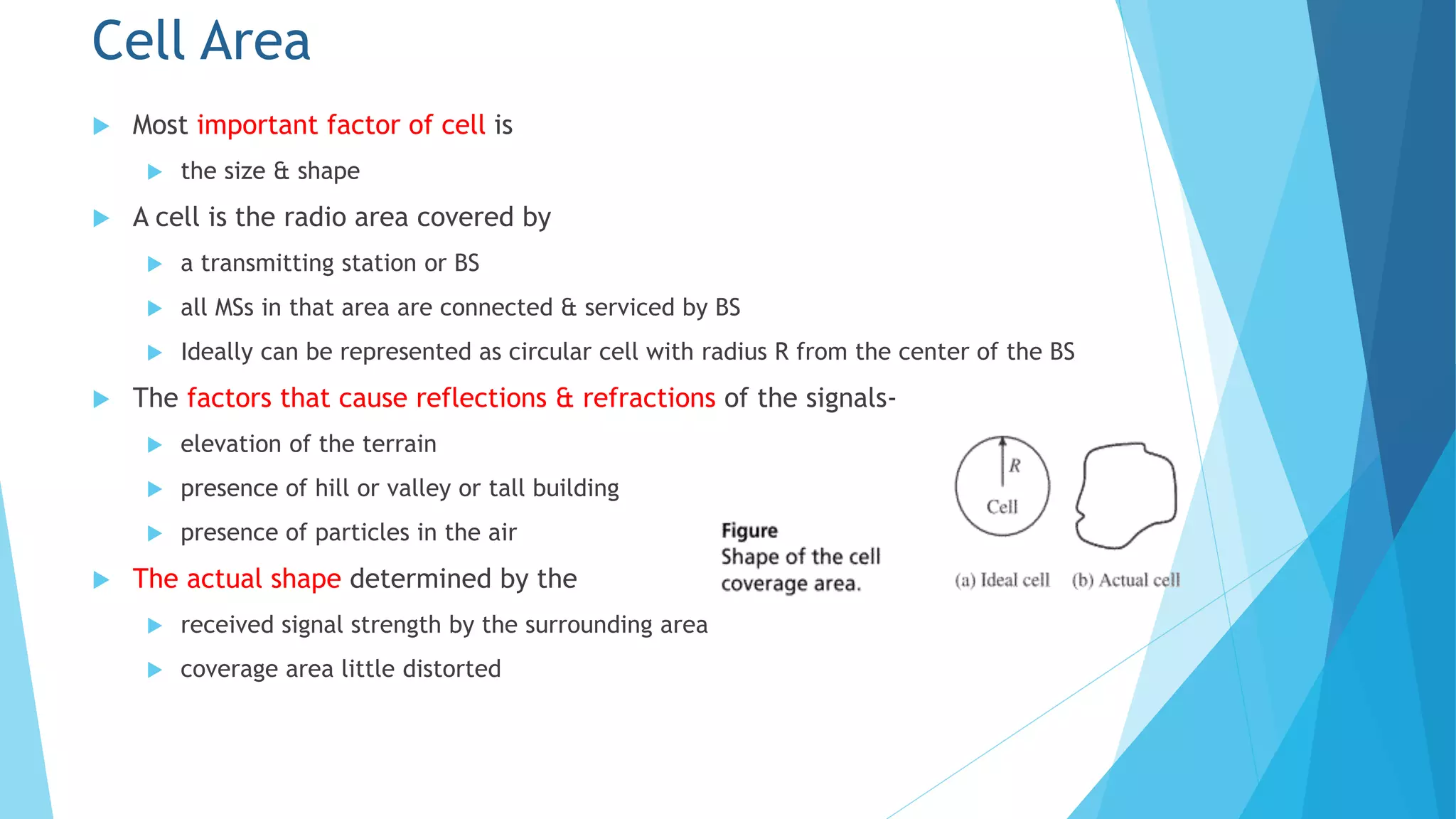
 A cell is the radio area covered by
 a transmitting station or BS
 all MSs in that area are connected & serviced by BS
 Ideally can be represented as circular cell with radius R from the center of the BS
 The factors that cause reflections & refractions of the signals-
 elevation of the terrain
 presence of hill or valley or tall building
 presence of particles in the air
 The actual shape determined by the
 received signal strength by the surrounding area
 coverage area little distorted
Cell Area
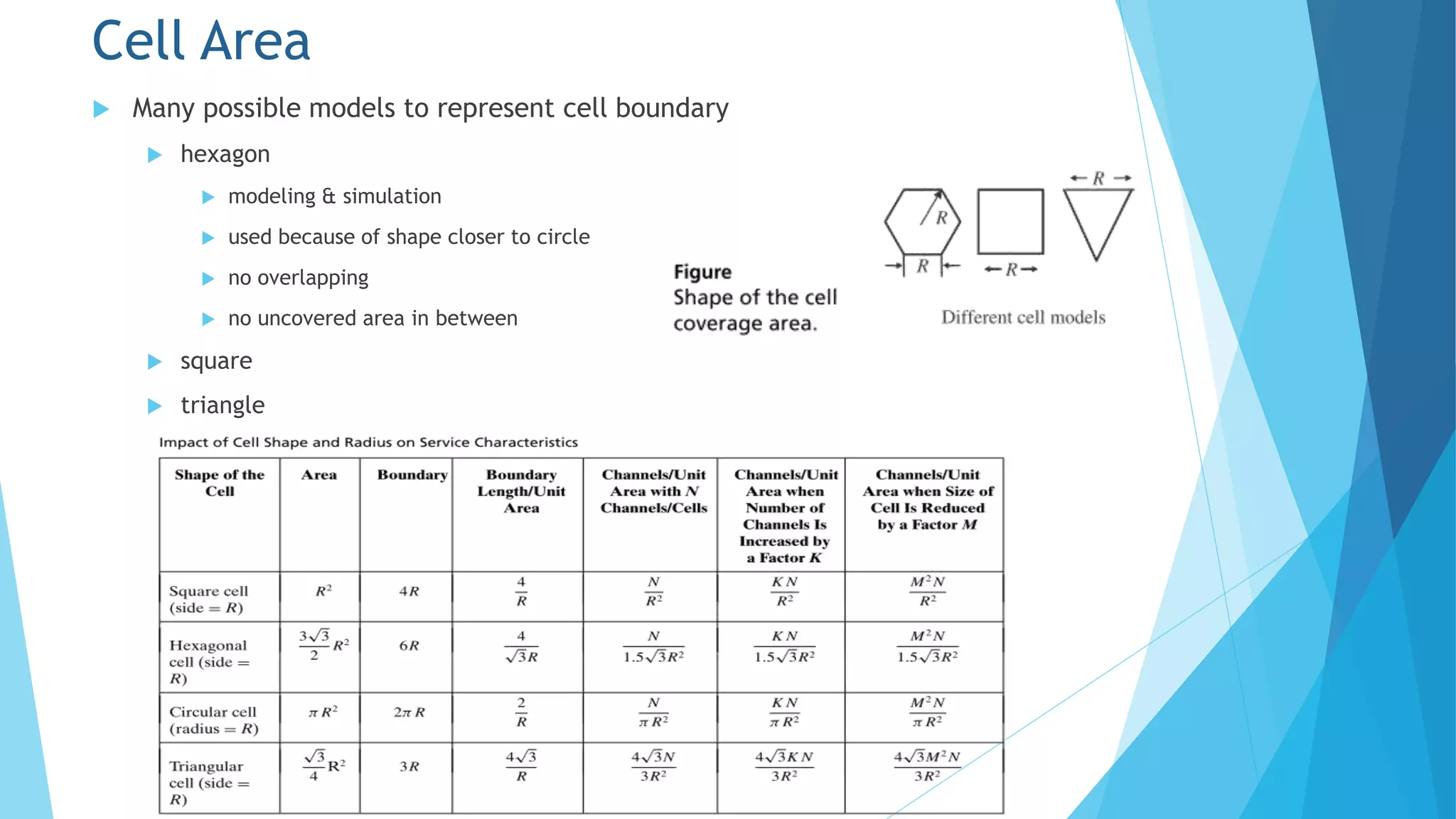
 Many possible models to represent cell boundary
 hexagon
 modeling & simulation
 used because of shape closer to circle
 no overlapping
 no uncovered area in between
 square
 triangle
Signal Strength & Cell Parameters
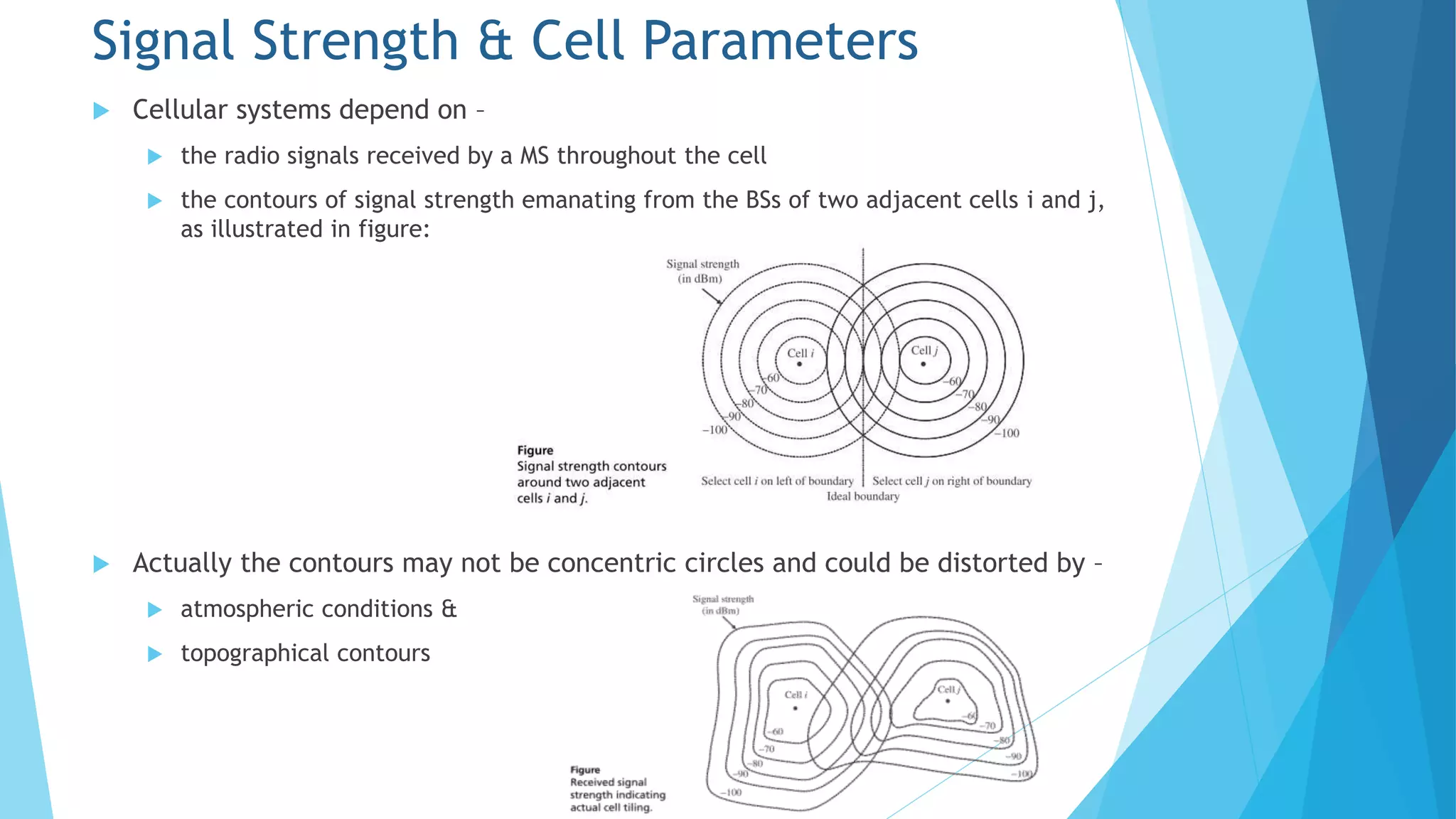
 Cellular systems depend on –
 the radio signals received by a MS throughout the cell
 the contours of signal strength emanating from the BSs of two adjacent cells i and j,
as illustrated in figure:
 Actually the contours may not be concentric circles and could be distorted by –
 atmospheric conditions &
 topographical contours
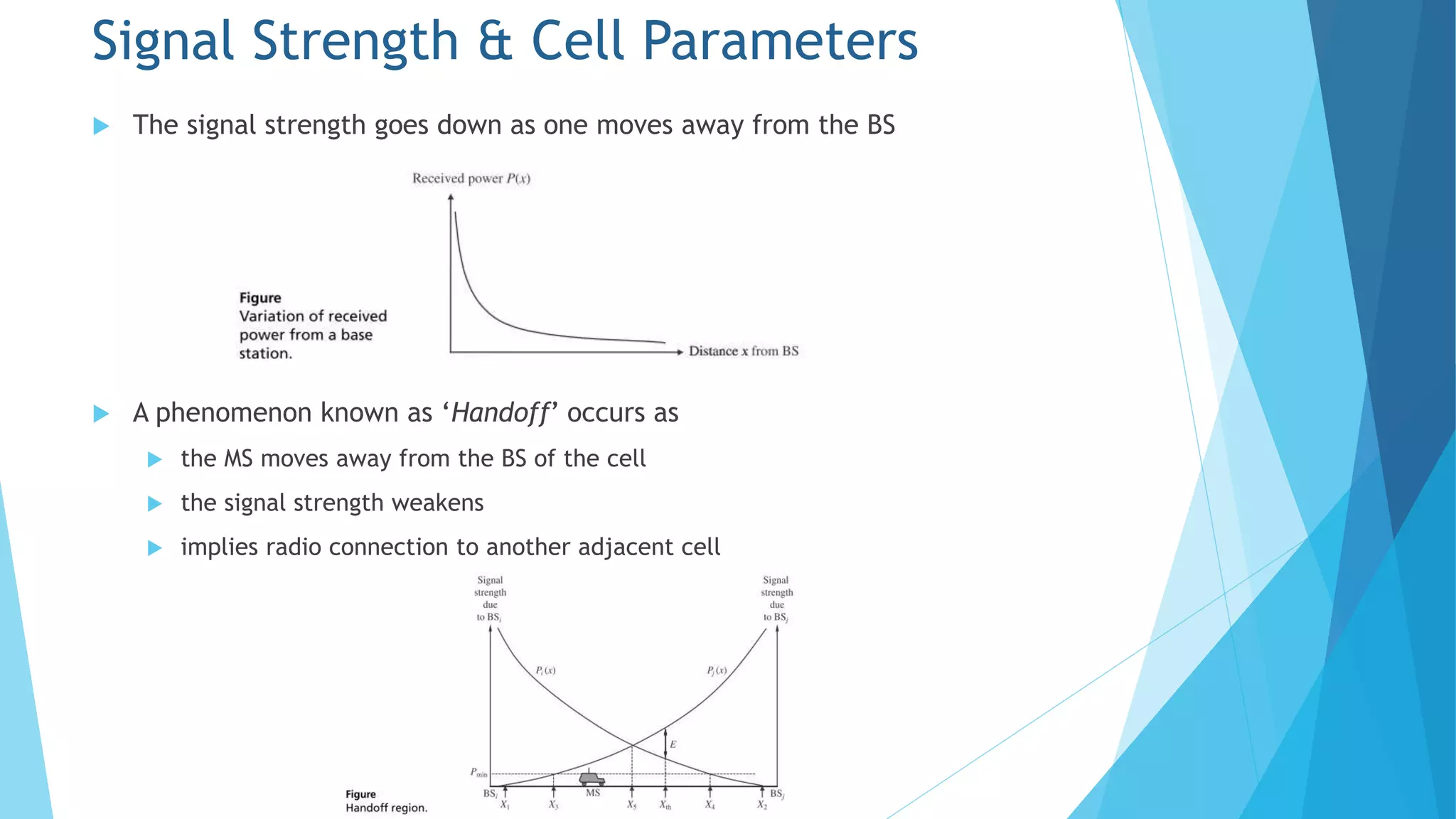
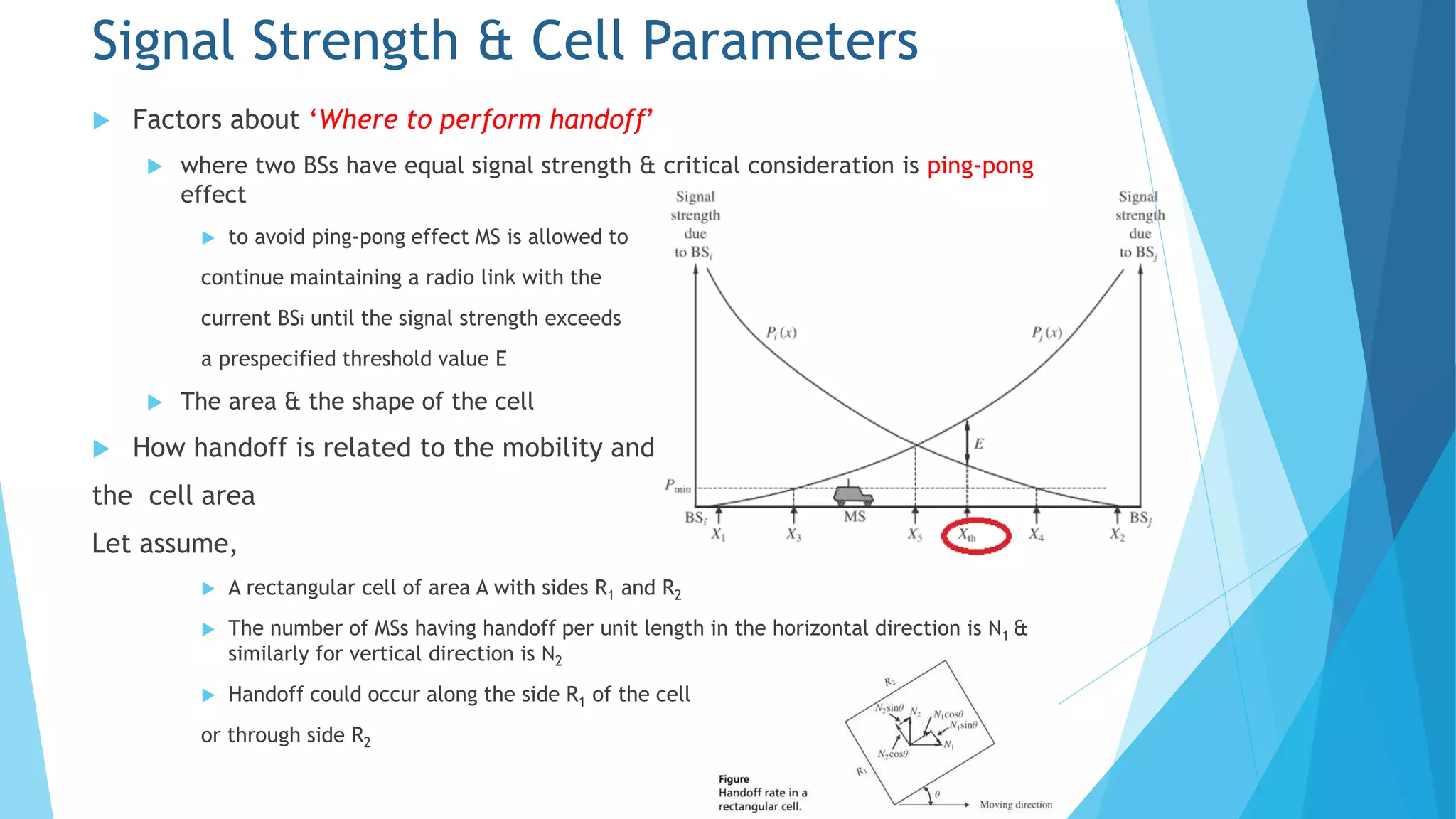
 The signal strength goes down as one moves away from the BS
 A phenomenon known as ‘Handoff’ occurs as
 the MS moves away from the BS of the cell
 the signal strength weakens
 implies radio connection to another adjacent cell
Signal Strength & Cell Parameters
 Factors about ‘Where to perform handoff’
 where two BSs have equal signal strength & critical consideration is ping-pong
effect
 to avoid ping-pong effect MS is allowed to
continue maintaining a radio link with the
current BSi until the signal strength exceeds
a prespecified threshold value E
 The area & the shape of the cell
 How handoff is related to the mobility and
the cell area
Let assume,
 A rectangular cell of area A with sides R1 and R2
 The number of MSs having handoff per unit length in the horizontal direction is N1 &
similarly for vertical direction is N2
 Handoff could occur along the side R1 of the cell
or through side R2
Signal Strength & Cell Parameters
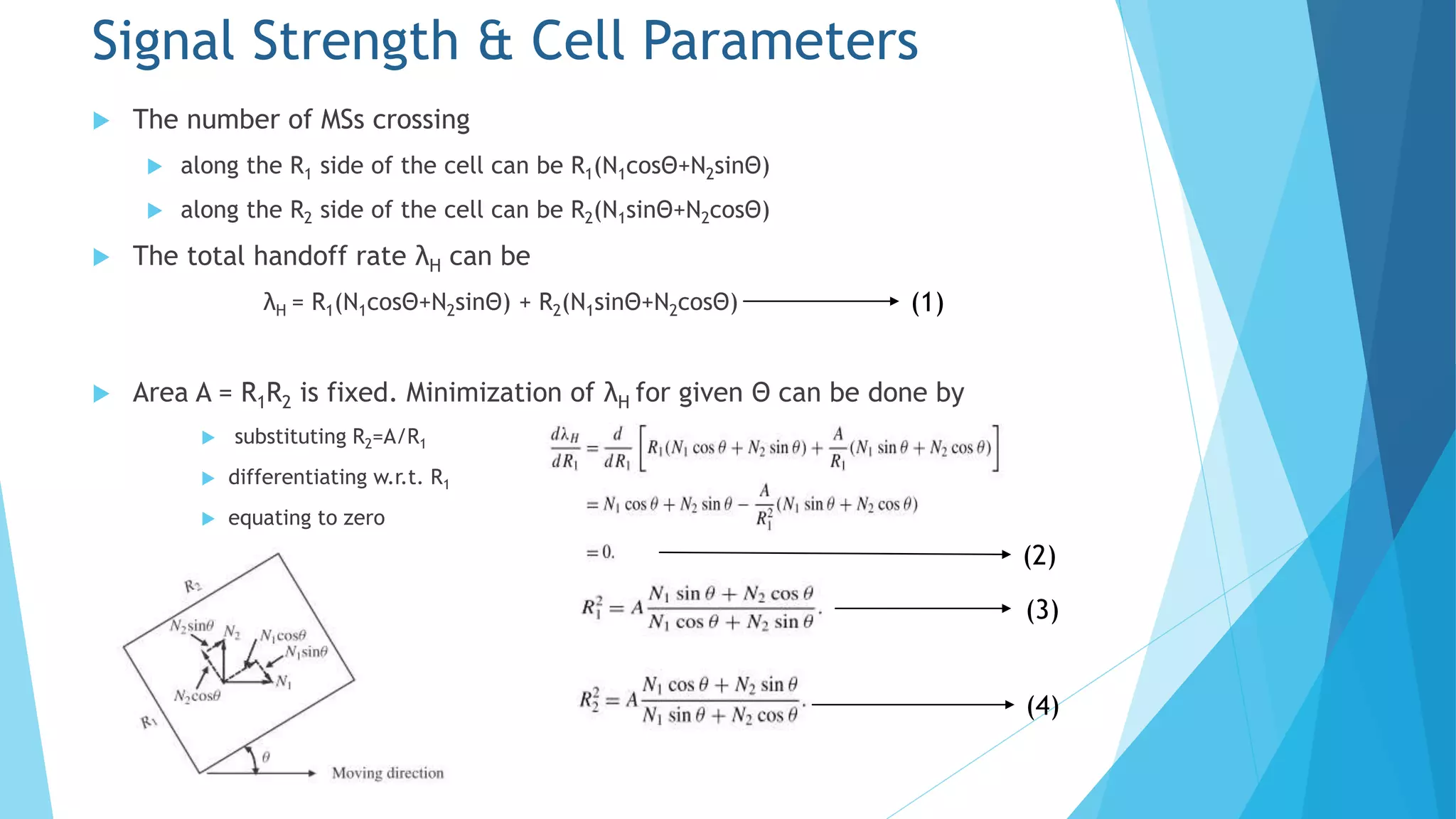
 The number of MSs crossing
 along the R1 side of the cell can be R1(N1cosΘ+N2sinΘ)
 along the R2 side of the cell can be R2(N1sinΘ+N2cosΘ)
 The total handoff rate λH can be
λH = R1(N1cosΘ+N2sinΘ) + R2(N1sinΘ+N2cosΘ)
 Area A = R1R2 is fixed. Minimization of λH for given Θ can be done by
 substituting R2=A/R1
 differentiating w.r.t. R1
 equating to zero
Signal Strength & Cell Parameters
(2)
(3)
(4)
(1)
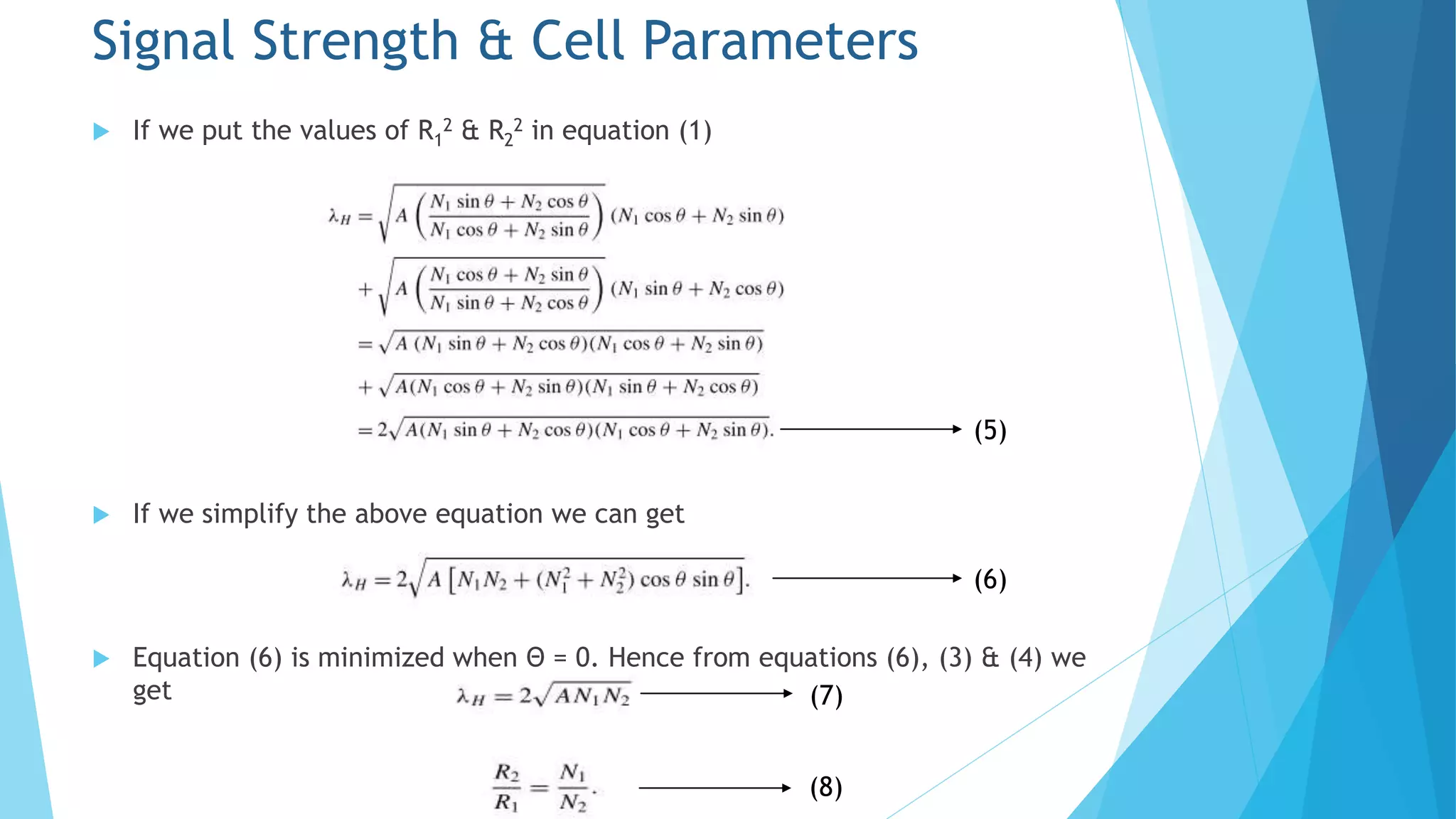
 If we put the values of R1
2 & R2
2 in equation (1)
 If we simplify the above equation we can get
 Equation (6) is minimized when Θ = 0. Hence from equations (6), (3) & (4) we
get
Signal Strength & Cell Parameters
(5)
(6)
(7)
(8)
Capacity of a Cell
 The offered traffic load is characterized by two important random parameters
1. Average number of MSs requesting the service (average call arrival rate λ)
2. Average length of time the MSs requiring the service (average holding time T)
 The offered traffic load is defined as
a = λT
 for example, in cell with 100 MSs, on an average , if 30 requests are generated
during an hour, with average holding time T=360 seconds, then the average request
rate (or average call arrival rate) is
λ = 30 requests/3600 seconds (1 hour=60min*60sec ) (9)
 1 Erlang = A servicing channel that is kept busy for an hour
Then for the above example Erlang is, a = (30 calls/3600seconds)*360 seconds (10)
= 3 Earlangs (11)
 The average arrival rate is λ, and the average service (departure) rate is μ
 The steady state probabilities P(i)s for this system with S is the number of the
channel in a cell. we have
P(i) =
𝑎𝑖
𝑖!
𝑃(0) (12)
 where a = λ/μ is the offered load and
(13)
 the probability P(S) of an arriving call being blocked = the probability that all
channels are busy
(14) called the Erlang B formula &
denoted as B(S,a)
 B(S,a) is also called blocking probability, probability of loss, or probability of
rejection
 If S is given as 2 with a = 3, the blocking probability is,
(15)]
So, a fraction of 0.529 calls is blocked & need to reinitiate the call. Thus the total number
of blocked call is about 30*0.529=15.87
 The efficiency of the system can be given by,
Capacity of a Cell
(16)
 The probability of an arriving call being delayed is
 This is called the Erlang C formula. If S=5 and a=3, we have B(5,3)=0.11. So
the probability of an arriving call being delayed is
Capacity of a Cell
(17)
Frequency Reuse
 Earlier cellular systems employed
 FDMA
 range was limited to a radius from 2 to 20 km
 ‘Reuse’-
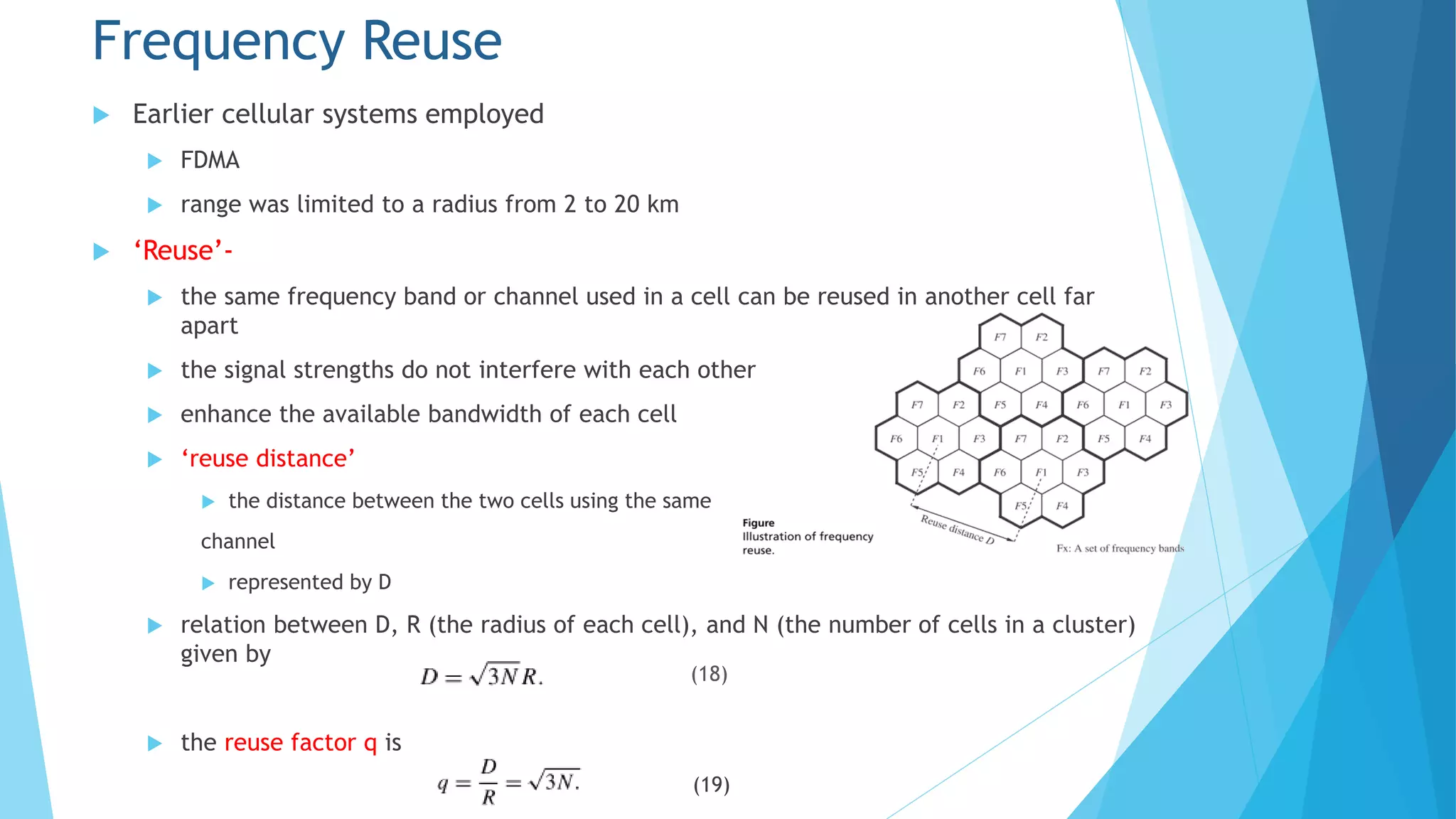
 the same frequency band or channel used in a cell can be reused in another cell far
apart
 the signal strengths do not interfere with each other
 enhance the available bandwidth of each cell
 ‘reuse distance’
 the distance between the two cells using the same
channel
 represented by D
 relation between D, R (the radius of each cell), and N (the number of cells in a cluster)
given by
 the reuse factor q is
(19)
(18)
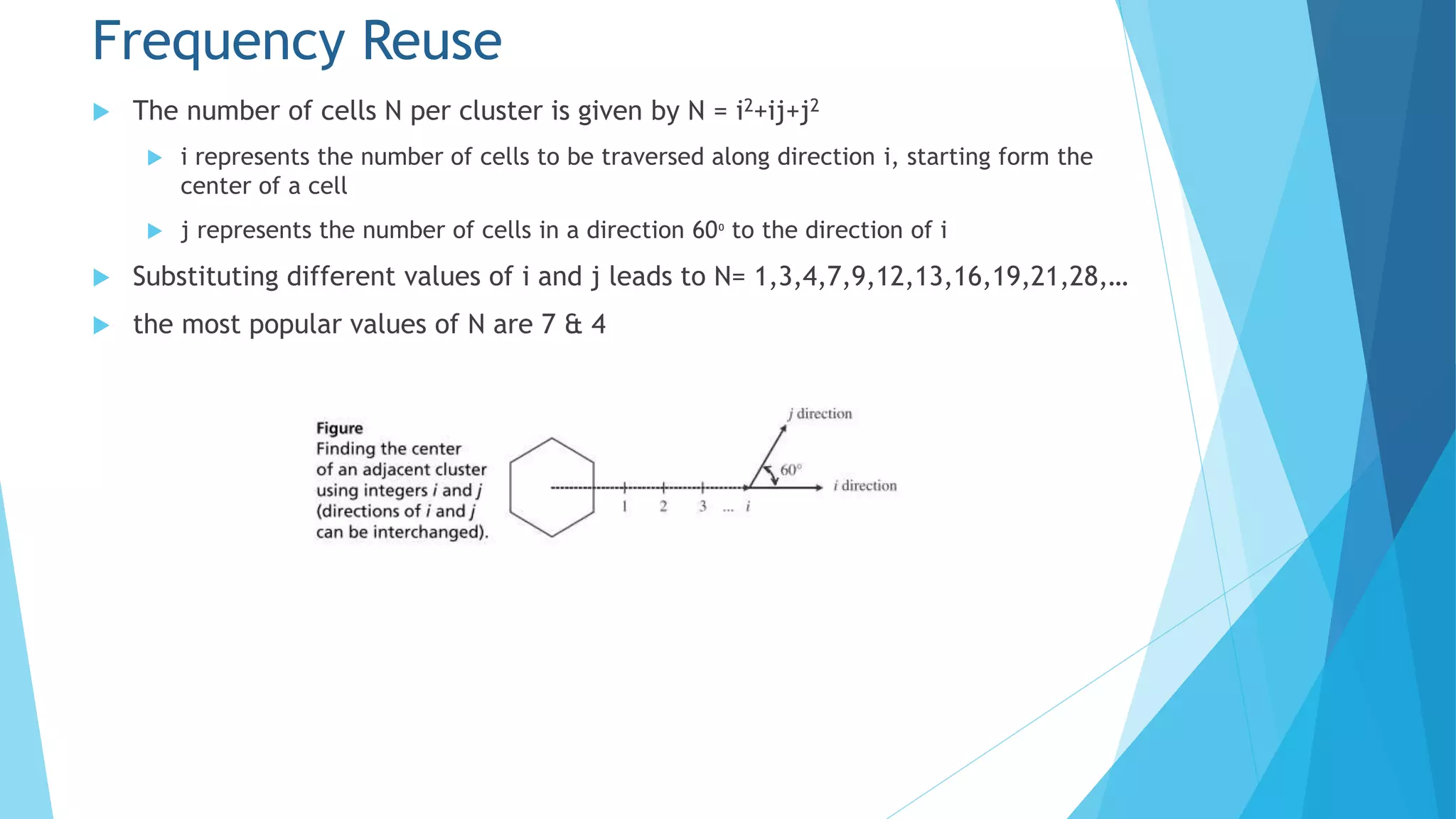
 The number of cells N per cluster is given by N = i2+ij+j2
 i represents the number of cells to be traversed along direction i, starting form the
center of a cell
 j represents the number of cells in a direction 60₀ to the direction of i
 Substituting different values of i and j leads to N= 1,3,4,7,9,12,13,16,19,21,28,…
 the most popular values of N are 7 & 4
Frequency Reuse
How to Form a Cluster
 The method to form a cluster is, N = i2+ij+j2 where i & j are integers and i>j
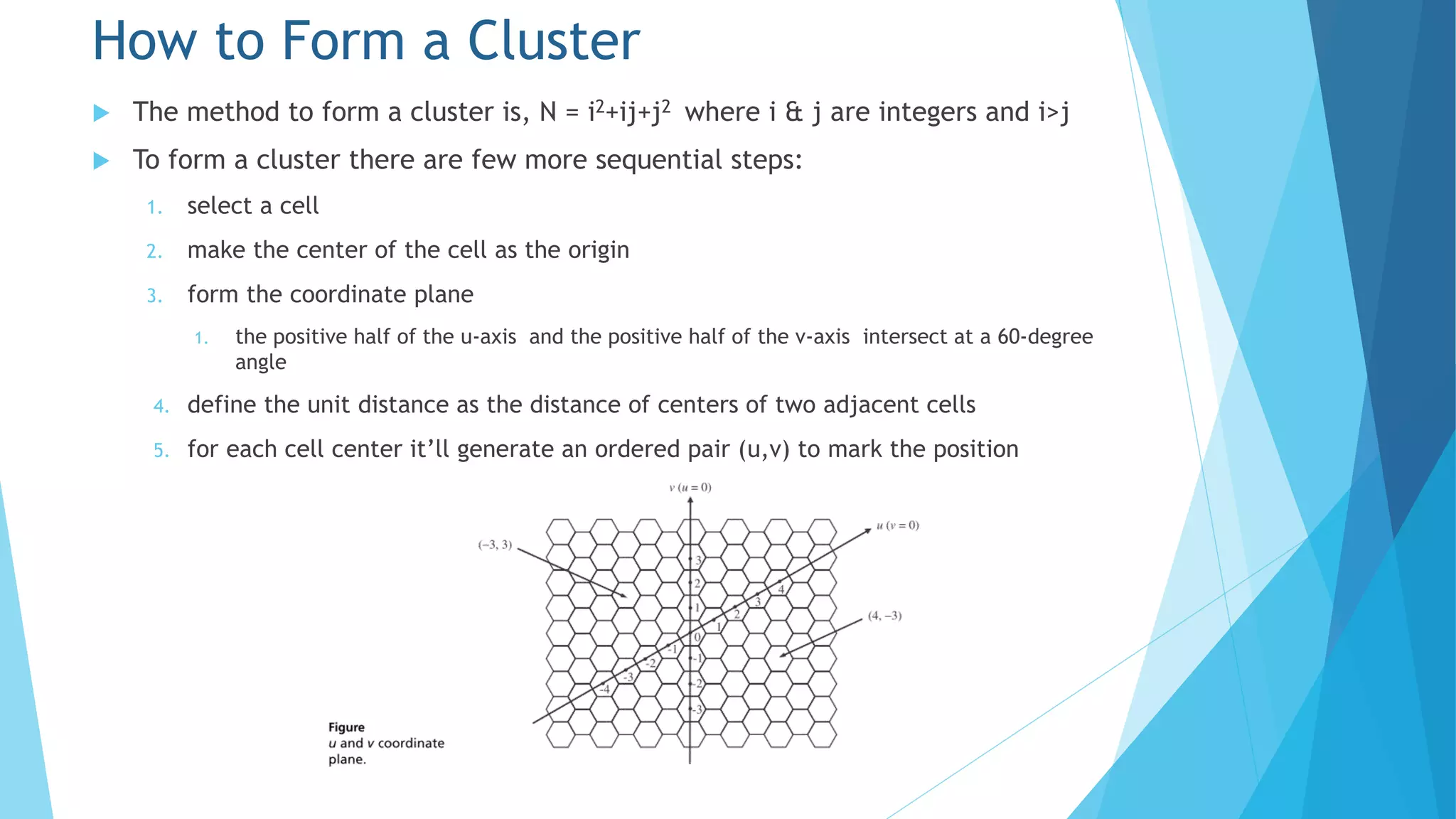
 To form a cluster there are few more sequential steps:
1. select a cell
2. make the center of the cell as the origin
3. form the coordinate plane
1. the positive half of the u-axis and the positive half of the v-axis intersect at a 60-degree
angle
4. define the unit distance as the distance of centers of two adjacent cells
5. for each cell center it’ll generate an ordered pair (u,v) to mark the position
 For a case j=1 with a given N & integer i is fixed then we get from the
equation
N = i2+ij+j2 = i2+i+1 (20)
Then using L = [(i+1)u+v]modN (21)
 The cells with labels from 0 through N-1 form a cluster of N cells by using the
above equations
 The cells with the same band can use same frequency
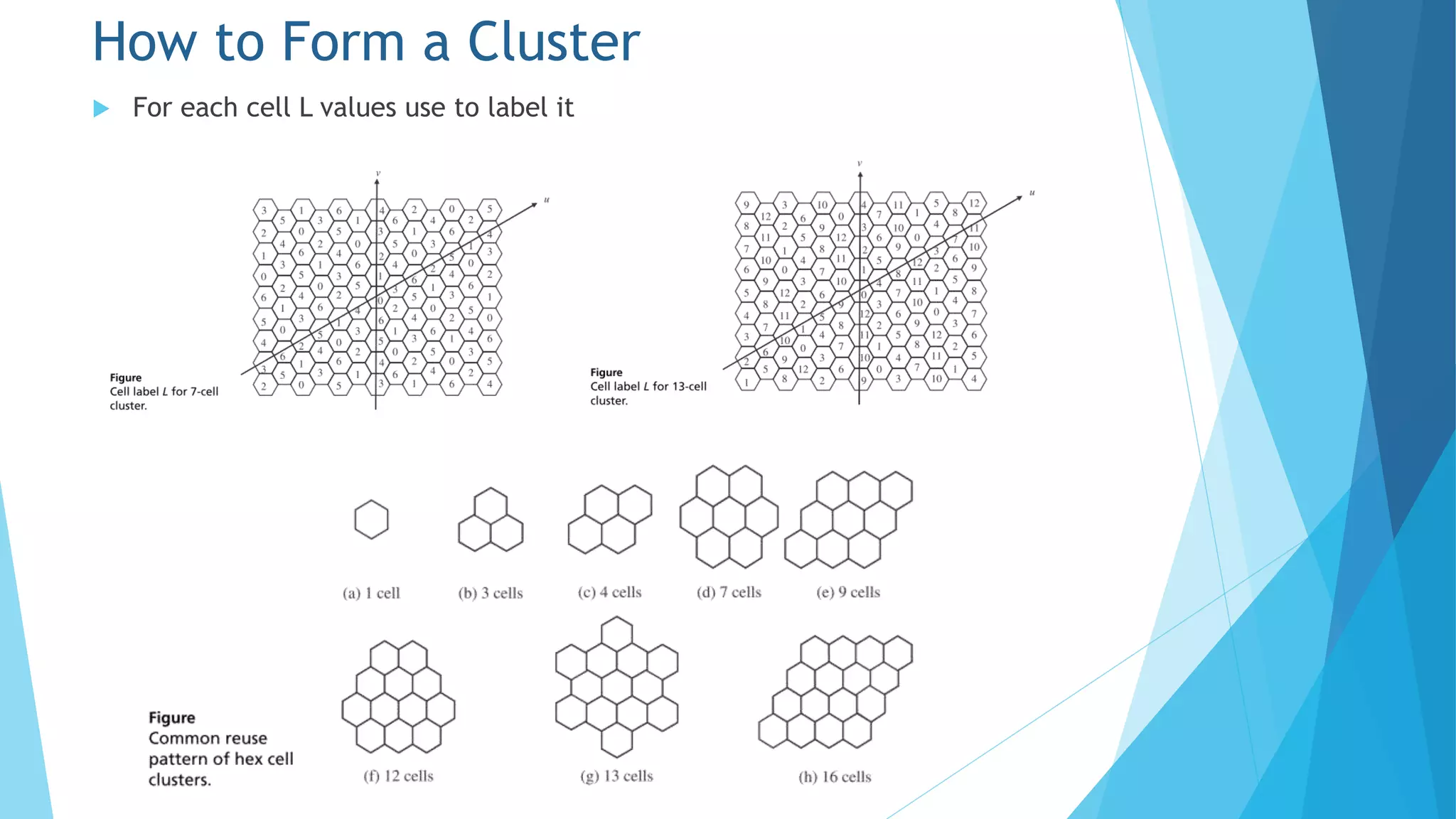
 For example if given N=7 & by using equation (20) we get i=2 & from equation
(21) we can get L=(3u+v) mod 7
 For center’s position (u,v) we can compute label L
How to Form a Cluster
 For each cell L values use to label it
How to Form a Cluster
Co-channel Interference
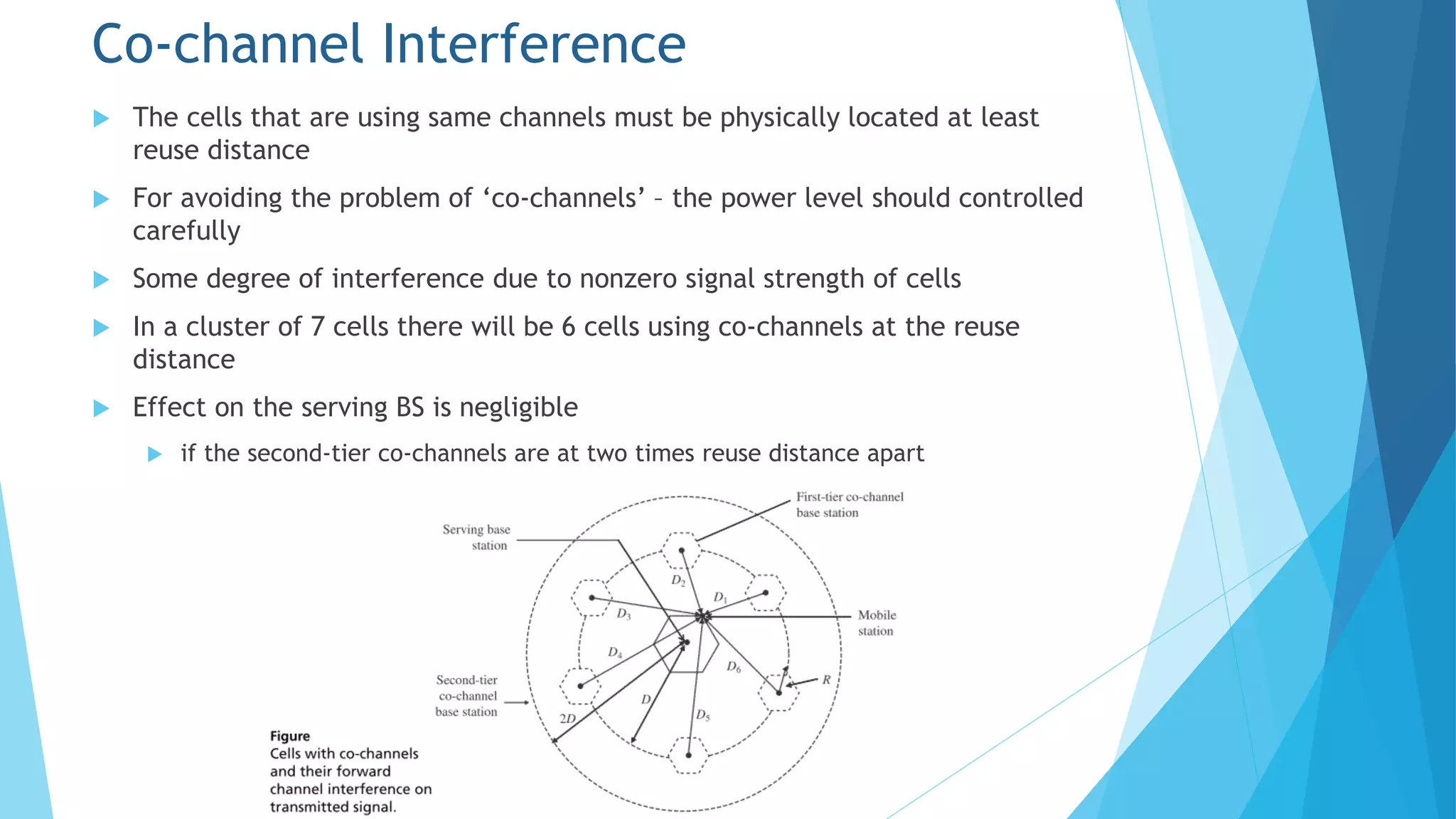
 The cells that are using same channels must be physically located at least
reuse distance
 For avoiding the problem of ‘co-channels’ – the power level should controlled
carefully
 Some degree of interference due to nonzero signal strength of cells
 In a cluster of 7 cells there will be 6 cells using co-channels at the reuse
distance
 Effect on the serving BS is negligible
 if the second-tier co-channels are at two times reuse distance apart
 The Co-channel Interference Ratio (CCIR) is given by
𝐶
𝐼
=
𝐶𝑎𝑟𝑟𝑖𝑒𝑟
𝐼𝑛𝑡𝑒𝑟𝑓𝑒𝑟𝑒𝑛𝑐𝑒
=
𝐶
𝑘=1
𝑀 𝐼 𝑘
(22)
where Ik is the co-channel interference from BSk
M is the maximum number of co-channel interfering cells
 For cluster size of 7, M=6, CCIR is given by
𝐶
𝐼
=
1
𝐾=1
𝑀 𝐷 𝑘
𝑅
⁻γ
(23)
where γ is the propagation path loss slope and varies between 2 and 5
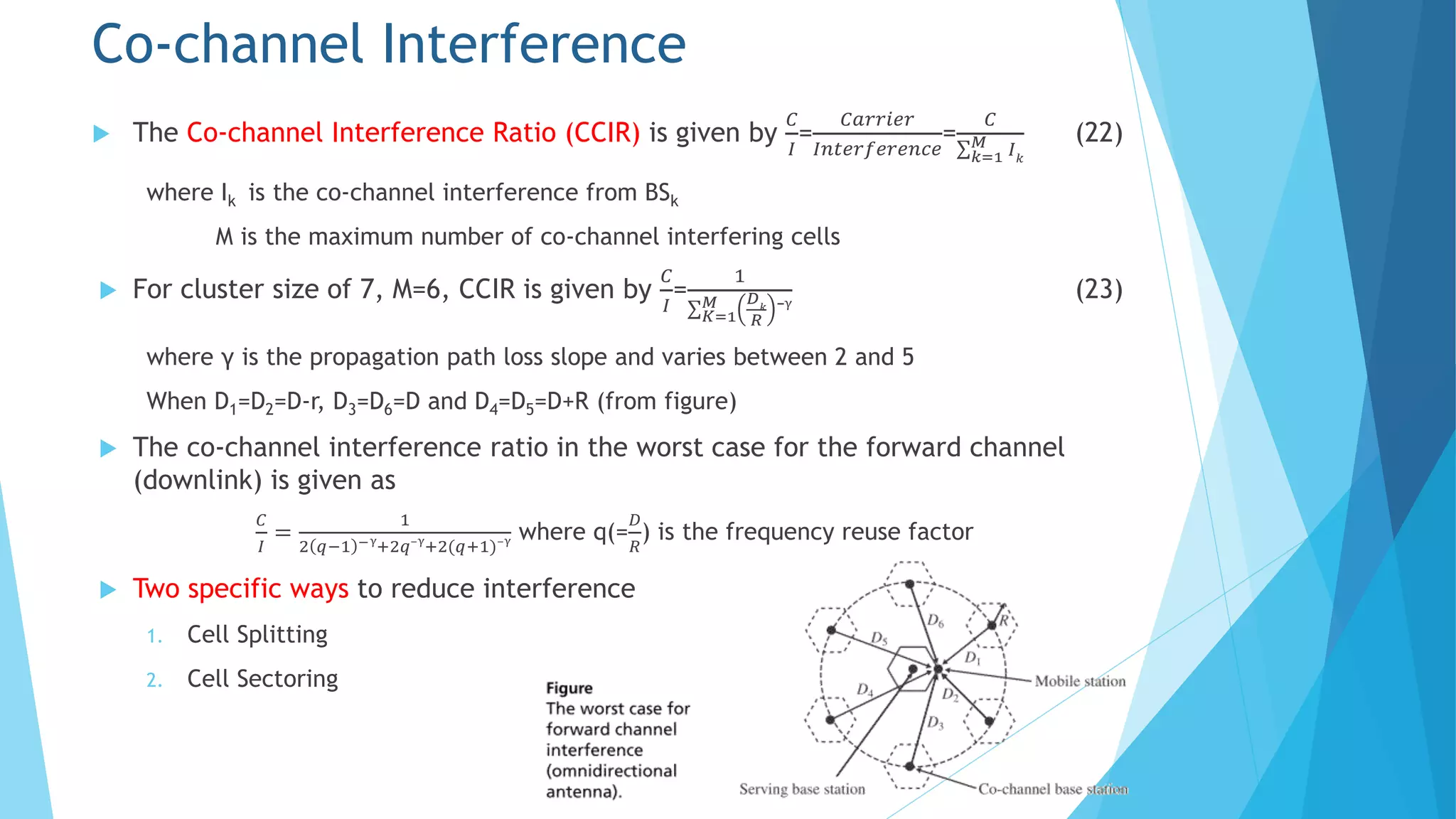
When D1=D2=D-r, D3=D6=D and D4=D5=D+R (from figure)
 The co-channel interference ratio in the worst case for the forward channel
(downlink) is given as
𝐶
𝐼
=
1
2 𝑞−1 −γ
+2𝑞⁻γ
+2(𝑞+1)⁻γ where q(=
𝐷
𝑅
) is the frequency reuse factor
 Two specific ways to reduce interference
1. Cell Splitting
2. Cell Sectoring
Co-channel Interference
Cell Splitting
 Service providers would like to service users in a cost effective way
 Resource demand may depend on the concentration of users in a given area
 A way to cope up with increased traffic is
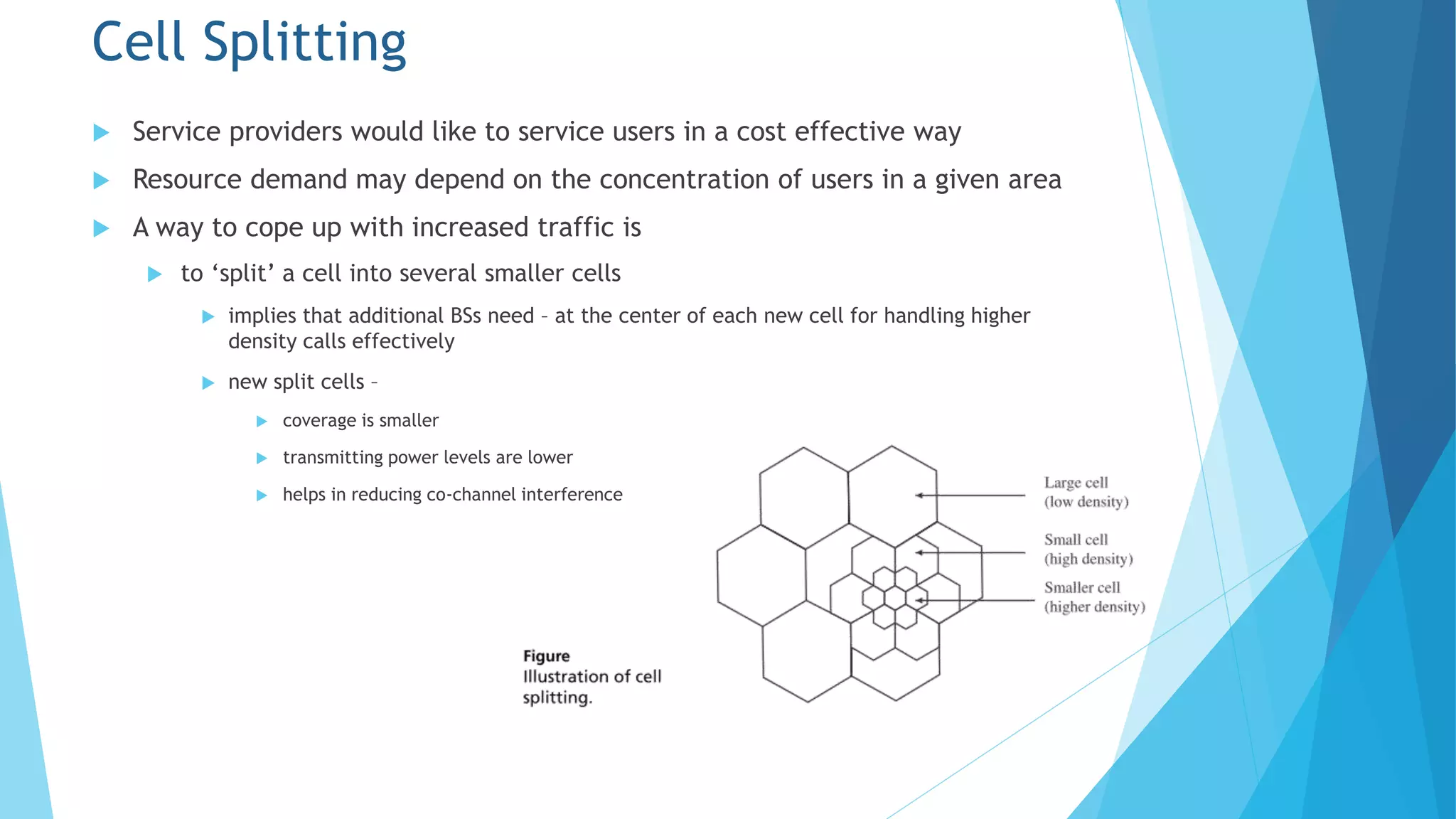
 to ‘split’ a cell into several smaller cells
 implies that additional BSs need – at the center of each new cell for handling higher
density calls effectively
 new split cells –
 coverage is smaller
 transmitting power levels are lower
 helps in reducing co-channel interference
Cell Sectoring
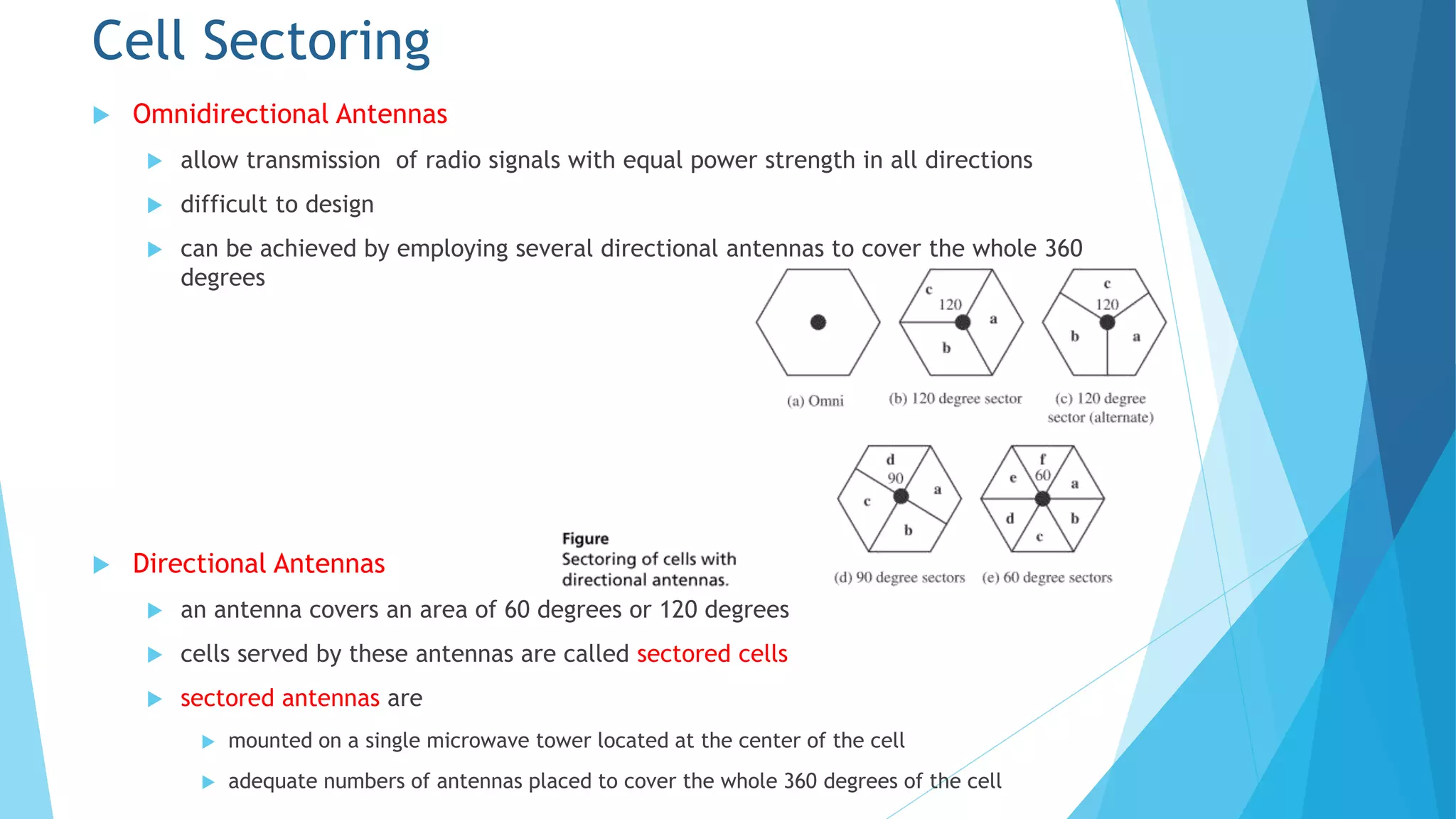
 Omnidirectional Antennas
 allow transmission of radio signals with equal power strength in all directions
 difficult to design
 can be achieved by employing several directional antennas to cover the whole 360
degrees
 Directional Antennas
 an antenna covers an area of 60 degrees or 120 degrees
 cells served by these antennas are called sectored cells
 sectored antennas are
 mounted on a single microwave tower located at the center of the cell
 adequate numbers of antennas placed to cover the whole 360 degrees of the cell
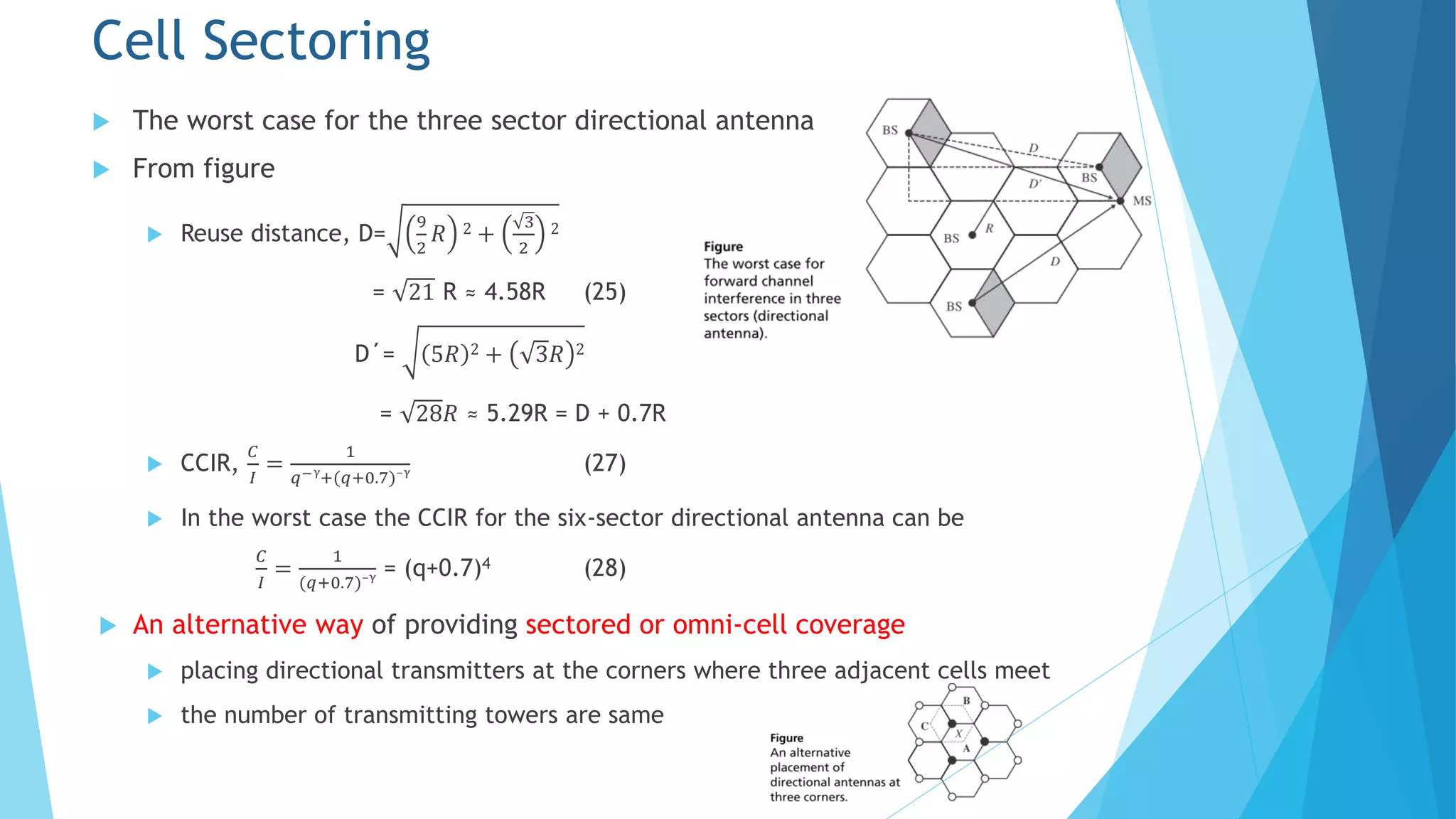
 The worst case for the three sector directional antenna
 From figure
 Reuse distance, D=
9
2
𝑅 2 +
3
2
2
= 21 R ≈ 4.58R (25)
D΄= 5𝑅 2 + 3𝑅 2
= 28𝑅 ≈ 5.29R = D + 0.7R
 CCIR,
𝐶
𝐼
=
1
𝑞−γ
+(𝑞+0.7)⁻γ (27)
 In the worst case the CCIR for the six-sector directional antenna can be
𝐶
𝐼
=
1
(𝑞+0.7)⁻γ = (q+0.7)4 (28)
 An alternative way of providing sectored or omni-cell coverage
 placing directional transmitters at the corners where three adjacent cells meet
 the number of transmitting towers are same
Cell Sectoring
Summary
 A overview of various cell parameters including –
 area
 load
 frequency reuse
 cell splitting
 cell sectoring
 In Wireless Communications
 limited bandwidth allocated
 reuse technique useful for both FDMA & TDMA schemes

Chapter 5(Cellular Concepts)

  • 1.
    Chapter 5: CellularConcept Prepared by: Nusrat Sharmin 142CPG08
  • 2.
    Introduction  ‘Cell’- theheart of Cellular Systems  A Cell is defined as-  the area where the radio communication resources is used by the MS & is controlled by BS  Given -  the number of users  average frequency of calls being made  average duration of call time  Base on the given parameters the performance of the system is largely depend on –  the size & shape of the cell  the amount of resources allocated to each cell
  • 3.
    Cell Area  Mostimportant factor of cell is  the size & shape  A cell is the radio area covered by  a transmitting station or BS  all MSs in that area are connected & serviced by BS  Ideally can be represented as circular cell with radius R from the center of the BS  The factors that cause reflections & refractions of the signals-  elevation of the terrain  presence of hill or valley or tall building  presence of particles in the air  The actual shape determined by the  received signal strength by the surrounding area  coverage area little distorted
  • 4.
    Cell Area  Manypossible models to represent cell boundary  hexagon  modeling & simulation  used because of shape closer to circle  no overlapping  no uncovered area in between  square  triangle
  • 5.
    Signal Strength &Cell Parameters  Cellular systems depend on –  the radio signals received by a MS throughout the cell  the contours of signal strength emanating from the BSs of two adjacent cells i and j, as illustrated in figure:  Actually the contours may not be concentric circles and could be distorted by –  atmospheric conditions &  topographical contours
  • 6.
     The signalstrength goes down as one moves away from the BS  A phenomenon known as ‘Handoff’ occurs as  the MS moves away from the BS of the cell  the signal strength weakens  implies radio connection to another adjacent cell Signal Strength & Cell Parameters
  • 7.
     Factors about‘Where to perform handoff’  where two BSs have equal signal strength & critical consideration is ping-pong effect  to avoid ping-pong effect MS is allowed to continue maintaining a radio link with the current BSi until the signal strength exceeds a prespecified threshold value E  The area & the shape of the cell  How handoff is related to the mobility and the cell area Let assume,  A rectangular cell of area A with sides R1 and R2  The number of MSs having handoff per unit length in the horizontal direction is N1 & similarly for vertical direction is N2  Handoff could occur along the side R1 of the cell or through side R2 Signal Strength & Cell Parameters
  • 8.
     The numberof MSs crossing  along the R1 side of the cell can be R1(N1cosΘ+N2sinΘ)  along the R2 side of the cell can be R2(N1sinΘ+N2cosΘ)  The total handoff rate λH can be λH = R1(N1cosΘ+N2sinΘ) + R2(N1sinΘ+N2cosΘ)  Area A = R1R2 is fixed. Minimization of λH for given Θ can be done by  substituting R2=A/R1  differentiating w.r.t. R1  equating to zero Signal Strength & Cell Parameters (2) (3) (4) (1)
  • 9.
     If weput the values of R1 2 & R2 2 in equation (1)  If we simplify the above equation we can get  Equation (6) is minimized when Θ = 0. Hence from equations (6), (3) & (4) we get Signal Strength & Cell Parameters (5) (6) (7) (8)
  • 10.
    Capacity of aCell  The offered traffic load is characterized by two important random parameters 1. Average number of MSs requesting the service (average call arrival rate λ) 2. Average length of time the MSs requiring the service (average holding time T)  The offered traffic load is defined as a = λT  for example, in cell with 100 MSs, on an average , if 30 requests are generated during an hour, with average holding time T=360 seconds, then the average request rate (or average call arrival rate) is λ = 30 requests/3600 seconds (1 hour=60min*60sec ) (9)  1 Erlang = A servicing channel that is kept busy for an hour Then for the above example Erlang is, a = (30 calls/3600seconds)*360 seconds (10) = 3 Earlangs (11)  The average arrival rate is λ, and the average service (departure) rate is μ  The steady state probabilities P(i)s for this system with S is the number of the channel in a cell. we have P(i) = 𝑎𝑖 𝑖! 𝑃(0) (12)
  • 11.
     where a= λ/μ is the offered load and (13)  the probability P(S) of an arriving call being blocked = the probability that all channels are busy (14) called the Erlang B formula & denoted as B(S,a)  B(S,a) is also called blocking probability, probability of loss, or probability of rejection  If S is given as 2 with a = 3, the blocking probability is, (15)] So, a fraction of 0.529 calls is blocked & need to reinitiate the call. Thus the total number of blocked call is about 30*0.529=15.87  The efficiency of the system can be given by, Capacity of a Cell (16)
  • 12.
     The probabilityof an arriving call being delayed is  This is called the Erlang C formula. If S=5 and a=3, we have B(5,3)=0.11. So the probability of an arriving call being delayed is Capacity of a Cell (17)
  • 13.
    Frequency Reuse  Earliercellular systems employed  FDMA  range was limited to a radius from 2 to 20 km  ‘Reuse’-  the same frequency band or channel used in a cell can be reused in another cell far apart  the signal strengths do not interfere with each other  enhance the available bandwidth of each cell  ‘reuse distance’  the distance between the two cells using the same channel  represented by D  relation between D, R (the radius of each cell), and N (the number of cells in a cluster) given by  the reuse factor q is (19) (18)
  • 14.
     The numberof cells N per cluster is given by N = i2+ij+j2  i represents the number of cells to be traversed along direction i, starting form the center of a cell  j represents the number of cells in a direction 60₀ to the direction of i  Substituting different values of i and j leads to N= 1,3,4,7,9,12,13,16,19,21,28,…  the most popular values of N are 7 & 4 Frequency Reuse
  • 15.
    How to Forma Cluster  The method to form a cluster is, N = i2+ij+j2 where i & j are integers and i>j  To form a cluster there are few more sequential steps: 1. select a cell 2. make the center of the cell as the origin 3. form the coordinate plane 1. the positive half of the u-axis and the positive half of the v-axis intersect at a 60-degree angle 4. define the unit distance as the distance of centers of two adjacent cells 5. for each cell center it’ll generate an ordered pair (u,v) to mark the position
  • 16.
     For acase j=1 with a given N & integer i is fixed then we get from the equation N = i2+ij+j2 = i2+i+1 (20) Then using L = [(i+1)u+v]modN (21)  The cells with labels from 0 through N-1 form a cluster of N cells by using the above equations  The cells with the same band can use same frequency  For example if given N=7 & by using equation (20) we get i=2 & from equation (21) we can get L=(3u+v) mod 7  For center’s position (u,v) we can compute label L How to Form a Cluster
  • 17.
     For eachcell L values use to label it How to Form a Cluster
  • 18.
    Co-channel Interference  Thecells that are using same channels must be physically located at least reuse distance  For avoiding the problem of ‘co-channels’ – the power level should controlled carefully  Some degree of interference due to nonzero signal strength of cells  In a cluster of 7 cells there will be 6 cells using co-channels at the reuse distance  Effect on the serving BS is negligible  if the second-tier co-channels are at two times reuse distance apart
  • 19.
     The Co-channelInterference Ratio (CCIR) is given by 𝐶 𝐼 = 𝐶𝑎𝑟𝑟𝑖𝑒𝑟 𝐼𝑛𝑡𝑒𝑟𝑓𝑒𝑟𝑒𝑛𝑐𝑒 = 𝐶 𝑘=1 𝑀 𝐼 𝑘 (22) where Ik is the co-channel interference from BSk M is the maximum number of co-channel interfering cells  For cluster size of 7, M=6, CCIR is given by 𝐶 𝐼 = 1 𝐾=1 𝑀 𝐷 𝑘 𝑅 ⁻γ (23) where γ is the propagation path loss slope and varies between 2 and 5 When D1=D2=D-r, D3=D6=D and D4=D5=D+R (from figure)  The co-channel interference ratio in the worst case for the forward channel (downlink) is given as 𝐶 𝐼 = 1 2 𝑞−1 −γ +2𝑞⁻γ +2(𝑞+1)⁻γ where q(= 𝐷 𝑅 ) is the frequency reuse factor  Two specific ways to reduce interference 1. Cell Splitting 2. Cell Sectoring Co-channel Interference
  • 20.
    Cell Splitting  Serviceproviders would like to service users in a cost effective way  Resource demand may depend on the concentration of users in a given area  A way to cope up with increased traffic is  to ‘split’ a cell into several smaller cells  implies that additional BSs need – at the center of each new cell for handling higher density calls effectively  new split cells –  coverage is smaller  transmitting power levels are lower  helps in reducing co-channel interference
  • 21.
    Cell Sectoring  OmnidirectionalAntennas  allow transmission of radio signals with equal power strength in all directions  difficult to design  can be achieved by employing several directional antennas to cover the whole 360 degrees  Directional Antennas  an antenna covers an area of 60 degrees or 120 degrees  cells served by these antennas are called sectored cells  sectored antennas are  mounted on a single microwave tower located at the center of the cell  adequate numbers of antennas placed to cover the whole 360 degrees of the cell
  • 22.
     The worstcase for the three sector directional antenna  From figure  Reuse distance, D= 9 2 𝑅 2 + 3 2 2 = 21 R ≈ 4.58R (25) D΄= 5𝑅 2 + 3𝑅 2 = 28𝑅 ≈ 5.29R = D + 0.7R  CCIR, 𝐶 𝐼 = 1 𝑞−γ +(𝑞+0.7)⁻γ (27)  In the worst case the CCIR for the six-sector directional antenna can be 𝐶 𝐼 = 1 (𝑞+0.7)⁻γ = (q+0.7)4 (28)  An alternative way of providing sectored or omni-cell coverage  placing directional transmitters at the corners where three adjacent cells meet  the number of transmitting towers are same Cell Sectoring
  • 23.
    Summary  A overviewof various cell parameters including –  area  load  frequency reuse  cell splitting  cell sectoring  In Wireless Communications  limited bandwidth allocated  reuse technique useful for both FDMA & TDMA schemes