MINI PROJECT
 •Anupam Singh
    (0821331018)

•Vivek Kumar Gupta
    (0821332038)
Synopsis of

GSM BASED ANTI THEFT
SYSTEM FOR VECHICLES
INDEX
ď‚— Introduction
ď‚— Methodology
ď‚— Objectives of anti theft system for vehicle.
ď‚— Theoretical Background
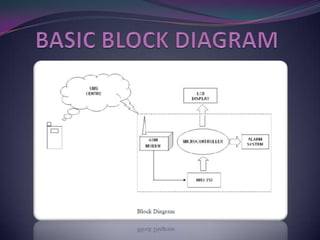
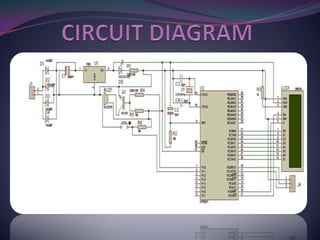
ď‚— Block Diagram & Circuit Diagram
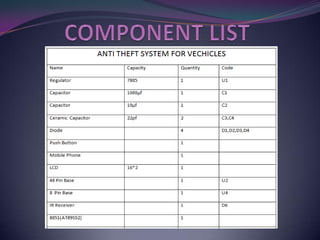
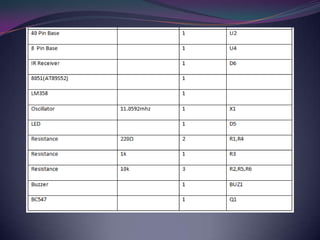
ď‚— Component List
ď‚— List of Important AT Commands
ď‚— Programmer
ď‚— Conclusion
INTRODUCTION
ď‚— Vehicles theft, which is the main concern for the
  conduct of this project, is one of the biggest crimes
  which are hard to eliminate.
ď‚— The project and research is conducted for additional
  features in vehicles alarm system. The device can be
  added to the present vehicles alarm system without
  any major modification to it.
ď‚— When the vehicles alarm is triggered, through forced
  entry or motion sensor detection, the in-vehicles
  phone will send SMS message to the owner’s mobile
  phone to alert him or her to check the vehicle.
ď‚— The SMS message gives immediate alert to the
  vehicles owner, even if the thief gotten away with
  the car, so that the owner can immediately take
  instant actions to notify the local police
  department or contact the vehicles immobilizer
  service which come with most GPS car system to
  immobilize the vehicle.
ď‚— Main components :
  microcontroller, ATMEL AT89S52
  GSM modem, Motorola W220
  LCD display:for simulation purpose.
METHODOLOGY
ď‚— The method used to carry out this project is the
  principle of serial communication in collaboration
  with embedded systems.
ď‚— System will work like when the user wants to send a
  sms on the mishaps like someone try to open the door
  of the vehicles, gas leakage at your houses and offices;
  the modem sent a message through the subscriber
  identity module (SIM) which is inserted in the display
  system MODEM.
OBJECTIVES OF THE PROJECT
ď‚— Programming of the mobile phone with AT
    (Attention) command sequence
ď‚—   Interfacing the programming chip with the personal
    computer
ď‚—   Interfacing the programmable chip with the Buzzer
    and Sensors.
ď‚—   Interfacing of the mobile phone with the
    programmable chip
ď‚—   Sending messages from the remote phone to control
    device.
THEORETICAL BACKGROUND
ď‚— GSM : It is a complex system and difficult to understand.
  The Mobile Station (MS) refers to the mobile equipment .
  The Base Station Subsystem controls the radio link with
  the Mobile Station. The Network Subsystem performs
  main functions such as switching of calls between mobile
  users, mobility management operations, and proper
  operation and setup of a network . These functions are
  controlled by the Mobile Services Switching Center (MSC).

ď‚— GSM networks operate in a number of different frequency
  ranges (separated into GSM frequency ranges for 2G and
  UMTS frequency bands for 3G). Most 2G GSM networks
  operate in the 900 MHz or 1800 MHz bands.
ď‚— SIM: It is a detachable smart card containing the
 user's subscription information and phone book.
 This allows the user to retain his or her
 information after switching handsets [10].
 Alternatively, the user can also change operators
 while retaining the handset simply by changing
 the SIM. Some operators will block this by
 allowing the phone to use only a single SIM, or
 only a SIM issued by them; this practice is known
 as SIM locking, and is illegal in some countries .
LIST OF IMPORTANT AT
               COMMANDS
ď‚— The following are the ATCOMMAND used for programming the
  GSM modem:

  Example: Changing and saving parameters
ď‚— AT+IPR=9600[Enter] Transfer rate to 9600bps
ď‚— AT&W [Enter] save parameters
ď‚—
ď‚— AT+CMGF means convert the message to machine instruction
  format
ď‚— AT+CPMS means selection of SMS memory
ď‚— AT+CMGR means read message from a given memory location
ď‚— AT+CMGD means delete message from a given memory location.
PROGRAMMER
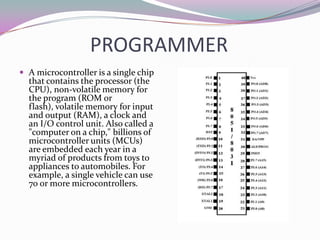
ď‚— A microcontroller is a single chip
  that contains the processor (the
  CPU), non-volatile memory for
  the program (ROM or
  flash), volatile memory for input
  and output (RAM), a clock and
  an I/O control unit. Also called a
  "computer on a chip," billions of
  microcontroller units (MCUs)
  are embedded each year in a
  myriad of products from toys to
  appliances to automobiles. For
  example, a single vehicle can use
  70 or more microcontrollers.
ď‚— The following are some of the capabilities of 8051 microcontroller.
          Internal ROM and RAM
          I/O ports with programmable pins
          Timers and counters
          Serial data communication

ď‚— The 8051 architecture consists of these specific features:
      ď‚—   16 bit PC &data pointer (DPTR)
      ď‚—   8 bit program status word (PSW)
      ď‚—   8 bit stack pointer (SP)
      ď‚—   Internal ROM 4k
      ď‚—   Internal RAM of 128 bytes.
      ď‚—   4 register banks, each containing 8 registers
      ď‚—   80 bits of general purpose data memory
      ď‚—   32 input/output pins arranged as four 8 bit ports: P0-P3
      ď‚—   Two 16 bit timer/counters: T0-T1
      ď‚—   Two external and three internal interrupt sources Oscillator and clock
          circuits.
CONCLUSION
ď‚— Vehicles theft, which is the main concern for the conduct of this
  project, is one of the biggest crimes which are hard to eliminate.

  Problems encountered:
ď‚— During soldering, many of the connection become short cktd. So we
  de-soldered the connection and did soldering again.
ď‚— A leg of the crystal oscillator was broken during mounting. So it has to
  be replaced.
ď‚— LED`s get damaged when we switched ON the supply so we replace it
  by the new one.
   Troubleshooting:
ď‚— Care should be taken while soldering. There should be no shorting of
  joints.
ď‚— Proper power supply should be maintained.

Gsm anti theft

  • 1.
    MINI PROJECT •AnupamSingh (0821331018) •Vivek Kumar Gupta (0821332038)
  • 2.
    Synopsis of GSM BASEDANTI THEFT SYSTEM FOR VECHICLES
  • 3.
    INDEX ď‚— Introduction ď‚— Methodology ď‚—Objectives of anti theft system for vehicle. ď‚— Theoretical Background ď‚— Block Diagram & Circuit Diagram ď‚— Component List ď‚— List of Important AT Commands ď‚— Programmer ď‚— Conclusion
  • 4.
    INTRODUCTION  Vehicles theft,which is the main concern for the conduct of this project, is one of the biggest crimes which are hard to eliminate.  The project and research is conducted for additional features in vehicles alarm system. The device can be added to the present vehicles alarm system without any major modification to it.  When the vehicles alarm is triggered, through forced entry or motion sensor detection, the in-vehicles phone will send SMS message to the owner’s mobile phone to alert him or her to check the vehicle.
  • 5.
    ď‚— The SMSmessage gives immediate alert to the vehicles owner, even if the thief gotten away with the car, so that the owner can immediately take instant actions to notify the local police department or contact the vehicles immobilizer service which come with most GPS car system to immobilize the vehicle. ď‚— Main components : microcontroller, ATMEL AT89S52 GSM modem, Motorola W220 LCD display:for simulation purpose.
  • 6.
    METHODOLOGY ď‚— The methodused to carry out this project is the principle of serial communication in collaboration with embedded systems. ď‚— System will work like when the user wants to send a sms on the mishaps like someone try to open the door of the vehicles, gas leakage at your houses and offices; the modem sent a message through the subscriber identity module (SIM) which is inserted in the display system MODEM.
  • 7.
    OBJECTIVES OF THEPROJECT ď‚— Programming of the mobile phone with AT (Attention) command sequence ď‚— Interfacing the programming chip with the personal computer ď‚— Interfacing the programmable chip with the Buzzer and Sensors. ď‚— Interfacing of the mobile phone with the programmable chip ď‚— Sending messages from the remote phone to control device.
  • 8.
    THEORETICAL BACKGROUND ď‚— GSM: It is a complex system and difficult to understand. The Mobile Station (MS) refers to the mobile equipment . The Base Station Subsystem controls the radio link with the Mobile Station. The Network Subsystem performs main functions such as switching of calls between mobile users, mobility management operations, and proper operation and setup of a network . These functions are controlled by the Mobile Services Switching Center (MSC). ď‚— GSM networks operate in a number of different frequency ranges (separated into GSM frequency ranges for 2G and UMTS frequency bands for 3G). Most 2G GSM networks operate in the 900 MHz or 1800 MHz bands.
  • 9.
    ď‚— SIM: Itis a detachable smart card containing the user's subscription information and phone book. This allows the user to retain his or her information after switching handsets [10]. Alternatively, the user can also change operators while retaining the handset simply by changing the SIM. Some operators will block this by allowing the phone to use only a single SIM, or only a SIM issued by them; this practice is known as SIM locking, and is illegal in some countries .
  • 14.
    LIST OF IMPORTANTAT COMMANDS ď‚— The following are the ATCOMMAND used for programming the GSM modem: Example: Changing and saving parameters ď‚— AT+IPR=9600[Enter] Transfer rate to 9600bps ď‚— AT&W [Enter] save parameters ď‚— ď‚— AT+CMGF means convert the message to machine instruction format ď‚— AT+CPMS means selection of SMS memory ď‚— AT+CMGR means read message from a given memory location ď‚— AT+CMGD means delete message from a given memory location.
  • 15.
    PROGRAMMER ď‚— A microcontrolleris a single chip that contains the processor (the CPU), non-volatile memory for the program (ROM or flash), volatile memory for input and output (RAM), a clock and an I/O control unit. Also called a "computer on a chip," billions of microcontroller units (MCUs) are embedded each year in a myriad of products from toys to appliances to automobiles. For example, a single vehicle can use 70 or more microcontrollers.
  • 16.
    ď‚— The followingare some of the capabilities of 8051 microcontroller. Internal ROM and RAM I/O ports with programmable pins Timers and counters Serial data communication ď‚— The 8051 architecture consists of these specific features: ď‚— 16 bit PC &data pointer (DPTR) ď‚— 8 bit program status word (PSW) ď‚— 8 bit stack pointer (SP) ď‚— Internal ROM 4k ď‚— Internal RAM of 128 bytes. ď‚— 4 register banks, each containing 8 registers ď‚— 80 bits of general purpose data memory ď‚— 32 input/output pins arranged as four 8 bit ports: P0-P3 ď‚— Two 16 bit timer/counters: T0-T1 ď‚— Two external and three internal interrupt sources Oscillator and clock circuits.
  • 17.
    CONCLUSION ď‚— Vehicles theft,which is the main concern for the conduct of this project, is one of the biggest crimes which are hard to eliminate. Problems encountered: ď‚— During soldering, many of the connection become short cktd. So we de-soldered the connection and did soldering again. ď‚— A leg of the crystal oscillator was broken during mounting. So it has to be replaced. ď‚— LED`s get damaged when we switched ON the supply so we replace it by the new one. Troubleshooting: ď‚— Care should be taken while soldering. There should be no shorting of joints. ď‚— Proper power supply should be maintained.