CAREER POINT UNIVERSITY
MAJOR ASSIGNMENT
ON
AUTOMATIC VEHICLE ACCIDENT INFORMATION
SYSTEM
SUBMITTED TO
MR. AMARDEEP KUMAR
DEPT.OF (MECHANICAL DPT.)
SUBMITTED BY
Brijesh Kumar
KID-K10668
B.Tech.
(MECHANICAL)
6th Semester
TABLE OF CONTENT
 INTRODUCTION
 WORKING PRINCIPLE
 GPS
 FUNCTION OF GSM
 GSM
 MICROCONTROLLER
 APPLICATION
 CONCLUSION
INTRODUCTION
 The purpose of the this is to find the vehicle where it is and locate the
vehicle by means of sending a message using a system which is placed inside
of vehicle system Most of the times we may not be able to find accident
location because we don’t know where accident will happen.
 In order to give treatment for injured people, first we need to know where
the accident happened through location tracking and sending a message to
your related one or to the emergency services.
 So in this work we are using the basic microcontroller AT89C52 for cost
effective and also for easy understanding. Here we used assembly
programming for better accuracy and GPS and GSM modules which helps to
trace the vehicle anywhere on the globe.
 The exact location of the vehicle is sent to our remote devices (mobile
phones) using GSM modem.
WORKING PRINCIPLE
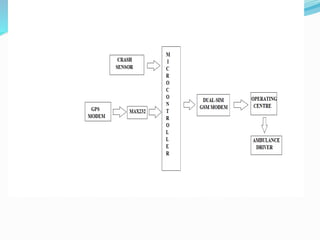
 We describes about the AUTOMATIC VEHICLE ACCI-DENT DETECTION AND
MESSAGING SYSTEM using GPS and GSM technologies.
 We are using AT89C52 microcontroller in this.
 When the system is switched on, LED will be ON indicating that power is
supplied to the circuit.
 When the IR sensors sense any obstacle, they send interrupt to
microcontroller.
 The GPS receives the location of the vehicle that met with an accident and
gives the information back.
 This information will be sent to a mobile number through a mes-sage.
 This message will be received using GSM modem present in the circuit. The
message will give the information of longitude and latitude values.
 Using these values the position of the vehicle can be estimated.
GLOBAL POSITIONING
SYSTEM
 The Global Positioning System (GPS) is a satellite-based
navigation system made up of a network of 24 satellites
placed into or-bit by the U.S. Department of defense.
 GPS was originally in-tended for military applications,
but in the 1980s, the government made the system
available for civilian use.
 GPS works in any weather conditions, anywhere in the
world, 24 hours a day. There are no subscription fees or
setup charges to use GPS.
 Distance = Velocity * Time here Velocity of the GPS
signal is the speed of light, approximately 300,000 Km/s.
Function Of GPS
 The Global Positioning System satellites transmit signals to
equipment on the ground. GPS receivers passively receive
satellite signals; they do not transmit.
 GPS receivers require an unobstructed view of the sky, so
they are used only outdoors and they often do not
perform well within forested areas or near tall buildings.
 GPS operations depend on a very accurate time
reference, which is provided by atomic clocks on board.
 Each GPS satellite transmits data that indicates its location
and the current time.
GLOBAL SYSTEM FOR MOBILE
COMMUNICATION
 GSM is a digital mobile telephone system that is widely used in Europe and
other parts of the world. GSM uses a variation of Time Division Multiple Access
(TDMA) and is the most widely used of the three digital wireless telephone
technologies (TDMA, GSM, and CDMA).
 GSM digitizes and compresses data, then sends it down a channel with two
other streams of user data, each in its own time slot.
 It operates at either the 900 MHz or 1,800 MHz frequency band.
 GSM is the de facto wireless telephone standard in Europe. GSM has over one
billion users worldwide and is available in 190 countries.
 Since many GSM network operators have roam-ing agreements with foreign
operators, users can often continue to use their mobile phones when they travel
to other countries.
AT89S52 Microcontroller
The AT89S52 is a low power, high-performance CMOS 8-bit
microcontroller with 8K bytes of in system programmable Flash
memory.
The device is manufactured using Atmel’s high-density nonvolatile
memory technology and is compatible with the industry-
standard 80C51 instruction set and pin out.
The on-chip Flash allows the program memory to be re-
programmed in-system or by a conventional nonvolatile memory
programmer.
By combining a versatile 8-bit CPU with in-system programmable
Flash on a monolithic chip, the Atmel AT89S52 is a powerful
microcontroller, which provides a highly flexible and cost-
effective solution to many embed-ded control applications.
APPLICATIONS
 Used in automotives and transport vehicles- from
lighter vehicles like cars, to heavier automotives like
ships and aeroplanes.
 Security and remote monitoring of vehicles especially
during military operations.
 This system is also can be interfaced with Vehicle
airbag system such that when the sensors detect the
accident, the air bags get opened.
CONCLUSION
 The biggest advantage of it is, whenever the sensor is
activated we will be immediately getting the
acknowledgement from GSM modem to our mobile
numbers which are stored in EEPROM, without any delay.
This system locates the accident spot accurately, realizing
the automation of accident detection and messaging
system. Consequently, it will save the precious time
required to save the accident victims. Further this system
can be implemented using the vibration sensors as well as
the sound sensors, in order to make it more accurate and
efficient to detect an accident .
THANK YOU

I.c ingine ppt

  • 1.
    CAREER POINT UNIVERSITY MAJORASSIGNMENT ON AUTOMATIC VEHICLE ACCIDENT INFORMATION SYSTEM SUBMITTED TO MR. AMARDEEP KUMAR DEPT.OF (MECHANICAL DPT.) SUBMITTED BY Brijesh Kumar KID-K10668 B.Tech. (MECHANICAL) 6th Semester
  • 2.
    TABLE OF CONTENT INTRODUCTION  WORKING PRINCIPLE  GPS  FUNCTION OF GSM  GSM  MICROCONTROLLER  APPLICATION  CONCLUSION
  • 3.
    INTRODUCTION  The purposeof the this is to find the vehicle where it is and locate the vehicle by means of sending a message using a system which is placed inside of vehicle system Most of the times we may not be able to find accident location because we don’t know where accident will happen.  In order to give treatment for injured people, first we need to know where the accident happened through location tracking and sending a message to your related one or to the emergency services.  So in this work we are using the basic microcontroller AT89C52 for cost effective and also for easy understanding. Here we used assembly programming for better accuracy and GPS and GSM modules which helps to trace the vehicle anywhere on the globe.  The exact location of the vehicle is sent to our remote devices (mobile phones) using GSM modem.
  • 4.
    WORKING PRINCIPLE  Wedescribes about the AUTOMATIC VEHICLE ACCI-DENT DETECTION AND MESSAGING SYSTEM using GPS and GSM technologies.  We are using AT89C52 microcontroller in this.  When the system is switched on, LED will be ON indicating that power is supplied to the circuit.  When the IR sensors sense any obstacle, they send interrupt to microcontroller.  The GPS receives the location of the vehicle that met with an accident and gives the information back.  This information will be sent to a mobile number through a mes-sage.  This message will be received using GSM modem present in the circuit. The message will give the information of longitude and latitude values.  Using these values the position of the vehicle can be estimated.
  • 6.
    GLOBAL POSITIONING SYSTEM  TheGlobal Positioning System (GPS) is a satellite-based navigation system made up of a network of 24 satellites placed into or-bit by the U.S. Department of defense.  GPS was originally in-tended for military applications, but in the 1980s, the government made the system available for civilian use.  GPS works in any weather conditions, anywhere in the world, 24 hours a day. There are no subscription fees or setup charges to use GPS.  Distance = Velocity * Time here Velocity of the GPS signal is the speed of light, approximately 300,000 Km/s.
  • 7.
    Function Of GPS The Global Positioning System satellites transmit signals to equipment on the ground. GPS receivers passively receive satellite signals; they do not transmit.  GPS receivers require an unobstructed view of the sky, so they are used only outdoors and they often do not perform well within forested areas or near tall buildings.  GPS operations depend on a very accurate time reference, which is provided by atomic clocks on board.  Each GPS satellite transmits data that indicates its location and the current time.
  • 8.
    GLOBAL SYSTEM FORMOBILE COMMUNICATION  GSM is a digital mobile telephone system that is widely used in Europe and other parts of the world. GSM uses a variation of Time Division Multiple Access (TDMA) and is the most widely used of the three digital wireless telephone technologies (TDMA, GSM, and CDMA).  GSM digitizes and compresses data, then sends it down a channel with two other streams of user data, each in its own time slot.  It operates at either the 900 MHz or 1,800 MHz frequency band.  GSM is the de facto wireless telephone standard in Europe. GSM has over one billion users worldwide and is available in 190 countries.  Since many GSM network operators have roam-ing agreements with foreign operators, users can often continue to use their mobile phones when they travel to other countries.
  • 9.
    AT89S52 Microcontroller The AT89S52is a low power, high-performance CMOS 8-bit microcontroller with 8K bytes of in system programmable Flash memory. The device is manufactured using Atmel’s high-density nonvolatile memory technology and is compatible with the industry- standard 80C51 instruction set and pin out. The on-chip Flash allows the program memory to be re- programmed in-system or by a conventional nonvolatile memory programmer. By combining a versatile 8-bit CPU with in-system programmable Flash on a monolithic chip, the Atmel AT89S52 is a powerful microcontroller, which provides a highly flexible and cost- effective solution to many embed-ded control applications.
  • 10.
    APPLICATIONS  Used inautomotives and transport vehicles- from lighter vehicles like cars, to heavier automotives like ships and aeroplanes.  Security and remote monitoring of vehicles especially during military operations.  This system is also can be interfaced with Vehicle airbag system such that when the sensors detect the accident, the air bags get opened.
  • 11.
    CONCLUSION  The biggestadvantage of it is, whenever the sensor is activated we will be immediately getting the acknowledgement from GSM modem to our mobile numbers which are stored in EEPROM, without any delay. This system locates the accident spot accurately, realizing the automation of accident detection and messaging system. Consequently, it will save the precious time required to save the accident victims. Further this system can be implemented using the vibration sensors as well as the sound sensors, in order to make it more accurate and efficient to detect an accident .
  • 12.