 Started by Mr. Kochouseph
Chittilappilly In 1977.
 Range of products include
Pumps & Motors, Electric Water
Heaters, Solar Water Heaters,
Cables, UPS’s, and Ceiling
Fans.
 Corporate Head Office in
Kochi.
UPS
•INTRODUCTION, USES, ARCHITECTURE, WAVEFORM, TECHNOLOGY
•COMPONENT, SWITCHOVER TIME, ADVANTAGES DISADVANTAGES, SAFETY
AVR
•PRINCIPLE, BASIC OPERATION
•TYPES
SWR
•INTRODUCTION, BASIC PRINCIPLE, COMPONENTS, APPLICATIONS
•FLAT PLATE COLLECTOR Vs EVACUATED TUBE COLLECTOR
INVERTER
•INTRODUCTION, APPLICATIONS
•SINGLE PHASE INVERTER, CHARATERISTICS OF A GOOD INVERTER
 AN UNINTERRUPTIBLE POWER SUPPLY (UPS) IS
A DEVICE THAT HAS AN ALTERNATE SOURCE
OF ENERGY THAT CAN PROVIDE POWER WHEN
THE PRIMARY POWER SOURCE IS
TEMPORARILY DISABLED
 THE SWITCHOVER TIME MUST BE SMALL
ENOUGH TO NOT CAUSE A DISRUPTION IN
THE OPERATION OF THE LOADS
 PROTECTS AGAINST MULTIPLE TYPES OF
POWER DISTURBANCES
 ONLY DEVICE THAT PROTECTS AGAINST AN
OUTAGE
 OFFERS PROTECTION AGAINST
EQUIPMENT NOT OPERATING PROPERLY
COMPUTER AND EQUIPMENT DAMAGE
DATA LOSS
TIME AND EXPENSE TO RECOVER BACK TO WHERE YOU
WERE, IF EVEN POSSIBLE
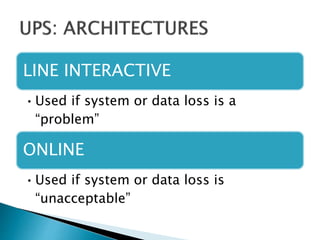
LINE INTERACTIVE
•Used if system or data loss is a
“problem”
ONLINE
•Used if system or data loss is
“unacceptable”
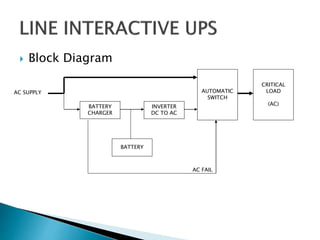
 Block Diagram
BATTERY
CHARGER
AC SUPPLY
INVERTER
DC TO AC
CRITICAL
LOAD
(AC)
BATTERY
AUTOMATIC
SWITCH
AC FAIL
 Block Diagram
CONVERTER
AC TO DC
INVERTER
DC TO AC
CRITICAL
LOAD
(AC)
BATTERY
AUTOMATIC
SWITCH
INVERTER FAIL
LINE INTERACTIVE UPS ONLINE UPS
 The inverter is
connected in parallel
and acts to backup
utility power. It also
charges the battery.
Through its reversible
operation, it interacts
with utility power to
stabilize the voltage.
 It offers double-
conversion topology:
The inverter is
connected in series
between the ac input
and the load. Power for
the load flows
continuously through
the inverter.
LINE INTERACTIVE UPS ONLINE UPS
 AC TO DC CONVERTER /
BATTERY CHARGER DOES
NOT HAVE TO PROVIDE
FULL LOAD POWER
 LESS STRESS ON DC TO AC
INVERTER SINCE IT RUNS
AT NO LOAD UNTIL UPS
SWITCHES TO BATTERY
POWER (POTENTIALLY
CHEAPER)
 ZERO SWITCHOVER TIME
FROM MAIN LINE TO
BATTERY POWER
 ALWAYS ISOLATED FROM
POWER DISTURBANCES ON
THE MAIN LINE
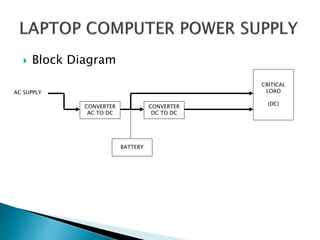
 Block Diagram
CONVERTER
AC TO DC
AC SUPPLY
CONVERTER
DC TO DC
BATTERY
CRITICAL
LOAD
(DC)
-170
0
170
0 4 8 12 16 20
TIME (ms)
VOLTAGE
TRUE SINEWAVE
MODIFIED SINEWAVE
SQUARE WAVE
PULSE WIDTH MODULATION(PWM)
LINEAR AMPLIFIER
RESONANT INVERTER
 Block Diagram
PULSE WIDTH
MODULATOR
BASE /
GATE
DRIVE
TRANSISTOR
BRIDGE
TRANSFORMER FILTER
CRITICAL
LOAD
(AC)
REFERENCE
SINEWAVE
GENERATOR
COMPARISON
AMPLIFIER
DC POWER
 Block Diagram
OSCILLATOR
AMPLIFIER
SINEWAVE
OSCILLATOR
TRANSFORMER
COMPARISON
AMPLIFIER
POWER
AMPLIFIER
CRITICAL
LOAD
(AC)
 Block Diagram
SQUARE WAVE
GENERATOR
SWITCH
DRIVE
TRANSISTOR
SWITCHES
TRANSFORMER
LC RESONANT
TANK FILTER
CRITICAL
LOAD
(AC)
DC POWER
(OR FERRORESONANT)
 CONVERTER - AC TO DC
SPD - PROTECTS AGAINST SPIKES AND TRANSIENTS
 BATTERY
STORED ENERGY DEVICE - PROTECTS AGAINST INTERRUPTIONS
 INVERTER – DC TO AC
WAVEFORM SYNTHESIS – PROTECTS AGAINST DC OFFSET AND
INTERHARMONICS
FILTER – PROTECTS AGAINST HARMONICS, NOTCHING AND
NOISE
VOLTAGE REGULATOR – PROTECTS AGAINST SAGS, SURGES AND
FLUCTUATIONS
 MONITOR AND CONTROL HARDWARE / SOFTWARE
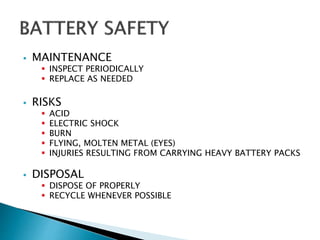
 MAINTENANCE
 INSPECT PERIODICALLY
 REPLACE AS NEEDED
 RISKS
 ACID
 ELECTRIC SHOCK
 BURN
 FLYING, MOLTEN METAL (EYES)
 INJURIES RESULTING FROM CARRYING HEAVY BATTERY PACKS
 DISPOSAL
 DISPOSE OF PROPERLY
 RECYCLE WHENEVER POSSIBLE
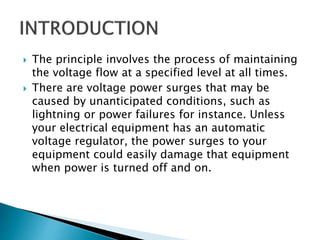
 The principle involves the process of maintaining
the voltage flow at a specified level at all times.
 There are voltage power surges that may be
caused by unanticipated conditions, such as
lightning or power failures for instance. Unless
your electrical equipment has an automatic
voltage regulator, the power surges to your
equipment could easily damage that equipment
when power is turned off and on.
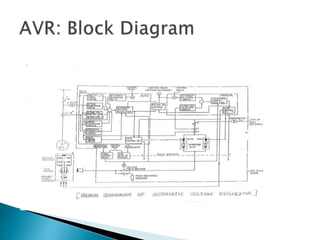
 In general, a voltage regulator functions by
comparing its output voltage to a fixed
reference and minimizing this difference with
a negative feedback loop.
 There are a variety of specific types of voltage
regulators based on the particular method
they use to control the voltage in a circuit.
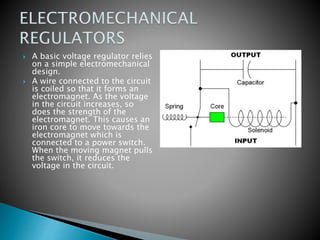
 A basic voltage regulator relies
on a simple electromechanical
design.
 A wire connected to the circuit
is coiled so that it forms an
electromagnet. As the voltage
in the circuit increases, so
does the strength of the
electromagnet. This causes an
iron core to move towards the
electromagnet which is
connected to a power switch.
When the moving magnet pulls
the switch, it reduces the
voltage in the circuit.
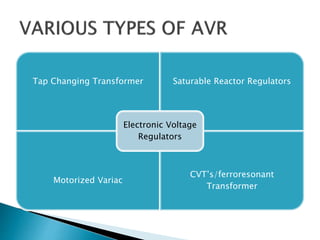
Tap Changing Transformer Saturable Reactor Regulators
Motorized Variac
CVT’s/ferroresonant
Transformer
Electronic Voltage
Regulators
TAP CHANGING TRANSFORMER
SATURABLE REACTOR
REGULATORS
 Solar water heating systems use free heat
from the sun to warm domestic hot water.
 The benefits of solar water heating:
1.Hot water throughout the year
2.Cut your electricity bill
3.Cut your carbon footprint
 Cold water is moved via a
pump from a water tank
and travels through solar
collectors in a solar
panel.
 In the process, it is
heated up by the power
of the sun hitting the
solar collectors.
 This heat is then carried
away from the solar
collectors by the water
returning to a heated
storage tank.
• To collect Solar Energy
• Types: Flat Panel & Evacuated Tube
SOLAR
COLLECTOR
• To store hot water
INSULATED
TANK
• Physical support to the SWH
system
SUPPORTING
STAND
FLAT PANEL EVACTUATED TUBE
 Have no internal method
of limiting heat build up
and have to use outside
tempering devices.
 Flat-plates can actually
rob the water of built up
heat if the collector
becomes colder than the
water temperature.
 Requires accurate
southern exposure and
elevation placement.
 The heat-pipe has a self-
limitation of maximum
working temperature
through the physical
properties of its special
fluid
 The heat pipe’s thermal
flows one way only; form
the collector to the water
and never in the reverse.
 Relatively insensitive to
placement angle,
allowing architectural
and aesthetic freedom
 An inverter is a device that changes or inverts
direct current (DC) input to alternating
current (AC) output.
 It doesn't "create" or "make" electricity, just
changes it from one form to another. DC in is
changed to AC out.
 Output is usually 120 or 240 volts at 60-
cycle alternating current to match line power.
Each part of an inverter has the following function.
 Converter Circuit: to change the commercial power
supply to the DC
 Smoothing circuit: Circuit to smooth the pulsation
included in the DC
 Inverter: Circuit to change the DC to the AC with
variable frequency
 Control circuit: Circuit to mainly control the inverter
part
 DC Power source utilization
 Uninterruptible power supplies
 Induction heating
 HVDC power transmission
 Variable-frequency drives
 Electric vehicle drives
 An uninterruptible power supply (UPS) uses
batteries and an inverter to supply AC power
when main power is not available.
 When main power is restored, a rectifier is
used to supply DC power to recharge the
batteries.
 Inverters convert low frequency main AC
power to a higher frequency for use in
induction heating.
 To do this, AC power is first rectified to
provide DC power. The inverter then changes
the DC power to high frequency AC power.
BASED ON CHARGING
PROCESS
BASED ON UTILITY
1.Power inverter - A power
inverter converts DC
power or direct current to
standard AC power or
alternating current
2.Solar inverter - A Solar
inverter is a type of
electrical inverter that is
made to change the direct
current electricity from a
photovoltaic array into
alternating current
3.Wind power inverter
1.Independent control
inverter
2.Grid-connected inverter
It is of two type –
1. CURRENT SOURCE INVERTER
2. VOLTAGE SOURCE INVERTER.
SINGLE PHASE HALF BRIDGE INVERTER
It consists of-
1. VOLTAGE SOURCE
2. TWO DIODE
3. TWO THYRISTOR
It consists of :
1. Four Thyristors
2. Four Diode
 Amplitude of o/p voltage is doubled whereas
o/p power is four times to that of single
phase half bridge inverter.
STATIC INVERTERS DYNAMIC INVERTERS
 Static inverter has no
moving parts and are
used in wide range of
application from a
small switching power
supply in computers to
large high voltage
direct current
application that are
transport bulk power.
 The charging system
operates normally with the
inverter off: A regulator
inside the inverter control
the changing voltage. When
the inverter is turn on, the
alternator is disconnected
from the vehicle battery and
tied into a transformer.
That uses electronic
controls to change the DC
alternator input to AC
inverter output
VOLATGE SOURCE
INVERTER
CURRENT SOURCE
INVERTER
 In voltage source inverter
input voltage is
maintained constant and
amplitude of the output
voltage does not depend
on the load How ever the
wave form of load
current as well as
magnitude depend upon
the nature of the load
Impedence
 In current source
inverters, input current
is constant but
adjustable. The
amplitude of the
output current from
CSI is independent of
the load.
 An H bridge or full bridge
converter is a switching
configuration composed of four
switches in arrangement that
resembles an H.
 By controlling different switches in
the bridge, a positive, negative, or
zero potential voltage can be
placed across a load.
 When this load is a motor, these
states correspond to forward,
reverse, and off.
 Selection of the proper switches
varies greatly. The use of P
channel MOSFETs on the high side
and N channel MOSFETs on the low
side is easier, but using all N
channel MOSFETs and a FET driver,
lower “on” resistance can be
obtained resulting in reduced
power loss.
 Its output voltage waveform should be sinusoidal.
 Its gain should be high.
 Its output voltage and frequency should be
controllable in the desired voltage.
 The power required by its controlling circuit should
be minimum.
 Its overall cost must be minimum
 Its working life must be long.
 The semi conductor device used in the inverter
should be minimum switching and conduction
losses.
Industrial training report format

Industrial training report format

  • 1.
     Started byMr. Kochouseph Chittilappilly In 1977.  Range of products include Pumps & Motors, Electric Water Heaters, Solar Water Heaters, Cables, UPS’s, and Ceiling Fans.  Corporate Head Office in Kochi.
  • 2.
    UPS •INTRODUCTION, USES, ARCHITECTURE,WAVEFORM, TECHNOLOGY •COMPONENT, SWITCHOVER TIME, ADVANTAGES DISADVANTAGES, SAFETY AVR •PRINCIPLE, BASIC OPERATION •TYPES SWR •INTRODUCTION, BASIC PRINCIPLE, COMPONENTS, APPLICATIONS •FLAT PLATE COLLECTOR Vs EVACUATED TUBE COLLECTOR INVERTER •INTRODUCTION, APPLICATIONS •SINGLE PHASE INVERTER, CHARATERISTICS OF A GOOD INVERTER
  • 4.
     AN UNINTERRUPTIBLEPOWER SUPPLY (UPS) IS A DEVICE THAT HAS AN ALTERNATE SOURCE OF ENERGY THAT CAN PROVIDE POWER WHEN THE PRIMARY POWER SOURCE IS TEMPORARILY DISABLED  THE SWITCHOVER TIME MUST BE SMALL ENOUGH TO NOT CAUSE A DISRUPTION IN THE OPERATION OF THE LOADS
  • 5.
     PROTECTS AGAINSTMULTIPLE TYPES OF POWER DISTURBANCES  ONLY DEVICE THAT PROTECTS AGAINST AN OUTAGE  OFFERS PROTECTION AGAINST EQUIPMENT NOT OPERATING PROPERLY COMPUTER AND EQUIPMENT DAMAGE DATA LOSS TIME AND EXPENSE TO RECOVER BACK TO WHERE YOU WERE, IF EVEN POSSIBLE
  • 6.
    LINE INTERACTIVE •Used ifsystem or data loss is a “problem” ONLINE •Used if system or data loss is “unacceptable”
  • 7.
     Block Diagram BATTERY CHARGER ACSUPPLY INVERTER DC TO AC CRITICAL LOAD (AC) BATTERY AUTOMATIC SWITCH AC FAIL
  • 8.
     Block Diagram CONVERTER ACTO DC INVERTER DC TO AC CRITICAL LOAD (AC) BATTERY AUTOMATIC SWITCH INVERTER FAIL
  • 9.
    LINE INTERACTIVE UPSONLINE UPS  The inverter is connected in parallel and acts to backup utility power. It also charges the battery. Through its reversible operation, it interacts with utility power to stabilize the voltage.  It offers double- conversion topology: The inverter is connected in series between the ac input and the load. Power for the load flows continuously through the inverter.
  • 10.
    LINE INTERACTIVE UPSONLINE UPS  AC TO DC CONVERTER / BATTERY CHARGER DOES NOT HAVE TO PROVIDE FULL LOAD POWER  LESS STRESS ON DC TO AC INVERTER SINCE IT RUNS AT NO LOAD UNTIL UPS SWITCHES TO BATTERY POWER (POTENTIALLY CHEAPER)  ZERO SWITCHOVER TIME FROM MAIN LINE TO BATTERY POWER  ALWAYS ISOLATED FROM POWER DISTURBANCES ON THE MAIN LINE
  • 11.
     Block Diagram CONVERTER ACTO DC AC SUPPLY CONVERTER DC TO DC BATTERY CRITICAL LOAD (DC)
  • 12.
    -170 0 170 0 4 812 16 20 TIME (ms) VOLTAGE TRUE SINEWAVE MODIFIED SINEWAVE SQUARE WAVE
  • 13.
    PULSE WIDTH MODULATION(PWM) LINEARAMPLIFIER RESONANT INVERTER
  • 14.
     Block Diagram PULSEWIDTH MODULATOR BASE / GATE DRIVE TRANSISTOR BRIDGE TRANSFORMER FILTER CRITICAL LOAD (AC) REFERENCE SINEWAVE GENERATOR COMPARISON AMPLIFIER DC POWER
  • 15.
  • 16.
     Block Diagram SQUAREWAVE GENERATOR SWITCH DRIVE TRANSISTOR SWITCHES TRANSFORMER LC RESONANT TANK FILTER CRITICAL LOAD (AC) DC POWER (OR FERRORESONANT)
  • 17.
     CONVERTER -AC TO DC SPD - PROTECTS AGAINST SPIKES AND TRANSIENTS  BATTERY STORED ENERGY DEVICE - PROTECTS AGAINST INTERRUPTIONS  INVERTER – DC TO AC WAVEFORM SYNTHESIS – PROTECTS AGAINST DC OFFSET AND INTERHARMONICS FILTER – PROTECTS AGAINST HARMONICS, NOTCHING AND NOISE VOLTAGE REGULATOR – PROTECTS AGAINST SAGS, SURGES AND FLUCTUATIONS  MONITOR AND CONTROL HARDWARE / SOFTWARE
  • 18.
     MAINTENANCE  INSPECTPERIODICALLY  REPLACE AS NEEDED  RISKS  ACID  ELECTRIC SHOCK  BURN  FLYING, MOLTEN METAL (EYES)  INJURIES RESULTING FROM CARRYING HEAVY BATTERY PACKS  DISPOSAL  DISPOSE OF PROPERLY  RECYCLE WHENEVER POSSIBLE
  • 20.
     The principleinvolves the process of maintaining the voltage flow at a specified level at all times.  There are voltage power surges that may be caused by unanticipated conditions, such as lightning or power failures for instance. Unless your electrical equipment has an automatic voltage regulator, the power surges to your equipment could easily damage that equipment when power is turned off and on.
  • 21.
     In general,a voltage regulator functions by comparing its output voltage to a fixed reference and minimizing this difference with a negative feedback loop.  There are a variety of specific types of voltage regulators based on the particular method they use to control the voltage in a circuit.
  • 23.
     A basicvoltage regulator relies on a simple electromechanical design.  A wire connected to the circuit is coiled so that it forms an electromagnet. As the voltage in the circuit increases, so does the strength of the electromagnet. This causes an iron core to move towards the electromagnet which is connected to a power switch. When the moving magnet pulls the switch, it reduces the voltage in the circuit.
  • 24.
    Tap Changing TransformerSaturable Reactor Regulators Motorized Variac CVT’s/ferroresonant Transformer Electronic Voltage Regulators
  • 25.
  • 26.
  • 31.
     Solar waterheating systems use free heat from the sun to warm domestic hot water.  The benefits of solar water heating: 1.Hot water throughout the year 2.Cut your electricity bill 3.Cut your carbon footprint
  • 32.
     Cold wateris moved via a pump from a water tank and travels through solar collectors in a solar panel.  In the process, it is heated up by the power of the sun hitting the solar collectors.  This heat is then carried away from the solar collectors by the water returning to a heated storage tank.
  • 33.
    • To collectSolar Energy • Types: Flat Panel & Evacuated Tube SOLAR COLLECTOR • To store hot water INSULATED TANK • Physical support to the SWH system SUPPORTING STAND
  • 34.
    FLAT PANEL EVACTUATEDTUBE  Have no internal method of limiting heat build up and have to use outside tempering devices.  Flat-plates can actually rob the water of built up heat if the collector becomes colder than the water temperature.  Requires accurate southern exposure and elevation placement.  The heat-pipe has a self- limitation of maximum working temperature through the physical properties of its special fluid  The heat pipe’s thermal flows one way only; form the collector to the water and never in the reverse.  Relatively insensitive to placement angle, allowing architectural and aesthetic freedom
  • 36.
     An inverteris a device that changes or inverts direct current (DC) input to alternating current (AC) output.  It doesn't "create" or "make" electricity, just changes it from one form to another. DC in is changed to AC out.  Output is usually 120 or 240 volts at 60- cycle alternating current to match line power.
  • 37.
    Each part ofan inverter has the following function.  Converter Circuit: to change the commercial power supply to the DC  Smoothing circuit: Circuit to smooth the pulsation included in the DC  Inverter: Circuit to change the DC to the AC with variable frequency  Control circuit: Circuit to mainly control the inverter part
  • 38.
     DC Powersource utilization  Uninterruptible power supplies  Induction heating  HVDC power transmission  Variable-frequency drives  Electric vehicle drives
  • 39.
     An uninterruptiblepower supply (UPS) uses batteries and an inverter to supply AC power when main power is not available.  When main power is restored, a rectifier is used to supply DC power to recharge the batteries.
  • 40.
     Inverters convertlow frequency main AC power to a higher frequency for use in induction heating.  To do this, AC power is first rectified to provide DC power. The inverter then changes the DC power to high frequency AC power.
  • 41.
    BASED ON CHARGING PROCESS BASEDON UTILITY 1.Power inverter - A power inverter converts DC power or direct current to standard AC power or alternating current 2.Solar inverter - A Solar inverter is a type of electrical inverter that is made to change the direct current electricity from a photovoltaic array into alternating current 3.Wind power inverter 1.Independent control inverter 2.Grid-connected inverter
  • 42.
    It is oftwo type – 1. CURRENT SOURCE INVERTER 2. VOLTAGE SOURCE INVERTER. SINGLE PHASE HALF BRIDGE INVERTER It consists of- 1. VOLTAGE SOURCE 2. TWO DIODE 3. TWO THYRISTOR
  • 43.
    It consists of: 1. Four Thyristors 2. Four Diode  Amplitude of o/p voltage is doubled whereas o/p power is four times to that of single phase half bridge inverter.
  • 44.
    STATIC INVERTERS DYNAMICINVERTERS  Static inverter has no moving parts and are used in wide range of application from a small switching power supply in computers to large high voltage direct current application that are transport bulk power.  The charging system operates normally with the inverter off: A regulator inside the inverter control the changing voltage. When the inverter is turn on, the alternator is disconnected from the vehicle battery and tied into a transformer. That uses electronic controls to change the DC alternator input to AC inverter output
  • 45.
    VOLATGE SOURCE INVERTER CURRENT SOURCE INVERTER In voltage source inverter input voltage is maintained constant and amplitude of the output voltage does not depend on the load How ever the wave form of load current as well as magnitude depend upon the nature of the load Impedence  In current source inverters, input current is constant but adjustable. The amplitude of the output current from CSI is independent of the load.
  • 46.
     An Hbridge or full bridge converter is a switching configuration composed of four switches in arrangement that resembles an H.  By controlling different switches in the bridge, a positive, negative, or zero potential voltage can be placed across a load.  When this load is a motor, these states correspond to forward, reverse, and off.  Selection of the proper switches varies greatly. The use of P channel MOSFETs on the high side and N channel MOSFETs on the low side is easier, but using all N channel MOSFETs and a FET driver, lower “on” resistance can be obtained resulting in reduced power loss.
  • 47.
     Its outputvoltage waveform should be sinusoidal.  Its gain should be high.  Its output voltage and frequency should be controllable in the desired voltage.  The power required by its controlling circuit should be minimum.  Its overall cost must be minimum  Its working life must be long.  The semi conductor device used in the inverter should be minimum switching and conduction losses.