Normal Developmental
     Milestones
 An emphasis on anticipatory guidance
         Ana Malinow, MD
Why we should teach
parents about development
Parents who understand their childᾼs
  developmental state, are more likely to
  have appropriate expectations.
Having appropriate expectations makes for a
  healthier relationship between parent and
  child.
Healthier relationships facilitate
  development.
Objectives
•   Principles of development
•   Primitive Reflexes
•   ᾿ Locomotion῀ : Gross Motor
•   ᾿ Manipulation῀ : Fine Motor
•   ᾿ Cognitive῀ : Language and Social
•   Behavior and Personality
Principles of
           Development
• A continuous process
• Sequence of development is the same, rate of
  development varies
• Not parallel
• Related to CNS maturation
• Involuntary movements give way to voluntary
  responses
• Occurs in cephalocaudal and proximal to distal
• Progresses from dependence to independence
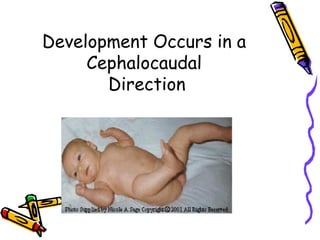
Development Occurs in a
     Cephalocaudal
       Direction
Development begins
          in utero
Age         Responses/Reflexes
8 ½ wks     tactile stimuli (reflex arc laid down)
12 wks      sucking
24 wks      sound
26 wks      rhythmic breathing movements/
      controls body temperature
30 wks      pupilary light reflex
35 wks      grasp/spontaneous orientation to light
All primitive reflexes
  develop during gestation
and disappear by the 3 rd to
   6th month after birth
Primitive reflexes
• Tonic labyrinthine reflex
• Asymmetric tonic neck reflex
• Positive support reflex
Declining intensity of
primitive reflexes and
  increasing role of
definitive motor actions
Gross motor development
     ᾿ Locomotion῀
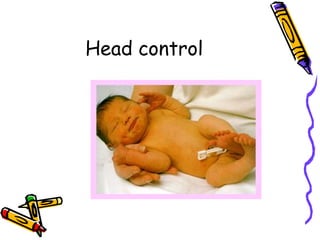
Locomotion begins with
     head control
Assessing Locomotion
•   Ventral suspension       NB-3m
•   Sitting position         NB-8m
•   Prone position           NB-9m
•   Standing/Forw. Walking   9m-18m
•   Running/Backw. Walking   2 yrs
•   Balancing                3 yrs +
Ventral suspension
Head control
2 month head control
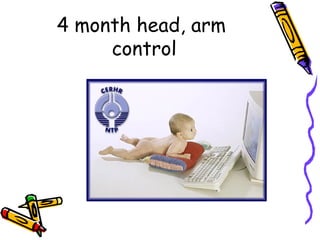
4 month head, arm
     control
6 month head, arm, trunk
         control
8 month head, arm,
 trunk, leg control
9 month pulls up to stand
12 month old locomotion
2 year old Running
Backward Walking
3 year old
 Balance
᾿ Manipulation῀
Fine Motor Development
Manipulation: Assessing the
 pincer grasp from 0-6m
•   NB            primitive
•   1m            primitive
•   2m            starting to lose
•   3m            voluntary on ulnar
•   4m            hands together
•   5m            palmar grasp
•   6m            hand-mouth-hand;
                  hand-to-hand
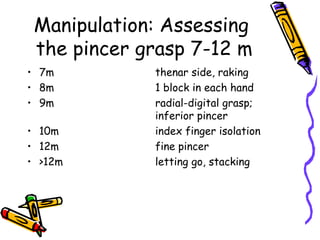
Manipulation: Assessing
 the pincer grasp 7-12 m
• 7m         thenar side, raking
• 8m         1 block in each hand
• 9m         radial-digital grasp;
             inferior pincer
• 10m        index finger isolation
• 12m        fine pincer
• >12m       letting go, stacking
᾿ Cognition῀
Social Development
 Problem solving
 Play
 Causality

Language Development
Assessing cognitive
          development
         Problem solving
•   NB        visual exploration
•   4-6wks    smiles, fixes, follows
•   2m        imitates mouth movements
•   3m        anticipates feeds
•   5m        object permanence
•   6m        looks to floor when toy dropped
•   7m        grabs 2nd cube, drops first
•   8m        seeks object after fall (silent)
•   9m        uncovers hidden object under cloth
•   10m       isolates index finger
Assessing cognitive
         development
                  Play
Age       Play stage          Piagetian stage
<12m      sensory-motor       sensory-motor
12m-18m   functional          sensory-motor
18m-24m   symbolic            sensory-motor
2-5y      imaginary/magical   pre-operational
6y        logical thinking    concrete operation
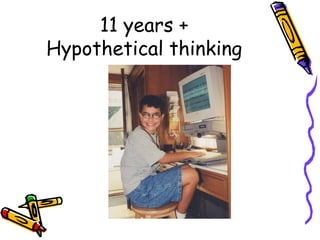
11y +     hypothetical        formal operational
12-month 18-month
  Functional Play
18-month 24-month
   Symbolic Play
2-5 year
Imaginary/Magical Play
6 year old
Logical Thinking
11 years +
Hypothetical thinking
Assessing cognitive development
           Causality
Age     Cause          Effect
Early   cries          mom comes
Early   smiles         mom responds
4m      kicks crib     mobile moves
8m      pulls string   gets ring
10m     funny          +response/repeats
24m     winds key      toy moves
Conversational speech
 probably starts with
       smiling
2 month old language
Assessing cognitive
  development: Language
Age      Milestone
4-6wks   smiles
2m       vocalizes with vowels
3m       vocalizes with consonants
4m       squeals
6m       syllables
7m       non-specific combinations
8m       imitates sounds, understands ᾿ no῀
12m      1-3 words
Assessing language
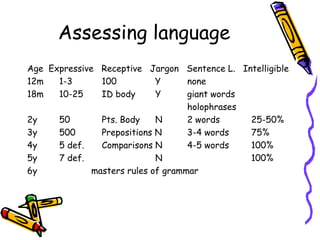
Age Expressive Receptive Jargon Sentence L. Intelligible
12m   1-3       100          Y      none
18m   10-25     ID body      Y      giant words
                                    holophrases
2y    50        Pts. Body    N      2 words     25-50%
3y    500       Prepositions N      3-4 words   75%
4y    5 def.    Comparisons N       4-5 words   100%
5y    7 def.                 N                  100%
6y            masters rules of grammar
Behavior
•   One-way or two-way interactions
•   Prenatal factors
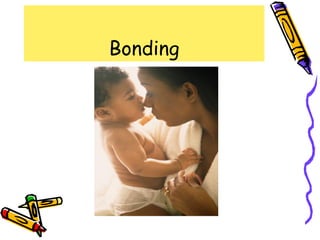
•   Bonding/attachment
•   CNS maturation
•   Match
•   Schedule
•   Language
•   Instincts
Behavior
           -continued-
• Cognitive, gross and fine motor
  development
• Illness, separation, feeding issues
• Birth order, family size
• Secondary attachments
• Environment
• Gender identification
Bonding
Personality
•   Factors that influence behavior
•   Create behavior
•   Through adaptability and flexibility
•   Produce personality/social behavior
Newborn ᾿ Personality῀
4 month old
᾿ Personality῀
9-month old
᾿ Personality῀
Other ᾿ Personality῀
        Landmarks
• 2-year old independence/dependence
• 3-year old master of impulse control,
  sharing, wants to please, guilt
• 7-year old ability to see anotherᾼ point of
                                   s
  view
• Adolescence begins identity formation
  (idealistic)
• Adulthood completion of identity
  formation
Conclusion
• Development is a continuous process
• Sequence is always the same, rate varies
• Development does not run parallel
• Intimate relationship with CNS
• Generalized activity gives way to voluntary
  activity
• Cephalocaudal development
• Dependence to independence

Develop38.ppt[1]

  • 1.
    Normal Developmental Milestones An emphasis on anticipatory guidance Ana Malinow, MD
  • 2.
    Why we shouldteach parents about development Parents who understand their childᾼs developmental state, are more likely to have appropriate expectations. Having appropriate expectations makes for a healthier relationship between parent and child. Healthier relationships facilitate development.
  • 3.
    Objectives • Principles of development • Primitive Reflexes • ᾿ Locomotion῀ : Gross Motor • ᾿ Manipulation῀ : Fine Motor • ᾿ Cognitive῀ : Language and Social • Behavior and Personality
  • 4.
    Principles of Development • A continuous process • Sequence of development is the same, rate of development varies • Not parallel • Related to CNS maturation • Involuntary movements give way to voluntary responses • Occurs in cephalocaudal and proximal to distal • Progresses from dependence to independence
  • 5.
    Development Occurs ina Cephalocaudal Direction
  • 7.
    Development begins in utero Age Responses/Reflexes 8 ½ wks tactile stimuli (reflex arc laid down) 12 wks sucking 24 wks sound 26 wks rhythmic breathing movements/ controls body temperature 30 wks pupilary light reflex 35 wks grasp/spontaneous orientation to light
  • 8.
    All primitive reflexes develop during gestation and disappear by the 3 rd to 6th month after birth
  • 10.
    Primitive reflexes • Toniclabyrinthine reflex • Asymmetric tonic neck reflex • Positive support reflex
  • 11.
    Declining intensity of primitivereflexes and increasing role of definitive motor actions
  • 12.
    Gross motor development ᾿ Locomotion῀
  • 13.
  • 14.
    Assessing Locomotion • Ventral suspension NB-3m • Sitting position NB-8m • Prone position NB-9m • Standing/Forw. Walking 9m-18m • Running/Backw. Walking 2 yrs • Balancing 3 yrs +
  • 15.
  • 16.
  • 17.
    2 month headcontrol
  • 18.
    4 month head,arm control
  • 19.
    6 month head,arm, trunk control
  • 20.
    8 month head,arm, trunk, leg control
  • 21.
    9 month pullsup to stand
  • 22.
    12 month oldlocomotion
  • 23.
    2 year oldRunning Backward Walking
  • 24.
    3 year old Balance
  • 25.
  • 26.
    Manipulation: Assessing the pincer grasp from 0-6m • NB primitive • 1m primitive • 2m starting to lose • 3m voluntary on ulnar • 4m hands together • 5m palmar grasp • 6m hand-mouth-hand; hand-to-hand
  • 27.
    Manipulation: Assessing thepincer grasp 7-12 m • 7m thenar side, raking • 8m 1 block in each hand • 9m radial-digital grasp; inferior pincer • 10m index finger isolation • 12m fine pincer • >12m letting go, stacking
  • 28.
    ᾿ Cognition῀ Social Development Problem solving Play Causality Language Development
  • 29.
    Assessing cognitive development Problem solving • NB visual exploration • 4-6wks smiles, fixes, follows • 2m imitates mouth movements • 3m anticipates feeds • 5m object permanence • 6m looks to floor when toy dropped • 7m grabs 2nd cube, drops first • 8m seeks object after fall (silent) • 9m uncovers hidden object under cloth • 10m isolates index finger
  • 30.
    Assessing cognitive development Play Age Play stage Piagetian stage <12m sensory-motor sensory-motor 12m-18m functional sensory-motor 18m-24m symbolic sensory-motor 2-5y imaginary/magical pre-operational 6y logical thinking concrete operation 11y + hypothetical formal operational
  • 31.
    12-month 18-month Functional Play
  • 32.
    18-month 24-month Symbolic Play
  • 33.
  • 34.
  • 35.
  • 36.
    Assessing cognitive development Causality Age Cause Effect Early cries mom comes Early smiles mom responds 4m kicks crib mobile moves 8m pulls string gets ring 10m funny +response/repeats 24m winds key toy moves
  • 37.
    Conversational speech probablystarts with smiling
  • 38.
    2 month oldlanguage
  • 39.
    Assessing cognitive development: Language Age Milestone 4-6wks smiles 2m vocalizes with vowels 3m vocalizes with consonants 4m squeals 6m syllables 7m non-specific combinations 8m imitates sounds, understands ᾿ no῀ 12m 1-3 words
  • 40.
    Assessing language Age ExpressiveReceptive Jargon Sentence L. Intelligible 12m 1-3 100 Y none 18m 10-25 ID body Y giant words holophrases 2y 50 Pts. Body N 2 words 25-50% 3y 500 Prepositions N 3-4 words 75% 4y 5 def. Comparisons N 4-5 words 100% 5y 7 def. N 100% 6y masters rules of grammar
  • 41.
    Behavior • One-way or two-way interactions • Prenatal factors • Bonding/attachment • CNS maturation • Match • Schedule • Language • Instincts
  • 42.
    Behavior -continued- • Cognitive, gross and fine motor development • Illness, separation, feeding issues • Birth order, family size • Secondary attachments • Environment • Gender identification
  • 43.
  • 44.
    Personality • Factors that influence behavior • Create behavior • Through adaptability and flexibility • Produce personality/social behavior
  • 45.
  • 46.
    4 month old ᾿Personality῀
  • 47.
  • 48.
    Other ᾿ Personality῀ Landmarks • 2-year old independence/dependence • 3-year old master of impulse control, sharing, wants to please, guilt • 7-year old ability to see anotherᾼ point of s view • Adolescence begins identity formation (idealistic) • Adulthood completion of identity formation
  • 49.
    Conclusion • Development isa continuous process • Sequence is always the same, rate varies • Development does not run parallel • Intimate relationship with CNS • Generalized activity gives way to voluntary activity • Cephalocaudal development • Dependence to independence