Guidance & Counseling
Prof (Dr) Rajesh G Konnur
KHFH
Patna
Introduction
Guidance and counseling have, in all
places, been a vital aspects of higher
education / medical practice. One of
the purposes of education is to help
the individual in becoming a useful
member of society. If an individual
receives education without proper
guidance and counseling, S/ he is not
able to develop his personality fully.
 TO GUIDE MEANS
 To indicate
 To point out
 To show the way
 To lead
 To direct
 To seek
MEANING OF GUIDANCE
1. Some form of help and assistance
given to an individual to solve their
problems.
2. Guidance as the promotion of the
growth of the individual in self-direction.
3. Guidance helps the individuals to
adjust to the environment.
DEFINITION
1.Guidance as a process through which an
individual is able to solve their problems and
pursue a path suited to their abilities and
aspirations.
JM Brewer.
2.Guidance is a continuous process of helping the
individual development in the maximum of their
capacity in the direction most beneficial to
himself and to society
- Stoops and wahlquist.
3.Guidance is an educational service designed to
help students make more effective use of the
schools training programme.
- Educational point of view
NEED FOR GUIDANCE :
Guidance based upon the fact, human
being needs help. Every one needs
assistance at sometime in his life, some
will need it constantly while others used
in only at rare.
The need for guidance is universal,
as it is not confined to a few individual.
Below are the various needs of
guidance according to the analysis of the
reasons. These reasons are of the
following three kinds,
a) Psychological reasons
b) Sociological reasons
c) Educational reasons
A. PSYCHOLOGICAL
REASONS :
1. Individual Differences.
1. Guidance Needs at Different Stage of
Development.
1. Development of Health Personality.
1. Making the Most of Available
Opportunities.
B. SOCIOLOGICAL REASONS
:
1) Guide. is need for Proper Use of Human
energy.
2) Change in the concept of education
necessitates guidance.
3) Guide. and changes in religious and
moral belief.
4) Guidance and extension of democracy.
5) Changed industrial and educational
pattern of country.
6) Lack of Guidance at home.
C.EDUCATIONAL REASONS
1) To help in traditional of student.
2) To help in proper choice of courses.
3) To help in proper choice of careers.
4) To minimize wastage.
5) To help exceptional children .
ELEMENTS OF GUIDANCE
 It focus our attention on the individual and not the problem.
 Leads to the discovery of abilities of an individual.
 Guidance is based upon the assets and limitations of an
individual.
 Guidance leads to self- development and self-directions.
 Helps the individual to plan wisely for the present and the future.
 Assists the individual to become adjusted to the environment.
 Guidance assists to achieve success and happiness.
CHARACTERISTICS OF GUIDANCE
1. It helps every individual to help himself to recognize and use his inner
resources,
 To set goals
 To make plans
 To work out his own problems of development.
2. It is a continuous process.
3. Choice and problem points are the distinctive concerns of guidance.
It is assistance to the individual in the process of development.
Aim: To develop the capacity for
 Self direction
 Self guidance
 Self improvement
5. Guidance is a service meant for all: It is a regular service, which is
required at every stage for every student/ person.
6. It is both generalized and a specialized service.
7. It enables the individuals to take decisions to grow independently.
PRINCIPLES OF GUIDANCE
According to Crow and Crow,
 Study of an individual and evaluation
 Evaluation of guidance programme
 Responsibility of skilled workers
 Responsibility of teachers or principals
 Advantage of guidance
 Guidance by a trained person
 Flexible programme of guidance
 Related to every aspect of life
 Preference to the all- round development
 Helps in achieving useful objectives
 Attitude of guidance
 A continuous process
CLASSIFICATION OF GUIDANCE
According to W.M.Procter’s view
1. Educational guidance
2. Vocational guidance
3. Guidance in social and civil activities
4. Guidance in health and physical
activities
5. Guidance in the worthy use of leisure
time.
6. Guidance in character building
activities.
According to Paterson Etals’ view:
1. Educational guidance
2. Vocational guidance
3. Personal guidance
4. Health guidance
5. Economic guidance
According to medical educator’s
view:
1. Group guidance
2. Counseling
3. Guidance in clinical area.
TYPES OF GUIDANCE :
1. Educational Guidance
2. Vocational Guidance
3. Personal Guidance
4. Social Guidance
5. Vocational Guidance
6. Health Guidance
GUIDACE GIVEN BY FOLLOWING
PERSONNEL:
1.Teacher
2.Advisor
3.Dean
4.Parents
5.Library staff
6.Medical staff
7.Warden
8.Liaison officer
9.Physical education instructor
10.Counsellors.
11.Psychiatrists
12.Psychologists.
COUNSELLING:
 MEANING OF COUNSELLING :
Counseling is a specialized service of
guidance, and it is an enabling process
designed to help through learning to take
responsibility and to make decisions for
himself / herself.
Counseling is a helping relationship which
includes-
Someone seeking help
Someone willing to give help
Capable or trained to help
In a setting that permits, help to be given
and received.
‘Counseling’ denotes, “Giving of advice”.
DEFINITION:
 “Counseling is a helping process where one
person, explicitly and purposefully gives his/ her
times attention and skills to assist a client to
explore the situation, identify and act upon
solutions within the limitations of their given
environment”.
 “Counseling is a method that helps the client to use
a problem- solving process to recognize and
manage stress and that facilitates interpersonal
relationships among client, family and health care
team”.
 Counseling is a series of direct contacts with the
individual which aims to offer him assistance in
changing his attitude & behaviors.
Carl Rogers
What is Counseling?
 Counseling is a process whereby a trained, competent counselor
will help or assist an individual who is seeking help or assist an
individual who is seeking help in gaining greater understanding of
self , improved decision – making and behaviour changes, to
overcome his or her problems.
 – A Counseling Process is a planned, structured dialogue
- between a counselor and a client.
 It is a cooperative process in which a trained professional
helps a person called the client to identify sources of difficulties or
concerns
that he or she is experiencing.
 Together they develop ways to deal with and overcome these
problems so that person has new skills and increased
understanding of themselves & others.
BASIC COMPONENT OF
COUNSELLING
1. Rapport
2. Communication
3. Understanding
4. Change in feeling and expressions
5. Planning of counseling interview
LEVELS OF COUNSELLING :
There are three levels of counseling
1. Informal counseling
2. Non – specialist counseling
3. Professional counseling
ELEMENTS OF COUNSELLING
According to Cattle :-
1. Rapport with the counselee.
2. Communication between the
counselor and the counselee.
3. Counselor's through background of
the counseling process.
4. Counselee's changes in the feelings
as counseling proceeds and progresses
through various stages.
5. Structured counseling interview.
BASIC PRINCIPLES OF COUNSELING :
According to McDaniel and shaffal,
1) Principle of acceptance.
2) Principle of respect for the individual.
3) Principle of permissiveness.
4) Principle of thinking with the individual
5) Principle of consistency with ideals of
democracy.
6) Principle of learning.
Theories of Counseling
1.Psychoanalytic Theory
2.Jungian Analytic Theory
3. Adlerian Counseling
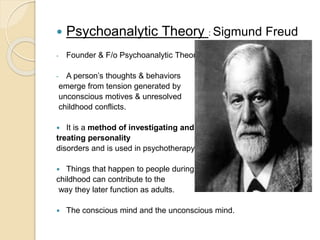
 Psychoanalytic Theory : Sigmund Freud
- Founder & F/o Psychoanalytic Theory.
- A person’s thoughts & behaviors
emerge from tension generated by
unconscious motives & unresolved
childhood conflicts.
 It is a method of investigating and
treating personality
disorders and is used in psychotherapy.
 Things that happen to people during
childhood can contribute to the
way they later function as adults.
 The conscious mind and the unconscious mind.
Tenets of Psychoanalytic Theory
 The three parts of the personality
(Id, Ego and Superego)
 Stages of Development
(Oral, anal, phallic, latency period &
genital)
 Defense mechanisms
(Repression, projection, reaction
formation, fixation, regression)
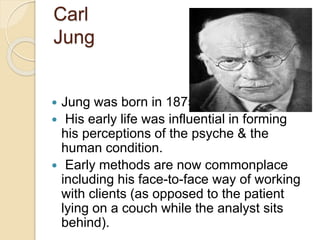
Carl
Jung
 Jung was born in 1875.
 His early life was influential in forming
his perceptions of the psyche & the
human condition.
 Early methods are now commonplace
including his face-to-face way of working
with clients (as opposed to the patient
lying on a couch while the analyst sits
behind).
JUNGIAN ANALYTIC THEORY
 Facilitating growth, healing and a
new synthesis of the patient’s
personality at a higher level of
functioning .
 The overall goal bringing about a
wholeness of the personality through
“individuation”.
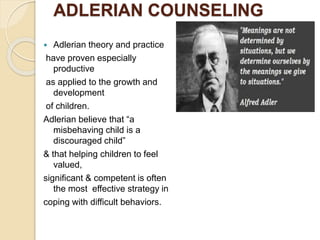
ADLERIAN COUNSELING
 Adlerian theory and practice
have proven especially
productive
as applied to the growth and
development
of children.
Adlerian believe that “a
misbehaving child is a
discouraged child”
& that helping children to feel
valued,
significant & competent is often
the most effective strategy in
coping with difficult behaviors.
ADLERIAN COUNSELING
 Self-perceived inferiority.
 Position in the family constellation.
 Early experiences of humiliation.
 Specific physical condition or defect
existed;
 Lack of social feeling for others was
present.
TENETS OF ADLERIAN COUNSELING
1. The one dynamic force behind people’s behavior is
the striving for success or superiority.
2. People subjective perceptions shape their behavior &
personality.
3. Personality is unified and self-consistent.
4. The value of all human activity must be seen from the
viewpoint
of social interest.
5. The self-consistent personality structure develops into a
person’s style of life.
6. The style of life is molded by people’s creative power.
Cont..
 See the power of self determination.
 Command the courage to alter their
interpretation in events & life
experience.
 Importance of human culture and
society in the development of
individual personality.
 Social interest urge in human nature to adapt
oneself to the conditions of the social
environment.
 Finalism – individuals are oriented towards
goals that guide their behavior; many of which
cannot be proven and are judged by their
usefulness.
 Crucial and contemporary issues as equality ,
parent education & the influence of birth order ;
life style and the holism of individuals.
 Adler believed that we all have one basic
desire & goal : to belong & to feel significant.
 According to Adler, when we feel
encouraged, we feel capable and
appreciated and will generally act in
a connected and cooperative way.
 When we are discouraged, we may
act in unhealthy ways by competing ,
withdrawing or giving up.
 Expressing and accepting
encouragement , respect & social
interest that help us feel fulfilled &
optimistic.
COUNSELLING PROCEDURE
Williamson and Darley have mention six
steps of counseling procedure.
1. Analysis
2. Synthesis
3. Diagnosis
4. Prognosis
5. Counseling
6. Follow up
TYPES OF COUNSELLING :
1. Directive Counseling
2. Non Directive Counseling / client centered Counseling
3. Short Term Counseling
4. Long Term Counseling
5. Psychological counseling
6. Clinical Counseling
7. Student Counseling
8. Placement Counseling
9) Marriage Counseling
10) Vocational counseling
11) Psycho therapeutic counseling
12) Individual Counseling
13) Group counseling
14) Behavioral counseling
15) Dietary counseling
16) Motivational counseling
17)Interpersonal counseling
18)Bereavement counseling
19)Problem solving counseling
20)Educational counseling
21)Personal counseling
22)Moral, religious and social counseling
23)Counseling in leisure time
24)Self help group counseling
25)peer group counseling
TECHNIQUES OF COUNSELLING
Williamson described the Techniques of
counseling under the following five
headings.
1. Establishing Rapport
2. Cultivating self understanding
3. Advising and planning a programme of
action
a) Direct Advising
b) Persuasive method
4. Explanatory method
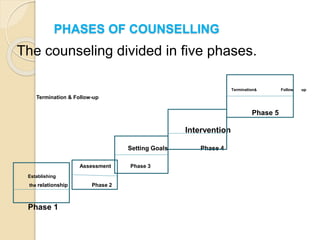
PHASES OF COUNSELLING
The counseling divided in five phases.
Termination& Follow up
Termination & Follow-up
Phase 5
Intervention
Setting Goals Phase 4
Assessment Phase 3
Establishing
the relationship Phase 2
Phase 1
QUALITIES OF A COUNSELLOR
1. Interpersonal relationship
 Friendly nature
 Fairness
 Sincerity
 Tactfulness
 Patience
 Ability to maintain confidentiality
 Respect clients abilities
 Attentive listener
 Speaks in client language
 Capacity for being trusted by others.
Personal Adjustment
 Show matured behavior
 Maintain emotional stability
 Flexibility and adaptability
 Aware of one’s limitations.
 Able to accept criticism
 Mentally sound
 Knowledge of self
3.Scholastic potentiality and educational
background
 Should be motivated and committed.
 Aware of polices, beliefs, and misconceptions
existing with in the local community.
 Highly cultured social interests
 Capacity for work
 Intelligent to tackle the situations effectively
 Positive interest
 Scholastic aptitude
 He will have master degree in the essential
area of guidance programme
 Ability to work with people.
. Health and personal appearance
 Pleasing voice
 Pleasing appearance
 Freedom from annoying mannerisms.
 Poise and neatness.
5. Leadership
 Ability to lead other
 Reinforce important information
 Guide the counselee to choose
appropriate method for problem solving.
6. Philosophy of life
 Good character
 Positive philosophy of life
 Integrated personality
 Faith in human value
 Show significant spiritual and religious
values.
7. Professional dedication
 Possess vocation interest and interest in
guidance work.
 Show loyalty, enthusiasm to provide service
for student
 Willing to work beyond call of duty.
Approaches in doing Counseling
1.Directive or Counselor –centered or authoritarian style:-
• Simplest to do.
• Counselor give advices, make decision based on what she thinks is
in the best interest of client.
• Expects the client to follow her advices.
• Completely directed by counselor.
 2. Non-directive counseling or client-centred :-
• Counselor is passive mainly listener.
• Client is active ,expresses herself freely and tells the counselor what
he/ she
wants.
• After careful reflection and clarification , makes her own
decision.
• The main function of the counselor is to create an atmosphere in
which the client can work out his problem.
 3.Non-authoritarian style:-
• Neither counselor nor client controlled.
• Methods of counseling may change
from client to client or even with the
same client from time to time.
• It is highly flexible.
• Freedom of choice and expression is
open to both the counselor and the
counselee.
Peer Counseling :
• Peer counseling are HIV positive men and women specially trained
to hear the concern of clients and offer support and referral services.
• In this, counselor is open about his/her HIV positive status and
shares experiences with client.
• It is the process that is carried out as one to one interaction followed
by group approach.
• It addresses the client issue through following process:-
- Sharing feeling about similar experiences.
- Share information about availability of HIV/AIDS prevention,
treatment and care services.
 Narrate their success stories to the peers and convey messages of
positive thinking.
 Supports client in becoming more involved in community activities.
Conclusion :
• Counseling is a process and not merely a
technique through
 which clients are helped to modify their
behaviour and cope with their status
effectively.
Counseling is not
• Telling or directing
• Giving advice
• A casual concern
• A confession
• Praying
THANK U

Guidance & counseling aku

  • 1.
    Guidance & Counseling Prof(Dr) Rajesh G Konnur KHFH Patna
  • 2.
    Introduction Guidance and counselinghave, in all places, been a vital aspects of higher education / medical practice. One of the purposes of education is to help the individual in becoming a useful member of society. If an individual receives education without proper guidance and counseling, S/ he is not able to develop his personality fully.
  • 3.
     TO GUIDEMEANS  To indicate  To point out  To show the way  To lead  To direct  To seek
  • 4.
    MEANING OF GUIDANCE 1.Some form of help and assistance given to an individual to solve their problems. 2. Guidance as the promotion of the growth of the individual in self-direction. 3. Guidance helps the individuals to adjust to the environment.
  • 5.
    DEFINITION 1.Guidance as aprocess through which an individual is able to solve their problems and pursue a path suited to their abilities and aspirations. JM Brewer. 2.Guidance is a continuous process of helping the individual development in the maximum of their capacity in the direction most beneficial to himself and to society - Stoops and wahlquist. 3.Guidance is an educational service designed to help students make more effective use of the schools training programme. - Educational point of view
  • 6.
    NEED FOR GUIDANCE: Guidance based upon the fact, human being needs help. Every one needs assistance at sometime in his life, some will need it constantly while others used in only at rare. The need for guidance is universal, as it is not confined to a few individual. Below are the various needs of guidance according to the analysis of the reasons. These reasons are of the following three kinds, a) Psychological reasons b) Sociological reasons c) Educational reasons
  • 7.
    A. PSYCHOLOGICAL REASONS : 1.Individual Differences. 1. Guidance Needs at Different Stage of Development. 1. Development of Health Personality. 1. Making the Most of Available Opportunities.
  • 8.
    B. SOCIOLOGICAL REASONS : 1)Guide. is need for Proper Use of Human energy. 2) Change in the concept of education necessitates guidance. 3) Guide. and changes in religious and moral belief. 4) Guidance and extension of democracy. 5) Changed industrial and educational pattern of country. 6) Lack of Guidance at home.
  • 9.
    C.EDUCATIONAL REASONS 1) Tohelp in traditional of student. 2) To help in proper choice of courses. 3) To help in proper choice of careers. 4) To minimize wastage. 5) To help exceptional children .
  • 10.
    ELEMENTS OF GUIDANCE It focus our attention on the individual and not the problem.  Leads to the discovery of abilities of an individual.  Guidance is based upon the assets and limitations of an individual.  Guidance leads to self- development and self-directions.  Helps the individual to plan wisely for the present and the future.  Assists the individual to become adjusted to the environment.  Guidance assists to achieve success and happiness.
  • 11.
    CHARACTERISTICS OF GUIDANCE 1.It helps every individual to help himself to recognize and use his inner resources,  To set goals  To make plans  To work out his own problems of development. 2. It is a continuous process. 3. Choice and problem points are the distinctive concerns of guidance. It is assistance to the individual in the process of development. Aim: To develop the capacity for  Self direction  Self guidance  Self improvement 5. Guidance is a service meant for all: It is a regular service, which is required at every stage for every student/ person. 6. It is both generalized and a specialized service. 7. It enables the individuals to take decisions to grow independently.
  • 12.
    PRINCIPLES OF GUIDANCE Accordingto Crow and Crow,  Study of an individual and evaluation  Evaluation of guidance programme  Responsibility of skilled workers  Responsibility of teachers or principals  Advantage of guidance  Guidance by a trained person  Flexible programme of guidance  Related to every aspect of life  Preference to the all- round development  Helps in achieving useful objectives  Attitude of guidance  A continuous process
  • 13.
    CLASSIFICATION OF GUIDANCE Accordingto W.M.Procter’s view 1. Educational guidance 2. Vocational guidance 3. Guidance in social and civil activities 4. Guidance in health and physical activities 5. Guidance in the worthy use of leisure time. 6. Guidance in character building activities.
  • 14.
    According to PatersonEtals’ view: 1. Educational guidance 2. Vocational guidance 3. Personal guidance 4. Health guidance 5. Economic guidance According to medical educator’s view: 1. Group guidance 2. Counseling 3. Guidance in clinical area.
  • 15.
    TYPES OF GUIDANCE: 1. Educational Guidance 2. Vocational Guidance 3. Personal Guidance 4. Social Guidance 5. Vocational Guidance 6. Health Guidance
  • 16.
    GUIDACE GIVEN BYFOLLOWING PERSONNEL: 1.Teacher 2.Advisor 3.Dean 4.Parents 5.Library staff 6.Medical staff 7.Warden 8.Liaison officer 9.Physical education instructor 10.Counsellors. 11.Psychiatrists 12.Psychologists.
  • 17.
    COUNSELLING:  MEANING OFCOUNSELLING : Counseling is a specialized service of guidance, and it is an enabling process designed to help through learning to take responsibility and to make decisions for himself / herself. Counseling is a helping relationship which includes- Someone seeking help Someone willing to give help Capable or trained to help In a setting that permits, help to be given and received. ‘Counseling’ denotes, “Giving of advice”.
  • 18.
    DEFINITION:  “Counseling isa helping process where one person, explicitly and purposefully gives his/ her times attention and skills to assist a client to explore the situation, identify and act upon solutions within the limitations of their given environment”.  “Counseling is a method that helps the client to use a problem- solving process to recognize and manage stress and that facilitates interpersonal relationships among client, family and health care team”.  Counseling is a series of direct contacts with the individual which aims to offer him assistance in changing his attitude & behaviors. Carl Rogers
  • 19.
    What is Counseling? Counseling is a process whereby a trained, competent counselor will help or assist an individual who is seeking help or assist an individual who is seeking help in gaining greater understanding of self , improved decision – making and behaviour changes, to overcome his or her problems.  – A Counseling Process is a planned, structured dialogue - between a counselor and a client.  It is a cooperative process in which a trained professional helps a person called the client to identify sources of difficulties or concerns that he or she is experiencing.  Together they develop ways to deal with and overcome these problems so that person has new skills and increased understanding of themselves & others.
  • 20.
    BASIC COMPONENT OF COUNSELLING 1.Rapport 2. Communication 3. Understanding 4. Change in feeling and expressions 5. Planning of counseling interview
  • 21.
    LEVELS OF COUNSELLING: There are three levels of counseling 1. Informal counseling 2. Non – specialist counseling 3. Professional counseling
  • 22.
    ELEMENTS OF COUNSELLING Accordingto Cattle :- 1. Rapport with the counselee. 2. Communication between the counselor and the counselee. 3. Counselor's through background of the counseling process. 4. Counselee's changes in the feelings as counseling proceeds and progresses through various stages. 5. Structured counseling interview.
  • 23.
    BASIC PRINCIPLES OFCOUNSELING : According to McDaniel and shaffal, 1) Principle of acceptance. 2) Principle of respect for the individual. 3) Principle of permissiveness. 4) Principle of thinking with the individual 5) Principle of consistency with ideals of democracy. 6) Principle of learning.
  • 24.
    Theories of Counseling 1.PsychoanalyticTheory 2.Jungian Analytic Theory 3. Adlerian Counseling
  • 25.
     Psychoanalytic Theory: Sigmund Freud - Founder & F/o Psychoanalytic Theory. - A person’s thoughts & behaviors emerge from tension generated by unconscious motives & unresolved childhood conflicts.  It is a method of investigating and treating personality disorders and is used in psychotherapy.  Things that happen to people during childhood can contribute to the way they later function as adults.  The conscious mind and the unconscious mind.
  • 26.
    Tenets of PsychoanalyticTheory  The three parts of the personality (Id, Ego and Superego)  Stages of Development (Oral, anal, phallic, latency period & genital)  Defense mechanisms (Repression, projection, reaction formation, fixation, regression)
  • 27.
    Carl Jung  Jung wasborn in 1875.  His early life was influential in forming his perceptions of the psyche & the human condition.  Early methods are now commonplace including his face-to-face way of working with clients (as opposed to the patient lying on a couch while the analyst sits behind).
  • 28.
    JUNGIAN ANALYTIC THEORY Facilitating growth, healing and a new synthesis of the patient’s personality at a higher level of functioning .  The overall goal bringing about a wholeness of the personality through “individuation”.
  • 29.
    ADLERIAN COUNSELING  Adleriantheory and practice have proven especially productive as applied to the growth and development of children. Adlerian believe that “a misbehaving child is a discouraged child” & that helping children to feel valued, significant & competent is often the most effective strategy in coping with difficult behaviors.
  • 30.
    ADLERIAN COUNSELING  Self-perceivedinferiority.  Position in the family constellation.  Early experiences of humiliation.  Specific physical condition or defect existed;  Lack of social feeling for others was present.
  • 31.
    TENETS OF ADLERIANCOUNSELING 1. The one dynamic force behind people’s behavior is the striving for success or superiority. 2. People subjective perceptions shape their behavior & personality. 3. Personality is unified and self-consistent. 4. The value of all human activity must be seen from the viewpoint of social interest. 5. The self-consistent personality structure develops into a person’s style of life. 6. The style of life is molded by people’s creative power.
  • 32.
    Cont..  See thepower of self determination.  Command the courage to alter their interpretation in events & life experience.  Importance of human culture and society in the development of individual personality.
  • 33.
     Social interesturge in human nature to adapt oneself to the conditions of the social environment.  Finalism – individuals are oriented towards goals that guide their behavior; many of which cannot be proven and are judged by their usefulness.  Crucial and contemporary issues as equality , parent education & the influence of birth order ; life style and the holism of individuals.  Adler believed that we all have one basic desire & goal : to belong & to feel significant.
  • 34.
     According toAdler, when we feel encouraged, we feel capable and appreciated and will generally act in a connected and cooperative way.  When we are discouraged, we may act in unhealthy ways by competing , withdrawing or giving up.  Expressing and accepting encouragement , respect & social interest that help us feel fulfilled & optimistic.
  • 35.
    COUNSELLING PROCEDURE Williamson andDarley have mention six steps of counseling procedure. 1. Analysis 2. Synthesis 3. Diagnosis 4. Prognosis 5. Counseling 6. Follow up
  • 36.
    TYPES OF COUNSELLING: 1. Directive Counseling 2. Non Directive Counseling / client centered Counseling 3. Short Term Counseling 4. Long Term Counseling 5. Psychological counseling 6. Clinical Counseling 7. Student Counseling 8. Placement Counseling 9) Marriage Counseling 10) Vocational counseling 11) Psycho therapeutic counseling 12) Individual Counseling 13) Group counseling 14) Behavioral counseling 15) Dietary counseling 16) Motivational counseling
  • 37.
    17)Interpersonal counseling 18)Bereavement counseling 19)Problemsolving counseling 20)Educational counseling 21)Personal counseling 22)Moral, religious and social counseling 23)Counseling in leisure time 24)Self help group counseling 25)peer group counseling
  • 38.
    TECHNIQUES OF COUNSELLING Williamsondescribed the Techniques of counseling under the following five headings. 1. Establishing Rapport 2. Cultivating self understanding 3. Advising and planning a programme of action a) Direct Advising b) Persuasive method 4. Explanatory method
  • 39.
    PHASES OF COUNSELLING Thecounseling divided in five phases. Termination& Follow up Termination & Follow-up Phase 5 Intervention Setting Goals Phase 4 Assessment Phase 3 Establishing the relationship Phase 2 Phase 1
  • 40.
    QUALITIES OF ACOUNSELLOR 1. Interpersonal relationship  Friendly nature  Fairness  Sincerity  Tactfulness  Patience  Ability to maintain confidentiality  Respect clients abilities  Attentive listener  Speaks in client language  Capacity for being trusted by others.
  • 41.
    Personal Adjustment  Showmatured behavior  Maintain emotional stability  Flexibility and adaptability  Aware of one’s limitations.  Able to accept criticism  Mentally sound  Knowledge of self
  • 42.
    3.Scholastic potentiality andeducational background  Should be motivated and committed.  Aware of polices, beliefs, and misconceptions existing with in the local community.  Highly cultured social interests  Capacity for work  Intelligent to tackle the situations effectively  Positive interest  Scholastic aptitude  He will have master degree in the essential area of guidance programme  Ability to work with people.
  • 43.
    . Health andpersonal appearance  Pleasing voice  Pleasing appearance  Freedom from annoying mannerisms.  Poise and neatness. 5. Leadership  Ability to lead other  Reinforce important information  Guide the counselee to choose appropriate method for problem solving.
  • 44.
    6. Philosophy oflife  Good character  Positive philosophy of life  Integrated personality  Faith in human value  Show significant spiritual and religious values. 7. Professional dedication  Possess vocation interest and interest in guidance work.  Show loyalty, enthusiasm to provide service for student  Willing to work beyond call of duty.
  • 45.
    Approaches in doingCounseling 1.Directive or Counselor –centered or authoritarian style:- • Simplest to do. • Counselor give advices, make decision based on what she thinks is in the best interest of client. • Expects the client to follow her advices. • Completely directed by counselor.  2. Non-directive counseling or client-centred :- • Counselor is passive mainly listener. • Client is active ,expresses herself freely and tells the counselor what he/ she wants. • After careful reflection and clarification , makes her own decision. • The main function of the counselor is to create an atmosphere in which the client can work out his problem.
  • 46.
     3.Non-authoritarian style:- •Neither counselor nor client controlled. • Methods of counseling may change from client to client or even with the same client from time to time. • It is highly flexible. • Freedom of choice and expression is open to both the counselor and the counselee.
  • 47.
    Peer Counseling : •Peer counseling are HIV positive men and women specially trained to hear the concern of clients and offer support and referral services. • In this, counselor is open about his/her HIV positive status and shares experiences with client. • It is the process that is carried out as one to one interaction followed by group approach. • It addresses the client issue through following process:- - Sharing feeling about similar experiences. - Share information about availability of HIV/AIDS prevention, treatment and care services.  Narrate their success stories to the peers and convey messages of positive thinking.  Supports client in becoming more involved in community activities.
  • 48.
    Conclusion : • Counselingis a process and not merely a technique through  which clients are helped to modify their behaviour and cope with their status effectively. Counseling is not • Telling or directing • Giving advice • A casual concern • A confession • Praying
  • 49.