TRAINING METHODS
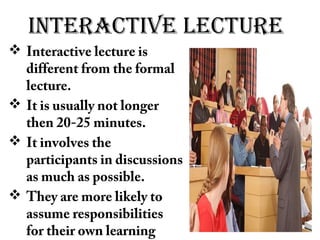
INTERACTIVE LECTURE
 Interactive lecture is
different from the formal
lecture.
 It is usually not longer
then 20-25 minutes.
 It involves the
participants in discussions
as much as possible.
 They are more likely to
assume responsibilities
for their own learning
KEy To dELIVER EffECTIVE
ANd INTERACTIVE LECTURE
 Two way communication
 Use visuals
 Eye contact
 Use of examples
 Use of participants experiences
 Use of slow pace
 Summarization.
AdVANTAGES of THE
LECTURE METHod
 Students can interrupt for clarification or more
detail.
 Other media and demonstration can be easily
combined with the lecture.
 It’s good to introduce a new subject or focus on
a content area.
 The lecture can be easily revised and updated.
 The lecture is a convenient method for
instructing large groups.
 The lecture is often useful to supplement
material from other
LIMITATIoNS of LECTURE METHod
Time of preparation and speech skill
necessary for effective lecture, provide the
focus for this course.
In its purest form, it is a passive method
learning.
Usually doesn’t allow the opportunity for
listeners to ask question.
Attempts to transfer the same content at the
same pace. How can students distinguish what
is most important
Instructor need to learn and use effective
writing and speaking skills
INTERACTIVE dEMoNSTRATIoN
In interactive demonstration number of
separate steps are performed by trainers and
trainees.
It is the sharing of experience between the
trainers and trainees throughout the
demonstration.
In interactive demonstration there is active
involvement of trainees/learners.
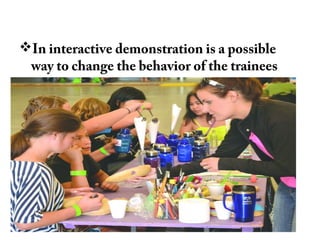
In interactive demonstration is a possible
way to change the behavior of the trainees
PoINT To bE KEPT IN MINd wHILE
PLANNING INTERACTIVE
dEMoNSTRATIoN
 Arrangement of the room.
 Set the climate.
 Set the objectives.
 Display and describe the materials.
 Conduct interactive demonstration.
 Closing demonstration.
RoLE PLAy
In which few participants are asked to act
out a realistic situation in order to meet
learning objectives.
Types of role play
Structured or rehearsed role play
Unstructured role play
Controlled and directed role play
advanTages
create a non-threatening atmosphere
it help in learning
highly flexible
increase the participants awareness about the
effect of felling on social behavior.
when conducted skillfully reduce the
resistance of the participants to learning
relevant skills and theory.
limiTaTions
The artificiality of the situations depicted in the
role play situation may sometimes allow. The
participants to discount the value of their
learning.
Sometimes participants lose them in the role.
Roles sometimes reinforce stereotype and
people’s behavior.
Role playing situation can sometimes over
personalize problem situations.
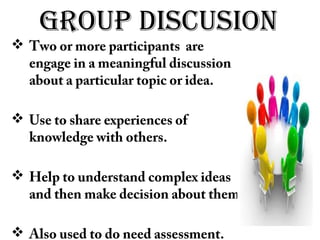
groUp disCUsion
 Two or more participants are
engage in a meaningful discussion
about a particular topic or idea.
 Use to share experiences of
knowledge with others.
 Help to understand complex ideas
and then make decision about them.
 Also used to do need assessment.
Types of groUp disCUssion
Small Group Discussion
Huddle Method
Symposium Method
Seminar Method
Conference Method
Buzz Method
Workshop Method
Panel Discussion Method
Statement Method
small groUp disCUssion
Used for imparting the training to
develop skills to a small group of
participants.
Important method for transfer of
technology to rural women.
Provide theoretical knowledge
and then supplementing with
practical experiences.
Motivate them to adopt new
practices through skill training.
CHaraCTerisTiCs
 Face to face seating of members.
 5 to 20 members
 Group leader is selected
 Good sitting arrangement
 Some members of the group may become
passive.
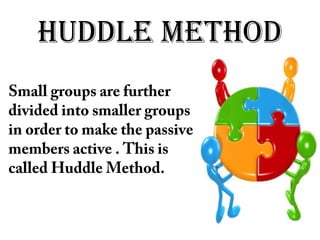
HUddle meTHod
Small groups are further
divided into smaller groups
in order to make the passive
members active . This is
called Huddle Method.
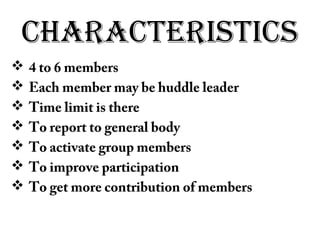
CHaraCTerisTiCs
 4 to 6 members
 Each member may be huddle leader
 Time limit is there
 To report to general body
 To activate group members
 To improve participation
 To get more contribution of members
BUZZ meTHod
Huddle Groups are further divided into smaller
groups known as Buzz Groups in order to make
passive members ,active.
One Huddle group is divided into two sub-
groups.
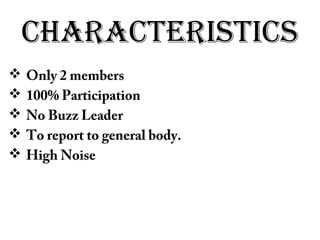
CHaraCTerisTiCs
 Only 2 members
 100% Participation
 No Buzz Leader
 To report to general body.
 High Noise
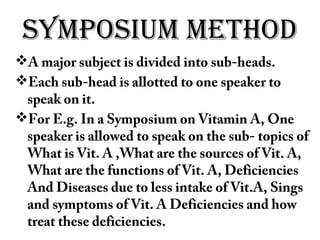
SYMPOSIUM METHOD
A major subject is divided into sub-heads.
Each sub-head is allotted to one speaker to
speak on it.
For E.g. In a Symposium on Vitamin A, One
speaker is allowed to speak on the sub- topics of
What is Vit. A ,What are the sources of Vit. A,
What are the functions of Vit. A, Deficiencies
And Diseases due to less intake of Vit.A, Sings
and symptoms of Vit. A Deficiencies and how
treat these deficiencies.
CHARACTERISTICS
20-30 minutes to each speaker are given.
One moderator is appointed.
Presentation supported by Visual Aids.
Panel Discussion/Question Answer session
organized after each presentation.
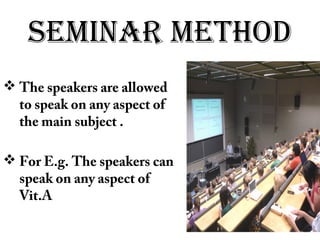
SEMINAR METHOD
 The speakers are allowed
to speak on any aspect of
the main subject .
 For E.g. The speakers can
speak on any aspect of
Vit.A
CHARACTERISTICS
Followed by Panel Discussion at the end.
One moderator is appointed for controlling
the discussion.
Each speaker is given 30 minutes.
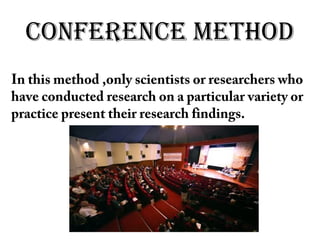
CONFERENCE METHOD
In this method ,only scientists or researchers who
have conducted research on a particular variety or
practice present their research findings.
CHARACTERISTICS
One moderator is appointed to control the
discussion.
Presentation is followed by Panel Discussion.
Recommendations of conference are also
circulated for use by the concern
person/institutions.
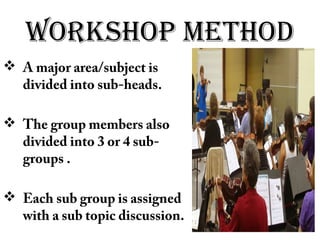
WORKSHOP METHOD
 A major area/subject is
divided into sub-heads.
 The group members also
divided into 3 or 4 sub-
groups .
 Each sub group is assigned
with a sub topic discussion.
CHARACTERISTICS
The result of discussion in each sub-group are
presented in the general session.
It is also followed by the Panel Discussion.
This workshop method is adopted to bring out
quick results on a complex problem/subject.
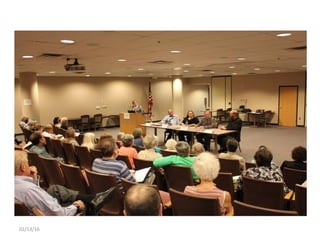
PANEL DISCUSSION
Panel Discussion is an excellent method for
discussing controversial subjects like , opinion
regarding avenues for empowerment of rural
women or concerns regarding women’s role in
development programmed .
In Panel Discussion a selected group of person
discuss the problem in a conversational manner
where a chairperson introduces and guides the
discussion
02/13/16
CHARACTERISTICS
 3 to 6 members.
 Highly structured and the control of the
content rests heavily with the panelists.
 The learners as audience have very little
opportunity to participate.
 At the end they get an opportunity to clarify
doubts or express their views.
STATEMENT METHOD
The group will be given statements for
discussion by the trainer who acts as
coordinator , facilitator and motivator to
motivate the group for discussion.
Trainees are very much involved.
The communication is two way b/w trainer and
trainees.
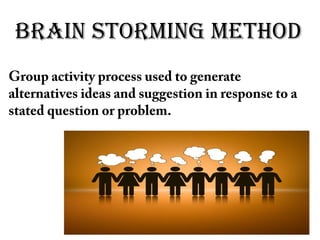
BRAIN STORMING METHOD
Group activity process used to generate
alternatives ideas and suggestion in response to a
stated question or problem.
PURPOSE
 Many alternatives suggestions are generated.
 Generates alternatives ways of looking at a
problem.
 Easy to identify persons who have sound
knowledge on the subject.
 original and innovative ideas are generated.
 cross checking ideas is possible.
02/13/16
LIMITATIONS
 In this boss and sub-ordinate both are
participating sub ordinate may not speak frankly.
 One or two persons may dominating others.
Some times ideas are not
applicable.
PROBLEM SOLVING METHOD
Very useful in identifying problem & their
solutions.
Trainees are cluster into little groups of two or
three.
They can use the information or principles
being taught in discussion for soughing out
problem
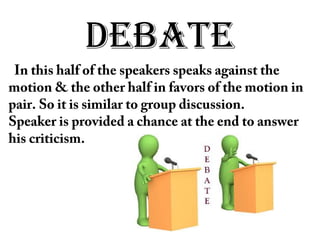
DEBATE
In this half of the speakers speaks against the
motion & the other half in favors of the motion in
pair. So it is similar to group discussion.
Speaker is provided a chance at the end to answer
his criticism.
02/13/16
Useful in sharpening the issues but it will be
discriminated by the desire to win rather then
concentrating on the realities.
REfERNcE
Singh.R.P,Training Methods
02/13/16

Interactive lecture

  • 1.
  • 2.
    INTERACTIVE LECTURE  Interactivelecture is different from the formal lecture.  It is usually not longer then 20-25 minutes.  It involves the participants in discussions as much as possible.  They are more likely to assume responsibilities for their own learning
  • 3.
    KEy To dELIVEREffECTIVE ANd INTERACTIVE LECTURE  Two way communication  Use visuals  Eye contact  Use of examples  Use of participants experiences  Use of slow pace  Summarization.
  • 4.
    AdVANTAGES of THE LECTUREMETHod  Students can interrupt for clarification or more detail.  Other media and demonstration can be easily combined with the lecture.  It’s good to introduce a new subject or focus on a content area.
  • 5.
     The lecturecan be easily revised and updated.  The lecture is a convenient method for instructing large groups.  The lecture is often useful to supplement material from other
  • 6.
    LIMITATIoNS of LECTUREMETHod Time of preparation and speech skill necessary for effective lecture, provide the focus for this course. In its purest form, it is a passive method learning. Usually doesn’t allow the opportunity for listeners to ask question.
  • 7.
    Attempts to transferthe same content at the same pace. How can students distinguish what is most important Instructor need to learn and use effective writing and speaking skills
  • 8.
    INTERACTIVE dEMoNSTRATIoN In interactivedemonstration number of separate steps are performed by trainers and trainees. It is the sharing of experience between the trainers and trainees throughout the demonstration. In interactive demonstration there is active involvement of trainees/learners.
  • 9.
    In interactive demonstrationis a possible way to change the behavior of the trainees
  • 10.
    PoINT To bEKEPT IN MINd wHILE PLANNING INTERACTIVE dEMoNSTRATIoN  Arrangement of the room.  Set the climate.  Set the objectives.  Display and describe the materials.  Conduct interactive demonstration.  Closing demonstration.
  • 11.
    RoLE PLAy In whichfew participants are asked to act out a realistic situation in order to meet learning objectives.
  • 12.
    Types of roleplay Structured or rehearsed role play Unstructured role play Controlled and directed role play
  • 13.
    advanTages create a non-threateningatmosphere it help in learning highly flexible increase the participants awareness about the effect of felling on social behavior. when conducted skillfully reduce the resistance of the participants to learning relevant skills and theory.
  • 14.
    limiTaTions The artificiality ofthe situations depicted in the role play situation may sometimes allow. The participants to discount the value of their learning. Sometimes participants lose them in the role. Roles sometimes reinforce stereotype and people’s behavior. Role playing situation can sometimes over personalize problem situations.
  • 15.
    groUp disCUsion  Twoor more participants are engage in a meaningful discussion about a particular topic or idea.  Use to share experiences of knowledge with others.  Help to understand complex ideas and then make decision about them.  Also used to do need assessment.
  • 16.
    Types of groUpdisCUssion Small Group Discussion Huddle Method Symposium Method Seminar Method Conference Method Buzz Method Workshop Method Panel Discussion Method Statement Method
  • 17.
    small groUp disCUssion Usedfor imparting the training to develop skills to a small group of participants. Important method for transfer of technology to rural women. Provide theoretical knowledge and then supplementing with practical experiences. Motivate them to adopt new practices through skill training.
  • 18.
    CHaraCTerisTiCs  Face toface seating of members.  5 to 20 members  Group leader is selected  Good sitting arrangement  Some members of the group may become passive.
  • 19.
    HUddle meTHod Small groupsare further divided into smaller groups in order to make the passive members active . This is called Huddle Method.
  • 20.
    CHaraCTerisTiCs  4 to6 members  Each member may be huddle leader  Time limit is there  To report to general body  To activate group members  To improve participation  To get more contribution of members
  • 21.
    BUZZ meTHod Huddle Groupsare further divided into smaller groups known as Buzz Groups in order to make passive members ,active. One Huddle group is divided into two sub- groups.
  • 22.
    CHaraCTerisTiCs  Only 2members  100% Participation  No Buzz Leader  To report to general body.  High Noise
  • 23.
    SYMPOSIUM METHOD A majorsubject is divided into sub-heads. Each sub-head is allotted to one speaker to speak on it. For E.g. In a Symposium on Vitamin A, One speaker is allowed to speak on the sub- topics of What is Vit. A ,What are the sources of Vit. A, What are the functions of Vit. A, Deficiencies And Diseases due to less intake of Vit.A, Sings and symptoms of Vit. A Deficiencies and how treat these deficiencies.
  • 24.
    CHARACTERISTICS 20-30 minutes toeach speaker are given. One moderator is appointed. Presentation supported by Visual Aids. Panel Discussion/Question Answer session organized after each presentation.
  • 25.
    SEMINAR METHOD  Thespeakers are allowed to speak on any aspect of the main subject .  For E.g. The speakers can speak on any aspect of Vit.A
  • 26.
    CHARACTERISTICS Followed by PanelDiscussion at the end. One moderator is appointed for controlling the discussion. Each speaker is given 30 minutes.
  • 27.
    CONFERENCE METHOD In thismethod ,only scientists or researchers who have conducted research on a particular variety or practice present their research findings.
  • 28.
    CHARACTERISTICS One moderator isappointed to control the discussion. Presentation is followed by Panel Discussion. Recommendations of conference are also circulated for use by the concern person/institutions.
  • 29.
    WORKSHOP METHOD  Amajor area/subject is divided into sub-heads.  The group members also divided into 3 or 4 sub- groups .  Each sub group is assigned with a sub topic discussion.
  • 30.
    CHARACTERISTICS The result ofdiscussion in each sub-group are presented in the general session. It is also followed by the Panel Discussion. This workshop method is adopted to bring out quick results on a complex problem/subject.
  • 31.
    PANEL DISCUSSION Panel Discussionis an excellent method for discussing controversial subjects like , opinion regarding avenues for empowerment of rural women or concerns regarding women’s role in development programmed . In Panel Discussion a selected group of person discuss the problem in a conversational manner where a chairperson introduces and guides the discussion
  • 32.
  • 33.
    CHARACTERISTICS  3 to6 members.  Highly structured and the control of the content rests heavily with the panelists.  The learners as audience have very little opportunity to participate.  At the end they get an opportunity to clarify doubts or express their views.
  • 34.
    STATEMENT METHOD The groupwill be given statements for discussion by the trainer who acts as coordinator , facilitator and motivator to motivate the group for discussion. Trainees are very much involved. The communication is two way b/w trainer and trainees.
  • 35.
    BRAIN STORMING METHOD Groupactivity process used to generate alternatives ideas and suggestion in response to a stated question or problem.
  • 36.
    PURPOSE  Many alternativessuggestions are generated.  Generates alternatives ways of looking at a problem.  Easy to identify persons who have sound knowledge on the subject.  original and innovative ideas are generated.  cross checking ideas is possible. 02/13/16
  • 37.
    LIMITATIONS  In thisboss and sub-ordinate both are participating sub ordinate may not speak frankly.  One or two persons may dominating others. Some times ideas are not applicable.
  • 38.
    PROBLEM SOLVING METHOD Veryuseful in identifying problem & their solutions. Trainees are cluster into little groups of two or three. They can use the information or principles being taught in discussion for soughing out problem
  • 39.
    DEBATE In this halfof the speakers speaks against the motion & the other half in favors of the motion in pair. So it is similar to group discussion. Speaker is provided a chance at the end to answer his criticism.
  • 40.
    02/13/16 Useful in sharpeningthe issues but it will be discriminated by the desire to win rather then concentrating on the realities.
  • 41.