Separation, Grief & Loss negative impact of multiple placements, importance of effective transitions, benefits of including the clients ’ family in therapy
Youth experience grief & loss during: …birthdays …holidays …anniversaries of death or significant event …loss of safety after a traumatic event …transitions from placements Youth remember being with their family or friends during these events.  It may be the first time away from home during a significant event
What is Grief? A natural response to loss The response to the loss results in how severe the grief Small losses may result in grief if the child had a poor response Grieving is personal and highly individual experience
How a person Grieves Depends on  Their personality Coping skills Life experience Their faith Nature of the Loss Grieving takes time – Healing cannot be rushed
No  “normal” timeline for grieving Grieving can take… -weeks -months -years Be Patient!
Myths or Facts about Grief? The pain will go away faster if the youth ignores it. It ’s important for the youth to “be strong” in the face of loss. If they don ’t cry, it means they aren’t sorry about the loss. Grief should last about a year.
5 Stages of Grief – Elisabeth Kubler-Ross Denial:  “This can’t be happening to me.” Anger:   “ Why  is this happening? Who is to blame?” (My case worker? Foster family?) Bargaining:   “Make this not happen, and in return I will ____.” Depression:  “I’m too sad to do anything.” Acceptance:   “I’m at peace with what happened.”
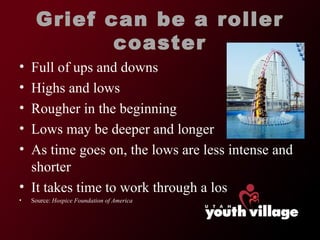
Grief can be a roller coaster Full of ups and downs Highs and lows Rougher in the beginning Lows may be deeper and longer As time goes on, the lows are less intense and shorter It takes time to work through a los Source:  Hospice Foundation of America
Common Symptoms of Grief Shock or disbelief Sadness Guilt Anger Fear Physical Symptoms Fatigue, nausea, lowered immunity, weight loss or weight gain, aches and pains, and insomnia
What we can do to help Identify that they are feeling grief Listen to youth Express empathy for their loss Communicate with your Supervisor and the youth ’s therapist Connect youth to other family or friends through phone calls or visits Provide Structure and a set Schedule Use Positive Reinforcement when they take care of themselves Don ’t tell a youth how they should feel Plan ahead for grief  “triggers” – Anniversaries, holidays, etc
Multiple Placements It is typical for youth with behavioral problems in foster care to experience multiple family placements.  Multiple placements leave children confused, scared, and grieving for previous families.  Multiple placements are to be avoided as much as possible
Transitioning If you do decide to move the youth, you are required to give a 10 days notice We like to have a gradual transition if possible, the youth spends visits with the new family, gradually increasing in length as the child adjusts to the new family.  If the youth is going to go home, it ’s important that the natural family be involved in family therapy and visits. The foster parent needs to be extremely pleasant to the relationship between the child and their parents.
Working with Natural Parents Look for the positives. Point out the positives.  Compliment the parents  Be supportive of visits, never threaten to take visits away.  Refer to your consultant for any criticism or frustration re: parents. Do not talk negatively of parents in front of the child.  Youth will be moved from placements if the foster family is not supportive of the reunification plan.
Family Therapy Many of our youth will have weekly or bi-monthly family therapy services.  Be supportive of the youth and family and the important work they are doing.  Be on-time to appointments, be pleasant to natural parents, ask natural parents for feedback or suggestions.  Family therapy is a great way for youth to work through their grief and loss and the feelings they have for being brought into foster care.  Allow the youth to be quiet or need space after family therapy. Typically youth will struggle with the time immediately after and will need your support and empathy.  Express to the youth that you ’re available if they need to talk.

Separation, Grief and Loss

  • 1.
    Separation, Grief &Loss negative impact of multiple placements, importance of effective transitions, benefits of including the clients ’ family in therapy
  • 2.
    Youth experience grief& loss during: …birthdays …holidays …anniversaries of death or significant event …loss of safety after a traumatic event …transitions from placements Youth remember being with their family or friends during these events. It may be the first time away from home during a significant event
  • 3.
    What is Grief?A natural response to loss The response to the loss results in how severe the grief Small losses may result in grief if the child had a poor response Grieving is personal and highly individual experience
  • 4.
    How a personGrieves Depends on Their personality Coping skills Life experience Their faith Nature of the Loss Grieving takes time – Healing cannot be rushed
  • 5.
    No “normal”timeline for grieving Grieving can take… -weeks -months -years Be Patient!
  • 6.
    Myths or Factsabout Grief? The pain will go away faster if the youth ignores it. It ’s important for the youth to “be strong” in the face of loss. If they don ’t cry, it means they aren’t sorry about the loss. Grief should last about a year.
  • 7.
    5 Stages ofGrief – Elisabeth Kubler-Ross Denial: “This can’t be happening to me.” Anger: “ Why is this happening? Who is to blame?” (My case worker? Foster family?) Bargaining: “Make this not happen, and in return I will ____.” Depression: “I’m too sad to do anything.” Acceptance: “I’m at peace with what happened.”
  • 8.
    Grief can bea roller coaster Full of ups and downs Highs and lows Rougher in the beginning Lows may be deeper and longer As time goes on, the lows are less intense and shorter It takes time to work through a los Source: Hospice Foundation of America
  • 9.
    Common Symptoms ofGrief Shock or disbelief Sadness Guilt Anger Fear Physical Symptoms Fatigue, nausea, lowered immunity, weight loss or weight gain, aches and pains, and insomnia
  • 10.
    What we cando to help Identify that they are feeling grief Listen to youth Express empathy for their loss Communicate with your Supervisor and the youth ’s therapist Connect youth to other family or friends through phone calls or visits Provide Structure and a set Schedule Use Positive Reinforcement when they take care of themselves Don ’t tell a youth how they should feel Plan ahead for grief “triggers” – Anniversaries, holidays, etc
  • 11.
    Multiple Placements Itis typical for youth with behavioral problems in foster care to experience multiple family placements. Multiple placements leave children confused, scared, and grieving for previous families. Multiple placements are to be avoided as much as possible
  • 12.
    Transitioning If youdo decide to move the youth, you are required to give a 10 days notice We like to have a gradual transition if possible, the youth spends visits with the new family, gradually increasing in length as the child adjusts to the new family. If the youth is going to go home, it ’s important that the natural family be involved in family therapy and visits. The foster parent needs to be extremely pleasant to the relationship between the child and their parents.
  • 13.
    Working with NaturalParents Look for the positives. Point out the positives. Compliment the parents Be supportive of visits, never threaten to take visits away. Refer to your consultant for any criticism or frustration re: parents. Do not talk negatively of parents in front of the child. Youth will be moved from placements if the foster family is not supportive of the reunification plan.
  • 14.
    Family Therapy Manyof our youth will have weekly or bi-monthly family therapy services. Be supportive of the youth and family and the important work they are doing. Be on-time to appointments, be pleasant to natural parents, ask natural parents for feedback or suggestions. Family therapy is a great way for youth to work through their grief and loss and the feelings they have for being brought into foster care. Allow the youth to be quiet or need space after family therapy. Typically youth will struggle with the time immediately after and will need your support and empathy. Express to the youth that you ’re available if they need to talk.

Editor's Notes

  • #7 Trying to ignore the youth ’s pain or keep it from surfacing will only make it worse in the long run. For real healing it is necessary to face the grief and actively deal with it.
  • #8 If the youth is experiencing any of these emotions following a loss, it may help to know that their reaction is natural and that he or she will heal in time. However, not everyone who is grieving goes through all of these stages – and that ’s okay. Contrary to popular belief, a person does not have to go through each stage in order to heal. In fact, some people resolve their grief without going through any of these stages. And if a child goes through these stages of grief, they probably won’t experience them in a neat, sequential order, so don’t worry about what the child “should” be feeling or which stage they’re supposed to be in. Kübler-Ross herself never intended for these stages to be a rigid framework that applies to everyone who mourns.