End of Life: Grieving
and Bereaving
Andrea Chatburn, DO, MA
WOMA Winter Seminar
12.5.2015
No Financial Disclosure
Objectives
• Revisit grief theory & tool of mindful
presence
• Examine grief related screening tools
• Distinguish between typical, complicated
grief
• Determine when structured psychotherapy
and pharmacotherapy is indicated for grief
• Apply bereavement interventions to special
populations
Awareness & Noting
U.S. Army
Won’t be covering
• Specific grief resources for Military or
Post-combat PTSD & bereavement
• Specific grief, PTSD resources for
Refugees
• Grief & funeral traditions across cultures
and world religion
Why talk about grief &
bereavement?
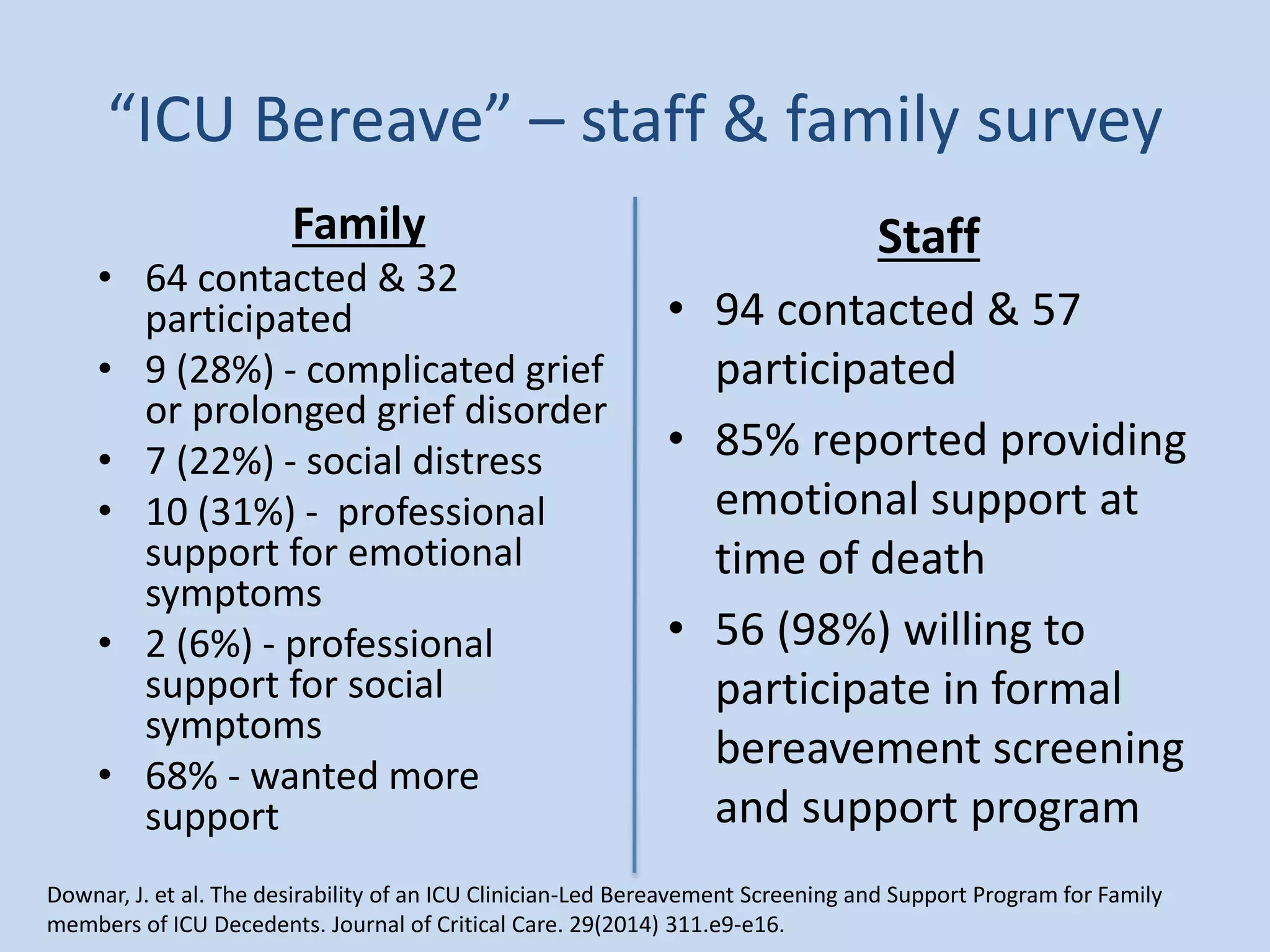
“ICU Bereave” – staff & family survey
Downar, J. et al. The desirability of an ICU Clinician-Led Bereavement Screening and Support Program for Family
members of ICU Decedents. Journal of Critical Care. 29(2014) 311.e9-e16.
Family
• 64 contacted & 32
participated
• 9 (28%) - complicated grief
or prolonged grief disorder
• 7 (22%) - social distress
• 10 (31%) - professional
support for emotional
symptoms
• 2 (6%) - professional
support for social
symptoms
• 68% - wanted more
support
Staff
• 94 contacted & 57
participated
• 85% reported providing
emotional support at
time of death
• 56 (98%) willing to
participate in formal
bereavement screening
and support program
Barriers to Supporting
Bereaved Family Members
• Not knowing what to say
• Not sure how to deal with emotion
• Lack of knowledge about community
resource
• High clinical workload
• Lack of continuity or established
relationship with the patient or family
member
Downar, J. et al. The desirability of an ICU Clinician-Led Bereavement Screening and Support Program for Family
members of ICU Descendants. Journal of Critical Care. 29(2014) 311.e9-e16.
Desires for bereavement support
• Training in how to support the bereaved
• List of available community resources
• Dedicated time after the death and at a
later date to provide support
Downar, et al.
Grief is centered in relationship
Sam Caplet “Don’t Let Go”
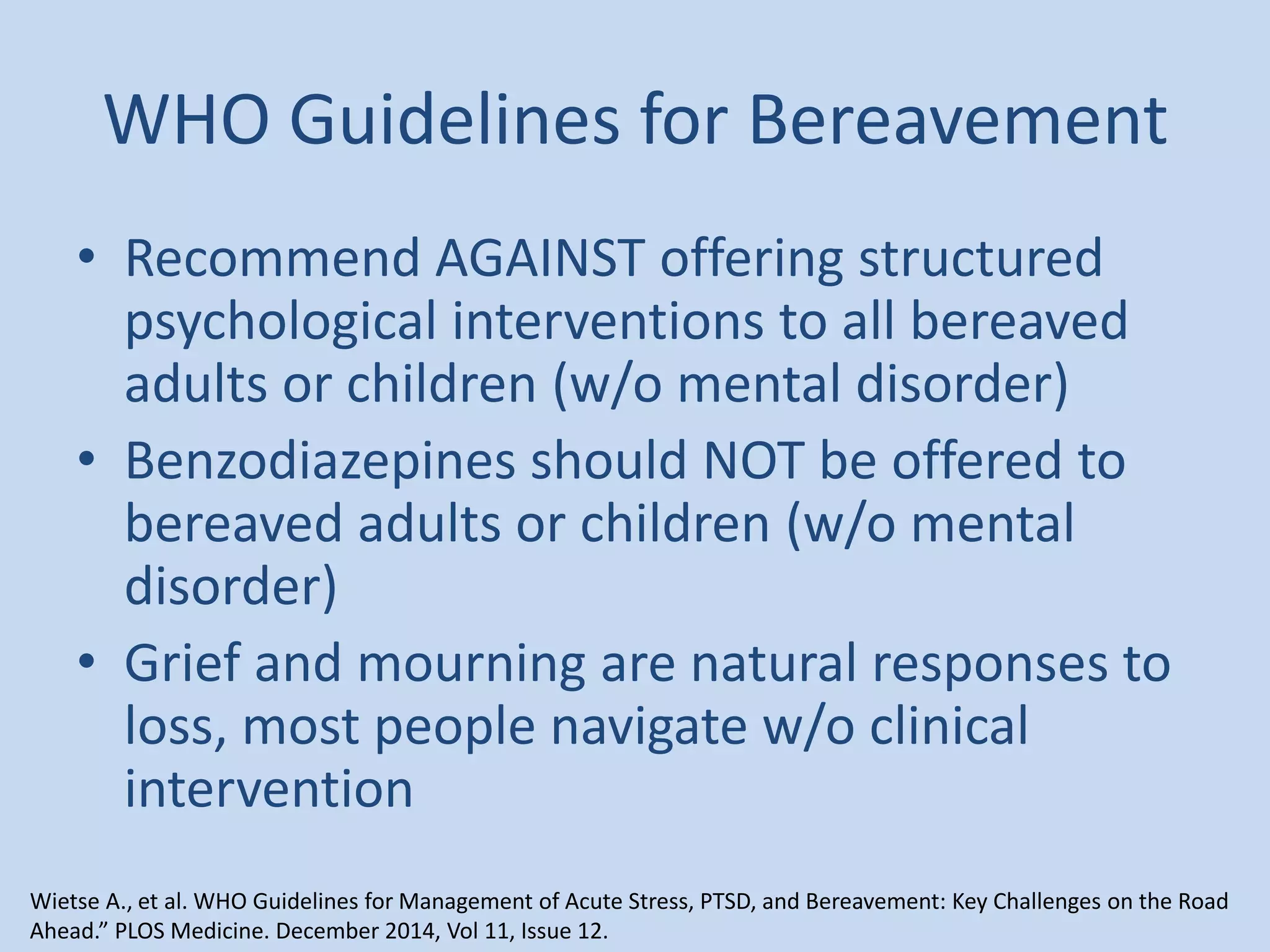
WHO Guidelines for Bereavement
• Recommend AGAINST offering structured
psychological interventions to all bereaved
adults or children (w/o mental disorder)
• Benzodiazepines should NOT be offered to
bereaved adults or children (w/o mental
disorder)
• Grief and mourning are natural responses to
loss, most people navigate w/o clinical
intervention
Wietse A., et al. WHO Guidelines for Management of Acute Stress, PTSD, and Bereavement: Key Challenges on the Road
Ahead.” PLOS Medicine. December 2014, Vol 11, Issue 12.
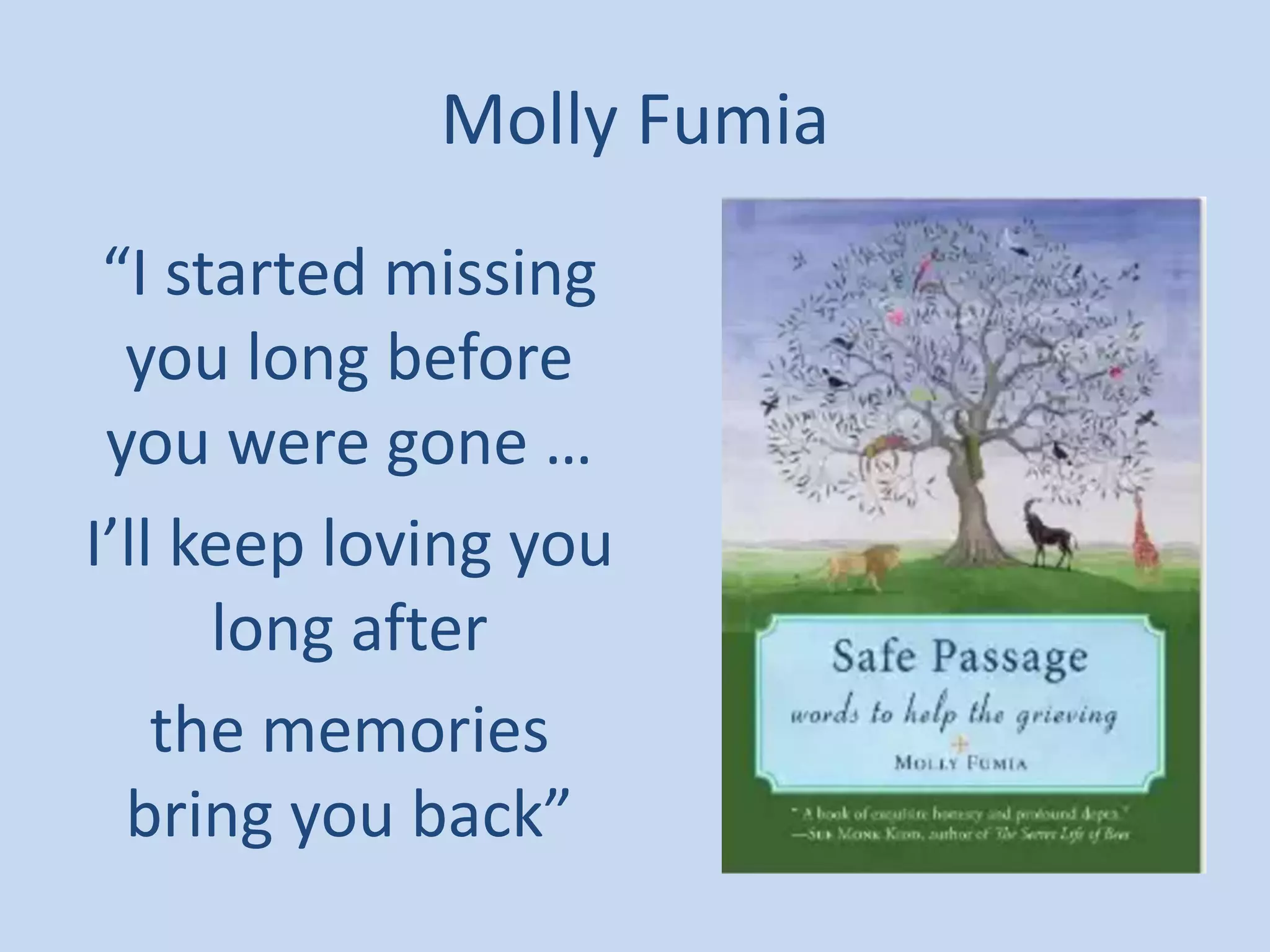
Molly Fumia
“I started missing
you long before
you were gone …
I’ll keep loving you
long after
the memories
bring you back”
Grief Theories
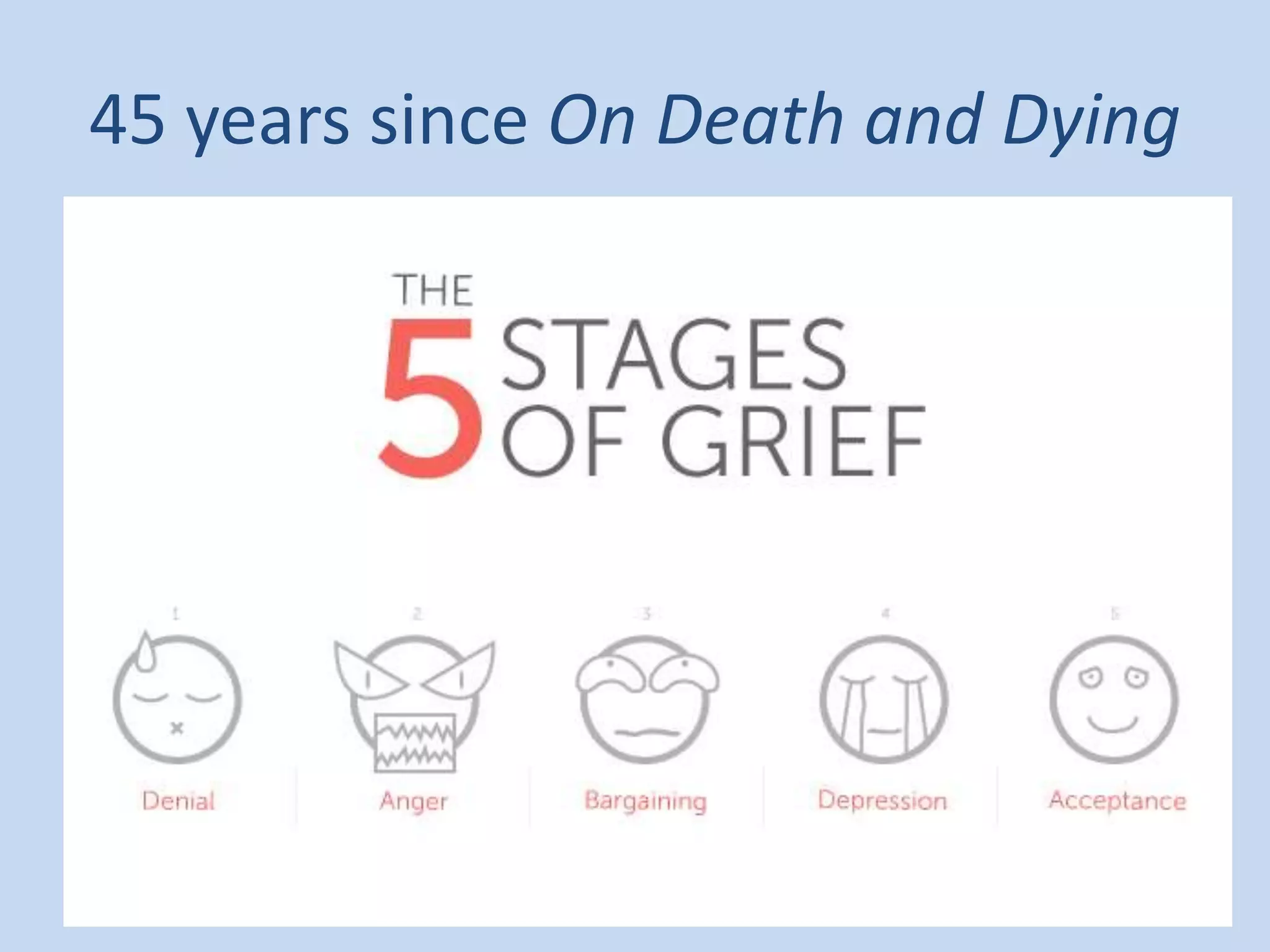
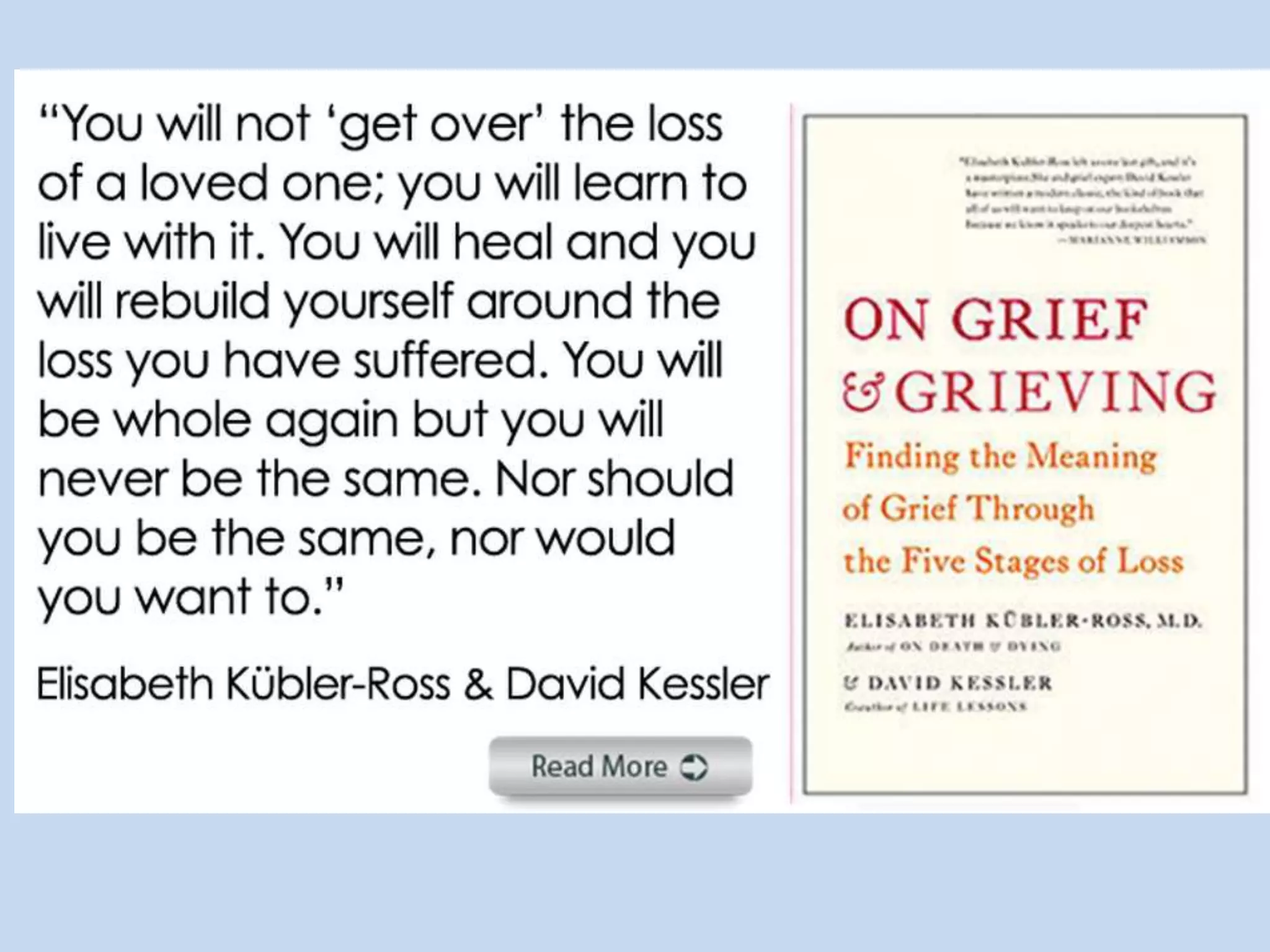
• Elizabeth Kubler Ross- 5 stages
• Ken Doka
• William Warden
• Alan Walset*
• Teresa Randall*
• “Integrated grief”
45 years since On Death and Dying
Grief is related to all types of loss
• Loss of relationship
• Loss of role (mother/sister/daughter)
• Loss of function- Debility
• Loss of health
• Loss of home
• Loss of independence
• Loss of job
Expression of Grief
• Emotional response
• Physical
• Social
• Spiritual
• Thought Process/Cognitive
Vincent van Gogh “Old Man Crying”
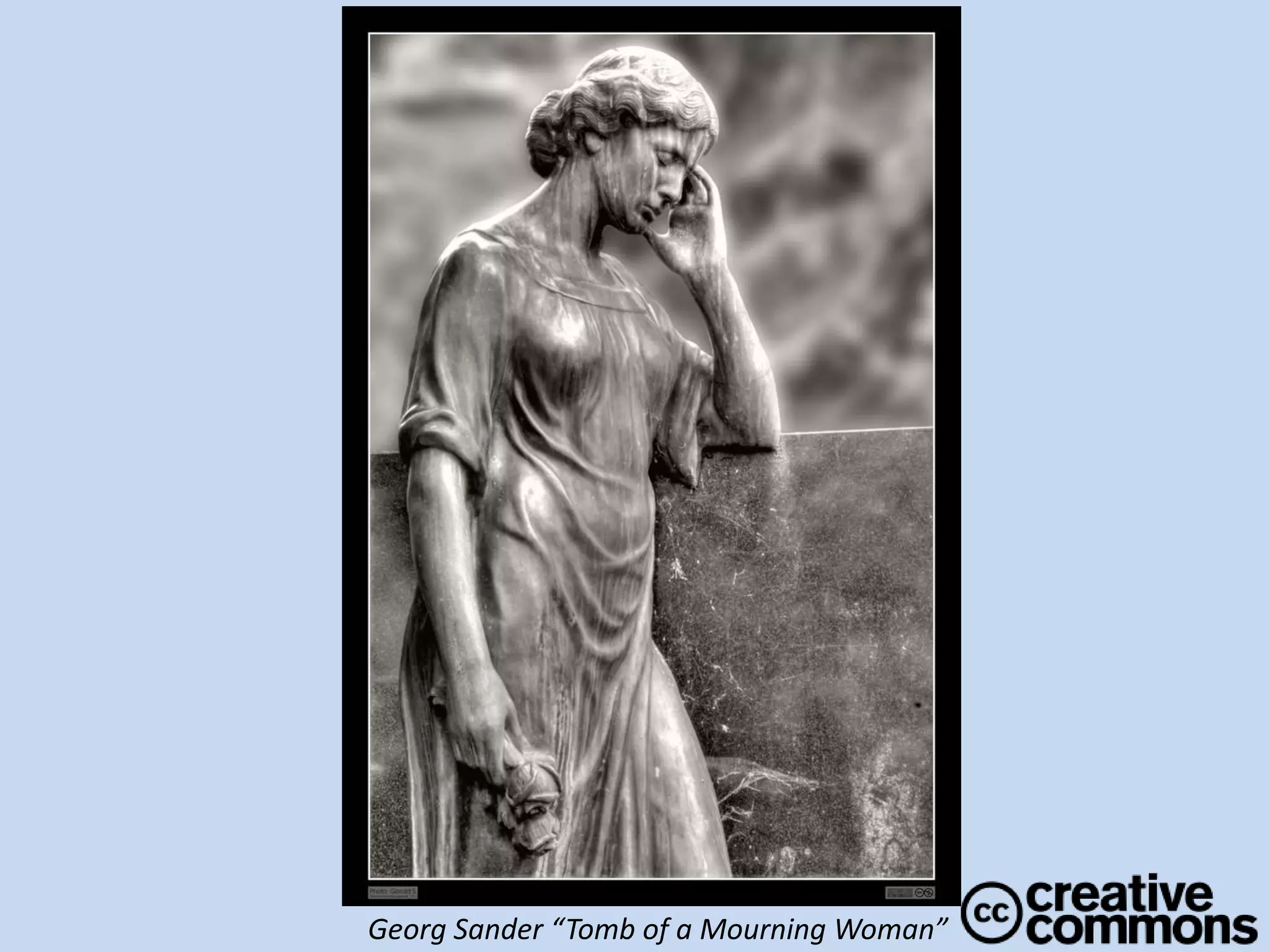
Georg Sander “Tomb of a Mourning Woman”
Gtneil
Action- 5K, Ice bucket challenge, etc.
Acceptance?
Griefwatch.com
Ministry of Presence
Legacy Work
Cueva de las Manas, Argentina by Xipe Totec39
Byock- 4 things that matter most
• Thank you
• Please forgive me
• I forgive you
• I love you
Dignity Therapy
• Chochinov- Manitoba.
• Life survey by patient
& loved ones
• Gave a sense of
purpose & meaning to
life
• Assisted in “living
with” grief
Suffering and Meaning
Ethical Will
• Zava’ah
• Values
• Blessings
• Life lessons
• Hopes for future
Typical Grief
• Normal emotional reaction to loss
• Resolves in < 6 months
• No residual serious social,
psychological or medical
consequences
Interventions for All Bereaved
• Support by provider at time of death
• Contact in weeks to months after a death
• Customized bereavement care plan
Screening Tools
• Start with symptoms:
–Eating?
–Sleeping?
• 5 item Brief Grief Questionnaire
• 19 item Inventory of Complicated Grief
–Score 25-30  significant symptoms
–Score >30 threshold for treatment research
Brief Grief Questionnaire
0 1 2
How much are you having trouble accepting the death of ____?
How much does your grief still interfere with your life?
How much are you having images or thoughts of ___ when they
died or other thoughts about the death that really bother you?
Are there things you used to do when ____ was alive that you
do not feel comfortable doing anymore, that you avoid? Like
going somewhere you went with them, or doing things you
used to enjoy together? Or avoiding looking at pictures or
talking about ____? How much are you avoiding these things?
How much are you feeling cut off or distant from other people
since _____ died, even people you used to be close to like
family or friends?
When is psychotherapy indicated?
When are prescriptions indicated?
PublicDomainPictures
Complicated Grief (CG) or
Prolonged Grief Disorder (PGD)
• Grief resulting in severe social,
psychological, or medical
consequences
• Persists beyond 6 months
• Social distress: marked by difficulties
with ADLs, financial matters, and
social interactions
Prolonged Grief Disorder
A. Loss of a significant person
B. Separation distress: feelings of yearning
that occur daily or cause disability
C. At least 5 specific cognitive, emotional or
behavioral symptoms
D. Timing >6 months since loss
E. Significant Social, occupational, or
functional impairment
F. Not caused by other psychiatric disorder
Shear MK, et al. Complicated grief and related bereavement issues for DSM-5. Depression Anxiety. Feb 2011;
28(2):103-17.
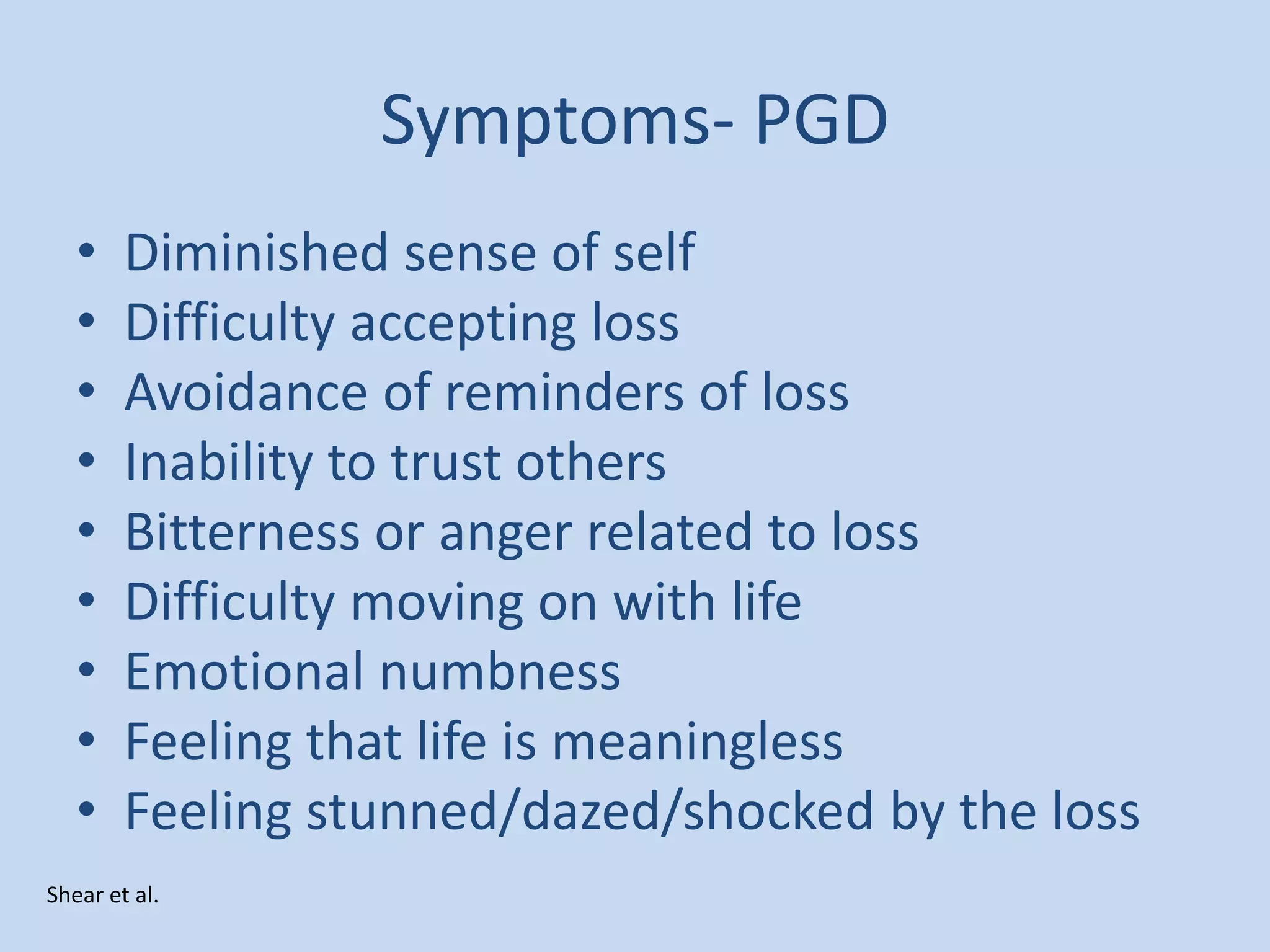
Symptoms- PGD
• Diminished sense of self
• Difficulty accepting loss
• Avoidance of reminders of loss
• Inability to trust others
• Bitterness or anger related to loss
• Difficulty moving on with life
• Emotional numbness
• Feeling that life is meaningless
• Feeling stunned/dazed/shocked by the loss
Shear et al.
Complicated Grief
A. Loss of a loved one >6 months ago
B. At least one symptom of acute grief present for
longer than expected in the person’s culture
C. At least 2 of the following symptoms present for >1
mo. (see next slide)
D. Duration: symptoms and impairment >1 mo.
E. Impairment: significant social, occupational, or
functional impairment caused by symptoms and not
better explained as a culturally appropriate
response
Shear et al.
B. Symptoms of Acute Grief - CG
• Persistent intense yearning
• Frequent intense loneliness/emptiness
• Recurrent feelings of meaninglessness of
life, or a desire to die in order to rejoin
the deceased
• Frequent intrusive thoughts about the
deceased
Shear et al.
C. Symptoms in CG (2 or more)
• Rumination about the death and its consequences
• Disbelief, inability to accept death
• Feeling of shock, numbness
• Bitterness or anger related to loss
• Inability to trust others
• Experiencing pain/symptoms that deceased person
experienced
• Intense reaction to memories/reminders of loss
• Excessive avoidance/proximity seeking relevant to
deceased
Shear et al.
CG New to DSM-5
“Persistent Complex Bereavement Disorder”
Subtype of :
– “Other specified trauma”
– “Stressor-related disorders”
• Estimated prevalence 7% of bereaved people
• Symptoms “out of proportion or inconsistent
with cultural, religious, or age-appropriate
norms”
Risk factors for Complicated Grief
• Pre-loss factors:
–Female
–Preexisting trauma (particularly childhood)-
ACE
–Prior loss
–Insecure attachment
–Preexisting mood and anxiety disorders
–Nature of the relationship
Simon, N. Treating Complicated Greif. JAMA July 24, 2013 Vol 310, No 4. p 416-423
Loss related Risks for CG
• Relationship and caretaking roles
– Spouses
– Mothers of dependent children
– Caretakers for chronically ill
• Nature of the death itself
– Violent, sudden, prolonged, suicide
• Mortality in Intensive Care Unit
– 34 to 67% of surviving family members have
CG
Simon, N.
Other Risk Factors
• Social circumstances
• Resources available after death
• Unknown: Lack of
information/understanding of the
circumstances of the death event
• Interference with natural healing process:
– Inability to follow usual cultural mourning
– Alcohol or substance abuse
– Lack of social support
Simon, N.
Differential Dx for CG
• Trigger for Comorbid Major Depressive
Disorder, PTSD, Substance Abuse
• Of patients with CG:
– 25% had no comorbid conditions
– 55% had comorbid Major Depressive Disorder
– 49% had PTSD
– 36% had both MDD and PTSD
• Difference btn CG and PTSD: Fear
Simon, N.
CG:
Deficits in
imagining a
future w/o the
deceased
MDD:
inability to
experience
positive
emotions when
contemplating
the deceased
PTSD:
Presence
of Fear
When to Intervene?
• Persistently high sx severity
• Lack of temporal involvement in the
grief response
• Functional Impairment
• Treatment-seeking behaviors
• Hopelessness
• Suicidal ideation or behaviors
Simon, N.
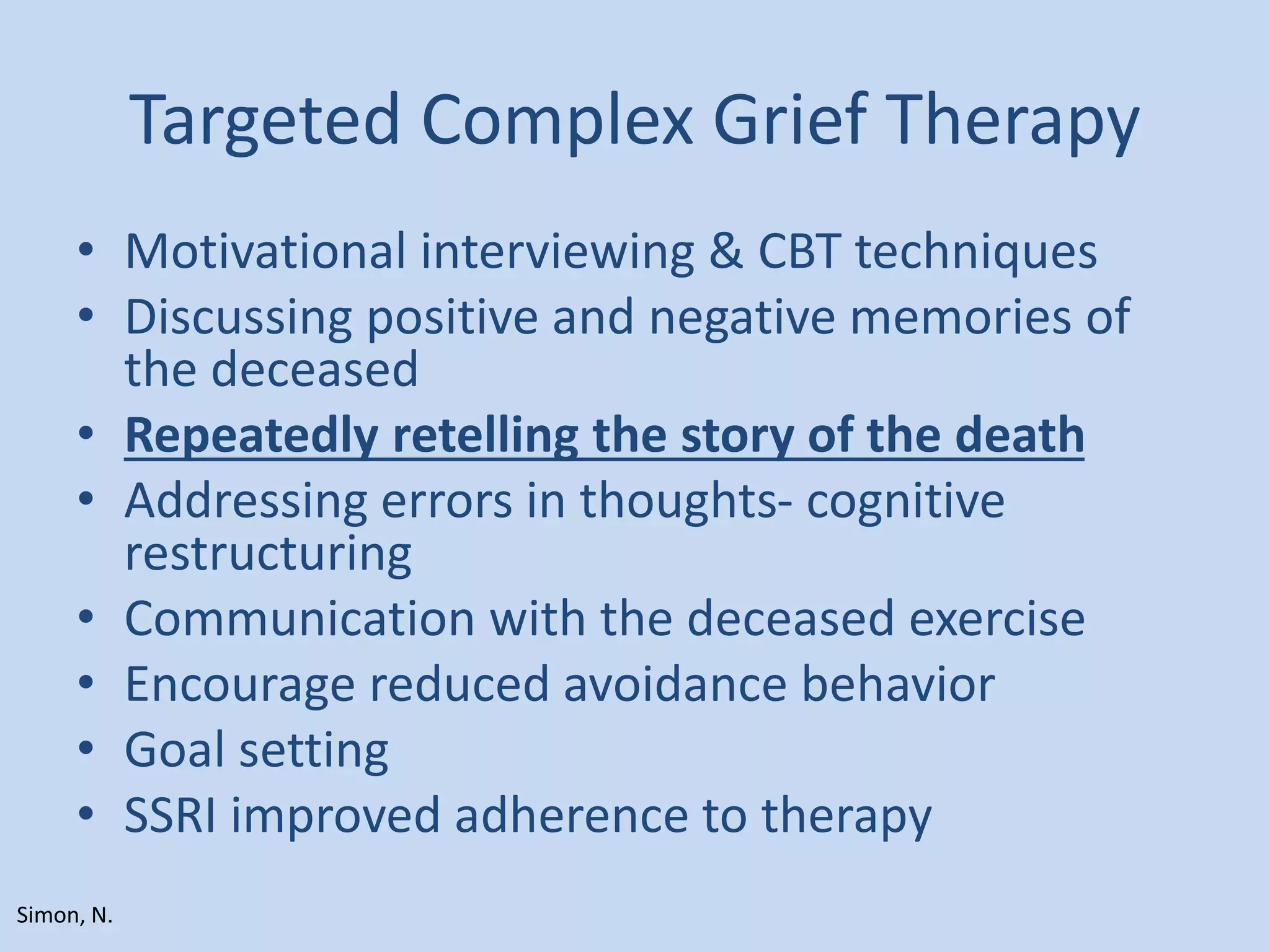
Targeted Complex Grief Therapy
• Motivational interviewing & CBT techniques
• Discussing positive and negative memories of
the deceased
• Repeatedly retelling the story of the death
• Addressing errors in thoughts- cognitive
restructuring
• Communication with the deceased exercise
• Encourage reduced avoidance behavior
• Goal setting
• SSRI improved adherence to therapy
Simon, N.
When are prescriptions indicated?
PublicDomainPictures
• Persistent symptoms
• Significant comorbidities
• Suicidal ideation or behaviors
Grief & Bereavement in
Special Populations
• Perinatal loss
• Grieving children and teens
• Parents who have lost a child
• Mortality risk in older couples
• Provider Grief
Grayerbaby
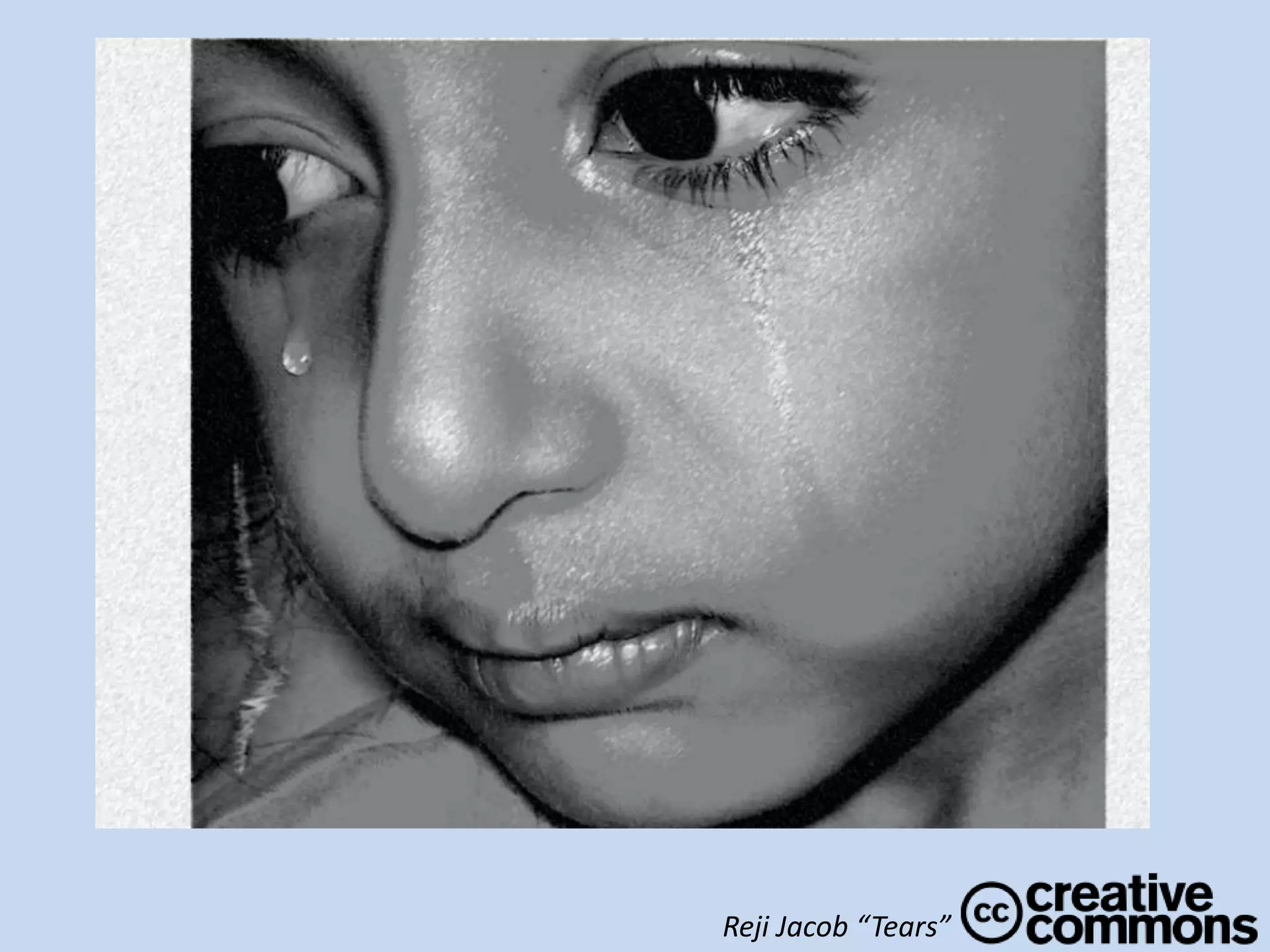
Reji Jacob “Tears”
MyStuart “Helping Hands in Ashville”
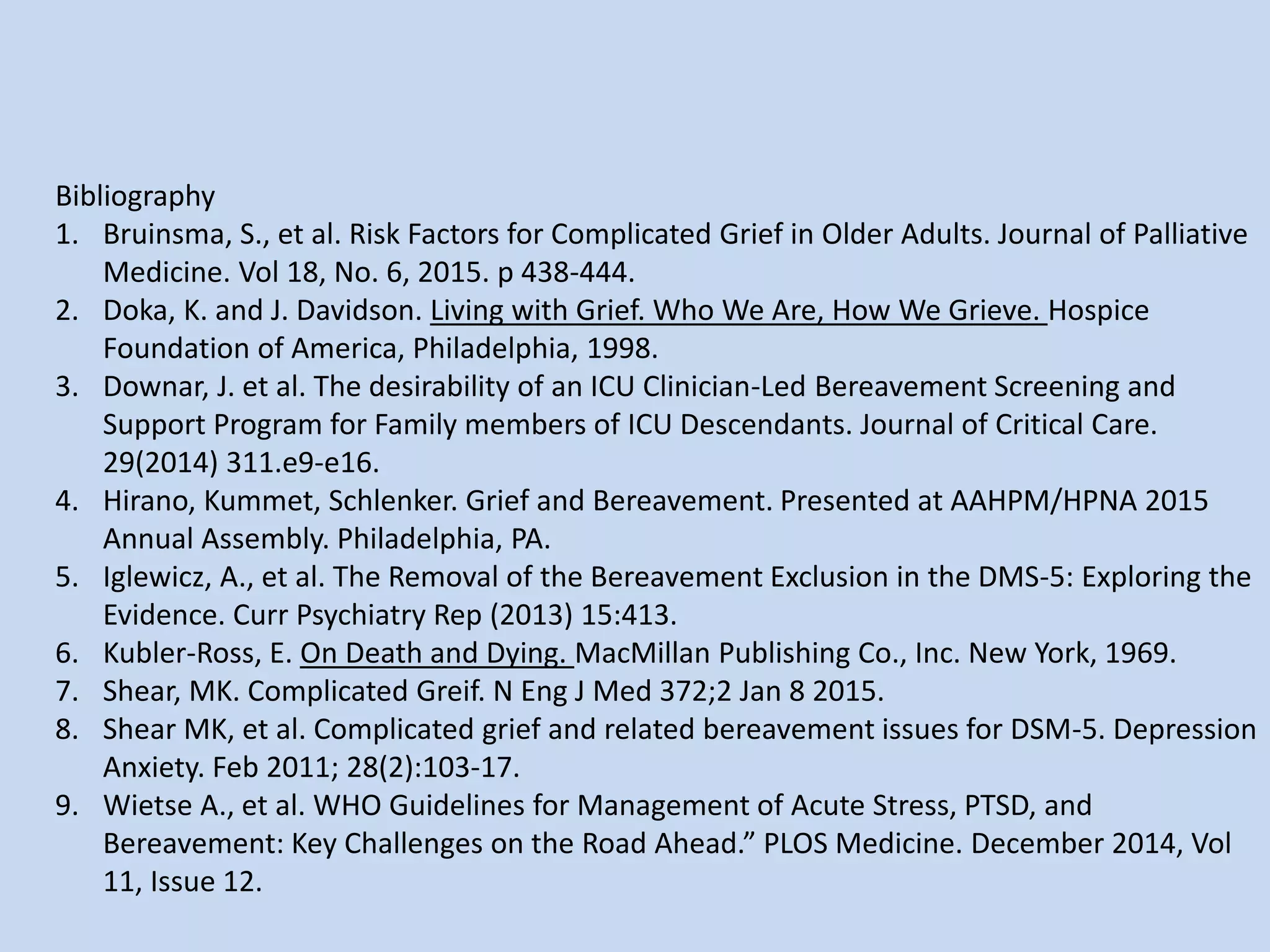
Bibliography
1. Bruinsma, S., et al. Risk Factors for Complicated Grief in Older Adults. Journal of Palliative
Medicine. Vol 18, No. 6, 2015. p 438-444.
2. Doka, K. and J. Davidson. Living with Grief. Who We Are, How We Grieve. Hospice
Foundation of America, Philadelphia, 1998.
3. Downar, J. et al. The desirability of an ICU Clinician-Led Bereavement Screening and
Support Program for Family members of ICU Descendants. Journal of Critical Care.
29(2014) 311.e9-e16.
4. Hirano, Kummet, Schlenker. Grief and Bereavement. Presented at AAHPM/HPNA 2015
Annual Assembly. Philadelphia, PA.
5. Iglewicz, A., et al. The Removal of the Bereavement Exclusion in the DMS-5: Exploring the
Evidence. Curr Psychiatry Rep (2013) 15:413.
6. Kubler-Ross, E. On Death and Dying. MacMillan Publishing Co., Inc. New York, 1969.
7. Shear, MK. Complicated Greif. N Eng J Med 372;2 Jan 8 2015.
8. Shear MK, et al. Complicated grief and related bereavement issues for DSM-5. Depression
Anxiety. Feb 2011; 28(2):103-17.
9. Wietse A., et al. WHO Guidelines for Management of Acute Stress, PTSD, and
Bereavement: Key Challenges on the Road Ahead.” PLOS Medicine. December 2014, Vol
11, Issue 12.

End of Life: Grief and Bereavement

  • 1.
    End of Life:Grieving and Bereaving Andrea Chatburn, DO, MA WOMA Winter Seminar 12.5.2015
  • 2.
  • 3.
    Objectives • Revisit grieftheory & tool of mindful presence • Examine grief related screening tools • Distinguish between typical, complicated grief • Determine when structured psychotherapy and pharmacotherapy is indicated for grief • Apply bereavement interventions to special populations
  • 4.
  • 5.
    Won’t be covering •Specific grief resources for Military or Post-combat PTSD & bereavement • Specific grief, PTSD resources for Refugees • Grief & funeral traditions across cultures and world religion
  • 6.
    Why talk aboutgrief & bereavement?
  • 7.
    “ICU Bereave” –staff & family survey Downar, J. et al. The desirability of an ICU Clinician-Led Bereavement Screening and Support Program for Family members of ICU Decedents. Journal of Critical Care. 29(2014) 311.e9-e16. Family • 64 contacted & 32 participated • 9 (28%) - complicated grief or prolonged grief disorder • 7 (22%) - social distress • 10 (31%) - professional support for emotional symptoms • 2 (6%) - professional support for social symptoms • 68% - wanted more support Staff • 94 contacted & 57 participated • 85% reported providing emotional support at time of death • 56 (98%) willing to participate in formal bereavement screening and support program
  • 8.
    Barriers to Supporting BereavedFamily Members • Not knowing what to say • Not sure how to deal with emotion • Lack of knowledge about community resource • High clinical workload • Lack of continuity or established relationship with the patient or family member Downar, J. et al. The desirability of an ICU Clinician-Led Bereavement Screening and Support Program for Family members of ICU Descendants. Journal of Critical Care. 29(2014) 311.e9-e16.
  • 9.
    Desires for bereavementsupport • Training in how to support the bereaved • List of available community resources • Dedicated time after the death and at a later date to provide support Downar, et al.
  • 10.
    Grief is centeredin relationship Sam Caplet “Don’t Let Go”
  • 11.
    WHO Guidelines forBereavement • Recommend AGAINST offering structured psychological interventions to all bereaved adults or children (w/o mental disorder) • Benzodiazepines should NOT be offered to bereaved adults or children (w/o mental disorder) • Grief and mourning are natural responses to loss, most people navigate w/o clinical intervention Wietse A., et al. WHO Guidelines for Management of Acute Stress, PTSD, and Bereavement: Key Challenges on the Road Ahead.” PLOS Medicine. December 2014, Vol 11, Issue 12.
  • 12.
    Molly Fumia “I startedmissing you long before you were gone … I’ll keep loving you long after the memories bring you back”
  • 13.
    Grief Theories • ElizabethKubler Ross- 5 stages • Ken Doka • William Warden • Alan Walset* • Teresa Randall* • “Integrated grief”
  • 14.
    45 years sinceOn Death and Dying
  • 16.
    Grief is relatedto all types of loss • Loss of relationship • Loss of role (mother/sister/daughter) • Loss of function- Debility • Loss of health • Loss of home • Loss of independence • Loss of job
  • 17.
    Expression of Grief •Emotional response • Physical • Social • Spiritual • Thought Process/Cognitive
  • 18.
    Vincent van Gogh“Old Man Crying”
  • 19.
    Georg Sander “Tombof a Mourning Woman”
  • 20.
  • 21.
    Action- 5K, Icebucket challenge, etc.
  • 22.
  • 23.
  • 24.
  • 25.
    Cueva de lasManas, Argentina by Xipe Totec39
  • 26.
    Byock- 4 thingsthat matter most • Thank you • Please forgive me • I forgive you • I love you
  • 27.
    Dignity Therapy • Chochinov-Manitoba. • Life survey by patient & loved ones • Gave a sense of purpose & meaning to life • Assisted in “living with” grief
  • 28.
  • 29.
    Ethical Will • Zava’ah •Values • Blessings • Life lessons • Hopes for future
  • 30.
    Typical Grief • Normalemotional reaction to loss • Resolves in < 6 months • No residual serious social, psychological or medical consequences
  • 31.
    Interventions for AllBereaved • Support by provider at time of death • Contact in weeks to months after a death • Customized bereavement care plan
  • 32.
    Screening Tools • Startwith symptoms: –Eating? –Sleeping? • 5 item Brief Grief Questionnaire • 19 item Inventory of Complicated Grief –Score 25-30  significant symptoms –Score >30 threshold for treatment research
  • 33.
    Brief Grief Questionnaire 01 2 How much are you having trouble accepting the death of ____? How much does your grief still interfere with your life? How much are you having images or thoughts of ___ when they died or other thoughts about the death that really bother you? Are there things you used to do when ____ was alive that you do not feel comfortable doing anymore, that you avoid? Like going somewhere you went with them, or doing things you used to enjoy together? Or avoiding looking at pictures or talking about ____? How much are you avoiding these things? How much are you feeling cut off or distant from other people since _____ died, even people you used to be close to like family or friends?
  • 34.
  • 35.
    When are prescriptionsindicated? PublicDomainPictures
  • 36.
    Complicated Grief (CG)or Prolonged Grief Disorder (PGD) • Grief resulting in severe social, psychological, or medical consequences • Persists beyond 6 months • Social distress: marked by difficulties with ADLs, financial matters, and social interactions
  • 37.
    Prolonged Grief Disorder A.Loss of a significant person B. Separation distress: feelings of yearning that occur daily or cause disability C. At least 5 specific cognitive, emotional or behavioral symptoms D. Timing >6 months since loss E. Significant Social, occupational, or functional impairment F. Not caused by other psychiatric disorder Shear MK, et al. Complicated grief and related bereavement issues for DSM-5. Depression Anxiety. Feb 2011; 28(2):103-17.
  • 38.
    Symptoms- PGD • Diminishedsense of self • Difficulty accepting loss • Avoidance of reminders of loss • Inability to trust others • Bitterness or anger related to loss • Difficulty moving on with life • Emotional numbness • Feeling that life is meaningless • Feeling stunned/dazed/shocked by the loss Shear et al.
  • 39.
    Complicated Grief A. Lossof a loved one >6 months ago B. At least one symptom of acute grief present for longer than expected in the person’s culture C. At least 2 of the following symptoms present for >1 mo. (see next slide) D. Duration: symptoms and impairment >1 mo. E. Impairment: significant social, occupational, or functional impairment caused by symptoms and not better explained as a culturally appropriate response Shear et al.
  • 40.
    B. Symptoms ofAcute Grief - CG • Persistent intense yearning • Frequent intense loneliness/emptiness • Recurrent feelings of meaninglessness of life, or a desire to die in order to rejoin the deceased • Frequent intrusive thoughts about the deceased Shear et al.
  • 41.
    C. Symptoms inCG (2 or more) • Rumination about the death and its consequences • Disbelief, inability to accept death • Feeling of shock, numbness • Bitterness or anger related to loss • Inability to trust others • Experiencing pain/symptoms that deceased person experienced • Intense reaction to memories/reminders of loss • Excessive avoidance/proximity seeking relevant to deceased Shear et al.
  • 42.
    CG New toDSM-5 “Persistent Complex Bereavement Disorder” Subtype of : – “Other specified trauma” – “Stressor-related disorders” • Estimated prevalence 7% of bereaved people • Symptoms “out of proportion or inconsistent with cultural, religious, or age-appropriate norms”
  • 43.
    Risk factors forComplicated Grief • Pre-loss factors: –Female –Preexisting trauma (particularly childhood)- ACE –Prior loss –Insecure attachment –Preexisting mood and anxiety disorders –Nature of the relationship Simon, N. Treating Complicated Greif. JAMA July 24, 2013 Vol 310, No 4. p 416-423
  • 44.
    Loss related Risksfor CG • Relationship and caretaking roles – Spouses – Mothers of dependent children – Caretakers for chronically ill • Nature of the death itself – Violent, sudden, prolonged, suicide • Mortality in Intensive Care Unit – 34 to 67% of surviving family members have CG Simon, N.
  • 45.
    Other Risk Factors •Social circumstances • Resources available after death • Unknown: Lack of information/understanding of the circumstances of the death event • Interference with natural healing process: – Inability to follow usual cultural mourning – Alcohol or substance abuse – Lack of social support Simon, N.
  • 46.
    Differential Dx forCG • Trigger for Comorbid Major Depressive Disorder, PTSD, Substance Abuse • Of patients with CG: – 25% had no comorbid conditions – 55% had comorbid Major Depressive Disorder – 49% had PTSD – 36% had both MDD and PTSD • Difference btn CG and PTSD: Fear Simon, N.
  • 47.
    CG: Deficits in imagining a futurew/o the deceased MDD: inability to experience positive emotions when contemplating the deceased PTSD: Presence of Fear
  • 48.
    When to Intervene? •Persistently high sx severity • Lack of temporal involvement in the grief response • Functional Impairment • Treatment-seeking behaviors • Hopelessness • Suicidal ideation or behaviors Simon, N.
  • 49.
    Targeted Complex GriefTherapy • Motivational interviewing & CBT techniques • Discussing positive and negative memories of the deceased • Repeatedly retelling the story of the death • Addressing errors in thoughts- cognitive restructuring • Communication with the deceased exercise • Encourage reduced avoidance behavior • Goal setting • SSRI improved adherence to therapy Simon, N.
  • 50.
    When are prescriptionsindicated? PublicDomainPictures • Persistent symptoms • Significant comorbidities • Suicidal ideation or behaviors
  • 51.
    Grief & Bereavementin Special Populations • Perinatal loss • Grieving children and teens • Parents who have lost a child • Mortality risk in older couples • Provider Grief
  • 52.
  • 53.
  • 55.
  • 56.
    Bibliography 1. Bruinsma, S.,et al. Risk Factors for Complicated Grief in Older Adults. Journal of Palliative Medicine. Vol 18, No. 6, 2015. p 438-444. 2. Doka, K. and J. Davidson. Living with Grief. Who We Are, How We Grieve. Hospice Foundation of America, Philadelphia, 1998. 3. Downar, J. et al. The desirability of an ICU Clinician-Led Bereavement Screening and Support Program for Family members of ICU Descendants. Journal of Critical Care. 29(2014) 311.e9-e16. 4. Hirano, Kummet, Schlenker. Grief and Bereavement. Presented at AAHPM/HPNA 2015 Annual Assembly. Philadelphia, PA. 5. Iglewicz, A., et al. The Removal of the Bereavement Exclusion in the DMS-5: Exploring the Evidence. Curr Psychiatry Rep (2013) 15:413. 6. Kubler-Ross, E. On Death and Dying. MacMillan Publishing Co., Inc. New York, 1969. 7. Shear, MK. Complicated Greif. N Eng J Med 372;2 Jan 8 2015. 8. Shear MK, et al. Complicated grief and related bereavement issues for DSM-5. Depression Anxiety. Feb 2011; 28(2):103-17. 9. Wietse A., et al. WHO Guidelines for Management of Acute Stress, PTSD, and Bereavement: Key Challenges on the Road Ahead.” PLOS Medicine. December 2014, Vol 11, Issue 12.

Editor's Notes

  • #5 Acknowledge the emotion that comes with the heavy topic of sorrow.
  • #7 Adds value study – November JPM Susan Block. 65% of deaths take place in institutions
  • #8 2 teaching hospitals in Toronto- Surveyed ICU staff and family members at a mean of 7.4 months (2.2 SD) after patient death to measure symptoms of complicated grief, prolonged grief disorder and social difficulties. 19 were a spouse/ex-spouse, 6 were child, 3 were parent, 2 sibling, 1 another relative. 81% had a religious community, 81% Canadian, 2 from central/south America, 2 from Africa, 1 from Asia. 91% rated the overall quality of care as either “good, very good, or excellent” and 56% reported having to make a decision about life-sustaining treatment or CPR on behalf of the patient. Staff participants had mean age 41 (SD 10.4 yrs), 40 were physicians and 11 were nurses, 35% had no religious affiliation, others identified as Roman Catholic, Protestant, Jewish, Buddhist, Hindu and 1 other.
  • #11 The death of a loved one is life’s most universal stressor and 2.5 million people die each year in the US. The death of someone close to you remains one of the most intense, distressing and traumatic events a person will experience.
  • #12 Both strong recommendations No evidence to support offering grief counseling to all bereaved adults and children- based on limited mental health resources Paucity of evidence about effectiveness of encouraging existing supportive cultural mourning practices for bereavement However international consensus guidelines specifically recommend building on existing practices
  • #13 So what do we do? Start with story
  • #15 Elizabeth Kubler Ross 1969
  • #16 Create own image
  • #19 Acute grief- shock, disbelief, intense separation distress, longing, sadness, self-blame/guilt, decreased engagement in life.
  • #20 We need to be looking in our clinics for more than just tears. We need to listen to the stories patients tell us about how they are experiencing life after loss- their words will tell us how they experience grief when we ask them the question, “how are you doing inside yourself right now?”
  • #21 Doka asked “do men and women grieve differently?” turns out the answer is both yes and no. What he found was that people grieve differently, have different styles of grief but those styles are NOT gender based.
  • #22 Intuitive grievers benefit from support groups Hospices offer
  • #23 Instrumental grievers focus on action related
  • #24 People remain connected with their loved ones. Necklace, picture, anniversary. Rather than acceptance & “move on,” Silverman Hickman & Boss “a death ends a life, but not a relationship.” The new grief theory is applicable for ANY loss, change, or challenge- loss of a job, change of relationship (child going off to school)
  • #25 William Warden. We bear witness to grieving, we sit with them in their dark night of the soul. We sit with, be present with. This encourages Warden’s continuing bonds theory- sitting with the bereaved lets them know that they don’t have to “move on”- they can just be.
  • #26 Continuing on with relationship after death can be found in legacy work. Legacy work is the work done by the patient or their loved ones with the intention of leaving their mark on the world. All people involved in legacy work benefit. Focus is on the narrative, story. Recording, letters/writing it down, pictures, hand prints. Legacy work doesn’t fit everyone. **Hand out: “love letter” example of letter to family members
  • #29 Hand out: life review questions
  • #30 Nessa Coyle’s study on Legacy work.
  • #36 WHO guidelines suggest that although grief counseling is a popular intervention following bereavement, there is a lack of evidence that it is effective. However, the best studied treatment for complicated grief is targeted psychotherapy- specifically 16 week targeted Complicated Grief Therapy, which was significantly more effective than interpersonal psychotherapy.
  • #37 Recommendation against offering benzodiazepines for acute stress symptoms INCLUDING INSOMNIA in the absence of a frank mental disorder.
  • #51 10 weeks group, 4 weeks individual CBT. Another trial used a 5 week internet based intervention using the same techniques. Medication specifically indicated for patients who have persistent sym
  • #52 Recommendation against offering benzodiazepines for acute stress symptoms INCLUDING INSOMNIA in the absence of a frank mental disorder.
  • #54 Listen to the story.
  • #57 You are not alone. Focus on self care. As a physician family member the grief is compartmentalized and you experience it later.