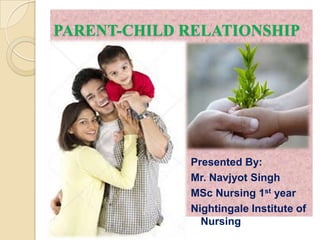
PARENT-CHILD RELATIONSHIP


             Presented By:
             Mr. Navjyot Singh
             MSc Nursing 1st year
             Nightingale Institute of
               Nursing
INTRODUCTION:
           Parents are usually the first
people a child learns to trust. Parents
and families are the most important
people in children’s lives. The many
different relationships people form over
the course of the life span, the
relationship between parent and child is
among the most important.
Definition:
          The parent-child relationship
 consists of a combination of behaviors,
 feelings, and expectations that are unique
 to a particular parent and a particular
 child. The relationship involves the full
 extent of a child's development.
Types of Parent Child Relationship

There are mainly four categories of parent
  child relationship.
 Secure relationships.
 Avoidant relationships.
 Ambivalent relationships.
 Disorganized relationships.
1. Secure relationships: - This is the
  strongest type of attachment. A child in
  this category feels he can depend on his
  parent or provider. He knows that person
  will be there when he needs support.

2. Avoidant relationships: - This is one
  category of attachment that is not secure.
  Avoidant children have learned that
  depending on parents won’t get them that
  secure feeling they want, so child learn to
  take care of themselves. Avoidant children
  may seem too independent and usually
  do not build strong relationships.
3. Ambivalent relationships: -
   Ambivalence is another way a child may
  be insecurely attached to his parents.
  Child notice what behavior got their
  parents’ attention in the past and use it
  over and over. Children are always
  looking for that feeling of security.
4. Disorganized relationships: -
  Disorganized children don’t know what to
 expect from their parents. Children with
 relationships learns to predict how his parent
 will react, whether it is positive or negative.
 Child also learns that doing certain things will
 make their parents do certain things.
PARENTING


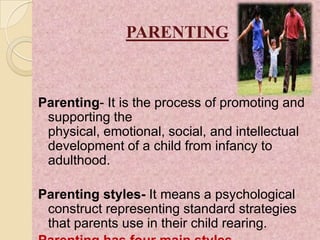
Parenting- It is the process of promoting and
 supporting the
 physical, emotional, social, and intellectual
 development of a child from infancy to
 adulthood.

Parenting styles- It means a psychological
 construct representing standard strategies
 that parents use in their child rearing.
Parenting styles:-
     • Authoritarian
1.

     • Authoritative
2.

     • Permissive/Indulgent
3.

     • Detached
4.
1.   Authoritarian Parents: - The parent is
     demanding but not
     responsive.Authoritarian parents are
     rigid in their rules; they expect absolute
     obedience from the child without any
     questioning. Authoritarian parents are
     strict disciplinarians.
2.   Authoritative: - Authoritative parents
     show respect for the opinions of their
     children. Authoritative parents are both
     responsive and demanding; they are
     firm, but they discipline with love and
     affection, rather than power.
3. Permissive/Indulgent: - Permissive
 (indulgent) parents have little or no control
 over the behavior of their children. Indulgent
 parents are responsive but not especially
 demanding. They have few expectations of
 their children and impose little or inconsistent
 discipline. There are empty threats of
 punishment without setting limits. Role
 reversal occurs.

4. Detached: - Detached parents are neither
 responsive nor demanding. They may be
 careless or unaware of the child's needs for
 affection and discipline.
Characteristics of a Healthy
Parent-Child Relationship

 Flexible/Adaptable
 Connected
 Appropriateboundaries
 Open Communication
 Discipline
1.Flexible/Adaptable: - Good parents must
be flexible and adaptable. They have ability
to recognize and accommodate the child’s
need. Help the child by giving clear
directions, offering opportunities to choose
and negotiate.

2.Connected: - Parents should have ability
to differentiate the child’s worth from his or
her behavior, and create a reward-oriented
environment in which consequences are
positive outcome. Respond to a child’s
problems or feelings with
3. Appropriate boundaries: - The parent-
  child relationship includes various
  boundaries. Healthy boundaries consider
  that what the parent and the child want in
  a positive way to find a mutually
  agreeable solution or limit.

4. Open Communication: -- The way the
parent and child communicate sets the tone
for the relationship. The healthy parent-
child relationships use positive
communication that separates the child's
worth from behavior.
5. Discipline: - For healthy parent child
  relationship discipline also very important
  aspect. To finding the solution of conflicts
  and behavioral problem helps to
  encourage the strong relation rather than
  punishing children in an attempt to teach.
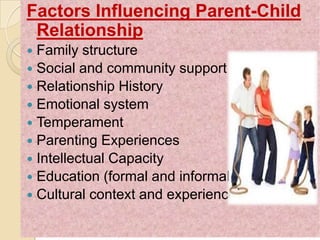
Factors Influencing Parent-Child
 Relationship
 Family structure
 Social and community support
 Relationship History
 Emotional system
 Temperament
 Parenting Experiences
 Intellectual Capacity
 Education (formal and informal)
 Cultural context and experiences
Methods to Improve Child - Parent
 Relationships
1. Play games with Child.
2. Casual conversation.
3. Bring the child to new places.
4. Rewarding
SUMMARY

           The parent-child relationship consists of a
combination of behaviors, feelings, and expectations that
are unique to a particular parent and a particular child.
Whereas Parenting is the process of promoting and
supporting the physical, emotional, social, and intellectual
development of a child which is having different styles child
rearing. There are many factors which influence the
relationship but parent child relationship can be maintained
by various ways as appreciating the child, taking him to
new places and casual conversation between parents and
children.
BIBLIOGRAPHY
 Dorothy   R. Marlow, Textbook of Pediatric
  nursing, Saunders publisher, 6th edition, page
  no. 31-39
 Marilyn J Hockenberry, Essential of pediatric
  nursing, Mosby publisher, 7th edition, page
  no.29-48
 http://www.extension.purdue.edu/providerparent/
  Family-Child%20Relationships/DifferentTypesP-
  C.htm
 http://www.answers.com/topic/parent-child-
  relationships#ixzz2A1arMTSO
 http://ezinearticles.com/?Methods-to-Improve-
  Child---Parent-Relationships&id=1703081
 http://www.vindadravid.com/tag/parent-child-
  relationship/
THANK YOU
Any question???

Parents child relationship

  • 1.
    PARENT-CHILD RELATIONSHIP Presented By: Mr. Navjyot Singh MSc Nursing 1st year Nightingale Institute of Nursing
  • 2.
    INTRODUCTION: Parents are usually the first people a child learns to trust. Parents and families are the most important people in children’s lives. The many different relationships people form over the course of the life span, the relationship between parent and child is among the most important.
  • 3.
    Definition: The parent-child relationship consists of a combination of behaviors, feelings, and expectations that are unique to a particular parent and a particular child. The relationship involves the full extent of a child's development.
  • 4.
    Types of ParentChild Relationship There are mainly four categories of parent child relationship.  Secure relationships.  Avoidant relationships.  Ambivalent relationships.  Disorganized relationships.
  • 5.
    1. Secure relationships:- This is the strongest type of attachment. A child in this category feels he can depend on his parent or provider. He knows that person will be there when he needs support. 2. Avoidant relationships: - This is one category of attachment that is not secure. Avoidant children have learned that depending on parents won’t get them that secure feeling they want, so child learn to take care of themselves. Avoidant children may seem too independent and usually do not build strong relationships.
  • 6.
    3. Ambivalent relationships:- Ambivalence is another way a child may be insecurely attached to his parents. Child notice what behavior got their parents’ attention in the past and use it over and over. Children are always looking for that feeling of security.
  • 7.
    4. Disorganized relationships:- Disorganized children don’t know what to expect from their parents. Children with relationships learns to predict how his parent will react, whether it is positive or negative. Child also learns that doing certain things will make their parents do certain things.
  • 8.
    PARENTING Parenting- It isthe process of promoting and supporting the physical, emotional, social, and intellectual development of a child from infancy to adulthood. Parenting styles- It means a psychological construct representing standard strategies that parents use in their child rearing.
  • 9.
    Parenting styles:- • Authoritarian 1. • Authoritative 2. • Permissive/Indulgent 3. • Detached 4.
  • 10.
    1. Authoritarian Parents: - The parent is demanding but not responsive.Authoritarian parents are rigid in their rules; they expect absolute obedience from the child without any questioning. Authoritarian parents are strict disciplinarians. 2. Authoritative: - Authoritative parents show respect for the opinions of their children. Authoritative parents are both responsive and demanding; they are firm, but they discipline with love and affection, rather than power.
  • 11.
    3. Permissive/Indulgent: -Permissive (indulgent) parents have little or no control over the behavior of their children. Indulgent parents are responsive but not especially demanding. They have few expectations of their children and impose little or inconsistent discipline. There are empty threats of punishment without setting limits. Role reversal occurs. 4. Detached: - Detached parents are neither responsive nor demanding. They may be careless or unaware of the child's needs for affection and discipline.
  • 12.
    Characteristics of aHealthy Parent-Child Relationship  Flexible/Adaptable  Connected  Appropriateboundaries  Open Communication  Discipline
  • 13.
    1.Flexible/Adaptable: - Goodparents must be flexible and adaptable. They have ability to recognize and accommodate the child’s need. Help the child by giving clear directions, offering opportunities to choose and negotiate. 2.Connected: - Parents should have ability to differentiate the child’s worth from his or her behavior, and create a reward-oriented environment in which consequences are positive outcome. Respond to a child’s problems or feelings with
  • 14.
    3. Appropriate boundaries:- The parent- child relationship includes various boundaries. Healthy boundaries consider that what the parent and the child want in a positive way to find a mutually agreeable solution or limit. 4. Open Communication: -- The way the parent and child communicate sets the tone for the relationship. The healthy parent- child relationships use positive communication that separates the child's worth from behavior.
  • 15.
    5. Discipline: -For healthy parent child relationship discipline also very important aspect. To finding the solution of conflicts and behavioral problem helps to encourage the strong relation rather than punishing children in an attempt to teach.
  • 16.
    Factors Influencing Parent-Child Relationship  Family structure  Social and community support  Relationship History  Emotional system  Temperament  Parenting Experiences  Intellectual Capacity  Education (formal and informal)  Cultural context and experiences
  • 17.
    Methods to ImproveChild - Parent Relationships 1. Play games with Child. 2. Casual conversation. 3. Bring the child to new places. 4. Rewarding
  • 18.
    SUMMARY The parent-child relationship consists of a combination of behaviors, feelings, and expectations that are unique to a particular parent and a particular child. Whereas Parenting is the process of promoting and supporting the physical, emotional, social, and intellectual development of a child which is having different styles child rearing. There are many factors which influence the relationship but parent child relationship can be maintained by various ways as appreciating the child, taking him to new places and casual conversation between parents and children.
  • 19.
    BIBLIOGRAPHY  Dorothy R. Marlow, Textbook of Pediatric nursing, Saunders publisher, 6th edition, page no. 31-39  Marilyn J Hockenberry, Essential of pediatric nursing, Mosby publisher, 7th edition, page no.29-48  http://www.extension.purdue.edu/providerparent/ Family-Child%20Relationships/DifferentTypesP- C.htm  http://www.answers.com/topic/parent-child- relationships#ixzz2A1arMTSO  http://ezinearticles.com/?Methods-to-Improve- Child---Parent-Relationships&id=1703081  http://www.vindadravid.com/tag/parent-child- relationship/
  • 20.