Parenting our Adolescent Child (A Personal Sharing) Parent-Child Dialogue  Third Year Level Day  La Salle Academy, Iligan City October 3, 2009, Saturday Marionito L. Hinacay ENTER TO LEARN
I.  Common Characteristics of Middle Adolescence Topics  Building Relationships Establishing  Communication Peer Group Rules, Limits & Fairness Affection & Appreciation ►  Issues ►  Personal Response  (Individual Parenting Styles) ►  Practical Tips for Parents III.  Concluding Notes (Video Presentation) Sharing Outline
Common Characteristics of Middle Adolescence A transition time  from childhood to adulthood . Asserts  independence and autonomy  from parents. Shows  less interest in family activities. Forms his/her  personal identity. Being  self-centered . Lives a life of  contradictions.   Shows  omnipotence and invulnerability.   Exposes to  greatest experiential risk-taking.   Adventures “ first time” experiences.
3.1. Building Relationships Parenting is about  building a relationship  with our child.  Issues:   Lack of relationship  due to  “generation gap”  or due to  “lack of presence.”  It is the result of long term  neglect .
1.  Parents need to take the  first initiative  in building relationships with their children because at this stage, their children’s life or relational interest is usually directed to the third party or to the outside world. 2.  Parents must make a  commitment   to having a relationship with their children.  Parenting is  not just a matter of providing our children’s basic and physical needs  (money figure) but of building a strong foundation relational aspect with our children; that is  “ how to be there ”  for our children. Practical Tips for Parents 3.1. Building Relationships
3.2. Establishing Communication Essential to building strong rapport with our children is the establishment of  communication.   Issues:  Lack of communication and this could be due to some  barriers  which may include  status difference  (parent-child);,  physical, emotional and attitudinal.
Practical Tips for Parents 1.  Create  open  and  effective communication  with your adolescent. 2.  An important goal in communicating with our adolescents should be  just talking with them ,  without trying to accomplish anything other than talking.  Listen more and talk less. 3.  Conversation  should not end up in lectures or preaching .   4.  Avoid throwing to our adolescent child  complex series of questions. 5.  Do not keep on  repeating   our lectures and questions.  3.2. Establishing Communication
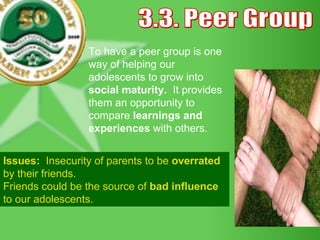
3.3. Peer Group To have a peer group is one way of helping our adolescents to grow into  social maturity.  It provides them an opportunity to compare  learnings and experiences  with others. Issues:  Insecurity of parents to be  overrated  by their friends. Friends could be the source of  bad influence  to our adolescents.
Practical Tips for Parents 1.  Encourage  positive relationships  with their friends.  2.  Encourage adolescents to get involved in the  communities.  3.  If you are not satisfied with your child's company then try and  talk to him about the harm  that it is causing to him.  Do not humiliate  him  by calling him a weak person or somebody who easily gets influenced by others. 4.  Set  reasonable limits  on how often your teens can go with their friends during the school week while at the same time recognizing how important friends are at this stage. 3.3. Peer Group
3.4. Rules, Limit, & Fairness The notions of  rules and limits  are part of parenting.  Rules and limits are not for  our own good and selfish motives  as parents but as  expressions of our care  for our child. We should let our adolescents know that there has to be  rules and limits  in the house and explain to them the  reasons  behind these rules and  listen to their points of view. Issues:  Consistency in enforcing rules  and limits. Parent-child conflicts and “power  struggles.”
Practical Tips for Parents 1.  House rules must not be formulated in  negative statements  (do not) but  affirmative statement  (do). 2.  We may set the rules and limit but with  gentle guidance.   Most adolescents have no knowledge yet of  cause and effect.   3.  We should keep our  rules clear  and  limit only to important issues. 4.  We should not   try to control areas of adolescents’ lives that adolescents consider to be  outside the  legitimate domain of parental authority. 3.4. Rules, Limits and Fairness
3.5. Affection and Appreciation We must  accept  our adolescents for  who they are, no matter what . Express these feelings of love and acceptance by appropriate sentences of  praise or appreciation .  The more we praise our adolescent for what he is doing right, the less we have to criticize and discipline him for doing something wrong. Issues:   How often do we show our affection, love, and appreciation to our adolescents?
Practical Tips for Parents 1.  Be conscious with developing our child’s  self-esteem. 2.  Set up our teen’s  social, academic, and professional success. 3.  Be tolerant and patient.   Enjoy them while we have them, with their failures and achievements. 4.  Do not retaliate  following initial feelings of anger.  This does not work, but it only builds up resentment. 5.  Try to  attend every event , game, and performance that our child is involved in. 6.  Make an extra effort to  set a good example  at home and in public. Use words like "I'm sorry," "please," and "thank you." 7.  Avoid  harsh criticism .  They are very sensitive to it. 8.  Eat meals together  as a family, without the distractions of the TV or cell phones.  Take this time to just talk to our children. 9.  Pray with our children .  Nothing will bring us closer than the power of the simple expression of prayer. 3.5. Affection and  Appreciation
C –  Contact .   Be approachable and willing to spend time. A –  Ask.  Ask questions, learn and understand their friends, activities, feelings and relationships. R –  Right.   You will earn the right over your child especially in giving a piece of advice (Moral ascendancy). E –  Encourage.   Seek out a child’s good behavior, and affirm things they do right. Indeed, PARENTS really C.A.R.E. LEAVE TO SERVE

Parenting Our Adolescent Child

  • 1.
    Parenting our AdolescentChild (A Personal Sharing) Parent-Child Dialogue Third Year Level Day La Salle Academy, Iligan City October 3, 2009, Saturday Marionito L. Hinacay ENTER TO LEARN
  • 2.
    I. CommonCharacteristics of Middle Adolescence Topics Building Relationships Establishing Communication Peer Group Rules, Limits & Fairness Affection & Appreciation ► Issues ► Personal Response (Individual Parenting Styles) ► Practical Tips for Parents III. Concluding Notes (Video Presentation) Sharing Outline
  • 3.
    Common Characteristics ofMiddle Adolescence A transition time from childhood to adulthood . Asserts independence and autonomy from parents. Shows less interest in family activities. Forms his/her personal identity. Being self-centered . Lives a life of contradictions. Shows omnipotence and invulnerability. Exposes to greatest experiential risk-taking. Adventures “ first time” experiences.
  • 4.
    3.1. Building RelationshipsParenting is about building a relationship with our child. Issues: Lack of relationship due to “generation gap” or due to “lack of presence.” It is the result of long term neglect .
  • 5.
    1. Parentsneed to take the first initiative in building relationships with their children because at this stage, their children’s life or relational interest is usually directed to the third party or to the outside world. 2. Parents must make a commitment to having a relationship with their children. Parenting is not just a matter of providing our children’s basic and physical needs (money figure) but of building a strong foundation relational aspect with our children; that is “ how to be there ” for our children. Practical Tips for Parents 3.1. Building Relationships
  • 6.
    3.2. Establishing CommunicationEssential to building strong rapport with our children is the establishment of communication. Issues: Lack of communication and this could be due to some barriers which may include status difference (parent-child);, physical, emotional and attitudinal.
  • 7.
    Practical Tips forParents 1. Create open and effective communication with your adolescent. 2. An important goal in communicating with our adolescents should be just talking with them , without trying to accomplish anything other than talking. Listen more and talk less. 3. Conversation should not end up in lectures or preaching . 4. Avoid throwing to our adolescent child complex series of questions. 5. Do not keep on repeating our lectures and questions. 3.2. Establishing Communication
  • 8.
    3.3. Peer GroupTo have a peer group is one way of helping our adolescents to grow into social maturity. It provides them an opportunity to compare learnings and experiences with others. Issues: Insecurity of parents to be overrated by their friends. Friends could be the source of bad influence to our adolescents.
  • 9.
    Practical Tips forParents 1. Encourage positive relationships with their friends. 2. Encourage adolescents to get involved in the communities. 3. If you are not satisfied with your child's company then try and talk to him about the harm that it is causing to him. Do not humiliate him by calling him a weak person or somebody who easily gets influenced by others. 4. Set reasonable limits on how often your teens can go with their friends during the school week while at the same time recognizing how important friends are at this stage. 3.3. Peer Group
  • 10.
    3.4. Rules, Limit,& Fairness The notions of rules and limits are part of parenting. Rules and limits are not for our own good and selfish motives as parents but as expressions of our care for our child. We should let our adolescents know that there has to be rules and limits in the house and explain to them the reasons behind these rules and listen to their points of view. Issues: Consistency in enforcing rules and limits. Parent-child conflicts and “power struggles.”
  • 11.
    Practical Tips forParents 1. House rules must not be formulated in negative statements (do not) but affirmative statement (do). 2. We may set the rules and limit but with gentle guidance. Most adolescents have no knowledge yet of cause and effect. 3. We should keep our rules clear and limit only to important issues. 4. We should not try to control areas of adolescents’ lives that adolescents consider to be outside the legitimate domain of parental authority. 3.4. Rules, Limits and Fairness
  • 12.
    3.5. Affection andAppreciation We must accept our adolescents for who they are, no matter what . Express these feelings of love and acceptance by appropriate sentences of praise or appreciation . The more we praise our adolescent for what he is doing right, the less we have to criticize and discipline him for doing something wrong. Issues: How often do we show our affection, love, and appreciation to our adolescents?
  • 13.
    Practical Tips forParents 1. Be conscious with developing our child’s self-esteem. 2. Set up our teen’s social, academic, and professional success. 3. Be tolerant and patient. Enjoy them while we have them, with their failures and achievements. 4. Do not retaliate following initial feelings of anger. This does not work, but it only builds up resentment. 5. Try to attend every event , game, and performance that our child is involved in. 6. Make an extra effort to set a good example at home and in public. Use words like "I'm sorry," "please," and "thank you." 7. Avoid harsh criticism . They are very sensitive to it. 8. Eat meals together as a family, without the distractions of the TV or cell phones. Take this time to just talk to our children. 9. Pray with our children . Nothing will bring us closer than the power of the simple expression of prayer. 3.5. Affection and Appreciation
  • 14.
    C – Contact . Be approachable and willing to spend time. A – Ask. Ask questions, learn and understand their friends, activities, feelings and relationships. R – Right. You will earn the right over your child especially in giving a piece of advice (Moral ascendancy). E – Encourage. Seek out a child’s good behavior, and affirm things they do right. Indeed, PARENTS really C.A.R.E. LEAVE TO SERVE