By
KrunalTrivedi
 Inverter is a device that convert DC(direct
current) into AC(Alternative current)
 Basically it is very harmful for use the DC supply
so inverter is very useful instrument for every
place and industry
 Solar panels output Direct Current (DC). As DC
electricity cannot be used directly by common
household appliances nor fed into the mains
grid; it first needs to be converted to Alternating
Current (AC).
-GRIDTIED INVERTERS
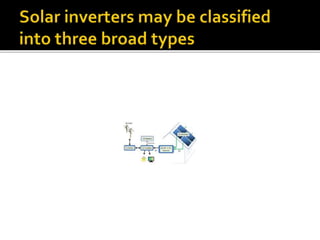
There are main three types of this inverters
MICRO INVERTERS
STRING INVERTERS
CENTRAL INVERTERS
 Solar panels convert the sun’s energy into
DC electricity
 The DC electricity is channelled into a solar
inverter that converts it to
240V 50HzAC electricity.
 The 240V AC electricity can be used to power
home appliances
 Surplus electricity is fed back into the main
grid.
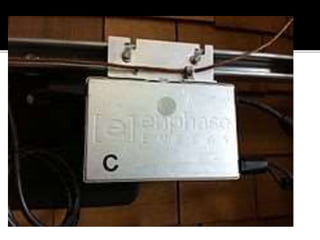
 A microinverter consists of a small box
located on the back of or situated very close
to a solar panel. Its role is to convert the DC
electricity produced by a single solar panel.
 Panel level MPPT (Maximum Power PointTracking)
 Increase system availability – a single malfunctioning panel will
not have such an impact on the entire array
 Panel level monitoring
 Lower DC voltage, increasing safety. No need for ~ 600V DC
cabling requiring conduits
 Allows for increased design flexibility, modules can be oriented in
different directions
 Increased yield from sites that suffer from overshadowing, as one
shadowed module doesn’t drag down a whole string
 No need to calculate string lengths – simpler to design systems
 Ability to use different makes/models of modules in one system,
particularly when repairing or updating older systems
 Higher costs in terms of dollars per watt,
currently up to double the cost compared to
string inverters
 Increased complexity in installation
 Given their positioning in an installation, some
micro-inverters may have issues in extreme heat
 Increased maintenance costs due to there being
multiple units in an array.
 Power-One is emerging as a leader in micro-
inverter technology.
 A string inverter is the type most commonly
used in home and commercial solar power
systems. It is a large-ish box that is often
situated some distance away from the solar
array. Depending on the size of
the installation, there may be more than one
string inverter present.
 Allows for high design flexibility
 High efficiency
 Robust
 3 phase variations available
 Low cost
 Well supported (if buying trusted brands)
 Remote system monitoring capabilities
 No panel level MPPT*
 No panel level monitoring*
 High voltage levels present a potential safety
hazard
 As with any other device, the “trusted brand”
issue is an important one. Not all string
inverters are created equal; as this video
demonstrates.
 Central inverters are designed for
applications such as large arrays installed on
buildings, industrial facilities as well as
field installations – they are basically just a
very large string inverter.
 Low capital price per watt
 High efficiency
 Comparative ease of installation – a single unit
in some scenarios
Central inverter disadvantages
 Size
 Noise
 A single potential point of entire system failure
 SMA (Sunny Central) and Fronius (CL series –
shown above) are leading central inverter
brands.
 sometimes called PV inverters, are types of
electrical inverters which are developed to
change a DC (direct current) voltage from
photovoltaic arrays into AC (alternating
current) currents which in turn are used to
power home appliances and some utility
grids.These solar inverters are very popular
nowadays as electricity costs continue to rise.
Also, this helps conserve energy for future
use.
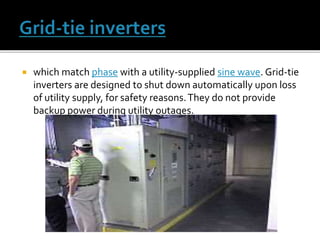
 which match phase with a utility-supplied sine wave. Grid-tie
inverters are designed to shut down automatically upon loss
of utility supply, for safety reasons.They do not provide
backup power during utility outages.
 used in isolated systems where the inverter
draws its DC energy from batteries charged
by photovoltaic arrays. Many stand-alone
inverters also incorporate integral battery
chargers to replenish the battery from anAC
source, when available. Normally these do
not interface in any way with the utility grid,
and as such, are not required to have anti-
islanding protection.
 , are special inverters which are designed to
draw energy from a battery, manage the
battery charge via an onboard charger, and
export excess energy to the utility grid.These
inverters are capable of supplying AC energy
to selected loads during a utility outage, and
are required to have anti-islanding protection
 Solar inverters use maximum power point
tracking (MPPT) to get the maximum possible
power from the PV array.[2] Solar cells have a
complex relationship between solar irradiation,
temperature and total resistance that produces
a non-linear output efficiency known as the I-V
curve. It is the purpose of the MPPT system to
sample the output of the cells and determine a
resistance (load) to obtain maximum power for
any given environmental conditions
 A charge controller may be used to power DC
equipment with solar panels.The charge
controller provides a regulated DC output
and stores excess energy in a battery as well
as monitoring the battery voltage to prevent
under/over charging. More expensive units
will also perform maximum power point
tracking.An inverter can be connected to the
output of a charge controller to drive AC
loads.
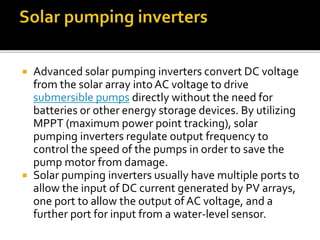
 Advanced solar pumping inverters convert DC voltage
from the solar array into AC voltage to drive
submersible pumps directly without the need for
batteries or other energy storage devices. By utilizing
MPPT (maximum power point tracking), solar
pumping inverters regulate output frequency to
control the speed of the pumps in order to save the
pump motor from damage.
 Solar pumping inverters usually have multiple ports to
allow the input of DC current generated by PV arrays,
one port to allow the output of AC voltage, and a
further port for input from a water-level sensor.
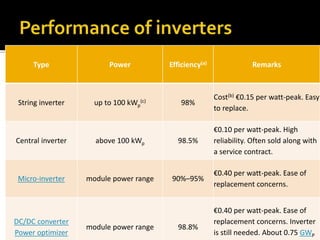
Type Power Efficiency(a) Remarks
String inverter up to 100 kWp
(c) 98%
Cost(b) €0.15 per watt-peak. Easy
to replace.
Central inverter above 100 kWp 98.5%
€0.10 per watt-peak. High
reliability. Often sold along with
a service contract.
Micro-inverter module power range 90%–95%
€0.40 per watt-peak. Ease of
replacement concerns.
DC/DC converter
Power optimizer
module power range 98.8%
€0.40 per watt-peak. Ease of
replacement concerns. Inverter
is still needed. About 0.75 GWP
Thank you
 Solar Inverters

Solar Inverters

  • 1.
  • 2.
     Inverter isa device that convert DC(direct current) into AC(Alternative current)  Basically it is very harmful for use the DC supply so inverter is very useful instrument for every place and industry  Solar panels output Direct Current (DC). As DC electricity cannot be used directly by common household appliances nor fed into the mains grid; it first needs to be converted to Alternating Current (AC).
  • 3.
    -GRIDTIED INVERTERS There aremain three types of this inverters MICRO INVERTERS STRING INVERTERS CENTRAL INVERTERS
  • 4.
     Solar panelsconvert the sun’s energy into DC electricity  The DC electricity is channelled into a solar inverter that converts it to 240V 50HzAC electricity.  The 240V AC electricity can be used to power home appliances  Surplus electricity is fed back into the main grid.
  • 5.
     A microinverterconsists of a small box located on the back of or situated very close to a solar panel. Its role is to convert the DC electricity produced by a single solar panel.
  • 6.
     Panel levelMPPT (Maximum Power PointTracking)  Increase system availability – a single malfunctioning panel will not have such an impact on the entire array  Panel level monitoring  Lower DC voltage, increasing safety. No need for ~ 600V DC cabling requiring conduits  Allows for increased design flexibility, modules can be oriented in different directions  Increased yield from sites that suffer from overshadowing, as one shadowed module doesn’t drag down a whole string  No need to calculate string lengths – simpler to design systems  Ability to use different makes/models of modules in one system, particularly when repairing or updating older systems
  • 7.
     Higher costsin terms of dollars per watt, currently up to double the cost compared to string inverters  Increased complexity in installation  Given their positioning in an installation, some micro-inverters may have issues in extreme heat  Increased maintenance costs due to there being multiple units in an array.  Power-One is emerging as a leader in micro- inverter technology.
  • 8.
     A stringinverter is the type most commonly used in home and commercial solar power systems. It is a large-ish box that is often situated some distance away from the solar array. Depending on the size of the installation, there may be more than one string inverter present.
  • 9.
     Allows forhigh design flexibility  High efficiency  Robust  3 phase variations available  Low cost  Well supported (if buying trusted brands)  Remote system monitoring capabilities
  • 10.
     No panellevel MPPT*  No panel level monitoring*  High voltage levels present a potential safety hazard  As with any other device, the “trusted brand” issue is an important one. Not all string inverters are created equal; as this video demonstrates.
  • 11.
     Central invertersare designed for applications such as large arrays installed on buildings, industrial facilities as well as field installations – they are basically just a very large string inverter.
  • 12.
     Low capitalprice per watt  High efficiency  Comparative ease of installation – a single unit in some scenarios Central inverter disadvantages  Size  Noise  A single potential point of entire system failure  SMA (Sunny Central) and Fronius (CL series – shown above) are leading central inverter brands.
  • 13.
     sometimes calledPV inverters, are types of electrical inverters which are developed to change a DC (direct current) voltage from photovoltaic arrays into AC (alternating current) currents which in turn are used to power home appliances and some utility grids.These solar inverters are very popular nowadays as electricity costs continue to rise. Also, this helps conserve energy for future use.
  • 16.
     which matchphase with a utility-supplied sine wave. Grid-tie inverters are designed to shut down automatically upon loss of utility supply, for safety reasons.They do not provide backup power during utility outages.
  • 17.
     used inisolated systems where the inverter draws its DC energy from batteries charged by photovoltaic arrays. Many stand-alone inverters also incorporate integral battery chargers to replenish the battery from anAC source, when available. Normally these do not interface in any way with the utility grid, and as such, are not required to have anti- islanding protection.
  • 18.
     , arespecial inverters which are designed to draw energy from a battery, manage the battery charge via an onboard charger, and export excess energy to the utility grid.These inverters are capable of supplying AC energy to selected loads during a utility outage, and are required to have anti-islanding protection
  • 19.
     Solar invertersuse maximum power point tracking (MPPT) to get the maximum possible power from the PV array.[2] Solar cells have a complex relationship between solar irradiation, temperature and total resistance that produces a non-linear output efficiency known as the I-V curve. It is the purpose of the MPPT system to sample the output of the cells and determine a resistance (load) to obtain maximum power for any given environmental conditions
  • 20.
     A chargecontroller may be used to power DC equipment with solar panels.The charge controller provides a regulated DC output and stores excess energy in a battery as well as monitoring the battery voltage to prevent under/over charging. More expensive units will also perform maximum power point tracking.An inverter can be connected to the output of a charge controller to drive AC loads.
  • 22.
     Advanced solarpumping inverters convert DC voltage from the solar array into AC voltage to drive submersible pumps directly without the need for batteries or other energy storage devices. By utilizing MPPT (maximum power point tracking), solar pumping inverters regulate output frequency to control the speed of the pumps in order to save the pump motor from damage.  Solar pumping inverters usually have multiple ports to allow the input of DC current generated by PV arrays, one port to allow the output of AC voltage, and a further port for input from a water-level sensor.
  • 23.
    Type Power Efficiency(a)Remarks String inverter up to 100 kWp (c) 98% Cost(b) €0.15 per watt-peak. Easy to replace. Central inverter above 100 kWp 98.5% €0.10 per watt-peak. High reliability. Often sold along with a service contract. Micro-inverter module power range 90%–95% €0.40 per watt-peak. Ease of replacement concerns. DC/DC converter Power optimizer module power range 98.8% €0.40 per watt-peak. Ease of replacement concerns. Inverter is still needed. About 0.75 GWP
  • 24.