OSI Layer
( O p e n S y s t e m I n t e r c o n n e c t i o n
M o d e l )
By
Swetha Rajendran
What is OSI Layers???
7 layer of OSI
1. Application
2. Presentation
3. Session
4. Transport
5. Network
6. Data link
7. Physical
Used for user support
To ensure end to end communication
Used for Network purpose
Physical Layer
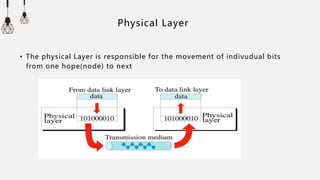
• The physical Layer is responsible for the movement of indivudual bits
from one hope(node) to next
Physical Layer(Conti)
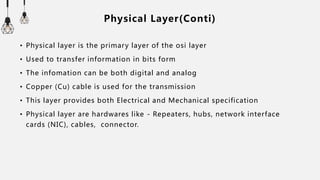
• Physical layer is the primary layer of the osi layer
• Used to transfer information in bits form
• The infomation can be both digital and analog
• Copper (Cu) cable is used for the transmission
• This layer provides both Electrical and Mechanical specification
• Physical layer are hardwares like - Repeaters, hubs, network interface
cards (NIC), cables, connector.
Data link layer
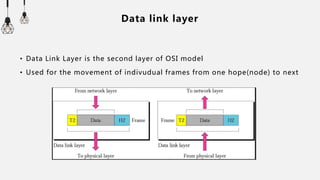
• Data Link Layer is the second layer of OSI model
• Used for the movement of indivudual frames from one hope(node) to next
Data Link Layer (conti)
• It organise bits into frames
• It provide node to node delivery
• Device used are Switch, Bridge, Ethernet
• This layer consist of 2 sublayers
logical link control (LLC) sublayer
Medium access control (MAC) sublayer
• LLC acts act an interface between the network layer and the medium
access control (MAC) sublayer of the data link layer.
• Data link layer allows multipoint connection
Network layer
• The Network Layer is the third layer of the OSI model.
• It translates the logical addresses into physical addresses.
• Information are sent in the form of packets.
• It is used to move packets from source to destination.
• It provide inter network link between source and destination.
• Device used in the network layer is routers.
• Routers are used to connect two or more IP networks.
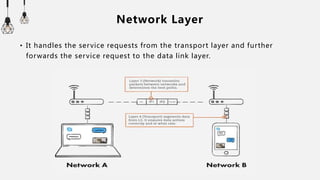
Network Layer
• It handles the service requests from the transport layer and further
forwards the service request to the data link layer.
Transport Layer
Application
Presentation
Session
Transport
Network
Data Link
Physical
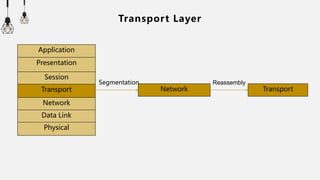
Network Transport
Segmentation Reassembly
Transport Layer
• It is the fourth layer of the OSI Layer
• It ensure end to end communication
• It is used in error recovery
• Device used in transport layers are Gateways, Firewalls
• Reliable delivery of segments between points on a network
• Transport Layer send packets in correct sequence
• Responsiblity - Segmentation, Reassembly, flow control, error control,
error detection and recovery, service point addressing
Session Layer
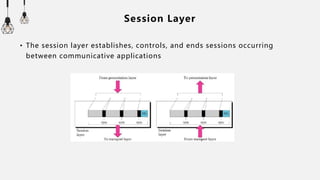
• The session layer establishes, controls, and ends sessions occurring
between communicative applications
Session Layer
• This layer establish, maintain and synchronize the interaction between
communicating systems.
• It controls the connections between multiple computers.
• The session layer tracks the dialogs between computers.
• Session Layer consist of requests and responses that occur between
application layer
• Responsible for inter host communication
Presentation Layer
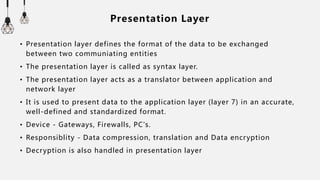
• The presentation layer mainly translates data between the application layer and
the network format
• It translate encrypt and compressed data
Presentation Layer
• Presentation layer defines the format of the data to be exchanged
between two communiating entities
• The presentation layer is called as syntax layer.
• The presentation layer acts as a translator between application and
network layer
• It is used to present data to the application layer (layer 7) in an accurate,
well-defined and standardized format.
• Device - Gateways, Firewalls, PC's.
• Responsiblity - Data compression, translation and Data encryption
• Decryption is also handled in presentation layer
Application Layer
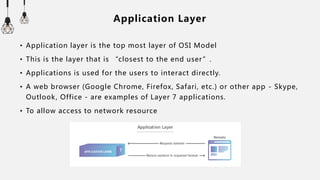
• Application layer is the top most layer of OSI Model
• This is the layer that is “closest to the end user”.
• Applications is used for the users to interact directly.
• A web browser (Google Chrome, Firefox, Safari, etc.) or other app - Skype,
Outlook, Office - are examples of Layer 7 applications.
• To allow access to network resource
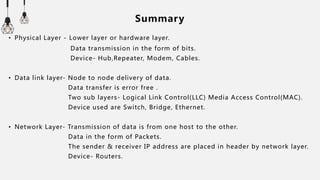
Summary
• Physical Layer - Lower layer or hardware layer.
Data transmission in the form of bits.
Device- Hub,Repeater, Modem, Cables.
• Data link layer- Node to node delivery of data.
Data transfer is error free .
Two sub layers- Logical Link Control(LLC) Media Access Control(MAC).
Device used are Switch, Bridge, Ethernet.
• Network Layer- Transmission of data is from one host to the other.
Data in the form of Packets.
The sender & receiver IP address are placed in header by network layer.
Device- Routers.
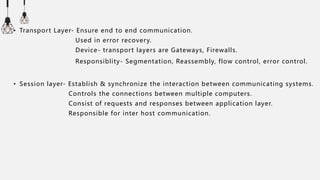
• Transport Layer- Ensure end to end communication.
Used in error recovery.
Device- transport layers are Gateways, Firewalls.
Responsiblity- Segmentation, Reassembly, flow control, error control.
• Session layer- Establish & synchronize the interaction between communicating systems.
Controls the connections between multiple computers.
Consist of requests and responses between application layer.
Responsible for inter host communication.
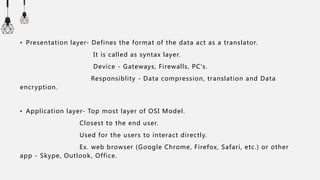
• Presentation layer- Defines the format of the data act as a translator.
It is called as syntax layer.
Device - Gateways, Firewalls, PC's.
Responsiblity - Data compression, translation and Data
encryption.
• Application layer- Top most layer of OSI Model.
Closest to the end user.
Used for the users to interact directly.
Ex. web browser (Google Chrome, Firefox, Safari, etc.) or other
app - Skype, Outlook, Office.
THANKS
Thanks for watching.

OSI layer (Network)

  • 1.
    OSI Layer ( Op e n S y s t e m I n t e r c o n n e c t i o n M o d e l ) By Swetha Rajendran
  • 2.
    What is OSILayers???
  • 3.
    7 layer ofOSI 1. Application 2. Presentation 3. Session 4. Transport 5. Network 6. Data link 7. Physical Used for user support To ensure end to end communication Used for Network purpose
  • 4.
    Physical Layer • Thephysical Layer is responsible for the movement of indivudual bits from one hope(node) to next
  • 5.
    Physical Layer(Conti) • Physicallayer is the primary layer of the osi layer • Used to transfer information in bits form • The infomation can be both digital and analog • Copper (Cu) cable is used for the transmission • This layer provides both Electrical and Mechanical specification • Physical layer are hardwares like - Repeaters, hubs, network interface cards (NIC), cables, connector.
  • 6.
    Data link layer •Data Link Layer is the second layer of OSI model • Used for the movement of indivudual frames from one hope(node) to next
  • 7.
    Data Link Layer(conti) • It organise bits into frames • It provide node to node delivery • Device used are Switch, Bridge, Ethernet • This layer consist of 2 sublayers logical link control (LLC) sublayer Medium access control (MAC) sublayer • LLC acts act an interface between the network layer and the medium access control (MAC) sublayer of the data link layer. • Data link layer allows multipoint connection
  • 8.
    Network layer • TheNetwork Layer is the third layer of the OSI model. • It translates the logical addresses into physical addresses. • Information are sent in the form of packets. • It is used to move packets from source to destination. • It provide inter network link between source and destination. • Device used in the network layer is routers. • Routers are used to connect two or more IP networks.
  • 9.
    Network Layer • Ithandles the service requests from the transport layer and further forwards the service request to the data link layer.
  • 10.
  • 11.
    Transport Layer • Itis the fourth layer of the OSI Layer • It ensure end to end communication • It is used in error recovery • Device used in transport layers are Gateways, Firewalls • Reliable delivery of segments between points on a network • Transport Layer send packets in correct sequence • Responsiblity - Segmentation, Reassembly, flow control, error control, error detection and recovery, service point addressing
  • 12.
    Session Layer • Thesession layer establishes, controls, and ends sessions occurring between communicative applications
  • 13.
    Session Layer • Thislayer establish, maintain and synchronize the interaction between communicating systems. • It controls the connections between multiple computers. • The session layer tracks the dialogs between computers. • Session Layer consist of requests and responses that occur between application layer • Responsible for inter host communication
  • 14.
    Presentation Layer • Thepresentation layer mainly translates data between the application layer and the network format • It translate encrypt and compressed data
  • 15.
    Presentation Layer • Presentationlayer defines the format of the data to be exchanged between two communiating entities • The presentation layer is called as syntax layer. • The presentation layer acts as a translator between application and network layer • It is used to present data to the application layer (layer 7) in an accurate, well-defined and standardized format. • Device - Gateways, Firewalls, PC's. • Responsiblity - Data compression, translation and Data encryption • Decryption is also handled in presentation layer
  • 16.
    Application Layer • Applicationlayer is the top most layer of OSI Model • This is the layer that is “closest to the end user”. • Applications is used for the users to interact directly. • A web browser (Google Chrome, Firefox, Safari, etc.) or other app - Skype, Outlook, Office - are examples of Layer 7 applications. • To allow access to network resource
  • 17.
    Summary • Physical Layer- Lower layer or hardware layer. Data transmission in the form of bits. Device- Hub,Repeater, Modem, Cables. • Data link layer- Node to node delivery of data. Data transfer is error free . Two sub layers- Logical Link Control(LLC) Media Access Control(MAC). Device used are Switch, Bridge, Ethernet. • Network Layer- Transmission of data is from one host to the other. Data in the form of Packets. The sender & receiver IP address are placed in header by network layer. Device- Routers.
  • 18.
    • Transport Layer-Ensure end to end communication. Used in error recovery. Device- transport layers are Gateways, Firewalls. Responsiblity- Segmentation, Reassembly, flow control, error control. • Session layer- Establish & synchronize the interaction between communicating systems. Controls the connections between multiple computers. Consist of requests and responses between application layer. Responsible for inter host communication.
  • 19.
    • Presentation layer-Defines the format of the data act as a translator. It is called as syntax layer. Device - Gateways, Firewalls, PC's. Responsiblity - Data compression, translation and Data encryption. • Application layer- Top most layer of OSI Model. Closest to the end user. Used for the users to interact directly. Ex. web browser (Google Chrome, Firefox, Safari, etc.) or other app - Skype, Outlook, Office.
  • 20.

Editor's Notes

  • #2 Hey guys today's topic is about OSI Layer
  • #3 So wat s OSI layer?
  • #4 There are 7 layers of OSI. First layer is Physical layer followed by Data link Network Transport Session Presentation and Application
  • #5 First layer is Phisical layer and it is responsible for the movement of indivudual bits from one hope(node) to next
  • #6 Physical layer is used to transfer information in bits form. The infomation can be both digital and analog. The information can be tranfered through copper cable. Physical layer are hardwares like - Repeaters, hubs, network interface cards (NIC), cables, connector.
  • #7 Next layer is Data link layer of OSI layer. It is used for the movement of indivudual frames from one hope(node) to next
  • #8 In Data link layer the data is sent in the form of frames. the device used in data link layers are Switch, Bridge, Ethernet. This layer consist of 2 sublayers logical link control (LLC) sublayer and Medium access control (MAC) sublayer. LLC acts act an interface between the network layer and the medium access control (MAC) sublayer of the data link layer.
  • #9 The Network Layer is the third layer of the OSI model. Information are sent in the form of packets. It provide inter network link between source and destination. Device used in the network layer is routers. Routers are used to connect two or more IP networks.
  • #10  Network layer handles the service requests from the transport layer and further forwards the service request to the data link layer.
  • #11 This layer is about transport layer.
  • #12 Transport Layer send packets in correct sequence. It is responsible for Segmentation, Reassembly, flow control, error control, error detection and recovery, service point addressing
  • #13 The session layer establishes, controls, and ends sessions occurring between communicative applications
  • #14 This layer establish, maintain and synchronize the interaction between communicating systems. It controls the connections between multiple computers. Session Layer consist of requests and responses that occur between application layer it is responsible for inter host communication
  • #15 This layer mainly translates data between the application layer and the network format It translate encrypt and compressed data
  • #16 The presentation layer is called as syntax layer. The presentation layer acts as a translator between application and network layer. Decryption is also handled in presentation layer. It is responsible for Data compression, translation and Data encryption. Device used in presentation layers are Gateways, Firewalls, PC's.
  • #17 Application layer is the top layer of OSI Model. This layer is used for the users to interact directly. For example : A web browser (Google Chrome, Firefox, Safari, etc.) or other app - Skype, Outlook, Office.