Grid Computing Gargi Shankar Verma Reader – Dept. Of Information Technology     Rungta College of Engg.& Technology Bhilai
Introduction to Grid Computing What if the computers you own don't have enough CPU cycles to meet your needs? What if the institution you work for doesn't have enough CPU cycles to meet your needs? What if no single HPC Center has enough CPU cycles to meet your needs?  What if you've got spare CPU cycles that aren't being used by local users?
Desktop A desktop computer is yours to do with what you like... Two quad-core 3 GHz CPUs 16 GB RAM 125 Gflops
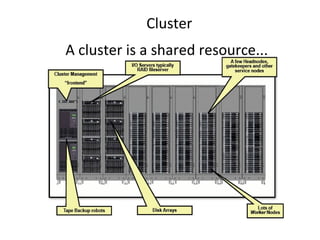
A cluster is a shared resource... Cluster
Computing Grids Grids represent a different approach ... Build  bigger supercomputers by joining smaller ones' together in a grid.
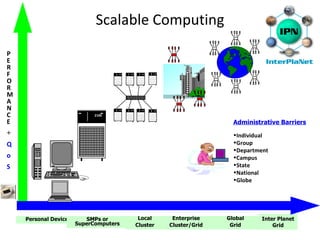
Scalable Computing Local Cluster Inter Planet Grid Personal Device SMPs or SuperComputers Global Grid PERFORMANCE + Q o S Individual Group Department Campus State National Globe Administrative Barriers Enterprise Cluster/Grid 2100 2100 2100 2100 2100 2100 2100 2100 2100
PC vs Cluster vs Grid PC:  Owner has total control Limited capabilities Cluster: Used by a small number of people (e.g., department, institution) Preserves some locality Grid: Thousands of users - large scale From many different places - highly distributed Increased problems (due to distributed nature)
What is a Grid? A Grid is a system that coordinates resources that are not subject to centralized control.  Using standard, open, general-purpose protocols and interfaces,  to deliver nontrivial qualities of service.
What is Grid Computing? Computational Grids Homogeneous (e.g., Clusters) Heterogeneous (e.g., with one-of-a-kind instruments) Cousins of Grid Computing Methods of Grid Computing
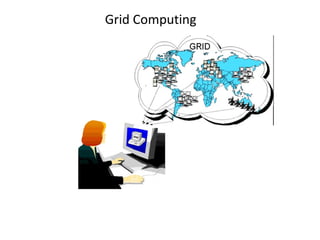
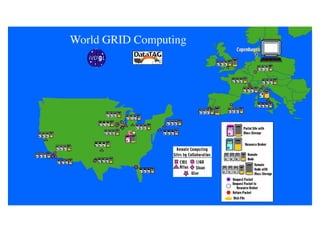
Grid Computing
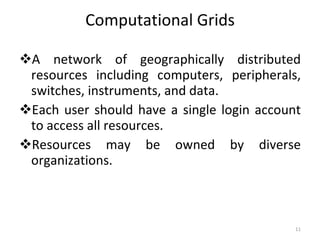
Computational Grids A network of geographically distributed resources including computers, peripherals, switches, instruments, and data. Each user should have a single login account to access all resources. Resources may be owned by diverse organizations.
Computational Grids Grids are typically managed by gridware.  Gridware can be viewed as a special type of middleware that enable sharing and manage grid components based on user requirements and resource attributes (e.g., capacity, performance, availability…)
Cousins of Grid Computing Parallel Computing Distributed Computing Peer-to-Peer Computing Many others: Cluster Computing, Network Computing, Client/Server Computing, Internet Computing, etc...
Distributed Computing People often ask: Is Grid Computing a fancy new name for the concept of distributed computing? In general, the answer is “no.” Distributed Computing is most often concerned with distributing the load of a program across two or more processes.
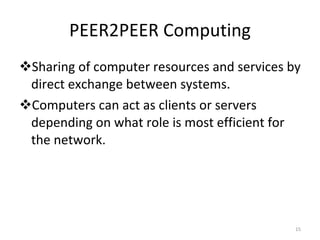
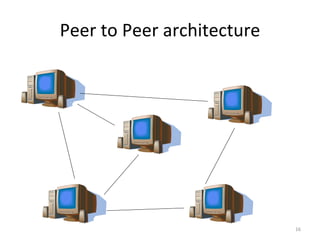
PEER2PEER Computing Sharing of computer resources and services by direct exchange between systems. Computers can act as clients or servers depending on what role is most efficient for the network.
Peer to Peer architecture
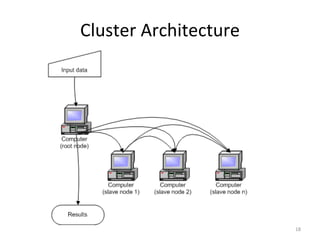
Cluster computing Put some PCs together and get them to communicate Cheaper to build than a mainframe supercomputer Different sizes of clusters Scalable – can grow a cluster by adding more PCs
Cluster Architecture
Methods of Grid Computing Distributed Supercomputing High-Throughput Computing On-Demand Computing Data-Intensive Computing Collaborative Computing Logistical Networking
Distributed Supercomputing Combining multiple high-capacity resources on a computational grid into a single, virtual distributed supercomputer. Tackle problems that cannot be solved on a single system.
High-Throughput Computing Uses the grid to schedule large numbers of loosely coupled or independent tasks, with the goal of putting unused processor cycles to work.
On-Demand Computing Uses grid capabilities to meet short-term requirements for resources that are not locally accessible. Models real-time computing demands.
Data-Intensive Computing The focus is on synthesizing new information from data that is maintained in geographically distributed repositories, digital libraries, and databases. Particularly useful for distributed data mining.
Collaborative Computing Concerned primarily with enabling and enhancing human-to-human interactions.  Applications are often structured in terms of a virtual shared space.
Logistical Networking Global scheduling and optimization of data movement. Contrasts with traditional networking, which does not explicitly model storage resources in the network.  Called "logistical" because of the analogy it bears with the systems of warehouses, depots, and distribution channels.
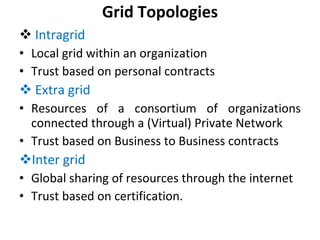
Grid Topologies Intragrid Local grid within an organization Trust based on personal contracts Extra grid Resources of a consortium of organizations connected through a (Virtual) Private Network Trust based on Business to Business contracts Inter grid Global sharing of resources through the internet Trust based on certification.
Who Needs Grid Computing? A chemist may utilize hundreds of processors to screen thousands of compounds per hour. Teams of engineers worldwide pool resources to analyze terabytes of structural data. Meteorologists seek to visualize and analyze petabytes of climate data with enormous computational demands .
 
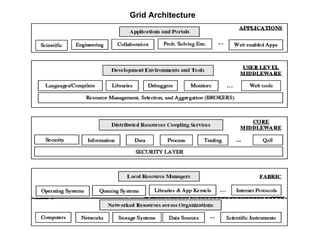
Grid Architecture
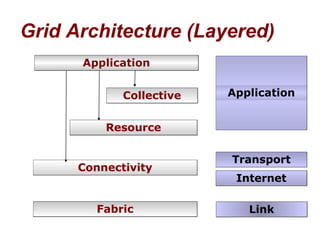
Connectivity Fabric Resource Collective Application Link Internet Transport Application Grid Architecture (Layered)
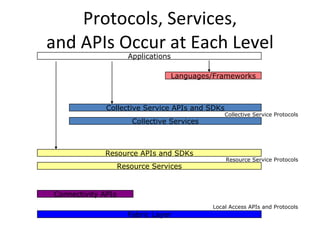
Protocols, Services, and APIs Occur at Each Level Languages/Frameworks Fabric Layer Applications Local Access APIs and Protocols Collective Service APIs and SDKs Collective Services Collective Service Protocols Resource APIs and SDKs Resource Services Resource Service Protocols Connectivity APIs
Application layer defines protocols and services that are parochial  in nature, targeted towards a specific application domain or class of applications.
Grid layer defines protocols  that provide system oriented capabilities that are expected to be wide scale in deployment and generic in function.  This includes GIIS,  bandwidth brokers, resource brokers,….
Resource layer defines protocols to initiate and control sharing of (local) resources.  Services defined at this level are gatekeeper, GRIS, along with some user oriented application protocols from the Internet protocol suite, such as file-transfer.
The connectivity layer defines core protocols required for Grid-specific network transactions.  This layer includes the IP protocol stack (system level application protocols [e.g. DNS, RSVP, Routing], transport and internet layers), as well as core Grid security protocols for authentication and authorization.
Fabric layer includes the protocols and interfaces that provide access to the resources that are being shared, including computers, storage systems, datasets, programs, and networks.  This layer is a logical view rather then a physical view.  For example, the view of a cluster with a local resource manager is defined by the local resource manger, and not the cluster hardware.  Likewise, the fabric provided by a storage system is defined by the file system that is available on that system, not the raw disk or tapes.
Types of Grids Computational Grid Scavenging  Grid  Data Grid
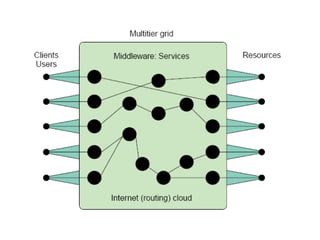
Architecture of Computational Grid
 
Continue…………. Independent clients are given access to a set of resources through a middle tier that routes information and implements the different services.  We define computational grid as a collection of computers, online instruments, data archives, and networks that are connected by a shared set of services which, when taken together, provide users with transparent access to the entire set of resources.
Computational Grid A computational grid is a hardware and software infrastructure that provides  dependable, consistent, pervasive, and inexpensive  access to high-end computational capabilities.
Dependable The need for dependable service Is fundamental. Users require assurances that they will receive predictable, sustained, and often high levels of performance from the diverse components that constitute the grid; in the absence of such assurances, applications will not be written or used. The performance characteristics that are of interest will vary widely from application to application, but may include network bandwidth, latency, jitter, computer power, software services, security, and reliability.
Consistent The need for consistency of service is a second fundamental concern.  As with electric power , we need standard services, accessible via standard interfaces, and operating within standard parameters. Without such standards, application development and pervasive use are impractical. A significant challenge when developing standards is to encapsulate heterogeneity without compromising high-performance execution.
Pervasive Pervasive access allows us to count on services always being available, within whatever environment we expect to move. Pervasiveness does not imply that resources are everywhere or are universally accessible. We cannot access electric power in a new home until wire has been laid and an account established with the local utility; computational grids will have similarly circumscribed availability and controlled access. However, we will be able to count on universal access within the confines of whatever environment the grid is designed to support.
Inexpensive An infrastructure must offer inexpensive (relative to income) access if it is to be broadly accepted and used. Homeowners and industrialists both make use of remote billion-dollar power plants on a daily basis because the cost to them is reasonable. A computational grid must achieve similarly attractive economics.
Approaches are needed to develop a computational grids. Grid developers  Tool developers  Application developers
Grid Developers Develop protocols and produce routine libraries. The challenge here is to produce a library of protocols which will work well with many underlying technologies (e.g., different types of networks). The library must also fulfill the many different requests from the tool developers, making it hard to give every different request best performance, while at the same time accommodating the different underlying technologies. There will therefore be a battle between generality and performance. It is very important to standardize all protocols so the tool developers knows how they can implement their work.
Tool Developer Concentrate on developing a system that will take care of the main things that must exist for using various applications. Security must be taken care of, things like authentication and confidentiality has to be implemented. They also develop methods for payments, which are very important in for example on-demand grids. Finally they also develop methods to find and organize resources and information. Which include communication, fault detection and many more things.
Continue……………. Tool developers must adapt their protocols to fit the protocols developed by the grid developers and also keep in mind the requests from the application developers. Everything must be standardized so that the application developers easily can make use of the capabilities from the tool-layer. The tool developers must also inform the application developers which implementation can get higher or lower performance.
Application Developers Application developers which are supposed to use all the methods they need from the tool level to make specific application programs for the end users. Applications that are intended to solve hard problems for the end users. The challenge for the application developers is finding algorithms that divide a task into thousands of smaller tasks that can be handled separately and to make the tasks work efficient with the tool layer. For the end user it will only be important to solve a request while it is less important for the user to know how it works
Application of computational grid Government  Health Maintenance  A material science collaboratory  Computational market economy


Scavenging grid A scavenging grid is most commonly used with large numbers of desktop machines. Machines are scavenged for available CPU cycles and other resources. Owners of the desktop machines are usually given control over when their resources are available to participate in the grid
Components of Grid
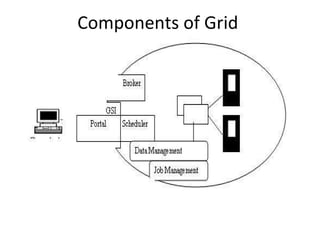
Grid Portal:  Portal  provides the user with an interface to launch applications.. Grid Security Infrastructure (GSI):  It consists of 2 components -user security and-node security.  User security   provides single sign-on, delegation, run-anywhere authentication service, with support  for local control over access rights . In node security, if a processor enrolls in a dynamic rather than pre-administered manner, then an identification and authentication validation must be performed before the processor can actually participate in the grid’s work. A certificate authority (CA) can be utilized to establish the identity of the processor as well as the users of the grid
Broker:  It provides information about available resources on the grid and  working status of  these resources.  Data management Block:  It is responsible for moving files and data to various nodes within the grid. Job Management Block:  It is also known as grid resource allocation Manager(GRAM). Its functions include providing the services to launch a job on a particular resource checking the job’s status, retrieve the results when the job is complete. It keeps track of the resources available to the grid and which users are members of the grid
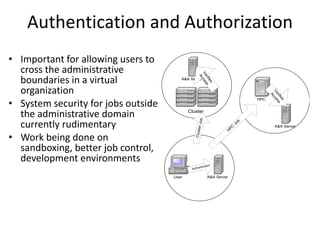
Authentication and Authorization Important for allowing users to cross the administrative boundaries in a virtual organization System security for jobs outside the administrative domain currently rudimentary Work being done on sandboxing, better job control, development environments
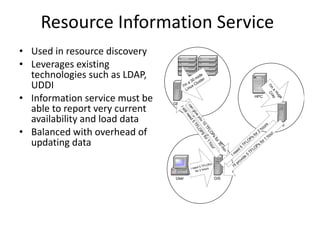
Resource Information Service Used in resource discovery Leverages existing technologies such as LDAP, UDDI Information service must be able to report very current availability and load data Balanced with overhead of updating data
Scheduler Owners of systems interested in maximizing throughput Users interested in maximizing runtime performance Both offer challenges with crossing administrative boundaries Unique issues such as co-allocation and co-location Interesting work being done in scheduling like market based scheduling

Inroduction to grid computing by gargi shankar verma

  • 1.
    Grid Computing GargiShankar Verma Reader – Dept. Of Information Technology Rungta College of Engg.& Technology Bhilai
  • 2.
    Introduction to GridComputing What if the computers you own don't have enough CPU cycles to meet your needs? What if the institution you work for doesn't have enough CPU cycles to meet your needs? What if no single HPC Center has enough CPU cycles to meet your needs? What if you've got spare CPU cycles that aren't being used by local users?
  • 3.
    Desktop A desktopcomputer is yours to do with what you like... Two quad-core 3 GHz CPUs 16 GB RAM 125 Gflops
  • 4.
    A cluster isa shared resource... Cluster
  • 5.
    Computing Grids Gridsrepresent a different approach ... Build bigger supercomputers by joining smaller ones' together in a grid.
  • 6.
    Scalable Computing LocalCluster Inter Planet Grid Personal Device SMPs or SuperComputers Global Grid PERFORMANCE + Q o S Individual Group Department Campus State National Globe Administrative Barriers Enterprise Cluster/Grid 2100 2100 2100 2100 2100 2100 2100 2100 2100
  • 7.
    PC vs Clustervs Grid PC: Owner has total control Limited capabilities Cluster: Used by a small number of people (e.g., department, institution) Preserves some locality Grid: Thousands of users - large scale From many different places - highly distributed Increased problems (due to distributed nature)
  • 8.
    What is aGrid? A Grid is a system that coordinates resources that are not subject to centralized control. Using standard, open, general-purpose protocols and interfaces, to deliver nontrivial qualities of service.
  • 9.
    What is GridComputing? Computational Grids Homogeneous (e.g., Clusters) Heterogeneous (e.g., with one-of-a-kind instruments) Cousins of Grid Computing Methods of Grid Computing
  • 10.
  • 11.
    Computational Grids Anetwork of geographically distributed resources including computers, peripherals, switches, instruments, and data. Each user should have a single login account to access all resources. Resources may be owned by diverse organizations.
  • 12.
    Computational Grids Gridsare typically managed by gridware. Gridware can be viewed as a special type of middleware that enable sharing and manage grid components based on user requirements and resource attributes (e.g., capacity, performance, availability…)
  • 13.
    Cousins of GridComputing Parallel Computing Distributed Computing Peer-to-Peer Computing Many others: Cluster Computing, Network Computing, Client/Server Computing, Internet Computing, etc...
  • 14.
    Distributed Computing Peopleoften ask: Is Grid Computing a fancy new name for the concept of distributed computing? In general, the answer is “no.” Distributed Computing is most often concerned with distributing the load of a program across two or more processes.
  • 15.
    PEER2PEER Computing Sharingof computer resources and services by direct exchange between systems. Computers can act as clients or servers depending on what role is most efficient for the network.
  • 16.
    Peer to Peerarchitecture
  • 17.
    Cluster computing Putsome PCs together and get them to communicate Cheaper to build than a mainframe supercomputer Different sizes of clusters Scalable – can grow a cluster by adding more PCs
  • 18.
  • 19.
    Methods of GridComputing Distributed Supercomputing High-Throughput Computing On-Demand Computing Data-Intensive Computing Collaborative Computing Logistical Networking
  • 20.
    Distributed Supercomputing Combiningmultiple high-capacity resources on a computational grid into a single, virtual distributed supercomputer. Tackle problems that cannot be solved on a single system.
  • 21.
    High-Throughput Computing Usesthe grid to schedule large numbers of loosely coupled or independent tasks, with the goal of putting unused processor cycles to work.
  • 22.
    On-Demand Computing Usesgrid capabilities to meet short-term requirements for resources that are not locally accessible. Models real-time computing demands.
  • 23.
    Data-Intensive Computing Thefocus is on synthesizing new information from data that is maintained in geographically distributed repositories, digital libraries, and databases. Particularly useful for distributed data mining.
  • 24.
    Collaborative Computing Concernedprimarily with enabling and enhancing human-to-human interactions. Applications are often structured in terms of a virtual shared space.
  • 25.
    Logistical Networking Globalscheduling and optimization of data movement. Contrasts with traditional networking, which does not explicitly model storage resources in the network. Called "logistical" because of the analogy it bears with the systems of warehouses, depots, and distribution channels.
  • 26.
    Grid Topologies IntragridLocal grid within an organization Trust based on personal contracts Extra grid Resources of a consortium of organizations connected through a (Virtual) Private Network Trust based on Business to Business contracts Inter grid Global sharing of resources through the internet Trust based on certification.
  • 27.
    Who Needs GridComputing? A chemist may utilize hundreds of processors to screen thousands of compounds per hour. Teams of engineers worldwide pool resources to analyze terabytes of structural data. Meteorologists seek to visualize and analyze petabytes of climate data with enormous computational demands .
  • 28.
  • 29.
  • 30.
    Connectivity Fabric ResourceCollective Application Link Internet Transport Application Grid Architecture (Layered)
  • 31.
    Protocols, Services, andAPIs Occur at Each Level Languages/Frameworks Fabric Layer Applications Local Access APIs and Protocols Collective Service APIs and SDKs Collective Services Collective Service Protocols Resource APIs and SDKs Resource Services Resource Service Protocols Connectivity APIs
  • 32.
    Application layer definesprotocols and services that are parochial in nature, targeted towards a specific application domain or class of applications.
  • 33.
    Grid layer definesprotocols that provide system oriented capabilities that are expected to be wide scale in deployment and generic in function. This includes GIIS, bandwidth brokers, resource brokers,….
  • 34.
    Resource layer definesprotocols to initiate and control sharing of (local) resources. Services defined at this level are gatekeeper, GRIS, along with some user oriented application protocols from the Internet protocol suite, such as file-transfer.
  • 35.
    The connectivity layerdefines core protocols required for Grid-specific network transactions. This layer includes the IP protocol stack (system level application protocols [e.g. DNS, RSVP, Routing], transport and internet layers), as well as core Grid security protocols for authentication and authorization.
  • 36.
    Fabric layer includesthe protocols and interfaces that provide access to the resources that are being shared, including computers, storage systems, datasets, programs, and networks. This layer is a logical view rather then a physical view. For example, the view of a cluster with a local resource manager is defined by the local resource manger, and not the cluster hardware. Likewise, the fabric provided by a storage system is defined by the file system that is available on that system, not the raw disk or tapes.
  • 37.
    Types of GridsComputational Grid Scavenging Grid Data Grid
  • 38.
  • 39.
  • 40.
    Continue…………. Independent clientsare given access to a set of resources through a middle tier that routes information and implements the different services. We define computational grid as a collection of computers, online instruments, data archives, and networks that are connected by a shared set of services which, when taken together, provide users with transparent access to the entire set of resources.
  • 41.
    Computational Grid Acomputational grid is a hardware and software infrastructure that provides dependable, consistent, pervasive, and inexpensive access to high-end computational capabilities.
  • 42.
    Dependable The needfor dependable service Is fundamental. Users require assurances that they will receive predictable, sustained, and often high levels of performance from the diverse components that constitute the grid; in the absence of such assurances, applications will not be written or used. The performance characteristics that are of interest will vary widely from application to application, but may include network bandwidth, latency, jitter, computer power, software services, security, and reliability.
  • 43.
    Consistent The needfor consistency of service is a second fundamental concern. As with electric power , we need standard services, accessible via standard interfaces, and operating within standard parameters. Without such standards, application development and pervasive use are impractical. A significant challenge when developing standards is to encapsulate heterogeneity without compromising high-performance execution.
  • 44.
    Pervasive Pervasive accessallows us to count on services always being available, within whatever environment we expect to move. Pervasiveness does not imply that resources are everywhere or are universally accessible. We cannot access electric power in a new home until wire has been laid and an account established with the local utility; computational grids will have similarly circumscribed availability and controlled access. However, we will be able to count on universal access within the confines of whatever environment the grid is designed to support.
  • 45.
    Inexpensive An infrastructuremust offer inexpensive (relative to income) access if it is to be broadly accepted and used. Homeowners and industrialists both make use of remote billion-dollar power plants on a daily basis because the cost to them is reasonable. A computational grid must achieve similarly attractive economics.
  • 46.
    Approaches are neededto develop a computational grids. Grid developers Tool developers Application developers
  • 47.
    Grid Developers Developprotocols and produce routine libraries. The challenge here is to produce a library of protocols which will work well with many underlying technologies (e.g., different types of networks). The library must also fulfill the many different requests from the tool developers, making it hard to give every different request best performance, while at the same time accommodating the different underlying technologies. There will therefore be a battle between generality and performance. It is very important to standardize all protocols so the tool developers knows how they can implement their work.
  • 48.
    Tool Developer Concentrateon developing a system that will take care of the main things that must exist for using various applications. Security must be taken care of, things like authentication and confidentiality has to be implemented. They also develop methods for payments, which are very important in for example on-demand grids. Finally they also develop methods to find and organize resources and information. Which include communication, fault detection and many more things.
  • 49.
    Continue……………. Tool developersmust adapt their protocols to fit the protocols developed by the grid developers and also keep in mind the requests from the application developers. Everything must be standardized so that the application developers easily can make use of the capabilities from the tool-layer. The tool developers must also inform the application developers which implementation can get higher or lower performance.
  • 50.
    Application Developers Applicationdevelopers which are supposed to use all the methods they need from the tool level to make specific application programs for the end users. Applications that are intended to solve hard problems for the end users. The challenge for the application developers is finding algorithms that divide a task into thousands of smaller tasks that can be handled separately and to make the tasks work efficient with the tool layer. For the end user it will only be important to solve a request while it is less important for the user to know how it works
  • 51.
    Application of computationalgrid Government Health Maintenance A material science collaboratory Computational market economy
  • 52.
  • 53.
  • 54.
  • 55.
  • 56.
  • 57.
  • 58.
    Scavenging grid Ascavenging grid is most commonly used with large numbers of desktop machines. Machines are scavenged for available CPU cycles and other resources. Owners of the desktop machines are usually given control over when their resources are available to participate in the grid
  • 59.
  • 60.
    Grid Portal: Portal provides the user with an interface to launch applications.. Grid Security Infrastructure (GSI): It consists of 2 components -user security and-node security. User security provides single sign-on, delegation, run-anywhere authentication service, with support for local control over access rights . In node security, if a processor enrolls in a dynamic rather than pre-administered manner, then an identification and authentication validation must be performed before the processor can actually participate in the grid’s work. A certificate authority (CA) can be utilized to establish the identity of the processor as well as the users of the grid
  • 61.
    Broker: Itprovides information about available resources on the grid and working status of these resources. Data management Block: It is responsible for moving files and data to various nodes within the grid. Job Management Block: It is also known as grid resource allocation Manager(GRAM). Its functions include providing the services to launch a job on a particular resource checking the job’s status, retrieve the results when the job is complete. It keeps track of the resources available to the grid and which users are members of the grid
  • 62.
    Authentication and AuthorizationImportant for allowing users to cross the administrative boundaries in a virtual organization System security for jobs outside the administrative domain currently rudimentary Work being done on sandboxing, better job control, development environments
  • 63.
    Resource Information ServiceUsed in resource discovery Leverages existing technologies such as LDAP, UDDI Information service must be able to report very current availability and load data Balanced with overhead of updating data
  • 64.
    Scheduler Owners ofsystems interested in maximizing throughput Users interested in maximizing runtime performance Both offer challenges with crossing administrative boundaries Unique issues such as co-allocation and co-location Interesting work being done in scheduling like market based scheduling

Editor's Notes

  • #32 This figure shows the relationship between APIs, services and protocols. At each protocol layer in the Grid architecture, one or more services are defined. Access to these services is provided by one or more APIs. More sophisticated interfaces, which we call software development toolkits (SDKs) provide complex functionality that may not map one to one onto service functions and may combine services and protocols at lower levels in the Grid protocol stack. At the top of this figure, we include languages and frameworks, which utilize the various APIs and SDKs to provide programming environments to the Grid application.