Course Title: Computer Networks
Submitted By
Name: Joty Akhter
ID: 1834902551
Topic
Basic Introduction of Computer Network
Introduction
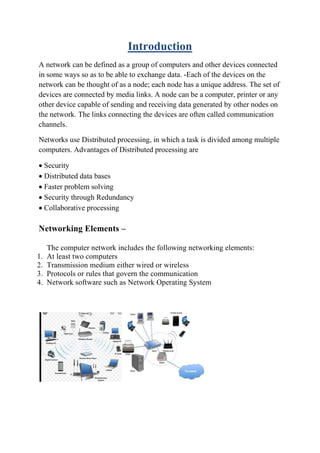
A network can be defined as a group of computers and other devices connected
in some ways so as to be able to exchange data. -Each of the devices on the
network can be thought of as a node; each node has a unique address. The set of
devices are connected by media links. A node can be a computer, printer or any
other device capable of sending and receiving data generated by other nodes on
the network. The links connecting the devices are often called communication
channels.
Networks use Distributed processing, in which a task is divided among multiple
computers. Advantages of Distributed processing are
• Security
• Distributed data bases
• Faster problem solving
• Security through Redundancy
• Collaborative processing
Networking Elements –
The computer network includes the following networking elements:
1. At least two computers
2. Transmission medium either wired or wireless
3. Protocols or rules that govern the communication
4. Network software such as Network Operating System
History Computer Network
18th Centuries:
Watt's Steam Engine. Optical Telegraph. ... The Lightning Rod.
19th Centuries:
Telegraph – 1837,Telephone - 1876. Electric Battery - 1800.Camera – 1888
Typewriter - 1867.
20th Centuries:
Radio ,Television, The Personal Computer. Information Gathering, Processing
and Distribution
21st Centuries:
Satellites, Fiber Optics, Internet
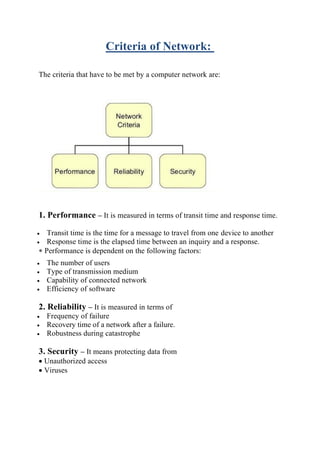
Criteria of Network:
The criteria that have to be met by a computer network are:
1. Performance – It is measured in terms of transit time and response time.
• Transit time is the time for a message to travel from one device to another
• Response time is the elapsed time between an inquiry and a response.
 Performance is dependent on the following factors:
• The number of users
• Type of transmission medium
• Capability of connected network
• Efficiency of software
2. Reliability – It is measured in terms of
• Frequency of failure
• Recovery time of a network after a failure.
• Robustness during catastrophe
3. Security – It means protecting data from
• Unauthorized access
• Viruses
Purpose of Computer Networks
The following are some important goals of computer networks:
• Resource Sharing –
Many organization has a substantial number of computers in operations,
which are located apart. Ex. A group of office workers can share a common
printer, fax, modem, scanner, etc.
• High Reliability –
If there are alternate sources of supply, all files could be replicated on two or
more machines. If one of them is not available, due to hardware failure, the
other copies could be used.
• Inter-Process Communication –
Network users, located geographically apart, may converse in an interactive
session through the network. In order to permit this, the network must provide
almost error-free communications.
• Flexible Access –
Files can be accessed from any computer in the network. The project can be
begun on one computer and finished on another.
Other goals include Distribution of processing functions, Centralized
management, and allocation of network resources, Compatibility of dissimilar
equipment and software, Good network performance, Scalability, Saving
money, Access to remote information, Person to person communication, etc.
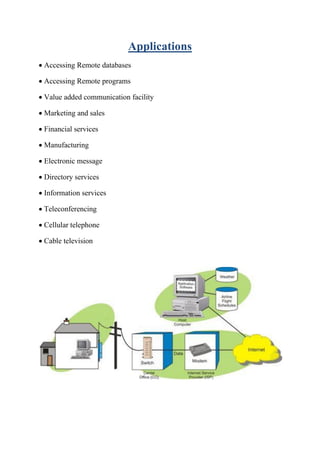
Applications
• Accessing Remote databases
• Accessing Remote programs
• Value added communication facility
• Marketing and sales
• Financial services
• Manufacturing
• Electronic message
• Directory services
• Information services
• Teleconferencing
• Cellular telephone
• Cable television
Thank You

Computer network Introduction

  • 1.
    Course Title: ComputerNetworks Submitted By Name: Joty Akhter ID: 1834902551 Topic Basic Introduction of Computer Network
  • 2.
    Introduction A network canbe defined as a group of computers and other devices connected in some ways so as to be able to exchange data. -Each of the devices on the network can be thought of as a node; each node has a unique address. The set of devices are connected by media links. A node can be a computer, printer or any other device capable of sending and receiving data generated by other nodes on the network. The links connecting the devices are often called communication channels. Networks use Distributed processing, in which a task is divided among multiple computers. Advantages of Distributed processing are • Security • Distributed data bases • Faster problem solving • Security through Redundancy • Collaborative processing Networking Elements – The computer network includes the following networking elements: 1. At least two computers 2. Transmission medium either wired or wireless 3. Protocols or rules that govern the communication 4. Network software such as Network Operating System
  • 3.
    History Computer Network 18thCenturies: Watt's Steam Engine. Optical Telegraph. ... The Lightning Rod. 19th Centuries: Telegraph – 1837,Telephone - 1876. Electric Battery - 1800.Camera – 1888 Typewriter - 1867. 20th Centuries: Radio ,Television, The Personal Computer. Information Gathering, Processing and Distribution 21st Centuries: Satellites, Fiber Optics, Internet
  • 4.
    Criteria of Network: Thecriteria that have to be met by a computer network are: 1. Performance – It is measured in terms of transit time and response time. • Transit time is the time for a message to travel from one device to another • Response time is the elapsed time between an inquiry and a response.  Performance is dependent on the following factors: • The number of users • Type of transmission medium • Capability of connected network • Efficiency of software 2. Reliability – It is measured in terms of • Frequency of failure • Recovery time of a network after a failure. • Robustness during catastrophe 3. Security – It means protecting data from • Unauthorized access • Viruses
  • 5.
    Purpose of ComputerNetworks The following are some important goals of computer networks: • Resource Sharing – Many organization has a substantial number of computers in operations, which are located apart. Ex. A group of office workers can share a common printer, fax, modem, scanner, etc. • High Reliability – If there are alternate sources of supply, all files could be replicated on two or more machines. If one of them is not available, due to hardware failure, the other copies could be used. • Inter-Process Communication – Network users, located geographically apart, may converse in an interactive session through the network. In order to permit this, the network must provide almost error-free communications. • Flexible Access – Files can be accessed from any computer in the network. The project can be begun on one computer and finished on another. Other goals include Distribution of processing functions, Centralized management, and allocation of network resources, Compatibility of dissimilar equipment and software, Good network performance, Scalability, Saving money, Access to remote information, Person to person communication, etc.
  • 6.
    Applications • Accessing Remotedatabases • Accessing Remote programs • Value added communication facility • Marketing and sales • Financial services • Manufacturing • Electronic message • Directory services • Information services • Teleconferencing • Cellular telephone • Cable television
  • 7.