Prepared By: Dikshita Viradia
 Introduction to Grid Computing 
 Definition in brief 
 History and Evaluation 
 Classification and Architecture 
 Real-time application 
 Advantage 
 Disadvantage 
 Conclusion 
 References
Grid Definition 
 a Grid is "a set of information resources 
(computers, databases, networks, instruments, 
etc.) that are integrated to provide users with 
tools and applications that treat those resources 
as components within a 'virtual' system". 
 Grid software solutions provide the underlying 
mechanisms necessary to create such systems, 
including authentication and authorization, 
resource discovery, resource management, 
communications, and information services, etc.
What is Grid Computing? 
 Grid computing is the collection of computer 
resources from multiple locations to reach a 
common goal. 
 Characteristics of a Grid: 
 No centralized control center 
 Heterogeneity (of resources) 
 Scalability 
 Dynamic and Adaptable
How do grid works? 
o Grids use networks to link the computing resources 
of many different computers. 
o The cyber-glue that binds all of these resources 
together is called “middleware.” There are many 
different types of middleware, developed for many 
different types of grid. 
o Middleware does all the work to connect users’ jobs 
to computing resources, thereby hiding the grid’s 
complexity from the user.
6 
Why do we need Grids? 
 Grids allow you to combine the resources of 
hundreds of computers to create a massively 
powerful, fully comprehensive computing resource, all 
accessible from the comfort of your own personal 
computer. 
 This means grids can react quickly to changing 
needs: a tremendous resource for crisis situations 
like natural disasters or epidemics.
o The idea is that in the future, plugging into a 
computing grid will be as simple as plugging into an 
electrical grid. And, like an electrical grid, users will 
simply plug in and use as much computing power as 
they need, without knowing where it comes from or 
how it was produced; you will simply plug in and use 
as much as you need.
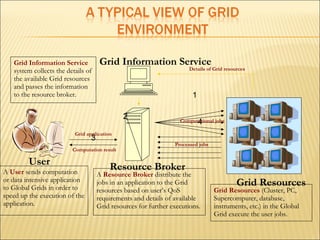
Grid application 
User Resource Broker 
Details of Grid resources 
Grid Resources 
Grid Information Service 
A User sends computation 
or data intensive application 
to Global Grids in order to 
speed up the execution of the 
application. 
1 
A Resource Broker distribute the 
jobs in an application to the Grid 
resources based on user’s QoS 
requirements and details of available 
Grid resources for further executions. 
Grid Resources (Cluster, PC, 
Supercomputer, database, 
instruments, etc.) in the Global 
Grid execute the user jobs. 
Grid Information Service 
system collects the details of 
the available Grid resources 
and passes the information 
to the resource broker. 
Computation result 
Computational jobs 
Processed jobs 
2 
3 
4
Introduction to Grid Architecture 
 Grid’s protocols allow VO users and resources to 
negotiate, establish, manage and exploit sharing 
relationships. 
 Interoperability a fundamental concern 
 The protocols are critical to interoperability 
 Services are important 
We need to consider APIs and SDKs 
VO: Virtual Organization
Introduction to Grid Architecture 
 The components are 
 numerous 
 owned and managed by different, potentially 
mutually distrustful organisations and individuals 
 may be potentially faulty 
 have different security requirements and policies 
 heterogeneous 
 connected by heterogeneous, multilevel 
networks 
 have different resource management policies 
 are likely to be geographically separated
11 
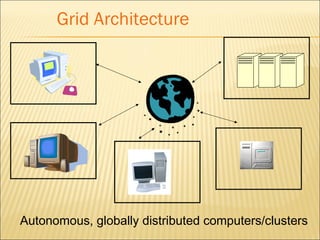
Grid Architecture 
Autonomous, globally distributed computers/clusters
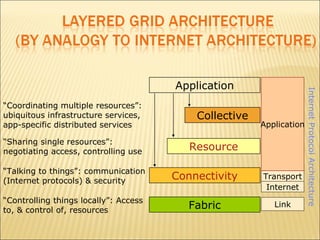
Application 
Collective 
“Coordinating multiple resources”: 
ubiquitous infrastructure services, 
app-specific distributed services 
“Sharing single resources”: Resource 
negotiating access, controlling use 
“Talking to things”: communication Connectivity 
(Internet protocols) & security 
“Controlling things locally”: Access Fabric 
to, & control of, resources 
Application 
Transport 
Internet 
Link 
Internet Protocol Architecture
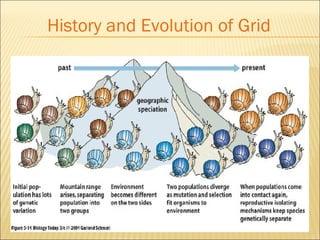
History and Evolution of Grid
History and Evolution of Grid 
 Early to mid 90s: numerous research projects on 
distributed computing 
 The term grid computing originated in the early 
1990s as a metaphor for making computer 
power as easy to access as an electric power 
grid. The power grid metaphor for accessible 
computing quickly became canonical when Ian 
Foster and Carl Kesselman published their 
seminal work, "The Grid: Blueprint for a new 
computing infrastructure
History and Evolution of Grid 
 1995, I-Way 
 IEEE/ACM 1995 Super Computing (San Diego), 11 high 
speed networks used to connect 17 sites to create one 
super meta-computer 
 Foster, Nature, 12/2002 
 1996, Globus project started (ANL & USC) 
 Followed I-Way 
 1997, Unicore (Germany)
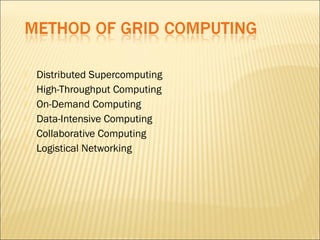
 Distributed Supercomputing 
 High-Throughput Computing 
 On-Demand Computing 
 Data-Intensive Computing 
 Collaborative Computing 
 Logistical Networking
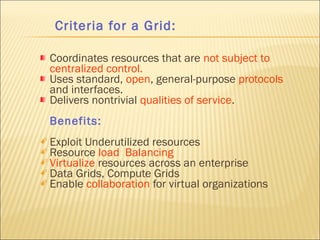
Criteria for a Grid: 
Coordinates resources that are not subject to 
centralized control. 
Uses standard, open, general-purpose protocols 
and interfaces. 
Delivers nontrivial qualities of service. 
Benefits: 
 Exploit Underutilized resources 
 Resource load Balancing 
 Virtualize resources across an enterprise 
 Data Grids, Compute Grids 
 Enable collaboration for virtual organizations
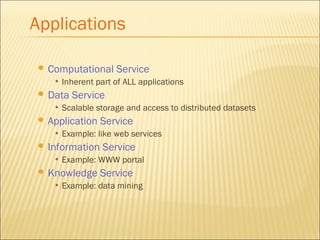
Applications 
 Computational Service 
• Inherent part of ALL applications 
 Data Service 
• Scalable storage and access to distributed datasets 
 Application Service 
• Example: like web services 
 Information Service 
• Example: WWW portal 
 Knowledge Service 
• Example: data mining
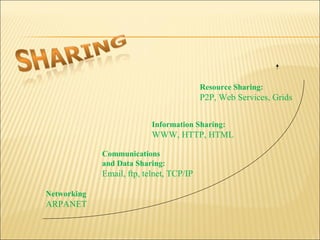
Networking 
ARPANET 
Information Sharing: 
WWW, HTTP, HTML 
Communications 
and Data Sharing: 
Email, ftp, telnet, TCP/IP 
Resource Sharing: 
P2P, Web Services, Grids
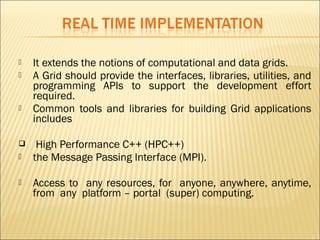
 It extends the notions of computational and data grids. 
 A Grid should provide the interfaces, libraries, utilities, and 
programming APIs to support the development effort 
required. 
 Common tools and libraries for building Grid applications 
includes 
 High Performance C++ (HPC++) 
 the Message Passing Interface (MPI). 
 Access to any resources, for anyone, anywhere, anytime, 
from any platform – portal (super) computing.
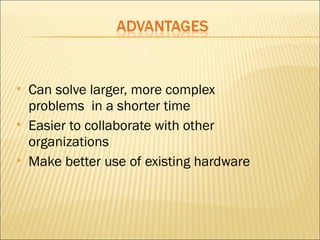
 Can solve larger, more complex 
problems in a shorter time 
 Easier to collaborate with other 
organizations 
 Make better use of existing hardware
 Grid software and standards are still evolving 
 Learning curve to get started 
 Non-interactive job submission
Conclusions 
 Characteristics of a grid relevant to middleware 
 Common design methodologies in grid middleware 
 Grid Services and open standardization 
 New and existing middleware systems are beginning 
to adopt core grid middleware to become easily ‘grid-enhanced’
www.gridcomputing.com 
www.dartmouth.edu 
www.eecg.toronto.edu 
www.sastra.edu 
www.usermonas.edu 
www.gridbus.org
Grid computing

Grid computing

  • 1.
  • 2.
     Introduction toGrid Computing  Definition in brief  History and Evaluation  Classification and Architecture  Real-time application  Advantage  Disadvantage  Conclusion  References
  • 3.
    Grid Definition a Grid is "a set of information resources (computers, databases, networks, instruments, etc.) that are integrated to provide users with tools and applications that treat those resources as components within a 'virtual' system".  Grid software solutions provide the underlying mechanisms necessary to create such systems, including authentication and authorization, resource discovery, resource management, communications, and information services, etc.
  • 4.
    What is GridComputing?  Grid computing is the collection of computer resources from multiple locations to reach a common goal.  Characteristics of a Grid:  No centralized control center  Heterogeneity (of resources)  Scalability  Dynamic and Adaptable
  • 5.
    How do gridworks? o Grids use networks to link the computing resources of many different computers. o The cyber-glue that binds all of these resources together is called “middleware.” There are many different types of middleware, developed for many different types of grid. o Middleware does all the work to connect users’ jobs to computing resources, thereby hiding the grid’s complexity from the user.
  • 6.
    6 Why dowe need Grids?  Grids allow you to combine the resources of hundreds of computers to create a massively powerful, fully comprehensive computing resource, all accessible from the comfort of your own personal computer.  This means grids can react quickly to changing needs: a tremendous resource for crisis situations like natural disasters or epidemics.
  • 7.
    o The ideais that in the future, plugging into a computing grid will be as simple as plugging into an electrical grid. And, like an electrical grid, users will simply plug in and use as much computing power as they need, without knowing where it comes from or how it was produced; you will simply plug in and use as much as you need.
  • 8.
    Grid application UserResource Broker Details of Grid resources Grid Resources Grid Information Service A User sends computation or data intensive application to Global Grids in order to speed up the execution of the application. 1 A Resource Broker distribute the jobs in an application to the Grid resources based on user’s QoS requirements and details of available Grid resources for further executions. Grid Resources (Cluster, PC, Supercomputer, database, instruments, etc.) in the Global Grid execute the user jobs. Grid Information Service system collects the details of the available Grid resources and passes the information to the resource broker. Computation result Computational jobs Processed jobs 2 3 4
  • 9.
    Introduction to GridArchitecture  Grid’s protocols allow VO users and resources to negotiate, establish, manage and exploit sharing relationships.  Interoperability a fundamental concern  The protocols are critical to interoperability  Services are important We need to consider APIs and SDKs VO: Virtual Organization
  • 10.
    Introduction to GridArchitecture  The components are  numerous  owned and managed by different, potentially mutually distrustful organisations and individuals  may be potentially faulty  have different security requirements and policies  heterogeneous  connected by heterogeneous, multilevel networks  have different resource management policies  are likely to be geographically separated
  • 11.
    11 Grid Architecture Autonomous, globally distributed computers/clusters
  • 12.
    Application Collective “Coordinatingmultiple resources”: ubiquitous infrastructure services, app-specific distributed services “Sharing single resources”: Resource negotiating access, controlling use “Talking to things”: communication Connectivity (Internet protocols) & security “Controlling things locally”: Access Fabric to, & control of, resources Application Transport Internet Link Internet Protocol Architecture
  • 13.
  • 14.
    History and Evolutionof Grid  Early to mid 90s: numerous research projects on distributed computing  The term grid computing originated in the early 1990s as a metaphor for making computer power as easy to access as an electric power grid. The power grid metaphor for accessible computing quickly became canonical when Ian Foster and Carl Kesselman published their seminal work, "The Grid: Blueprint for a new computing infrastructure
  • 15.
    History and Evolutionof Grid  1995, I-Way  IEEE/ACM 1995 Super Computing (San Diego), 11 high speed networks used to connect 17 sites to create one super meta-computer  Foster, Nature, 12/2002  1996, Globus project started (ANL & USC)  Followed I-Way  1997, Unicore (Germany)
  • 16.
     Distributed Supercomputing  High-Throughput Computing  On-Demand Computing  Data-Intensive Computing  Collaborative Computing  Logistical Networking
  • 17.
    Criteria for aGrid: Coordinates resources that are not subject to centralized control. Uses standard, open, general-purpose protocols and interfaces. Delivers nontrivial qualities of service. Benefits:  Exploit Underutilized resources  Resource load Balancing  Virtualize resources across an enterprise  Data Grids, Compute Grids  Enable collaboration for virtual organizations
  • 18.
    Applications  ComputationalService • Inherent part of ALL applications  Data Service • Scalable storage and access to distributed datasets  Application Service • Example: like web services  Information Service • Example: WWW portal  Knowledge Service • Example: data mining
  • 19.
    Networking ARPANET InformationSharing: WWW, HTTP, HTML Communications and Data Sharing: Email, ftp, telnet, TCP/IP Resource Sharing: P2P, Web Services, Grids
  • 20.
     It extendsthe notions of computational and data grids.  A Grid should provide the interfaces, libraries, utilities, and programming APIs to support the development effort required.  Common tools and libraries for building Grid applications includes  High Performance C++ (HPC++)  the Message Passing Interface (MPI).  Access to any resources, for anyone, anywhere, anytime, from any platform – portal (super) computing.
  • 21.
     Can solvelarger, more complex problems in a shorter time  Easier to collaborate with other organizations  Make better use of existing hardware
  • 22.
     Grid softwareand standards are still evolving  Learning curve to get started  Non-interactive job submission
  • 23.
    Conclusions  Characteristicsof a grid relevant to middleware  Common design methodologies in grid middleware  Grid Services and open standardization  New and existing middleware systems are beginning to adopt core grid middleware to become easily ‘grid-enhanced’
  • 24.
    www.gridcomputing.com www.dartmouth.edu www.eecg.toronto.edu www.sastra.edu www.usermonas.edu www.gridbus.org

Editor's Notes

  • #13 We define Grid architecture in terms of a layered collection of protocols. Fabric layer includes the protocols and interfaces that provide access to the resources that are being shared, including computers, storage systems, datasets, programs, and networks. This layer is a logical view rather then a physical view. For example, the view of a cluster with a local resource manager is defined by the local resource manger, and not the cluster hardware. Likewise, the fabric provided by a storage system is defined by the file system that is available on that system, not the raw disk or tapes. The connectivity layer defines core protocols required for Grid-specific network transactions. This layer includes the IP protocol stack (system level application protocols [e.g. DNS, RSVP, Routing], transport and internet layers), as well as core Grid security protocols for authentication and authorization. Resource layer defines protocols to initiate and control sharing of (local) resources. Services defined at this level are gatekeeper, GRIS, along with some user oriented application protocols from the Internet protocol suite, such as file-transfer. Collective layer defines protocols that provide system oriented capabilities that are expected to be wide scale in deployment and generic in function. This includes GIIS, bandwidth brokers, resource brokers,…. Application layer defines protocols and services that are parochial in nature, targeted towards a specific application domain or class of applications. These are are are … arrgh