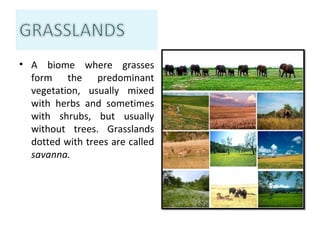
• A biome where grasses
  form the predominant
  vegetation, usually mixed
  with herbs and sometimes
  with shrubs, but usually
  without trees. Grasslands
  dotted with trees are called
  savanna.
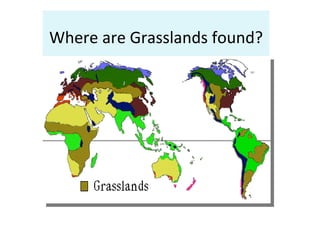
Where are Grasslands found?
Types of Grasslands
I.     Domestic Grasslands
II.    North American Grasslands
III.   Eurasian Streppes
IV.    South American Pampas
V.     South African Veld
VI.    Australian Grasslands
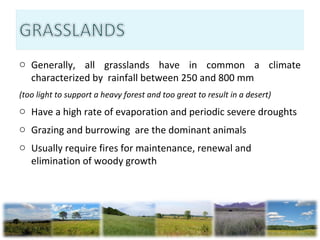
o Generally, all grasslands have in common a climate
  characterized by rainfall between 250 and 800 mm
(too light to support a heavy forest and too great to result in a desert)
o Have a high rate of evaporation and periodic severe droughts
o Grazing and burrowing are the dominant animals
o Usually require fires for maintenance, renewal and
  elimination of woody growth
 adapted to periods of drought and survive under low rainfall
  but grasses grow best under optimal moisture and temperature.
 Poorest: where precipitation is the lowest and high
  temperature
 Best: where the mean annual precipitation is greater than
800 mm and mean annual temperature is above 15 °C,
 The greater the mean annual precipitation, the greater the
  aboveground production
Vegetation
 Most visible feature is the tall, green, ephemeral
herbaceous growth that develops in spring and dies
back during autumn.
 Herbaceous Layer
       1.   First layer - consist of low growing and ground-hugging plants
       2.   Middle layer - consist of shorter grasses and forbs
       3.   Upper layer – consist of leaves and flowering stems of tall grasses,
            leafy stalks and flowers of forbs
Animal life
o Life in herbaceous layer varies as the strata become
  more pronounced from spring to fall.
o Invertebrate life is most abundant and varied.
o Large grazing ungulates and burrowing mammals are
  the most conspicuous vertebrates
Human Impact
 Most grasslands are plowed under for cropland
 Degraded by overgrazing
 Replaced native plants species with highly forage
  plants
 Removed great herds of
wild ungulates and replaced
with domestic stock


                                           DUST BOWL

Grasslands

  • 2.
    • A biomewhere grasses form the predominant vegetation, usually mixed with herbs and sometimes with shrubs, but usually without trees. Grasslands dotted with trees are called savanna.
  • 3.
  • 4.
    Types of Grasslands I. Domestic Grasslands II. North American Grasslands III. Eurasian Streppes IV. South American Pampas V. South African Veld VI. Australian Grasslands
  • 5.
    o Generally, allgrasslands have in common a climate characterized by rainfall between 250 and 800 mm (too light to support a heavy forest and too great to result in a desert) o Have a high rate of evaporation and periodic severe droughts o Grazing and burrowing are the dominant animals o Usually require fires for maintenance, renewal and elimination of woody growth
  • 6.
     adapted toperiods of drought and survive under low rainfall but grasses grow best under optimal moisture and temperature.  Poorest: where precipitation is the lowest and high temperature  Best: where the mean annual precipitation is greater than 800 mm and mean annual temperature is above 15 °C,  The greater the mean annual precipitation, the greater the aboveground production
  • 7.
    Vegetation  Most visiblefeature is the tall, green, ephemeral herbaceous growth that develops in spring and dies back during autumn.  Herbaceous Layer 1. First layer - consist of low growing and ground-hugging plants 2. Middle layer - consist of shorter grasses and forbs 3. Upper layer – consist of leaves and flowering stems of tall grasses, leafy stalks and flowers of forbs
  • 8.
    Animal life o Lifein herbaceous layer varies as the strata become more pronounced from spring to fall. o Invertebrate life is most abundant and varied. o Large grazing ungulates and burrowing mammals are the most conspicuous vertebrates
  • 9.
    Human Impact  Mostgrasslands are plowed under for cropland  Degraded by overgrazing  Replaced native plants species with highly forage plants  Removed great herds of wild ungulates and replaced with domestic stock DUST BOWL

Editor's Notes

  • #4 Grasslands are found in most ecoregions of the Earth . For example there are five terrestrial ecoregion classifications (subdivisions) of the temperate grasslands, savannas, and shrublands biome (' ecosystem '), which is one of eight terrestrial ecozones of the Earth's surface.