


TROPICAL
RAINFOREST
• within the latitudes 28 degrees north or
  south of the equator (in the equatorial
  zone between the Tropic of
  Cancer and Tropic of Capricorn).
• An average of 50 to 260 inches (125 to
  660 cm.) of rain falls yearly.
• Temperature-higher than 93 °F (34 °C) or
  drops below 68 °F (20 °C)
• Humidity- between 77 and 88%;
• Covered less than 6% of the Earth’s land
  surface
• 50% of animals and plants live
• Produce 40% of Earth’s oxygen
• Two-thirds of all flowering plants can be
  found in rainforests.
• A single hectare 42,000 different species
  of insect, up to 807 trees of 313 species
  and 1,500 species of higher plants.
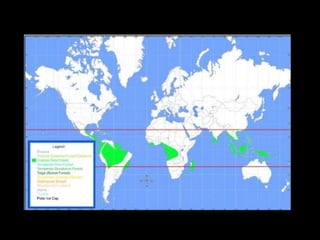
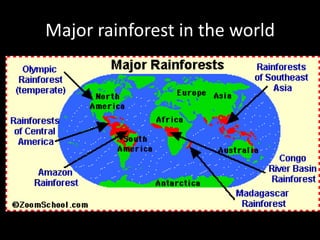
Major rainforest in the world
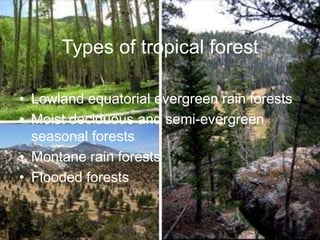
Types of tropical forest

• Lowland equatorial evergreen rain forests
• Moist deciduous and semi-evergreen
  seasonal forests
• Montane rain forests
• Flooded forests
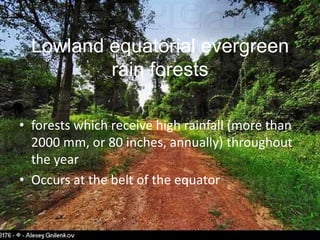
Lowland equatorial evergreen
          rain forests

• forests which receive high rainfall (more than
  2000 mm, or 80 inches, annually) throughout
  the year
• Occurs at the belt of the equator
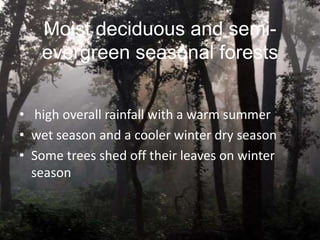
Moist deciduous and semi-
   evergreen seasonal forests


• high overall rainfall with a warm summer
• wet season and a cooler winter dry season
• Some trees shed off their leaves on winter
  season
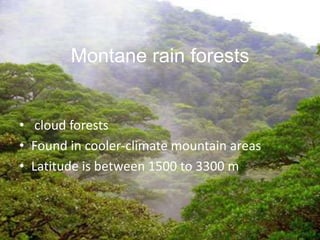
Montane rain forests


• cloud forests
• Found in cooler-climate mountain areas
• Latitude is between 1500 to 3300 m
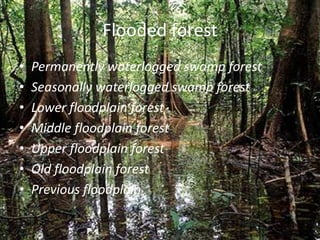
Flooded forest
•   Permanently waterlogged swamp forest
•   Seasonally waterlogged swamp forest
•   Lower floodplain forest
•   Middle floodplain forest
•   Upper floodplain forest
•   Old floodplain forest
•   Previous floodplain
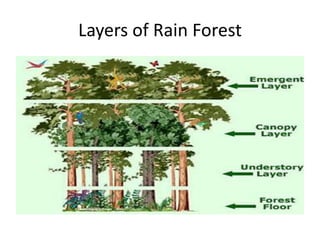
Layers of Rain Forest
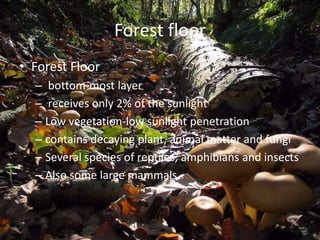
Forest floor
• Forest Floor
  – bottom-most layer
  – receives only 2% of the sunlight
  – Low vegetation-low sunlight penetration
  – contains decaying plant, animal matter and fungi
  – Several species of reptiles, amphibians and insects
  – Also some large mammals
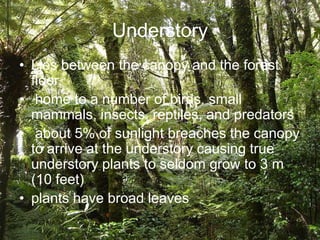
Understory
• Lies between the canopy and the forest
  floor
• home to a number of birds, small
  mammals, insects, reptiles, and predators
• about 5% of sunlight breaches the canopy
  to arrive at the understory causing true
  understory plants to seldom grow to 3 m
  (10 feet)
• plants have broad leaves
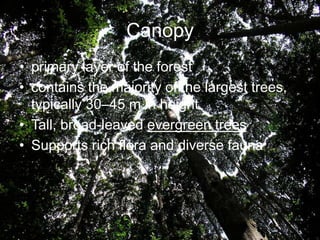
Canopy
• primary layer of the forest
• contains the majority of the largest trees,
  typically 30–45 m in height
• Tall, broad-leaved evergreen trees
• Supports rich flora and diverse fauna
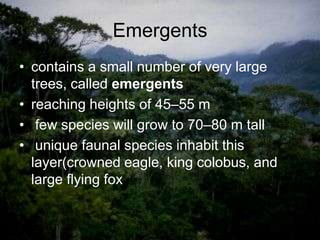
Emergents
• contains a small number of very large
  trees, called emergents
• reaching heights of 45–55 m
• few species will grow to 70–80 m tall
• unique faunal species inhabit this
  layer(crowned eagle, king colobus, and
  large flying fox
Abiotic
     and
Biotic factors
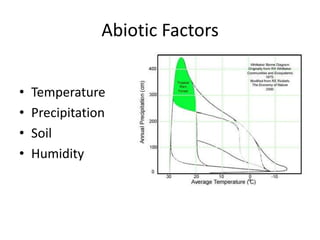
Abiotic Factors


•   Temperature
•   Precipitation
•   Soil
•   Humidity
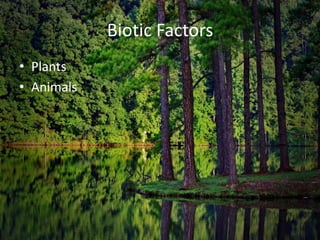
Biotic Factors
• Plants
• Animals
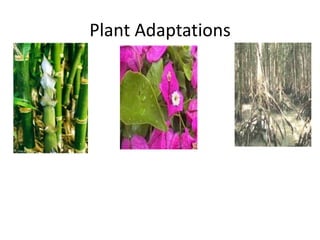
Plant Adaptations
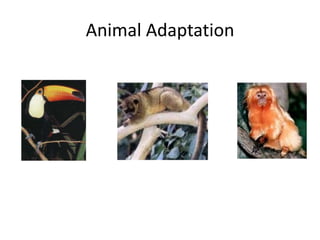
Animal Adaptation
Human Impact
Mining and drilling
Conversion to agriculture land
Climate Change
Human impact
• Deforestation
• Urbanization
• Pollution
• Poaching
• Tourism

Tropical rainforest

  • 1.
  • 2.
    • within thelatitudes 28 degrees north or south of the equator (in the equatorial zone between the Tropic of Cancer and Tropic of Capricorn). • An average of 50 to 260 inches (125 to 660 cm.) of rain falls yearly. • Temperature-higher than 93 °F (34 °C) or drops below 68 °F (20 °C) • Humidity- between 77 and 88%;
  • 3.
    • Covered lessthan 6% of the Earth’s land surface • 50% of animals and plants live • Produce 40% of Earth’s oxygen • Two-thirds of all flowering plants can be found in rainforests. • A single hectare 42,000 different species of insect, up to 807 trees of 313 species and 1,500 species of higher plants.
  • 5.
  • 6.
    Types of tropicalforest • Lowland equatorial evergreen rain forests • Moist deciduous and semi-evergreen seasonal forests • Montane rain forests • Flooded forests
  • 7.
    Lowland equatorial evergreen rain forests • forests which receive high rainfall (more than 2000 mm, or 80 inches, annually) throughout the year • Occurs at the belt of the equator
  • 8.
    Moist deciduous andsemi- evergreen seasonal forests • high overall rainfall with a warm summer • wet season and a cooler winter dry season • Some trees shed off their leaves on winter season
  • 9.
    Montane rain forests •cloud forests • Found in cooler-climate mountain areas • Latitude is between 1500 to 3300 m
  • 10.
    Flooded forest • Permanently waterlogged swamp forest • Seasonally waterlogged swamp forest • Lower floodplain forest • Middle floodplain forest • Upper floodplain forest • Old floodplain forest • Previous floodplain
  • 11.
  • 12.
    Forest floor • ForestFloor – bottom-most layer – receives only 2% of the sunlight – Low vegetation-low sunlight penetration – contains decaying plant, animal matter and fungi – Several species of reptiles, amphibians and insects – Also some large mammals
  • 13.
    Understory • Lies betweenthe canopy and the forest floor • home to a number of birds, small mammals, insects, reptiles, and predators • about 5% of sunlight breaches the canopy to arrive at the understory causing true understory plants to seldom grow to 3 m (10 feet) • plants have broad leaves
  • 14.
    Canopy • primary layerof the forest • contains the majority of the largest trees, typically 30–45 m in height • Tall, broad-leaved evergreen trees • Supports rich flora and diverse fauna
  • 15.
    Emergents • contains asmall number of very large trees, called emergents • reaching heights of 45–55 m • few species will grow to 70–80 m tall • unique faunal species inhabit this layer(crowned eagle, king colobus, and large flying fox
  • 16.
    Abiotic and Biotic factors
  • 17.
    Abiotic Factors • Temperature • Precipitation • Soil • Humidity
  • 18.
  • 19.
  • 20.
  • 21.
    Human Impact Mining anddrilling Conversion to agriculture land Climate Change
  • 22.
    Human impact • Deforestation •Urbanization • Pollution • Poaching • Tourism