1
GRASSES AND SEDGES IN SALADENGEN-DIMAPATOY
WATERSHED FOREST RESERVED
JEVIT P. MEDICO
Submmited to the Faculty Members of the School of Forestry
Cotabato City State Polytechnic College in Partial
Fulfillment of the Requirement for the
Degree of
BACHELOR OF SCIENCE IN FORESTRY
(General Forestry)
2015
2
Abstract
JEVIT P. MEDICO, Cotabato City State Polytechnic College, Cotabato City, School year
2014-2015. “Grasses and Sedges in Saladengen-Dimapatoy Watershed Forest Reserved”.
Major Adviser: Ambusa T. Badal RF.
The study was conducted at Saladengen-Dimapatoy Watershed Forest Reserved. The
study aimed to determine the Classification, Identefication, Botanical Description and
Importance/Uses of Grasses and Sedges. The Identification includes the Local Name, Common
Name, Scientific Name and Family Name. In addition, the Researcher also find out the Botanical
Description and Importance/Uses of Individual Grasses and Sedges. Specifically, the objectives
of the study were the following:
1. What were the identification of the different existing Grasses and Sedges in Saladengen-
Dimapatoy Watershed Forest Reserved;
2. What were the Botanical Description of the different existing Grasses and Sedges in
Saladengen-Dimapatoy Watershed Forest Reserved;
3. What were the importance and uses of the different existing Grasses and Sedges in
Saladengen-Dimapatoy Watershed Forest Reserved?
The research design used in the Study was the descriptive classification and identification
survey design. This includes grouping or classification and identification of Grasses and Sedges
found in the study area.
There were eleven (11) Grasses species and one (1) Sedges found in the study area with
local name, common name, scientific name and family name. Grasses were mostly found in dry
areas.
3
CHAPTER I
INTRODUCTION
The Problem and its Background
The Philippines is considered a mega-diverse country rivaled only by a few
countries in the world when it comes to variety of ecosystems, species and genetic resources.
Many of the islands comprising the archipelago are believed to have a very high degree of plant
and animal endemism. The country hosts more than 52,177 described species of which more than
half is found nowhere else in the world. On a per unit area basis, the Philippines probably
harbors more diversity of life than any other country on the planet. The country is also
considered a biodiversity hotspot. This is because the Philippines continues to experience an
alarming rate of destruction of these important resources brought about by overexploitation,
deforestation, land degradation, climate change, and pollution (including biological pollution),
among others (2009 Philippine Clearing House Mechanism for Biodiversity).
Grasslands cover about 70% of the world’s agricultural area (Soussana and Luscher,
2007). Their use in a way that is economically, environmentally and socially sustainable is a
major challenge facing many countries. Clearly they play an important role in food production.
However, there is increasing recognition of the need to approach grasslands from the viewpoint
of ‘multi-functionality, particularly from livestock production, whilst at the same time delivering
important ecosystems services and underpinning the tourism, amenity and leisure industries in
many parts of the world. The changing considerations concerning the use and management of
grasslands have been recently reviewed (Kemp and Michalk, 2007).
4
Grasses, or more technically Graminoids, are monocotyledonous, usually
herbaceous plants with narrow leaves growing from the base. They include the "true grasses", of
the family Poaceae (also called Gramineae), as well as the sedges (Cyperaceae). The true grasses
include cereals, bamboo and the grasses of lawns (turf) and grassland. Sedges include many
wildmarsh and grassland plants, and some cultivated ones such as water chestnut (Eleocharis
dulcis) and papyrus sedge (Cyperus papyrus). Grasses have adapted to conditions in lush rain
forests, dry deserts, cold mountains and even intertidal habitats, and are now the most
widespread plant type; grass is a valuable source of food and energy for all sorts of wildlife and
organics. Graminoids are the dominant vegetation in many habitats, including grassland, salt-
marsh, reedswamp and steppes. They also occur as a smaller part of the vegetation in almost
every other terrestrial habitat. Many types of animals eat grass as their main source of food, and
are called graminivores – these include cattle, sheep, horses, rabbits and many invertebrates,
such as grasshoppers and the caterpillars of many brown butterflies. Grasses are also eaten
by omnivorous or even occasionally by primarily carnivorous animals. Uses for graminoids
include food (as grain, sprouted grain, shoots or rhizomes),
drink(beer, whisky, vodka), pasture for livestock, thatch, paper, fuel, clothing,insulation, constru
ction, sports turf, basket weaving and many others. The most important food crops are the grains
of grasses such as wheat, rice and barley. They have many other uses, such as feeding animals,
and for lawns. There are many minor uses, and grasses are familiar to most human cultures.
Grass is also important in many sports, notably with those played on fields such as American
football, Association football, baseball, cricket, and rugby. In some sports facilities, including
indoor domes and other places where maintenance of a grass field would be difficult, grass may
be replaced with artificial turf, a synthetic grass-like substitute. Sports such
5
as golf, tennis and cricket are particularly dependent on the quality of the grass on which the
sport is played (2010-2013 Living Expression Landscapes, 20907 Elder Road, Conroe
TX77385).
Sedges often have triangular stems. The female flowers of sedges are enclosed in a single
sheath-like scale called a perigynia. Many sedge species spread through long rhizomes making
them useful in erosion control of moister soils. The Sedge Family groups several related genera
including Scirpus, Rhynchospora, Eleocharis,Cladium, Schoenoplectus &others, but
the largest genus is the Carex with over 130 species growing in California, most of them are
native. Although Sedges it looks like an ornamental grass, most of which need full sun and thrive
in hot, dry conditions, clump-forming sedge is completely different. For one thing, it's sedge, not
an ornamental grass. And it prefers shade along with moist soils (making it a great plant to tuck
among the hostas). But like an ornamental grass, sedge has colorful arching foliage, most notably
in beautiful glowing yellows, that is evergreen in warm climates and semi-evergreen in cold
areas (Darris and Gonzalves 2008).
The grasses known as cereals or grains are the most obvious human food source and have
traditionally been planted for agriculture and food production. Types of cereal producing grasses
include wheat, barley, corn, rye, sorghum, millet, and rice. Products from the cereal grains are
the mainstay of the human diet. Sugar cane is also a member of the grass family and is used to
make refined sugar. Alcohol and starch are products of plants in the grass family. Humans have
also benefited more indirectly from grasses through eating herbivores, which eat the grass and
turn it into protein and fat for human use. Larger and more stout grasses (such as bamboo) have
long been used to build structures in many parts of the world. A pioneer during the American
6
westward migration made their homes out of grass sod where wood was not available. Pioneers
who had the benefit (or curse) of settling areas with highly cohesive clay soils made bricks of
mud and dried straw or grass to build their structures. The grass in the bricks acted as a filler and
binder, adding strength, and making less mud necessary. Modern day practices for "green-
buildings" often incorporate grass roofs. Healthy stands of grass have long been the foundation
for livestock operations around the world, while farmers chose to plow under the native grasses
and plant wheat, corn, and other cultivated grass crops. A more recent industrial use for corn and
other selected grasses is use of them in the production of ethanol for fuel. For many years, the
landscaping trade and garden enthusiasts didn’t appreciate the aesthetic value of grasses. That is
finally changing as grasses are being planted in home and office landscapes because they add
texture and accent to a garden, and can be relatively low maintenance (A.S. Hitchcock and
Agnes Chase, Manual of the Grasses of the United States, Second Edition, Pp. 1-13).
Historically, humans have found many uses for grass to make tools that have made
everyday life easier. A few examples are basketry, mats, straw hats, and brooms. Environmental
Benefits of Grasses the strong and pervasive root systems of most grasses make them largely
responsible for holding soil in place and preventing erosion in grasslands and many forested
ecosystems. Healthy and abundant leaf cover above ground also reduces the impact of rainfall to
further reduce erosion. The leaves and dead litter temporarily hold some of the water so it can
dissipate through evaporation instead of running off (New York: Dover, 1971)
They concluded that agriculture and forestry can potentially contribute to GHG emission
mitigation and that emission reduction can be achieved cost effectively by reducing methane
emissions. Carbon sequestration is an additional way of mitigating GHG emission but more
costly than direct abatement. Currently, in terms of carbon mitigation options from livestock
7
agriculture, only a reduction in the number of animals can be registered as a reduction according
to the Intergovernmental Panel on Climate Change (IPCC, 1997).
Way back on 1959, a Public land on the Northwest side of North Upi and Western side of
Dinaig (now Datu Odin Sinsuat Municipalities) were declared as reforestation as Reforestation
Project known as Dimapatoy Reforestation Project (covering an approximate area of 9,999 has.)
in which part of it is now “Dimapatoy Watershed Forest Reserve” under Autonomous Region in
Muslim Mindanao Proclamation No.18 dated July 5, 2001 by the ARMM Government Professor
Nor Misuari, is located within the municipalities of North Upi and Datu Odin Sinsuat, both in the
province of Maguindanao and it covers an area approximately Three Thousand Seven Hundred
Sixty Five (3,765) hectares of open denuded and brush land areas with patches of old and second
growth forest and reforestation species. It is bounded by latitude between 07o03’45” to
07o08’47” and longitude between 124o07’15” to 124o13’27” with a topography of extremely
gentle rolling to a moderate slope with gradient ranging 20o to 50o (Metro Cotabato Water
District Ten Years Development Plan, Undated).
Saladengen (the study site) lies in the Northern part of Dimapatoy Watershed Forest
Reserve. Its creek, a perennial stream fed a voluminous amount of water in Dimapatoy River
(Personal interview with Dr. Abonawas M. Pendaliday). Dimapatoy River is the main source of
water for about 200,000 concessionaires’ residents of Cotabato City and nearby communities
(DelfinHelario 2011).
The reason why the researcher conducts this study is to verify how grasses and sedges
play its important role, based on the observed data gathered from the physical appearance and the
distribution in the area, particularly in Saladengen-Dimapatoy Watershed Forest Reserved.
8
Statement of the Problem
Grasses and sedges are both important in our environment, especially when it regard on
many aspect in our ecosystem such as grass steppe, and grassland.
Hence, there is increasing recognition of the need to approach grasslands from the viewpoint of
‘multi-functionality’ particularly from livestock production, whilst at the same time delivering
important ecosystems services and underpinning the tourism, amenity and leisure industries in
many parts of the world (Kemp and Michalk, 2007).
Main Objective
The researcher aims to survey the Grasses and Sedges in Saladengen-Dimapatoy
Watershed Forest Reserved.
Specific Objectives
Specifically, the study sought to determine the following specific objectives:
4. To find out the identification of different existing Grasses and Sedges in Saladengen-
Dimapatoy Watershed Forest Reserved;
5. To find out the Botanical Description of different existing Grasses and Sedges in
Saladengen-Dimapatoy Watershed Forest Reserved;
6. To find out the Importance and Uses of different existing Grasses and Sedges in Saladengen-
Dimapatoy Watershed Forest Reserved.
9
Significance of the Study
The result of this study hopefully becomes a basis of information on the identification,
botanical description, importance and uses of existing Grasses and Sedges in Saladengen-
Dimapatoy Watershed Forest Reserved.
This would help developmental plan in this area, particularly the environmental-based
rehabilitation interventions geared towards sustainable biodiversity agenda of the country.
The result of this study provides data for land use planning of local government unit or
entity that has management authority over the area, serves as reference and now form part of the
college data bank.
Scope and Limitation of the Study
The scope of this study was confined and limited to the identification, botanical
description, importance and uses of existing Grasses and Sedges in Saladengen-Dimapatoy
Watershed Forest Reserved.
This study was conducted on second semester of the School Year 2014-2015 in
Saladengen-Dimapatoy Watershed Forest Reserved.
10
Operational Definition of Terms
Assessment. Classification, Identification, Botanical description, and Importance of
Grasses and Sedges.
Flora. Grasses and Sedges.
Classification.Grouping of plants/species into Grasses and Sedges.
Diversity.Varieties of Grasses and Sedges.
Identification.Knowing the names of Grasses and Sedges by Local name, Common
name, Family name, and Scientific name.
Grass. Any plants of the family Gramineae, characterized by jointed stem, sheathing
leaves, flowers spikelet and fruits consisting of a seed like grain or caryopsis like wheat,
rice, barley etc.
Sedge. Plant whose system is solid, usually triangular or flatten not jointed leaves
arranged in whole at the terminal apex of the stem and leaflets are entire.
Terminologies
Assessment.The process of documenting knowledge, skills, attitudes, and beliefs.
Grass.Any plants of the family Gramineae, characterized by jointed stem, sheathing
leaves, flowers spikelet and fruits consisting of a seed like grain or caryopsis like wheat,
rice, barley etc.
Grass Steppe.
Sedge.Plants whose system are solid, usually triangular or flatten not jointed leaves are
arranged in whole at the terminal apex of the stem and leaflets are entire.
11
Classification.Refer to categorization, the process in which ideas and objects are
recognized, differentiated, and understood.
Identification.Knowing the names of Grasses and Sedges by Local name, Common
name, Family name, and Scientific name.
Flora.The collective term to a plant life of a particular period of time or part of the
World.
Grassland.Areas where the vegetation is dominated by grasses, however sedge and rush
families can also be found. Grasslands occur naturally on all continents except Antarctica.
Grasslands are found in most ecoregions of the Earth.
Steppe.In physical geography, a steppe is an ecoregion, in the montane grasslands and
shrublands and temperate grasslands, savannas, and shrublands biomes, characterized by
grassland plains without trees apart from those near rivers and lakes.
Thatch.Roofing of straw, or reeds, or similar materials.
12
CHAPTER II
REVIEW OF RELATED LITERATURE & STUDIES
In this chapter, several speculation of authors and results of studies related to the study
has been presented.
The most conspicuous grasses are perennial bunch grasses. Bunch grasses form tufts,
clumps, or tussocks by sending up new shoots called tillers. The tillers remain attached to the
base of the grass and the plant gradually thickens. Because bunch grasses do not spread out
like rhizomatous grasses, they provide an open structure to coastal prairie that enhances
biodiversity: the spaces between bunches allow room for a diverse selection of forbs, mosses and
other grasses to grow and provide habitat for feeding, nesting, and hiding birds and animals
(Darris and Gonzalves 2008).
In Mediterranean climate areas, the use of annual species is common and considerable
work has been carried out to assess the suitability of a range of different annual legumes
(reviewed in Sulas, 2005).
Janket al (2005) described the potential for breeding to contribute substantially to
increased productivity of the 260 million hectares of well drained savannah grassland in South
America. Recent decades have seen dramatic increases in the use of the introduced grasses
Brachiariaspecies particularly in the Brazilian cerrados region. Over the past 30 yrs more than
70m ha of native vegetation has been replaced by pastures for beef production particularly
Brachiaria and Andropogon.
In seasonally flooded lands Paspalumatratumis a grass species native to South America
which has attracted research and commercial interest (Janket al 2005).
13
grasses to grow and provide habitat for feeding, nesting, and hiding birds and animals
(Darris and Gonzalves 2008).
Breeding of tropical grasses, many of which, including important species of Brachiaria,
PapsalumandCenchrus, are apomictic (i.e. do not reproduce sexually through seed production) is
still in its infancy and focused primarily on underpinning more efficient and economic livestock
production. Many important forage legume genera have originated in tropical America, e.g.
Stylosanthes, Arachis, and Leucaena. Germplasm collections of these species have been made
and new cultivars developed although uptake by farmers appears limited (Janket al 2005).
In a recent review, Povellatoet al (2007) stated that agriculture (as a whole) and forestry
account for 30% of worldwide greenhouse gas (GHG) emissions from human activities and 10%
in Europe.
Morgan (2005) considered the global picture in terms of the response of grazing lands to
increased atmospheric carbon dioxide.
Hopkins and Del Prado (2007) compiled the scenarios for climate change affecting
European grasslands. Likely responses include: increased herbage growth, increased use of
forage legumes particularly white and red clover and alfalfa (lucerne), reduced opportunities for
grazing and harvesting on wetter soils, greater incidence of summer drought and increased
leaching from more winter rainfall.
The impact of climate change on European grasslands and their role in climate change
mitigation have been recently reviewed (Mannetje, 2007a; Hopkins and Del Prado, 2007;
Soussana and Luscher, 2007).
14
Cogon grass paper-making uses the soda method to break down the fibers. Making paper
using cogon grass is a way to productively use the invasive weed. Cogon weed is not native to
America but spread from the accidental introduction of the seed from Japanese packing materials
in the early 1900s. Making paper from cogon grass requires the effective breakdown of fibers to
produce the quality of material necessary for paper-making. The process can be achieved using
the correct method and provides effective result (Jane Humphries, eHow Contributor,
Retrieved on July 17, 2014).
15
CHAPTER III
METHODOLOGY
This chapter presents the Locale of the Study, Research Design, Sampling Procedure,
Research Instrument, Data Gathering Procedure, and Data Analysis.
Locale of the Study
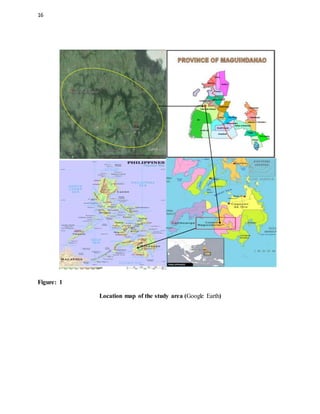
Dimapatoy Watershed Forest Reserve is located in the Southwest of Datu Odin Sinsuat
Municipality and Northwest of North Upi Municipality covering an approximate area of Three
Thousand Seven Hundred Sixty Five hectares (3,765 has.). It is bounded 124o07’15” to
124o13’27” with topography of extremely gentle rolling to a moderate slope with gradient
ranging 20o to 50o.
Dimapatoy creek of Dimapatoy Watershed Forest Reserved is one of the main sources of
domestic water tap by Metro Cotabato Water District for the domestic use of Cotabato City
residence and nearby areas.
16
Figure: 1
Location map of the study area (Google Earth)
17
Research Design
This study is a descriptive classification and identification survey design. This includes
grouping and identification of Grasses and Sedges found in the study area.
Sampling Procedure
The research area was determined, where running list method was used in data gathering.
Research Instrument
The researcher was used the following instrument such as; camera with lens for taking
photographs of Grasses and Sedges. Materials used in this study were: record note, pencil/ball
pen, marker, bolo, bag and bond paper.
Data Gathering Procedures
Every Grasses and Sedges encountered while doing the running list in the area was being
recorded and identified individually. The botanical description was found out in the references
and in the internet as well as the importance and uses of individual Grasses and Sedges.
Data Analysis
Descriptive statistics was used to analyze all data gathered.
18
CHAPTER IV
PRESENTATION OF DATA AND RESULT
This chapter shows the Data Gathered during the field conduction. The Data were
presented here were obtained from the actual survey of Grasses and Sedges species that were
found in Saladengen-Dimapatoy Watershed Forest Reserved. Presented in Table 1 for Grasses
and Table 2 for Sedges where the Local Name, Common Name, Scientific Name, Family Name,
Importance and Uses was also presented.
Presentation and Discussion of the Data
This chapter presents the Data Gathered by the Researcher from his practical works. Data
were presented in Tabular form, followed by textual Discussion.
19
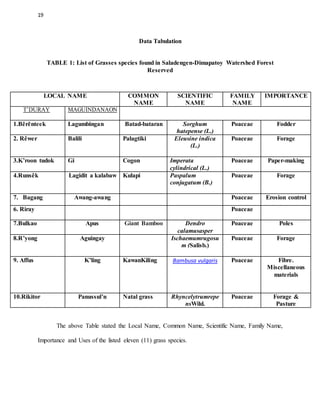
Data Tabulation
TABLE 1: List of Grasses species found in Saladengen-Dimapatoy Watershed Forest
Reserved
LOCAL NAME COMMON
NAME
SCIENTIFIC
NAME
FAMILY
NAME
IMPORTANCE
T’DURAY MAGUINDANAON
1.Běrěnteek Lagumbingan Batad-bataran Sorghum
hatepense (L.)
Poaceae Fodder
2. Rěwer Balili Palagtiki Eleusine indica
(L.)
Poaceae Forage
3.K’roon tudok Gi Cogon Imperata
cylindrical (L.)
Poaceae Paper-making
4.Runsěk Lagidit a kalabaw Kulapi Paspalum
conjugatum (B.)
Poaceae Forage
7. Bagang Awang-awang Poaceae Erosion control
6. Riray Poaceae
7.Bulkao Apus Giant Bamboo Dendro
calamusasper
Poaceae Poles
8.R’yong Aguingay Ischaemumrugosu
m (Salisb.)
Poaceae Forage
9. Affus K’ling KawanKiling Bambusa vulgaris Poaceae Fibre.
Miscellaneous
materials
10.Rikitor Panussul’n Natal grass Rhyncelytrumrepe
nsWild.
Poaceae Forage &
Pasture
The above Table stated the Local Name, Common Name, Scientific Name, Family Name,
Importance and Uses of the listed eleven (11) grass species.
20
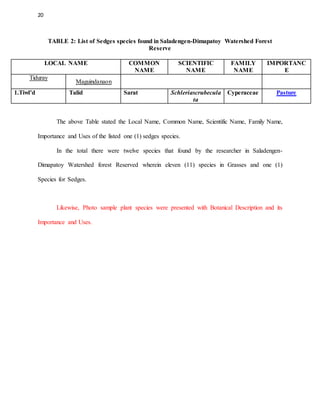
TABLE 2: List of Sedges species found in Saladengen-Dimapatoy Watershed Forest
Reserve
LOCAL NAME COMMON
NAME
SCIENTIFIC
NAME
FAMILY
NAME
IMPORTANC
E
Tiduray
Maguindanaon
1.Tiwl’d Talid Sarat Schleriascrubecula
ta
Cyperaceae Pasture
The above Table stated the Local Name, Common Name, Scientific Name, Family Name,
Importance and Uses of the listed one (1) sedges species.
In the total there were twelve species that found by the researcher in Saladengen-
Dimapatoy Watershed forest Reserved wherein eleven (11) species in Grasses and one (1)
Species for Sedges.
Likewise, Photo sample plant species were presented with Botanical Description and its
Importance and Uses.
21
CHAPTER V
SUMMARY, CONCLUSION AND RECOMMENDATION
General |Summary
The study was conducted at the research area Saladengen-Dimapatoy Watershed Forest
Reserve. The researcher aimed to identify the different existing Grasses and Sedges that was
seen in the study area. To identify includes the Local Name, Common Name, Scientific Name,
and Family Name. In addition, the researcher also found out the botanical description as well as
the importance and uses of every individual Grasses and Sedge in Saledengen-Dimapatoy
Watershed Forest Reserved by using the references in the book as well as in the internet.
Running list method was used for the identification of Grasses and Sedges in the study area.
Summary of Findings
The study revealed that there were eleven (11) Grasses species and only one (1) species
from Sedges identified in the study area.
Conclusion
Based on the result of the study, the researcher concluded that there were few species of
Grasses and only one species from Sedges that were found in Saladengen-Dimapatoy Watershed
Forest Reserved.
22
Recommendation
Throughout the realization of this research study entitled “Grasses and Sedges in
Saladengen-Dimapatoy Watershed Forest Reserved”, the researcher was highly recommended
the following:
1. The reserve is maintained for conservation, education, enjoyment and research, that
provides natural habitat for wildlife, connects the community to the natural human
race, and gives the Watershed Association in one of the best platforms in Saladengen-
Dimapatoy Watershed Forest Reserved;
2. Protection, should always in the mind of the people in terms of the important Role of
Grasses and Sedges such as: water storage for the continuing flow of the watershed,
and to sustain the needs of community in nearby areas;
3. Monitoring the endangered and locally rare plant species (Grasses and Sedges) using
standardized protocol to improve the survival of residual vegetation, in Saladengen-
Dimapatoy Watershed Forest Reserved.
23
PHOTO
DOCUMENTATION
24
LOCAL NAME
TEDURAY: Běrěnteek
MAGUINDANAON: Lagumbingan
BISAYA: Lawe-lawe
TAGALOG: Ngigai
COMMON NAME: Batad-bataran
SCIENTIFIC NAME: Sorghum hatepense (L.)
FAMILY NAME: Poaceae
Botanical Description
Sorghum hatepense (L.) "Perennial [grass] with strong rhizomes; culms erect, to 1.5 m
tall; nodes with short pubescence; sheaths glabrous; ligule ciliate-membranous, 2 mm long;
blades elongate, usually 1-1.5 cm wide, the midrib prominent; panicles 15-25 cm long, branches
ascending; spikelets 5 mm long, acute; first glume hard; fertile lemma awned or awnless, awn if
present 1 cm long or less" (Stone 1970; p. 239).
Importance:
Economic; Fodder/Forage.
Environmental: Due to its capacity to form extensive networks of rhizomes, S.
halepense can also be useful for control of soil erosion (Bennett, 1973).
Uses:
Economic (Livelihood): It can be used whole in a similar manner to rice or millet, or it
can be ground in to a flour and used as a cereal in making bread cakes and more
(Febraida2004).
25
Medicine: Under certain conditions, the plant, if grazed, may cause cyanide poisoning.
The pollen may induce hay fever.
26
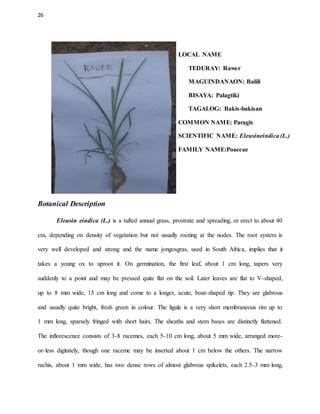
LOCAL NAME
TEDURAY: Rawer
MAGUINDANAON: Balili
BISAYA: Palagtiki
TAGALOG: Bakis-bakisan
COMMON NAME: Paragis
SCIENTIFIC NAME: Eleusineindica (L.)
FAMILY NAME:Poaceae
Botanical Description
Eleusin eindica (L.) is a tufted annual grass, prostrate and spreading, or erect to about 40
cm, depending on density of vegetation but not usually rooting at the nodes. The root system is
very well developed and strong and the name jongosgras, used in South Africa, implies that it
takes a young ox to uproot it. On germination, the first leaf, about 1 cm long, tapers very
suddenly to a point and may be pressed quite flat on the soil. Later leaves are flat to V-shaped,
up to 8 mm wide, 15 cm long and come to a longer, acute, boat-shaped tip. They are glabrous
and usually quite bright, fresh green in colour. The ligule is a very short membraneous rim up to
1 mm long, sparsely fringed with short hairs. The sheaths and stem bases are distinctly flattened.
The inflorescence consists of 3-8 racemes, each 5-10 cm long, about 5 mm wide, arranged more-
or-less digitately, though one raceme may be inserted about 1 cm below the others. The narrow
rachis, about 1 mm wide, has two dense rows of almost glabrous spikelets, each 2.5-3 mm long,
27
3-5 flowered, the lower and upper glumes about 1.5 and 3 mm long, respectively, and the
lemmas very similar in both texture and size to the upper glume. All have a slightly scabrid keel
and are acute but not awned. The reddish-brown to black seeds are oblong, about 1 mm long,
conspicuously ridged (Holm et al., 1979).
Importance:
Economic; Fodder/Forage.
Environmental: Erosion control or dune stabilization
Uses:
Economic (Livelihood): Fiber
Medicine: Poisonous to mammals
28
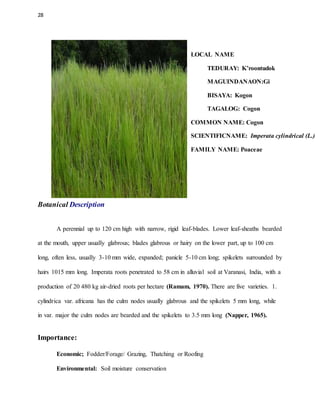
LOCAL NAME
TEDURAY: K’roontudok
MAGUINDANAON:Gi
BISAYA: Kogon
TAGALOG: Cogon
COMMON NAME: Cogon
SCIENTIFICNAME: Imperata cylindrical (L.)
FAMILY NAME: Poaceae
Botanical Description
A perennial up to 120 cm high with narrow, rigid leaf-blades. Lower leaf-sheaths bearded
at the mouth, upper usually glabrous; blades glabrous or hairy on the lower part, up to 100 cm
long, often less, usually 3-10 mm wide, expanded; panicle 5-10 cm long; spikelets surrounded by
hairs 1015 mm long. Imperata roots penetrated to 58 cm in alluvial soil at Varanasi, India, with a
production of 20 480 kg air-dried roots per hectare (Ramam, 1970). There are five varieties. 1.
cylindrica var. africana has the culm nodes usually glabrous and the spikelets 5 mm long, while
in var. major the culm nodes are bearded and the spikelets to 3.5 mm long (Napper, 1965).
Importance:
Economic; Fodder/Forage/ Grazing, Thatching or Roofing
Environmental: Soil moisture conservation
29
Uses:
Economic (Livelihood): Paper-making, packing materials, brush-making, rope-making, fuel.
Medicine: Sugar and alcohol production and a range of medicinal purposes. The flowers and
roots of I. cylindrica have antibacterial, diuretic, emollient, febrifuge, sialagogue, styptic and
tonic properties.
30
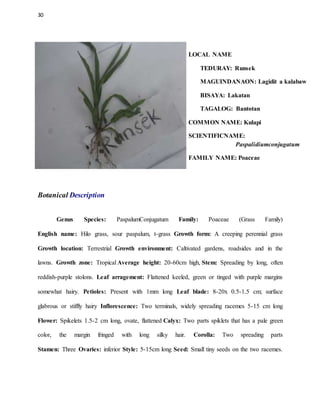
LOCAL NAME
TEDURAY: Runsek
MAGUINDANAON: Lagidit a kalabaw
BISAYA: Lakatan
TAGALOG: Bantotan
COMMON NAME: Kulapi
SCIENTIFICNAME:
Paspalidiumconjugatum
FAMILY NAME: Poaceae
Botanical Description
Genus Species: PaspalumConjugatum Family: Poaceae (Grass Family)
English name: Hilo grass, sour paspalum, t-grass Growth form: A creeping perennial grass
Growth location: Terrestrial Growth environment: Caltivated gardens, roadsides and in the
lawns. Growth zone: Tropical Average height: 20-60cm high, Stem: Spreading by long, often
reddish-purple stolons. Leaf arragement: Flattened keeled, green or tinged with purple margins
somewhat hairy. Petioles: Present with 1mm long Leaf blade: 8-20x 0.5-1.5 cm; surface
glabrous or stiffly hairy Inflorescence: Two terminals, widely spreading racemes 5-15 cm long
Flower: Spikelets 1.5-2 cm long, ovate, flattened Calyx: Two parts spiklets that has a pale green
color, the margin fringed with long silky hair. Corolla: Two spreading parts
Stamen: Three Ovaries: inferior Style: 5-15cm long Seed: Small tiny seeds on the two racemes.
31
Anything else: It particularly grows in a wet place up to 950 m elevation
(http://www.comfsm.fm/~dleeling/botany/1999/vhp/paspalum.html Retrieved on January 24, 2015).
Importance:
Economic; Fodder/Forage.
Environmental: Erosion control or dune stabilization
Uses:
Economic (Livelihood): Chicken's stock reserved for every day uses.
Medicine: vertebrate poisons, non-vertebrate poisons, medicines, environmental uses, and
gene sources,
32
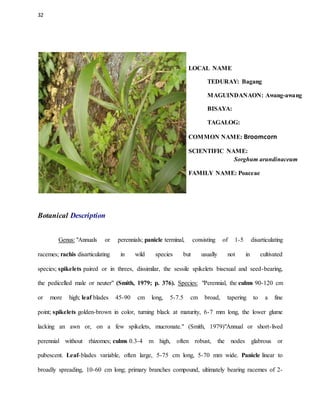
LOCAL NAME
TEDURAY: Bagang
MAGUINDANAON: Awang-awang
BISAYA:
TAGALOG:
COMMON NAME: Broomcorn
SCIENTIFIC NAME:
Sorghum arundinaceum
FAMILY NAME: Poaceae
Botanical Description
Genus: "Annuals or perennials; panicle terminal, consisting of 1-5 disarticulating
racemes; rachis disarticulating in wild species but usually not in cultivated
species; spikelets paired or in threes, dissimilar, the sessile spikelets bisexual and seed-bearing,
the pedicelled male or neuter" (Smith, 1979; p. 376). Species: "Perennial, the culms 90-120 cm
or more high; leaf blades 45-90 cm long, 5-7.5 cm broad, tapering to a fine
point; spikelets golden-brown in color, turning black at maturity, 6-7 mm long, the lower glume
lacking an awn or, on a few spikelets, mucronate." (Smith, 1979)"Annual or short-lived
perennial without rhizomes; culms 0.3-4 m high, often robust, the nodes glabrous or
pubescent. Leaf-blades variable, often large, 5-75 cm long, 5-70 mm wide. Panicle linear to
broadly spreading, 10-60 cm long; primary branches compound, ultimately bearing racemes of 2-
33
7 spikelet pairs. Sessile spikeletlanceolate to narrowly ovate, 4-9 mm long, glabrescent to white
pubescent, sometimes tomentose or fulvously pubescent, awnless or more often with an awn 5-
30 mm long. Pedicelled spikelet linear to lanceolate, male or barren, smaller than the sessile"
(Clayton and Renvoize, 1982; p. 727).
Importance:
Economic; The use of sorghum stalks as forage for animals and as fuel for cooking fires.
Environmental: Erosion control or dune stabilization
Uses:
Economic (Livelihood): Early uses of sorghum include its preparation with native yeast to
produce a kind of bread or flat cake. The tiny grains (probably 500,000 to 1 million per kg) could
also be eaten as porridge. Both of these would be familiar to people conversant with early wheat,
barley or the Ethiopian grain Teff (Eragrostis tef (Zucc.) Sorghum grains were probably also
turned into 'small beer' using souring, or lactic acid fermentation, resulting in a fermented gruel
rather than a beer as we know it. This fermentation technique involves using germinating grains
and the resulting brew is very nutritious.
Medicine: A very important point is that sorghum leaves, when young, contain large
quantities of dhurrin, a precursor of the lethal vegetable form of cyanide. Small plants and young
shoots have 20 times the amount of dhurrin compared with adult, mature leaves. The poison is
34
destroyed when the leaves are made into hay or silage (Carolus Linnaeus in 1753, Conrad
Moench transferred cultivated sorghum into its own genus in 1794).
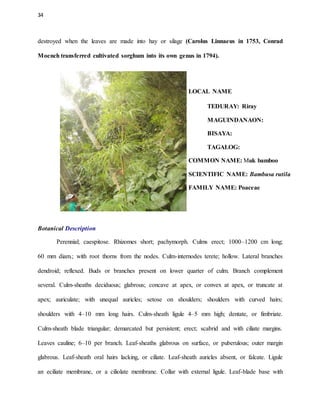
LOCAL NAME
TEDURAY: Riray
MAGUINDANAON:
BISAYA:
TAGALOG:
COMMON NAME: Muk bamboo
SCIENTIFIC NAME: Bambusa rutila
FAMILY NAME: Poaceae
Botanical Description
Perennial; caespitose. Rhizomes short; pachymorph. Culms erect; 1000–1200 cm long;
60 mm diam.; with root thorns from the nodes. Culm-internodes terete; hollow. Lateral branches
dendroid; reflexed. Buds or branches present on lower quarter of culm. Branch complement
several. Culm-sheaths deciduous; glabrous; concave at apex, or convex at apex, or truncate at
apex; auriculate; with unequal auricles; setose on shoulders; shoulders with curved hairs;
shoulders with 4–10 mm long hairs. Culm-sheath ligule 4–5 mm high; dentate, or fimbriate.
Culm-sheath blade triangular; demarcated but persistent; erect; scabrid and with ciliate margins.
Leaves cauline; 6–10 per branch. Leaf-sheaths glabrous on surface, or puberulous; outer margin
glabrous. Leaf-sheath oral hairs lacking, or ciliate. Leaf-sheath auricles absent, or falcate. Ligule
an eciliate membrane, or a ciliolate membrane. Collar with external ligule. Leaf-blade base with
35
a brief petiole-like connection to sheath; petiole 0.2–0.3 cm long; petiole glabrous. Leaf-blades
linear, or lanceolate; 15–30 cm long; 25–45 mm wide. Leaf-blade venation with 10–16
secondary veins; without cross veins. Leaf-blade surface glabrous, or puberulous; hairy
abaxially. Leaf-blade apex acuminates (K.T. Harman & H. Williamson).
Importance:
Economic; The young shoots are edible.
Environmental: Erosion control or dune stabilization
Uses:
Economic (Livelihood): Scaffolding
Medicine:
36
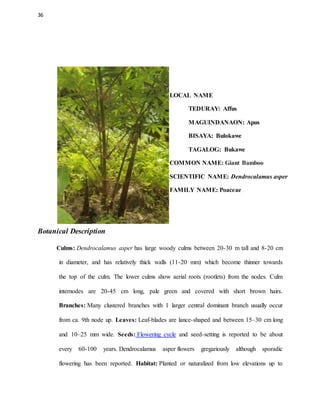
LOCAL NAME
TEDURAY: Affus
MAGUINDANAON: Apus
BISAYA: Bulokawe
TAGALOG: Bukawe
COMMON NAME: Giant Bamboo
SCIENTIFIC NAME: Dendrocalamus asper
FAMILY NAME: Poaceae
Botanical Description
Culms: Dendrocalamus asper has large woody culms between 20-30 m tall and 8-20 cm
in diameter, and has relatively thick walls (11-20 mm) which become thinner towards
the top of the culm. The lower culms show aerial roots (rootlets) from the nodes. Culm
internodes are 20-45 cm long, pale green and covered with short brown hairs.
Branches: Many clustered branches with 1 larger central dominant branch usually occur
from ca. 9th node up. Leaves: Leaf-blades are lance-shaped and between 15–30 cm long
and 10–25 mm wide. Seeds: Flowering cycle and seed-setting is reported to be about
every 60-100 years. Dendrocalamus asper flowers gregariously although sporadic
flowering has been reported. Habitat: Planted or naturalized from low elevations up to
37
1,500 m. Dendrocalamus asper thrives best at 400-500 m altitude in areas with average
annual rainfall of about 2,400 mm. They grow well on various soil types, even on sandy
and rather acidic soils, but prefers well-drained heavy soils (StéphaneSchröder 2010).
Importance:
Economic; Building material and structural timber for heavy construction such as houses
and bridges. The culm internodes used as containers for water and other fluids, and as
cooking pots.
Environmental: Dendrocalamus asper will grow in any type of soil, but it prefers heavy
soils with good drainage.
Uses:
Economic (Livelihood): This bamboo is also used for making laminated boards,
furniture, musical instruments, chopsticks, household utensils and handicraft
(StéphaneSchröder 2010).
Medicine: (Dendrocalamus asper) is one of the abundant bamboos in Indonesia. Its shoot
is nutritious and its wood is used for housing. Meanwhile, the leaves have been used as
traditional medicine for remedy diarrhea in animals. Therefore, this research was
conducted to compare the antibacterial activity of leaf extracts against diarrheagenic
Escherichia coli. The extracts were prepared using methanol, ethanol, and the mixture
thereof at the ratio 1:1, followed by solvent evaporation, to obtain methanolic, ethanolic,
and methanol-ethanolic extracts, respectively.
38
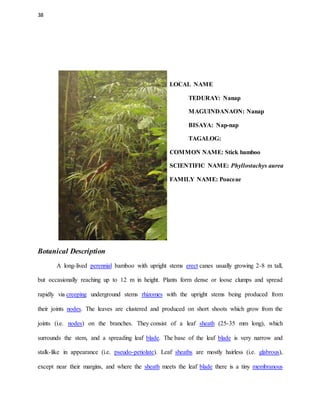
LOCAL NAME
TEDURAY: Nanap
MAGUINDANAON: Nanap
BISAYA: Nap-nap
TAGALOG:
COMMON NAME: Stick bamboo
SCIENTIFIC NAME: Phyllostachys aurea
FAMILY NAME: Poaceae
Botanical Description
A long-lived perennial bamboo with upright stems erect canes usually growing 2-8 m tall,
but occasionally reaching up to 12 m in height. Plants form dense or loose clumps and spread
rapidly via creeping underground stems rhizomes with the upright stems being produced from
their joints nodes. The leaves are clustered and produced on short shoots which grow from the
joints (i.e. nodes) on the branches. They consist of a leaf sheath (25-35 mm long), which
surrounds the stem, and a spreading leaf blade. The base of the leaf blade is very narrow and
stalk-like in appearance (i.e. pseudo-petiolate). Leaf sheaths are mostly hairless (i.e. glabrous),
except near their margins, and where the sheath meets the leaf blade there is a tiny membranous
39
structure (about 1 mm long) topped with long hairs (i.e. a ciliated ligule). On either side of this
structure there are sometimes also 1-3 larger bristles (i.e. setae). The leaf blades (5-15 cm long
and 5-22 mm wide) are elongated (i.e. lanceolate) in shape, may be either hairless (i.e. glabrous)
or softly hairy (i.e. pubescent), and have rough (i.e. scabrous) but entire margins.
Importance:
Economic: Furniture, musical instruments, chopsticks, household utensils and handicraft
Environmental: Erosion control or dune stabilization
Uses:
Economic (Livelihood): Fibre
Medicine:
40
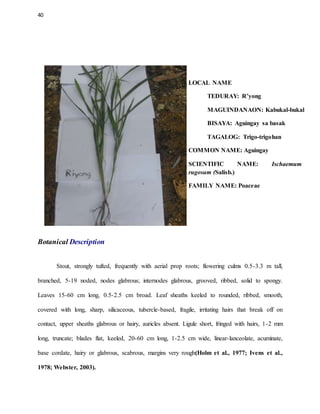
LOCAL NAME
TEDURAY: R’yong
MAGUINDANAON: Kabukal-bukal
BISAYA: Aguingay sa basak
TAGALOG: Trigo-trigohan
COMMON NAME: Aguingay
SCIENTIFIC NAME: Ischaemum
rugosum (Salisb.)
FAMILY NAME: Poaceae
Botanical Description
Stout, strongly tufted, frequently with aerial prop roots; flowering culms 0.5-3.3 m tall,
branched, 5-19 noded, nodes glabrous; internodes glabrous, grooved, ribbed, solid to spongy.
Leaves 15-60 cm long, 0.5-2.5 cm broad. Leaf sheaths keeled to rounded, ribbed, smooth,
covered with long, sharp, silicaceous, tubercle-based, fragile, irritating hairs that break off on
contact, upper sheaths glabrous or hairy, auricles absent. Ligule short, fringed with hairs, 1-2 mm
long, truncate; blades flat, keeled, 20-60 cm long, 1-2.5 cm wide, linear-lanceolate, acuminate,
base cordate, hairy or glabrous, scabrous, margins very rough(Holm et al., 1977; Ivens et al.,
1978; Webster, 2003).
41
Importance:
Economic; Fodder/Forage.
Environmental: Erosion control or dune stabilization
Uses:
Economic (Livelihood): Fibre
Medicine:
42
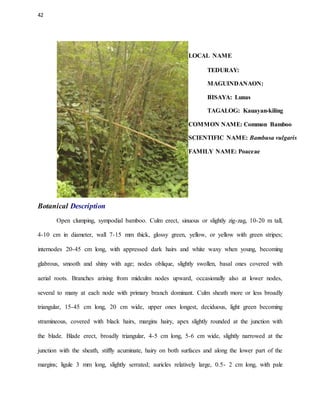
LOCAL NAME
TEDURAY:
MAGUINDANAON:
BISAYA: Lunas
TAGALOG: Kauayan-kiling
COMMON NAME: Common Bamboo
SCIENTIFIC NAME: Bambusa vulgaris
FAMILY NAME: Poaceae
Botanical Description
Open clumping, sympodial bamboo. Culm erect, sinuous or slightly zig-zag, 10-20 m tall,
4-10 cm in diameter, wall 7-15 mm thick, glossy green, yellow, or yellow with green stripes;
internodes 20-45 cm long, with appressed dark hairs and white waxy when young, becoming
glabrous, smooth and shiny with age; nodes oblique, slightly swollen, basal ones covered with
aerial roots. Branches arising from midculm nodes upward, occasionally also at lower nodes,
several to many at each node with primary branch dominant. Culm sheath more or less broadly
triangular, 15-45 cm long, 20 cm wide, upper ones longest, deciduous, light green becoming
stramineous, covered with black hairs, margins hairy, apex slightly rounded at the junction with
the blade. Blade erect, broadly triangular, 4-5 cm long, 5-6 cm wide, slightly narrowed at the
junction with the sheath, stiffly acuminate, hairy on both surfaces and along the lower part of the
margins; ligule 3 mm long, slightly serrated; auricles relatively large, 0.5- 2 cm long, with pale
43
brown bristles 3-8 mm long along the edges. Young shoot yellow green, covered with black
hairs. Leaf blade 6-30 cm long, 1-4 cm wide, glabrous; ligule a subentire rim 0.5-1.5 mm;
auricles small rounded lobes, with a few bristles 1-3 mm. Inflorescence usually borne on a
leafless branch of a leafless culm or on a culm with small leaves, bearing small groups of
pseudospikelets at the nodes, 2-6 cm apart; spikelets 12-19 (-35) mm long, laterally flattened,
appearing strongly 2-cleft, comprising 5-10 perfect florets and a terminal vestigial floret.
Caryopsis not known.Flowering in B. vulgaris is not common. When a culm flowers, it produces
a large number of flowers but no fruit, and eventually the culm dies, but the clumps usually
survive and return to fully vegetative growth within a few years(Stapleton, 2007).
Importance:
Economic; The very young shoots are edible and sold as a vegetable mainly in
Asia. Leaves of B. vulgaris are also used as forage and animal fodder (Dransfield
and Widjaja, 1995; PROTA, 2014).
Environmental: Erosion control or dune stabilization, Windbreak, support and hedge
plant.
Uses:
Economic (Livelihood): Culms are also the main material for the bamboo furniture
industry and they also produce good quality pulp to make paper. Split stems are made
into baskets, fences, roofs, and roof tiles (Francis, 1993).
44
Medicine: This species is also used in traditional Asian and African medicine where
young shoots are boiled and used to treat hepatitis and measles (Dransfield and Widjaja,
1995; PROTA, 2014).
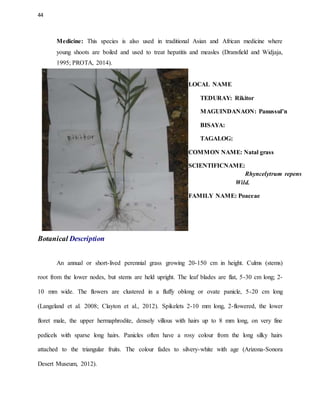
LOCAL NAME
TEDURAY: Rikitor
MAGUINDANAON: Panussul’n
BISAYA:
TAGALOG:
COMMON NAME: Natal grass
SCIENTIFICNAME:
Rhyncelytrum repens
Wild.
FAMILY NAME: Poaceae
Botanical Description
An annual or short-lived perennial grass growing 20-150 cm in height. Culms (stems)
root from the lower nodes, but stems are held upright. The leaf blades are flat, 5-30 cm long; 2-
10 mm wide. The flowers are clustered in a fluffy oblong or ovate panicle, 5-20 cm long
(Langeland et al. 2008; Clayton et al., 2012). Spikelets 2-10 mm long, 2-flowered, the lower
floret male, the upper hermaphrodite, densely villous with hairs up to 8 mm long, on very fine
pedicels with sparse long hairs. Panicles often have a rosy colour from the long silky hairs
attached to the triangular fruits. The colour fades to silvery-white with age (Arizona-Sonora
Desert Museum, 2012).
45
Importance:
Economic; Fodder/Forage.
Environmental: Erosion control or dune stabilization, Land reclamation, Re vegetation,
Soil conservation.
Uses:
Economic (Livelihood): Seed trade, Natal grass has value as an ornamental plant and for use
in phyto remediation and soil stabilization on mined sites (Santos et al., 2000).
Medicine: The plant is used popularly as a phytotherapeutic remedy for the treatment of
diabetes in Brazil and in a recent report the precipitate of the aqueous extract of R. repens has
been shown to significantly reduce plasma glucose levels when administered to diabetic rats
(Braz J Med Biol Res vol.38 no.6 Ribeirão Preto June 2005).
46
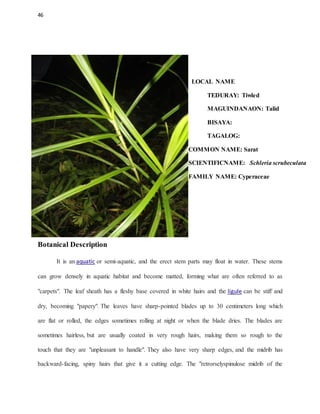
LOCAL NAME
TEDURAY: Tiwled
MAGUINDANAON: Talid
BISAYA:
TAGALOG:
COMMON NAME: Sarat
SCIENTIFICNAME: Schleria scrubeculata
FAMILY NAME: Cyperaceae
Botanical Description
It is an aquatic or semi-aquatic, and the erect stem parts may float in water. These stems
can grow densely in aquatic habitat and become matted, forming what are often referred to as
"carpets". The leaf sheath has a fleshy base covered in white hairs and the ligule can be stiff and
dry, becoming "papery". The leaves have sharp-pointed blades up to 30 centimeters long which
are flat or rolled, the edges sometimes rolling at night or when the blade dries. The blades are
sometimes hairless, but are usually coated in very rough hairs, making them so rough to the
touch that they are "unpleasant to handle". They also have very sharp edges, and the midrib has
backward-facing, spiny hairs that give it a cutting edge. The "retrorselyspinulose midrib of the
47
leaf can inflict most painful lacerations".The panicle is narrow or spreading and erect or nodding,
and up to about 12 centimeters long. The branches are almost fully lined with overlapping
spikelets each up to half a centimeter long. The spikelets may be greenish or purplish in color,or
sometimes tinged with orange or brick red. They are surrounded by white or purplish bracts that
have characteristic comb-like hairs along their greenish nerves. The flower has
six stamens. After the spikelets fall, the panicle branches have a zig-zag shape. Fertile seed is
rarely produced and the grass commonly reproduces vegetatively by sprouting from the rhizome
or the nodes on the stem (John, J. R., et al. (2012).
Importance:
Economic; Despite its sharp leaf edges, it is palatable to cattle and it is maintained as
a pasture grass on swampy land and cut for hay.
Environmental: Its ability to absorb chromium in particular has been described as
"extraordinary".It is considered to be a potential agent of phytoremediation in efforts to
clean up metal-contaminated soils and water.
Uses:
Economic (Livelihood):
Medicine:
48
CITED LITERATURE AND STUDIES
ABUBAKAR H. 2003 Tree of Timako Hill KalangananCotabato.Retrieved on July 2014.
BUSTAMANTE (2006)Broitman and Kinlan 2006) which in turn may support higher levels
of herbivore grazer biomass. Retrieved on July 2014 from
www.books.google.com.ph/books?isbn=1109077513.
DARRIS and GONZALVES 2008 Retrieved on July 14 2014 from
(http://www.bhg.com/gardening/plant-dictionary/perennial/grass/sedge/).
HOPKINS AND DEL PRADO (2007) Jun 13, 2007 - Hopkins, A. and Del Prado, A. (2007),
Implications of climate change for grassland in Europe: impacts, adaptations and
mitigation. Retrieved on July 2014 from www.onlinelibrary.wiley.com/doi/10.1111/j.1365-
2494.
JANK (2005), SULAS, 2005, MANNETJE (1997), MOSIER and DELGADO
(1997).Retrieved on July 2014 from (New York: Dover, 1971), 1-13.
(https://suite.io/helen-mcgranahan/5a1c2b8.)
MANNETJE (1997)Enschede Area, Netherlands - Design Engineer Nijwald BV at
Sensata Technologies View Dieter’t Mannetje's professional profile on
LinkedIn. ... Network, helping professionals like Dieter 't Mannetje discover inside
connections to ... 1997 2003. Retrieved on July 2014 from
www.linkedin.com/pub/dieter-t-mannetje/14/631/256.
MORGAN, Sep 16, 2005 - R.P.C. Soil Erosion and Conservation, 3rd edition. Blackwell
Publishing, Oxford, 2005. x + 304 pp. £29.95, paperback.Retrieved on July 2014 from
www.onlinelibrary.wiley.com/doi/10.1111/j.1365-2389.2005...x/abstract
MOSIER AND DELGADO (1997) As mentioned, the soil-grass system of temperate
grasslands (Mosier et al., 1991,1997) and tropical pastures (Keller and Reiners,
1994; Mosier and Delgado, Retrieved on July 2014 from
www.scielo.org.ve/scielo.php?pid=S0378-18442007000100007.
49
POVELLATO (2007) found that agriculture (as a whole) and forestry account for 30 %
of worldwide GHG emissions from human activities and 10 % in Europe. Retrieved on
July 2014 from www.books.google.com.ph/books?isbn=3642370489
SOUSSANA and LUSCHER, 2007, KEMP AND MICHALK, 2007.Grasslands cover about
70% of the world’s agricultural area.Retrieved on July 2014 from
(http://www.bhg.com/gardening/plant-dictionary/perennial/grass/sedge/).
SOUSSANA and LUSCHER, Review Article. Temperate grasslands and global atmospheric
change: a review. J-F.Soussana* and A. Lüscher†. *Grassland Ecosystem Research, INRA
UR. 2007. Retrieved on July 2014 from www.southwestnrm.org.au/.../soussana-jf-luscher-
2007temperate-grassland.
SULAIMAN M.A. 2004 Flora in Barangay Badak General Salipada K. Pendatun.
Retrieved on July 2014.
50
PICTORIALS
51
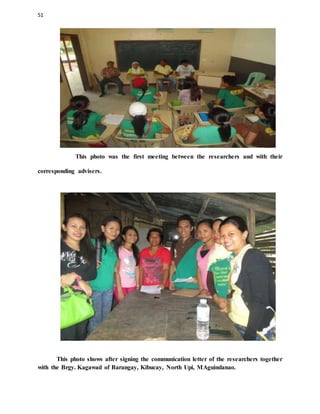
This photo was the first meeting between the researchers and with their
corresponding advisers.
This photo shows after signing the communication letter of the researchers together
with the Brgy. Kagawad of Barangay, Kibucay, North Upi, MAguindanao.
52
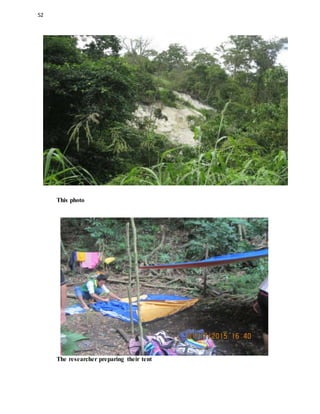
This photo
The researcher preparing their tent
53
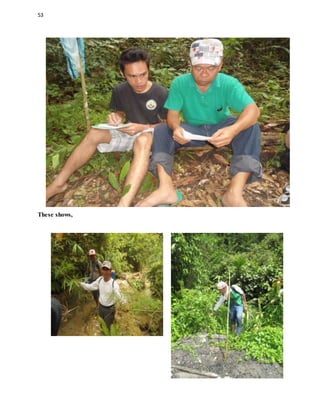
These shows,
54
55
APPENDICES

Grasses and Sedges in Saladengen

  • 1.
    1 GRASSES AND SEDGESIN SALADENGEN-DIMAPATOY WATERSHED FOREST RESERVED JEVIT P. MEDICO Submmited to the Faculty Members of the School of Forestry Cotabato City State Polytechnic College in Partial Fulfillment of the Requirement for the Degree of BACHELOR OF SCIENCE IN FORESTRY (General Forestry) 2015
  • 2.
    2 Abstract JEVIT P. MEDICO,Cotabato City State Polytechnic College, Cotabato City, School year 2014-2015. “Grasses and Sedges in Saladengen-Dimapatoy Watershed Forest Reserved”. Major Adviser: Ambusa T. Badal RF. The study was conducted at Saladengen-Dimapatoy Watershed Forest Reserved. The study aimed to determine the Classification, Identefication, Botanical Description and Importance/Uses of Grasses and Sedges. The Identification includes the Local Name, Common Name, Scientific Name and Family Name. In addition, the Researcher also find out the Botanical Description and Importance/Uses of Individual Grasses and Sedges. Specifically, the objectives of the study were the following: 1. What were the identification of the different existing Grasses and Sedges in Saladengen- Dimapatoy Watershed Forest Reserved; 2. What were the Botanical Description of the different existing Grasses and Sedges in Saladengen-Dimapatoy Watershed Forest Reserved; 3. What were the importance and uses of the different existing Grasses and Sedges in Saladengen-Dimapatoy Watershed Forest Reserved? The research design used in the Study was the descriptive classification and identification survey design. This includes grouping or classification and identification of Grasses and Sedges found in the study area. There were eleven (11) Grasses species and one (1) Sedges found in the study area with local name, common name, scientific name and family name. Grasses were mostly found in dry areas.
  • 3.
    3 CHAPTER I INTRODUCTION The Problemand its Background The Philippines is considered a mega-diverse country rivaled only by a few countries in the world when it comes to variety of ecosystems, species and genetic resources. Many of the islands comprising the archipelago are believed to have a very high degree of plant and animal endemism. The country hosts more than 52,177 described species of which more than half is found nowhere else in the world. On a per unit area basis, the Philippines probably harbors more diversity of life than any other country on the planet. The country is also considered a biodiversity hotspot. This is because the Philippines continues to experience an alarming rate of destruction of these important resources brought about by overexploitation, deforestation, land degradation, climate change, and pollution (including biological pollution), among others (2009 Philippine Clearing House Mechanism for Biodiversity). Grasslands cover about 70% of the world’s agricultural area (Soussana and Luscher, 2007). Their use in a way that is economically, environmentally and socially sustainable is a major challenge facing many countries. Clearly they play an important role in food production. However, there is increasing recognition of the need to approach grasslands from the viewpoint of ‘multi-functionality, particularly from livestock production, whilst at the same time delivering important ecosystems services and underpinning the tourism, amenity and leisure industries in many parts of the world. The changing considerations concerning the use and management of grasslands have been recently reviewed (Kemp and Michalk, 2007).
  • 4.
    4 Grasses, or moretechnically Graminoids, are monocotyledonous, usually herbaceous plants with narrow leaves growing from the base. They include the "true grasses", of the family Poaceae (also called Gramineae), as well as the sedges (Cyperaceae). The true grasses include cereals, bamboo and the grasses of lawns (turf) and grassland. Sedges include many wildmarsh and grassland plants, and some cultivated ones such as water chestnut (Eleocharis dulcis) and papyrus sedge (Cyperus papyrus). Grasses have adapted to conditions in lush rain forests, dry deserts, cold mountains and even intertidal habitats, and are now the most widespread plant type; grass is a valuable source of food and energy for all sorts of wildlife and organics. Graminoids are the dominant vegetation in many habitats, including grassland, salt- marsh, reedswamp and steppes. They also occur as a smaller part of the vegetation in almost every other terrestrial habitat. Many types of animals eat grass as their main source of food, and are called graminivores – these include cattle, sheep, horses, rabbits and many invertebrates, such as grasshoppers and the caterpillars of many brown butterflies. Grasses are also eaten by omnivorous or even occasionally by primarily carnivorous animals. Uses for graminoids include food (as grain, sprouted grain, shoots or rhizomes), drink(beer, whisky, vodka), pasture for livestock, thatch, paper, fuel, clothing,insulation, constru ction, sports turf, basket weaving and many others. The most important food crops are the grains of grasses such as wheat, rice and barley. They have many other uses, such as feeding animals, and for lawns. There are many minor uses, and grasses are familiar to most human cultures. Grass is also important in many sports, notably with those played on fields such as American football, Association football, baseball, cricket, and rugby. In some sports facilities, including indoor domes and other places where maintenance of a grass field would be difficult, grass may be replaced with artificial turf, a synthetic grass-like substitute. Sports such
  • 5.
    5 as golf, tennisand cricket are particularly dependent on the quality of the grass on which the sport is played (2010-2013 Living Expression Landscapes, 20907 Elder Road, Conroe TX77385). Sedges often have triangular stems. The female flowers of sedges are enclosed in a single sheath-like scale called a perigynia. Many sedge species spread through long rhizomes making them useful in erosion control of moister soils. The Sedge Family groups several related genera including Scirpus, Rhynchospora, Eleocharis,Cladium, Schoenoplectus &others, but the largest genus is the Carex with over 130 species growing in California, most of them are native. Although Sedges it looks like an ornamental grass, most of which need full sun and thrive in hot, dry conditions, clump-forming sedge is completely different. For one thing, it's sedge, not an ornamental grass. And it prefers shade along with moist soils (making it a great plant to tuck among the hostas). But like an ornamental grass, sedge has colorful arching foliage, most notably in beautiful glowing yellows, that is evergreen in warm climates and semi-evergreen in cold areas (Darris and Gonzalves 2008). The grasses known as cereals or grains are the most obvious human food source and have traditionally been planted for agriculture and food production. Types of cereal producing grasses include wheat, barley, corn, rye, sorghum, millet, and rice. Products from the cereal grains are the mainstay of the human diet. Sugar cane is also a member of the grass family and is used to make refined sugar. Alcohol and starch are products of plants in the grass family. Humans have also benefited more indirectly from grasses through eating herbivores, which eat the grass and turn it into protein and fat for human use. Larger and more stout grasses (such as bamboo) have long been used to build structures in many parts of the world. A pioneer during the American
  • 6.
    6 westward migration madetheir homes out of grass sod where wood was not available. Pioneers who had the benefit (or curse) of settling areas with highly cohesive clay soils made bricks of mud and dried straw or grass to build their structures. The grass in the bricks acted as a filler and binder, adding strength, and making less mud necessary. Modern day practices for "green- buildings" often incorporate grass roofs. Healthy stands of grass have long been the foundation for livestock operations around the world, while farmers chose to plow under the native grasses and plant wheat, corn, and other cultivated grass crops. A more recent industrial use for corn and other selected grasses is use of them in the production of ethanol for fuel. For many years, the landscaping trade and garden enthusiasts didn’t appreciate the aesthetic value of grasses. That is finally changing as grasses are being planted in home and office landscapes because they add texture and accent to a garden, and can be relatively low maintenance (A.S. Hitchcock and Agnes Chase, Manual of the Grasses of the United States, Second Edition, Pp. 1-13). Historically, humans have found many uses for grass to make tools that have made everyday life easier. A few examples are basketry, mats, straw hats, and brooms. Environmental Benefits of Grasses the strong and pervasive root systems of most grasses make them largely responsible for holding soil in place and preventing erosion in grasslands and many forested ecosystems. Healthy and abundant leaf cover above ground also reduces the impact of rainfall to further reduce erosion. The leaves and dead litter temporarily hold some of the water so it can dissipate through evaporation instead of running off (New York: Dover, 1971) They concluded that agriculture and forestry can potentially contribute to GHG emission mitigation and that emission reduction can be achieved cost effectively by reducing methane emissions. Carbon sequestration is an additional way of mitigating GHG emission but more costly than direct abatement. Currently, in terms of carbon mitigation options from livestock
  • 7.
    7 agriculture, only areduction in the number of animals can be registered as a reduction according to the Intergovernmental Panel on Climate Change (IPCC, 1997). Way back on 1959, a Public land on the Northwest side of North Upi and Western side of Dinaig (now Datu Odin Sinsuat Municipalities) were declared as reforestation as Reforestation Project known as Dimapatoy Reforestation Project (covering an approximate area of 9,999 has.) in which part of it is now “Dimapatoy Watershed Forest Reserve” under Autonomous Region in Muslim Mindanao Proclamation No.18 dated July 5, 2001 by the ARMM Government Professor Nor Misuari, is located within the municipalities of North Upi and Datu Odin Sinsuat, both in the province of Maguindanao and it covers an area approximately Three Thousand Seven Hundred Sixty Five (3,765) hectares of open denuded and brush land areas with patches of old and second growth forest and reforestation species. It is bounded by latitude between 07o03’45” to 07o08’47” and longitude between 124o07’15” to 124o13’27” with a topography of extremely gentle rolling to a moderate slope with gradient ranging 20o to 50o (Metro Cotabato Water District Ten Years Development Plan, Undated). Saladengen (the study site) lies in the Northern part of Dimapatoy Watershed Forest Reserve. Its creek, a perennial stream fed a voluminous amount of water in Dimapatoy River (Personal interview with Dr. Abonawas M. Pendaliday). Dimapatoy River is the main source of water for about 200,000 concessionaires’ residents of Cotabato City and nearby communities (DelfinHelario 2011). The reason why the researcher conducts this study is to verify how grasses and sedges play its important role, based on the observed data gathered from the physical appearance and the distribution in the area, particularly in Saladengen-Dimapatoy Watershed Forest Reserved.
  • 8.
    8 Statement of theProblem Grasses and sedges are both important in our environment, especially when it regard on many aspect in our ecosystem such as grass steppe, and grassland. Hence, there is increasing recognition of the need to approach grasslands from the viewpoint of ‘multi-functionality’ particularly from livestock production, whilst at the same time delivering important ecosystems services and underpinning the tourism, amenity and leisure industries in many parts of the world (Kemp and Michalk, 2007). Main Objective The researcher aims to survey the Grasses and Sedges in Saladengen-Dimapatoy Watershed Forest Reserved. Specific Objectives Specifically, the study sought to determine the following specific objectives: 4. To find out the identification of different existing Grasses and Sedges in Saladengen- Dimapatoy Watershed Forest Reserved; 5. To find out the Botanical Description of different existing Grasses and Sedges in Saladengen-Dimapatoy Watershed Forest Reserved; 6. To find out the Importance and Uses of different existing Grasses and Sedges in Saladengen- Dimapatoy Watershed Forest Reserved.
  • 9.
    9 Significance of theStudy The result of this study hopefully becomes a basis of information on the identification, botanical description, importance and uses of existing Grasses and Sedges in Saladengen- Dimapatoy Watershed Forest Reserved. This would help developmental plan in this area, particularly the environmental-based rehabilitation interventions geared towards sustainable biodiversity agenda of the country. The result of this study provides data for land use planning of local government unit or entity that has management authority over the area, serves as reference and now form part of the college data bank. Scope and Limitation of the Study The scope of this study was confined and limited to the identification, botanical description, importance and uses of existing Grasses and Sedges in Saladengen-Dimapatoy Watershed Forest Reserved. This study was conducted on second semester of the School Year 2014-2015 in Saladengen-Dimapatoy Watershed Forest Reserved.
  • 10.
    10 Operational Definition ofTerms Assessment. Classification, Identification, Botanical description, and Importance of Grasses and Sedges. Flora. Grasses and Sedges. Classification.Grouping of plants/species into Grasses and Sedges. Diversity.Varieties of Grasses and Sedges. Identification.Knowing the names of Grasses and Sedges by Local name, Common name, Family name, and Scientific name. Grass. Any plants of the family Gramineae, characterized by jointed stem, sheathing leaves, flowers spikelet and fruits consisting of a seed like grain or caryopsis like wheat, rice, barley etc. Sedge. Plant whose system is solid, usually triangular or flatten not jointed leaves arranged in whole at the terminal apex of the stem and leaflets are entire. Terminologies Assessment.The process of documenting knowledge, skills, attitudes, and beliefs. Grass.Any plants of the family Gramineae, characterized by jointed stem, sheathing leaves, flowers spikelet and fruits consisting of a seed like grain or caryopsis like wheat, rice, barley etc. Grass Steppe. Sedge.Plants whose system are solid, usually triangular or flatten not jointed leaves are arranged in whole at the terminal apex of the stem and leaflets are entire.
  • 11.
    11 Classification.Refer to categorization,the process in which ideas and objects are recognized, differentiated, and understood. Identification.Knowing the names of Grasses and Sedges by Local name, Common name, Family name, and Scientific name. Flora.The collective term to a plant life of a particular period of time or part of the World. Grassland.Areas where the vegetation is dominated by grasses, however sedge and rush families can also be found. Grasslands occur naturally on all continents except Antarctica. Grasslands are found in most ecoregions of the Earth. Steppe.In physical geography, a steppe is an ecoregion, in the montane grasslands and shrublands and temperate grasslands, savannas, and shrublands biomes, characterized by grassland plains without trees apart from those near rivers and lakes. Thatch.Roofing of straw, or reeds, or similar materials.
  • 12.
    12 CHAPTER II REVIEW OFRELATED LITERATURE & STUDIES In this chapter, several speculation of authors and results of studies related to the study has been presented. The most conspicuous grasses are perennial bunch grasses. Bunch grasses form tufts, clumps, or tussocks by sending up new shoots called tillers. The tillers remain attached to the base of the grass and the plant gradually thickens. Because bunch grasses do not spread out like rhizomatous grasses, they provide an open structure to coastal prairie that enhances biodiversity: the spaces between bunches allow room for a diverse selection of forbs, mosses and other grasses to grow and provide habitat for feeding, nesting, and hiding birds and animals (Darris and Gonzalves 2008). In Mediterranean climate areas, the use of annual species is common and considerable work has been carried out to assess the suitability of a range of different annual legumes (reviewed in Sulas, 2005). Janket al (2005) described the potential for breeding to contribute substantially to increased productivity of the 260 million hectares of well drained savannah grassland in South America. Recent decades have seen dramatic increases in the use of the introduced grasses Brachiariaspecies particularly in the Brazilian cerrados region. Over the past 30 yrs more than 70m ha of native vegetation has been replaced by pastures for beef production particularly Brachiaria and Andropogon. In seasonally flooded lands Paspalumatratumis a grass species native to South America which has attracted research and commercial interest (Janket al 2005).
  • 13.
    13 grasses to growand provide habitat for feeding, nesting, and hiding birds and animals (Darris and Gonzalves 2008). Breeding of tropical grasses, many of which, including important species of Brachiaria, PapsalumandCenchrus, are apomictic (i.e. do not reproduce sexually through seed production) is still in its infancy and focused primarily on underpinning more efficient and economic livestock production. Many important forage legume genera have originated in tropical America, e.g. Stylosanthes, Arachis, and Leucaena. Germplasm collections of these species have been made and new cultivars developed although uptake by farmers appears limited (Janket al 2005). In a recent review, Povellatoet al (2007) stated that agriculture (as a whole) and forestry account for 30% of worldwide greenhouse gas (GHG) emissions from human activities and 10% in Europe. Morgan (2005) considered the global picture in terms of the response of grazing lands to increased atmospheric carbon dioxide. Hopkins and Del Prado (2007) compiled the scenarios for climate change affecting European grasslands. Likely responses include: increased herbage growth, increased use of forage legumes particularly white and red clover and alfalfa (lucerne), reduced opportunities for grazing and harvesting on wetter soils, greater incidence of summer drought and increased leaching from more winter rainfall. The impact of climate change on European grasslands and their role in climate change mitigation have been recently reviewed (Mannetje, 2007a; Hopkins and Del Prado, 2007; Soussana and Luscher, 2007).
  • 14.
    14 Cogon grass paper-makinguses the soda method to break down the fibers. Making paper using cogon grass is a way to productively use the invasive weed. Cogon weed is not native to America but spread from the accidental introduction of the seed from Japanese packing materials in the early 1900s. Making paper from cogon grass requires the effective breakdown of fibers to produce the quality of material necessary for paper-making. The process can be achieved using the correct method and provides effective result (Jane Humphries, eHow Contributor, Retrieved on July 17, 2014).
  • 15.
    15 CHAPTER III METHODOLOGY This chapterpresents the Locale of the Study, Research Design, Sampling Procedure, Research Instrument, Data Gathering Procedure, and Data Analysis. Locale of the Study Dimapatoy Watershed Forest Reserve is located in the Southwest of Datu Odin Sinsuat Municipality and Northwest of North Upi Municipality covering an approximate area of Three Thousand Seven Hundred Sixty Five hectares (3,765 has.). It is bounded 124o07’15” to 124o13’27” with topography of extremely gentle rolling to a moderate slope with gradient ranging 20o to 50o. Dimapatoy creek of Dimapatoy Watershed Forest Reserved is one of the main sources of domestic water tap by Metro Cotabato Water District for the domestic use of Cotabato City residence and nearby areas.
  • 16.
    16 Figure: 1 Location mapof the study area (Google Earth)
  • 17.
    17 Research Design This studyis a descriptive classification and identification survey design. This includes grouping and identification of Grasses and Sedges found in the study area. Sampling Procedure The research area was determined, where running list method was used in data gathering. Research Instrument The researcher was used the following instrument such as; camera with lens for taking photographs of Grasses and Sedges. Materials used in this study were: record note, pencil/ball pen, marker, bolo, bag and bond paper. Data Gathering Procedures Every Grasses and Sedges encountered while doing the running list in the area was being recorded and identified individually. The botanical description was found out in the references and in the internet as well as the importance and uses of individual Grasses and Sedges. Data Analysis Descriptive statistics was used to analyze all data gathered.
  • 18.
    18 CHAPTER IV PRESENTATION OFDATA AND RESULT This chapter shows the Data Gathered during the field conduction. The Data were presented here were obtained from the actual survey of Grasses and Sedges species that were found in Saladengen-Dimapatoy Watershed Forest Reserved. Presented in Table 1 for Grasses and Table 2 for Sedges where the Local Name, Common Name, Scientific Name, Family Name, Importance and Uses was also presented. Presentation and Discussion of the Data This chapter presents the Data Gathered by the Researcher from his practical works. Data were presented in Tabular form, followed by textual Discussion.
  • 19.
    19 Data Tabulation TABLE 1:List of Grasses species found in Saladengen-Dimapatoy Watershed Forest Reserved LOCAL NAME COMMON NAME SCIENTIFIC NAME FAMILY NAME IMPORTANCE T’DURAY MAGUINDANAON 1.Běrěnteek Lagumbingan Batad-bataran Sorghum hatepense (L.) Poaceae Fodder 2. Rěwer Balili Palagtiki Eleusine indica (L.) Poaceae Forage 3.K’roon tudok Gi Cogon Imperata cylindrical (L.) Poaceae Paper-making 4.Runsěk Lagidit a kalabaw Kulapi Paspalum conjugatum (B.) Poaceae Forage 7. Bagang Awang-awang Poaceae Erosion control 6. Riray Poaceae 7.Bulkao Apus Giant Bamboo Dendro calamusasper Poaceae Poles 8.R’yong Aguingay Ischaemumrugosu m (Salisb.) Poaceae Forage 9. Affus K’ling KawanKiling Bambusa vulgaris Poaceae Fibre. Miscellaneous materials 10.Rikitor Panussul’n Natal grass Rhyncelytrumrepe nsWild. Poaceae Forage & Pasture The above Table stated the Local Name, Common Name, Scientific Name, Family Name, Importance and Uses of the listed eleven (11) grass species.
  • 20.
    20 TABLE 2: Listof Sedges species found in Saladengen-Dimapatoy Watershed Forest Reserve LOCAL NAME COMMON NAME SCIENTIFIC NAME FAMILY NAME IMPORTANC E Tiduray Maguindanaon 1.Tiwl’d Talid Sarat Schleriascrubecula ta Cyperaceae Pasture The above Table stated the Local Name, Common Name, Scientific Name, Family Name, Importance and Uses of the listed one (1) sedges species. In the total there were twelve species that found by the researcher in Saladengen- Dimapatoy Watershed forest Reserved wherein eleven (11) species in Grasses and one (1) Species for Sedges. Likewise, Photo sample plant species were presented with Botanical Description and its Importance and Uses.
  • 21.
    21 CHAPTER V SUMMARY, CONCLUSIONAND RECOMMENDATION General |Summary The study was conducted at the research area Saladengen-Dimapatoy Watershed Forest Reserve. The researcher aimed to identify the different existing Grasses and Sedges that was seen in the study area. To identify includes the Local Name, Common Name, Scientific Name, and Family Name. In addition, the researcher also found out the botanical description as well as the importance and uses of every individual Grasses and Sedge in Saledengen-Dimapatoy Watershed Forest Reserved by using the references in the book as well as in the internet. Running list method was used for the identification of Grasses and Sedges in the study area. Summary of Findings The study revealed that there were eleven (11) Grasses species and only one (1) species from Sedges identified in the study area. Conclusion Based on the result of the study, the researcher concluded that there were few species of Grasses and only one species from Sedges that were found in Saladengen-Dimapatoy Watershed Forest Reserved.
  • 22.
    22 Recommendation Throughout the realizationof this research study entitled “Grasses and Sedges in Saladengen-Dimapatoy Watershed Forest Reserved”, the researcher was highly recommended the following: 1. The reserve is maintained for conservation, education, enjoyment and research, that provides natural habitat for wildlife, connects the community to the natural human race, and gives the Watershed Association in one of the best platforms in Saladengen- Dimapatoy Watershed Forest Reserved; 2. Protection, should always in the mind of the people in terms of the important Role of Grasses and Sedges such as: water storage for the continuing flow of the watershed, and to sustain the needs of community in nearby areas; 3. Monitoring the endangered and locally rare plant species (Grasses and Sedges) using standardized protocol to improve the survival of residual vegetation, in Saladengen- Dimapatoy Watershed Forest Reserved.
  • 23.
  • 24.
    24 LOCAL NAME TEDURAY: Běrěnteek MAGUINDANAON:Lagumbingan BISAYA: Lawe-lawe TAGALOG: Ngigai COMMON NAME: Batad-bataran SCIENTIFIC NAME: Sorghum hatepense (L.) FAMILY NAME: Poaceae Botanical Description Sorghum hatepense (L.) "Perennial [grass] with strong rhizomes; culms erect, to 1.5 m tall; nodes with short pubescence; sheaths glabrous; ligule ciliate-membranous, 2 mm long; blades elongate, usually 1-1.5 cm wide, the midrib prominent; panicles 15-25 cm long, branches ascending; spikelets 5 mm long, acute; first glume hard; fertile lemma awned or awnless, awn if present 1 cm long or less" (Stone 1970; p. 239). Importance: Economic; Fodder/Forage. Environmental: Due to its capacity to form extensive networks of rhizomes, S. halepense can also be useful for control of soil erosion (Bennett, 1973). Uses: Economic (Livelihood): It can be used whole in a similar manner to rice or millet, or it can be ground in to a flour and used as a cereal in making bread cakes and more (Febraida2004).
  • 25.
    25 Medicine: Under certainconditions, the plant, if grazed, may cause cyanide poisoning. The pollen may induce hay fever.
  • 26.
    26 LOCAL NAME TEDURAY: Rawer MAGUINDANAON:Balili BISAYA: Palagtiki TAGALOG: Bakis-bakisan COMMON NAME: Paragis SCIENTIFIC NAME: Eleusineindica (L.) FAMILY NAME:Poaceae Botanical Description Eleusin eindica (L.) is a tufted annual grass, prostrate and spreading, or erect to about 40 cm, depending on density of vegetation but not usually rooting at the nodes. The root system is very well developed and strong and the name jongosgras, used in South Africa, implies that it takes a young ox to uproot it. On germination, the first leaf, about 1 cm long, tapers very suddenly to a point and may be pressed quite flat on the soil. Later leaves are flat to V-shaped, up to 8 mm wide, 15 cm long and come to a longer, acute, boat-shaped tip. They are glabrous and usually quite bright, fresh green in colour. The ligule is a very short membraneous rim up to 1 mm long, sparsely fringed with short hairs. The sheaths and stem bases are distinctly flattened. The inflorescence consists of 3-8 racemes, each 5-10 cm long, about 5 mm wide, arranged more- or-less digitately, though one raceme may be inserted about 1 cm below the others. The narrow rachis, about 1 mm wide, has two dense rows of almost glabrous spikelets, each 2.5-3 mm long,
  • 27.
    27 3-5 flowered, thelower and upper glumes about 1.5 and 3 mm long, respectively, and the lemmas very similar in both texture and size to the upper glume. All have a slightly scabrid keel and are acute but not awned. The reddish-brown to black seeds are oblong, about 1 mm long, conspicuously ridged (Holm et al., 1979). Importance: Economic; Fodder/Forage. Environmental: Erosion control or dune stabilization Uses: Economic (Livelihood): Fiber Medicine: Poisonous to mammals
  • 28.
    28 LOCAL NAME TEDURAY: K’roontudok MAGUINDANAON:Gi BISAYA:Kogon TAGALOG: Cogon COMMON NAME: Cogon SCIENTIFICNAME: Imperata cylindrical (L.) FAMILY NAME: Poaceae Botanical Description A perennial up to 120 cm high with narrow, rigid leaf-blades. Lower leaf-sheaths bearded at the mouth, upper usually glabrous; blades glabrous or hairy on the lower part, up to 100 cm long, often less, usually 3-10 mm wide, expanded; panicle 5-10 cm long; spikelets surrounded by hairs 1015 mm long. Imperata roots penetrated to 58 cm in alluvial soil at Varanasi, India, with a production of 20 480 kg air-dried roots per hectare (Ramam, 1970). There are five varieties. 1. cylindrica var. africana has the culm nodes usually glabrous and the spikelets 5 mm long, while in var. major the culm nodes are bearded and the spikelets to 3.5 mm long (Napper, 1965). Importance: Economic; Fodder/Forage/ Grazing, Thatching or Roofing Environmental: Soil moisture conservation
  • 29.
    29 Uses: Economic (Livelihood): Paper-making,packing materials, brush-making, rope-making, fuel. Medicine: Sugar and alcohol production and a range of medicinal purposes. The flowers and roots of I. cylindrica have antibacterial, diuretic, emollient, febrifuge, sialagogue, styptic and tonic properties.
  • 30.
    30 LOCAL NAME TEDURAY: Runsek MAGUINDANAON:Lagidit a kalabaw BISAYA: Lakatan TAGALOG: Bantotan COMMON NAME: Kulapi SCIENTIFICNAME: Paspalidiumconjugatum FAMILY NAME: Poaceae Botanical Description Genus Species: PaspalumConjugatum Family: Poaceae (Grass Family) English name: Hilo grass, sour paspalum, t-grass Growth form: A creeping perennial grass Growth location: Terrestrial Growth environment: Caltivated gardens, roadsides and in the lawns. Growth zone: Tropical Average height: 20-60cm high, Stem: Spreading by long, often reddish-purple stolons. Leaf arragement: Flattened keeled, green or tinged with purple margins somewhat hairy. Petioles: Present with 1mm long Leaf blade: 8-20x 0.5-1.5 cm; surface glabrous or stiffly hairy Inflorescence: Two terminals, widely spreading racemes 5-15 cm long Flower: Spikelets 1.5-2 cm long, ovate, flattened Calyx: Two parts spiklets that has a pale green color, the margin fringed with long silky hair. Corolla: Two spreading parts Stamen: Three Ovaries: inferior Style: 5-15cm long Seed: Small tiny seeds on the two racemes.
  • 31.
    31 Anything else: Itparticularly grows in a wet place up to 950 m elevation (http://www.comfsm.fm/~dleeling/botany/1999/vhp/paspalum.html Retrieved on January 24, 2015). Importance: Economic; Fodder/Forage. Environmental: Erosion control or dune stabilization Uses: Economic (Livelihood): Chicken's stock reserved for every day uses. Medicine: vertebrate poisons, non-vertebrate poisons, medicines, environmental uses, and gene sources,
  • 32.
    32 LOCAL NAME TEDURAY: Bagang MAGUINDANAON:Awang-awang BISAYA: TAGALOG: COMMON NAME: Broomcorn SCIENTIFIC NAME: Sorghum arundinaceum FAMILY NAME: Poaceae Botanical Description Genus: "Annuals or perennials; panicle terminal, consisting of 1-5 disarticulating racemes; rachis disarticulating in wild species but usually not in cultivated species; spikelets paired or in threes, dissimilar, the sessile spikelets bisexual and seed-bearing, the pedicelled male or neuter" (Smith, 1979; p. 376). Species: "Perennial, the culms 90-120 cm or more high; leaf blades 45-90 cm long, 5-7.5 cm broad, tapering to a fine point; spikelets golden-brown in color, turning black at maturity, 6-7 mm long, the lower glume lacking an awn or, on a few spikelets, mucronate." (Smith, 1979)"Annual or short-lived perennial without rhizomes; culms 0.3-4 m high, often robust, the nodes glabrous or pubescent. Leaf-blades variable, often large, 5-75 cm long, 5-70 mm wide. Panicle linear to broadly spreading, 10-60 cm long; primary branches compound, ultimately bearing racemes of 2-
  • 33.
    33 7 spikelet pairs.Sessile spikeletlanceolate to narrowly ovate, 4-9 mm long, glabrescent to white pubescent, sometimes tomentose or fulvously pubescent, awnless or more often with an awn 5- 30 mm long. Pedicelled spikelet linear to lanceolate, male or barren, smaller than the sessile" (Clayton and Renvoize, 1982; p. 727). Importance: Economic; The use of sorghum stalks as forage for animals and as fuel for cooking fires. Environmental: Erosion control or dune stabilization Uses: Economic (Livelihood): Early uses of sorghum include its preparation with native yeast to produce a kind of bread or flat cake. The tiny grains (probably 500,000 to 1 million per kg) could also be eaten as porridge. Both of these would be familiar to people conversant with early wheat, barley or the Ethiopian grain Teff (Eragrostis tef (Zucc.) Sorghum grains were probably also turned into 'small beer' using souring, or lactic acid fermentation, resulting in a fermented gruel rather than a beer as we know it. This fermentation technique involves using germinating grains and the resulting brew is very nutritious. Medicine: A very important point is that sorghum leaves, when young, contain large quantities of dhurrin, a precursor of the lethal vegetable form of cyanide. Small plants and young shoots have 20 times the amount of dhurrin compared with adult, mature leaves. The poison is
  • 34.
    34 destroyed when theleaves are made into hay or silage (Carolus Linnaeus in 1753, Conrad Moench transferred cultivated sorghum into its own genus in 1794). LOCAL NAME TEDURAY: Riray MAGUINDANAON: BISAYA: TAGALOG: COMMON NAME: Muk bamboo SCIENTIFIC NAME: Bambusa rutila FAMILY NAME: Poaceae Botanical Description Perennial; caespitose. Rhizomes short; pachymorph. Culms erect; 1000–1200 cm long; 60 mm diam.; with root thorns from the nodes. Culm-internodes terete; hollow. Lateral branches dendroid; reflexed. Buds or branches present on lower quarter of culm. Branch complement several. Culm-sheaths deciduous; glabrous; concave at apex, or convex at apex, or truncate at apex; auriculate; with unequal auricles; setose on shoulders; shoulders with curved hairs; shoulders with 4–10 mm long hairs. Culm-sheath ligule 4–5 mm high; dentate, or fimbriate. Culm-sheath blade triangular; demarcated but persistent; erect; scabrid and with ciliate margins. Leaves cauline; 6–10 per branch. Leaf-sheaths glabrous on surface, or puberulous; outer margin glabrous. Leaf-sheath oral hairs lacking, or ciliate. Leaf-sheath auricles absent, or falcate. Ligule an eciliate membrane, or a ciliolate membrane. Collar with external ligule. Leaf-blade base with
  • 35.
    35 a brief petiole-likeconnection to sheath; petiole 0.2–0.3 cm long; petiole glabrous. Leaf-blades linear, or lanceolate; 15–30 cm long; 25–45 mm wide. Leaf-blade venation with 10–16 secondary veins; without cross veins. Leaf-blade surface glabrous, or puberulous; hairy abaxially. Leaf-blade apex acuminates (K.T. Harman & H. Williamson). Importance: Economic; The young shoots are edible. Environmental: Erosion control or dune stabilization Uses: Economic (Livelihood): Scaffolding Medicine:
  • 36.
    36 LOCAL NAME TEDURAY: Affus MAGUINDANAON:Apus BISAYA: Bulokawe TAGALOG: Bukawe COMMON NAME: Giant Bamboo SCIENTIFIC NAME: Dendrocalamus asper FAMILY NAME: Poaceae Botanical Description Culms: Dendrocalamus asper has large woody culms between 20-30 m tall and 8-20 cm in diameter, and has relatively thick walls (11-20 mm) which become thinner towards the top of the culm. The lower culms show aerial roots (rootlets) from the nodes. Culm internodes are 20-45 cm long, pale green and covered with short brown hairs. Branches: Many clustered branches with 1 larger central dominant branch usually occur from ca. 9th node up. Leaves: Leaf-blades are lance-shaped and between 15–30 cm long and 10–25 mm wide. Seeds: Flowering cycle and seed-setting is reported to be about every 60-100 years. Dendrocalamus asper flowers gregariously although sporadic flowering has been reported. Habitat: Planted or naturalized from low elevations up to
  • 37.
    37 1,500 m. Dendrocalamusasper thrives best at 400-500 m altitude in areas with average annual rainfall of about 2,400 mm. They grow well on various soil types, even on sandy and rather acidic soils, but prefers well-drained heavy soils (StéphaneSchröder 2010). Importance: Economic; Building material and structural timber for heavy construction such as houses and bridges. The culm internodes used as containers for water and other fluids, and as cooking pots. Environmental: Dendrocalamus asper will grow in any type of soil, but it prefers heavy soils with good drainage. Uses: Economic (Livelihood): This bamboo is also used for making laminated boards, furniture, musical instruments, chopsticks, household utensils and handicraft (StéphaneSchröder 2010). Medicine: (Dendrocalamus asper) is one of the abundant bamboos in Indonesia. Its shoot is nutritious and its wood is used for housing. Meanwhile, the leaves have been used as traditional medicine for remedy diarrhea in animals. Therefore, this research was conducted to compare the antibacterial activity of leaf extracts against diarrheagenic Escherichia coli. The extracts were prepared using methanol, ethanol, and the mixture thereof at the ratio 1:1, followed by solvent evaporation, to obtain methanolic, ethanolic, and methanol-ethanolic extracts, respectively.
  • 38.
    38 LOCAL NAME TEDURAY: Nanap MAGUINDANAON:Nanap BISAYA: Nap-nap TAGALOG: COMMON NAME: Stick bamboo SCIENTIFIC NAME: Phyllostachys aurea FAMILY NAME: Poaceae Botanical Description A long-lived perennial bamboo with upright stems erect canes usually growing 2-8 m tall, but occasionally reaching up to 12 m in height. Plants form dense or loose clumps and spread rapidly via creeping underground stems rhizomes with the upright stems being produced from their joints nodes. The leaves are clustered and produced on short shoots which grow from the joints (i.e. nodes) on the branches. They consist of a leaf sheath (25-35 mm long), which surrounds the stem, and a spreading leaf blade. The base of the leaf blade is very narrow and stalk-like in appearance (i.e. pseudo-petiolate). Leaf sheaths are mostly hairless (i.e. glabrous), except near their margins, and where the sheath meets the leaf blade there is a tiny membranous
  • 39.
    39 structure (about 1mm long) topped with long hairs (i.e. a ciliated ligule). On either side of this structure there are sometimes also 1-3 larger bristles (i.e. setae). The leaf blades (5-15 cm long and 5-22 mm wide) are elongated (i.e. lanceolate) in shape, may be either hairless (i.e. glabrous) or softly hairy (i.e. pubescent), and have rough (i.e. scabrous) but entire margins. Importance: Economic: Furniture, musical instruments, chopsticks, household utensils and handicraft Environmental: Erosion control or dune stabilization Uses: Economic (Livelihood): Fibre Medicine:
  • 40.
    40 LOCAL NAME TEDURAY: R’yong MAGUINDANAON:Kabukal-bukal BISAYA: Aguingay sa basak TAGALOG: Trigo-trigohan COMMON NAME: Aguingay SCIENTIFIC NAME: Ischaemum rugosum (Salisb.) FAMILY NAME: Poaceae Botanical Description Stout, strongly tufted, frequently with aerial prop roots; flowering culms 0.5-3.3 m tall, branched, 5-19 noded, nodes glabrous; internodes glabrous, grooved, ribbed, solid to spongy. Leaves 15-60 cm long, 0.5-2.5 cm broad. Leaf sheaths keeled to rounded, ribbed, smooth, covered with long, sharp, silicaceous, tubercle-based, fragile, irritating hairs that break off on contact, upper sheaths glabrous or hairy, auricles absent. Ligule short, fringed with hairs, 1-2 mm long, truncate; blades flat, keeled, 20-60 cm long, 1-2.5 cm wide, linear-lanceolate, acuminate, base cordate, hairy or glabrous, scabrous, margins very rough(Holm et al., 1977; Ivens et al., 1978; Webster, 2003).
  • 41.
    41 Importance: Economic; Fodder/Forage. Environmental: Erosioncontrol or dune stabilization Uses: Economic (Livelihood): Fibre Medicine:
  • 42.
    42 LOCAL NAME TEDURAY: MAGUINDANAON: BISAYA: Lunas TAGALOG:Kauayan-kiling COMMON NAME: Common Bamboo SCIENTIFIC NAME: Bambusa vulgaris FAMILY NAME: Poaceae Botanical Description Open clumping, sympodial bamboo. Culm erect, sinuous or slightly zig-zag, 10-20 m tall, 4-10 cm in diameter, wall 7-15 mm thick, glossy green, yellow, or yellow with green stripes; internodes 20-45 cm long, with appressed dark hairs and white waxy when young, becoming glabrous, smooth and shiny with age; nodes oblique, slightly swollen, basal ones covered with aerial roots. Branches arising from midculm nodes upward, occasionally also at lower nodes, several to many at each node with primary branch dominant. Culm sheath more or less broadly triangular, 15-45 cm long, 20 cm wide, upper ones longest, deciduous, light green becoming stramineous, covered with black hairs, margins hairy, apex slightly rounded at the junction with the blade. Blade erect, broadly triangular, 4-5 cm long, 5-6 cm wide, slightly narrowed at the junction with the sheath, stiffly acuminate, hairy on both surfaces and along the lower part of the margins; ligule 3 mm long, slightly serrated; auricles relatively large, 0.5- 2 cm long, with pale
  • 43.
    43 brown bristles 3-8mm long along the edges. Young shoot yellow green, covered with black hairs. Leaf blade 6-30 cm long, 1-4 cm wide, glabrous; ligule a subentire rim 0.5-1.5 mm; auricles small rounded lobes, with a few bristles 1-3 mm. Inflorescence usually borne on a leafless branch of a leafless culm or on a culm with small leaves, bearing small groups of pseudospikelets at the nodes, 2-6 cm apart; spikelets 12-19 (-35) mm long, laterally flattened, appearing strongly 2-cleft, comprising 5-10 perfect florets and a terminal vestigial floret. Caryopsis not known.Flowering in B. vulgaris is not common. When a culm flowers, it produces a large number of flowers but no fruit, and eventually the culm dies, but the clumps usually survive and return to fully vegetative growth within a few years(Stapleton, 2007). Importance: Economic; The very young shoots are edible and sold as a vegetable mainly in Asia. Leaves of B. vulgaris are also used as forage and animal fodder (Dransfield and Widjaja, 1995; PROTA, 2014). Environmental: Erosion control or dune stabilization, Windbreak, support and hedge plant. Uses: Economic (Livelihood): Culms are also the main material for the bamboo furniture industry and they also produce good quality pulp to make paper. Split stems are made into baskets, fences, roofs, and roof tiles (Francis, 1993).
  • 44.
    44 Medicine: This speciesis also used in traditional Asian and African medicine where young shoots are boiled and used to treat hepatitis and measles (Dransfield and Widjaja, 1995; PROTA, 2014). LOCAL NAME TEDURAY: Rikitor MAGUINDANAON: Panussul’n BISAYA: TAGALOG: COMMON NAME: Natal grass SCIENTIFICNAME: Rhyncelytrum repens Wild. FAMILY NAME: Poaceae Botanical Description An annual or short-lived perennial grass growing 20-150 cm in height. Culms (stems) root from the lower nodes, but stems are held upright. The leaf blades are flat, 5-30 cm long; 2- 10 mm wide. The flowers are clustered in a fluffy oblong or ovate panicle, 5-20 cm long (Langeland et al. 2008; Clayton et al., 2012). Spikelets 2-10 mm long, 2-flowered, the lower floret male, the upper hermaphrodite, densely villous with hairs up to 8 mm long, on very fine pedicels with sparse long hairs. Panicles often have a rosy colour from the long silky hairs attached to the triangular fruits. The colour fades to silvery-white with age (Arizona-Sonora Desert Museum, 2012).
  • 45.
    45 Importance: Economic; Fodder/Forage. Environmental: Erosioncontrol or dune stabilization, Land reclamation, Re vegetation, Soil conservation. Uses: Economic (Livelihood): Seed trade, Natal grass has value as an ornamental plant and for use in phyto remediation and soil stabilization on mined sites (Santos et al., 2000). Medicine: The plant is used popularly as a phytotherapeutic remedy for the treatment of diabetes in Brazil and in a recent report the precipitate of the aqueous extract of R. repens has been shown to significantly reduce plasma glucose levels when administered to diabetic rats (Braz J Med Biol Res vol.38 no.6 Ribeirão Preto June 2005).
  • 46.
    46 LOCAL NAME TEDURAY: Tiwled MAGUINDANAON:Talid BISAYA: TAGALOG: COMMON NAME: Sarat SCIENTIFICNAME: Schleria scrubeculata FAMILY NAME: Cyperaceae Botanical Description It is an aquatic or semi-aquatic, and the erect stem parts may float in water. These stems can grow densely in aquatic habitat and become matted, forming what are often referred to as "carpets". The leaf sheath has a fleshy base covered in white hairs and the ligule can be stiff and dry, becoming "papery". The leaves have sharp-pointed blades up to 30 centimeters long which are flat or rolled, the edges sometimes rolling at night or when the blade dries. The blades are sometimes hairless, but are usually coated in very rough hairs, making them so rough to the touch that they are "unpleasant to handle". They also have very sharp edges, and the midrib has backward-facing, spiny hairs that give it a cutting edge. The "retrorselyspinulose midrib of the
  • 47.
    47 leaf can inflictmost painful lacerations".The panicle is narrow or spreading and erect or nodding, and up to about 12 centimeters long. The branches are almost fully lined with overlapping spikelets each up to half a centimeter long. The spikelets may be greenish or purplish in color,or sometimes tinged with orange or brick red. They are surrounded by white or purplish bracts that have characteristic comb-like hairs along their greenish nerves. The flower has six stamens. After the spikelets fall, the panicle branches have a zig-zag shape. Fertile seed is rarely produced and the grass commonly reproduces vegetatively by sprouting from the rhizome or the nodes on the stem (John, J. R., et al. (2012). Importance: Economic; Despite its sharp leaf edges, it is palatable to cattle and it is maintained as a pasture grass on swampy land and cut for hay. Environmental: Its ability to absorb chromium in particular has been described as "extraordinary".It is considered to be a potential agent of phytoremediation in efforts to clean up metal-contaminated soils and water. Uses: Economic (Livelihood): Medicine:
  • 48.
    48 CITED LITERATURE ANDSTUDIES ABUBAKAR H. 2003 Tree of Timako Hill KalangananCotabato.Retrieved on July 2014. BUSTAMANTE (2006)Broitman and Kinlan 2006) which in turn may support higher levels of herbivore grazer biomass. Retrieved on July 2014 from www.books.google.com.ph/books?isbn=1109077513. DARRIS and GONZALVES 2008 Retrieved on July 14 2014 from (http://www.bhg.com/gardening/plant-dictionary/perennial/grass/sedge/). HOPKINS AND DEL PRADO (2007) Jun 13, 2007 - Hopkins, A. and Del Prado, A. (2007), Implications of climate change for grassland in Europe: impacts, adaptations and mitigation. Retrieved on July 2014 from www.onlinelibrary.wiley.com/doi/10.1111/j.1365- 2494. JANK (2005), SULAS, 2005, MANNETJE (1997), MOSIER and DELGADO (1997).Retrieved on July 2014 from (New York: Dover, 1971), 1-13. (https://suite.io/helen-mcgranahan/5a1c2b8.) MANNETJE (1997)Enschede Area, Netherlands - Design Engineer Nijwald BV at Sensata Technologies View Dieter’t Mannetje's professional profile on LinkedIn. ... Network, helping professionals like Dieter 't Mannetje discover inside connections to ... 1997 2003. Retrieved on July 2014 from www.linkedin.com/pub/dieter-t-mannetje/14/631/256. MORGAN, Sep 16, 2005 - R.P.C. Soil Erosion and Conservation, 3rd edition. Blackwell Publishing, Oxford, 2005. x + 304 pp. £29.95, paperback.Retrieved on July 2014 from www.onlinelibrary.wiley.com/doi/10.1111/j.1365-2389.2005...x/abstract MOSIER AND DELGADO (1997) As mentioned, the soil-grass system of temperate grasslands (Mosier et al., 1991,1997) and tropical pastures (Keller and Reiners, 1994; Mosier and Delgado, Retrieved on July 2014 from www.scielo.org.ve/scielo.php?pid=S0378-18442007000100007.
  • 49.
    49 POVELLATO (2007) foundthat agriculture (as a whole) and forestry account for 30 % of worldwide GHG emissions from human activities and 10 % in Europe. Retrieved on July 2014 from www.books.google.com.ph/books?isbn=3642370489 SOUSSANA and LUSCHER, 2007, KEMP AND MICHALK, 2007.Grasslands cover about 70% of the world’s agricultural area.Retrieved on July 2014 from (http://www.bhg.com/gardening/plant-dictionary/perennial/grass/sedge/). SOUSSANA and LUSCHER, Review Article. Temperate grasslands and global atmospheric change: a review. J-F.Soussana* and A. Lüscher†. *Grassland Ecosystem Research, INRA UR. 2007. Retrieved on July 2014 from www.southwestnrm.org.au/.../soussana-jf-luscher- 2007temperate-grassland. SULAIMAN M.A. 2004 Flora in Barangay Badak General Salipada K. Pendatun. Retrieved on July 2014.
  • 50.
  • 51.
    51 This photo wasthe first meeting between the researchers and with their corresponding advisers. This photo shows after signing the communication letter of the researchers together with the Brgy. Kagawad of Barangay, Kibucay, North Upi, MAguindanao.
  • 52.
    52 This photo The researcherpreparing their tent
  • 53.
  • 54.
  • 55.