Amplitude, Period, &
Phase Shift
6.2 Trig Functions
3 ways we can change our graphs
Copyright © by Houghton Mifflin Company, Inc. All rights reserved. 2
6. The cycle repeats itself indefinitely in both directions of the
x-axis.
Properties of Sine and Cosine Functions
The graphs of y = sin x and y = cos x have similar properties:
3. The maximum value is 1 and the minimum value is –1.
4. The graph is a smooth curve.
1. The domain is the set of real numbers.
5. Each function cycles through all the values of the range
over an x-interval of .

2
2. The range is the set of y values such that .
1
1 

 y
Copyright © by Houghton Mifflin Company, Inc. All rights reserved. 3
Graph of the Sine Function
To sketch the graph of y = sin x first locate the key points.
These are the maximum points, the minimum points, and the
intercepts.
0
-1
0
1
0
sin x
0
x
2

2
3

2

Then, connect the points on the graph with a smooth curve
that extends in both directions beyond the five points. A
single cycle is called a period.
y
2
3


 2



2
2
3

2

2
5
1

1
x
y = sin x
Graph of Tangent Function: Periodic
θ tan θ
−π/2 −∞
−π/4 −1
0 0
π/4 1
π/2 ∞
0 θ
tan θ
−π/2 π/2
One period: π
3π/2
−3π/2
Vertical asymptotes
where cos θ = 0



cos
sin
tan 
Graph of Cotangent Function: Periodic
θ tan θ
0 ∞
π/4 1
π/2 0
3π/4 −1
π −∞
3π/2
−3π/2
Vertical asymptotes
where sin θ = 0



sin
cos
cot 
π
-π −π/2 π/2
cot θ
Cosecant is the reciprocal of sine
One period: 2π
π 2π 3π
0
−π
−2π
−3π
Vertical asymptotes
where sin θ = 0
θ
csc θ
sin θ
Secant is the reciprocal of cosine
One period: 2π
π 3π
−2π 2π
−π
−3π 0
θ
sec θ
cos θ
Vertical asymptotes
where cos θ = 0
Copyright © by Houghton Mifflin Company, Inc. All rights reserved. 8
y
1
1

2

3

2
x
 
3

2

 
4
Example: Sketch the graph of y = 3 cos x on the interval [–, 4].
Partition the interval [-π,4] on your x-axis
max
x-int
min
x-int
max
3
0
-3
0
3
y = 3 cos x
2

0
x 2

2
3
(0, 3)
2
3
( , 0)
( , 0)
2


2
( , 3)

( , –3)
Copyright © by Houghton Mifflin Company, Inc. All rights reserved. 9
The amplitude of y = a sin x (or y = a cos x) is half the distance
between the maximum and minimum values of the function.
amplitude = |a|
If |a| > 1, the amplitude stretches the graph vertically.
If 0 < |a| < 1, the amplitude shrinks the graph vertically.
If a < 0, the graph is reflected in the x-axis.
2
3
2

4
y
x
4


2

y = –4 sin x
reflection of y = 4 sin x y = 4 sin x
y = 2sin x
2
1
y = sin x
y = sin x
Copyright © by Houghton Mifflin Company, Inc. All rights reserved.
y
x

 
2

sin x
y 

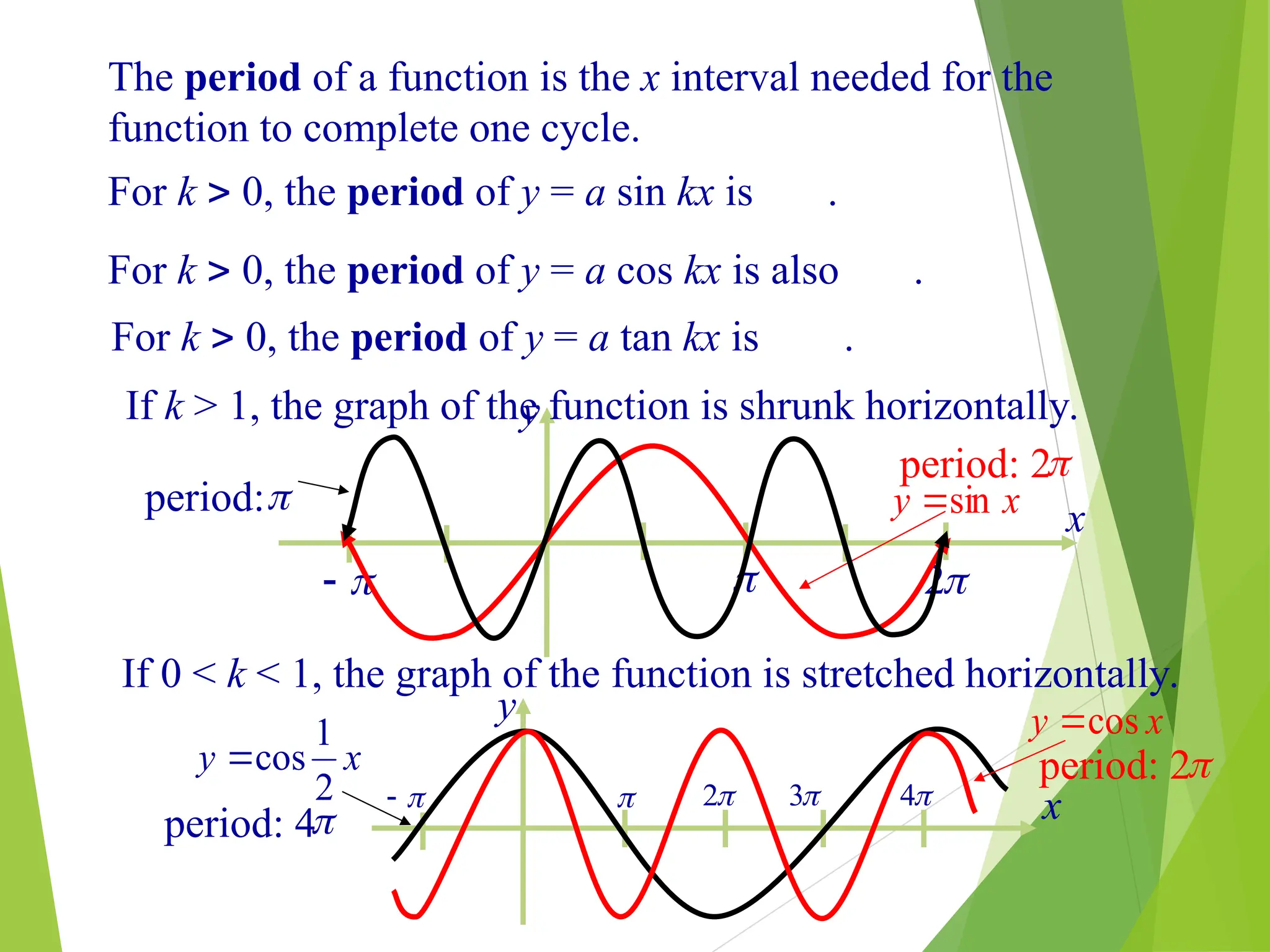
period: 2

period:
The period of a function is the x interval needed for the
function to complete one cycle.
For k  0, the period of y = a sin kx is .
For k  0, the period of y = a cos kx is also .
If 0 < k < 1, the graph of the function is stretched horizontally.
If k > 1, the graph of the function is shrunk horizontally.
y
x

 
2
 
3 
4
cos x
y 

period: 2
2
1
cos x
y 

period: 4
For k  0, the period of y = a tan kx is .
Copyright © by Houghton Mifflin Company, Inc. All rights reserved. 11
y
x

2

y = cos (–x)
Use basic trigonometric identities to graph y = f(–x)
Example 1: Sketch the graph of y = sin(–x).
Use the identity
sin(–x) = – sin x
The graph of y = sin(–x) is the graph of y = sin x reflected in
the x-axis.
Example 2: Sketch the graph of y = cos(–x).
Use the identity
cos(–x) = – cos x
The graph of y = cos (–x) is identical to the graph of y = cos x.
y
x

2

y = sin x
y = sin(–x)
y = cos (–x)
Copyright © by Houghton Mifflin Company, Inc. All rights reserved. 12
2
y
2

6

x
2


6
5
3

3
2
6

6

3

2

3
2
0
2
0
–2
0
y = –2 sin 3x
0
x
Example: Sketch the graph of y = 2 sin(–3x).
Rewrite the function in the form y = a sin kx with k > 0
amplitude: |a| = |–2| = 2
Calculate the five key points.
(0, 0) ( , 0)
3

( , 2)
2

( ,-2)
6

( , 0)
3
2
Use the identity sin (– x) = – sin x: y = 2 sin (–3x) = –2 sin 3x
period: 2 
2
3
=
Copyright © by Houghton Mifflin Company, Inc. All rights reserved. 13
The graph of y = A sin (Kx – C) is obtained by horizontally shifting the graph
of y = A sin Kx so that the starting point of the cycle is shifted from x = 0 to
x = -C
/K. The number – C
/K is called the phase shift.
amplitude = | A|
period = 2 /K.
x
y
Amplitude: | A|
Period: 2/B
y = A sin Kx
Starting point: x = -C/K
The Graph of y = Asin(Kx - C)
Example
Copyright © by Houghton Mifflin Company, Inc. All rights reserved. 14
Determine the amplitude, period, and phase shift of y = 2sin(3x-)
Solution:
Amplitude = |A| = 2
period = 2/K = 2/3
phase shift = -C/K = /3 to the right
Example cont.
 y = 2sin(3x- )
Copyright © by Houghton Mifflin Company, Inc. All rights reserved. 15
Copyright © by Houghton Mifflin Company, Inc. All rights reserved. 16
Amplitude
Period: 2π/k
Phase Shift:
-c/k
Vertical
Shift
17
State the periods of each function:
1.
2.
4π or 720°
π/2 or 90°
18
State the phase shift of each function:
1.
2.
Right phase shift 45°
Left phase shift -90°
19
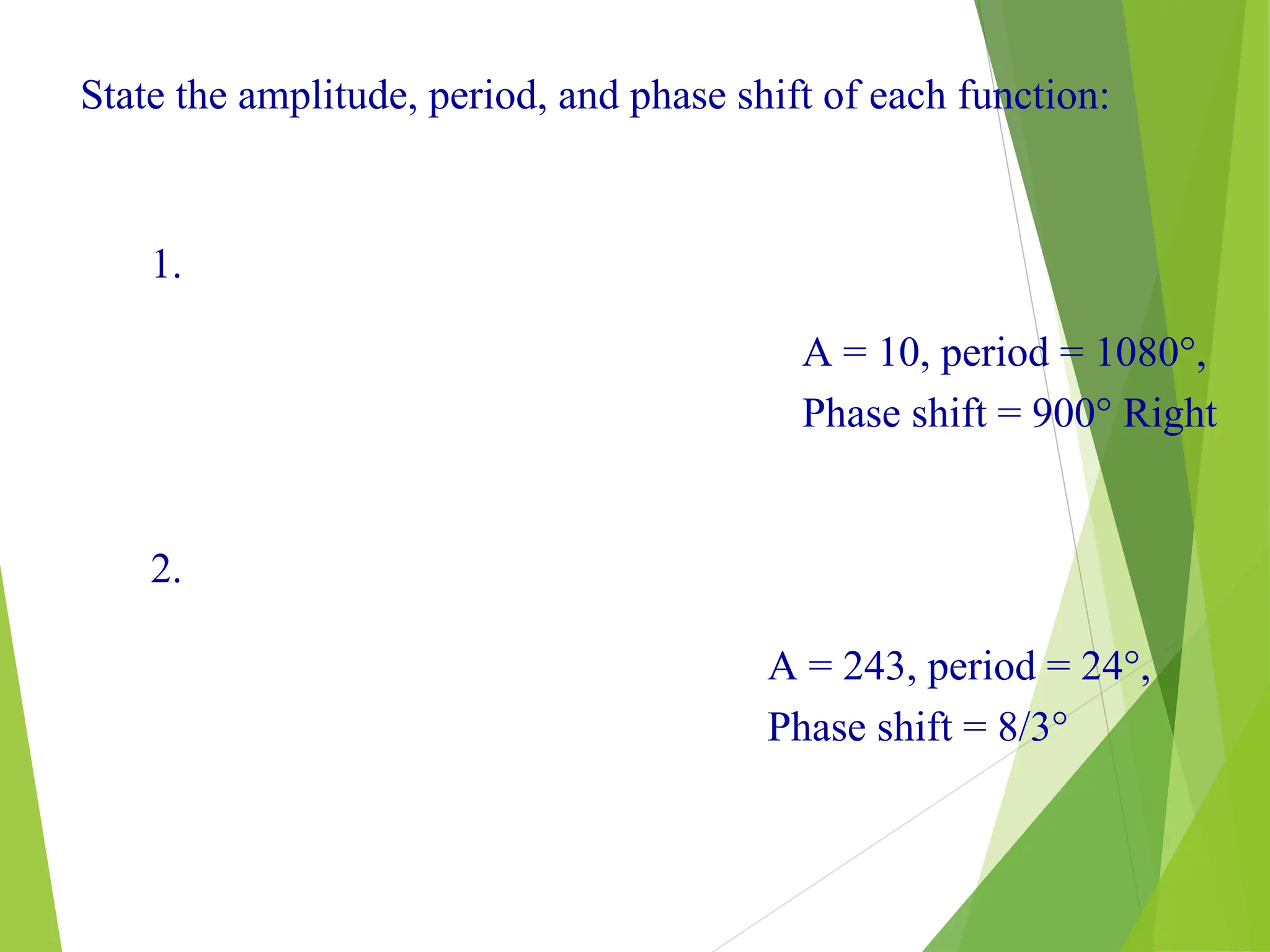
State the amplitude, period, and phase shift of each function:
1.
2.
3.
4.
5.
6.
A = 4, period = 360°,
Phase shift = 0°
A = NONE, period = 45°,
Phase shift = 0°
A = 2, period = 180°,
Phase shift = 0°
A = 4, period = 720°,
Phase shift = 0°
A = NONE, period = 90°,
Phase shift = π/2 Right
A = 3, period = 360°,
Phase shift = 90° Right
20
State the amplitude, period, and phase shift of each function:
1.
2.
A = 10, period = 1080°,
Phase shift = 900° Right
A = 243, period = 24°,
Phase shift = 8/3°
21
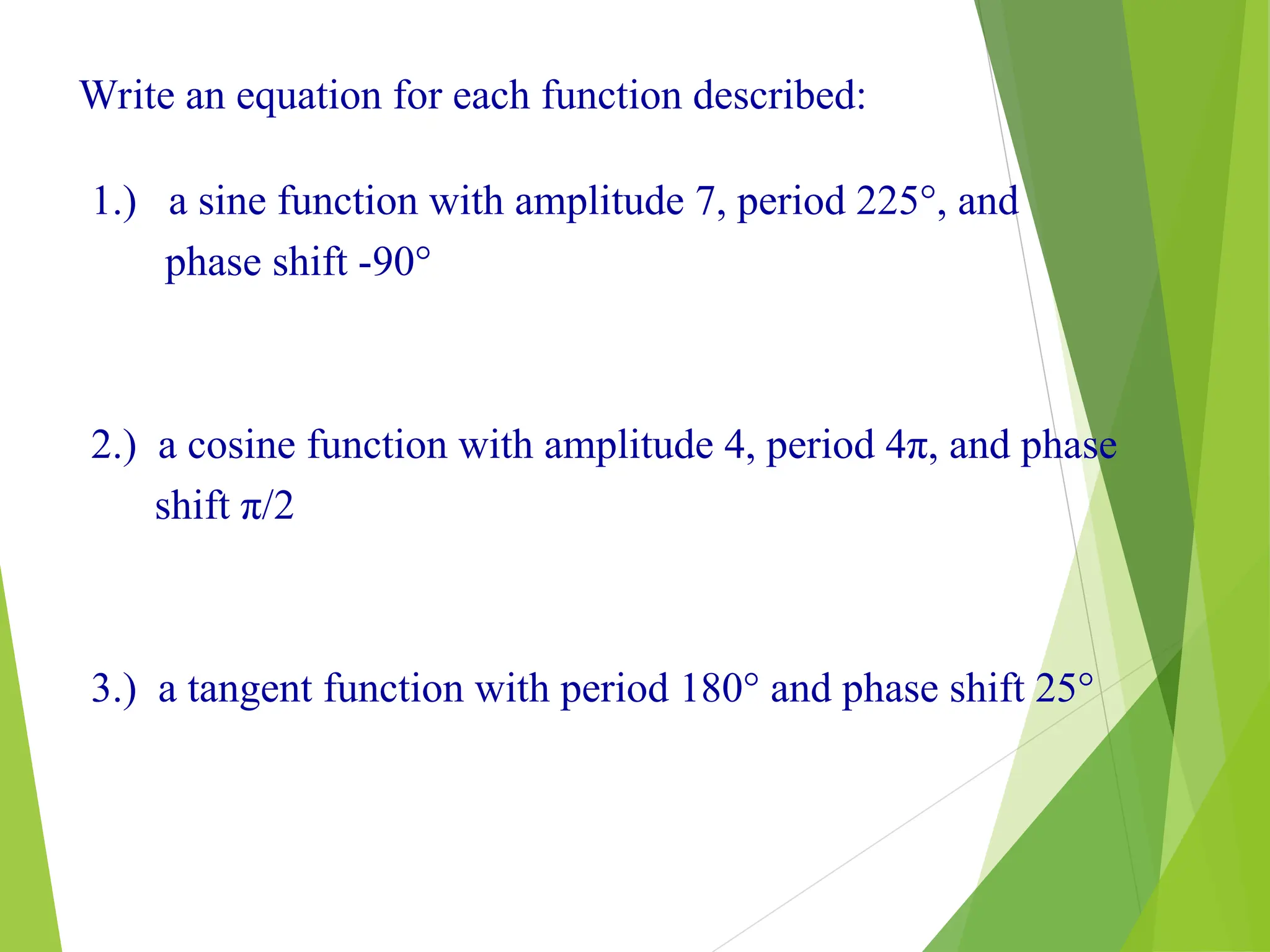
Write an equation for each function described:
1.) a sine function with amplitude 7, period 225°, and
phase shift -90°
2.) a cosine function with amplitude 4, period 4π, and phase
shift π/2
3.) a tangent function with period 180° and phase shift 25°
Copyright © by Houghton Mifflin Company, Inc. All rights reserved. 22
Graph each function:
1.) 2.)

Phase shift and amplitude of trigonometric

  • 1.
    Amplitude, Period, & PhaseShift 6.2 Trig Functions 3 ways we can change our graphs
  • 2.
    Copyright © byHoughton Mifflin Company, Inc. All rights reserved. 2 6. The cycle repeats itself indefinitely in both directions of the x-axis. Properties of Sine and Cosine Functions The graphs of y = sin x and y = cos x have similar properties: 3. The maximum value is 1 and the minimum value is –1. 4. The graph is a smooth curve. 1. The domain is the set of real numbers. 5. Each function cycles through all the values of the range over an x-interval of .  2 2. The range is the set of y values such that . 1 1    y
  • 3.
    Copyright © byHoughton Mifflin Company, Inc. All rights reserved. 3 Graph of the Sine Function To sketch the graph of y = sin x first locate the key points. These are the maximum points, the minimum points, and the intercepts. 0 -1 0 1 0 sin x 0 x 2  2 3  2  Then, connect the points on the graph with a smooth curve that extends in both directions beyond the five points. A single cycle is called a period. y 2 3    2    2 2 3  2  2 5 1  1 x y = sin x
  • 4.
    Graph of TangentFunction: Periodic θ tan θ −π/2 −∞ −π/4 −1 0 0 π/4 1 π/2 ∞ 0 θ tan θ −π/2 π/2 One period: π 3π/2 −3π/2 Vertical asymptotes where cos θ = 0    cos sin tan 
  • 5.
    Graph of CotangentFunction: Periodic θ tan θ 0 ∞ π/4 1 π/2 0 3π/4 −1 π −∞ 3π/2 −3π/2 Vertical asymptotes where sin θ = 0    sin cos cot  π -π −π/2 π/2 cot θ
  • 6.
    Cosecant is thereciprocal of sine One period: 2π π 2π 3π 0 −π −2π −3π Vertical asymptotes where sin θ = 0 θ csc θ sin θ
  • 7.
    Secant is thereciprocal of cosine One period: 2π π 3π −2π 2π −π −3π 0 θ sec θ cos θ Vertical asymptotes where cos θ = 0
  • 8.
    Copyright © byHoughton Mifflin Company, Inc. All rights reserved. 8 y 1 1  2  3  2 x   3  2    4 Example: Sketch the graph of y = 3 cos x on the interval [–, 4]. Partition the interval [-π,4] on your x-axis max x-int min x-int max 3 0 -3 0 3 y = 3 cos x 2  0 x 2  2 3 (0, 3) 2 3 ( , 0) ( , 0) 2   2 ( , 3)  ( , –3)
  • 9.
    Copyright © byHoughton Mifflin Company, Inc. All rights reserved. 9 The amplitude of y = a sin x (or y = a cos x) is half the distance between the maximum and minimum values of the function. amplitude = |a| If |a| > 1, the amplitude stretches the graph vertically. If 0 < |a| < 1, the amplitude shrinks the graph vertically. If a < 0, the graph is reflected in the x-axis. 2 3 2  4 y x 4   2  y = –4 sin x reflection of y = 4 sin x y = 4 sin x y = 2sin x 2 1 y = sin x y = sin x
  • 10.
    Copyright © byHoughton Mifflin Company, Inc. All rights reserved. y x    2  sin x y   period: 2  period: The period of a function is the x interval needed for the function to complete one cycle. For k  0, the period of y = a sin kx is . For k  0, the period of y = a cos kx is also . If 0 < k < 1, the graph of the function is stretched horizontally. If k > 1, the graph of the function is shrunk horizontally. y x    2   3  4 cos x y   period: 2 2 1 cos x y   period: 4 For k  0, the period of y = a tan kx is .
  • 11.
    Copyright © byHoughton Mifflin Company, Inc. All rights reserved. 11 y x  2  y = cos (–x) Use basic trigonometric identities to graph y = f(–x) Example 1: Sketch the graph of y = sin(–x). Use the identity sin(–x) = – sin x The graph of y = sin(–x) is the graph of y = sin x reflected in the x-axis. Example 2: Sketch the graph of y = cos(–x). Use the identity cos(–x) = – cos x The graph of y = cos (–x) is identical to the graph of y = cos x. y x  2  y = sin x y = sin(–x) y = cos (–x)
  • 12.
    Copyright © byHoughton Mifflin Company, Inc. All rights reserved. 12 2 y 2  6  x 2   6 5 3  3 2 6  6  3  2  3 2 0 2 0 –2 0 y = –2 sin 3x 0 x Example: Sketch the graph of y = 2 sin(–3x). Rewrite the function in the form y = a sin kx with k > 0 amplitude: |a| = |–2| = 2 Calculate the five key points. (0, 0) ( , 0) 3  ( , 2) 2  ( ,-2) 6  ( , 0) 3 2 Use the identity sin (– x) = – sin x: y = 2 sin (–3x) = –2 sin 3x period: 2  2 3 =
  • 13.
    Copyright © byHoughton Mifflin Company, Inc. All rights reserved. 13 The graph of y = A sin (Kx – C) is obtained by horizontally shifting the graph of y = A sin Kx so that the starting point of the cycle is shifted from x = 0 to x = -C /K. The number – C /K is called the phase shift. amplitude = | A| period = 2 /K. x y Amplitude: | A| Period: 2/B y = A sin Kx Starting point: x = -C/K The Graph of y = Asin(Kx - C)
  • 14.
    Example Copyright © byHoughton Mifflin Company, Inc. All rights reserved. 14 Determine the amplitude, period, and phase shift of y = 2sin(3x-) Solution: Amplitude = |A| = 2 period = 2/K = 2/3 phase shift = -C/K = /3 to the right
  • 15.
    Example cont.  y= 2sin(3x- ) Copyright © by Houghton Mifflin Company, Inc. All rights reserved. 15
  • 16.
    Copyright © byHoughton Mifflin Company, Inc. All rights reserved. 16 Amplitude Period: 2π/k Phase Shift: -c/k Vertical Shift
  • 17.
    17 State the periodsof each function: 1. 2. 4π or 720° π/2 or 90°
  • 18.
    18 State the phaseshift of each function: 1. 2. Right phase shift 45° Left phase shift -90°
  • 19.
    19 State the amplitude,period, and phase shift of each function: 1. 2. 3. 4. 5. 6. A = 4, period = 360°, Phase shift = 0° A = NONE, period = 45°, Phase shift = 0° A = 2, period = 180°, Phase shift = 0° A = 4, period = 720°, Phase shift = 0° A = NONE, period = 90°, Phase shift = π/2 Right A = 3, period = 360°, Phase shift = 90° Right
  • 20.
    20 State the amplitude,period, and phase shift of each function: 1. 2. A = 10, period = 1080°, Phase shift = 900° Right A = 243, period = 24°, Phase shift = 8/3°
  • 21.
    21 Write an equationfor each function described: 1.) a sine function with amplitude 7, period 225°, and phase shift -90° 2.) a cosine function with amplitude 4, period 4π, and phase shift π/2 3.) a tangent function with period 180° and phase shift 25°
  • 22.
    Copyright © byHoughton Mifflin Company, Inc. All rights reserved. 22 Graph each function: 1.) 2.)