Unit 4
Graph
Definition
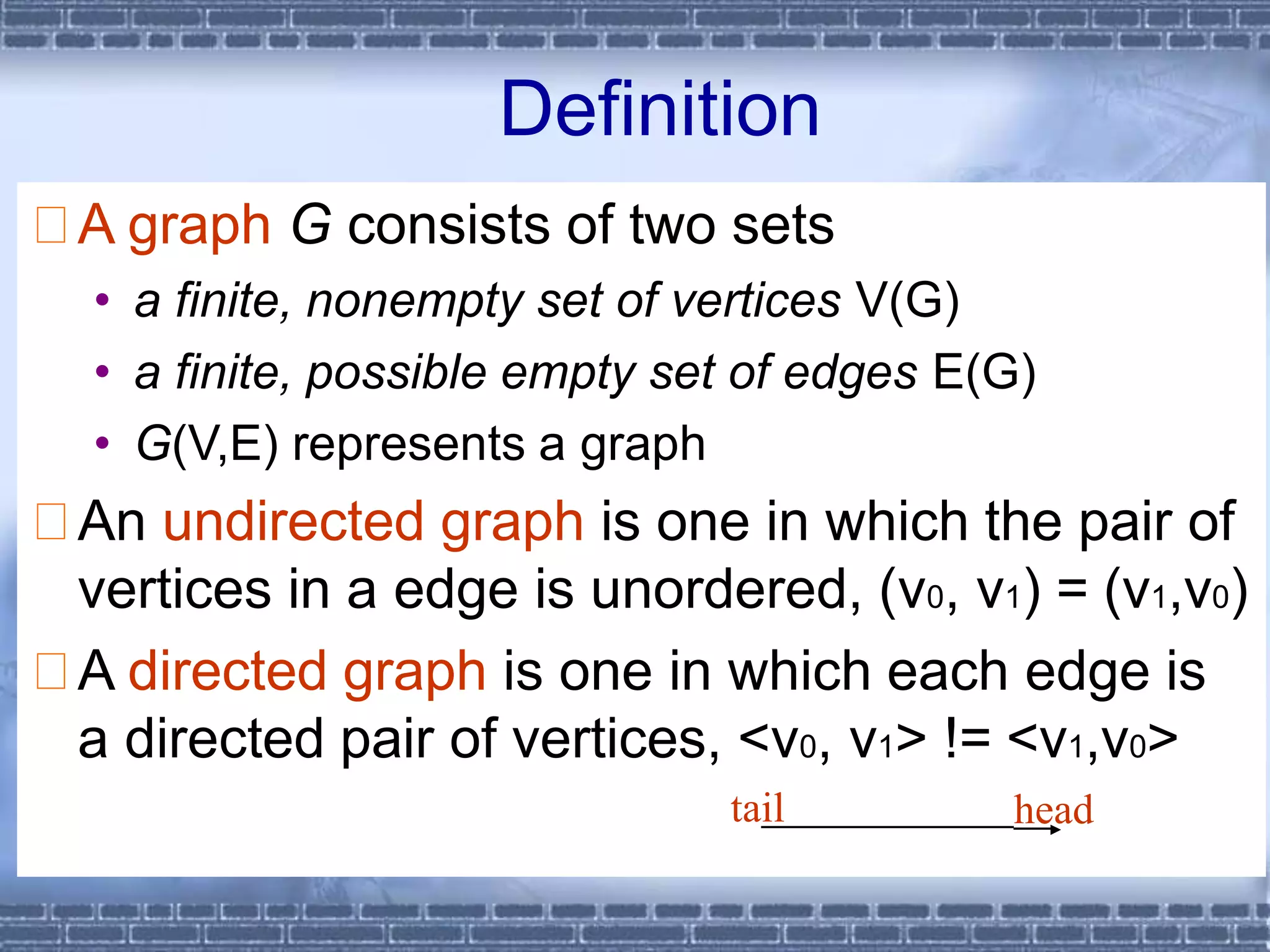
A graph G consists of two sets
• a finite, nonempty set of vertices V(G)
• a finite, possible empty set of edges E(G)
• G(V,E) represents a graph
An undirected graph is one in which the pair of
vertices in a edge is unordered, (v0, v1) = (v1,v0)
A directed graph is one in which each edge is
a directed pair of vertices, <v0, v1> != <v1,v0>
tail head
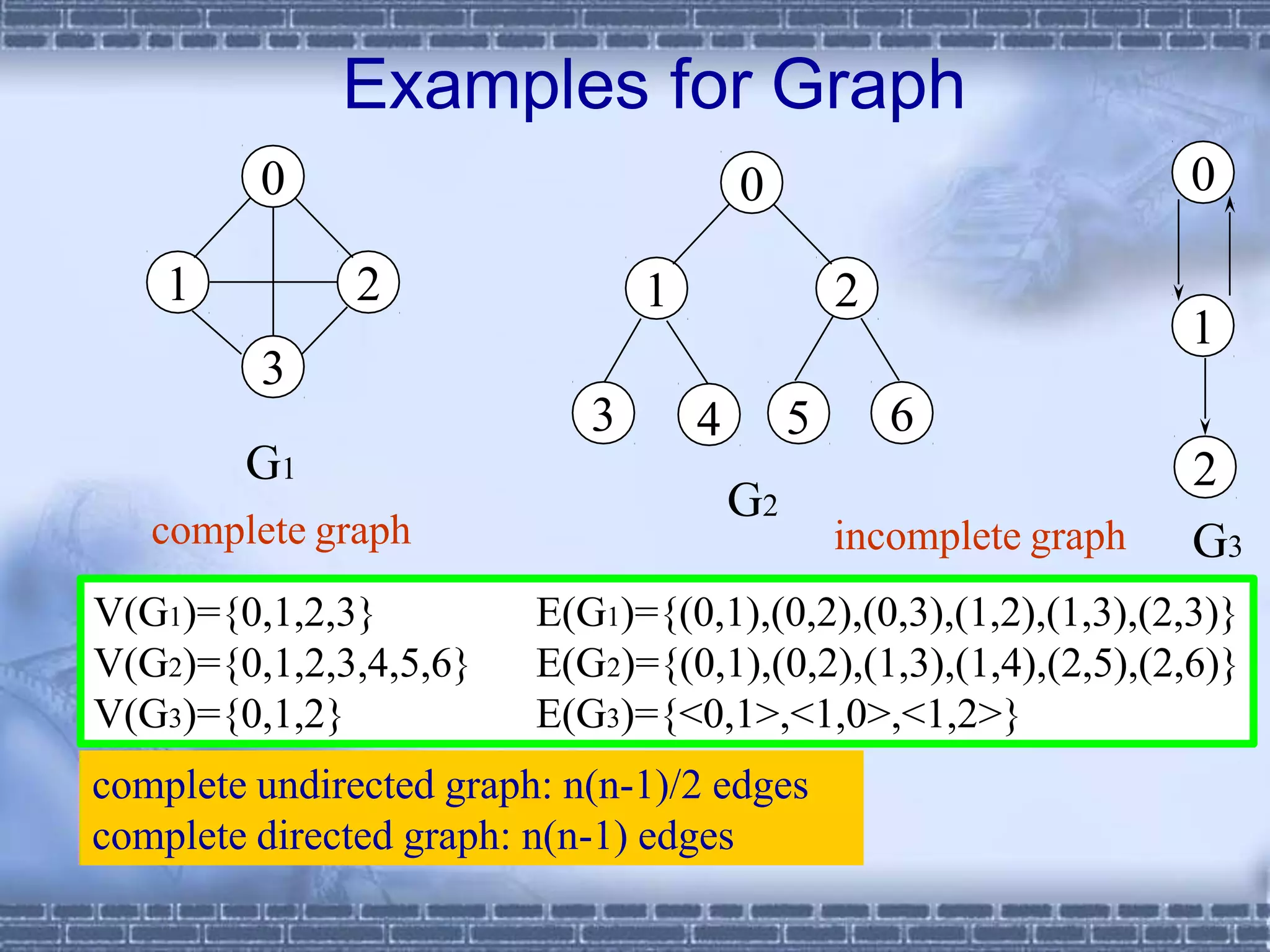
Examples for Graph
0 0
1
0
3
1 2
4 5 6
G2
2
G3
V(G1)={0,1,2,3}
V(G2)={0,1,2,3,4,5,6}
V(G3)={0,1,2}
E(G1)={(0,1),(0,2),(0,3),(1,2),(1,3),(2,3)}
E(G2)={(0,1),(0,2),(1,3),(1,4),(2,5),(2,6)}
E(G3)={<0,1>,<1,0>,<1,2>}
complete undirected graph: n(n-1)/2 edges
complete directed graph: n(n-1) edges
1 2
3
G1
complete graph incomplete graph
Complete Graph
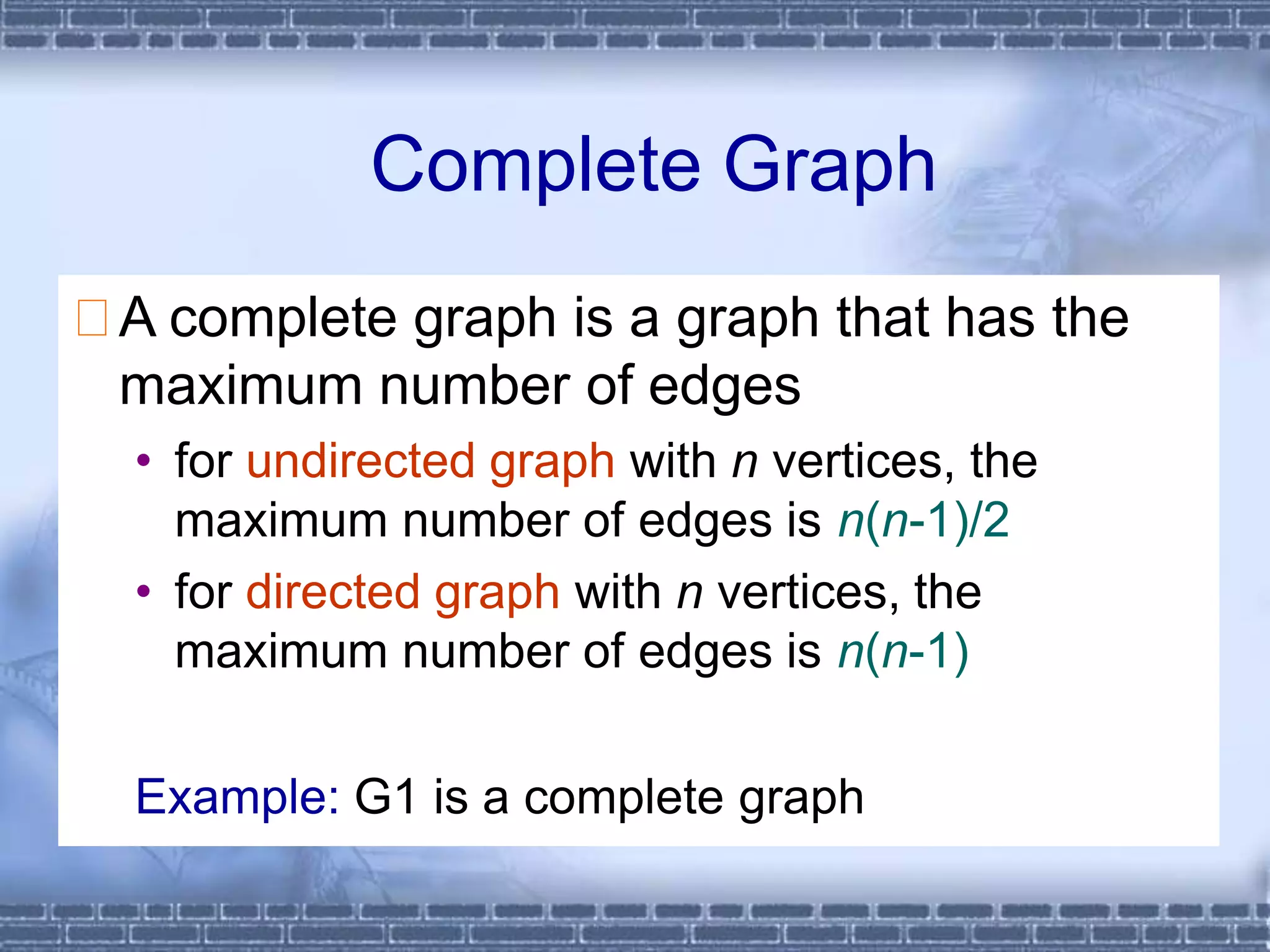
A complete graph is a graph that has the
maximum number of edges
• for undirected graph with n vertices, the
maximum number of edges is n(n-1)/2
• for directed graph with n vertices, the
maximum number of edges is n(n-1)
Example: G1 is a complete graph
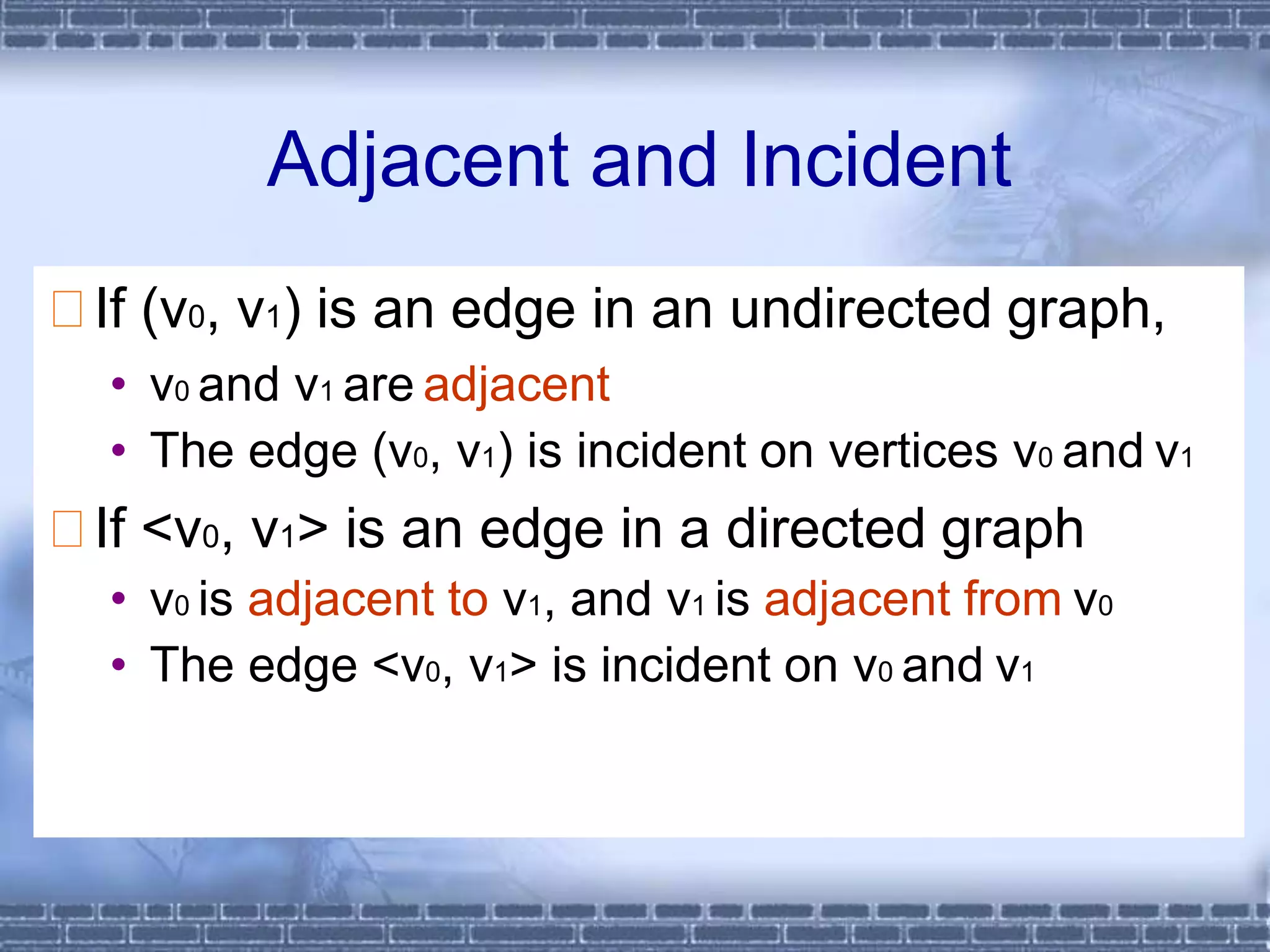
Adjacent and Incident
If (v0, v1) is an edge in an undirected graph,
• v0 and v1 are adjacent
• The edge (v0, v1) is incident on vertices v0 and v1
If <v0, v1> is an edge in a directed graph
• v0 is adjacent to v1, and v1 is adjacent from v0
• The edge <v0, v1> is incident on v0 and v1
0 2
1
(a)
2
1 3
(b)
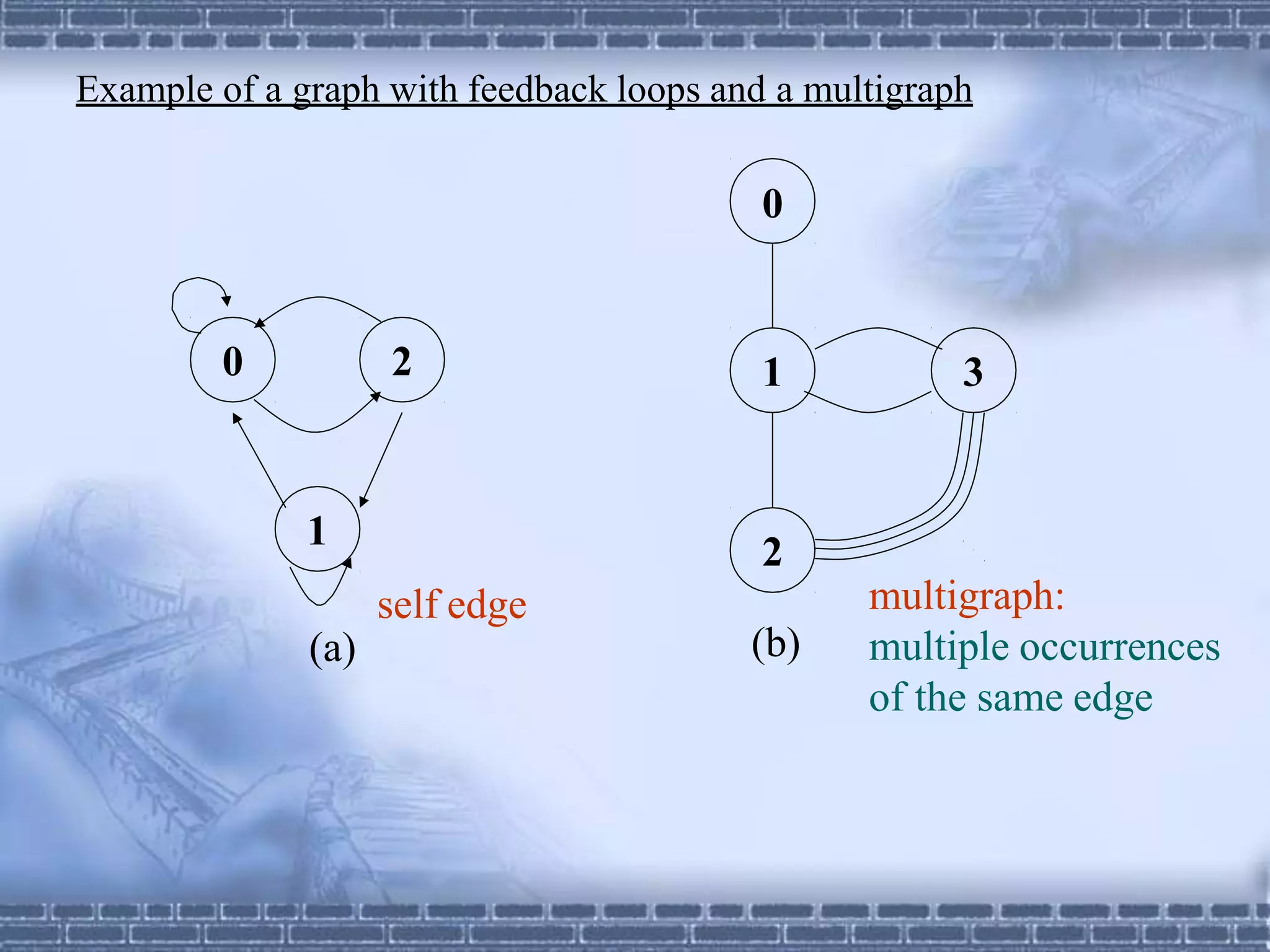
Example of a graph with feedback loops and a multigraph
0
self edge multigraph:
multiple occurrences
of the same edge
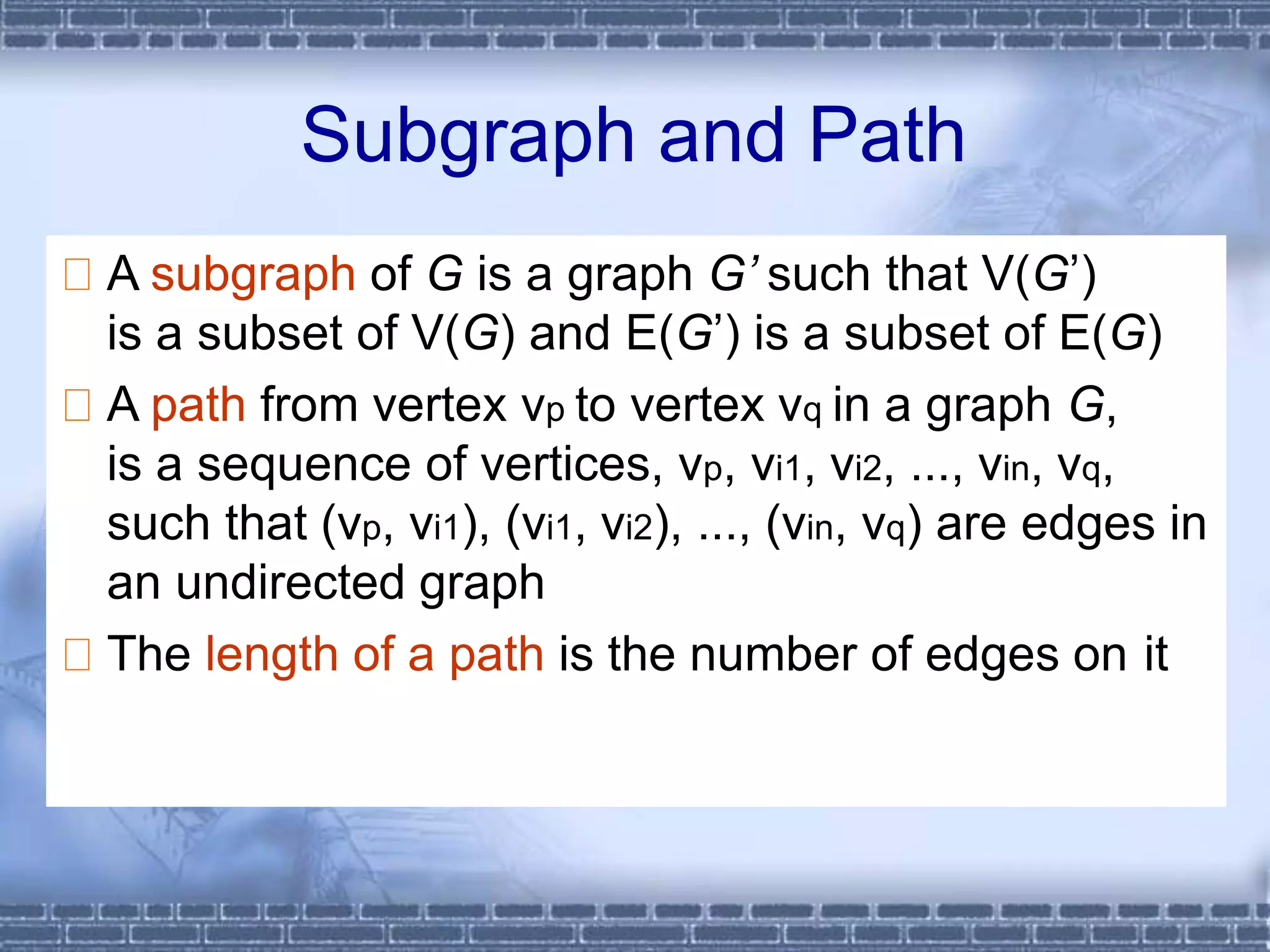
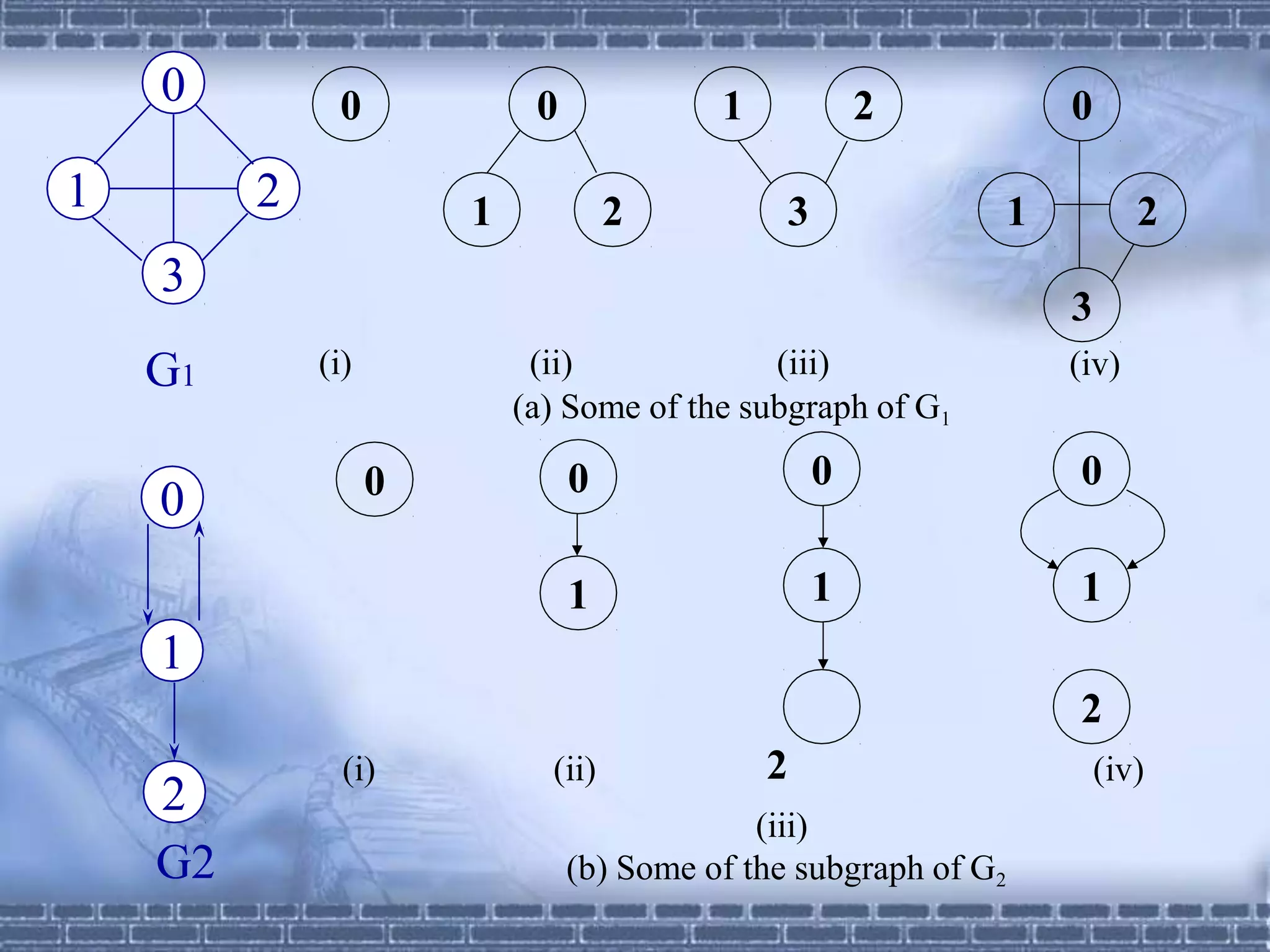
A subgraph of G is a graph G’ such that V(G’)
is a subset of V(G) and E(G’) is a subset of E(G)
A path from vertex vp to vertex vq in a graph G,
is a sequence of vertices, vp, vi1, vi2, ..., vin, vq,
such that (vp, vi1), (vi1, vi2), ..., (vin, vq) are edges in
an undirected graph
The length of a path is the number of edges on it
Subgraph and Path
0 0
1 2 3
1 2 0
1 2
(i)
3
(iv)
(ii) (iii)
(a) Some of the subgraph of G1
0 0
1
0
1
0
1
(i) (ii)
2
(iv)
2
(iii)
(b) Some of the subgraph of G2
0
1 2
3
G1
0
1
2
G2
A simple path is a path in which all vertices,
except possibly the first and the last, are distinct
A cycle is a simple path in which the first and
the last vertices are the same
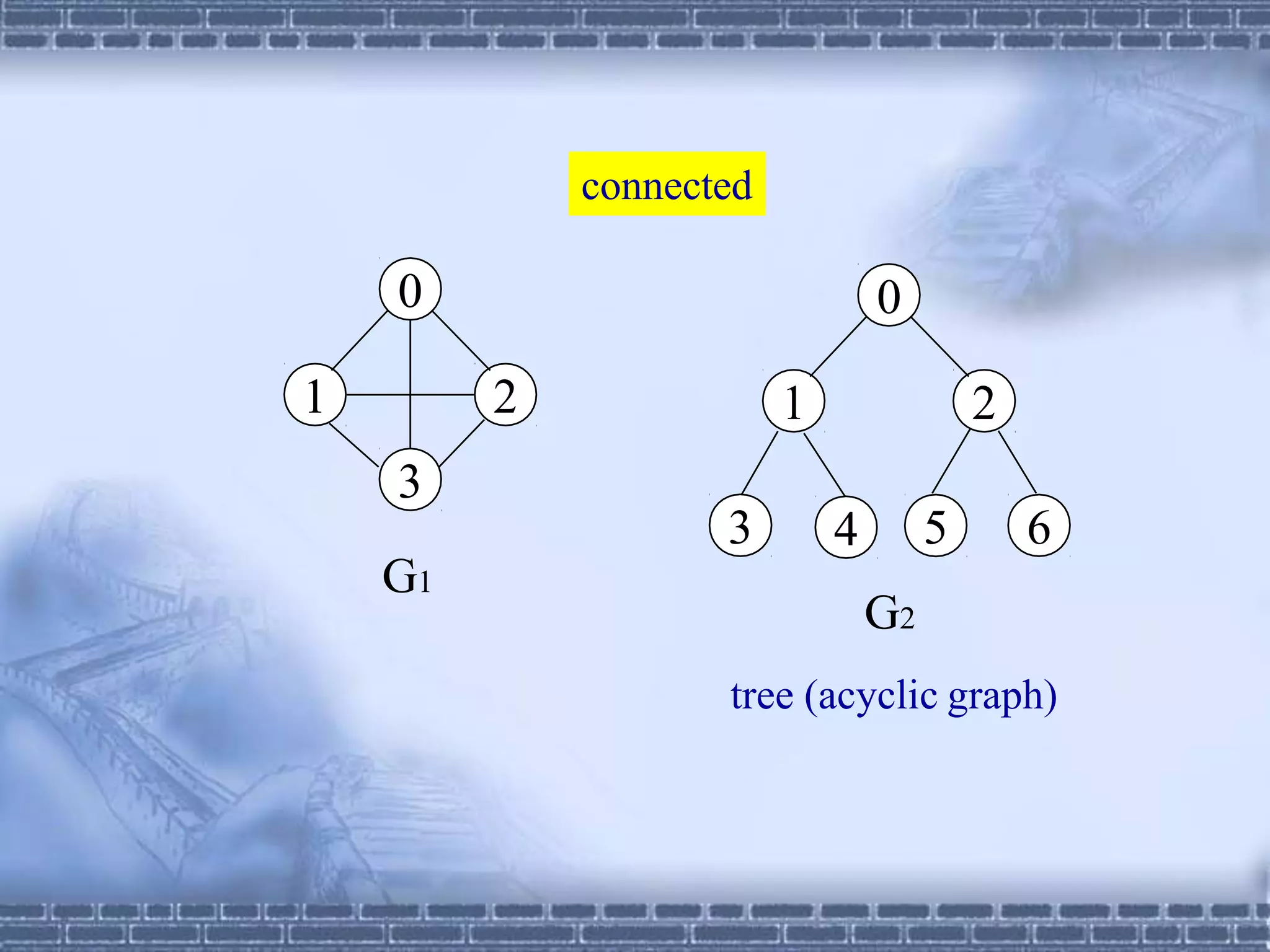
In an undirected graph G, two vertices, v0 and v1, are
connected if there is a path in G from v0 tov1
An undirected graph is connected if, for every
pair of distinct vertices vi, vj, there is a path
from vi tovj
Simple Path and Style
0
1 2
0
1 2
3 4 5 6
3
G1
G2
connected
tree (acyclic graph)
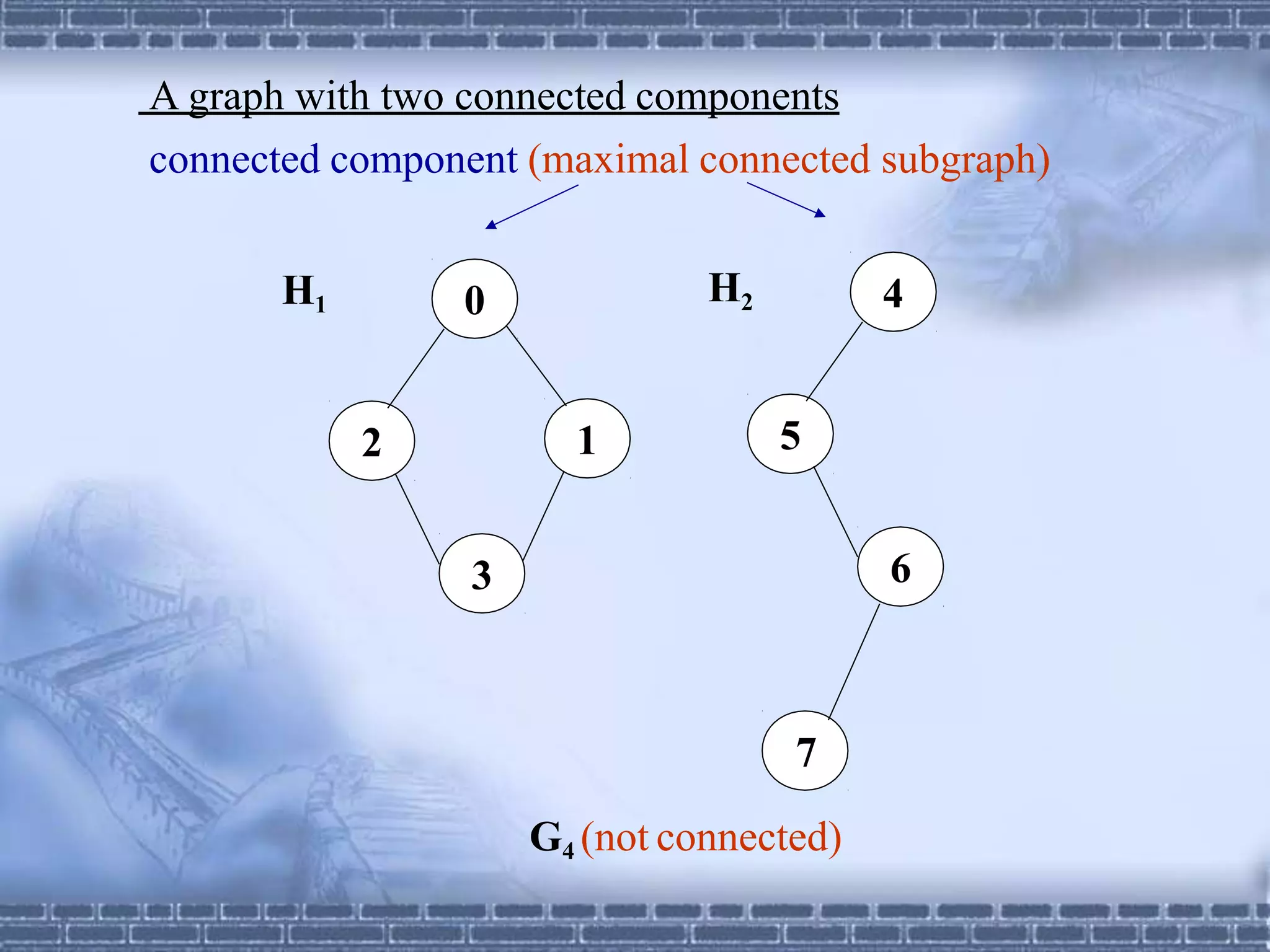
A connected component of an undirected graph
is a maximal connected subgraph.
A tree is a graph that is connected and acyclic.
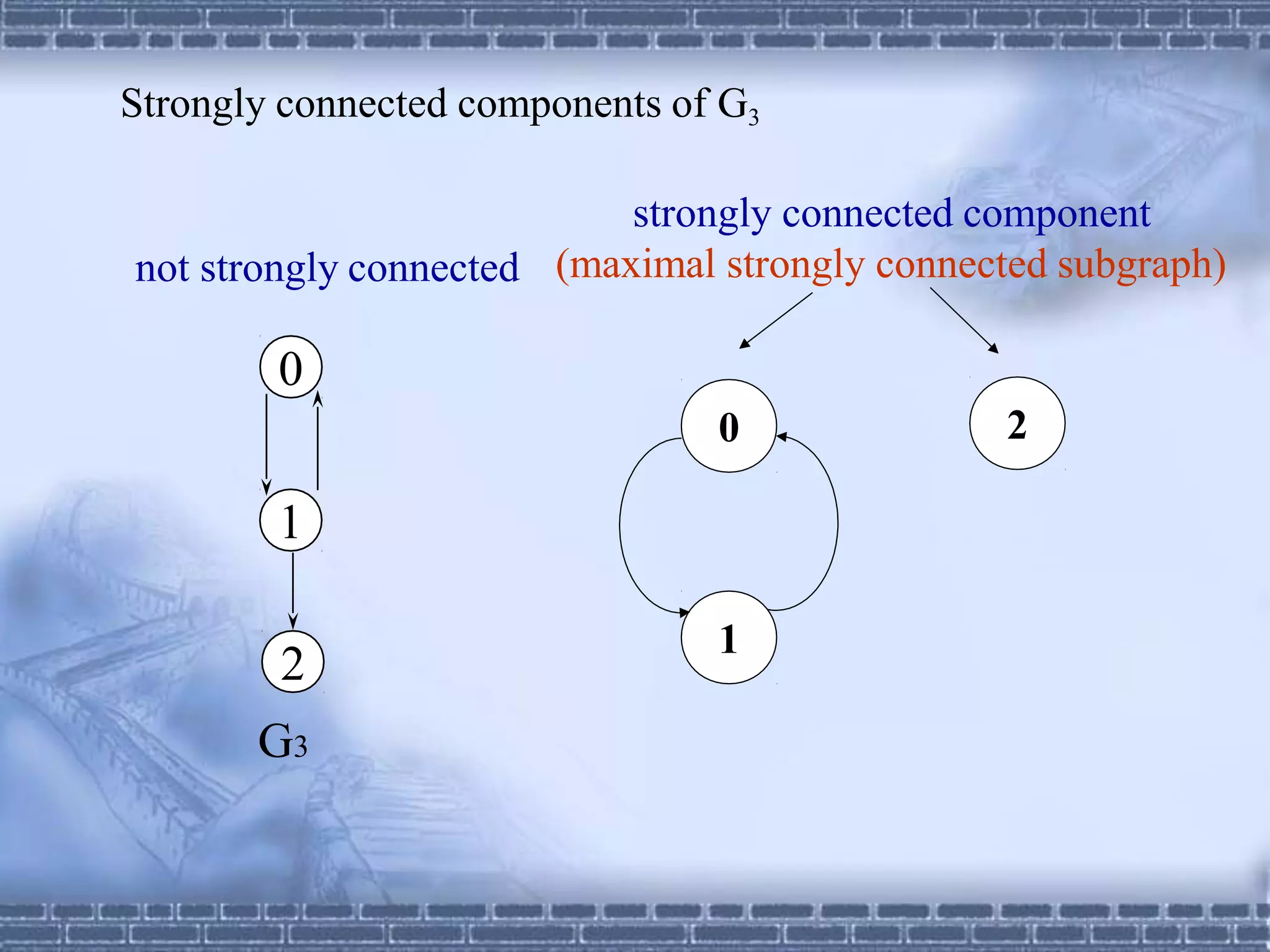
A directed graph is strongly connected if there
is a directed path from vi to vj and also from vj to vi.
A strongly connected component is a maximal
subgraph that is strongly connected.
Connected Component
1
0
2
3
4
5
6
H1 H2
7
G4 (not connected)
A graph with two connected components
connected component (maximal connected subgraph)
Strongly connected components of G3
0
1
2
0
1
2
G3
not strongly connected
strongly connected component
(maximal strongly connected subgraph)
CHAPTER 6 14
Degree
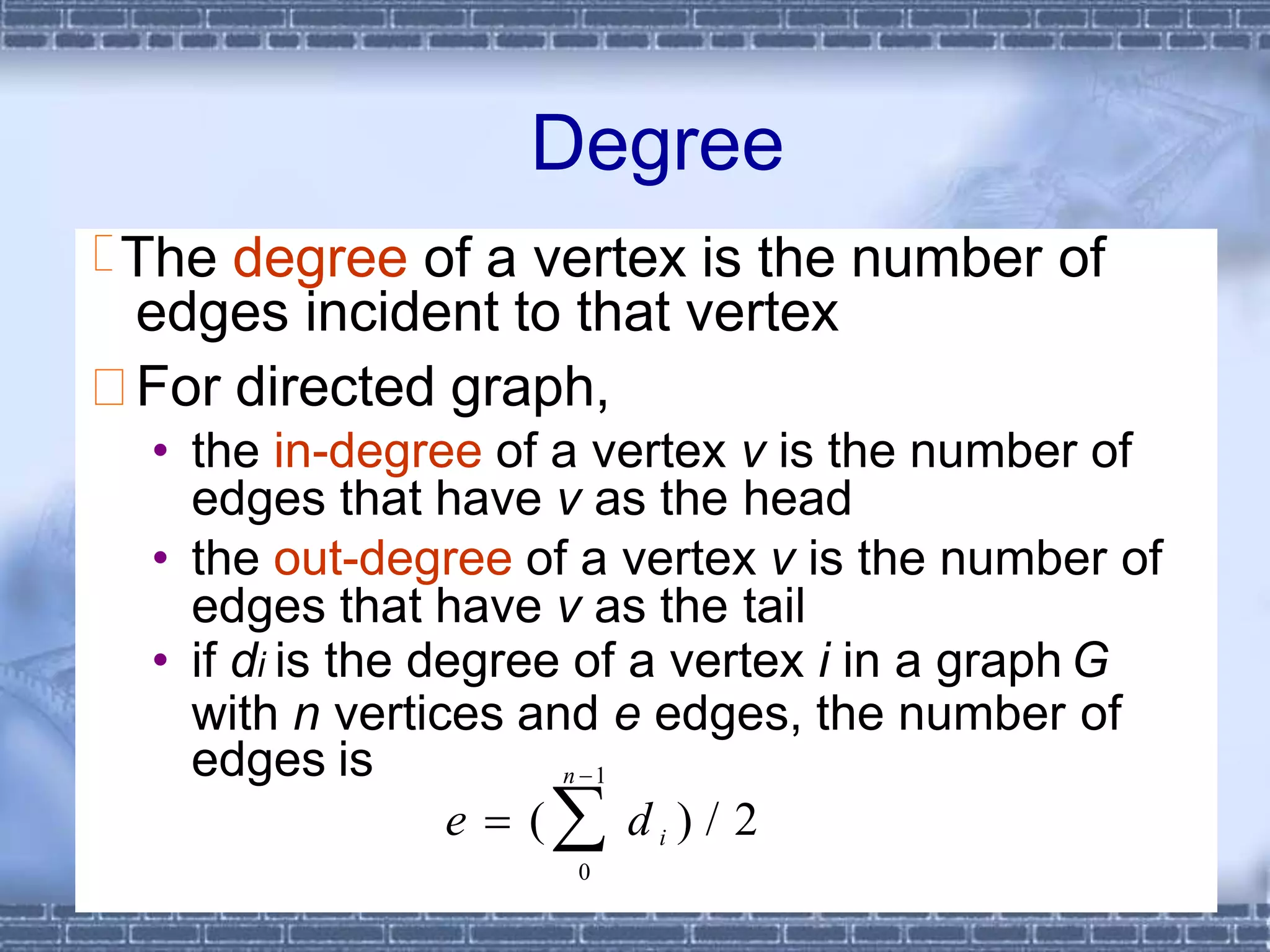
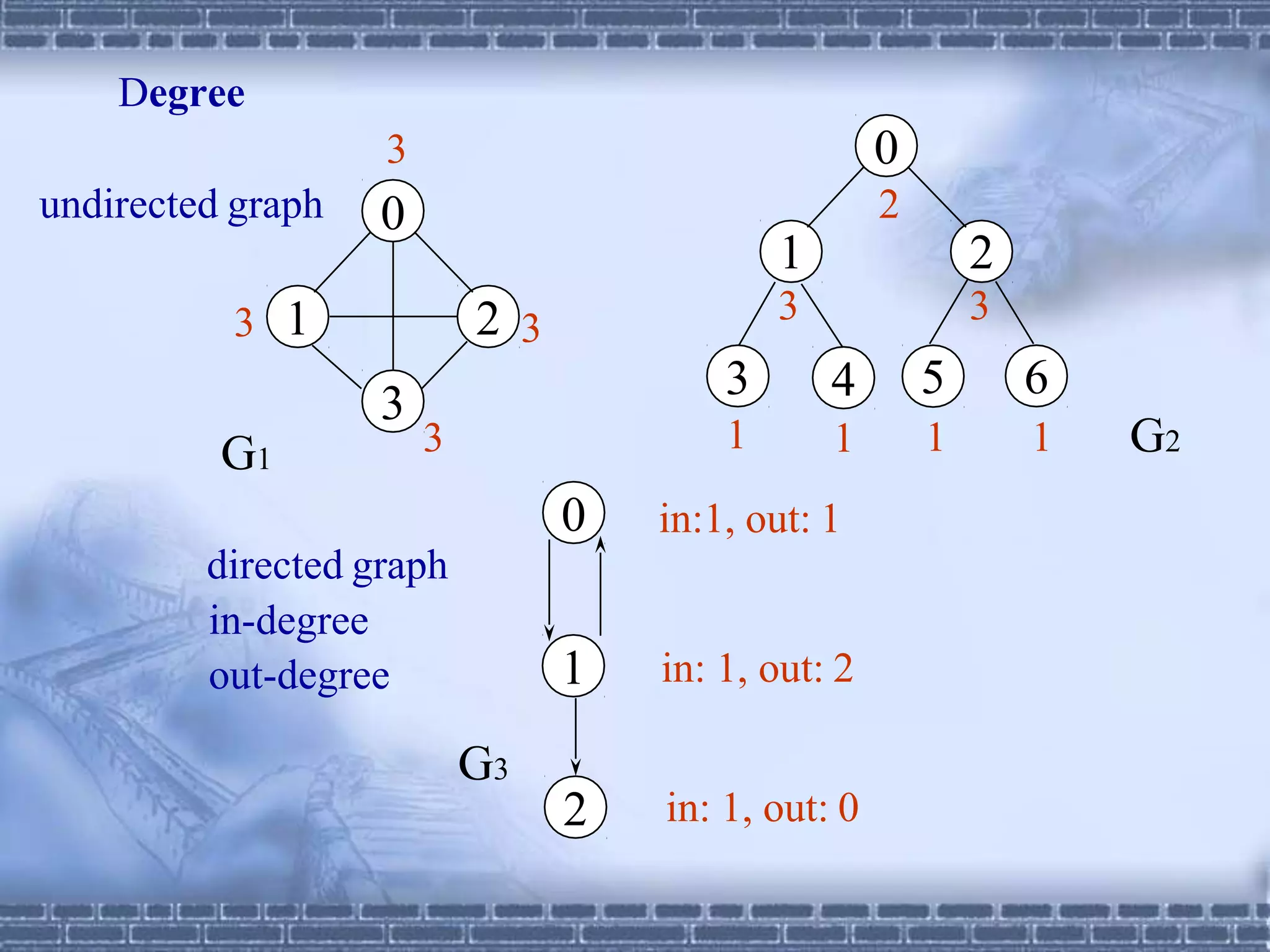
The degree of a vertex is the number of
edges incident to that vertex
For directed graph,
• the in-degree of a vertex v is the number of
edges that have v as the head
• the out-degree of a vertex v is the number of
edges that have v as the tail
• if di is the degree of a vertex i in a graph G
with n vertices and e edges, the number of
edges is n 1
e  ( d i ) / 2
0
undirected graph
Degree
G1
0
2
1
3
2
3
3
1
4
1
5 6
1 1 G2
directed graph
in-degree
out-degree
0
1
2
G3
in:1, out: 1
in: 1, out: 2
in: 1, out: 0
3
0
1
3
2 3
3
3
CHAPTER 6 16
ADT for Graph
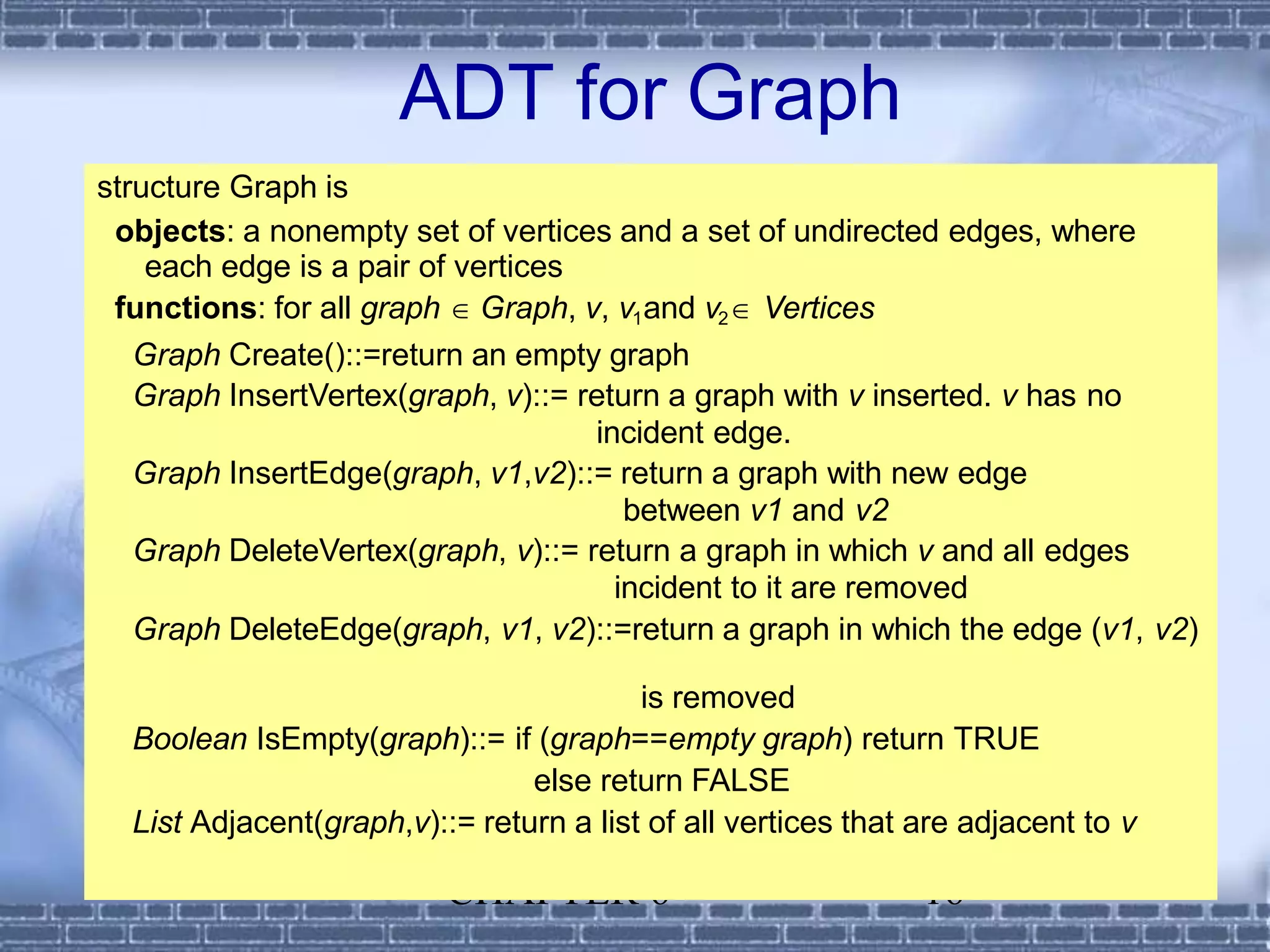
structure Graph is
objects: a nonempty set of vertices and a set of undirected edges, where
each edge is a pair of vertices
functions: for all graph  Graph, v, v1and v2 Vertices
Graph Create()::=return an empty graph
Graph InsertVertex(graph, v)::= return a graph with v inserted. v has no
incident edge.
Graph InsertEdge(graph, v1,v2)::= return a graph with new edge
between v1 and v2
Graph DeleteVertex(graph, v)::= return a graph in which v and all edges
incident to it are removed
Graph DeleteEdge(graph, v1, v2)::=return a graph in which the edge (v1, v2)
is removed
Boolean IsEmpty(graph)::= if (graph==empty graph) return TRUE
else return FALSE
List Adjacent(graph,v)::= return a list of all vertices that are adjacent to v
Graph Representations
Adjacency Matrix
Adjacency Lists
Adjacency Matrix
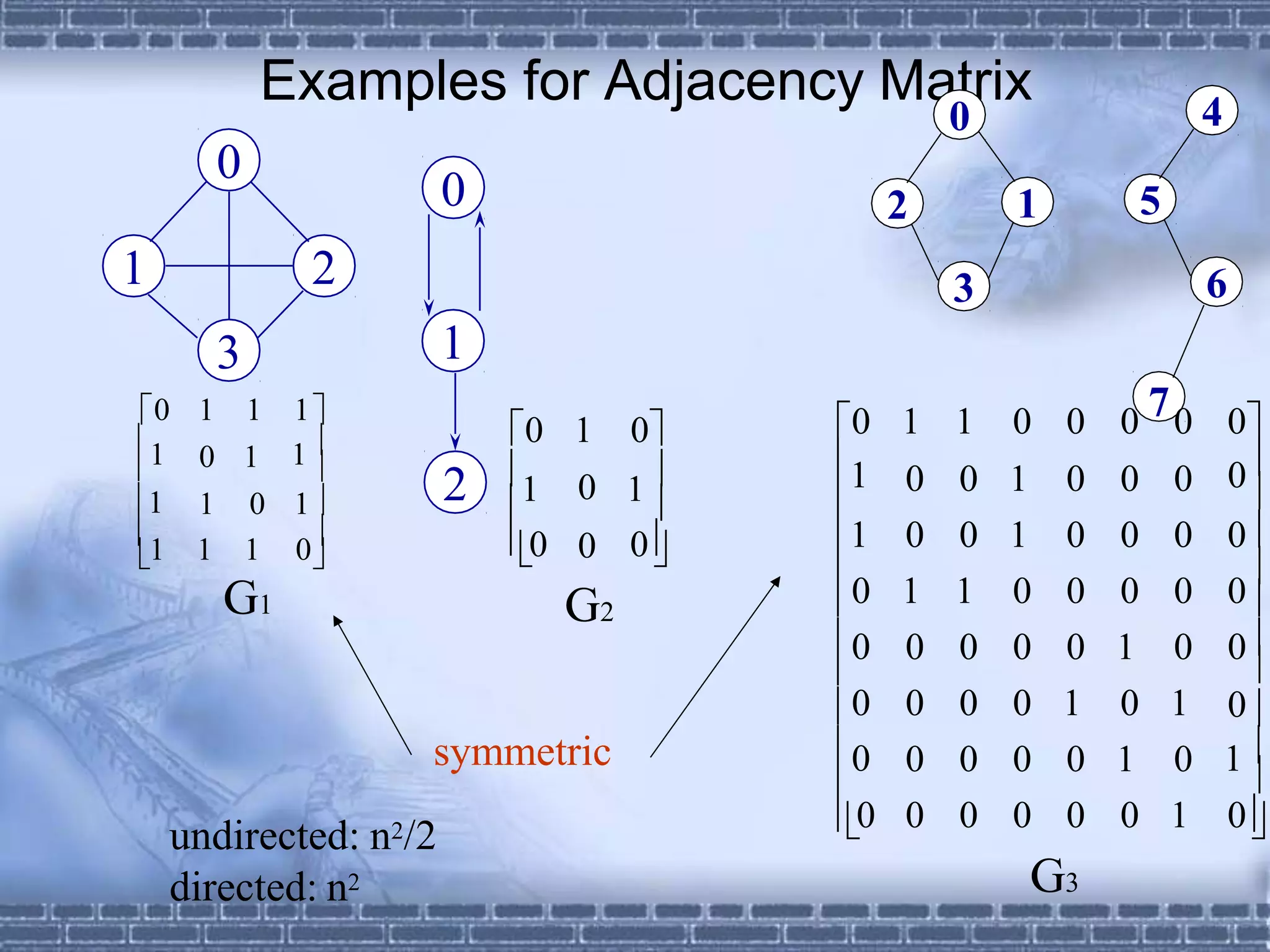
Let G=(V,E) be a graph with n vertices.
The adjacency matrix of G is a two-dimensional
n by n array, say adj_mat
- If the edge (vi, vj) is in E(G), adj_mat[i][j]=1
- If there is no such edge in E(G), adj_mat[i][j]=0
The adjacency matrix for an undirected graph is
symmetric; the adjacency matrix for a digraph
need not be symmetric
Examples for Adjacency Matrix
1

1

1

1 1

0

0
1

0
0
0

0

0
1
0 1 1 1
0 1 
1 0 1
1 1 1 0
G1
0 1 0
 0 
0
G2
G3
0
1 2
3
0
1
2
0
2 1
3
4
5
6
0 1 1 0 0 0 70 0
 0 0 1 0 0 0 
1 0 0 1 0 0 0 0
0 1 1 0 0 0 0 0

0 0 0 0 1 0
0 0 0 0 1 0 1

0 0 0 0 1 0

0 0 0 0 0 0 1 0
symmetric
undirected: n2/2
directed: n2
Merits of Adjacency Matrix
From the adjacency matrix, to determine
the connection of vertices is easy
The degree of a vertex isadj_ mat[i][ j]
For a digraph, the row sum is the
out_degree, while the column sum is the
in_degree
j0
n1
ind(vi)   A[ j,i]
j0
n1
outd(vi)   A[i, j]
j0
n1
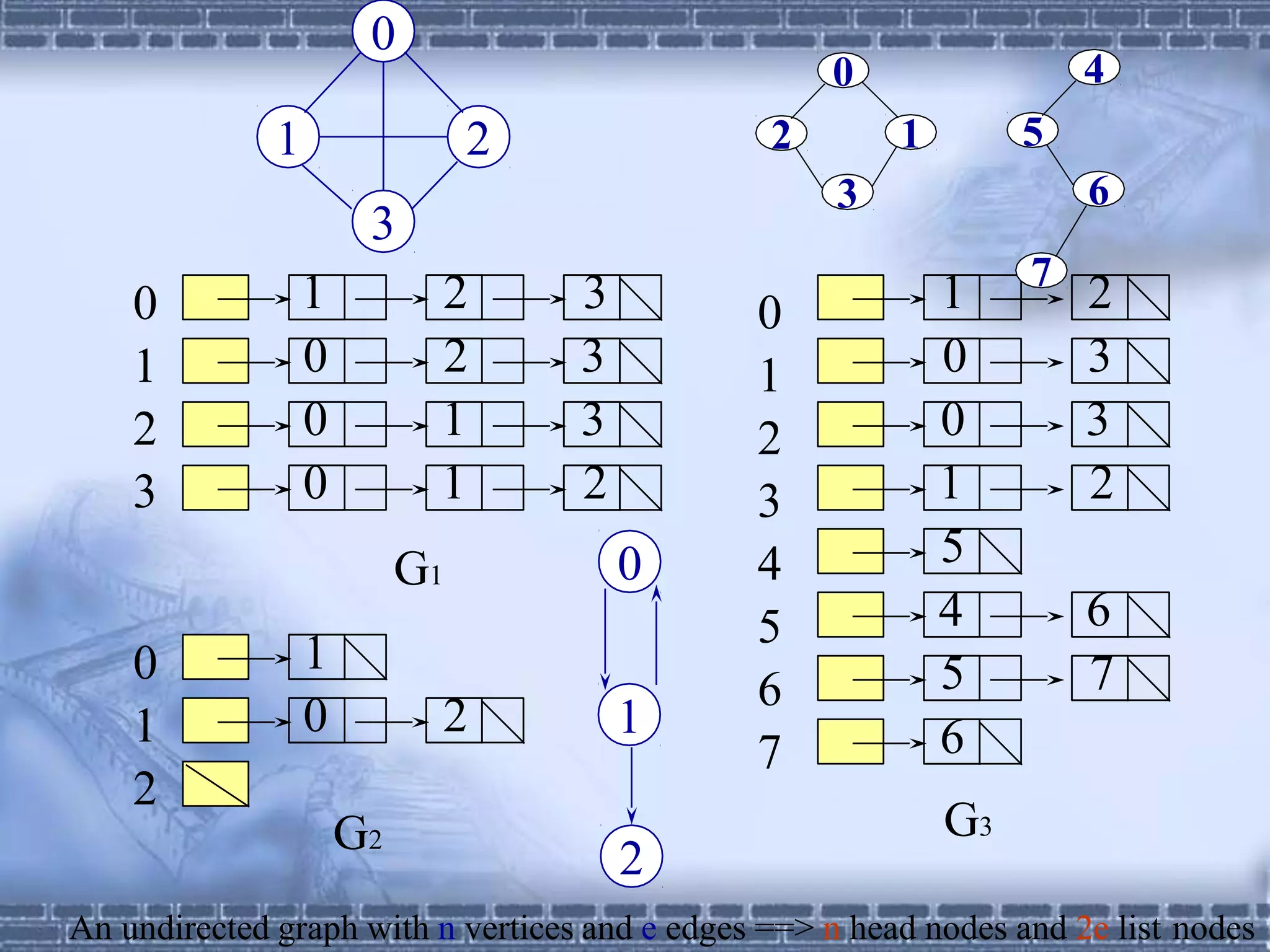
Data Structures for Adjacency Lists
#define MAX_VERTICES 50
typedef struct node *node_pointer;
typedef struct node {
int vertex;
struct node *link;
};
node_pointer graph[MAX_VERTICES];
int n=0; /* vertices currently in use */
Each row in adjacency matrix is represented as an adjacency list.
0
1
2
3
0
1
2
0
1
2
3
4
5
6
7
1 2 3
0 2 3
0 1 3
0 1 2
G1
1
0 2
G2
1 2
0 3
0 3
1 2
5
4 6
5 7
6
G3
0
1 2
3
0
1
2
1
0
2
3
4
5
6
7
An undirected graph with n vertices and e edges ==> n head nodes and 2e list nodes
CHAPTER 6 23
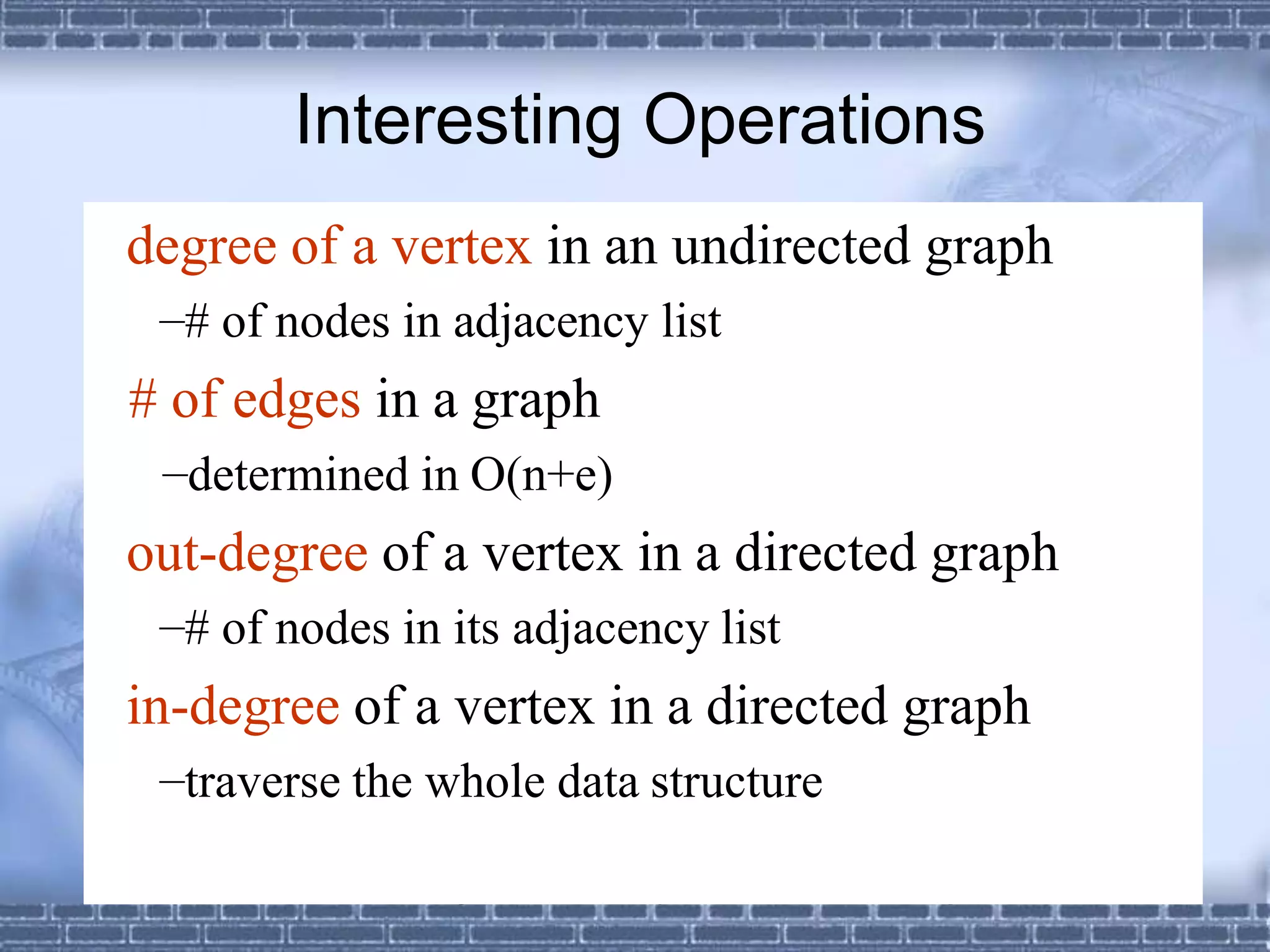
Interesting Operations
degree of a vertex in an undirected graph
–# of nodes in adjacency list
# of edges in a graph
–determined in O(n+e)
out-degree of a vertex in a directed graph
–# of nodes in its adjacency list
in-degree of a vertex in a directed graph
–traverse the whole data structure
1
0
2
3
5
6
7
[0] 9 [8] 23 [16] 2
[1] 11 0 [9] 1 4 [17] 5
[2] 13 [10] 2 5 [18] 4
[3] 15 1 [11] 0 [19] 6
[4] 17 [12] 3 6 [20] 5
[5] 18 2 [13] 0 [21] 7
[6] 20 [14] 3 7 [22] 6
[7] 22 3 [15] 1
4
node[0] … node[n-1]: starting point for vertices
node[n]: n+2e+1
node[n+1] … node[n+2e]: head node of edge
Compact Representation
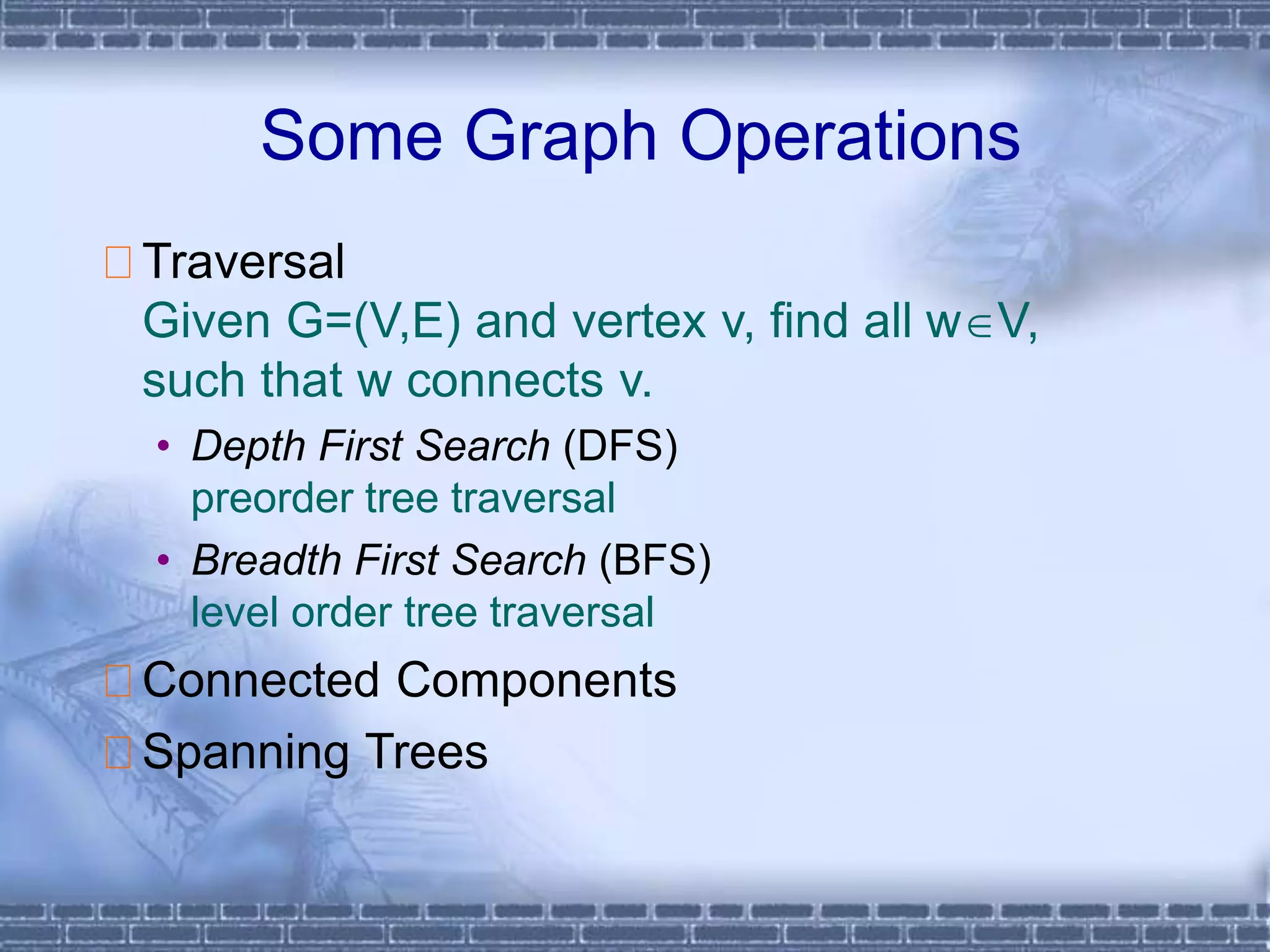
Some Graph Operations
Traversal
Given G=(V,E) and vertex v, find all wV,
such that w connects v.
• Depth First Search (DFS)
preorder tree traversal
• Breadth First Search (BFS)
level order tree traversal
Connected Components
Spanning Trees
Graph G and its adjacency lists (p.274)
depth first search: v0, v1, v3, v7, v4, v5, v2, v6
#define FALSE 0
#define TRUE 1
short int visited [MAX_VERTEX];
void dfs(int v)
{
node_pointer w;
visited[v]= TRUE;
printf(“%5d”, v);
for (w=graph[v]; w;
w=w->link)
if (!visited[w->vertex])
dfs(w->vertex);
}
Breadth First Search
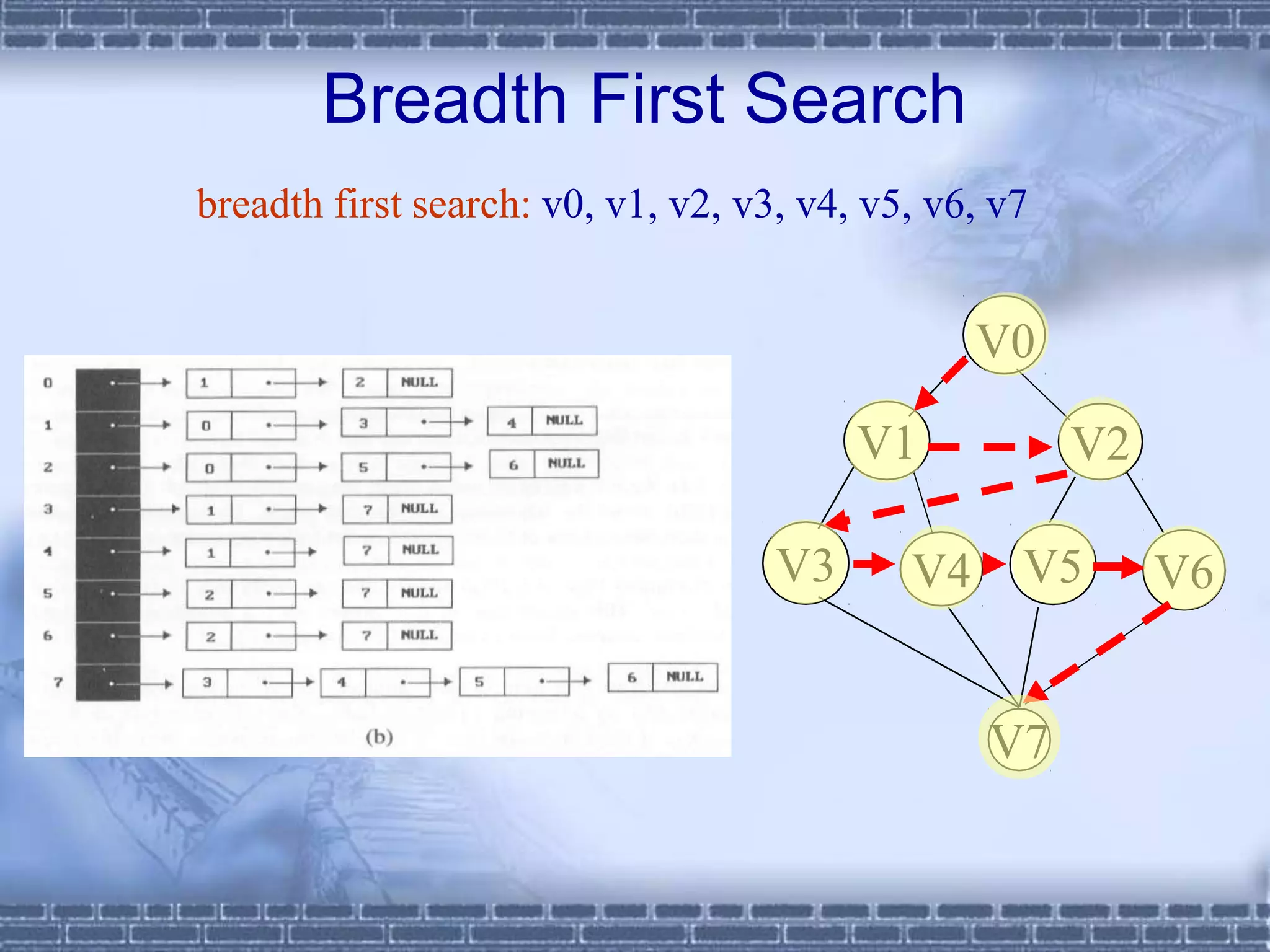
breadth first search: v0, v1, v2, v3, v4, v5, v6, v7
V0
V1 V2
V3 V4 V5 V6
V7
Breadth First Search (Cont.)
printf(“%5d”, v);
visited[v] = TRUE;
addq(&front, &rear, v);
while (front) {
v= deleteq(&front);
for (w=graph[v]; w; w=w->link)
if (!visited[w->vertex]) {
printf(“%5d”, w->vertex);
addq(&front, &rear, w-
>vertex);
visited[w->vertex] = TRUE;
}
}
}
adjacency list: O(e)
adjacency matrix: O(n2)
typedef struct queue *queue_pointer;
typedef struct queue {
int vertex;
queue_pointer link;
};
void addq(queue_pointer *,
queue_pointer *, int);
int deleteq(queue_pointer *);
void bfs(int v)
{
node_pointer w;
queue_pointer front, rear;
front = rear = NULL;
Spanning Trees
When graph G is connected, a depth first or breadth first search
starting at any vertex will visit all vertices in G
A spanning tree is any tree that consists solely of edges in G and that
includes all the vertices
E(G): T (tree edges) + N (nontree edges)
where T: set of edges used during search; N: set of remaining edges
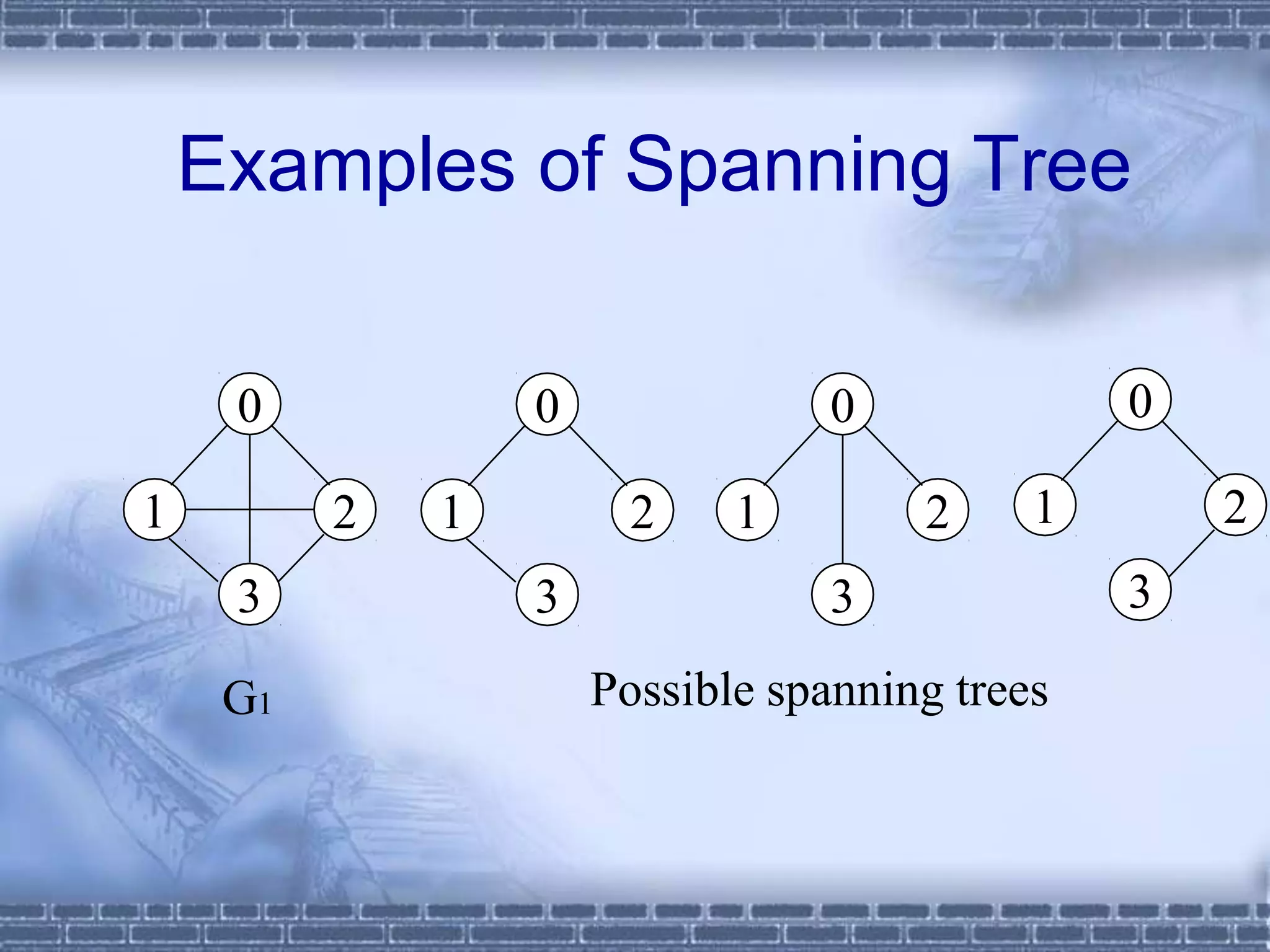
Examples of Spanning Tree
0
1
3
0
2 1
3
0
2 1 2
0
1 2
3
G1
3
Possible spanning trees
Spanning Trees
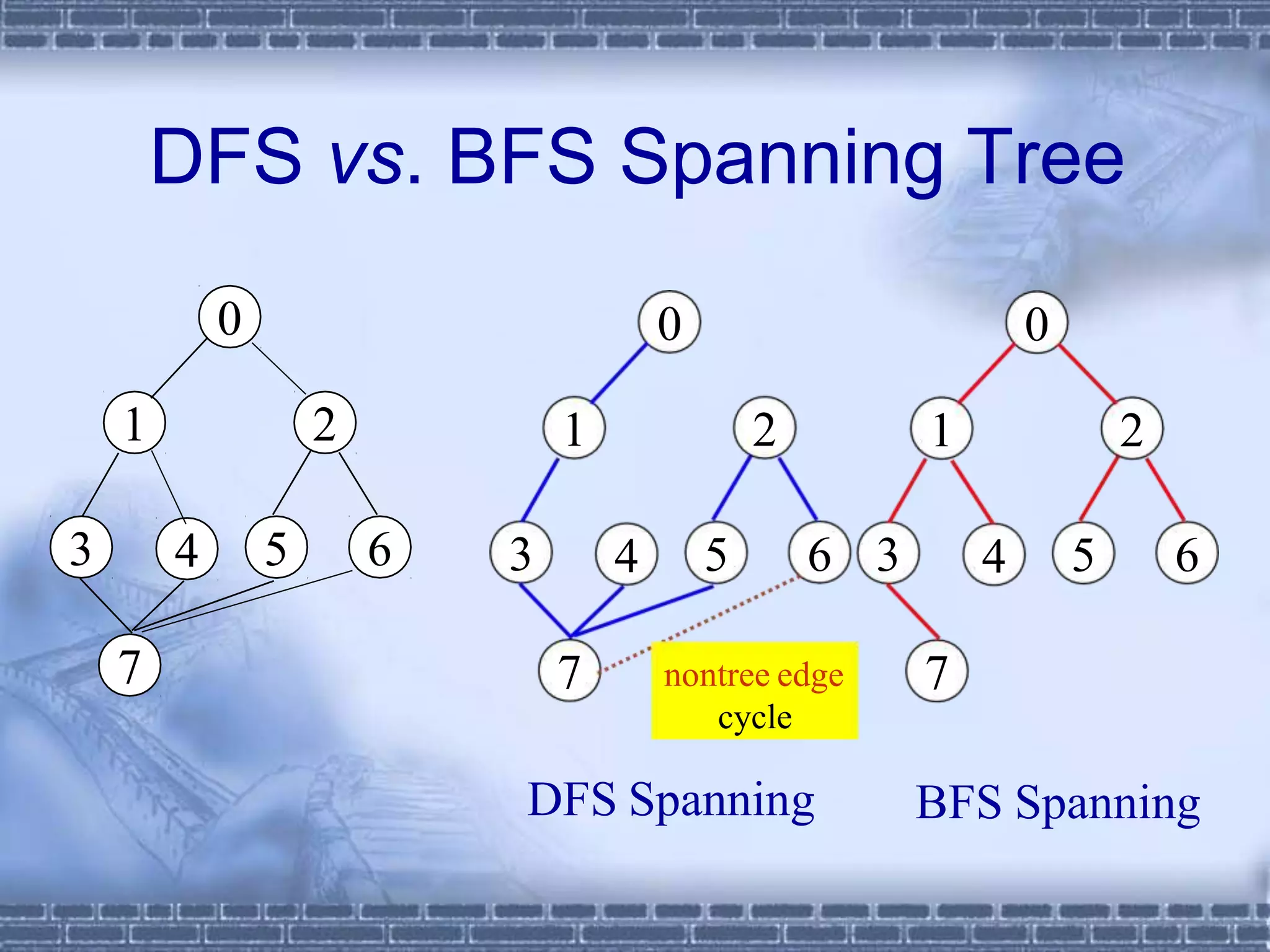
Either dfs or bfs can be used to create a
spanning tree
• When dfs is used, the resulting spanning tree is
known as a depth first spanning tree
• When bfs is used, the resulting spanning tree is
known as a breadth first spanning tree
While adding a nontree edge into any spanning tree,
this will create a cycle
DFS vs. BFS Spanning Tree
0
1 2
3 4
7
0
1 2
4 5 6
7
DFS Spanning BFS Spanning
0
1 2
3 4 5 6
7
5 6 3
nontree edge
cycle
A spanning tree is a minimal subgraph, G’, of G
such that V(G’)=V(G) and G’is connected.
Any connected graph with n vertices must have
at least n-1 edges.
Spanning Trees(cont.)
Minimum Cost Spanning Tree
The cost of a spanning tree of a weighted
undirected graph is the sum of the costs of
the edges in the spanning tree
A minimum cost spanning tree is a spanning
tree of least cost
Three different algorithms can be used
• Kruskal
• Prim
• Sollin Select n-1 edges from a weighted graph
of n vertices with minimum cost.

graph.pptx

  • 1.
  • 2.
    Definition A graph Gconsists of two sets • a finite, nonempty set of vertices V(G) • a finite, possible empty set of edges E(G) • G(V,E) represents a graph An undirected graph is one in which the pair of vertices in a edge is unordered, (v0, v1) = (v1,v0) A directed graph is one in which each edge is a directed pair of vertices, <v0, v1> != <v1,v0> tail head
  • 3.
    Examples for Graph 00 1 0 3 1 2 4 5 6 G2 2 G3 V(G1)={0,1,2,3} V(G2)={0,1,2,3,4,5,6} V(G3)={0,1,2} E(G1)={(0,1),(0,2),(0,3),(1,2),(1,3),(2,3)} E(G2)={(0,1),(0,2),(1,3),(1,4),(2,5),(2,6)} E(G3)={<0,1>,<1,0>,<1,2>} complete undirected graph: n(n-1)/2 edges complete directed graph: n(n-1) edges 1 2 3 G1 complete graph incomplete graph
  • 4.
    Complete Graph A completegraph is a graph that has the maximum number of edges • for undirected graph with n vertices, the maximum number of edges is n(n-1)/2 • for directed graph with n vertices, the maximum number of edges is n(n-1) Example: G1 is a complete graph
  • 5.
    Adjacent and Incident If(v0, v1) is an edge in an undirected graph, • v0 and v1 are adjacent • The edge (v0, v1) is incident on vertices v0 and v1 If <v0, v1> is an edge in a directed graph • v0 is adjacent to v1, and v1 is adjacent from v0 • The edge <v0, v1> is incident on v0 and v1
  • 6.
    0 2 1 (a) 2 1 3 (b) Exampleof a graph with feedback loops and a multigraph 0 self edge multigraph: multiple occurrences of the same edge
  • 7.
    A subgraph ofG is a graph G’ such that V(G’) is a subset of V(G) and E(G’) is a subset of E(G) A path from vertex vp to vertex vq in a graph G, is a sequence of vertices, vp, vi1, vi2, ..., vin, vq, such that (vp, vi1), (vi1, vi2), ..., (vin, vq) are edges in an undirected graph The length of a path is the number of edges on it Subgraph and Path
  • 8.
    0 0 1 23 1 2 0 1 2 (i) 3 (iv) (ii) (iii) (a) Some of the subgraph of G1 0 0 1 0 1 0 1 (i) (ii) 2 (iv) 2 (iii) (b) Some of the subgraph of G2 0 1 2 3 G1 0 1 2 G2
  • 9.
    A simple pathis a path in which all vertices, except possibly the first and the last, are distinct A cycle is a simple path in which the first and the last vertices are the same In an undirected graph G, two vertices, v0 and v1, are connected if there is a path in G from v0 tov1 An undirected graph is connected if, for every pair of distinct vertices vi, vj, there is a path from vi tovj Simple Path and Style
  • 10.
    0 1 2 0 1 2 34 5 6 3 G1 G2 connected tree (acyclic graph)
  • 11.
    A connected componentof an undirected graph is a maximal connected subgraph. A tree is a graph that is connected and acyclic. A directed graph is strongly connected if there is a directed path from vi to vj and also from vj to vi. A strongly connected component is a maximal subgraph that is strongly connected. Connected Component
  • 12.
    1 0 2 3 4 5 6 H1 H2 7 G4 (notconnected) A graph with two connected components connected component (maximal connected subgraph)
  • 13.
    Strongly connected componentsof G3 0 1 2 0 1 2 G3 not strongly connected strongly connected component (maximal strongly connected subgraph)
  • 14.
    CHAPTER 6 14 Degree Thedegree of a vertex is the number of edges incident to that vertex For directed graph, • the in-degree of a vertex v is the number of edges that have v as the head • the out-degree of a vertex v is the number of edges that have v as the tail • if di is the degree of a vertex i in a graph G with n vertices and e edges, the number of edges is n 1 e  ( d i ) / 2 0
  • 15.
    undirected graph Degree G1 0 2 1 3 2 3 3 1 4 1 5 6 11 G2 directed graph in-degree out-degree 0 1 2 G3 in:1, out: 1 in: 1, out: 2 in: 1, out: 0 3 0 1 3 2 3 3 3
  • 16.
    CHAPTER 6 16 ADTfor Graph structure Graph is objects: a nonempty set of vertices and a set of undirected edges, where each edge is a pair of vertices functions: for all graph  Graph, v, v1and v2 Vertices Graph Create()::=return an empty graph Graph InsertVertex(graph, v)::= return a graph with v inserted. v has no incident edge. Graph InsertEdge(graph, v1,v2)::= return a graph with new edge between v1 and v2 Graph DeleteVertex(graph, v)::= return a graph in which v and all edges incident to it are removed Graph DeleteEdge(graph, v1, v2)::=return a graph in which the edge (v1, v2) is removed Boolean IsEmpty(graph)::= if (graph==empty graph) return TRUE else return FALSE List Adjacent(graph,v)::= return a list of all vertices that are adjacent to v
  • 17.
  • 18.
    Adjacency Matrix Let G=(V,E)be a graph with n vertices. The adjacency matrix of G is a two-dimensional n by n array, say adj_mat - If the edge (vi, vj) is in E(G), adj_mat[i][j]=1 - If there is no such edge in E(G), adj_mat[i][j]=0 The adjacency matrix for an undirected graph is symmetric; the adjacency matrix for a digraph need not be symmetric
  • 19.
    Examples for AdjacencyMatrix 1  1  1  1 1  0  0 1  0 0 0  0  0 1 0 1 1 1 0 1  1 0 1 1 1 1 0 G1 0 1 0  0  0 G2 G3 0 1 2 3 0 1 2 0 2 1 3 4 5 6 0 1 1 0 0 0 70 0  0 0 1 0 0 0  1 0 0 1 0 0 0 0 0 1 1 0 0 0 0 0  0 0 0 0 1 0 0 0 0 0 1 0 1  0 0 0 0 1 0  0 0 0 0 0 0 1 0 symmetric undirected: n2/2 directed: n2
  • 20.
    Merits of AdjacencyMatrix From the adjacency matrix, to determine the connection of vertices is easy The degree of a vertex isadj_ mat[i][ j] For a digraph, the row sum is the out_degree, while the column sum is the in_degree j0 n1 ind(vi)   A[ j,i] j0 n1 outd(vi)   A[i, j] j0 n1
  • 21.
    Data Structures forAdjacency Lists #define MAX_VERTICES 50 typedef struct node *node_pointer; typedef struct node { int vertex; struct node *link; }; node_pointer graph[MAX_VERTICES]; int n=0; /* vertices currently in use */ Each row in adjacency matrix is represented as an adjacency list.
  • 22.
    0 1 2 3 0 1 2 0 1 2 3 4 5 6 7 1 2 3 02 3 0 1 3 0 1 2 G1 1 0 2 G2 1 2 0 3 0 3 1 2 5 4 6 5 7 6 G3 0 1 2 3 0 1 2 1 0 2 3 4 5 6 7 An undirected graph with n vertices and e edges ==> n head nodes and 2e list nodes
  • 23.
    CHAPTER 6 23 InterestingOperations degree of a vertex in an undirected graph –# of nodes in adjacency list # of edges in a graph –determined in O(n+e) out-degree of a vertex in a directed graph –# of nodes in its adjacency list in-degree of a vertex in a directed graph –traverse the whole data structure
  • 24.
    1 0 2 3 5 6 7 [0] 9 [8]23 [16] 2 [1] 11 0 [9] 1 4 [17] 5 [2] 13 [10] 2 5 [18] 4 [3] 15 1 [11] 0 [19] 6 [4] 17 [12] 3 6 [20] 5 [5] 18 2 [13] 0 [21] 7 [6] 20 [14] 3 7 [22] 6 [7] 22 3 [15] 1 4 node[0] … node[n-1]: starting point for vertices node[n]: n+2e+1 node[n+1] … node[n+2e]: head node of edge Compact Representation
  • 25.
    Some Graph Operations Traversal GivenG=(V,E) and vertex v, find all wV, such that w connects v. • Depth First Search (DFS) preorder tree traversal • Breadth First Search (BFS) level order tree traversal Connected Components Spanning Trees
  • 26.
    Graph G andits adjacency lists (p.274) depth first search: v0, v1, v3, v7, v4, v5, v2, v6 #define FALSE 0 #define TRUE 1 short int visited [MAX_VERTEX]; void dfs(int v) { node_pointer w; visited[v]= TRUE; printf(“%5d”, v); for (w=graph[v]; w; w=w->link) if (!visited[w->vertex]) dfs(w->vertex); }
  • 27.
    Breadth First Search breadthfirst search: v0, v1, v2, v3, v4, v5, v6, v7 V0 V1 V2 V3 V4 V5 V6 V7
  • 28.
    Breadth First Search(Cont.) printf(“%5d”, v); visited[v] = TRUE; addq(&front, &rear, v); while (front) { v= deleteq(&front); for (w=graph[v]; w; w=w->link) if (!visited[w->vertex]) { printf(“%5d”, w->vertex); addq(&front, &rear, w- >vertex); visited[w->vertex] = TRUE; } } } adjacency list: O(e) adjacency matrix: O(n2) typedef struct queue *queue_pointer; typedef struct queue { int vertex; queue_pointer link; }; void addq(queue_pointer *, queue_pointer *, int); int deleteq(queue_pointer *); void bfs(int v) { node_pointer w; queue_pointer front, rear; front = rear = NULL;
  • 29.
    Spanning Trees When graphG is connected, a depth first or breadth first search starting at any vertex will visit all vertices in G A spanning tree is any tree that consists solely of edges in G and that includes all the vertices E(G): T (tree edges) + N (nontree edges) where T: set of edges used during search; N: set of remaining edges
  • 30.
    Examples of SpanningTree 0 1 3 0 2 1 3 0 2 1 2 0 1 2 3 G1 3 Possible spanning trees
  • 31.
    Spanning Trees Either dfsor bfs can be used to create a spanning tree • When dfs is used, the resulting spanning tree is known as a depth first spanning tree • When bfs is used, the resulting spanning tree is known as a breadth first spanning tree While adding a nontree edge into any spanning tree, this will create a cycle
  • 32.
    DFS vs. BFSSpanning Tree 0 1 2 3 4 7 0 1 2 4 5 6 7 DFS Spanning BFS Spanning 0 1 2 3 4 5 6 7 5 6 3 nontree edge cycle
  • 33.
    A spanning treeis a minimal subgraph, G’, of G such that V(G’)=V(G) and G’is connected. Any connected graph with n vertices must have at least n-1 edges. Spanning Trees(cont.)
  • 34.
    Minimum Cost SpanningTree The cost of a spanning tree of a weighted undirected graph is the sum of the costs of the edges in the spanning tree A minimum cost spanning tree is a spanning tree of least cost Three different algorithms can be used • Kruskal • Prim • Sollin Select n-1 edges from a weighted graph of n vertices with minimum cost.