CHAPTER 6
GRAPHS
Dr. R. Khanchana
Assistant Professor
Department of Computer Science
Sri Ramakrishna College of Arts and Science for
Women
CHAPTER 6 1
http://icodeguru.com/vc/10book/books/book1/chap06.htm
CHAPTER 6
2
Definition
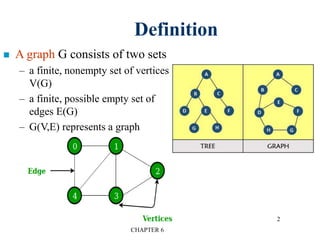
 A graph G consists of two sets
– a finite, nonempty set of vertices
V(G)
– a finite, possible empty set of
edges E(G)
– G(V,E) represents a graph
Directed Graph Vs Undirected Graph
CHAPTER 6 3
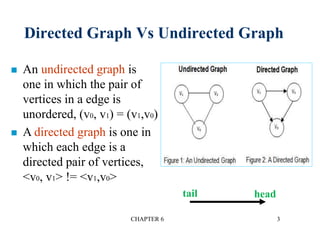
 An undirected graph is
one in which the pair of
vertices in a edge is
unordered, (v0, v1) = (v1,v0)
 A directed graph is one in
which each edge is a
directed pair of vertices,
<v0, v1> != <v1,v0>
tail head
CHAPTER 6
4
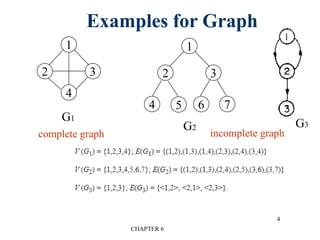
Examples for Graph
1
2 3
4
1
2 3
4 5 6 7
G1
G2 G3
complete graph incomplete graph
CHAPTER 6 5
Complete Graph
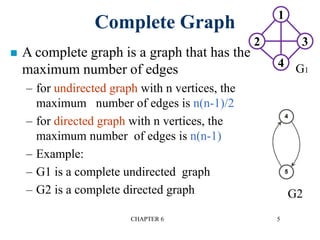
 A complete graph is a graph that has the
maximum number of edges
– for undirected graph with n vertices, the
maximum number of edges is n(n-1)/2
– for directed graph with n vertices, the
maximum number of edges is n(n-1)
– Example:
– G1 is a complete undirected graph
– G2 is a complete directed graph
1
2 3
4 G1
G2
CHAPTER 6 6
Adjacent and Incident in
Undirected Graph
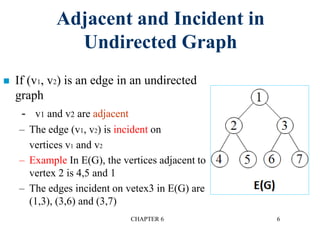
 If (v1, v2) is an edge in an undirected
graph
- v1 and v2 are adjacent
– The edge (v1, v2) is incident on
vertices v1 and v2
– Example In E(G), the vertices adjacent to
vertex 2 is 4,5 and 1
– The edges incident on vetex3 in E(G) are
(1,3), (3,6) and (3,7)
CHAPTER 6 7
Adjacent and Incident in
Directed Graph
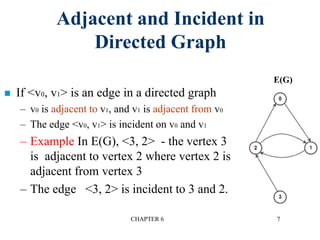
 If <v0, v1> is an edge in a directed graph
– v0 is adjacent to v1, and v1 is adjacent from v0
– The edge <v0, v1> is incident on v0 and v1
– Example In E(G), <3, 2> - the vertex 3
is adjacent to vertex 2 where vertex 2 is
adjacent from vertex 3
– The edge <3, 2> is incident to 3 and 2.
E(G)
CHAPTER 6 8
0 2
1
(a)
3
2
1
4
(b)
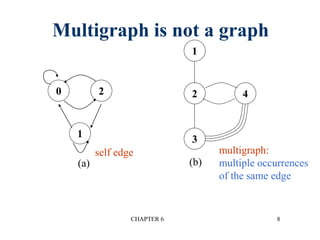
self edge multigraph:
multiple occurrences
of the same edge
Figure 6.3
Multigraph is not a graph
CHAPTER 6 9
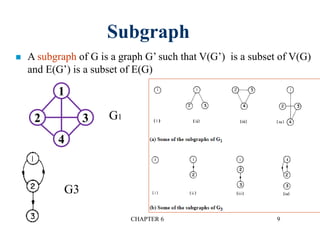
 A subgraph of G is a graph G’ such that V(G’) is a subset of V(G)
and E(G’) is a subset of E(G)
Subgraph
1
2 3
4
G1
G3
CHAPTER 6 10
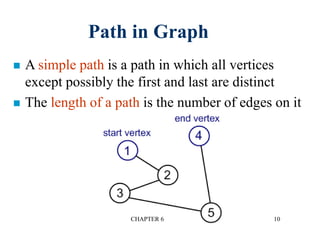
 A simple path is a path in which all vertices
except possibly the first and last are distinct
 The length of a path is the number of edges on it
Path in Graph
CHAPTER 6 11
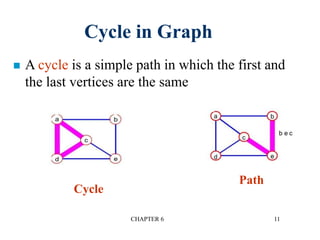
 A cycle is a simple path in which the first and
the last vertices are the same
Cycle in Graph
Cycle
Path
CHAPTER 6
12
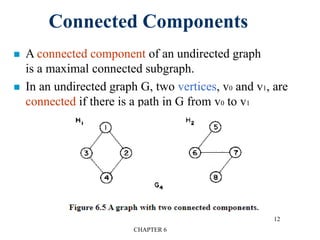
 A connected component of an undirected graph
is a maximal connected subgraph.
 In an undirected graph G, two vertices, v0 and v1, are
connected if there is a path in G from v0 to v1
Connected Components
CHAPTER 6 13
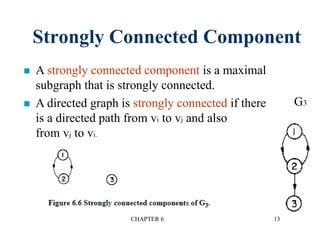
 A strongly connected component is a maximal
subgraph that is strongly connected.
 A directed graph is strongly connected if there
is a directed path from vi to vj and also
from vj to vi.
Strongly Connected Component
G3
CHAPTER 6 14
0
1 2
3
0
1 2
3 4 5 6
G1
G2
Tree (acyclic graph)
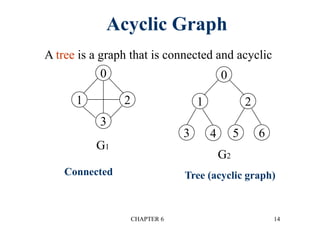
A tree is a graph that is connected and acyclic
Acyclic Graph
Connected
CHAPTER 6 15
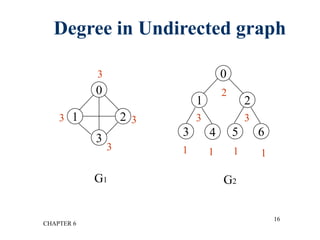
Degree
 The degree of a vertex is the number of edges
incident to that vertex
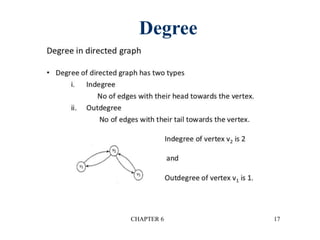
 For directed graph,
– in-degree of a vertex v is the number of
edges that have v as the head
– out-degree of a vertex v is the number of
edges that have v as the tail
CHAPTER 6
16
Degree in Undirected graph
0
1 2
3 4 5 6
G1 G2
3
2
3 3
1 1 1 1
0
1 2
3
33
3
CHAPTER 6 17
Degree
CHAPTER 6
18
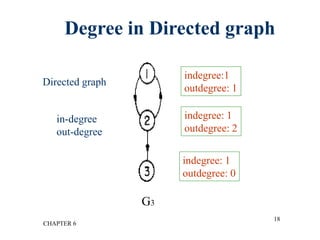
Degree in Directed graph
Directed graph
in-degree
out-degree
G3
indegree:1
outdegree: 1
indegree: 1
outdegree: 2
indegree: 1
outdegree: 0
Quiz
 https://quizizz.com/admin/quiz/5f5de89ead
5020001dab5a3a
CHAPTER 6 19
CHAPTER 6 20
Graph Representations
 Adjacency Matrix
 Adjacency Lists
 Adjacency Multilists
CHAPTER 6 21
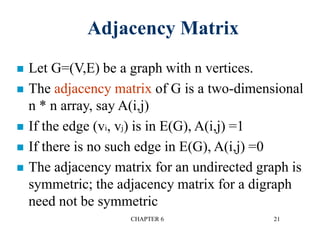
Adjacency Matrix
 Let G=(V,E) be a graph with n vertices.
 The adjacency matrix of G is a two-dimensional
n * n array, say A(i,j)
 If the edge (vi, vj) is in E(G), A(i,j) =1
 If there is no such edge in E(G), A(i,j) =0
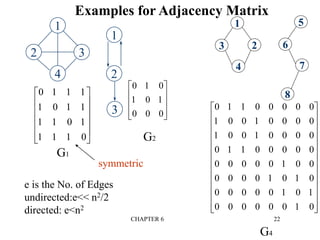
 The adjacency matrix for an undirected graph is
symmetric; the adjacency matrix for a digraph
need not be symmetric
CHAPTER 6 22
Examples for Adjacency Matrix
0
1
1
1
1
0
1
1
1
1
0
1
1
1
1
0












0
1
0
1
0
0
0
1
0










0
1
1
0
0
0
0
0
1
0
0
1
0
0
0
0
1
0
0
1
0
0
0
0
0
1
1
0
0
0
0
0
0
0
0
0
0
1
0
0
0
0
0
0
1
0
1
0
0
0
0
0
0
1
0
1
0
0
0
0
0
0
1
0


























G1
G2
G4
1
2 3
4
1
2
3
2
1
3
4
5
6
7
8
symmetric
e is the No. of Edges
undirected:e<< n2/2
directed: e<n2
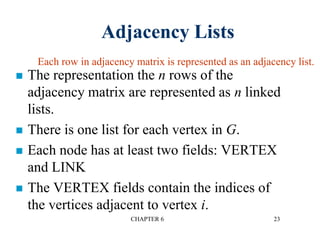
 The representation the n rows of the
adjacency matrix are represented as n linked
lists.
 There is one list for each vertex in G.
 Each node has at least two fields: VERTEX
and LINK
 The VERTEX fields contain the indices of
the vertices adjacent to vertex i.
CHAPTER 6 23
Adjacency Lists
Each row in adjacency matrix is represented as an adjacency list.
CHAPTER 6 24
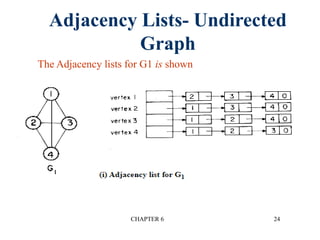
Adjacency Lists- Undirected
Graph
The Adjacency lists for G1 is shown
CHAPTER 6 25
Adjacency Lists –Directed Graph
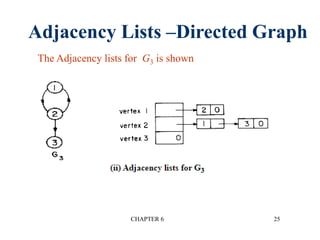
The Adjacency lists for G3 is shown
CHAPTER 6 26
Adjacency Lists- Connected
Components
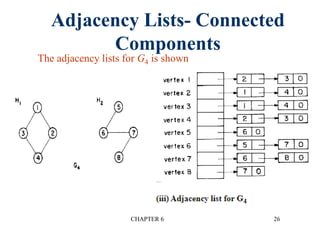
The adjacency lists for G4 is shown
CHAPTER 6 27
Inverse Adjacency Lists
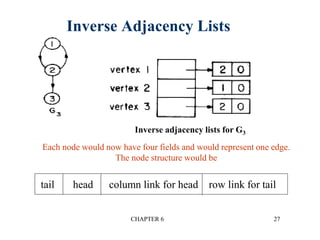
Inverse adjacency lists for G3
Each node would now have four fields and would represent one edge.
The node structure would be
tail head column link for head row link for tail
CHAPTER 6 28
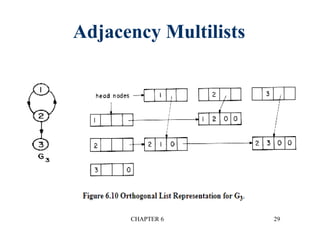
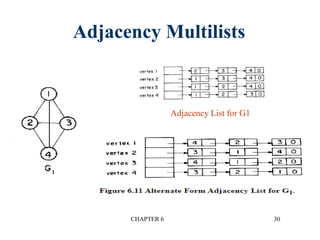
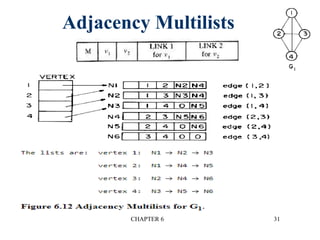
Adjacency Multilists
An edge in an undirected graph is
represented by two nodes in adjacency list
representation.
Adjacency Multilists
–lists in which nodes may be shared among
several lists.
(an edge is shared by two different paths)
Adjacency Multilists
CHAPTER 6 29
Adjacency Multilists
CHAPTER 6 30
Adjacency List for G1
Adjacency Multilists
CHAPTER 6 31
CHAPTER 6 32
TRAVERSALS
 Traversal
Given G=(V,E) and vertex v, find all wV,
such that w connects v.
– Depth First Search (DFS)
preorder tree traversal
– Breadth First Search (BFS)
level order tree traversal
 Connected Components
 Spanning Trees
CHAPTER 6 33
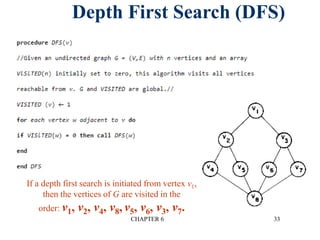
Depth First Search (DFS)
If a depth first search is initiated from vertex v1,
then the vertices of G are visited in the
order: v1, v2, v4, v8, v5, v6, v3, v7.
CHAPTER 6 34
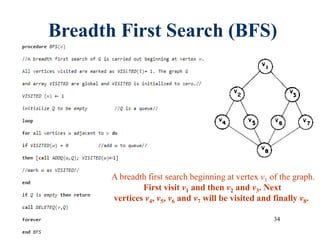
Breadth First Search (BFS)
A breadth first search beginning at vertex v1 of the graph.
First visit v1 and then v2 and v3. Next
vertices v4, v5, v6 and v7 will be visited and finally v8.
CHAPTER 6 35
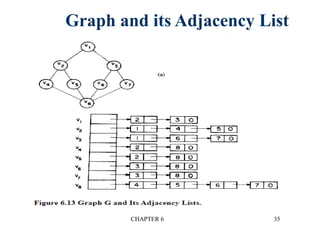
Graph and its Adjacency List
CHAPTER 6 36
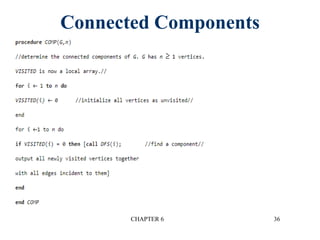
Connected Components
CHAPTER 6 37
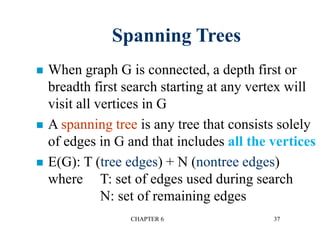
Spanning Trees
 When graph G is connected, a depth first or
breadth first search starting at any vertex will
visit all vertices in G
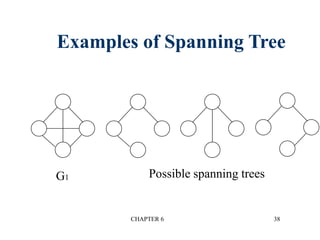
 A spanning tree is any tree that consists solely
of edges in G and that includes all the vertices
 E(G): T (tree edges) + N (nontree edges)
where T: set of edges used during search
N: set of remaining edges
CHAPTER 6 38
Examples of Spanning Tree
G1 Possible spanning trees
CHAPTER 6 39
Spanning Trees
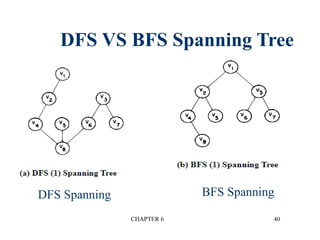
 Either DFS or BFS can be used to create a
spanning tree
– When DFS is used, the resulting spanning tree is
known as a depth first spanning tree
– When BFS is used, the resulting spanning tree is
known as a breadth first spanning tree
 While adding a nontree edge into any spanning
tree, this will create a cycle
CHAPTER 6 40
DFS VS BFS Spanning Tree
DFS Spanning BFS Spanning
CHAPTER 6 41
Minimum Cost Spanning Tree
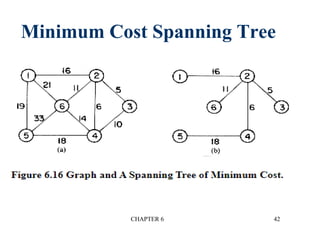
 The cost of a spanning tree of a weighted
undirected graph is the sum of the costs of the
edges in the spanning tree
 A minimum cost spanning tree is a spanning
tree of least cost
 Three different algorithms can be used
– Kruskal
– Prim
– Sollin
Select n-1 edges from a weighted graph
of n vertices with minimum cost.
Minimum Cost Spanning Tree
CHAPTER 6 42
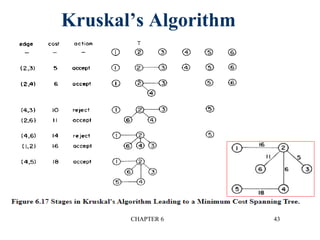
Kruskal’s Algorithm
CHAPTER 6 43
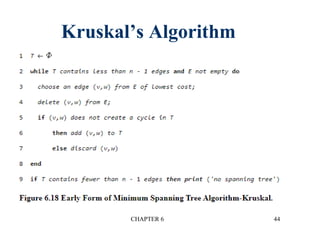
Kruskal’s Algorithm
CHAPTER 6 44
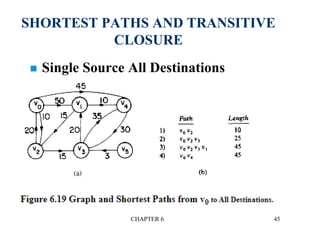
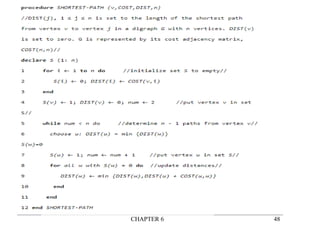
SHORTEST PATHS AND TRANSITIVE
CLOSURE
 Single Source All Destinations
CHAPTER 6 45
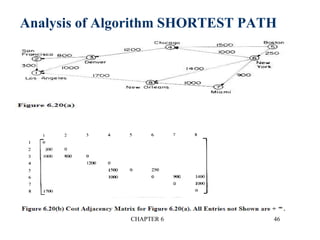
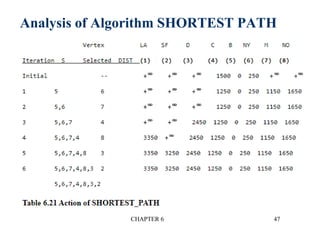
Analysis of Algorithm SHORTEST PATH
CHAPTER 6 46
Analysis of Algorithm SHORTEST PATH
CHAPTER 6 47
CHAPTER 6 48
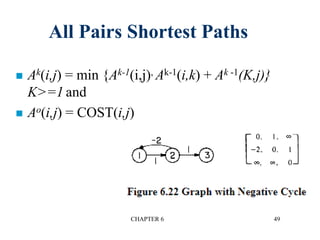
All Pairs Shortest Paths
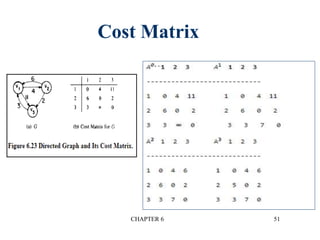
 Ak(i,j) = min {Ak-1(i,j), Ak-1(i,k) + Ak -1(K,j)}
K>=1 and
 Ao(i,j) = COST(i,j)
CHAPTER 6 49
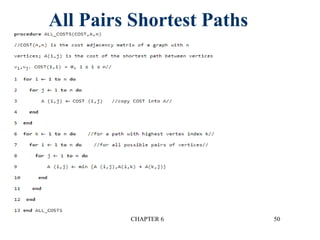
All Pairs Shortest Paths
CHAPTER 6 50
Cost Matrix
CHAPTER 6 51
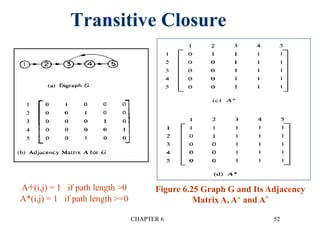
Transitive Closure
CHAPTER 6 52
Figure 6.25 Graph G and Its Adjacency
Matrix A, A+ and A*
A+(i,j) = 1 if path length >0
A*(i,j) = 1 if path length >=0

Unit 3 graph chapter6

  • 1.
    CHAPTER 6 GRAPHS Dr. R.Khanchana Assistant Professor Department of Computer Science Sri Ramakrishna College of Arts and Science for Women CHAPTER 6 1 http://icodeguru.com/vc/10book/books/book1/chap06.htm
  • 2.
    CHAPTER 6 2 Definition  Agraph G consists of two sets – a finite, nonempty set of vertices V(G) – a finite, possible empty set of edges E(G) – G(V,E) represents a graph
  • 3.
    Directed Graph VsUndirected Graph CHAPTER 6 3  An undirected graph is one in which the pair of vertices in a edge is unordered, (v0, v1) = (v1,v0)  A directed graph is one in which each edge is a directed pair of vertices, <v0, v1> != <v1,v0> tail head
  • 4.
    CHAPTER 6 4 Examples forGraph 1 2 3 4 1 2 3 4 5 6 7 G1 G2 G3 complete graph incomplete graph
  • 5.
    CHAPTER 6 5 CompleteGraph  A complete graph is a graph that has the maximum number of edges – for undirected graph with n vertices, the maximum number of edges is n(n-1)/2 – for directed graph with n vertices, the maximum number of edges is n(n-1) – Example: – G1 is a complete undirected graph – G2 is a complete directed graph 1 2 3 4 G1 G2
  • 6.
    CHAPTER 6 6 Adjacentand Incident in Undirected Graph  If (v1, v2) is an edge in an undirected graph - v1 and v2 are adjacent – The edge (v1, v2) is incident on vertices v1 and v2 – Example In E(G), the vertices adjacent to vertex 2 is 4,5 and 1 – The edges incident on vetex3 in E(G) are (1,3), (3,6) and (3,7)
  • 7.
    CHAPTER 6 7 Adjacentand Incident in Directed Graph  If <v0, v1> is an edge in a directed graph – v0 is adjacent to v1, and v1 is adjacent from v0 – The edge <v0, v1> is incident on v0 and v1 – Example In E(G), <3, 2> - the vertex 3 is adjacent to vertex 2 where vertex 2 is adjacent from vertex 3 – The edge <3, 2> is incident to 3 and 2. E(G)
  • 8.
    CHAPTER 6 8 02 1 (a) 3 2 1 4 (b) self edge multigraph: multiple occurrences of the same edge Figure 6.3 Multigraph is not a graph
  • 9.
    CHAPTER 6 9 A subgraph of G is a graph G’ such that V(G’) is a subset of V(G) and E(G’) is a subset of E(G) Subgraph 1 2 3 4 G1 G3
  • 10.
    CHAPTER 6 10 A simple path is a path in which all vertices except possibly the first and last are distinct  The length of a path is the number of edges on it Path in Graph
  • 11.
    CHAPTER 6 11 A cycle is a simple path in which the first and the last vertices are the same Cycle in Graph Cycle Path
  • 12.
    CHAPTER 6 12  Aconnected component of an undirected graph is a maximal connected subgraph.  In an undirected graph G, two vertices, v0 and v1, are connected if there is a path in G from v0 to v1 Connected Components
  • 13.
    CHAPTER 6 13 A strongly connected component is a maximal subgraph that is strongly connected.  A directed graph is strongly connected if there is a directed path from vi to vj and also from vj to vi. Strongly Connected Component G3
  • 14.
    CHAPTER 6 14 0 12 3 0 1 2 3 4 5 6 G1 G2 Tree (acyclic graph) A tree is a graph that is connected and acyclic Acyclic Graph Connected
  • 15.
    CHAPTER 6 15 Degree The degree of a vertex is the number of edges incident to that vertex  For directed graph, – in-degree of a vertex v is the number of edges that have v as the head – out-degree of a vertex v is the number of edges that have v as the tail
  • 16.
    CHAPTER 6 16 Degree inUndirected graph 0 1 2 3 4 5 6 G1 G2 3 2 3 3 1 1 1 1 0 1 2 3 33 3
  • 17.
  • 18.
    CHAPTER 6 18 Degree inDirected graph Directed graph in-degree out-degree G3 indegree:1 outdegree: 1 indegree: 1 outdegree: 2 indegree: 1 outdegree: 0
  • 19.
  • 20.
    CHAPTER 6 20 GraphRepresentations  Adjacency Matrix  Adjacency Lists  Adjacency Multilists
  • 21.
    CHAPTER 6 21 AdjacencyMatrix  Let G=(V,E) be a graph with n vertices.  The adjacency matrix of G is a two-dimensional n * n array, say A(i,j)  If the edge (vi, vj) is in E(G), A(i,j) =1  If there is no such edge in E(G), A(i,j) =0  The adjacency matrix for an undirected graph is symmetric; the adjacency matrix for a digraph need not be symmetric
  • 22.
    CHAPTER 6 22 Examplesfor Adjacency Matrix 0 1 1 1 1 0 1 1 1 1 0 1 1 1 1 0             0 1 0 1 0 0 0 1 0           0 1 1 0 0 0 0 0 1 0 0 1 0 0 0 0 1 0 0 1 0 0 0 0 0 1 1 0 0 0 0 0 0 0 0 0 0 1 0 0 0 0 0 0 1 0 1 0 0 0 0 0 0 1 0 1 0 0 0 0 0 0 1 0                           G1 G2 G4 1 2 3 4 1 2 3 2 1 3 4 5 6 7 8 symmetric e is the No. of Edges undirected:e<< n2/2 directed: e<n2
  • 23.
     The representationthe n rows of the adjacency matrix are represented as n linked lists.  There is one list for each vertex in G.  Each node has at least two fields: VERTEX and LINK  The VERTEX fields contain the indices of the vertices adjacent to vertex i. CHAPTER 6 23 Adjacency Lists Each row in adjacency matrix is represented as an adjacency list.
  • 24.
    CHAPTER 6 24 AdjacencyLists- Undirected Graph The Adjacency lists for G1 is shown
  • 25.
    CHAPTER 6 25 AdjacencyLists –Directed Graph The Adjacency lists for G3 is shown
  • 26.
    CHAPTER 6 26 AdjacencyLists- Connected Components The adjacency lists for G4 is shown
  • 27.
    CHAPTER 6 27 InverseAdjacency Lists Inverse adjacency lists for G3 Each node would now have four fields and would represent one edge. The node structure would be tail head column link for head row link for tail
  • 28.
    CHAPTER 6 28 AdjacencyMultilists An edge in an undirected graph is represented by two nodes in adjacency list representation. Adjacency Multilists –lists in which nodes may be shared among several lists. (an edge is shared by two different paths)
  • 29.
  • 30.
    Adjacency Multilists CHAPTER 630 Adjacency List for G1
  • 31.
  • 32.
    CHAPTER 6 32 TRAVERSALS Traversal Given G=(V,E) and vertex v, find all wV, such that w connects v. – Depth First Search (DFS) preorder tree traversal – Breadth First Search (BFS) level order tree traversal  Connected Components  Spanning Trees
  • 33.
    CHAPTER 6 33 DepthFirst Search (DFS) If a depth first search is initiated from vertex v1, then the vertices of G are visited in the order: v1, v2, v4, v8, v5, v6, v3, v7.
  • 34.
    CHAPTER 6 34 BreadthFirst Search (BFS) A breadth first search beginning at vertex v1 of the graph. First visit v1 and then v2 and v3. Next vertices v4, v5, v6 and v7 will be visited and finally v8.
  • 35.
    CHAPTER 6 35 Graphand its Adjacency List
  • 36.
  • 37.
    CHAPTER 6 37 SpanningTrees  When graph G is connected, a depth first or breadth first search starting at any vertex will visit all vertices in G  A spanning tree is any tree that consists solely of edges in G and that includes all the vertices  E(G): T (tree edges) + N (nontree edges) where T: set of edges used during search N: set of remaining edges
  • 38.
    CHAPTER 6 38 Examplesof Spanning Tree G1 Possible spanning trees
  • 39.
    CHAPTER 6 39 SpanningTrees  Either DFS or BFS can be used to create a spanning tree – When DFS is used, the resulting spanning tree is known as a depth first spanning tree – When BFS is used, the resulting spanning tree is known as a breadth first spanning tree  While adding a nontree edge into any spanning tree, this will create a cycle
  • 40.
    CHAPTER 6 40 DFSVS BFS Spanning Tree DFS Spanning BFS Spanning
  • 41.
    CHAPTER 6 41 MinimumCost Spanning Tree  The cost of a spanning tree of a weighted undirected graph is the sum of the costs of the edges in the spanning tree  A minimum cost spanning tree is a spanning tree of least cost  Three different algorithms can be used – Kruskal – Prim – Sollin Select n-1 edges from a weighted graph of n vertices with minimum cost.
  • 42.
    Minimum Cost SpanningTree CHAPTER 6 42
  • 43.
  • 44.
  • 45.
    SHORTEST PATHS ANDTRANSITIVE CLOSURE  Single Source All Destinations CHAPTER 6 45
  • 46.
    Analysis of AlgorithmSHORTEST PATH CHAPTER 6 46
  • 47.
    Analysis of AlgorithmSHORTEST PATH CHAPTER 6 47
  • 48.
  • 49.
    All Pairs ShortestPaths  Ak(i,j) = min {Ak-1(i,j), Ak-1(i,k) + Ak -1(K,j)} K>=1 and  Ao(i,j) = COST(i,j) CHAPTER 6 49
  • 50.
    All Pairs ShortestPaths CHAPTER 6 50
  • 51.
  • 52.
    Transitive Closure CHAPTER 652 Figure 6.25 Graph G and Its Adjacency Matrix A, A+ and A* A+(i,j) = 1 if path length >0 A*(i,j) = 1 if path length >=0