Presented By: 
KESHAV SOMANI 
BBA(E-COMM)IIISEM. 
ROLLNO.56417
MATRIX REPRESENTATION 
OF GRAPH
Graph is a set of edges and vertices. 
Graph can be represented in the form of matrix. 
Different matrix that can be formed are: 
1. Incidence Matrix 
2. Adjacency Matrix 
3. Cut-Set Matrix 
4. Circuit Matrix 
5. Path Matrix
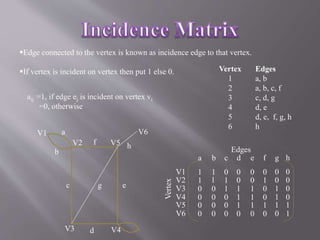
Edge connected to the vertex is known as incidence edge to that vertex. 
If vertex is incident on vertex then put 1 else 0. 
aij =1, if edge ej is incident on vertex vi 
V6 
f 
=0, otherwise 
V2 V5 
V4 
V3 
h 
c e 
d 
V1 a 
b 
a b c d e f 
0 0 0 
0 0 1 
1 1 0 
1 1 0 
1 1 
1 
0 0 1 
0 0 0 1 1 0 
V1 
V2 
V3 
V4 
g h 
0 
0 
0 
0 
1 
0 
1 
0 
Edges 
Vertex 
V5 1 
1 1 1 
0 0 0 
0 0 0 0 0 0 
V6 
0 
1 
1 
Vertex 
1 
2 
3 
4 
5 
6 
Edges 
a, b 
a, b, c, f 
c, d, g 
d, e 
d, e, f, g, h 
h
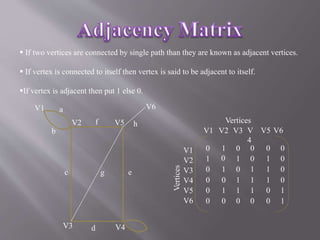
 If two vertices are connected by single path than they are known as adjacent vertices. 
 If vertex is connected to itself then vertex is said to be adjacent to itself. 
If vertex is adjacent then put 1 else 0. 
V6 
f 
V2 V5 
V4 
V3 
h 
c e 
d 
V1 a 
b 
V1 V2 V3 V5 V6 
0 0 0 
0 1 0 
1 1 0 
1 1 0 
1 0 1 
0 0 1 
0 1 0 
1 0 
1 
0 1 0 
0 0 1 
0 1 1 
0 0 0 
V 
4 
V1 
V2 
V3 
V4 
V5 
V6 
Vertices 
Vertices
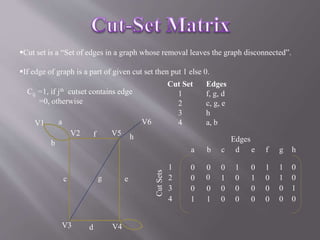
Cut set is a “Set of edges in a graph whose removal leaves the graph disconnected”. 
If edge of graph is a part of given cut set then put 1 else 0. 
V6 
V2 V5 
V4 
V3 
h 
f 
c e 
d 
V1 a 
b 
a b c d e f 
1 0 1 
0 1 0 
0 0 0 
0 0 0 
0 0 
1 
0 0 0 
1 1 0 0 0 0 
1 
2 
3 
4 
g h 
1 
1 
0 
0 
0 
0 
1 
0 
Edges 
Cut Sets 
Cut Set 
1 
2 
3 
4 
Edges 
f, g, d 
c, g, e 
h 
a, b 
Cij =1, if jth cutset contains edge 
=0, otherwise
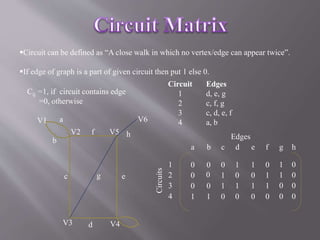
Circuit can be defined as “A close walk in which no vertex/edge can appear twice”. 
If edge of graph is a part of given circuit then put 1 else 0. 
V6 
V2 V5 
V4 
V3 
h 
f 
c e 
d 
V1 a 
b 
a b c d e f 
1 1 0 
0 0 1 
1 1 1 
0 0 0 
0 0 
1 
0 0 1 
1 1 0 0 0 0 
1 
2 
3 
4 
g h 
1 
1 
0 
0 
0 
0 
0 
0 
Edges 
Circuits 
Circuit 
1 
2 
3 
4 
Edges 
d, e, g 
c, f, g 
c, d, e, f 
a, b 
Cij =1, if circuit contains edge 
=0, otherwise
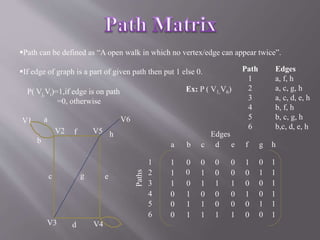
Path can be defined as “A open walk in which no vertex/edge can appear twice”. 
If edge of graph is a part of given path then put 1 else 0. Path 
V6 
V2 V5 
V4 
V3 
h 
f 
c e 
d 
V1 a 
b 
1 
2 
3 
4 
5 
6 
Edges 
a, f, h 
a, c, g, h 
a, c, d, e, h 
b, f, h 
b, c, g, h 
b,c, d, e, h 
P( Vj,Vi)=1,if edge is on path 
=0, otherwise 
Ex: P ( V1,V6) 
a b c d e f 
0 0 1 
0 0 0 
1 1 0 
1 0 0 
1 0 
1 
1 0 1 
0 1 0 0 0 1 
1 
2 
3 
4 
g h 
0 
1 
0 
0 
1 
1 
1 
1 
Edges 
Paths 
5 1 
0 0 0 
0 1 1 
0 1 1 1 1 0 
6 
0 
1 
1
 A graph, G, consist of two sets, V and E. 
 E is set of pairs of vertices called edges. V is a finite, nonempty 
set of vertices. 
 The vertices of a graph G can be represented as V(G). 
 Likewise, the edges of a graph, G, can be represented 
as E(G). 
 Graphs can be either undirected graphs or directed 
graphs. 
 For a undirected graph, a pair of vertices (u, v) or (v, u) 
represent the same edge. 
 For a directed graph, a directed pair <u, v> has u as the 
tail and the v as the head. Therefore, <u, v> and <v, u> 
represent different edges.
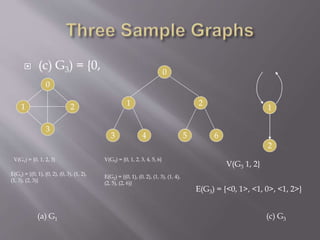
 (c) G3) = {0, 
0 
1 2 
3 
0 
1 
3 4 
2 
5 6 
1 
2 
V(G2) = {0, 1, 2, 3, 4, 5, 6} 
E(G2) = {(0, 1), (0, 2), (1, 3), (1, 4), 
(2, 5), (2, 6)} 
V(G1) = {0, 1, 2, 3} 
E(G1) = {(0, 1), (0, 2), (0, 3), (1, 2), 
(1, 3), (2, 3)} 
(a) G1 
(c) G3 
V(G3 1, 2} 
E(G3) = {<0, 1>, <1, 0>, <1, 2>}
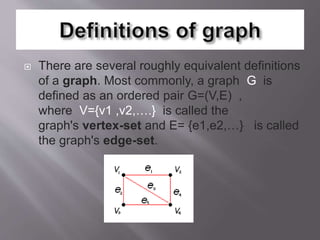
 There are several roughly equivalent definitions 
of a graph. Most commonly, a graph G is 
defined as an ordered pair G=(V,E) , 
where V={v1 ,v2,….} is called the 
graph's vertex-set and E= {e1,e2,…} is called 
the graph's edge-set.
 A graph may not have an edge from a vertex 
back to itself. 
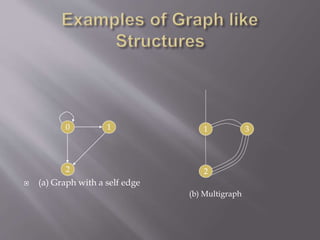
 (v, v) or <v, v> are called self edge or self loop. If a 
graph with self edges, it is called a graph with self 
edges. 
v1 A graph man not have multiple occurrences of 
the same edge. 
 If without this restriction, it is called a multigraph.
0 
2 
1 1 
 (a) Graph with a self edge 
2 
3 
(b) Multigraph
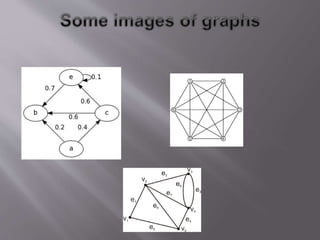
 Degree of a vertex: The degree of a vertex is the 
number of edges incident to that vertex. 
 If G is a directed graph, then we define 
 in-degree of a vertex: is the number of edges 
for which vertex is the head. 
 out-degree of a vertex: is the number of edges 
for which the vertex is the tail.
 Let G(V, E) be a graph with n vertices, n ≥ 1. The 
adjacency matrix of G is a two-dimensional nxn array, 
A. 
 A[i][j] = 1 iff the edge (i, j) is in E(G). 
 The adjacency matrix for a undirected graph is symmetric, it 
may not be the case for a directed graph. 
 For an undirected graph the degree of any vertex i is its 
row sum. 
 For a directed graph, the row sum is the out-degree 
and the column sum is the in-degree.
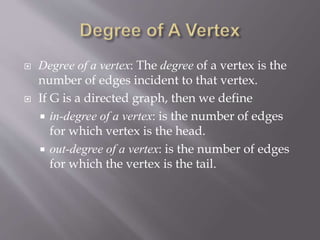
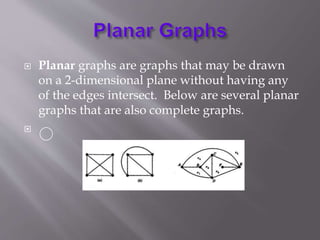
 Planar graphs are graphs that may be drawn 
on a 2-dimensional plane without having any 
of the edges intersect. Below are several planar 
graphs that are also complete graphs. 

Discrete maths assignment

Discrete maths assignment

  • 1.
    Presented By: KESHAVSOMANI BBA(E-COMM)IIISEM. ROLLNO.56417
  • 2.
  • 3.
    Graph is aset of edges and vertices. Graph can be represented in the form of matrix. Different matrix that can be formed are: 1. Incidence Matrix 2. Adjacency Matrix 3. Cut-Set Matrix 4. Circuit Matrix 5. Path Matrix
  • 4.
    Edge connected tothe vertex is known as incidence edge to that vertex. If vertex is incident on vertex then put 1 else 0. aij =1, if edge ej is incident on vertex vi V6 f =0, otherwise V2 V5 V4 V3 h c e d V1 a b a b c d e f 0 0 0 0 0 1 1 1 0 1 1 0 1 1 1 0 0 1 0 0 0 1 1 0 V1 V2 V3 V4 g h 0 0 0 0 1 0 1 0 Edges Vertex V5 1 1 1 1 0 0 0 0 0 0 0 0 0 V6 0 1 1 Vertex 1 2 3 4 5 6 Edges a, b a, b, c, f c, d, g d, e d, e, f, g, h h
  • 5.
     If twovertices are connected by single path than they are known as adjacent vertices.  If vertex is connected to itself then vertex is said to be adjacent to itself. If vertex is adjacent then put 1 else 0. V6 f V2 V5 V4 V3 h c e d V1 a b V1 V2 V3 V5 V6 0 0 0 0 1 0 1 1 0 1 1 0 1 0 1 0 0 1 0 1 0 1 0 1 0 1 0 0 0 1 0 1 1 0 0 0 V 4 V1 V2 V3 V4 V5 V6 Vertices Vertices
  • 6.
    Cut set isa “Set of edges in a graph whose removal leaves the graph disconnected”. If edge of graph is a part of given cut set then put 1 else 0. V6 V2 V5 V4 V3 h f c e d V1 a b a b c d e f 1 0 1 0 1 0 0 0 0 0 0 0 0 0 1 0 0 0 1 1 0 0 0 0 1 2 3 4 g h 1 1 0 0 0 0 1 0 Edges Cut Sets Cut Set 1 2 3 4 Edges f, g, d c, g, e h a, b Cij =1, if jth cutset contains edge =0, otherwise
  • 7.
    Circuit can bedefined as “A close walk in which no vertex/edge can appear twice”. If edge of graph is a part of given circuit then put 1 else 0. V6 V2 V5 V4 V3 h f c e d V1 a b a b c d e f 1 1 0 0 0 1 1 1 1 0 0 0 0 0 1 0 0 1 1 1 0 0 0 0 1 2 3 4 g h 1 1 0 0 0 0 0 0 Edges Circuits Circuit 1 2 3 4 Edges d, e, g c, f, g c, d, e, f a, b Cij =1, if circuit contains edge =0, otherwise
  • 8.
    Path can bedefined as “A open walk in which no vertex/edge can appear twice”. If edge of graph is a part of given path then put 1 else 0. Path V6 V2 V5 V4 V3 h f c e d V1 a b 1 2 3 4 5 6 Edges a, f, h a, c, g, h a, c, d, e, h b, f, h b, c, g, h b,c, d, e, h P( Vj,Vi)=1,if edge is on path =0, otherwise Ex: P ( V1,V6) a b c d e f 0 0 1 0 0 0 1 1 0 1 0 0 1 0 1 1 0 1 0 1 0 0 0 1 1 2 3 4 g h 0 1 0 0 1 1 1 1 Edges Paths 5 1 0 0 0 0 1 1 0 1 1 1 1 0 6 0 1 1
  • 10.
     A graph,G, consist of two sets, V and E.  E is set of pairs of vertices called edges. V is a finite, nonempty set of vertices.  The vertices of a graph G can be represented as V(G).  Likewise, the edges of a graph, G, can be represented as E(G).  Graphs can be either undirected graphs or directed graphs.  For a undirected graph, a pair of vertices (u, v) or (v, u) represent the same edge.  For a directed graph, a directed pair <u, v> has u as the tail and the v as the head. Therefore, <u, v> and <v, u> represent different edges.
  • 11.
     (c) G3)= {0, 0 1 2 3 0 1 3 4 2 5 6 1 2 V(G2) = {0, 1, 2, 3, 4, 5, 6} E(G2) = {(0, 1), (0, 2), (1, 3), (1, 4), (2, 5), (2, 6)} V(G1) = {0, 1, 2, 3} E(G1) = {(0, 1), (0, 2), (0, 3), (1, 2), (1, 3), (2, 3)} (a) G1 (c) G3 V(G3 1, 2} E(G3) = {<0, 1>, <1, 0>, <1, 2>}
  • 12.
     There areseveral roughly equivalent definitions of a graph. Most commonly, a graph G is defined as an ordered pair G=(V,E) , where V={v1 ,v2,….} is called the graph's vertex-set and E= {e1,e2,…} is called the graph's edge-set.
  • 13.
     A graphmay not have an edge from a vertex back to itself.  (v, v) or <v, v> are called self edge or self loop. If a graph with self edges, it is called a graph with self edges. v1 A graph man not have multiple occurrences of the same edge.  If without this restriction, it is called a multigraph.
  • 14.
    0 2 11  (a) Graph with a self edge 2 3 (b) Multigraph
  • 15.
     Degree ofa vertex: The degree of a vertex is the number of edges incident to that vertex.  If G is a directed graph, then we define  in-degree of a vertex: is the number of edges for which vertex is the head.  out-degree of a vertex: is the number of edges for which the vertex is the tail.
  • 16.
     Let G(V,E) be a graph with n vertices, n ≥ 1. The adjacency matrix of G is a two-dimensional nxn array, A.  A[i][j] = 1 iff the edge (i, j) is in E(G).  The adjacency matrix for a undirected graph is symmetric, it may not be the case for a directed graph.  For an undirected graph the degree of any vertex i is its row sum.  For a directed graph, the row sum is the out-degree and the column sum is the in-degree.
  • 17.
     Planar graphsare graphs that may be drawn on a 2-dimensional plane without having any of the edges intersect. Below are several planar graphs that are also complete graphs. 