Introduction to Wireless
Ad-Hoc Networks Routing
Michalis Faloutsos
Some slides borrowed
From Guor-Huar Lu
Outline
Challenges
Design Goals Specified by MANET (for now…)
Types of Routing
Protocols in Detail
Conclusion
Challenges
Dynamic Topologies
Bandwidth-constrained, variable capacity links
Energy-constrained
Limited Physical security
Scalability
Types of routing
Flat Proactive Routing
• Link state Fish-Eye Routing, GSR, OLSR.
• Table driven: Destination-Sequenced Distance Vector (DSDV), WRP)
On-Demand or Reactive Routing
• Ad hoc On-demand Distant Vector (AODV)
• Dynamic Source Routing (DSR)
Hybrid Schemes
• Zone Routing ZRP, SHARP (proactive near, reactive long distance)
• Safari (reactive near, proactive long distance)
Geographical Routing
Hierarchical: One or many levels of hierarchy
Routing with dynamic address
• Dynamic Address RouTing (DART)
Proactive Protocols
Proactive: maintain routing information
independently of need for communication
Update messages send throughout the network
periodically or when network topology changes.
Low latency, suitable for real-time traffic
Bandwidth might get wasted due to periodic
updates
They maintain O(N) state per node, N = #nodes
On-Demand or Reactive Routing
Reactive: discover route only when you need it
Saves energy and bandwidth during inactivity
Can be bursty -> congestion during high activity
Significant delay might occur as a result of route
discovery
Good for light loads, collapse in large loads
Hybrid Routing
Proactive for neighborhood, Reactive for far
away (Zone Routing Protocol, Haas group)
Proactive for long distance, Reactive for
neighborhood (Safari)
Attempts to strike balance between the two
Hierarchical Routing
Nodes are organized in clusters
Cluster head “controls” cluster
Trade off
• Overhead and confusion for leader election
• Scalability: intra-cluster vs intercluster
One or Multiple levels of hierarchy
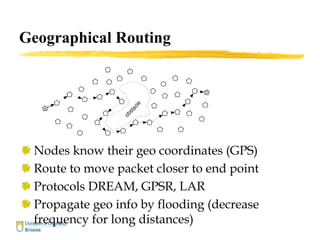
Geographical Routing
Nodes know their geo coordinates (GPS)
Route to move packet closer to end point
Protocols DREAM, GPSR, LAR
Propagate geo info by flooding (decrease
frequency for long distances)
Theoretical perspective
The capacity of a wireless
network is
Where N nodes, and C channel
capacity
Explanation: N nodes in the field
Destinations are random
On average N^0.5 hops per path
Each node has N^0.5 paths go through
Gupta Kumar paper
Mobility increases capacity
Grossglausser and Tse (infocom 2001)
Statement: if nodes move they will enentually carry the
info where you want
Protocol:
• sender send one copy to receiver or one neighbor
• Sender and relay will at some run into destination and send the
packet
All paths are at most two hops
They show that the capacity of the network does not go
to zero
Tradeoff?
Hierarchical routing: bounds
Cluster nodes, and route between and within clusters
Location management: finding where
Routing finding how to get there
Multiple levels: log(N) levels
Location Mgm: Each nodes stores O(N) locations
Routing overhead: O(log^3N)
Dominating factor: location management and not the
routing
Location mgmt handoff: O(log^2N)
See Susec Marsic, infocom 02
Types of routing
Flat Proactive Routing
• Link state Fish-Eye Routing, GSR, OLSR.
• Table driven: Destination-Sequenced Distance Vector (DSDV), WRP)
On-Demand or Reactive Routing
• Ad hoc On-demand Distant Vector (AODV)
• Dynamic Source Routing (DSR)
Hybrid Schemes
• Zone Routing ZRP, SHARP (proactive near, reactive long distance)
• Safari (reactive near, proactive long distance)
Geographical Routing
Hierarchical: One or many levels of hierarchy
Routing with dynamic address
• Dynamic Address RouTing (DART)
Proactive: DSDV - Destination-Sequenced
Distance Vector Algorithm
By Perkins and Bhagvat
Based on Bellman Ford algorithm
• Exchange of routing tables
• Routing table: the way to the destination, cost
Every node knows “where” everybody else is
• Thus routing table O(N)
Each node advertises its position
• Sequence number to avoid loops
• Maintain fresh routes
DSDV details
Routes are broadcasted from the “receiver”
• Nodes announce their presence: advertisements
Each broadcast has
• Destination address: originator
• No of hops
• Sequence number of broadcast
The route with the most recent sequence is used
Reactive: Ad-Hoc On-demand Distance
Vector Routing (AODV)
By Perkins and Royer
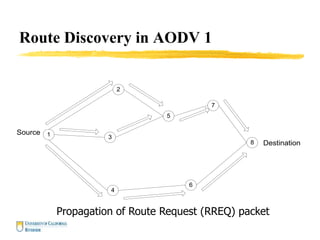
Sender tries to find destination:
• broadcasts a Route Request Packet (RREQ).
Nodes maintain route cache and use destination
sequence number for each route entry
State is installed at nodes per destination
Does nothing when connection between end points is
still valid
When route fails
• Local recovery
• Sender repeats a Route Discovery
Route Discovery in AODV 1
1
2
3
4
5
6
7
8
Source
Destination
Propagation of Route Request (RREQ) packet
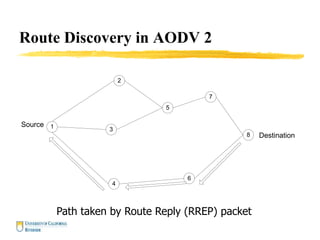
Route Discovery in AODV 2
1
2
3
4
5
6
7
8
Source
Destination
Path taken by Route Reply (RREP) packet
In case of broken links…
Node monitors the link status of next hop in
active routes
Route Error packets (RERR) is used to notify
other nodes if link is broken
Nodes remove corresponding route entry after
hearing RERR
Dynamic Source Routing (DSR)
Two mechanisms: Route Maintenance and Route
Discovery
Route Discovery mechanism is similar to the one
in AODV but with source routing instead
Nodes maintain route caches
Entries in route caches are updated as nodes
learn new routes.
Packet send carries complete, ordered list of
nodes through which packet will pass
When Sending Packets
Sender checks its route cache, if route exists,
sender constructs a source route in the packet’s
header
If route expires or does not exist, sender initiates
the Route Discovery Mechanism
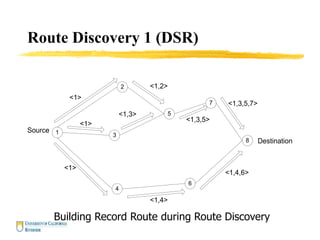
Route Discovery 1 (DSR)
1
2
3
4
5
6
7
8
<1>
<1,2>
<1,3,5>
<1,3,5,7>
<1,4,6>
<1,4>
<1>
<1>
<1,3>
Source
Destination
Building Record Route during Route Discovery
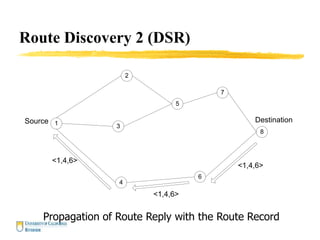
Route Discovery 2 (DSR)
1
2
3
4
5
6
7
8
<1,4,6>
<1,4,6>
<1,4,6>
Source Destination
Propagation of Route Reply with the Route Record
Route Maintenance
Two types of packets used: Route Error Packet and
Acknowledgement
If transmission error is detected at data link layer, Route
Error Packet is generated and send to the original sender
of the packet.
The node removes the hop is error from its route cache
when a Route Error packet is received
ACKs are used to verify the correction of the route links.
The Zone Routing Protocol (ZRP)
Hybrid Scheme
Proactively maintains routes within a local
region (routing zone)
Also a globally reactive route query/reply
mechanism available
Consists of 3 separate protocols
Protocols patented by Cornell University!
Intrazone Routing Protocol
Intrazone Routing Protocol (IARP) used to
proactively maintain routes in the zone.
Each node maintains its own routing zone
Neighbors are discovered by either MAC
protocols or Neighbor Discovery Protocol (NDP)
When global search is needed, route queries are
guided by IARP via bordercasting
Interzone Routing Protocol
Adapts existing reactive routing protocols
Route Query packet uniquely identified by
source’s address and request number.
Query relayed to a subset of neighbors by the
bordercast algorithm
Comparisons 1
Things in common:
• IP based operation
• Distributed operation
• Loop-free routing
• Very little or no support for sleep period operation
and security
Comparisons 2
FSR AODV DSR ZPR
Source
Routing
No No Yes No
Periodic
message
Yes No No Yes
(Locally)
Functioning
Proactively
Yes No No Yes
(Locally)
Functioning
Reactively
No Yes Yes Yes
(Globally)
DSDV
Conclusion
On-demand routing protocols (AODV and DSR)
are gaining momentum.
More analysis and features are needed
(Performance comparison between protocols,
QoS extension and analysis, multicast, security
issues etc…)
Good paper (though old):
A review of current routing protocols for ad-hoc
mobile wireless networks, E. Royer, C.K. Toh
Performance?
End-to-end data throughput and delay
Route acquisition time
Percentage of out-of-order delivery
Efficiency:
• Average number of data bits transmitted/data bits delivered
• Average number of control bits transmitted/data bits delivered
• Average number of control and data packets transmitted/data
packet delivered
Parameters
Network Size
Connectivity (average degree of a node)
Topology rate of change
Link capacity (bps)
Fraction of unidirectional links
Traffic patterns
Mobility
Fraction/frequency of sleeping nodes
References
Mobile Ad hoc Networking (MANET): Routing Protocol Performance
Issues and Evalution Considerations (RFC 2501)
P. Misra., “Routing Protocols for Ad Hoc Mobile Wireless Networks”,
http://www.cis.ohio-state.edu/~jain/cis788-99/adhoc_routing/
The Zone Routing Protocol (ZRP) for Ad Hoc Networks <draft-ietf-manet-
zone-zrp-04.txt>
Fisheye State Routing Protocol (FSR) for Ad Hoc Networks <draft-ietf-
manet-fsr-03.txt>
Ad hoc On-demand Distance Vector (AODV) Routing <draft-ietf-manet-
aodv-11.txt>
The Dynamic Source Routing Protocol for Mobile Ad Hoc Networks (DSR)
<draft-ietf-manet-dsr-07.txt>
Fisheye State Routing (FSR)
Node stores the Link State for every destination in the
network
Node periodically broadcast update messages to its
neighbors
Updates correspond to closer nodes propagate more
frequently
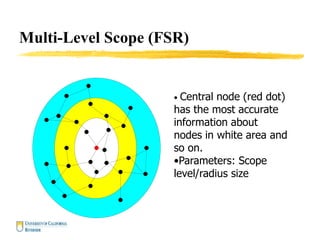
Multi-Level Scope (FSR)
• Central node (red dot)
has the most accurate
information about
nodes in white area and
so on.
•Parameters: Scope
level/radius size
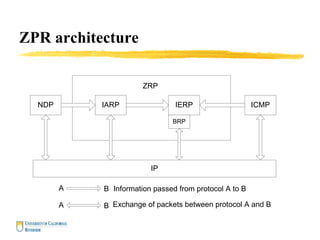
ZPR architecture
NDP IARP IERP ICMP
BRP
ZRP
IP
A B Information passed from protocol A to B
A B Exchange of packets between protocol A and B
Design Goals
Peer-to-peer mobile routing capability in mobile,
wireless domain.
Intra-domain unicast routing protocol:
• Effective operation over a wide range of mobile networking
scenarios and environments
• Supports traditional, connectionless IP services
• Efficiently manages topologies changes and traffic demands
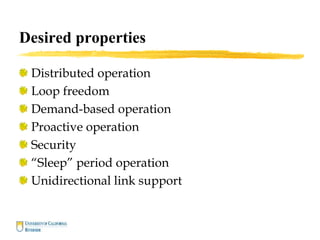
Desired properties
Distributed operation
Loop freedom
Demand-based operation
Proactive operation
Security
“Sleep” period operation
Unidirectional link support

introAdhocRoutingRoutingRoutingRouting-new.ppt

  • 1.
    Introduction to Wireless Ad-HocNetworks Routing Michalis Faloutsos Some slides borrowed From Guor-Huar Lu
  • 2.
    Outline Challenges Design Goals Specifiedby MANET (for now…) Types of Routing Protocols in Detail Conclusion
  • 3.
    Challenges Dynamic Topologies Bandwidth-constrained, variablecapacity links Energy-constrained Limited Physical security Scalability
  • 4.
    Types of routing FlatProactive Routing • Link state Fish-Eye Routing, GSR, OLSR. • Table driven: Destination-Sequenced Distance Vector (DSDV), WRP) On-Demand or Reactive Routing • Ad hoc On-demand Distant Vector (AODV) • Dynamic Source Routing (DSR) Hybrid Schemes • Zone Routing ZRP, SHARP (proactive near, reactive long distance) • Safari (reactive near, proactive long distance) Geographical Routing Hierarchical: One or many levels of hierarchy Routing with dynamic address • Dynamic Address RouTing (DART)
  • 5.
    Proactive Protocols Proactive: maintainrouting information independently of need for communication Update messages send throughout the network periodically or when network topology changes. Low latency, suitable for real-time traffic Bandwidth might get wasted due to periodic updates They maintain O(N) state per node, N = #nodes
  • 6.
    On-Demand or ReactiveRouting Reactive: discover route only when you need it Saves energy and bandwidth during inactivity Can be bursty -> congestion during high activity Significant delay might occur as a result of route discovery Good for light loads, collapse in large loads
  • 7.
    Hybrid Routing Proactive forneighborhood, Reactive for far away (Zone Routing Protocol, Haas group) Proactive for long distance, Reactive for neighborhood (Safari) Attempts to strike balance between the two
  • 8.
    Hierarchical Routing Nodes areorganized in clusters Cluster head “controls” cluster Trade off • Overhead and confusion for leader election • Scalability: intra-cluster vs intercluster One or Multiple levels of hierarchy
  • 9.
    Geographical Routing Nodes knowtheir geo coordinates (GPS) Route to move packet closer to end point Protocols DREAM, GPSR, LAR Propagate geo info by flooding (decrease frequency for long distances)
  • 10.
    Theoretical perspective The capacityof a wireless network is Where N nodes, and C channel capacity Explanation: N nodes in the field Destinations are random On average N^0.5 hops per path Each node has N^0.5 paths go through Gupta Kumar paper
  • 11.
    Mobility increases capacity Grossglausserand Tse (infocom 2001) Statement: if nodes move they will enentually carry the info where you want Protocol: • sender send one copy to receiver or one neighbor • Sender and relay will at some run into destination and send the packet All paths are at most two hops They show that the capacity of the network does not go to zero Tradeoff?
  • 12.
    Hierarchical routing: bounds Clusternodes, and route between and within clusters Location management: finding where Routing finding how to get there Multiple levels: log(N) levels Location Mgm: Each nodes stores O(N) locations Routing overhead: O(log^3N) Dominating factor: location management and not the routing Location mgmt handoff: O(log^2N) See Susec Marsic, infocom 02
  • 14.
    Types of routing FlatProactive Routing • Link state Fish-Eye Routing, GSR, OLSR. • Table driven: Destination-Sequenced Distance Vector (DSDV), WRP) On-Demand or Reactive Routing • Ad hoc On-demand Distant Vector (AODV) • Dynamic Source Routing (DSR) Hybrid Schemes • Zone Routing ZRP, SHARP (proactive near, reactive long distance) • Safari (reactive near, proactive long distance) Geographical Routing Hierarchical: One or many levels of hierarchy Routing with dynamic address • Dynamic Address RouTing (DART)
  • 15.
    Proactive: DSDV -Destination-Sequenced Distance Vector Algorithm By Perkins and Bhagvat Based on Bellman Ford algorithm • Exchange of routing tables • Routing table: the way to the destination, cost Every node knows “where” everybody else is • Thus routing table O(N) Each node advertises its position • Sequence number to avoid loops • Maintain fresh routes
  • 16.
    DSDV details Routes arebroadcasted from the “receiver” • Nodes announce their presence: advertisements Each broadcast has • Destination address: originator • No of hops • Sequence number of broadcast The route with the most recent sequence is used
  • 17.
    Reactive: Ad-Hoc On-demandDistance Vector Routing (AODV) By Perkins and Royer Sender tries to find destination: • broadcasts a Route Request Packet (RREQ). Nodes maintain route cache and use destination sequence number for each route entry State is installed at nodes per destination Does nothing when connection between end points is still valid When route fails • Local recovery • Sender repeats a Route Discovery
  • 18.
    Route Discovery inAODV 1 1 2 3 4 5 6 7 8 Source Destination Propagation of Route Request (RREQ) packet
  • 19.
    Route Discovery inAODV 2 1 2 3 4 5 6 7 8 Source Destination Path taken by Route Reply (RREP) packet
  • 20.
    In case ofbroken links… Node monitors the link status of next hop in active routes Route Error packets (RERR) is used to notify other nodes if link is broken Nodes remove corresponding route entry after hearing RERR
  • 21.
    Dynamic Source Routing(DSR) Two mechanisms: Route Maintenance and Route Discovery Route Discovery mechanism is similar to the one in AODV but with source routing instead Nodes maintain route caches Entries in route caches are updated as nodes learn new routes. Packet send carries complete, ordered list of nodes through which packet will pass
  • 22.
    When Sending Packets Senderchecks its route cache, if route exists, sender constructs a source route in the packet’s header If route expires or does not exist, sender initiates the Route Discovery Mechanism
  • 23.
    Route Discovery 1(DSR) 1 2 3 4 5 6 7 8 <1> <1,2> <1,3,5> <1,3,5,7> <1,4,6> <1,4> <1> <1> <1,3> Source Destination Building Record Route during Route Discovery
  • 24.
    Route Discovery 2(DSR) 1 2 3 4 5 6 7 8 <1,4,6> <1,4,6> <1,4,6> Source Destination Propagation of Route Reply with the Route Record
  • 25.
    Route Maintenance Two typesof packets used: Route Error Packet and Acknowledgement If transmission error is detected at data link layer, Route Error Packet is generated and send to the original sender of the packet. The node removes the hop is error from its route cache when a Route Error packet is received ACKs are used to verify the correction of the route links.
  • 26.
    The Zone RoutingProtocol (ZRP) Hybrid Scheme Proactively maintains routes within a local region (routing zone) Also a globally reactive route query/reply mechanism available Consists of 3 separate protocols Protocols patented by Cornell University!
  • 27.
    Intrazone Routing Protocol IntrazoneRouting Protocol (IARP) used to proactively maintain routes in the zone. Each node maintains its own routing zone Neighbors are discovered by either MAC protocols or Neighbor Discovery Protocol (NDP) When global search is needed, route queries are guided by IARP via bordercasting
  • 28.
    Interzone Routing Protocol Adaptsexisting reactive routing protocols Route Query packet uniquely identified by source’s address and request number. Query relayed to a subset of neighbors by the bordercast algorithm
  • 29.
    Comparisons 1 Things incommon: • IP based operation • Distributed operation • Loop-free routing • Very little or no support for sleep period operation and security
  • 30.
    Comparisons 2 FSR AODVDSR ZPR Source Routing No No Yes No Periodic message Yes No No Yes (Locally) Functioning Proactively Yes No No Yes (Locally) Functioning Reactively No Yes Yes Yes (Globally) DSDV
  • 31.
    Conclusion On-demand routing protocols(AODV and DSR) are gaining momentum. More analysis and features are needed (Performance comparison between protocols, QoS extension and analysis, multicast, security issues etc…) Good paper (though old): A review of current routing protocols for ad-hoc mobile wireless networks, E. Royer, C.K. Toh
  • 33.
    Performance? End-to-end data throughputand delay Route acquisition time Percentage of out-of-order delivery Efficiency: • Average number of data bits transmitted/data bits delivered • Average number of control bits transmitted/data bits delivered • Average number of control and data packets transmitted/data packet delivered
  • 34.
    Parameters Network Size Connectivity (averagedegree of a node) Topology rate of change Link capacity (bps) Fraction of unidirectional links Traffic patterns Mobility Fraction/frequency of sleeping nodes
  • 35.
    References Mobile Ad hocNetworking (MANET): Routing Protocol Performance Issues and Evalution Considerations (RFC 2501) P. Misra., “Routing Protocols for Ad Hoc Mobile Wireless Networks”, http://www.cis.ohio-state.edu/~jain/cis788-99/adhoc_routing/ The Zone Routing Protocol (ZRP) for Ad Hoc Networks <draft-ietf-manet- zone-zrp-04.txt> Fisheye State Routing Protocol (FSR) for Ad Hoc Networks <draft-ietf- manet-fsr-03.txt> Ad hoc On-demand Distance Vector (AODV) Routing <draft-ietf-manet- aodv-11.txt> The Dynamic Source Routing Protocol for Mobile Ad Hoc Networks (DSR) <draft-ietf-manet-dsr-07.txt>
  • 36.
    Fisheye State Routing(FSR) Node stores the Link State for every destination in the network Node periodically broadcast update messages to its neighbors Updates correspond to closer nodes propagate more frequently
  • 37.
    Multi-Level Scope (FSR) •Central node (red dot) has the most accurate information about nodes in white area and so on. •Parameters: Scope level/radius size
  • 38.
    ZPR architecture NDP IARPIERP ICMP BRP ZRP IP A B Information passed from protocol A to B A B Exchange of packets between protocol A and B
  • 39.
    Design Goals Peer-to-peer mobilerouting capability in mobile, wireless domain. Intra-domain unicast routing protocol: • Effective operation over a wide range of mobile networking scenarios and environments • Supports traditional, connectionless IP services • Efficiently manages topologies changes and traffic demands
  • 40.
    Desired properties Distributed operation Loopfreedom Demand-based operation Proactive operation Security “Sleep” period operation Unidirectional link support