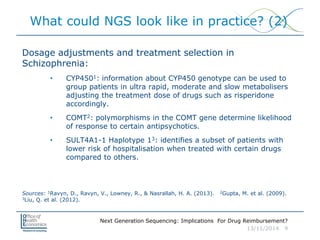
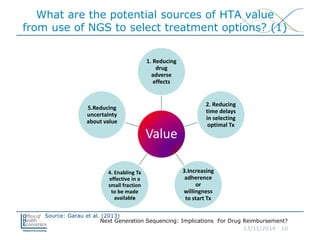
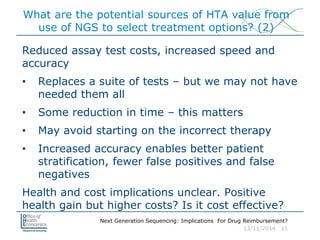
![Next Generation Sequencing: Implications For Drug Reimbursement?
13/11/2014 13
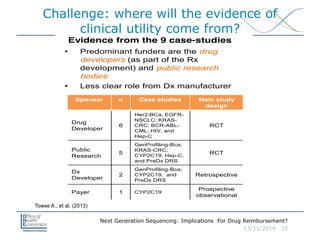
Table 1. Sources of clinical utility evidence for decision-making in the nine case studies.
Marker Main Study Design
Study size
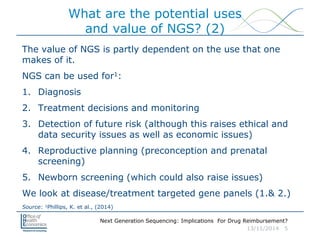
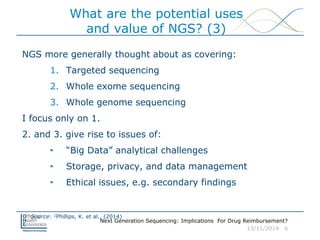
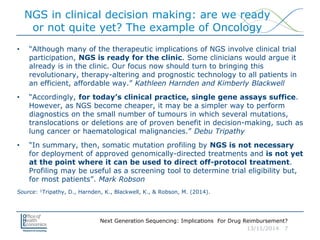
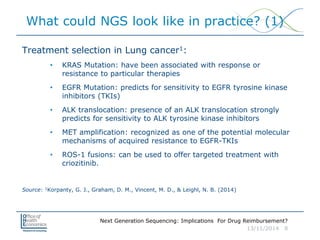
(patient numbers)
Sponsor Decision-making Impact
Breast cancer recurrence
(a) Oncotype DX®
and (b)
MammaPrint®
(Prognostic/predictive in BrCa)
Retrospective RCT
cohorts
RCTs
(a) 688 [4] +651 [5] +895 [6]
(b) Prognostic: 117 [9] +295
[10] +307 [11]
+123 [12] ,
Predictive: 241 [13]
(a) 11248 [7]
(b) 6600 [14]
Diagnostic
manufacturer
Public research body
Public research
bodies
Generating clinical utility can yield
inclusion in clinical guidelines and
positive reimbursement decisions at a
favourable price for test developers.
HER2
(Trastuzumab in metastatic and
early stage BrCa)
RCTs
469 [16]
3676 [19]
Drug developer
Drug developer
Positive reimbursement decision for
drug-diagnostic in a specific
subpopulation based on health gains and
cost-effectiveness.
EGFR mutations
(1st line TKI treatment in
NSCLC)
RCTs
RCTs
1217 [25]
165 [26]
173 [27]
Drug developer
Drug developer
Drug rescued because of a predictive, ex
post companion diagnostic.
Obtained first line indication
KRAS mutations
(Anti-EGFR monoclonal
antibodies in CRC)
Retrospective cohort
analysis of an RCT
1198 [39]
Drug developer and
Public research body
Decision-makers are willing to consider
evidence generated ex post as sufficient to
change recommended treatment protocols.
BCR-ABL transcript
(TKI treatment in CML)
RCT 1106 [42] Drug developer
Actionable, clinical information allowed
for full incorporation into clinical
guidelines; however, issues with inter-
and intra-laboratory variability may
impact patient management thus health
outcomes.](https://image.slidesharecdn.com/nextgenerationsequencingaktnov14-141222033304-conversion-gate02/85/Next_generation_sequencing_AKT_Nov14-13-320.jpg)
![Next Generation Sequencing: Implications For Drug Reimbursement?
13/11/2014 14
Table 1. Cont.
Marker Main Study Design
Study size
(patient numbers)
Sponsor Decision-making Impact
CYP2C19
(Clopidogrel in ACS)
Retrospective RCT
cohort+Healthy
volunteers
Prospective cohort study
Proof-of concept RCT
1477+162 [52]
4471 [57] (Terminated early)
187 [58]
Public research body
Payer
Diagnostic
manufacturer
The clinically significant and validated
predictive effect would allow for health
care efficiencies in the treatment of ACS.
New POC test could improve
implementation in clinical practice.
HLA-B*5701
(ABC in HIV)
Retrospective case
control
RCT
408 [59]
1956 [59]
Drug developer
Drug developer
Prospective screening for first-line
treatment is cost-effective in specific
sub-populations. Treatment guidelines
recommend abacavir only if patients have
tested negative for HLA-B*5701.
Viral load
(Pegylated interferon and
ribavirin in hepatitis C)
Retrospective analyses of
RCT data
1016 [61]
260 [62]
Drug developer
Public research body
Testing becomes fundamental for
predicting treatment outcome, reducing
treatment side-effects and avoiding futile
treatment and subsequent costs in non-
responding patients.
PreDx® DRS
(Risk in Type 2 diabetes)
Retrospective analysis of
a sub-cohort of a lifestyle
interventional trial
6784 [67,68]
Assay developer (trial
funded by a public
research body)
Although the score has been proven
significantly better than other available
methods and similar to the gold standard,
uptake has been very limited. Data may
not be generalisable to the whole
population, and payers may not want to
cover the test in addition to fasting
glucose testing.](https://image.slidesharecdn.com/nextgenerationsequencingaktnov14-141222033304-conversion-gate02/85/Next_generation_sequencing_AKT_Nov14-14-320.jpg)
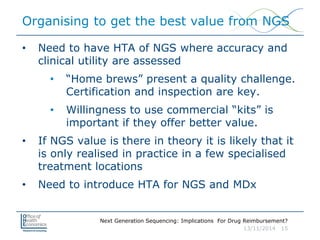
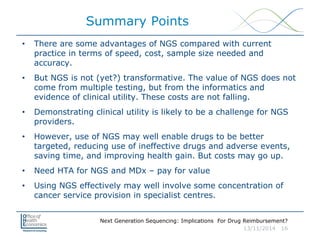

The document discusses the implications of next generation sequencing (NGS) on drug reimbursement, highlighting its advantages over traditional sequencing methods, such as speed, cost, and accuracy, while also raising concerns about the current clinical utility evidence. It addresses the potential uses of NGS in oncology and other medical fields, emphasizing the need for health technology assessment (HTA) to ensure its effective integration into clinical practice. Challenges exist in demonstrating clinical utility and managing costs, as effective use of NGS may be confined to specialized treatment centers.


