TOTAL PHYSICAL
RESPONSE
(TPR)
By : fitria arum sholikhah
BACKGROUD
 Total Physical Response (TPR) is a language teaching
method built around the coordination of speech and
action; it attempts to teach language through physical
(motor) activity. Developed by James Asher, a
professor of psychology at San Jose State University,
California, it draws on several traditions, including
developmental psychology, learning the-ory, and
humanistic pedagogy, as well as on language teaching
proce-dures proposed by Harold and Dorothy Palmer
in 1925. Let us briefly consider these precedents to
Total Physical Response.
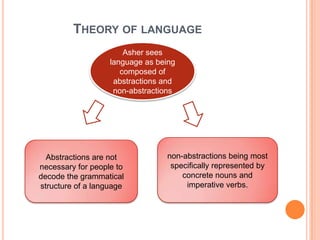
THEORY OF LANGUAGE
Asher sees
language as being
composed of
abstractions and
non-abstractions
Abstractions are not
necessary for people to
decode the grammatical
structure of a language
non-abstractions being most
specifically represented by
concrete nouns and
imperative verbs.
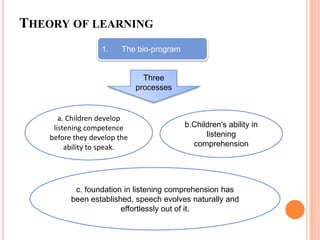
THEORY OF LEARNING
1. The bio-program
a. Children develop
listening competence
before they develop the
ability to speak.
Three
processes
b.Children's ability in
listening
comprehension
c. foundation in listening comprehension has
been established, speech evolves naturally and
effortlessly out of it.
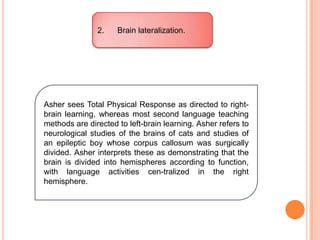
2. Brain lateralization.
Asher sees Total Physical Response as directed to right-
brain learning, whereas most second language teaching
methods are directed to left-brain learning. Asher refers to
neurological studies of the brains of cats and studies of
an epileptic boy whose corpus callosum was surgically
divided. Asher interprets these as demonstrating that the
brain is divided into hemispheres according to function,
with language activities cen-tralized in the right
hemisphere.
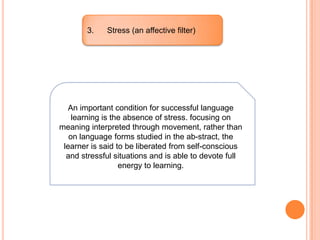
3. Stress (an affective filter)
An important condition for successful language
learning is the absence of stress. focusing on
meaning interpreted through movement, rather than
on language forms studied in the ab-stract, the
learner is said to be liberated from self-conscious
and stressful situations and is able to devote full
energy to learning.
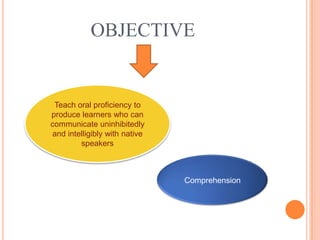
OBJECTIVE
Comprehension
Teach oral proficiency to
produce learners who can
communicate uninhibitedly
and intelligibly with native
speakers
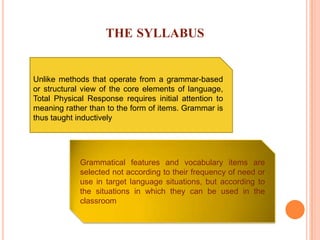
THE SYLLABUS
Unlike methods that operate from a grammar-based
or structural view of the core elements of language,
Total Physical Response requires initial attention to
meaning rather than to the form of items. Grammar is
thus taught inductively
Grammatical features and vocabulary items are
selected not according to their frequency of need or
use in target language situations, but according to
the situations in which they can be used in the
classroom
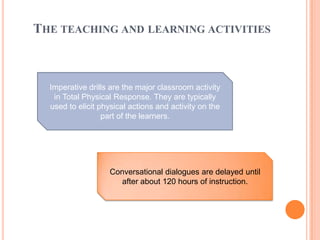
THE TEACHING AND LEARNING ACTIVITIES
Imperative drills are the major classroom activity
in Total Physical Response. They are typically
used to elicit physical actions and activity on the
part of the learners.
Conversational dialogues are delayed until
after about 120 hours of instruction.
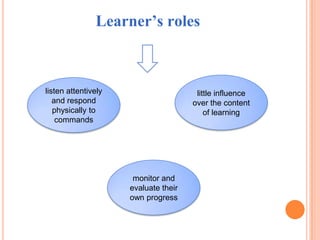
Learner’s roles
listen attentively
and respond
physically to
commands
monitor and
evaluate their
own progress
little influence
over the content
of learning
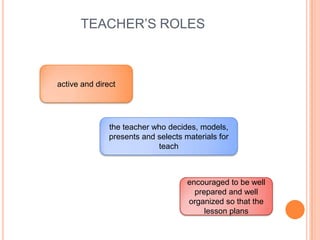
TEACHER’S ROLES
the teacher who decides, models,
presents and selects materials for
teach
active and direct
encouraged to be well
prepared and well
organized so that the
lesson plans
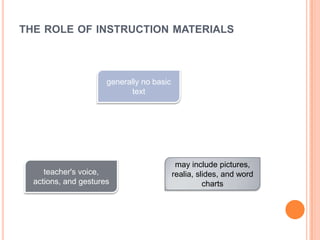
THE ROLE OF INSTRUCTION MATERIALS
generally no basic
text
may include pictures,
realia, slides, and word
charts
teacher's voice,
actions, and gestures
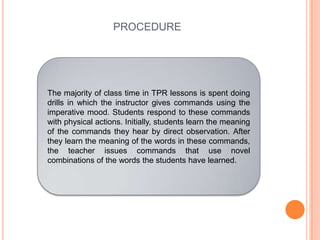
PROCEDURE
The majority of class time in TPR lessons is spent doing
drills in which the instructor gives commands using the
imperative mood. Students respond to these commands
with physical actions. Initially, students learn the meaning
of the commands they hear by direct observation. After
they learn the meaning of the words in these commands,
the teacher issues commands that use novel
combinations of the words the students have learned.
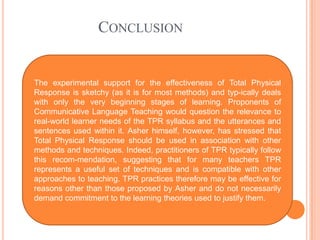
CONCLUSION
The experimental support for the effectiveness of Total Physical
Response is sketchy (as it is for most methods) and typ-ically deals
with only the very beginning stages of learning. Proponents of
Communicative Language Teaching would question the relevance to
real-world learner needs of the TPR syllabus and the utterances and
sentences used within it. Asher himself, however, has stressed that
Total Physical Response should be used in association with other
methods and techniques. Indeed, practitioners of TPR typically follow
this recom-mendation, suggesting that for many teachers TPR
represents a useful set of techniques and is compatible with other
approaches to teaching. TPR practices therefore may be effective for
reasons other than those proposed by Asher and do not necessarily
demand commitment to the learning theories used to justify them.

Me tpr

  • 1.
  • 2.
    BACKGROUD  Total PhysicalResponse (TPR) is a language teaching method built around the coordination of speech and action; it attempts to teach language through physical (motor) activity. Developed by James Asher, a professor of psychology at San Jose State University, California, it draws on several traditions, including developmental psychology, learning the-ory, and humanistic pedagogy, as well as on language teaching proce-dures proposed by Harold and Dorothy Palmer in 1925. Let us briefly consider these precedents to Total Physical Response.
  • 3.
    THEORY OF LANGUAGE Ashersees language as being composed of abstractions and non-abstractions Abstractions are not necessary for people to decode the grammatical structure of a language non-abstractions being most specifically represented by concrete nouns and imperative verbs.
  • 4.
    THEORY OF LEARNING 1.The bio-program a. Children develop listening competence before they develop the ability to speak. Three processes b.Children's ability in listening comprehension c. foundation in listening comprehension has been established, speech evolves naturally and effortlessly out of it.
  • 5.
    2. Brain lateralization. Ashersees Total Physical Response as directed to right- brain learning, whereas most second language teaching methods are directed to left-brain learning. Asher refers to neurological studies of the brains of cats and studies of an epileptic boy whose corpus callosum was surgically divided. Asher interprets these as demonstrating that the brain is divided into hemispheres according to function, with language activities cen-tralized in the right hemisphere.
  • 6.
    3. Stress (anaffective filter) An important condition for successful language learning is the absence of stress. focusing on meaning interpreted through movement, rather than on language forms studied in the ab-stract, the learner is said to be liberated from self-conscious and stressful situations and is able to devote full energy to learning.
  • 7.
    OBJECTIVE Comprehension Teach oral proficiencyto produce learners who can communicate uninhibitedly and intelligibly with native speakers
  • 8.
    THE SYLLABUS Unlike methodsthat operate from a grammar-based or structural view of the core elements of language, Total Physical Response requires initial attention to meaning rather than to the form of items. Grammar is thus taught inductively Grammatical features and vocabulary items are selected not according to their frequency of need or use in target language situations, but according to the situations in which they can be used in the classroom
  • 9.
    THE TEACHING ANDLEARNING ACTIVITIES Imperative drills are the major classroom activity in Total Physical Response. They are typically used to elicit physical actions and activity on the part of the learners. Conversational dialogues are delayed until after about 120 hours of instruction.
  • 10.
    Learner’s roles listen attentively andrespond physically to commands monitor and evaluate their own progress little influence over the content of learning
  • 11.
    TEACHER’S ROLES the teacherwho decides, models, presents and selects materials for teach active and direct encouraged to be well prepared and well organized so that the lesson plans
  • 12.
    THE ROLE OFINSTRUCTION MATERIALS generally no basic text may include pictures, realia, slides, and word charts teacher's voice, actions, and gestures
  • 13.
    PROCEDURE The majority ofclass time in TPR lessons is spent doing drills in which the instructor gives commands using the imperative mood. Students respond to these commands with physical actions. Initially, students learn the meaning of the commands they hear by direct observation. After they learn the meaning of the words in these commands, the teacher issues commands that use novel combinations of the words the students have learned.
  • 14.
    CONCLUSION The experimental supportfor the effectiveness of Total Physical Response is sketchy (as it is for most methods) and typ-ically deals with only the very beginning stages of learning. Proponents of Communicative Language Teaching would question the relevance to real-world learner needs of the TPR syllabus and the utterances and sentences used within it. Asher himself, however, has stressed that Total Physical Response should be used in association with other methods and techniques. Indeed, practitioners of TPR typically follow this recom-mendation, suggesting that for many teachers TPR represents a useful set of techniques and is compatible with other approaches to teaching. TPR practices therefore may be effective for reasons other than those proposed by Asher and do not necessarily demand commitment to the learning theories used to justify them.