John Read
University of Auckland
1
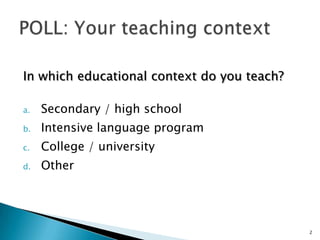
In which educational context do you teach?
a. Secondary / high school
b. Intensive language program
c. College / university
d. Other
2
Which is the main language you teach?
a. English / EFL
b. Another major European language (Spanish,
French, German …)
c. A less commonly taught language (LCTL)
d. Other
3
 To place learners at the appropriate level in a
language teaching programme.
 To assess learners’ progress in vocabulary learning
in a particular course.
 To help plan a vocabulary teaching/learning
programme.
 To evaluate how adequate the learners’ word
knowledge is for a specific purpose.
 To gain a greater understanding of vocabulary
learning processes.
In your teaching context, what role(s) do
vocabulary tests play (if any)?
a. Placement of students in classes
b. Planning vocabulary teaching
c. Assessing progress in vocabulary learning
d. Measuring end of course achievement
e. Other
5
 Words presented in the course textbook
 Words specified in a syllabus or curriculum
 Words from a frequency list
◦ General frequency in the language
◦ Frequency in a particular domain e.g. academic
language
6
7
(Schmitt & Schmitt, forthcoming)
 High-frequency vocabulary
 Mid-frequency vocabulary
 Low-frequency vocabulary
 Academic vocabulary
 Technical vocabulary
(see Webinar handout for definitions and word lists)
3,000 9,000
High-frequency Mid-frequency Low-frequency
vocabulary vocabulary vocabulary
The form - meaning link
This L2 word means ‘[L1 equivalent]’
English Spanish
(a) house (una) casa
colorful colorido
to swim nadar
8
 Linking L2 forms with (L1) meanings is the
most basic element of vocabulary learning.
 Using effective mnemonic techniques, it is an
effective way to build a core L2 vocabulary.
 It provides the basis for measuring
vocabulary size (also called ‘breadth’ of
knowledge).
9
 Tests that are used for placement, diagnostic,
proficiency and research purposes.
 Based on a sample of words from a relevant
word frequency list (see handout for details).
 Knowledge of the sampled words is measured
by a simple item type.
 The test score is converted into an estimate
of vocabulary size.
10
 Yes/No
◦ Learners simply report whether know the meaning
of each word or not; a percentage of the items are
non-words
 Matching
◦ Learners match each word with its definition/
synonym/L1 equivalent
 Multiple-choice
◦ Learners select the correct word/definition from the
four options given
11
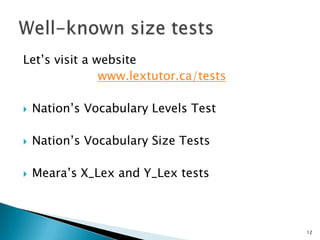
Let’s visit a website
www.lextutor.ca/tests
 Nation’s Vocabulary Levels Test
 Nation’s Vocabulary Size Tests
 Meara’s X_Lex and Y_Lex tests
12
Time to answer some of your questions
from the Chat window
13
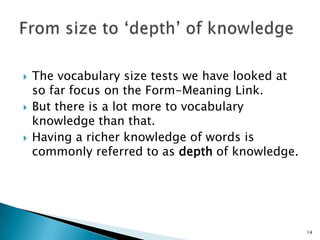
 The vocabulary size tests we have looked at
so far focus on the Form-Meaning Link.
 But there is a lot more to vocabulary
knowledge than that.
 Having a richer knowledge of words is
commonly referred to as depth of knowledge.
14
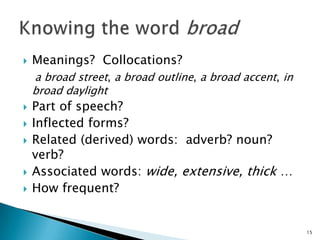
 Meanings? Collocations?
a broad street, a broad outline, a broad accent, in
broad daylight
 Part of speech?
 Inflected forms?
 Related (derived) words: adverb? noun?
verb?
 Associated words: wide, extensive, thick …
 How frequent?
15
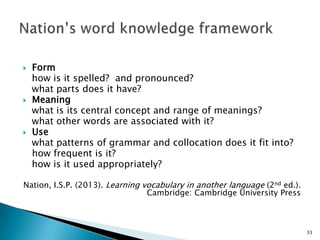
 Form
how is it spelled? and pronounced?
what parts does it have?
 Meaning
what is its central concept and range of meanings?
what other words are associated with it?
 Use
what patterns of grammar and collocation does it fit into?
how frequent is it?
how is it used appropriately?
[See Webinar handout for the full table]
Nation, I.S.P. (2013). Learning vocabulary in another language (2nd ed.).
Cambridge: Cambridge University Press
16
Depth of knowledge has much in common with
rich vocabulary instruction, which involves
◦ Selecting useful, high-frequency words
◦ Communicating the meaning(s) of each word in an
accessible way
◦ Giving opportunities to hear the word and practise its
spoken form
◦ Giving repeated exposure to the word in different
contexts over time
◦ Providing information on the form, meaning and use of
the word
◦ Giving opportunities to use the word productively in
speech and writing
17
For both engaging in rich instruction and
assessing depth of knowledge, there are
common challenges:
◦ There are so many words for students to learn.
◦ Each word involves multiple aspects of vocabulary
knowledge.
◦ A lot of time is required for teaching and assessing
the words.
◦ There may be other more effective ways to promote
and monitor vocabulary acquisition.
(based on Nation, 2013, pp. 92-93)
18
1. Precision of meaning
How well learners know the specific meaning(s) of a word
2. Network knowledge
How well learners can relate a word to other words they
know
3. Comprehensive word knowledge
How much learners know about the form, meaning and use
of a word
(Read, 2004)
19
How well learners know the specific
meaning of a word
20
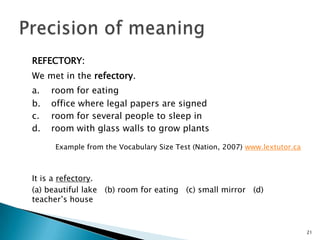
REFECTORY:
We met in the refectory.
a. room for eating
b. office where legal papers are signed
c. room for several people to sleep in
d. room with glass walls to grow plants
Example from the Vocabulary Size Test (Nation, 2007) www.lextutor.ca
It is a refectory.
(a) beautiful lake (b) room for eating (c) small mirror (d)
teacher’s house
21
Developed by Sima Paribakht and Mari Wesche at the
University of Ottawa, Canada for research on
◦ vocabulary learning in the context of academic
reading activities
◦ the ability to infer the meaning of unknown words.
Wesche, M., & Paribakht, T.S. (1996). Assessing second language
vocabulary knowledge: Depth vs. breadth.
Canadian Modern Language Review, 53, 13-39.
22
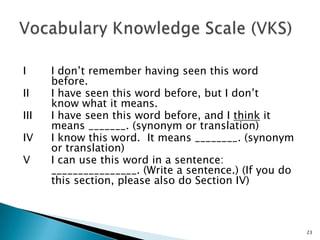
I I don’t remember having seen this word
before.
II I have seen this word before, but I don’t
know what it means.
III I have seen this word before, and I think it
means _______. (synonym or translation)
IV I know this word. It means ________. (synonym
or translation)
V I can use this word in a sentence:
________________. (Write a sentence.) (If you do
this section, please also do Section IV)
23
 It is a combination of a self-rating task (Steps I-IV)
and a kind of test (Steps III-V).
 Step V goes beyond meaning to draw on various
other kinds of word knowledge.
 In addition, Step V may not provide good evidence
that the meaning of the word is known.
 The scale does not allow for a word having more
than one meaning (or for homonyms).
24
How well learners can relate a word to
other words they know
25
cooperative
attitude cautious growing helpful humour joint
dynamic
active excitement greedy leader meeting serious
Read, J. (1993). The development of a new measure of L2 vocabulary
knowledge. Language Testing, 10, 355-371.
26
 edit
arithmetic film pole publishing
revise risk surface text
 paradigmatic: the two words are synonyms or similar in
meaning, and belong to the same word class e.g. ‘edit’ & ‘revise’.
 syntagmatic: the two words could occur one after the other, as
a collocation, e.g., ‘edit’ & ‘text’.
 analytic: the associate represents one aspect of the meaning of
the target word and is likely to form part of its dictionary
definition, e.g., ‘edit’ & ‘publishing’.
27
 edit
arithmetic film pole publishing
revise risk surface text
 conscious
Read, J.(1998). Validating a test to measure depth of vocabulary
knowledge. In A. Kunnan (Ed.), Validation in language assessment,
Mahwah, NJ: Lawrence Erlbaum.
awake healthy knowing laughing face decision effort student
28
 University learners in New Zealand, Canada, the UK
and Japan
 TOEFL test-takers in Canada
 Advanced learners of French in Dutch universities
 Dutch elementary school students in the
Netherlands
(see Read, 2012)
29
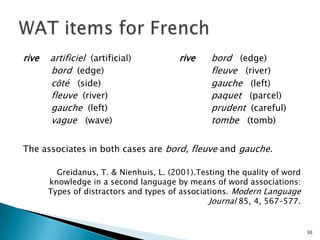
rive artificiel (artificial) rive bord (edge)
bord (edge) fleuve (river)
cȏté (side) gauche (left)
fleuve (river) paquet (parcel)
gauche (left) prudent (careful)
vague (wave) tombe (tomb)
The associates in both cases are bord, fleuve and gauche.
Greidanus, T. & Nienhuis, L. (2001).Testing the quality of word
knowledge in a second language by means of word associations:
Types of distractors and types of associations. Modern Language
Journal 85, 4, 567–577.
30
 It is important to orient the test takers in advance
to the nature of the task.
 Generally WA tests are reliable overall.
 The test takers’ willingness to guess is a significant
factor in their performance.
 Semantically related distractors make the test more
difficult.
 Syntagmatic associates are generally more difficult
than paradigmatic ones.
31
How much learners know about the
form, meaning and use of a word
32
 Form
how is it spelled? and pronounced?
what parts does it have?
 Meaning
what is its central concept and range of meanings?
what other words are associated with it?
 Use
what patterns of grammar and collocation does it fit into?
how frequent is it?
how is it used appropriately?
Nation, I.S.P. (2013). Learning vocabulary in another language (2nd ed.).
Cambridge: Cambridge University Press
33
34
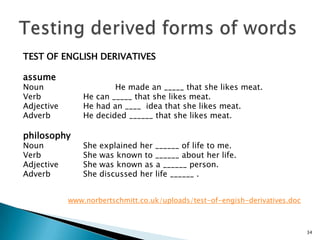
TEST OF ENGLISH DERIVATIVES
assume
Noun He made an _____ that she likes meat.
Verb He can _____ that she likes meat.
Adjective He had an ____ idea that she likes meat.
Adverb He decided ______ that she likes meat.
philosophy
Noun She explained her ______ of life to me.
Verb She was known to ______ about her life.
Adjective She was known as a ______ person.
Adverb She discussed her life ______ .
www.norbertschmitt.co.uk/uploads/test-of-engish-derivatives.doc
35
Write one word from the list below in each blank. Make sure
that you write the word in its correct grammatical form.
In almost all developing countries, the lack of ______
supplies of cheap, convenient and ______ fuel is a ______
problem. Rural ______ depend on kerosene, wood and
dung for their cooking and lighting needs. But
kerosene is now too ______ for many people and, except
in heavily forested ______, wood is in short supply. The
search for firewood ______ a large part of the working
day and has resulted in ______ deforestation.
adequate / area / community / expensive / major / occupy /
positive / quantity / reliable / widespread
36
Write a sentence for each of the following words to
show that you know what the word means and how
it is used.
 starve
_________________________________________
 principal
_________________________________________
 twist
_________________________________________
 vegetation
_________________________________________
DISCO: Discriminating Collocations Test
(Eyckmans, 2009)
 Tick the two phrases that are the correct idioms in English:
◦ seek advice
◦ express charges
◦ pay attention
Barfield, A., & Gyllstad, H. (Eds.) (2009). Researching collocations in another
language: Multiple interpretations. Basingstoke, UK: Palgrave Macmillan.
37
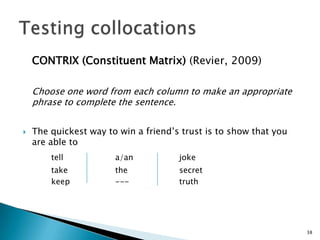
CONTRIX (Constituent Matrix) (Revier, 2009)
Choose one word from each column to make an appropriate
phrase to complete the sentence.
 The quickest way to win a friend’s trust is to show that you
are able to
tell a/an joke
take the secret
keep --- truth
38
 Decisions should be guided by the purpose of the
assessment and the utility of the vocabulary for the
learners.
 There is a trade-off between assessing multiple
aspects of word knowledge and testing a large
number of words in a single test.
 Raising learner awareness of the various
components of word knowledge may be more
important than assessing knowledge of particular
words.
39
If there’s time, some answers to
more of your questions…
40
Thank you for your attention!
ja.read@auckland.ac.nz
41

Assessing Vocabulary with Dr. John Read

  • 1.
  • 2.
    In which educationalcontext do you teach? a. Secondary / high school b. Intensive language program c. College / university d. Other 2
  • 3.
    Which is themain language you teach? a. English / EFL b. Another major European language (Spanish, French, German …) c. A less commonly taught language (LCTL) d. Other 3
  • 4.
     To placelearners at the appropriate level in a language teaching programme.  To assess learners’ progress in vocabulary learning in a particular course.  To help plan a vocabulary teaching/learning programme.  To evaluate how adequate the learners’ word knowledge is for a specific purpose.  To gain a greater understanding of vocabulary learning processes.
  • 5.
    In your teachingcontext, what role(s) do vocabulary tests play (if any)? a. Placement of students in classes b. Planning vocabulary teaching c. Assessing progress in vocabulary learning d. Measuring end of course achievement e. Other 5
  • 6.
     Words presentedin the course textbook  Words specified in a syllabus or curriculum  Words from a frequency list ◦ General frequency in the language ◦ Frequency in a particular domain e.g. academic language 6
  • 7.
    7 (Schmitt & Schmitt,forthcoming)  High-frequency vocabulary  Mid-frequency vocabulary  Low-frequency vocabulary  Academic vocabulary  Technical vocabulary (see Webinar handout for definitions and word lists) 3,000 9,000 High-frequency Mid-frequency Low-frequency vocabulary vocabulary vocabulary
  • 8.
    The form -meaning link This L2 word means ‘[L1 equivalent]’ English Spanish (a) house (una) casa colorful colorido to swim nadar 8
  • 9.
     Linking L2forms with (L1) meanings is the most basic element of vocabulary learning.  Using effective mnemonic techniques, it is an effective way to build a core L2 vocabulary.  It provides the basis for measuring vocabulary size (also called ‘breadth’ of knowledge). 9
  • 10.
     Tests thatare used for placement, diagnostic, proficiency and research purposes.  Based on a sample of words from a relevant word frequency list (see handout for details).  Knowledge of the sampled words is measured by a simple item type.  The test score is converted into an estimate of vocabulary size. 10
  • 11.
     Yes/No ◦ Learnerssimply report whether know the meaning of each word or not; a percentage of the items are non-words  Matching ◦ Learners match each word with its definition/ synonym/L1 equivalent  Multiple-choice ◦ Learners select the correct word/definition from the four options given 11
  • 12.
    Let’s visit awebsite www.lextutor.ca/tests  Nation’s Vocabulary Levels Test  Nation’s Vocabulary Size Tests  Meara’s X_Lex and Y_Lex tests 12
  • 13.
    Time to answersome of your questions from the Chat window 13
  • 14.
     The vocabularysize tests we have looked at so far focus on the Form-Meaning Link.  But there is a lot more to vocabulary knowledge than that.  Having a richer knowledge of words is commonly referred to as depth of knowledge. 14
  • 15.
     Meanings? Collocations? abroad street, a broad outline, a broad accent, in broad daylight  Part of speech?  Inflected forms?  Related (derived) words: adverb? noun? verb?  Associated words: wide, extensive, thick …  How frequent? 15
  • 16.
     Form how isit spelled? and pronounced? what parts does it have?  Meaning what is its central concept and range of meanings? what other words are associated with it?  Use what patterns of grammar and collocation does it fit into? how frequent is it? how is it used appropriately? [See Webinar handout for the full table] Nation, I.S.P. (2013). Learning vocabulary in another language (2nd ed.). Cambridge: Cambridge University Press 16
  • 17.
    Depth of knowledgehas much in common with rich vocabulary instruction, which involves ◦ Selecting useful, high-frequency words ◦ Communicating the meaning(s) of each word in an accessible way ◦ Giving opportunities to hear the word and practise its spoken form ◦ Giving repeated exposure to the word in different contexts over time ◦ Providing information on the form, meaning and use of the word ◦ Giving opportunities to use the word productively in speech and writing 17
  • 18.
    For both engagingin rich instruction and assessing depth of knowledge, there are common challenges: ◦ There are so many words for students to learn. ◦ Each word involves multiple aspects of vocabulary knowledge. ◦ A lot of time is required for teaching and assessing the words. ◦ There may be other more effective ways to promote and monitor vocabulary acquisition. (based on Nation, 2013, pp. 92-93) 18
  • 19.
    1. Precision ofmeaning How well learners know the specific meaning(s) of a word 2. Network knowledge How well learners can relate a word to other words they know 3. Comprehensive word knowledge How much learners know about the form, meaning and use of a word (Read, 2004) 19
  • 20.
    How well learnersknow the specific meaning of a word 20
  • 21.
    REFECTORY: We met inthe refectory. a. room for eating b. office where legal papers are signed c. room for several people to sleep in d. room with glass walls to grow plants Example from the Vocabulary Size Test (Nation, 2007) www.lextutor.ca It is a refectory. (a) beautiful lake (b) room for eating (c) small mirror (d) teacher’s house 21
  • 22.
    Developed by SimaParibakht and Mari Wesche at the University of Ottawa, Canada for research on ◦ vocabulary learning in the context of academic reading activities ◦ the ability to infer the meaning of unknown words. Wesche, M., & Paribakht, T.S. (1996). Assessing second language vocabulary knowledge: Depth vs. breadth. Canadian Modern Language Review, 53, 13-39. 22
  • 23.
    I I don’tremember having seen this word before. II I have seen this word before, but I don’t know what it means. III I have seen this word before, and I think it means _______. (synonym or translation) IV I know this word. It means ________. (synonym or translation) V I can use this word in a sentence: ________________. (Write a sentence.) (If you do this section, please also do Section IV) 23
  • 24.
     It isa combination of a self-rating task (Steps I-IV) and a kind of test (Steps III-V).  Step V goes beyond meaning to draw on various other kinds of word knowledge.  In addition, Step V may not provide good evidence that the meaning of the word is known.  The scale does not allow for a word having more than one meaning (or for homonyms). 24
  • 25.
    How well learnerscan relate a word to other words they know 25
  • 26.
    cooperative attitude cautious growinghelpful humour joint dynamic active excitement greedy leader meeting serious Read, J. (1993). The development of a new measure of L2 vocabulary knowledge. Language Testing, 10, 355-371. 26
  • 27.
     edit arithmetic filmpole publishing revise risk surface text  paradigmatic: the two words are synonyms or similar in meaning, and belong to the same word class e.g. ‘edit’ & ‘revise’.  syntagmatic: the two words could occur one after the other, as a collocation, e.g., ‘edit’ & ‘text’.  analytic: the associate represents one aspect of the meaning of the target word and is likely to form part of its dictionary definition, e.g., ‘edit’ & ‘publishing’. 27
  • 28.
     edit arithmetic filmpole publishing revise risk surface text  conscious Read, J.(1998). Validating a test to measure depth of vocabulary knowledge. In A. Kunnan (Ed.), Validation in language assessment, Mahwah, NJ: Lawrence Erlbaum. awake healthy knowing laughing face decision effort student 28
  • 29.
     University learnersin New Zealand, Canada, the UK and Japan  TOEFL test-takers in Canada  Advanced learners of French in Dutch universities  Dutch elementary school students in the Netherlands (see Read, 2012) 29
  • 30.
    rive artificiel (artificial)rive bord (edge) bord (edge) fleuve (river) cȏté (side) gauche (left) fleuve (river) paquet (parcel) gauche (left) prudent (careful) vague (wave) tombe (tomb) The associates in both cases are bord, fleuve and gauche. Greidanus, T. & Nienhuis, L. (2001).Testing the quality of word knowledge in a second language by means of word associations: Types of distractors and types of associations. Modern Language Journal 85, 4, 567–577. 30
  • 31.
     It isimportant to orient the test takers in advance to the nature of the task.  Generally WA tests are reliable overall.  The test takers’ willingness to guess is a significant factor in their performance.  Semantically related distractors make the test more difficult.  Syntagmatic associates are generally more difficult than paradigmatic ones. 31
  • 32.
    How much learnersknow about the form, meaning and use of a word 32
  • 33.
     Form how isit spelled? and pronounced? what parts does it have?  Meaning what is its central concept and range of meanings? what other words are associated with it?  Use what patterns of grammar and collocation does it fit into? how frequent is it? how is it used appropriately? Nation, I.S.P. (2013). Learning vocabulary in another language (2nd ed.). Cambridge: Cambridge University Press 33
  • 34.
    34 TEST OF ENGLISHDERIVATIVES assume Noun He made an _____ that she likes meat. Verb He can _____ that she likes meat. Adjective He had an ____ idea that she likes meat. Adverb He decided ______ that she likes meat. philosophy Noun She explained her ______ of life to me. Verb She was known to ______ about her life. Adjective She was known as a ______ person. Adverb She discussed her life ______ . www.norbertschmitt.co.uk/uploads/test-of-engish-derivatives.doc
  • 35.
    35 Write one wordfrom the list below in each blank. Make sure that you write the word in its correct grammatical form. In almost all developing countries, the lack of ______ supplies of cheap, convenient and ______ fuel is a ______ problem. Rural ______ depend on kerosene, wood and dung for their cooking and lighting needs. But kerosene is now too ______ for many people and, except in heavily forested ______, wood is in short supply. The search for firewood ______ a large part of the working day and has resulted in ______ deforestation. adequate / area / community / expensive / major / occupy / positive / quantity / reliable / widespread
  • 36.
    36 Write a sentencefor each of the following words to show that you know what the word means and how it is used.  starve _________________________________________  principal _________________________________________  twist _________________________________________  vegetation _________________________________________
  • 37.
    DISCO: Discriminating CollocationsTest (Eyckmans, 2009)  Tick the two phrases that are the correct idioms in English: ◦ seek advice ◦ express charges ◦ pay attention Barfield, A., & Gyllstad, H. (Eds.) (2009). Researching collocations in another language: Multiple interpretations. Basingstoke, UK: Palgrave Macmillan. 37
  • 38.
    CONTRIX (Constituent Matrix)(Revier, 2009) Choose one word from each column to make an appropriate phrase to complete the sentence.  The quickest way to win a friend’s trust is to show that you are able to tell a/an joke take the secret keep --- truth 38
  • 39.
     Decisions shouldbe guided by the purpose of the assessment and the utility of the vocabulary for the learners.  There is a trade-off between assessing multiple aspects of word knowledge and testing a large number of words in a single test.  Raising learner awareness of the various components of word knowledge may be more important than assessing knowledge of particular words. 39
  • 40.
    If there’s time,some answers to more of your questions… 40
  • 41.
    Thank you foryour attention! ja.read@auckland.ac.nz 41