Proofreading & Editing Grammar Skill Checks Gayla S. Keesee Education Specialist Mack Gipson, Jr. Tutorial & Enrichment Center 2/2007
Have You Ever? Been penalized for too many errors on your paper? Sharpen your eye for correct English.  Make proofreading a habit. Learned something and then found you couldn’t remember it? Practice and application of skills help you remember.
Have You Ever? Made a grammatical error but couldn’t explain why? Learn how to identify common errors and ways to correct them—and why. Questioned whether you will ever use what you are learning? You will be writing to communicate for the rest of your life.
Errors = Social Markers Speaking and writing errors signal  Social background Educational background/level One's concern for correctness
Common Errors Spelling Punctuation Capitalization Pronouns Verbs Sentence Fragments Run-on Sentences
Common Errors Usage Dangling/Misplaced Modifiers Parallel Structure Homonyms
Spelling Serious Errors: common words Be aware of your “enemies” Words you often misspell Create mnemonic tricks Help remember
Usage Errors Usage— words often confused Accept, except Advice, advise Affect, effect Between, among Lie, lay Than, then  Really, real Good, well More errors A lot alot All right alright Could have could of From off of Regardless irregardless Through thru
Homonym Errors Homonyms— similar sounds; different meanings To, too, two Their, they’re, there Your, you’re Whose, who’s Coarse, course Complement, compliment Council, counsel Principal, principle
Capitalization Titles—all words 4+ letters long First word in complete sentence Including direct quotes Proper nouns Names with Titles—President Bush Sacred Names—God, Allah
Capitalization Seasons Only when personified—Spring danced joyfully. Directions When naming specific regions—The North won. School Subjects Names of languages—French, English Numbered courses--Biology I, History 211
Review:  Sentence Elements Subject Who is doing the action Verb Action—State of being Complete Thought Independent Clause—IC  Stands alone Dependent Clause—DC   Must be attached
Phrases Prepositional phrase—most common Mnemonic trick: Preposition = anything a plane can do to a cloud To, From Over, Under Through, Around Inside, Outside The Subject will  NOT  be in a prep. phrase
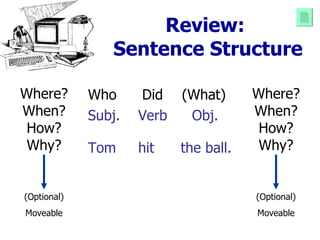
Review:  Sentence Structure Who Did (What) Subj. Verb Obj. Tom  hit  the ball. Where? When? How? Why? Where? When? How? Why? (Optional) Moveable (Optional) Moveable
Punctuation Commas Apostrophes Quotation marks Underlining Semi-colons
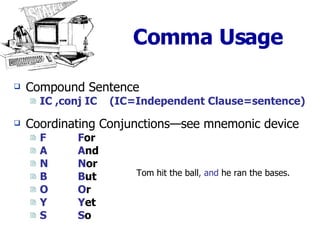
Comma Usage Compound Sentence   IC ,conj IC  (IC=Independent Clause=sentence) Coordinating Conjunctions—see mnemonic device F F or A A nd N N or B B ut O O r Y Y et S S o Tom hit the ball , and  he ran the bases.
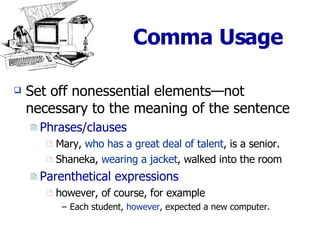
Comma Usage Set off nonessential elements—not  necessary to the meaning of the sentence Phrases/clauses Mary,  who has a great deal of talent , is a senior. Shaneka,  wearing a jacket , walked into the room Parenthetical expressions however, of course, for example Each student,  however , expected a new computer.
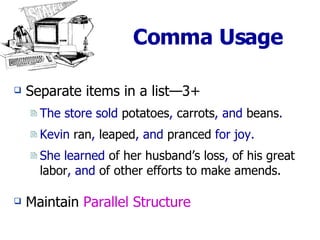
Comma Usage Separate items in a list—3+ The store sold  potatoes ,  carrots , and  beans . Kevin  ran ,  leaped , and  pranced  for joy. She learned  of her husband’s loss ,  of his great labor , and  of other efforts   to make amends. Maintain  Parallel Structure
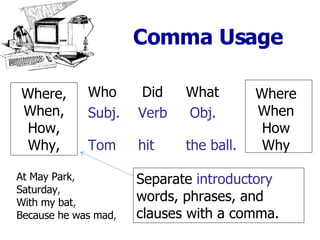
Comma Usage Who Did What Subj. Verb Obj. Tom  hit  the ball. Where When How Why Where, When, How, Why, At May Park , Saturday , With my bat , Because he was mad , Separate  introductory  words, phrases, and clauses with a comma.
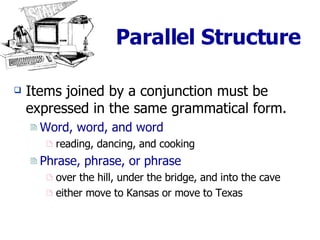
Parallel Structure Items joined by a conjunction must be expressed in the same grammatical form. Word, word, and word reading, dancing, and cooking Phrase, phrase, or phrase over the hill, under the bridge, and into the cave either move to Kansas or move to Texas
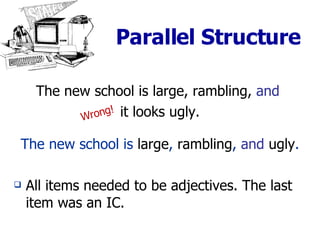
Parallel Structure The new school is large, rambling,  and   it looks ugly. The new school is  large ,  rambling ,  and   ugly . All items needed to be adjectives. The last item was an IC. Wrong!
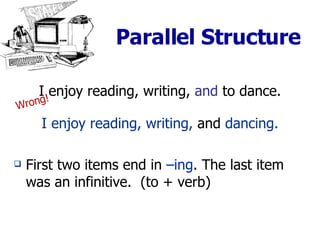
Parallel Structure I enjoy reading, writing,  and  to dance. I enjoy reading, writing,  and  dancing. First two items end in  –ing . The last item was an infinitive.  (to + verb) Wrong!
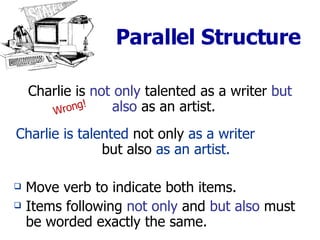
Parallel Structure Charlie is  not only  talented as a writer  but also  as an artist.   Charlie is talented  not only  as a writer  but also  as an artist. Move verb to indicate both items. Items following  not only  and  but also  must be worded exactly the same. Wrong!
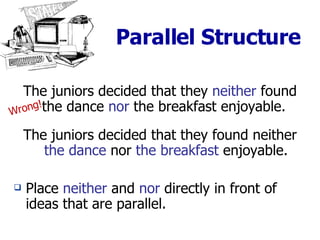
Parallel Structure The juniors decided that they  neither  found the dance  nor  the breakfast enjoyable.  The juniors decided that they found neither  the dance  nor  the breakfast  enjoyable. Place  neither  and  nor  directly in front of ideas that are parallel. Wrong!
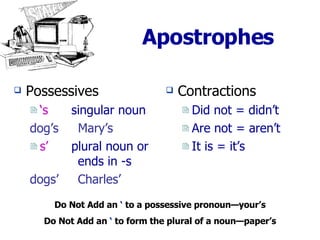
Apostrophes Possessives ‘ s   singular noun  dog’s  Mary’s s’   plural noun or  ends in -s dogs’ Charles’ Contractions Did not = didn’t Are not = aren’t It is = it’s Do Not Add an  ‘  to a possessive pronoun—your’s Do Not Add an  ‘  to form the plural of a noun—paper’s
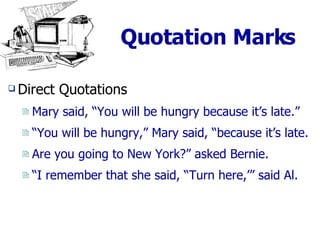
Quotation Marks Direct Quotations Mary said, “You will be hungry because it’s late.” “ You will be hungry,” Mary said, “because it’s late. Are you going to New York?” asked Bernie. “ I remember that she said, “Turn here,’” said Al.
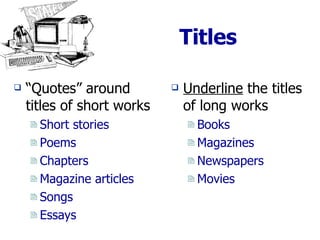
Titles Underline  the titles of long works Books Magazines Newspapers Movies “ Quotes” around titles of short works Short stories Poems Chapters Magazine articles Songs Essays
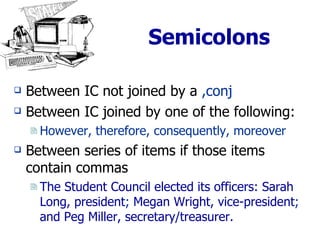
Semicolons Between IC not joined by a  ,conj Between IC joined by one of the following: However, therefore, consequently, moreover Between series of items if those items contain commas The Student Council elected its officers: Sarah Long, president ;  Megan Wright, vice-president ;  and Peg Miller, secretary/treasurer.
Capitalization Titles—all words 4+ letters long First word in complete sentence Including direct quotes Specific nouns Names with Titles—President Bush Sacred Names—God, Allah
Capitalization Seasons When personified—Spring danced joyfully. Directions When naming specific regions—The North won. School Subjects Names of languages—French, English Numbered courses--Biology I, History 211
Pronouns Pronoun Shifts Do not shift between person I, we, us He, she, it, they, them Pronoun Reference Make sure clear She was one of those people who is always helping others. YOU
Pronouns Pronoun Agreement  Agree with antecedent Number—singular, plural Gender—masculine, feminine Case—subject, object, possessive Pronouns ending in  –one ,  –body , or  –thing Always singular Has everyone brought his/her book?
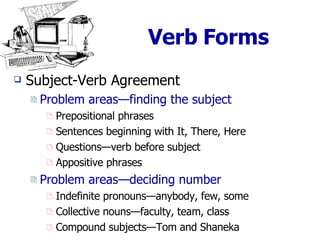
Verb Forms Subject-Verb Agreement  Problem areas—finding the subject Prepositional phrases Sentences beginning with It, There, Here Questions—verb before subject Appositive phrases Problem areas—deciding number Indefinite pronouns—anybody, few, some Collective nouns—faculty, team, class Compound subjects—Tom and Shaneka
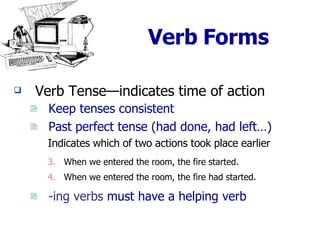
Verb Forms Verb Tense—indicates time of action Keep tenses consistent Past perfect tense (had done, had left…) Indicates which of two actions took place earlier When we entered the room, the fire started. When we entered the room, the fire had started. -ing verbs  must have a helping verb
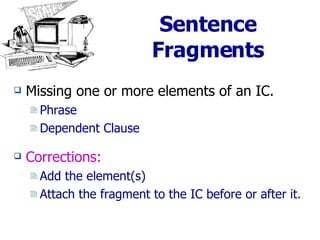
Sentence Fragments Missing one or more elements of an IC. Phrase Dependent Clause Corrections: Add the element(s) Attach the fragment to the IC before or after it.
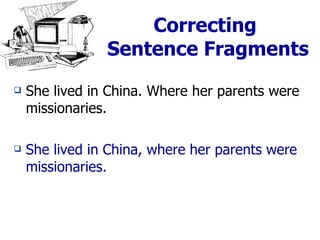
Correcting  Sentence Fragments She lived in China. Where her parents were missionaries. She lived in China, where her parents were missionaries.
Correcting  Sentence Fragments Our country has many famous musicians. Such as Pearl Bailey and Bing Crosby. Our country has many famous musicians such as Pearl Bailey and Bing Crosby.
Correcting  Sentence Fragments Because she was too tall.  Because she was too tall, Anna had to duck to enter the room.
Correcting  Sentence Fragments I saw him carrying a package. A big one with a red bow. I saw him carrying a package, a big one with a red bow.
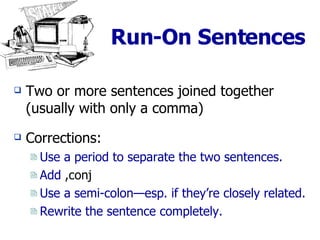
Run-On Sentences Two or more sentences joined together (usually with only a comma) Corrections: Use a period to separate the two sentences. Add  ,conj Use a semi-colon—esp. if they’re closely related. Rewrite the sentence completely.
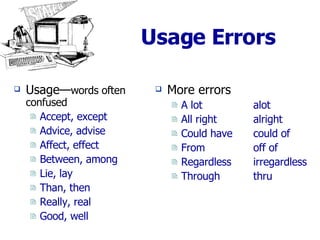
Usage Errors Usage— words often confused Accept, except Advice, advise Affect, effect Between, among Lie, lay Than, then  Really, real Good, well More errors A lot alot All right alright Could have could of From off of Regardless irregardless Through thru
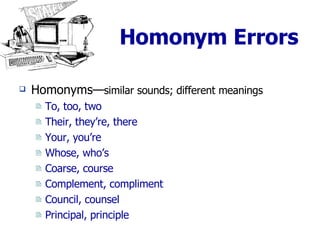
Homonym Errors Homonyms— similar sounds; different meanings To, too, two Their, they’re, there Your, you’re Whose, who’s Coarse, course Complement, compliment Council, counsel Principal, principle
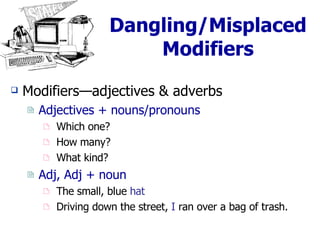
Dangling/Misplaced Modifiers Modifiers—adjectives & adverbs Adjectives + nouns/pronouns Which one? How many? What kind? Adj, Adj + noun The small, blue  hat Driving down the street,  I  ran over a bag of trash.
Dangling/Misplaced Modifiers Modifiers—adjectives, adverbs Must be placed as close to word being described as possible Running down the hall , his jacket caught on a nail. At the age of four , Alice’s family moved to Texas. To improve our wrestling team , new weight equipment was purchased by the school.

Grammar Review

  • 1.
    Proofreading & EditingGrammar Skill Checks Gayla S. Keesee Education Specialist Mack Gipson, Jr. Tutorial & Enrichment Center 2/2007
  • 2.
    Have You Ever?Been penalized for too many errors on your paper? Sharpen your eye for correct English. Make proofreading a habit. Learned something and then found you couldn’t remember it? Practice and application of skills help you remember.
  • 3.
    Have You Ever?Made a grammatical error but couldn’t explain why? Learn how to identify common errors and ways to correct them—and why. Questioned whether you will ever use what you are learning? You will be writing to communicate for the rest of your life.
  • 4.
    Errors = SocialMarkers Speaking and writing errors signal Social background Educational background/level One's concern for correctness
  • 5.
    Common Errors SpellingPunctuation Capitalization Pronouns Verbs Sentence Fragments Run-on Sentences
  • 6.
    Common Errors UsageDangling/Misplaced Modifiers Parallel Structure Homonyms
  • 7.
    Spelling Serious Errors:common words Be aware of your “enemies” Words you often misspell Create mnemonic tricks Help remember
  • 8.
    Usage Errors Usage—words often confused Accept, except Advice, advise Affect, effect Between, among Lie, lay Than, then Really, real Good, well More errors A lot alot All right alright Could have could of From off of Regardless irregardless Through thru
  • 9.
    Homonym Errors Homonyms—similar sounds; different meanings To, too, two Their, they’re, there Your, you’re Whose, who’s Coarse, course Complement, compliment Council, counsel Principal, principle
  • 10.
    Capitalization Titles—all words4+ letters long First word in complete sentence Including direct quotes Proper nouns Names with Titles—President Bush Sacred Names—God, Allah
  • 11.
    Capitalization Seasons Onlywhen personified—Spring danced joyfully. Directions When naming specific regions—The North won. School Subjects Names of languages—French, English Numbered courses--Biology I, History 211
  • 12.
    Review: SentenceElements Subject Who is doing the action Verb Action—State of being Complete Thought Independent Clause—IC Stands alone Dependent Clause—DC Must be attached
  • 13.
    Phrases Prepositional phrase—mostcommon Mnemonic trick: Preposition = anything a plane can do to a cloud To, From Over, Under Through, Around Inside, Outside The Subject will NOT be in a prep. phrase
  • 14.
    Review: SentenceStructure Who Did (What) Subj. Verb Obj. Tom hit the ball. Where? When? How? Why? Where? When? How? Why? (Optional) Moveable (Optional) Moveable
  • 15.
    Punctuation Commas ApostrophesQuotation marks Underlining Semi-colons
  • 16.
    Comma Usage CompoundSentence IC ,conj IC (IC=Independent Clause=sentence) Coordinating Conjunctions—see mnemonic device F F or A A nd N N or B B ut O O r Y Y et S S o Tom hit the ball , and he ran the bases.
  • 17.
    Comma Usage Setoff nonessential elements—not necessary to the meaning of the sentence Phrases/clauses Mary, who has a great deal of talent , is a senior. Shaneka, wearing a jacket , walked into the room Parenthetical expressions however, of course, for example Each student, however , expected a new computer.
  • 18.
    Comma Usage Separateitems in a list—3+ The store sold potatoes , carrots , and beans . Kevin ran , leaped , and pranced for joy. She learned of her husband’s loss , of his great labor , and of other efforts to make amends. Maintain Parallel Structure
  • 19.
    Comma Usage WhoDid What Subj. Verb Obj. Tom hit the ball. Where When How Why Where, When, How, Why, At May Park , Saturday , With my bat , Because he was mad , Separate introductory words, phrases, and clauses with a comma.
  • 20.
    Parallel Structure Itemsjoined by a conjunction must be expressed in the same grammatical form. Word, word, and word reading, dancing, and cooking Phrase, phrase, or phrase over the hill, under the bridge, and into the cave either move to Kansas or move to Texas
  • 21.
    Parallel Structure Thenew school is large, rambling, and it looks ugly. The new school is large , rambling , and ugly . All items needed to be adjectives. The last item was an IC. Wrong!
  • 22.
    Parallel Structure Ienjoy reading, writing, and to dance. I enjoy reading, writing, and dancing. First two items end in –ing . The last item was an infinitive. (to + verb) Wrong!
  • 23.
    Parallel Structure Charlieis not only talented as a writer but also as an artist. Charlie is talented not only as a writer but also as an artist. Move verb to indicate both items. Items following not only and but also must be worded exactly the same. Wrong!
  • 24.
    Parallel Structure Thejuniors decided that they neither found the dance nor the breakfast enjoyable. The juniors decided that they found neither the dance nor the breakfast enjoyable. Place neither and nor directly in front of ideas that are parallel. Wrong!
  • 25.
    Apostrophes Possessives ‘s singular noun dog’s Mary’s s’ plural noun or ends in -s dogs’ Charles’ Contractions Did not = didn’t Are not = aren’t It is = it’s Do Not Add an ‘ to a possessive pronoun—your’s Do Not Add an ‘ to form the plural of a noun—paper’s
  • 26.
    Quotation Marks DirectQuotations Mary said, “You will be hungry because it’s late.” “ You will be hungry,” Mary said, “because it’s late. Are you going to New York?” asked Bernie. “ I remember that she said, “Turn here,’” said Al.
  • 27.
    Titles Underline the titles of long works Books Magazines Newspapers Movies “ Quotes” around titles of short works Short stories Poems Chapters Magazine articles Songs Essays
  • 28.
    Semicolons Between ICnot joined by a ,conj Between IC joined by one of the following: However, therefore, consequently, moreover Between series of items if those items contain commas The Student Council elected its officers: Sarah Long, president ; Megan Wright, vice-president ; and Peg Miller, secretary/treasurer.
  • 29.
    Capitalization Titles—all words4+ letters long First word in complete sentence Including direct quotes Specific nouns Names with Titles—President Bush Sacred Names—God, Allah
  • 30.
    Capitalization Seasons Whenpersonified—Spring danced joyfully. Directions When naming specific regions—The North won. School Subjects Names of languages—French, English Numbered courses--Biology I, History 211
  • 31.
    Pronouns Pronoun ShiftsDo not shift between person I, we, us He, she, it, they, them Pronoun Reference Make sure clear She was one of those people who is always helping others. YOU
  • 32.
    Pronouns Pronoun Agreement Agree with antecedent Number—singular, plural Gender—masculine, feminine Case—subject, object, possessive Pronouns ending in –one , –body , or –thing Always singular Has everyone brought his/her book?
  • 33.
    Verb Forms Subject-VerbAgreement Problem areas—finding the subject Prepositional phrases Sentences beginning with It, There, Here Questions—verb before subject Appositive phrases Problem areas—deciding number Indefinite pronouns—anybody, few, some Collective nouns—faculty, team, class Compound subjects—Tom and Shaneka
  • 34.
    Verb Forms VerbTense—indicates time of action Keep tenses consistent Past perfect tense (had done, had left…) Indicates which of two actions took place earlier When we entered the room, the fire started. When we entered the room, the fire had started. -ing verbs must have a helping verb
  • 35.
    Sentence Fragments Missingone or more elements of an IC. Phrase Dependent Clause Corrections: Add the element(s) Attach the fragment to the IC before or after it.
  • 36.
    Correcting SentenceFragments She lived in China. Where her parents were missionaries. She lived in China, where her parents were missionaries.
  • 37.
    Correcting SentenceFragments Our country has many famous musicians. Such as Pearl Bailey and Bing Crosby. Our country has many famous musicians such as Pearl Bailey and Bing Crosby.
  • 38.
    Correcting SentenceFragments Because she was too tall. Because she was too tall, Anna had to duck to enter the room.
  • 39.
    Correcting SentenceFragments I saw him carrying a package. A big one with a red bow. I saw him carrying a package, a big one with a red bow.
  • 40.
    Run-On Sentences Twoor more sentences joined together (usually with only a comma) Corrections: Use a period to separate the two sentences. Add ,conj Use a semi-colon—esp. if they’re closely related. Rewrite the sentence completely.
  • 41.
    Usage Errors Usage—words often confused Accept, except Advice, advise Affect, effect Between, among Lie, lay Than, then Really, real Good, well More errors A lot alot All right alright Could have could of From off of Regardless irregardless Through thru
  • 42.
    Homonym Errors Homonyms—similar sounds; different meanings To, too, two Their, they’re, there Your, you’re Whose, who’s Coarse, course Complement, compliment Council, counsel Principal, principle
  • 43.
    Dangling/Misplaced Modifiers Modifiers—adjectives& adverbs Adjectives + nouns/pronouns Which one? How many? What kind? Adj, Adj + noun The small, blue hat Driving down the street, I ran over a bag of trash.
  • 44.
    Dangling/Misplaced Modifiers Modifiers—adjectives,adverbs Must be placed as close to word being described as possible Running down the hall , his jacket caught on a nail. At the age of four , Alice’s family moved to Texas. To improve our wrestling team , new weight equipment was purchased by the school.