EOC REVIEW ENGLISH I Mrs. Janicki Central Academy of Technology and Arts
CONFLICT: struggle between character and opposing force Internal conflict Man vs. man External conflicts Man vs. man Man vs. environment Man vs. nature Man vs. machine Man vs. supernatural
CHARACTERIZATION: how writers reveal the traits of the character to the reader Character’s thoughts and feelings Character’s words and actions Character’s description- by narrator Thoughts/words/actions of other characters
POINT OF VIEW First person-  “I” Third person- “he/she” narrator tells what happens  Omniscient- narrator knows everything about all characters-  thoughts/feelings Limited omniscient- narrator knows everything about ONE character
AUTHOR’S PURPOSE: reason the author writes To inform-  (nonfiction, presents info) To persuade- (issues, editorials, “you should…I”) To entertain- (tells story)
AUTHOR’S CRAFT: own style of writing Diction= word choice Depends on topic and format Formal to informal Repetition to create emphasis Descriptive to add to mood
LITERARY DEVICES ALLUSION-  reference to a person, place, event from history, literature, religion, mythology, politics, sports, science, or pop culture SYMBOL- an object, event, person or animal that represents something else more meaningful
IRONY: contrast between expectation and reality Verbal: contrast between what is said and what is meant Situational: contrast between what is expected to happen and what happens Dramatic: contrast between what a character thinks is true and what the audience knows to be true
THEME: special insight about life / message Bravery is courage in the face of danger Loyalty means being faithful Friendship often involves valuing a relationship over personal gain Lonelines often involves the pains related to being on one’s own Love is blind
MOOD AND TONE MOOD = FEELING  Agitation, anxiety, excitement, Depression,  TONE = APPROACH author takes to create mood How does the author want you to feel? Tone triggers your reaction Tones: tense, light, dark, mysterious, somber, sad, angry, exciting, serious
Poetic Devices ALLITERATION- repeating same initial sound in two or more words in a row P eter  P iper  p icked a  p eck of  p ickled...  PERSONIFICATION- giving humanlike qualities to something that is not human The stars danced across the sky SIMILE- comparison of two unlike things using like or as - She was as pretty as a daisy
Poetic devices (con’t) METAPHOR- comparison between unlike things (NO like or as) -love is a rose HYPERBOLE- an exaggeration I nearly died laughing IMAGERY- language that appeals to the five senses
POETRY TERMS Stanza- groups of lines that break up a poem (like paragraphs break up stories) Speaker- the persona or narrator of poem Rhyme- same or similar sounds at the ends of words Rhyme scheme- use a different letter to each final sound in a poem aabba
ELEMENTS OF DRAMA DIALOGUE- words spoken by characters STAGE DIRECTIONS- tell actors how to act, description of scenery - usually italicized or in parenthesis
Drama  (con’t) ACTS- divisions of a play SCENES- divisions of the acts Don’t forget to read the stage directions for clues about the characters
GENRES: type of literary work FICTION- imaginary stories ~novel, novella, short story NONFICTION- factual ~textbooks, newspaper articles, manuals, DRAMAS- stories written to be performed POETRY- short lines in stanzas
COMPOSITION Read selections and find and correct the mistakes Combine sentences correctly Re-organize the sentences or paragraphs Choose better words to revise meaning
MODIFIERS: words that change the meaning of other words ADJECTIVES-modify nouns or pronouns ADVERBS- modify verbs, adjectives, other adverbs  (how? when? where?) MAKE SURE MODIFYING WORD IS CLOSE TO THE WORD IT IS MODIFYING!! Jan saw the café walking home. Walking home, Jan saw the café.
PARALLEL STRUCTURE: use the same phrasing in pair or series of words Repeat same verb tenses or constructions Mary enjoys eating cake and to sing “Happy Birthday” Mary enjoys eating cake and singing “Happy Birthday.”
PUNCTUATION Quotation marks Speakers exact words  (end marks INSIDE) Titles of minor works- poems, songs, short stories, articles, essays, etc.
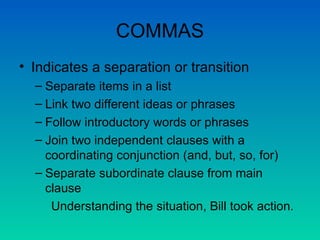
COMMAS Indicates a separation or transition Separate items in a list Link two different ideas or phrases Follow introductory words or phrases Join two independent clauses with a coordinating conjunction (and, but, so, for) Separate subordinate clause from main clause Understanding the situation, Bill took action.
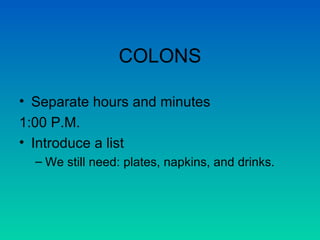
COLONS Separate hours and minutes 1:00 P.M. Introduce a list We still need: plates, napkins, and drinks.
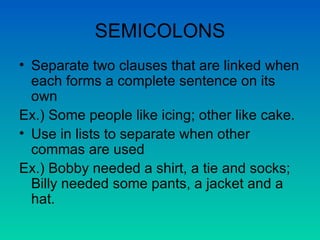
SEMICOLONS Separate two clauses that are linked when each forms a complete sentence on its own Ex.) Some people like icing; other like cake. Use in lists to separate when other commas are used Ex.) Bobby needed a shirt, a tie and socks; Billy needed some pants, a jacket and a hat.
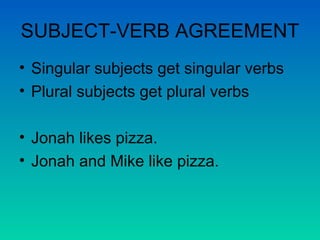
SUBJECT-VERB AGREEMENT Singular subjects get singular verbs Plural subjects get plural verbs Jonah likes pizza. Jonah and Mike like pizza.
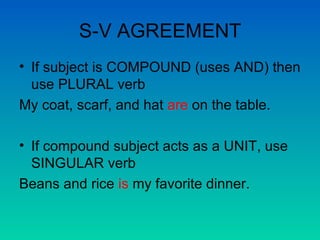
S-V AGREEMENT If subject is COMPOUND (uses AND) then use PLURAL verb My coat, scarf, and hat  are  on the table. If compound subject acts as a UNIT, use SINGULAR verb Beans and rice  is  my favorite dinner.
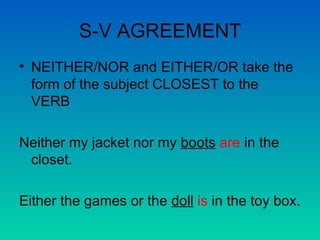
S-V AGREEMENT NEITHER/NOR and EITHER/OR take the form of the subject CLOSEST to the VERB Neither my jacket nor my  boots   are  in the closet. Either the games or the  doll   is  in the toy box.
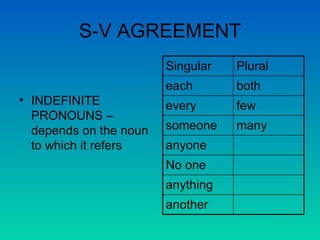
S-V AGREEMENT INDEFINITE PRONOUNS –depends on the noun to which it refers another anything No one anyone many someone few every both each Plural Singular
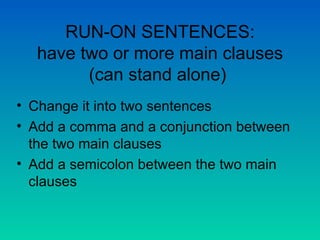
RUN-ON SENTENCES: have two or more main clauses (can stand alone)  Change it into two sentences Add a comma and a conjunction between the two main clauses Add a semicolon between the two main clauses
FRAGMENTS:  incomplete thoughts Jazz, rap, and rock. Does it have a subject? Does it have a verb or predicate? Add  the missing element or combine properly with complete sentence Replace period with comma, add joining word or coordinating conjunction and add fragment Olivia likes many types of music, including jazz, rap, and rock.
ADDITIONAL RESOURCES Mrs. Janicki’s Moodle page Resources:  Grammar practice EOC practice tests Grammar Bytes:  chompchomp.com

Eoc Review

  • 1.
    EOC REVIEW ENGLISHI Mrs. Janicki Central Academy of Technology and Arts
  • 2.
    CONFLICT: struggle betweencharacter and opposing force Internal conflict Man vs. man External conflicts Man vs. man Man vs. environment Man vs. nature Man vs. machine Man vs. supernatural
  • 3.
    CHARACTERIZATION: how writersreveal the traits of the character to the reader Character’s thoughts and feelings Character’s words and actions Character’s description- by narrator Thoughts/words/actions of other characters
  • 4.
    POINT OF VIEWFirst person- “I” Third person- “he/she” narrator tells what happens Omniscient- narrator knows everything about all characters- thoughts/feelings Limited omniscient- narrator knows everything about ONE character
  • 5.
    AUTHOR’S PURPOSE: reasonthe author writes To inform- (nonfiction, presents info) To persuade- (issues, editorials, “you should…I”) To entertain- (tells story)
  • 6.
    AUTHOR’S CRAFT: ownstyle of writing Diction= word choice Depends on topic and format Formal to informal Repetition to create emphasis Descriptive to add to mood
  • 7.
    LITERARY DEVICES ALLUSION- reference to a person, place, event from history, literature, religion, mythology, politics, sports, science, or pop culture SYMBOL- an object, event, person or animal that represents something else more meaningful
  • 8.
    IRONY: contrast betweenexpectation and reality Verbal: contrast between what is said and what is meant Situational: contrast between what is expected to happen and what happens Dramatic: contrast between what a character thinks is true and what the audience knows to be true
  • 9.
    THEME: special insightabout life / message Bravery is courage in the face of danger Loyalty means being faithful Friendship often involves valuing a relationship over personal gain Lonelines often involves the pains related to being on one’s own Love is blind
  • 10.
    MOOD AND TONEMOOD = FEELING Agitation, anxiety, excitement, Depression, TONE = APPROACH author takes to create mood How does the author want you to feel? Tone triggers your reaction Tones: tense, light, dark, mysterious, somber, sad, angry, exciting, serious
  • 11.
    Poetic Devices ALLITERATION-repeating same initial sound in two or more words in a row P eter P iper p icked a p eck of p ickled... PERSONIFICATION- giving humanlike qualities to something that is not human The stars danced across the sky SIMILE- comparison of two unlike things using like or as - She was as pretty as a daisy
  • 12.
    Poetic devices (con’t)METAPHOR- comparison between unlike things (NO like or as) -love is a rose HYPERBOLE- an exaggeration I nearly died laughing IMAGERY- language that appeals to the five senses
  • 13.
    POETRY TERMS Stanza-groups of lines that break up a poem (like paragraphs break up stories) Speaker- the persona or narrator of poem Rhyme- same or similar sounds at the ends of words Rhyme scheme- use a different letter to each final sound in a poem aabba
  • 14.
    ELEMENTS OF DRAMADIALOGUE- words spoken by characters STAGE DIRECTIONS- tell actors how to act, description of scenery - usually italicized or in parenthesis
  • 15.
    Drama (con’t)ACTS- divisions of a play SCENES- divisions of the acts Don’t forget to read the stage directions for clues about the characters
  • 16.
    GENRES: type ofliterary work FICTION- imaginary stories ~novel, novella, short story NONFICTION- factual ~textbooks, newspaper articles, manuals, DRAMAS- stories written to be performed POETRY- short lines in stanzas
  • 17.
    COMPOSITION Read selectionsand find and correct the mistakes Combine sentences correctly Re-organize the sentences or paragraphs Choose better words to revise meaning
  • 18.
    MODIFIERS: words thatchange the meaning of other words ADJECTIVES-modify nouns or pronouns ADVERBS- modify verbs, adjectives, other adverbs (how? when? where?) MAKE SURE MODIFYING WORD IS CLOSE TO THE WORD IT IS MODIFYING!! Jan saw the café walking home. Walking home, Jan saw the café.
  • 19.
    PARALLEL STRUCTURE: usethe same phrasing in pair or series of words Repeat same verb tenses or constructions Mary enjoys eating cake and to sing “Happy Birthday” Mary enjoys eating cake and singing “Happy Birthday.”
  • 20.
    PUNCTUATION Quotation marksSpeakers exact words (end marks INSIDE) Titles of minor works- poems, songs, short stories, articles, essays, etc.
  • 21.
    COMMAS Indicates aseparation or transition Separate items in a list Link two different ideas or phrases Follow introductory words or phrases Join two independent clauses with a coordinating conjunction (and, but, so, for) Separate subordinate clause from main clause Understanding the situation, Bill took action.
  • 22.
    COLONS Separate hoursand minutes 1:00 P.M. Introduce a list We still need: plates, napkins, and drinks.
  • 23.
    SEMICOLONS Separate twoclauses that are linked when each forms a complete sentence on its own Ex.) Some people like icing; other like cake. Use in lists to separate when other commas are used Ex.) Bobby needed a shirt, a tie and socks; Billy needed some pants, a jacket and a hat.
  • 24.
    SUBJECT-VERB AGREEMENT Singularsubjects get singular verbs Plural subjects get plural verbs Jonah likes pizza. Jonah and Mike like pizza.
  • 25.
    S-V AGREEMENT Ifsubject is COMPOUND (uses AND) then use PLURAL verb My coat, scarf, and hat are on the table. If compound subject acts as a UNIT, use SINGULAR verb Beans and rice is my favorite dinner.
  • 26.
    S-V AGREEMENT NEITHER/NORand EITHER/OR take the form of the subject CLOSEST to the VERB Neither my jacket nor my boots are in the closet. Either the games or the doll is in the toy box.
  • 27.
    S-V AGREEMENT INDEFINITEPRONOUNS –depends on the noun to which it refers another anything No one anyone many someone few every both each Plural Singular
  • 28.
    RUN-ON SENTENCES: havetwo or more main clauses (can stand alone) Change it into two sentences Add a comma and a conjunction between the two main clauses Add a semicolon between the two main clauses
  • 29.
    FRAGMENTS: incompletethoughts Jazz, rap, and rock. Does it have a subject? Does it have a verb or predicate? Add the missing element or combine properly with complete sentence Replace period with comma, add joining word or coordinating conjunction and add fragment Olivia likes many types of music, including jazz, rap, and rock.
  • 30.
    ADDITIONAL RESOURCES Mrs.Janicki’s Moodle page Resources: Grammar practice EOC practice tests Grammar Bytes: chompchomp.com