Memory and Study Aids Mack Gipson, Jr. Tutorial and  Enrichment Center Gayla S. Keesee Education Specialist
Build Good Habits Positive Thinking Build confidence; set goals Self-Management Be aware of how you learn Hierarchical Thinking Prioritizing & organizing Creative & Critical Thinking Problem-solving & synthesizing Asking Questions Focus, Motivation, Active learning
Complete the Learning Cycle Memorize  new information, rules and concepts Assimilate and organize  new information  Use information  to analyze, synthesize and problem-solve Incorporate information  into evaluations, judgments and predictions
Memory  and Study Aids
Memory and Study Aids Visual aids/word associations Drawings, Pictures, Models Graphic Organizers Diagrams and Charts—Tables/Grids Flashcards
Visual Aids Drawings, pictures, models Physically create visual elements Drawings or pictures of definitions Pictures of situations where the word would be used Draw crazy visual associations
Word Associations Façade—false, superficial, or artificial appearance FACE—false face
Benign—kindly, gentle Be + 9 + 9 Word Associations
Visual Aids Create a  graphic organizer  in which you answer the following questions What is it?  (Category) Other forms  (Change part of speech) What is it like?  (Properties) What are some examples?  (Illustrations) Learning Styles: Writing (tactile) and reading (visual)
Cynic What is it? noun, kind of person Other forms: adj.—cynical  adv.—cynically noun—cynicism What is it like? pessimistic, scornful, sneering, contemptuous, distrustful, sarcastic Examples:   Someone who doesn’t think democracy can be honest and efficient Someone who believes that human conduct is motivated solely by self-interest
Diagrams Charts Table or grid — possible headings  Word Meaning Part of speech Word Structure Roots, prefixes, suffixes Number of syllables Common Usage Describes people Describes places Describes things
Categorization Grid Words to describe people Timid  Cynical Pessimistic Flippant Uncouth Malicious Garrulous  Morose Obtuse Diligent Arrogant Pompous
Flashcards Create flashcards to help you study Don’t make too small 4x6 are best Carry them with you Review them often Break into small groups for easier learning Shuffle frequently so you don’t learn a pattern
Flashcards—Advantages Chunks  information  into  smaller categories  to aid memory Nouns—persons, places, things Verbs—plural/singular or tenses Phrases—common usage Use of  color  signals  categories different colored cards highlighters
Flashcards—Advantages  Use either  written  or  visual  information Easily  rearranged  and  sorted Do  not  learn the words in a  fixed order. Learn  only   words   need to remember . Can be used for  different purposes   Lists  of items Grammar  rules Quiz prep —questions/answers
Flashcards—Advantages  Size  and  portability   easy to carry use for  short, frequent reviews review in spare time  that is often wasted—like waiting in line or between classes. Physically  moving  and  manipulating  the  cards  incorporates  tactile learning
Flashcards—Advantages Writing down  the  material  on cards  aids  your  memory  in itself. 76 repetitions  of information to go into  long term memory
One Way to Study At least once a day , go through your pack of index cards—spend  10-15 minutes  each time. Sort  the cards into  two stacks —those you know and those you do not know. Periodically review the entire set of words  to keep them fresh in your mind.
When to Use Flashcards Study your vocabulary for 10-15 minutes a day Riding the bus Riding in a car Before bed When you get up in the morning Waiting in line  Doing your laundry
What to Include:
Flashcards Conglomerate con-glom’-er-it Def:  an organization comprising two or more companies that produce unrelated  products.  EX:   Nichols company owns a shoe factory, vineyards in France, soft drink factories, and Sara Jane pastry . Front Back
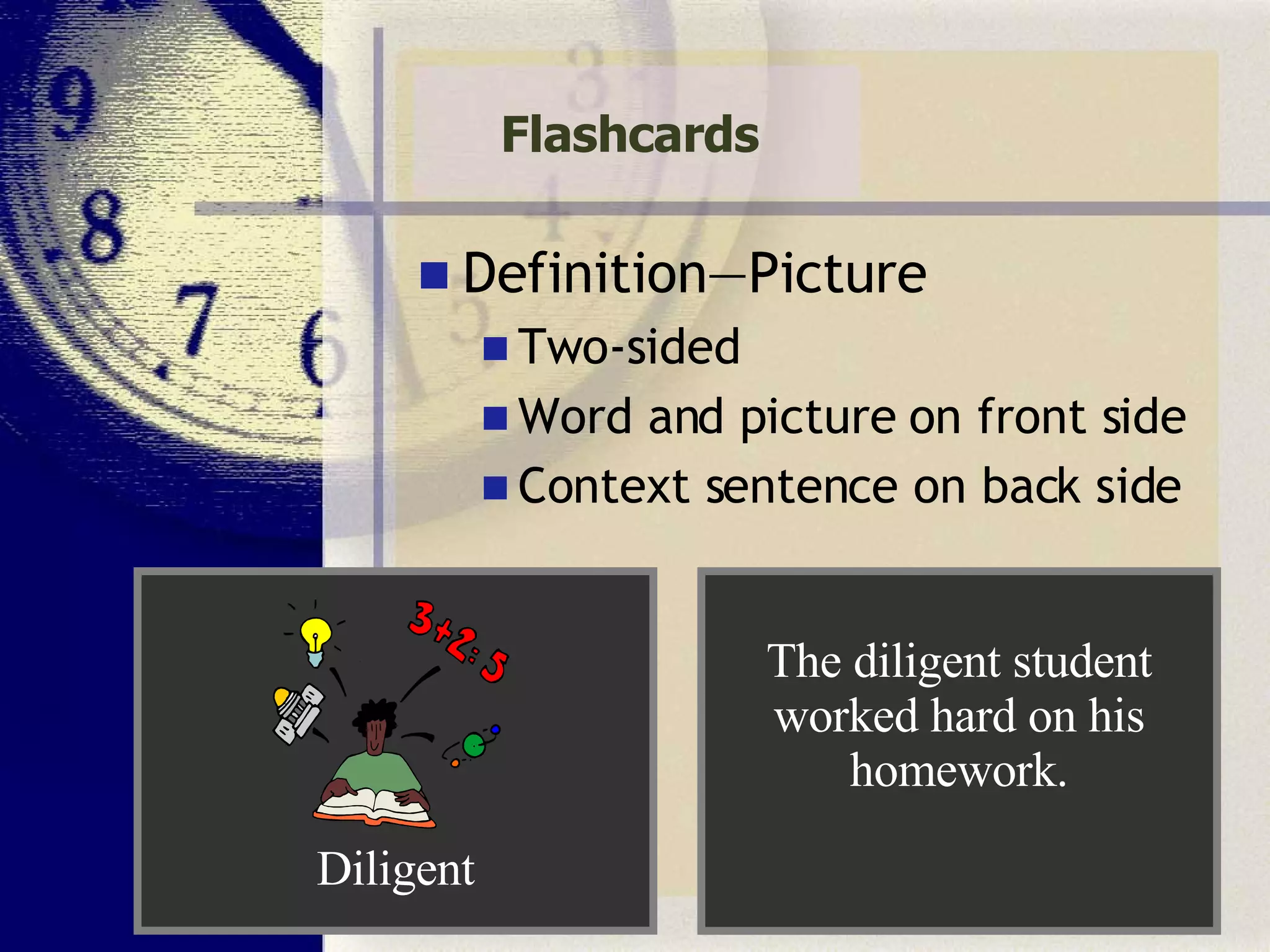
Flashcards Definition—Picture   Two-sided Word and picture on front side Context sentence on back side The diligent student worked hard on his homework. Diligent
Study Tips Do your studying in relatively small chunks 45-60 minutes at a time Study vocabulary several times a day  5-10 minutes at a time
Study Tips When studying, use as many senses as possible Speaking—say the word Listening—hear you or someone else  Writing—physically practice writing the words Reading—words in context Act-out the definitions
Study Tips Be an interactive learner Study with a friend Start a study group Make up sentences together Quiz each other  Create crossword puzzles and exchange them
Study Tips Be an active learner Say the words out loud Write the words Record words/definitions on a cassette and play over & over Practice saying new words out loud
Study Tips Use new vocabulary Conversations Essays, reports Letters Notice when others use your vocabulary words radio, TV magazines, newspapers
Study Tips Don’t refer to your vocabulary list as you do your homework  Review material before starting homework Work from memory Complete the entire exercise, then check your work
Study Tips Practice seeing the new word in context Create simple sentences about a specific context Describe what is happening in that setting home, school, work, Augusta Mall, movie theater…
Don’t Don’t panic Normal not to master new vocabulary on the first try  Constant practice and review are essential Don’t study for long periods without a break Memory overload
Have Fun! Learning is a lifelong process. Develop good habits now, and they will last forever.

Memory Aids

  • 1.
    Memory and StudyAids Mack Gipson, Jr. Tutorial and Enrichment Center Gayla S. Keesee Education Specialist
  • 2.
    Build Good HabitsPositive Thinking Build confidence; set goals Self-Management Be aware of how you learn Hierarchical Thinking Prioritizing & organizing Creative & Critical Thinking Problem-solving & synthesizing Asking Questions Focus, Motivation, Active learning
  • 3.
    Complete the LearningCycle Memorize new information, rules and concepts Assimilate and organize new information Use information to analyze, synthesize and problem-solve Incorporate information into evaluations, judgments and predictions
  • 4.
    Memory andStudy Aids
  • 5.
    Memory and StudyAids Visual aids/word associations Drawings, Pictures, Models Graphic Organizers Diagrams and Charts—Tables/Grids Flashcards
  • 6.
    Visual Aids Drawings,pictures, models Physically create visual elements Drawings or pictures of definitions Pictures of situations where the word would be used Draw crazy visual associations
  • 7.
    Word Associations Façade—false,superficial, or artificial appearance FACE—false face
  • 8.
    Benign—kindly, gentle Be+ 9 + 9 Word Associations
  • 9.
    Visual Aids Createa graphic organizer in which you answer the following questions What is it? (Category) Other forms (Change part of speech) What is it like? (Properties) What are some examples? (Illustrations) Learning Styles: Writing (tactile) and reading (visual)
  • 10.
    Cynic What isit? noun, kind of person Other forms: adj.—cynical adv.—cynically noun—cynicism What is it like? pessimistic, scornful, sneering, contemptuous, distrustful, sarcastic Examples: Someone who doesn’t think democracy can be honest and efficient Someone who believes that human conduct is motivated solely by self-interest
  • 11.
    Diagrams Charts Tableor grid — possible headings Word Meaning Part of speech Word Structure Roots, prefixes, suffixes Number of syllables Common Usage Describes people Describes places Describes things
  • 12.
    Categorization Grid Wordsto describe people Timid Cynical Pessimistic Flippant Uncouth Malicious Garrulous Morose Obtuse Diligent Arrogant Pompous
  • 13.
    Flashcards Create flashcardsto help you study Don’t make too small 4x6 are best Carry them with you Review them often Break into small groups for easier learning Shuffle frequently so you don’t learn a pattern
  • 14.
    Flashcards—Advantages Chunks information into smaller categories to aid memory Nouns—persons, places, things Verbs—plural/singular or tenses Phrases—common usage Use of color signals categories different colored cards highlighters
  • 15.
    Flashcards—Advantages Useeither written or visual information Easily rearranged and sorted Do not learn the words in a fixed order. Learn only words need to remember . Can be used for different purposes Lists of items Grammar rules Quiz prep —questions/answers
  • 16.
    Flashcards—Advantages Size and portability easy to carry use for short, frequent reviews review in spare time that is often wasted—like waiting in line or between classes. Physically moving and manipulating the cards incorporates tactile learning
  • 17.
    Flashcards—Advantages Writing down the material on cards aids your memory in itself. 76 repetitions of information to go into long term memory
  • 18.
    One Way toStudy At least once a day , go through your pack of index cards—spend 10-15 minutes each time. Sort the cards into two stacks —those you know and those you do not know. Periodically review the entire set of words to keep them fresh in your mind.
  • 19.
    When to UseFlashcards Study your vocabulary for 10-15 minutes a day Riding the bus Riding in a car Before bed When you get up in the morning Waiting in line Doing your laundry
  • 20.
  • 21.
    Flashcards Conglomerate con-glom’-er-itDef: an organization comprising two or more companies that produce unrelated products. EX: Nichols company owns a shoe factory, vineyards in France, soft drink factories, and Sara Jane pastry . Front Back
  • 22.
    Flashcards Definition—Picture Two-sided Word and picture on front side Context sentence on back side The diligent student worked hard on his homework. Diligent
  • 23.
    Study Tips Doyour studying in relatively small chunks 45-60 minutes at a time Study vocabulary several times a day 5-10 minutes at a time
  • 24.
    Study Tips Whenstudying, use as many senses as possible Speaking—say the word Listening—hear you or someone else Writing—physically practice writing the words Reading—words in context Act-out the definitions
  • 25.
    Study Tips Bean interactive learner Study with a friend Start a study group Make up sentences together Quiz each other Create crossword puzzles and exchange them
  • 26.
    Study Tips Bean active learner Say the words out loud Write the words Record words/definitions on a cassette and play over & over Practice saying new words out loud
  • 27.
    Study Tips Usenew vocabulary Conversations Essays, reports Letters Notice when others use your vocabulary words radio, TV magazines, newspapers
  • 28.
    Study Tips Don’trefer to your vocabulary list as you do your homework Review material before starting homework Work from memory Complete the entire exercise, then check your work
  • 29.
    Study Tips Practiceseeing the new word in context Create simple sentences about a specific context Describe what is happening in that setting home, school, work, Augusta Mall, movie theater…
  • 30.
    Don’t Don’t panicNormal not to master new vocabulary on the first try Constant practice and review are essential Don’t study for long periods without a break Memory overload
  • 31.
    Have Fun! Learningis a lifelong process. Develop good habits now, and they will last forever.