The Parts of Speech
A Review
Presented by Mrs. Mary Acevedo, M.Ed., TESOL
Nouns


Nouns are words that name a person, place, object, or idea.



There are several characteristics of nouns:







Common: Common nouns name general categories and begin
with a lower-case letter.
Proper: Proper nouns are named and must be capitalized.
Non-count and Count Nouns:
Non-count nouns cannot be counted and therefore have no
plural form.
Count nouns can be counted and therefore have singular and
plural forms.


Plurals can be regular (add –s or –es) or irregular (1 man 
2 men, 1 sheep  2 sheep)



Nouns are often preceded by the articles a, an, or the, but
sometimes no article should be used.
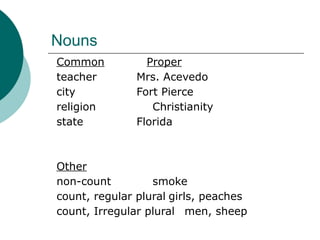
Nouns
Common
teacher
city
religion
state

Proper
Mrs. Acevedo
Fort Pierce
Christianity
Florida

Other
non-count
smoke
count, regular plural girls, peaches
count, Irregular plural men, sheep
Pronouns
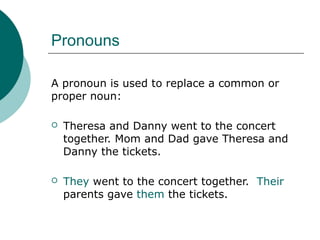
A pronoun is used to replace a common or
proper noun:


Theresa and Danny went to the concert
together. Mom and Dad gave Theresa and
Danny the tickets.



They went to the concert together. Their
parents gave them the tickets.
Pronouns
There are three pronoun cases:


Subject Pronouns: I, you, we, they, he, she, and it




Object Pronouns: me, you, us, them, him, her, and it




These can only be used in the subject position of the sentence.

These can only be used in an object position
 (object of the verb or object of the preposition).

Possessive Pronouns: my/mine, your/yours, our/ours,
their/theirs, his, hers, its


These can only be used when possessive case is required
(PRONOUN + NOUN [my book] or linking verb [This book is mine.])
Verbs
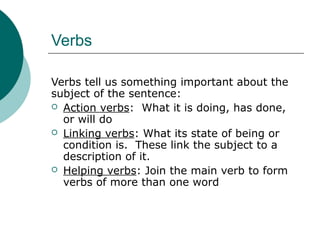
Verbs tell us something important about the
subject of the sentence:
 Action verbs: What it is doing, has done,
or will do
 Linking verbs: What its state of being or
condition is. These link the subject to a
description of it.
 Helping verbs: Join the main verb to form
verbs of more than one word
Verbs
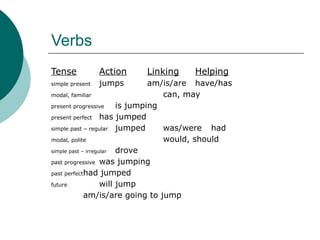
Tense

Action

Helping

am/is/are have/has
modal, familiar
can, may
present progressive
is jumping
present perfect has jumped
simple past – regular jumped
was/were had
modal, polite
would, should
simple past – irregular
drove
past progressive was jumping
past perfecthad jumped
future
will jump
am/is/are going to jump
simple present

jumps

Linking
Adjectives


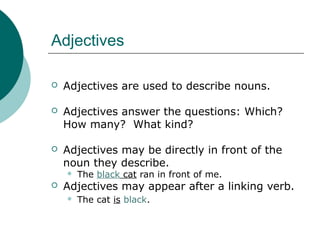
Adjectives are used to describe nouns.



Adjectives answer the questions: Which?
How many? What kind?



Adjectives may be directly in front of the
noun they describe.




The black cat ran in front of me.

Adjectives may appear after a linking verb.


The cat is black.
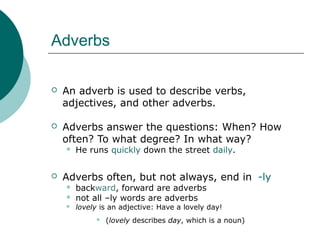
Adverbs


An adverb is used to describe verbs,
adjectives, and other adverbs.



Adverbs answer the questions: When? How
often? To what degree? In what way?




He runs quickly down the street daily.

Adverbs often, but not always, end in -ly




backward, forward are adverbs
not all –ly words are adverbs

lovely is an adjective: Have a lovely day!


(lovely describes day, which is a noun)
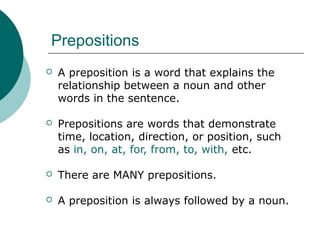
Prepositions


A preposition is a word that explains the
relationship between a noun and other
words in the sentence.



Prepositions are words that demonstrate
time, location, direction, or position, such
as in, on, at, for, from, to, with, etc.



There are MANY prepositions.



A preposition is always followed by a noun.
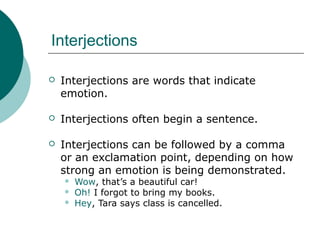
Interjections


Interjections are words that indicate
emotion.



Interjections often begin a sentence.



Interjections can be followed by a comma
or an exclamation point, depending on how
strong an emotion is being demonstrated.




Wow, that’s a beautiful car!
Oh! I forgot to bring my books.
Hey, Tara says class is cancelled.
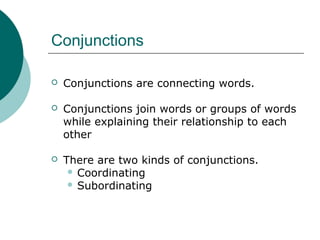
Conjunctions


Conjunctions are connecting words.



Conjunctions join words or groups of words
while explaining their relationship to each
other



There are two kinds of conjunctions.
 Coordinating
 Subordinating
Conjunctions






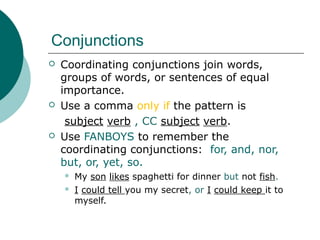
Coordinating conjunctions join words,
groups of words, or sentences of equal
importance.
Use a comma only if the pattern is
subject verb , CC subject verb.
Use FANBOYS to remember the
coordinating conjunctions: for, and, nor,
but, or, yet, so.



My son likes spaghetti for dinner but not fish.
I could tell you my secret, or I could keep it to
myself.
Conjunctions


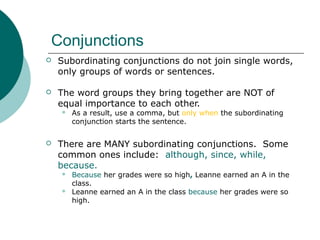
Subordinating conjunctions do not join single words,
only groups of words or sentences.



The word groups they bring together are NOT of
equal importance to each other.




As a result, use a comma, but only when the subordinating
conjunction starts the sentence.

There are MANY subordinating conjunctions. Some
common ones include: although, since, while,
because.



Because her grades were so high, Leanne earned an A in the
class.
Leanne earned an A in the class because her grades were so
high.
That’s it!



Your review of the parts of speech is
complete.

The Parts of Speech

  • 1.
    The Parts ofSpeech A Review Presented by Mrs. Mary Acevedo, M.Ed., TESOL
  • 2.
    Nouns  Nouns are wordsthat name a person, place, object, or idea.  There are several characteristics of nouns:      Common: Common nouns name general categories and begin with a lower-case letter. Proper: Proper nouns are named and must be capitalized. Non-count and Count Nouns: Non-count nouns cannot be counted and therefore have no plural form. Count nouns can be counted and therefore have singular and plural forms.  Plurals can be regular (add –s or –es) or irregular (1 man  2 men, 1 sheep  2 sheep)  Nouns are often preceded by the articles a, an, or the, but sometimes no article should be used.
  • 3.
  • 4.
    Pronouns A pronoun isused to replace a common or proper noun:  Theresa and Danny went to the concert together. Mom and Dad gave Theresa and Danny the tickets.  They went to the concert together. Their parents gave them the tickets.
  • 5.
    Pronouns There are threepronoun cases:  Subject Pronouns: I, you, we, they, he, she, and it   Object Pronouns: me, you, us, them, him, her, and it   These can only be used in the subject position of the sentence. These can only be used in an object position  (object of the verb or object of the preposition). Possessive Pronouns: my/mine, your/yours, our/ours, their/theirs, his, hers, its  These can only be used when possessive case is required (PRONOUN + NOUN [my book] or linking verb [This book is mine.])
  • 6.
    Verbs Verbs tell ussomething important about the subject of the sentence:  Action verbs: What it is doing, has done, or will do  Linking verbs: What its state of being or condition is. These link the subject to a description of it.  Helping verbs: Join the main verb to form verbs of more than one word
  • 7.
    Verbs Tense Action Helping am/is/are have/has modal, familiar can,may present progressive is jumping present perfect has jumped simple past – regular jumped was/were had modal, polite would, should simple past – irregular drove past progressive was jumping past perfecthad jumped future will jump am/is/are going to jump simple present jumps Linking
  • 8.
    Adjectives  Adjectives are usedto describe nouns.  Adjectives answer the questions: Which? How many? What kind?  Adjectives may be directly in front of the noun they describe.   The black cat ran in front of me. Adjectives may appear after a linking verb.  The cat is black.
  • 9.
    Adverbs  An adverb isused to describe verbs, adjectives, and other adverbs.  Adverbs answer the questions: When? How often? To what degree? In what way?   He runs quickly down the street daily. Adverbs often, but not always, end in -ly    backward, forward are adverbs not all –ly words are adverbs lovely is an adjective: Have a lovely day!  (lovely describes day, which is a noun)
  • 10.
    Prepositions  A preposition isa word that explains the relationship between a noun and other words in the sentence.  Prepositions are words that demonstrate time, location, direction, or position, such as in, on, at, for, from, to, with, etc.  There are MANY prepositions.  A preposition is always followed by a noun.
  • 11.
    Interjections  Interjections are wordsthat indicate emotion.  Interjections often begin a sentence.  Interjections can be followed by a comma or an exclamation point, depending on how strong an emotion is being demonstrated.    Wow, that’s a beautiful car! Oh! I forgot to bring my books. Hey, Tara says class is cancelled.
  • 12.
    Conjunctions  Conjunctions are connectingwords.  Conjunctions join words or groups of words while explaining their relationship to each other  There are two kinds of conjunctions.  Coordinating  Subordinating
  • 13.
    Conjunctions    Coordinating conjunctions joinwords, groups of words, or sentences of equal importance. Use a comma only if the pattern is subject verb , CC subject verb. Use FANBOYS to remember the coordinating conjunctions: for, and, nor, but, or, yet, so.   My son likes spaghetti for dinner but not fish. I could tell you my secret, or I could keep it to myself.
  • 14.
    Conjunctions  Subordinating conjunctions donot join single words, only groups of words or sentences.  The word groups they bring together are NOT of equal importance to each other.   As a result, use a comma, but only when the subordinating conjunction starts the sentence. There are MANY subordinating conjunctions. Some common ones include: although, since, while, because.   Because her grades were so high, Leanne earned an A in the class. Leanne earned an A in the class because her grades were so high.
  • 15.
    That’s it!  Your reviewof the parts of speech is complete.