INFINITIVES
In English many verbs can exist in a sentence.


     My cousin lives in a town near here.
In English many verbs can exist in a sentence.


     My cousin lives in a town near here.
In English many verbs can exist in a sentence.


     My cousin lives in a town near here.


          MAIN VERB
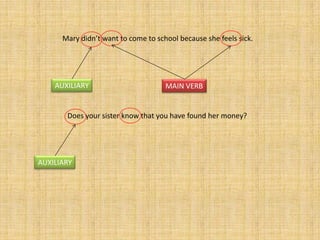
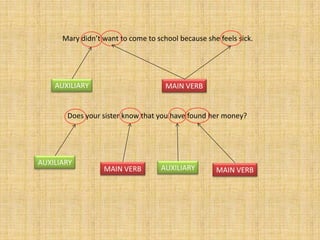
Mary didn’t want to come to school because she feels sick.


AUXILIARY
Mary didn’t want to come to school because she feels sick.


AUXILIARY                        MAIN VERB
Mary didn’t want to come to school because she feels sick.


AUXILIARY                        MAIN VERB


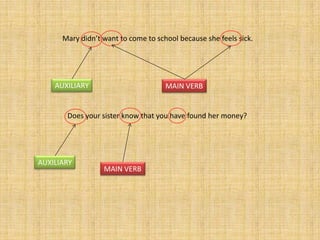
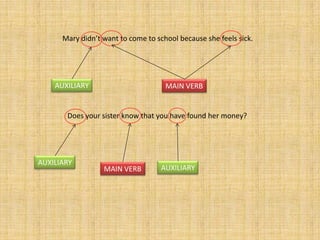
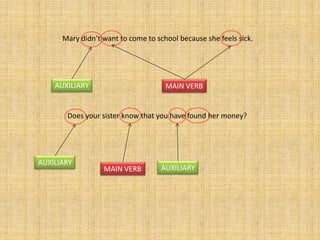
   Does your sister know that you have found her money?
Mary didn’t want to come to school because she feels sick.


AUXILIARY                        MAIN VERB


   Does your sister know that you have found her money?
Mary didn’t want to come to school because she feels sick.


    AUXILIARY                        MAIN VERB


       Does your sister know that you have found her money?


AUXILIARY
Mary didn’t want to come to school because she feels sick.


    AUXILIARY                        MAIN VERB


       Does your sister know that you have found her money?


AUXILIARY
Mary didn’t want to come to school because she feels sick.


    AUXILIARY                        MAIN VERB


       Does your sister know that you have found her money?


AUXILIARY
                  MAIN VERB
Mary didn’t want to come to school because she feels sick.


    AUXILIARY                        MAIN VERB


       Does your sister know that you have found her money?


AUXILIARY
                  MAIN VERB
Mary didn’t want to come to school because she feels sick.


    AUXILIARY                        MAIN VERB


       Does your sister know that you have found her money?


AUXILIARY
                  MAIN VERB         AUXILIARY
Mary didn’t want to come to school because she feels sick.


    AUXILIARY                        MAIN VERB


       Does your sister know that you have found her money?


AUXILIARY
                  MAIN VERB         AUXILIARY
Mary didn’t want to come to school because she feels sick.


    AUXILIARY                        MAIN VERB


       Does your sister know that you have found her money?


AUXILIARY
                  MAIN VERB         AUXILIARY       MAIN VERB
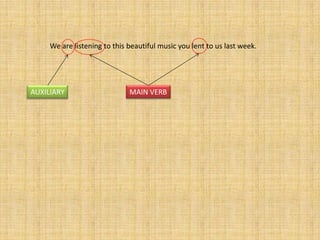
We are listening to this beautiful music you lent to us last week.


AUXILIARY
We are listening to this beautiful music you lent to us last week.


AUXILIARY                     MAIN VERB
We are listening to this beautiful music you lent to us last week.


AUXILIARY                     MAIN VERB


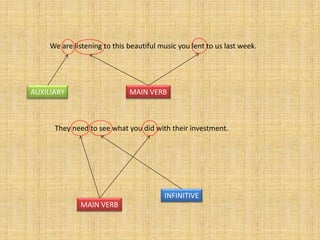
      They need to see what you did with their investment.
We are listening to this beautiful music you lent to us last week.


AUXILIARY                     MAIN VERB


      They need to see what you did with their investment.


              MAIN VERB
We are listening to this beautiful music you lent to us last week.


AUXILIARY                     MAIN VERB


      They need to see what you did with their investment.


                                         INFINITIVE
              MAIN VERB
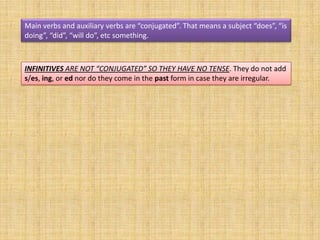
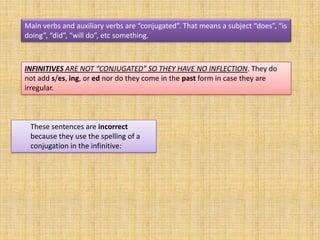
Main verbs and auxiliary verbs are “conjugated”. That means a subject “does”, “is
doing”, “did”, “will do”, etc something.
Main verbs and auxiliary verbs are “conjugated”. That means a subject “does”, “is
doing”, “did”, “will do”, etc something.


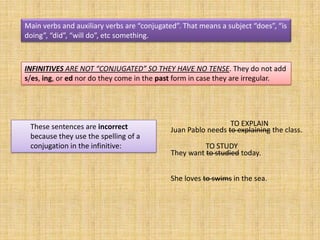
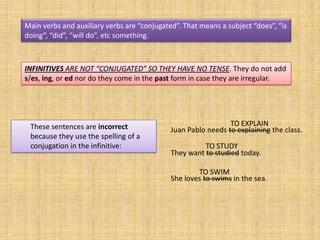
INFINITIVES ARE NOT “CONJUGATED” SO THEY HAVE NO TENSE. They do not add
s/es, ing, or ed nor do they come in the past form in case they are irregular.
Main verbs and auxiliary verbs are “conjugated”. That means a subject “does”, “is
doing”, “did”, “will do”, etc something.


INFINITIVES ARE NOT “CONJUGATED” SO THEY HAVE NO INFLECTION. They do
not add s/es, ing, or ed nor do they come in the past form in case they are
irregular.


 These sentences are incorrect
 because they use the spelling of a
 conjugation in the infinitive:
Main verbs and auxiliary verbs are “conjugated”. That means a subject “does”, “is
doing”, “did”, “will do”, etc something.


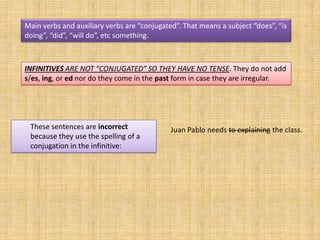
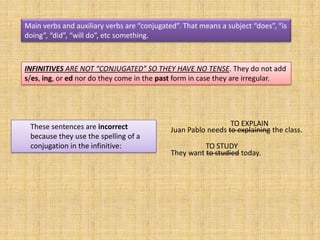
INFINITIVES ARE NOT “CONJUGATED” SO THEY HAVE NO TENSE. They do not add
s/es, ing, or ed nor do they come in the past form in case they are irregular.


 These sentences are incorrect               Juan Pablo needs to explaining the class.
 because they use the spelling of a
 conjugation in the infinitive:
Main verbs and auxiliary verbs are “conjugated”. That means a subject “does”, “is
doing”, “did”, “will do”, etc something.


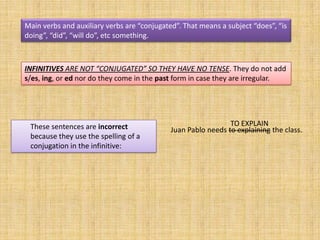
INFINITIVES ARE NOT “CONJUGATED” SO THEY HAVE NO TENSE. They do not add
s/es, ing, or ed nor do they come in the past form in case they are irregular.


 These sentences are incorrect                                 TO EXPLAIN
                                             Juan Pablo needs to explaining the class.
 because they use the spelling of a
 conjugation in the infinitive:
Main verbs and auxiliary verbs are “conjugated”. That means a subject “does”, “is
doing”, “did”, “will do”, etc something.


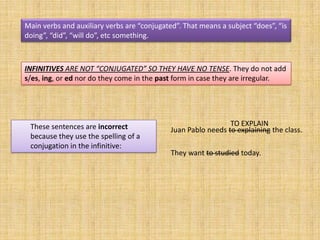
INFINITIVES ARE NOT “CONJUGATED” SO THEY HAVE NO TENSE. They do not add
s/es, ing, or ed nor do they come in the past form in case they are irregular.


 These sentences are incorrect                                 TO EXPLAIN
                                             Juan Pablo needs to explaining the class.
 because they use the spelling of a
 conjugation in the infinitive:
                                             They want to studied today.
Main verbs and auxiliary verbs are “conjugated”. That means a subject “does”, “is
doing”, “did”, “will do”, etc something.


INFINITIVES ARE NOT “CONJUGATED” SO THEY HAVE NO TENSE. They do not add
s/es, ing, or ed nor do they come in the past form in case they are irregular.


 These sentences are incorrect                                 TO EXPLAIN
                                             Juan Pablo needs to explaining the class.
 because they use the spelling of a
 conjugation in the infinitive:                        TO STUDY
                                             They want to studied today.
Main verbs and auxiliary verbs are “conjugated”. That means a subject “does”, “is
doing”, “did”, “will do”, etc something.


INFINITIVES ARE NOT “CONJUGATED” SO THEY HAVE NO TENSE. They do not add
s/es, ing, or ed nor do they come in the past form in case they are irregular.


 These sentences are incorrect                                 TO EXPLAIN
                                             Juan Pablo needs to explaining the class.
 because they use the spelling of a
 conjugation in the infinitive:                        TO STUDY
                                             They want to studied today.


                                             She loves to swims in the sea.
Main verbs and auxiliary verbs are “conjugated”. That means a subject “does”, “is
doing”, “did”, “will do”, etc something.


INFINITIVES ARE NOT “CONJUGATED” SO THEY HAVE NO TENSE. They do not add
s/es, ing, or ed nor do they come in the past form in case they are irregular.


 These sentences are incorrect                                 TO EXPLAIN
                                             Juan Pablo needs to explaining the class.
 because they use the spelling of a
 conjugation in the infinitive:                        TO STUDY
                                             They want to studied today.

                                                     TO SWIM
                                             She loves to swims in the sea.
The only exception, where a verb that comes after a “to” uses ing, is when using the
expressions are:
The only exception, where a verb that comes after a “to” uses ing, is when using the
expressions are:


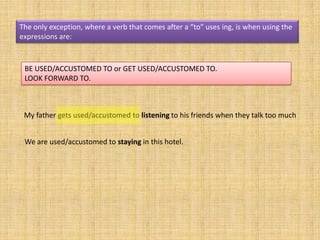
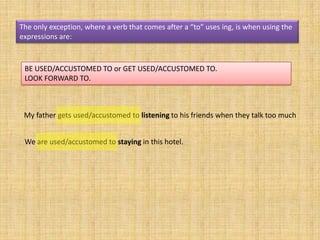
 BE USED/ACCUSTOMED TO or GET USED/ACCUSTOMED TO.
 LOOK FORWARD TO.
The only exception, where a verb that comes after a “to” uses ing, is when using the
expressions are:


 BE USED/ACCUSTOMED TO or GET USED/ACCUSTOMED TO.
 LOOK FORWARD TO.


 My father gets used/accustomed to listening to his friends when they talk too much
The only exception, where a verb that comes after a “to” uses ing, is when using the
expressions are:


 BE USED/ACCUSTOMED TO or GET USED/ACCUSTOMED TO.
 LOOK FORWARD TO.


 My father gets used/accustomed to listening to his friends when they talk too much
The only exception, where a verb that comes after a “to” uses ing, is when using the
expressions are:


 BE USED/ACCUSTOMED TO or GET USED/ACCUSTOMED TO.
 LOOK FORWARD TO.


 My father gets used/accustomed to listening to his friends when they talk too much


 We are used/accustomed to staying in this hotel.
The only exception, where a verb that comes after a “to” uses ing, is when using the
expressions are:


 BE USED/ACCUSTOMED TO or GET USED/ACCUSTOMED TO.
 LOOK FORWARD TO.


 My father gets used/accustomed to listening to his friends when they talk too much


 We are used/accustomed to staying in this hotel.
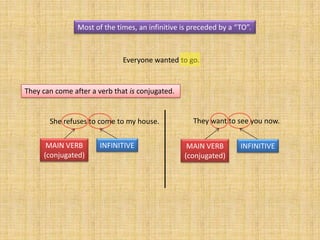
Most of the times, an infinitive is preceded by a “TO”.


              Everyone wanted to go.
Most of the times, an infinitive is preceded by a “TO”.


              Everyone wanted to go.
Most of the times, an infinitive is preceded by a “TO”.


                              Everyone wanted to go.


They can come after a verb that is conjugated.
Most of the times, an infinitive is preceded by a “TO”.


                              Everyone wanted to go.


They can come after a verb that is conjugated.

       She refuses to come to my house.

Most of the times, an infinitive is preceded by a “TO”.


                              Everyone wanted to go.


They can come after a verb that is conjugated.


       She refuses to come to my house.


      MAIN VERB        INFINITIVE
     (conjugated)
Most of the times, an infinitive is preceded by a “TO”.


                              Everyone wanted to go.


They can come after a verb that is conjugated.


       She refuses to come to my house.


      MAIN VERB        INFINITIVE
     (conjugated)
Most of the times, an infinitive is preceded by a “TO”.


                              Everyone wanted to go.


They can come after a verb that is conjugated.


       She refuses to come to my house.             They want to see you now.


      MAIN VERB        INFINITIVE
     (conjugated)
Most of the times, an infinitive is preceded by a “TO”.


                              Everyone wanted to go.


They can come after a verb that is conjugated.


       She refuses to come to my house.             They want to see you now.


      MAIN VERB        INFINITIVE                 MAIN VERB        INFINITIVE
     (conjugated)                                (conjugated)
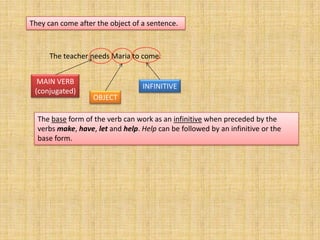
They can come after the object of a sentence.


      The teacher needs Maria to come.
They can come after the object of a sentence.


      The teacher needs Maria to come.


  MAIN VERB
 (conjugated)
They can come after the object of a sentence.


      The teacher needs Maria to come.


  MAIN VERB
 (conjugated)
                   OBJECT
They can come after the object of a sentence.


      The teacher needs Maria to come.


  MAIN VERB
                                  INFINITIVE
 (conjugated)
                   OBJECT
They can come after the object of a sentence.


      The teacher needs Maria to come.


  MAIN VERB
                                  INFINITIVE
 (conjugated)
                   OBJECT

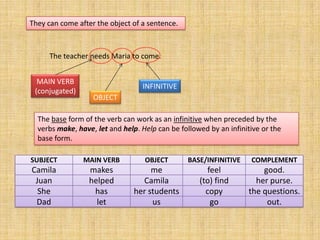
  The base form of the verb can work as an infinitive when preceded by the
  verbs make, have, let and help. Help can be followed by an infinitive or the
  base form.
They can come after the object of a sentence.


      The teacher needs Maria to come.


  MAIN VERB
                                  INFINITIVE
 (conjugated)
                   OBJECT

  The base form of the verb can work as an infinitive when preceded by the
  verbs make, have, let and help. Help can be followed by an infinitive or the
  base form.

SUBJECT         MAIN VERB          OBJECT       BASE/INFINITIVE     COMPLEMENT
Camila            makes              me                feel            good.
 Juan             helped          Camila            (to) find        her purse.
  She              has          her students          copy         the questions.
 Dad                let              us                 go              out.

Infinitives presentation slide share

  • 1.
  • 2.
    In English manyverbs can exist in a sentence.
  • 3.
    In English manyverbs can exist in a sentence. My cousin lives in a town near here.
  • 4.
    In English manyverbs can exist in a sentence. My cousin lives in a town near here.
  • 5.
    In English manyverbs can exist in a sentence. My cousin lives in a town near here. MAIN VERB
  • 6.
    Mary didn’t wantto come to school because she feels sick.
  • 7.
    Mary didn’t wantto come to school because she feels sick.
  • 8.
    Mary didn’t wantto come to school because she feels sick.
  • 9.
    Mary didn’t wantto come to school because she feels sick.
  • 10.
    Mary didn’t wantto come to school because she feels sick. AUXILIARY
  • 11.
    Mary didn’t wantto come to school because she feels sick. AUXILIARY MAIN VERB
  • 12.
    Mary didn’t wantto come to school because she feels sick. AUXILIARY MAIN VERB Does your sister know that you have found her money?
  • 13.
    Mary didn’t wantto come to school because she feels sick. AUXILIARY MAIN VERB Does your sister know that you have found her money?
  • 14.
    Mary didn’t wantto come to school because she feels sick. AUXILIARY MAIN VERB Does your sister know that you have found her money? AUXILIARY
  • 15.
    Mary didn’t wantto come to school because she feels sick. AUXILIARY MAIN VERB Does your sister know that you have found her money? AUXILIARY
  • 16.
    Mary didn’t wantto come to school because she feels sick. AUXILIARY MAIN VERB Does your sister know that you have found her money? AUXILIARY MAIN VERB
  • 17.
    Mary didn’t wantto come to school because she feels sick. AUXILIARY MAIN VERB Does your sister know that you have found her money? AUXILIARY MAIN VERB
  • 18.
    Mary didn’t wantto come to school because she feels sick. AUXILIARY MAIN VERB Does your sister know that you have found her money? AUXILIARY MAIN VERB AUXILIARY
  • 19.
    Mary didn’t wantto come to school because she feels sick. AUXILIARY MAIN VERB Does your sister know that you have found her money? AUXILIARY MAIN VERB AUXILIARY
  • 20.
    Mary didn’t wantto come to school because she feels sick. AUXILIARY MAIN VERB Does your sister know that you have found her money? AUXILIARY MAIN VERB AUXILIARY MAIN VERB
  • 21.
    We are listeningto this beautiful music you lent to us last week.
  • 22.
    We are listeningto this beautiful music you lent to us last week.
  • 23.
    We are listeningto this beautiful music you lent to us last week.
  • 24.
    We are listeningto this beautiful music you lent to us last week.
  • 25.
    We are listeningto this beautiful music you lent to us last week. AUXILIARY
  • 26.
    We are listeningto this beautiful music you lent to us last week. AUXILIARY MAIN VERB
  • 27.
    We are listeningto this beautiful music you lent to us last week. AUXILIARY MAIN VERB They need to see what you did with their investment.
  • 28.
    We are listeningto this beautiful music you lent to us last week. AUXILIARY MAIN VERB They need to see what you did with their investment. MAIN VERB
  • 29.
    We are listeningto this beautiful music you lent to us last week. AUXILIARY MAIN VERB They need to see what you did with their investment. INFINITIVE MAIN VERB
  • 30.
    Main verbs andauxiliary verbs are “conjugated”. That means a subject “does”, “is doing”, “did”, “will do”, etc something.
  • 31.
    Main verbs andauxiliary verbs are “conjugated”. That means a subject “does”, “is doing”, “did”, “will do”, etc something. INFINITIVES ARE NOT “CONJUGATED” SO THEY HAVE NO TENSE. They do not add s/es, ing, or ed nor do they come in the past form in case they are irregular.
  • 32.
    Main verbs andauxiliary verbs are “conjugated”. That means a subject “does”, “is doing”, “did”, “will do”, etc something. INFINITIVES ARE NOT “CONJUGATED” SO THEY HAVE NO INFLECTION. They do not add s/es, ing, or ed nor do they come in the past form in case they are irregular. These sentences are incorrect because they use the spelling of a conjugation in the infinitive:
  • 33.
    Main verbs andauxiliary verbs are “conjugated”. That means a subject “does”, “is doing”, “did”, “will do”, etc something. INFINITIVES ARE NOT “CONJUGATED” SO THEY HAVE NO TENSE. They do not add s/es, ing, or ed nor do they come in the past form in case they are irregular. These sentences are incorrect Juan Pablo needs to explaining the class. because they use the spelling of a conjugation in the infinitive:
  • 34.
    Main verbs andauxiliary verbs are “conjugated”. That means a subject “does”, “is doing”, “did”, “will do”, etc something. INFINITIVES ARE NOT “CONJUGATED” SO THEY HAVE NO TENSE. They do not add s/es, ing, or ed nor do they come in the past form in case they are irregular. These sentences are incorrect TO EXPLAIN Juan Pablo needs to explaining the class. because they use the spelling of a conjugation in the infinitive:
  • 35.
    Main verbs andauxiliary verbs are “conjugated”. That means a subject “does”, “is doing”, “did”, “will do”, etc something. INFINITIVES ARE NOT “CONJUGATED” SO THEY HAVE NO TENSE. They do not add s/es, ing, or ed nor do they come in the past form in case they are irregular. These sentences are incorrect TO EXPLAIN Juan Pablo needs to explaining the class. because they use the spelling of a conjugation in the infinitive: They want to studied today.
  • 36.
    Main verbs andauxiliary verbs are “conjugated”. That means a subject “does”, “is doing”, “did”, “will do”, etc something. INFINITIVES ARE NOT “CONJUGATED” SO THEY HAVE NO TENSE. They do not add s/es, ing, or ed nor do they come in the past form in case they are irregular. These sentences are incorrect TO EXPLAIN Juan Pablo needs to explaining the class. because they use the spelling of a conjugation in the infinitive: TO STUDY They want to studied today.
  • 37.
    Main verbs andauxiliary verbs are “conjugated”. That means a subject “does”, “is doing”, “did”, “will do”, etc something. INFINITIVES ARE NOT “CONJUGATED” SO THEY HAVE NO TENSE. They do not add s/es, ing, or ed nor do they come in the past form in case they are irregular. These sentences are incorrect TO EXPLAIN Juan Pablo needs to explaining the class. because they use the spelling of a conjugation in the infinitive: TO STUDY They want to studied today. She loves to swims in the sea.
  • 38.
    Main verbs andauxiliary verbs are “conjugated”. That means a subject “does”, “is doing”, “did”, “will do”, etc something. INFINITIVES ARE NOT “CONJUGATED” SO THEY HAVE NO TENSE. They do not add s/es, ing, or ed nor do they come in the past form in case they are irregular. These sentences are incorrect TO EXPLAIN Juan Pablo needs to explaining the class. because they use the spelling of a conjugation in the infinitive: TO STUDY They want to studied today. TO SWIM She loves to swims in the sea.
  • 39.
    The only exception,where a verb that comes after a “to” uses ing, is when using the expressions are:
  • 40.
    The only exception,where a verb that comes after a “to” uses ing, is when using the expressions are: BE USED/ACCUSTOMED TO or GET USED/ACCUSTOMED TO. LOOK FORWARD TO.
  • 41.
    The only exception,where a verb that comes after a “to” uses ing, is when using the expressions are: BE USED/ACCUSTOMED TO or GET USED/ACCUSTOMED TO. LOOK FORWARD TO. My father gets used/accustomed to listening to his friends when they talk too much
  • 42.
    The only exception,where a verb that comes after a “to” uses ing, is when using the expressions are: BE USED/ACCUSTOMED TO or GET USED/ACCUSTOMED TO. LOOK FORWARD TO. My father gets used/accustomed to listening to his friends when they talk too much
  • 43.
    The only exception,where a verb that comes after a “to” uses ing, is when using the expressions are: BE USED/ACCUSTOMED TO or GET USED/ACCUSTOMED TO. LOOK FORWARD TO. My father gets used/accustomed to listening to his friends when they talk too much We are used/accustomed to staying in this hotel.
  • 44.
    The only exception,where a verb that comes after a “to” uses ing, is when using the expressions are: BE USED/ACCUSTOMED TO or GET USED/ACCUSTOMED TO. LOOK FORWARD TO. My father gets used/accustomed to listening to his friends when they talk too much We are used/accustomed to staying in this hotel.
  • 45.
    Most of thetimes, an infinitive is preceded by a “TO”.
  • 46.
    Most of thetimes, an infinitive is preceded by a “TO”. Everyone wanted to go.
  • 47.
    Most of thetimes, an infinitive is preceded by a “TO”. Everyone wanted to go.
  • 48.
    Most of thetimes, an infinitive is preceded by a “TO”. Everyone wanted to go. They can come after a verb that is conjugated.
  • 49.
    Most of thetimes, an infinitive is preceded by a “TO”. Everyone wanted to go. They can come after a verb that is conjugated. She refuses to come to my house.
  • 50.
    Most of thetimes, an infinitive is preceded by a “TO”. Everyone wanted to go. They can come after a verb that is conjugated. She refuses to come to my house. MAIN VERB INFINITIVE (conjugated)
  • 51.
    Most of thetimes, an infinitive is preceded by a “TO”. Everyone wanted to go. They can come after a verb that is conjugated. She refuses to come to my house. MAIN VERB INFINITIVE (conjugated)
  • 52.
    Most of thetimes, an infinitive is preceded by a “TO”. Everyone wanted to go. They can come after a verb that is conjugated. She refuses to come to my house. They want to see you now. MAIN VERB INFINITIVE (conjugated)
  • 53.
    Most of thetimes, an infinitive is preceded by a “TO”. Everyone wanted to go. They can come after a verb that is conjugated. She refuses to come to my house. They want to see you now. MAIN VERB INFINITIVE MAIN VERB INFINITIVE (conjugated) (conjugated)
  • 54.
    They can comeafter the object of a sentence.
  • 55.
    They can comeafter the object of a sentence. The teacher needs Maria to come.
  • 56.
    They can comeafter the object of a sentence. The teacher needs Maria to come. MAIN VERB (conjugated)
  • 57.
    They can comeafter the object of a sentence. The teacher needs Maria to come. MAIN VERB (conjugated) OBJECT
  • 58.
    They can comeafter the object of a sentence. The teacher needs Maria to come. MAIN VERB INFINITIVE (conjugated) OBJECT
  • 59.
    They can comeafter the object of a sentence. The teacher needs Maria to come. MAIN VERB INFINITIVE (conjugated) OBJECT The base form of the verb can work as an infinitive when preceded by the verbs make, have, let and help. Help can be followed by an infinitive or the base form.
  • 60.
    They can comeafter the object of a sentence. The teacher needs Maria to come. MAIN VERB INFINITIVE (conjugated) OBJECT The base form of the verb can work as an infinitive when preceded by the verbs make, have, let and help. Help can be followed by an infinitive or the base form. SUBJECT MAIN VERB OBJECT BASE/INFINITIVE COMPLEMENT Camila makes me feel good. Juan helped Camila (to) find her purse. She has her students copy the questions. Dad let us go out.