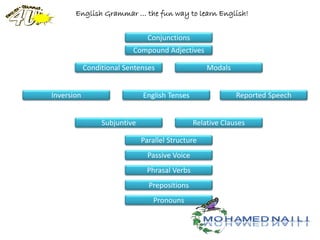
English Grammar … the fun way to learn English!
Subjuntive
Compound Adjectives
English Tenses
Modals
Passive Voice
Pronouns
Conjunctions
Phrasal Verbs
Prepositions
Inversion Reported Speech
Conditional Sentenses
Parallel Structure
Relative Clauses
Graphic Comparison
Simple Present
Present Progressive
Simple Past
Past Progressive
Present Perfect Simpl
Present Perfect Progr
Past Perfect Simple
Past Perfect Progress
Future
Conditionals
English Grammar … the fun way to learn English!
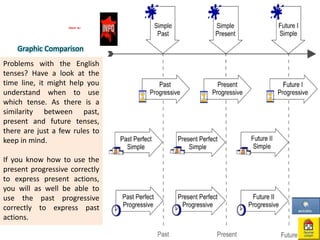
Problems with the English
tenses? Have a look at the
time line, it might help you
understand when to use
which tense. As there is a
similarity between past,
present and future tenses,
there are just a few rules to
keep in mind.
If you know how to use the
present progressive correctly
to express present actions,
you will as well be able to
use the past progressive
correctly to express past
actions.
Graphic Comparison
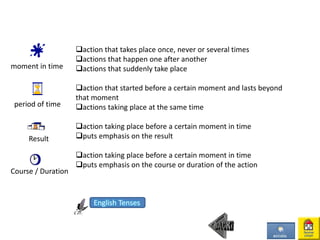
action that takes place once, never or several times
actions that happen one after another
actions that suddenly take place
action that started before a certain moment and lasts beyond
that moment
actions taking place at the same time
action taking place before a certain moment in time
puts emphasis on the result
action taking place before a certain moment in time
puts emphasis on the course or duration of the action
moment in time
period of time
Result
Course / Duration
English Tenses
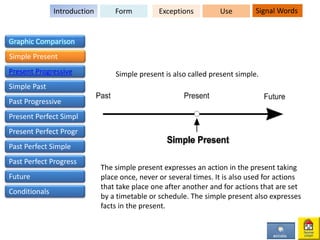
Simple present is also called present simple.
The simple present expresses an action in the present taking
place once, never or several times. It is also used for actions
that take place one after another and for actions that are set
by a timetable or schedule. The simple present also expresses
facts in the present.
FormIntroduction Use Signal WordsExceptions
Graphic Comparison
Simple Present
Present Progressive
Simple Past
Past Progressive
Present Perfect Simpl
Present Perfect Progr
Past Perfect Simple
Past Perfect Progress
Future
Conditionals
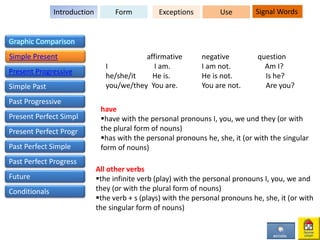
affirmative negative question
I I am. I am not. Am I?
he/she/it He is. He is not. Is he?
you/we/they You are. You are not. Are you?
have
have with the personal pronouns I, you, we und they (or with
the plural form of nouns)
has with the personal pronouns he, she, it (or with the singular
form of nouns)
All other verbs
the infinite verb (play) with the personal pronouns I, you, we and
they (or with the plural form of nouns)
the verb + s (plays) with the personal pronouns he, she, it (or with
the singular form of nouns)
Introduction Form Exceptions Use Signal Words
Graphic Comparison
Simple Present
Present Progressive
Simple Past
Past Progressive
Present Perfect Simpl
Present Perfect Progr
Past Perfect Simple
Past Perfect Progress
Future
Conditionals
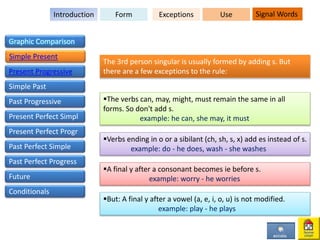
The 3rd person singular is usually formed by adding s. But
there are a few exceptions to the rule:
The verbs can, may, might, must remain the same in all
forms. So don't add s.
example: he can, she may, it must
Verbs ending in o or a sibilant (ch, sh, s, x) add es instead of s.
example: do - he does, wash - she washes
A final y after a consonant becomes ie before s.
example: worry - he worries
But: A final y after a vowel (a, e, i, o, u) is not modified.
example: play - he plays
FormIntroduction Exceptions Use Signal Words
Graphic Comparison
Simple Present
Present Progressive
Simple Past
Past Progressive
Present Perfect Simpl
Present Perfect Progr
Past Perfect Simple
Past Perfect Progress
Future
Conditionals
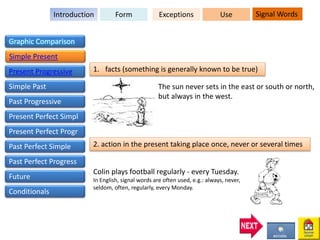
1. facts (something is generally known to be true)
The sun never sets in the east or south or north,
but always in the west.
2. action in the present taking place once, never or several times
Colin plays football regularly - every Tuesday.
In English, signal words are often used, e.g.: always, never,
seldom, often, regularly, every Monday.
FormIntroduction Exceptions Signal WordsUse
Graphic Comparison
Simple Present
Present Progressive
Simple Past
Past Progressive
Present Perfect Simpl
Present Perfect Progr
Past Perfect Simple
Past Perfect Progress
Future
Conditionals
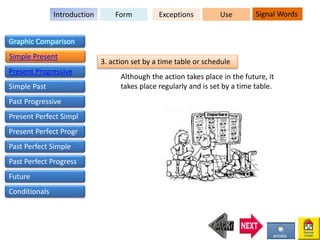
3. action set by a time table or schedule
Although the action takes place in the future, it
takes place regularly and is set by a time table.
FormIntroduction Exceptions Signal WordsUse
Graphic Comparison
Simple Present
Present Progressive
Simple Past
Past Progressive
Present Perfect Simpl
Present Perfect Progr
Past Perfect Simple
Past Perfect Progress
Future
Conditionals
4. verbs expressing states, possession, senses, emotions
and mental activity
When you love someone, that's a state, a fact or emotion, but
not an action (like running for example). Whenever you want
to express a state, possession, sense or emotions, use the
simple form (not the progressive). The following words all
belong to this group:
•be (state)
•believe (mental activity)
•belong (possession)
•hate (feeling and emotion)
•hear (senses)
•like (feeling and emotion)
FormIntroduction Exceptions Signal WordsUse
Graphic Comparison
Simple Present
Present Progressive
Simple Past
Past Progressive
Present Perfect Simpl
Present Perfect Progr
Past Perfect Simple
Past Perfect Progress
Future
Conditionals
•love (feeling and emotion)
•mean (mental activity)
•prefer (mental activity)
•remain (state)
•realize (mental activity)
•see (senses)
•seem (feeling and emotion)
•smell (senses)
•think (mental activity)
•understand (mental activity)
•want (feeling and emotion)
•wish (feeling and emotion)
FormIntroduction Exceptions Use Signal Words
Graphic Comparison
Simple Present
Present Progressive
Simple Past
Past Progressive
Present Perfect Simpl
Present Perfect Progr
Past Perfect Simple
Past Perfect Progress
Future
Conditionals
Signal Words
always
every ...
often
normally
usually
sometimes
seldom
never
FormIntroduction Exceptions Use Signal Words
Graphic Comparison
Simple Present
Present Progressive
Simple Past
Past Progressive
Present Perfect Simpl
Present Perfect Progr
Past Perfect Simple
Past Perfect Progress
Future
Conditionals
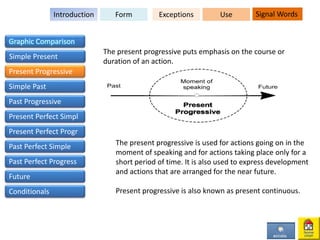
The present progressive puts emphasis on the course or
duration of an action.
The present progressive is used for actions going on in the
moment of speaking and for actions taking place only for a
short period of time. It is also used to express development
and actions that are arranged for the near future.
Present progressive is also known as present continuous.
FormIntroduction Exceptions Use Signal Words
Graphic Comparison
Simple Present
Present Progressive
Simple Past
Past Progressive
Present Perfect Simpl
Present Perfect Progr
Past Perfect Simple
Past Perfect Progress
Future
Conditionals
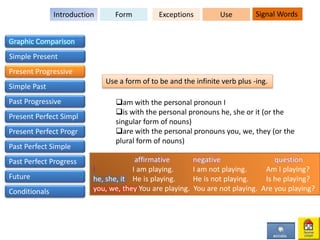
Use a form of to be and the infinite verb plus -ing.
am with the personal pronoun I
is with the personal pronouns he, she or it (or the
singular form of nouns)
are with the personal pronouns you, we, they (or the
plural form of nouns)
affirmative negative question
I I am playing. I am not playing. Am I playing?
he, she, it He is playing. He is not playing. Is he playing?
you, we, they You are playing. You are not playing. Are you playing?
FormIntroduction Exceptions Use Signal Words
Graphic Comparison
Simple Present
Present Progressive
Simple Past
Past Progressive
Present Perfect Simpl
Present Perfect Progr
Past Perfect Simple
Past Perfect Progress
Future
Conditionals
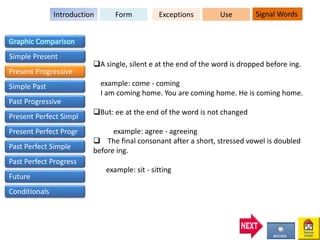
A single, silent e at the end of the word is dropped before ing.
example: come - coming
I am coming home. You are coming home. He is coming home.
But: ee at the end of the word is not changed
example: agree - agreeing
 The final consonant after a short, stressed vowel is doubled
before ing.
example: sit - sitting
FormIntroduction Exceptions Use Signal Words
Graphic Comparison
Simple Present
Present Progressive
Simple Past
Past Progressive
Present Perfect Simpl
Present Perfect Progr
Past Perfect Simple
Past Perfect Progress
Future
Conditionals
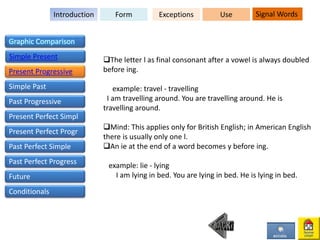
The letter l as final consonant after a vowel is always doubled
before ing.
example: travel - travelling
I am travelling around. You are travelling around. He is
travelling around.
Mind: This applies only for British English; in American English
there is usually only one l.
An ie at the end of a word becomes y before ing.
example: lie - lying
I am lying in bed. You are lying in bed. He is lying in bed.
FormIntroduction Exceptions Use Signal Words
Graphic Comparison
Simple Present
Present Progressive
Simple Past
Past Progressive
Present Perfect Simpl
Present Perfect Progr
Past Perfect Simple
Past Perfect Progress
Future
Conditionals
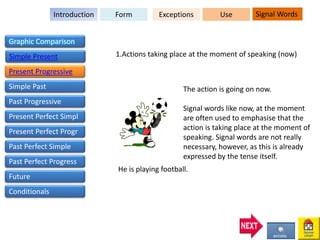
1.Actions taking place at the moment of speaking (now)
The action is going on now.
Signal words like now, at the moment
are often used to emphasise that the
action is taking place at the moment of
speaking. Signal words are not really
necessary, however, as this is already
expressed by the tense itself.
He is playing football.
FormIntroduction Exceptions Signal WordsUse
Graphic Comparison
Simple Present
Present Progressive
Simple Past
Past Progressive
Present Perfect Simpl
Present Perfect Progr
Past Perfect Simple
Past Perfect Progress
Future
Conditionals
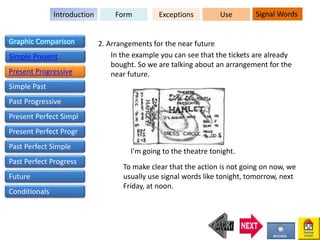
In the example you can see that the tickets are already
bought. So we are talking about an arrangement for the
near future.
I'm going to the theatre tonight.
2. Arrangements for the near future
To make clear that the action is not going on now, we
usually use signal words like tonight, tomorrow, next
Friday, at noon.
FormIntroduction Exceptions Signal WordsUse
Graphic Comparison
Simple Present
Present Progressive
Simple Past
Past Progressive
Present Perfect Simpl
Present Perfect Progr
Past Perfect Simple
Past Perfect Progress
Future
Conditionals
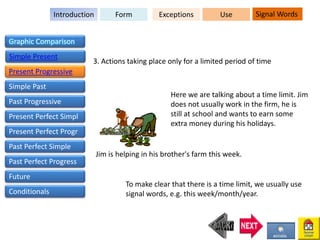
Here we are talking about a time limit. Jim
does not usually work in the firm, he is
still at school and wants to earn some
extra money during his holidays.
3. Actions taking place only for a limited period of time
Jim is helping in his brother's farm this week.
To make clear that there is a time limit, we usually use
signal words, e.g. this week/month/year.
FormIntroduction Exceptions Signal WordsUse
Graphic Comparison
Simple Present
Present Progressive
Simple Past
Past Progressive
Present Perfect Simpl
Present Perfect Progr
Past Perfect Simple
Past Perfect Progress
Future
Conditionals
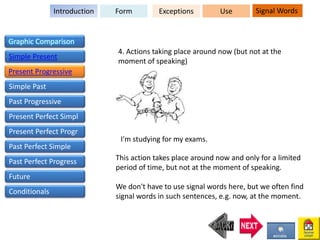
This action takes place around now and only for a limited
period of time, but not at the moment of speaking.
We don't have to use signal words here, but we often find
signal words in such sentences, e.g. now, at the moment.
4. Actions taking place around now (but not at the
moment of speaking)
I'm studying for my exams.
FormIntroduction Exceptions Signal WordsUse
Graphic Comparison
Simple Present
Present Progressive
Simple Past
Past Progressive
Present Perfect Simpl
Present Perfect Progr
Past Perfect Simple
Past Perfect Progress
Future
Conditionals
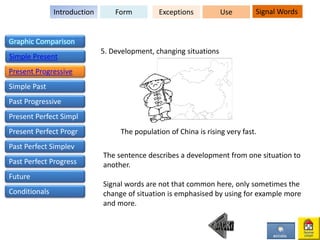
The sentence describes a development from one situation to
another.
Signal words are not that common here, only sometimes the
change of situation is emphasised by using for example more
and more.
5. Development, changing situations
The population of China is rising very fast.
FormIntroduction Exceptions Use Signal Words
Graphic Comparison
Simple Present
Present Progressive
Simple Past
Past Progressive
Present Perfect Simpl
Present Perfect Progr
Past Perfect Simplev
Past Perfect Progress
Future
Conditionals
FormIntroduction Exceptions Use Signal Words
Actions taking place at the moment of speaking (now)
at the moment
now / just now / right now
Listen!
Look!
Arrangements for the near future
•in the morning / in the afternoon / in the evening
•at noon / tonight
•tomorrow
•next ...
Graphic Comparison
Simple Present
Present Progressive
Simple Past
Past Progressive
Present Perfect Simpl
Present Perfect Progr
Past Perfect Simple
Past Perfect Progress
Future
Conditionals
Actions taking place only for a limited period of time
othis week / this month / this year
Actions taking place around now (but not at the
moment of speaking)
at the moment
now / just now / right now
Development, changing situations
more and more
FormIntroduction Exceptions Use Signal Words
Graphic Comparison
Simple Present
Present Progressive
Simple Past
Past Progressive
Present Perfect Simpl
Present Perfect Progr
Past Perfect Simple
Past Perfect Progress
Future
Conditionals
Graphic Comparison
Simple Present
Present Progressive
The simple past expresses an action in the past taking place
once, never, several times. It can also be used for actions
taking place one after another or in the middle of another
action.
For irregular verbs, use the past form (see list of irregular
verbs, 2nd column). For regular verbs, just add “ed”.
Form of Simple Past
Positive Negative Question
I spoke. I did not speak. Did I speak?
Simple Past
UseExceptions Signal words
Past Progressive
Present Perfect Simpl
Present Perfect Progr
Past Perfect Simple
Past Perfect Progress
Future
Conditionals
Graphic Comparison
Simple Present
Present Progressive
Simple Past
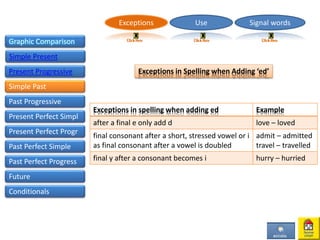
Exceptions in Spelling when Adding ‘ed’
Exceptions in spelling when adding ed Example
after a final e only add d love – loved
final consonant after a short, stressed vowel or i
as final consonant after a vowel is doubled
admit – admitted
travel – travelled
final y after a consonant becomes i hurry – hurried
UseExceptions Signal words
Past Progressive
Present Perfect Simpl
Present Perfect Progr
Past Perfect Simple
Past Perfect Progress
Future
Conditionals
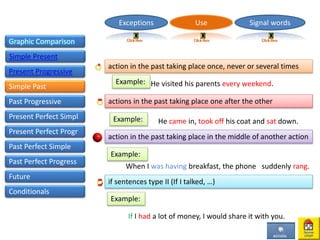
action in the past taking place once, never or several times
He visited his parents every weekend.
actions in the past taking place one after the other
He came in, took off his coat and sat down.
action in the past taking place in the middle of another action
When I was having breakfast, the phone suddenly rang.
if sentences type II (If I talked, …)
If I had a lot of money, I would share it with you.
Example:
UseExceptions Signal words
Graphic Comparison
Simple Present
Present Progressive
Simple Past
Example:
Example:
Example:
Past Progressive
Present Perfect Simpl
Present Perfect Progr
Past Perfect Simple
Past Perfect Progress
Future
Conditionals
Graphic Comparison
Simple Present
Present Progressive
Simple Past
UseExceptions Signal words
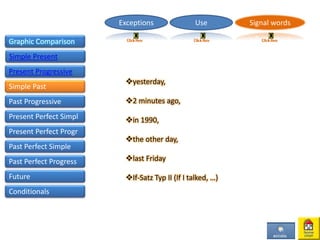
yesterday,
2 minutes ago,
in 1990,
the other day,
last Friday
If-Satz Typ II (If I talked, …)
Past Progressive
Present Perfect Simpl
Present Perfect Progr
Past Perfect Simple
Past Perfect Progress
Future
Conditionals
Graphic Comparison
Simple Present
Present Progressive
Simple Past
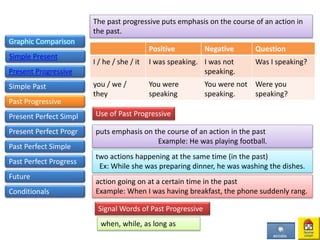
The past progressive puts emphasis on the course of an action in
the past.
Positive Negative Question
I / he / she / it I was speaking. I was not
speaking.
Was I speaking?
you / we /
they
You were
speaking
You were not
speaking.
Were you
speaking?
Use of Past Progressive
puts emphasis on the course of an action in the past
Example: He was playing football.
two actions happening at the same time (in the past)
Ex: While she was preparing dinner, he was washing the dishes.
action going on at a certain time in the past
Example: When I was having breakfast, the phone suddenly rang.
Signal Words of Past Progressive
when, while, as long as
Past Progressive
Present Perfect Simpl
Present Perfect Progr
Past Perfect Simple
Past Perfect Progress
Future
Conditionals
[has/have + past participle]
The present perfect simple expresses an action that is still going
on or that stopped recently, but has an influence on the present.
It puts emphasis on the result.
Graphic Comparison
Simple Present
Present Progressive
Simple Past
Past Progressive
You CANNOT use the Present Perfect with specific time expressions
such as: yesterday, one year ago, last week, when I was a child,
when I lived in Japan, at that moment, that day, one day, etc.
We CAN use the Present Perfect with unspecific expressions such
as: ever, never, once, many times, several times, before, so far,
already, yet, etc.
Form
Present Perfect Simpl
Present Perfect Progr
Form Use
Past Perfect Simple
Past Perfect Progress
Future
Conditionals
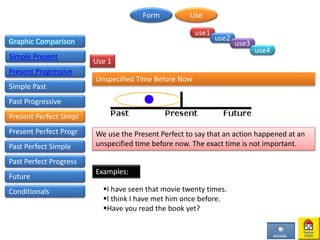
Unspecified Time Before Now
Graphic Comparison
Simple Present
Present Progressive
Simple Past
Past Progressive
We use the Present Perfect to say that an action happened at an
unspecified time before now. The exact time is not important.
I have seen that movie twenty times.
I think I have met him once before.
Have you read the book yet?
Examples:
Use 1
Present Perfect Simpl
Present Perfect Progr
Form Use
use1
use2
use3
use4
Past Perfect Simple
Past Perfect Progress
Future
Conditionals
Graphic Comparison
Simple Present
Present Progressive
Simple Past
Past Progressive
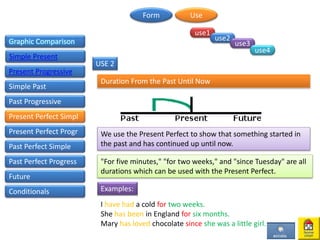
Duration From the Past Until Now
We use the Present Perfect to show that something started in
the past and has continued up until now.
"For five minutes," "for two weeks," and "since Tuesday" are all
durations which can be used with the Present Perfect.
Examples:
I have had a cold for two weeks.
She has been in England for six months.
Mary has loved chocolate since she was a little girl.
USE 2
Present Perfect Simpl
Present Perfect Progr
Form Use
use1
use2
use3
use4
Past Perfect Simple
Past Perfect Progress
Future
Conditionals
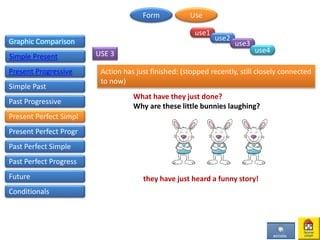
Action has just finished: (stopped recently, still closely connected
to now)
What have they just done?
Why are these little bunnies laughing?
they have just heard a funny story!
Graphic Comparison
Simple Present
Present Progressive
Simple Past
Past Progressive
USE 3
Present Perfect Simpl
Present Perfect Progr
Form Use
use1
use2
use3
use4
Past Perfect Simple
Past Perfect Progress
Future
Conditionals
Graphic Comparison
Simple Present
Present Progressive
Simple Past
Past Progressive
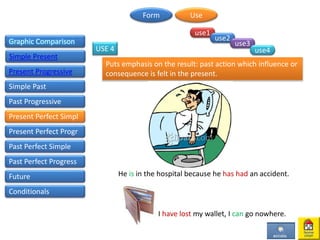
USE 4
Puts emphasis on the result: past action which influence or
consequence is felt in the present.
He is in the hospital because he has had an accident.
I have lost my wallet, I can go nowhere.
Present Perfect Simpl
Present Perfect Progr
Form Use
use1
use2
use3
use4
Past Perfect Simple
Past Perfect Progress
Future
Conditionals
Graphic Comparison
Simple Present
Present Progressive
Simple Past
Past Progressive
Present Perfect Simpl
[has/have + been + present participle]
FORM
Use of Present Perfect Progressive
puts emphasis on the duration or course of an action (not the
result)
Example: She has been writing for two hours.
action that recently stopped or is still going on
Example: I have been living here since 2001.
finished action that influenced the present
Example: I have been working all afternoon.
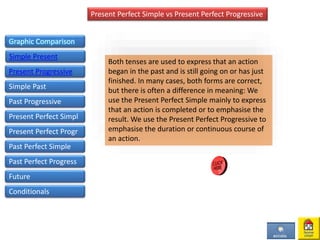
Present Perfect Simple vs Present Perfect Progressive
Present Perfect Progr
Past Perfect Simple
Past Perfect Progress
Future
Conditionals
Present Perfect Simple vs Present Perfect Progressive
Graphic Comparison
Simple Present
Present Progressive
Simple Past
Past Progressive
Present Perfect Simpl
Present Perfect Progr
Both tenses are used to express that an action
began in the past and is still going on or has just
finished. In many cases, both forms are correct,
but there is often a difference in meaning: We
use the Present Perfect Simple mainly to express
that an action is completed or to emphasise the
result. We use the Present Perfect Progressive to
emphasise the duration or continuous course of
an action.
Past Perfect Simple
Past Perfect Progress
Future
Conditionals
Graphic Comparison
Simple Present
Present Progressive
Simple Past
Past Progressive
Present Perfect Simpl
Present Perfect Progr
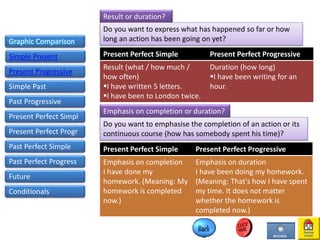
Result or duration?
Do you want to express what has happened so far or how
long an action has been going on yet?
Present Perfect Simple Present Perfect Progressive
Result (what / how much /
how often)
I have written 5 letters.
I have been to London twice.
Duration (how long)
I have been writing for an
hour.
Emphasis on completion or duration?
Do you want to emphasise the completion of an action or its
continuous course (how has somebody spent his time)?
Present Perfect Simple Present Perfect Progressive
Emphasis on completion
I have done my
homework. (Meaning: My
homework is completed
now.)
Emphasis on duration
I have been doing my homework.
(Meaning: That's how I have spent
my time. It does not matter
whether the homework is
completed now.)
Past Perfect Simple
Past Perfect Progress
Future
Conditionals
Graphic Comparison
Simple Present
Present Progressive
Simple Past
Past Progressive
Present Perfect Simpl
Present Perfect Progr
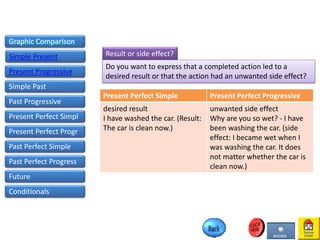
Result or side effect?
Do you want to express that a completed action led to a
desired result or that the action had an unwanted side effect?
Present Perfect Simple Present Perfect Progressive
desired result
I have washed the car. (Result:
The car is clean now.)
unwanted side effect
Why are you so wet? - I have
been washing the car. (side
effect: I became wet when I
was washing the car. It does
not matter whether the car is
clean now.)
Past Perfect Simple
Past Perfect Progress
Future
Conditionals
Graphic Comparison
Simple Present
Present Progressive
Simple Past
Past Progressive
Present Perfect Simpl
Present Perfect Progr
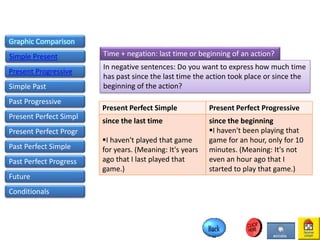
Time + negation: last time or beginning of an action?
In negative sentences: Do you want to express how much time
has past since the last time the action took place or since the
beginning of the action?
Present Perfect Simple Present Perfect Progressive
since the last time
I haven't played that game
for years. (Meaning: It's years
ago that I last played that
game.)
since the beginning
I haven't been playing that
game for an hour, only for 10
minutes. (Meaning: It's not
even an hour ago that I
started to play that game.)
Past Perfect Simple
Past Perfect Progress
Future
Conditionals
Graphic Comparison
Simple Present
Present Progressive
Simple Past
Past Progressive
Present Perfect Simpl
Present Perfect Progr
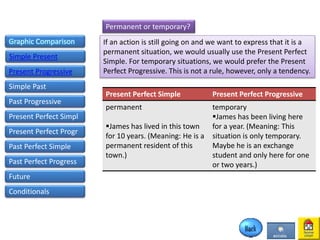
Permanent or temporary?
If an action is still going on and we want to express that it is a
permanent situation, we would usually use the Present Perfect
Simple. For temporary situations, we would prefer the Present
Perfect Progressive. This is not a rule, however, only a tendency.
Present Perfect Simple Present Perfect Progressive
permanent
James has lived in this town
for 10 years. (Meaning: He is a
permanent resident of this
town.)
temporary
James has been living here
for a year. (Meaning: This
situation is only temporary.
Maybe he is an exchange
student and only here for one
or two years.)
Past Perfect Simple
Past Perfect Progress
Future
Conditionals
Graphic Comparison
Simple Present
Present Progressive
Simple Past
Past Progressive
Present Perfect Simpl
Present Perfect Progr
[had + past participle]
FORM
You had studied English before you moved to New York.
Had you studied English before you moved to New York?
You had not studied English before you moved to New York.
The Past Perfect expresses the idea that something occurred
before another action in the past. It can also show that
something happened before a specific time in the past. (putting
emphasis only on the fact, not the duration)
already, just, never, not yet, once, until that day (with
reference to the past, not the present)
If-Satz Typ III (If I had talked, …)
Signal Words
Examples:
Past Perfect Simple
Past Perfect Progress
Future
Conditionals
Graphic Comparison
Simple Present
Present Progressive
Simple Past
Past Progressive
Present Perfect Simpl
Present Perfect Progr
Past Perfect Simple
[had been + present participle]
FORM
You had been waiting there for more than two hours when
she finally arrived.
Had you been waiting there for more than two hours when
she finally arrived?
You had not been waiting there for more than two hours
when she finally arrived.
Examples:
We use the Past Perfect Continuous to show that something
started in the past and continued up until another time in
the past. (puts emphasis on the course or duration of an
action)
for, since, the whole day, all day
signal words
Past Perfect Progress
Future
Conditionals
Graphic Comparison
Simple Present
Present Progressive
Simple Past
Past Progressive
Present Perfect Simpl
Present Perfect Progr
Past Perfect Simple
Past Perfect Progress
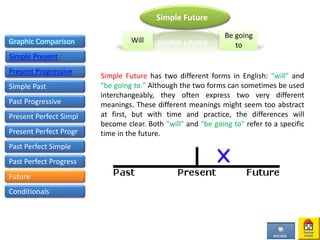
Simple Future has two different forms in English: "will" and
"be going to." Although the two forms can sometimes be used
interchangeably, they often express two very different
meanings. These different meanings might seem too abstract
at first, but with time and practice, the differences will
become clear. Both "will" and "be going to" refer to a specific
time in the future.
Simple Future
Will
Be going
to
Future
Conditionals
Signal Words: in a year, next …, tomorrow, I think, probably, perhaps
Graphic Comparison
Simple Present
Present Progressive
Simple Past
Past Progressive
Present Perfect Simpl
Present Perfect Progr
Past Perfect Simple
Past Perfect Progress
Future
Simple Future
Will
Be going
to
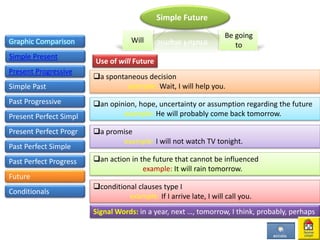
a spontaneous decision
example: Wait, I will help you.
Use of will Future
an opinion, hope, uncertainty or assumption regarding the future
example: He will probably come back tomorrow.
a promise
example: I will not watch TV tonight.
an action in the future that cannot be influenced
example: It will rain tomorrow.
conditional clauses type I
example: If I arrive late, I will call you.
Conditionals
Signal Words
in one year, next week, tomorrow
Graphic Comparison
Simple Present
Present Progressive
Simple Past
Past Progressive
Present Perfect Simpl
Present Perfect Progr
Past Perfect Simple
Past Perfect Progress
Future
Simple Future
Will
Be going
to
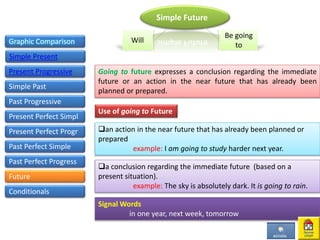
Going to future expresses a conclusion regarding the immediate
future or an action in the near future that has already been
planned or prepared.
Use of going to Future
an action in the near future that has already been planned or
prepared
example: I am going to study harder next year.
a conclusion regarding the immediate future (based on a
present situation).
example: The sky is absolutely dark. It is going to rain.
Conditionals
Conditional Sentences / If-Clauses
Graphic Comparison
Simple Present
Present Progressive
Simple Past
Past Progressive
Present Perfect Simpl
Present Perfect Progr
Past Perfect Simple
Past Perfect Progress
Future
Type I
Type II
Type III
Conditionals
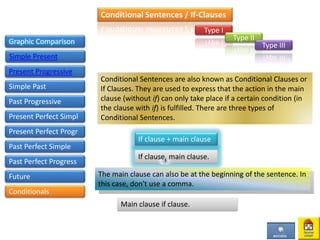
Conditional Sentences are also known as Conditional Clauses or
If Clauses. They are used to express that the action in the main
clause (without if) can only take place if a certain condition (in
the clause with if) is fulfilled. There are three types of
Conditional Sentences.
If clause + main clause
If clause, main clause.
The main clause can also be at the beginning of the sentence. In
this case, don't use a comma.
Main clause if clause.
Conditional Sentences / If-Clauses
Graphic Comparison
Simple Present
Present Progressive
Simple Past
Past Progressive
Present Perfect Simpl
Present Perfect Progr
Past Perfect Simple
Past Perfect Progress
Future
Type I
Type II
Type III
Conditionals
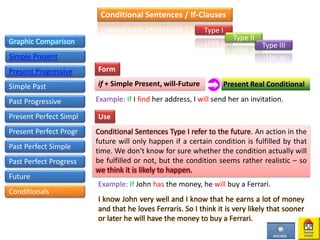
if + Simple Present, will-Future
Form
Example: If I find her address, I will send her an invitation.
Conditional Sentences Type I refer to the future. An action in the
future will only happen if a certain condition is fulfilled by that
time. We don't know for sure whether the condition actually will
be fulfilled or not, but the condition seems rather realistic – so
we think it is likely to happen.
Use
Example: If John has the money, he will buy a Ferrari.
I know John very well and I know that he earns a lot of money
and that he loves Ferraris. So I think it is very likely that sooner
or later he will have the money to buy a Ferrari.
Present Real Conditional
Conditional Sentences / If-Clauses
Graphic Comparison
Simple Present
Present Progressive
Simple Past
Past Progressive
Present Perfect Simpl
Present Perfect Progr
Past Perfect Simple
Past Perfect Progress
Future
Type I
Type II
Type III
Conditionals
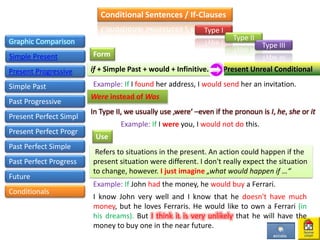
Form
if + Simple Past + would + Infinitive.
Example: If I found her address, I would send her an invitation.
Were instead of Was
In Type II, we usually use ‚were‘ –even if the pronoun is I, he, she or it
Example: If I were you, I would not do this.
Refers to situations in the present. An action could happen if the
present situation were different. I don't really expect the situation
to change, however. I just imagine „what would happen if …“
Use
Example: If John had the money, he would buy a Ferrari.
I know John very well and I know that he doesn't have much
money, but he loves Ferraris. He would like to own a Ferrari (in
his dreams). But I think it is very unlikely that he will have the
money to buy one in the near future.
Present Unreal Conditional
I knew John very well and I know that he never had much money, but
he loved Ferraris. He would have loved to own a Ferrari, but he never
had the money to buy one.
Conditional Sentences / If-Clauses
Graphic Comparison
Simple Present
Present Progressive
Simple Past
Past Progressive
Present Perfect Simpl
Present Perfect Progr
Past Perfect Simple
Past Perfect Progress
Future
Type I
Type II
Type III
Conditionals
Past Unreal Conditional
FORM
[If ... Past Perfect ..., ... would have + past participle ... ]
[... would have + past participle ... if ... Past Perfect ...]
USE
The Past Unreal Conditional is used to talk about imaginary
situations in the past. You can describe what you would have
done differently or how something could have happened
differently if circumstances had been different. We just imagine,
what would have happened if the situation had been fulfilled.
Eg: If I had found her address, I would have sent her an invitation.
Eg: If John had had the money, he would have bought a Ferrari.
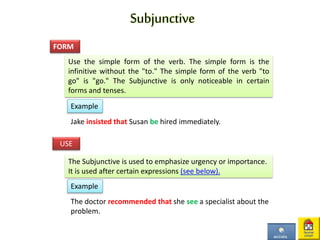
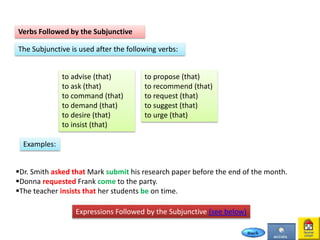
Subjunctive
Use the simple form of the verb. The simple form is the
infinitive without the "to." The simple form of the verb "to
go" is "go." The Subjunctive is only noticeable in certain
forms and tenses.
FORM
The Subjunctive is used to emphasize urgency or importance.
It is used after certain expressions (see below).
USE
Example
Jake insisted that Susan be hired immediately.
The doctor recommended that she see a specialist about the
problem.
Example
Examples:
Dr. Smith asked that Mark submit his research paper before the end of the month.
Donna requested Frank come to the party.
The teacher insists that her students be on time.
to propose (that)
to recommend (that)
to request (that)
to suggest (that)
to urge (that)
to advise (that)
to ask (that)
to command (that)
to demand (that)
to desire (that)
to insist (that)
Verbs Followed by the Subjunctive
The Subjunctive is used after the following verbs:
Expressions Followed by the Subjunctive (see below)
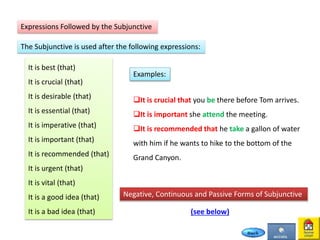
Expressions Followed by the Subjunctive
The Subjunctive is used after the following expressions:
It is best (that)
It is crucial (that)
It is desirable (that)
It is essential (that)
It is imperative (that)
It is important (that)
It is recommended (that)
It is urgent (that)
It is vital (that)
It is a good idea (that)
It is a bad idea (that)
It is crucial that you be there before Tom arrives.
It is important she attend the meeting.
It is recommended that he take a gallon of water
with him if he wants to hike to the bottom of the
Grand Canyon.
Examples:
Negative, Continuous and Passive Forms of Subjunctive
(see below)
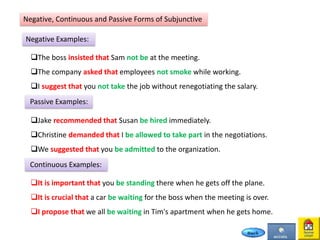
Negative, Continuous and Passive Forms of Subjunctive
Negative Examples:
The boss insisted that Sam not be at the meeting.
The company asked that employees not smoke while working.
I suggest that you not take the job without renegotiating the salary.
Passive Examples:
Jake recommended that Susan be hired immediately.
Christine demanded that I be allowed to take part in the negotiations.
We suggested that you be admitted to the organization.
Continuous Examples:
It is important that you be standing there when he gets off the plane.
It is crucial that a car be waiting for the boss when the meeting is over.
I propose that we all be waiting in Tim's apartment when he gets home.
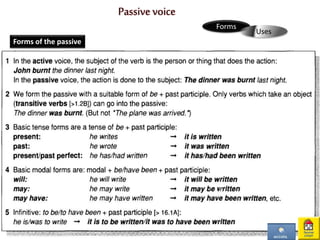
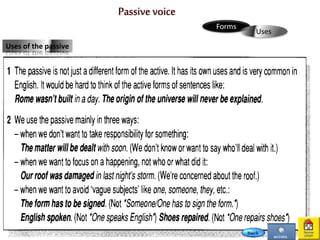
Passive voice
Forms of the passive
Forms
Uses
Forms
Uses
Uses of the passive
Passive voice
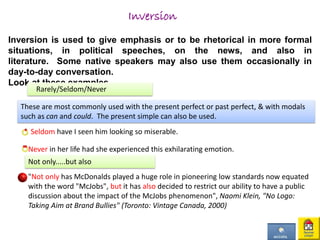
Inversion
Inversion is used to give emphasis or to be rhetorical in more formal
situations, in political speeches, on the news, and also in
literature. Some native speakers may also use them occasionally in
day-to-day conversation.
Look at these examples,
Rarely/Seldom/Never
These are most commonly used with the present perfect or past perfect, & with modals
such as can and could. The present simple can also be used.
Seldom have I seen him looking so miserable.
Never in her life had she experienced this exhilarating emotion.
Not only.....but also
"Not only has McDonalds played a huge role in pioneering low standards now equated
with the word "McJobs", but it has also decided to restrict our ability to have a public
discussion about the impact of the McJobs phenomenon", Naomi Klein, "No Logo:
Taking Aim at Brand Bullies" (Toronto: Vintage Canada, 2000)
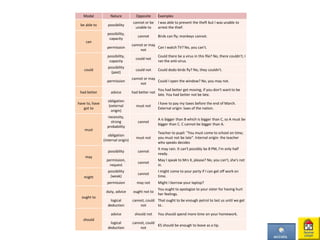
Modal Nature Opposite Examples
be able to possibility
cannot or be
unable to
I was able to prevent the theft but I was unable to
arrest the thief.
can
possibility,
capacity
cannot Birds can fly; monkeys cannot.
permission
cannot or may
not
Can I watch TV? No, you can't.
could
possibility,
capactiy
could not
Could there be a virus in this file? No, there couldn't; I
ran the anti-virus.
possibility
(past)
could not Could dodo birds fly? No, they couldn't.
permission
cannot or may
not
Could I open the window? No, you may not.
had better advice had better not
You had better get moving, if you don't want to be
late. You had better not be late.
have to, have
got to
obligation
(external
origin)
must not
I have to pay my taxes before the end of March.
External origin: laws of the nation.
must
necessity,
strong
probability
cannot
A is bigger than B which is bigger than C, so A must be
bigger than C. C cannot be bigger than A.
obligation
(internal origin)
must not
Teacher to pupil: "You must come to school on time;
you must not be late". Internal origin: the teacher
who speaks decides
may
possibility cannot
It may rain. It can't possibly be 8 PM, I'm only half
ready.
permission,
request
cannot
May I speak to Mrs X, please? No, you can't, she's not
in.
might
possibility
(weak)
cannot
I might come to your party if I can get off work on
time.
permission may not Might I borrow your laptop?
ought to
duty, advice ought not to
You ought to apologize to your sister for having hurt
her feelings.
logical
deduction
cannot, could
not
That ought to be enough petrol to last us until we get
to .
should
advice should not You should spend more time on your homework.
logical
deduction
cannot, could
not
€5 should be enough to leave as a tip.
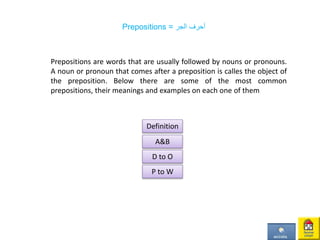
Prepositions = ‫الجر‬ ‫أحرف‬
Prepositions are words that are usually followed by nouns or pronouns.
A noun or pronoun that comes after a preposition is calles the object of
the preposition. Below there are some of the most common
prepositions, their meanings and examples on each one of them
Definition
A&B
D to O
P to W
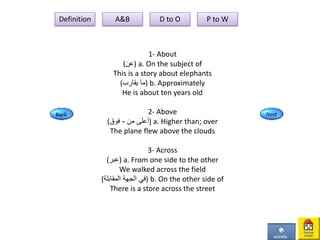
1- About
(‫)عن‬ a. On the subject of
This is a story about elephants
(‫يقارب‬ ‫)ما‬ b. Approximately
He is about ten years old
2- Above
( ‫من‬ ‫أعلى‬-‫فوق‬ ) a. Higher than; over
The plane flew above the clouds
3- Across
(‫)عبر‬ a. From one side to the other
We walked across the field
(‫المقابلة‬ ‫الجهة‬ ‫)في‬ b. On the other side of
There is a store across the street
Definition A&B D to O P to W
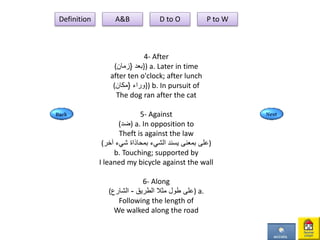
4- After
( ‫بعد‬{‫زمان‬ }) a. Later in time
after ten o'clock; after lunch
( ‫وراء‬{‫مكان‬ }) b. In pursuit of
The dog ran after the cat
5- Against
(‫)ضد‬ a. In opposition to
Theft is against the law
(‫آخر‬ ‫شيء‬ ‫بمحاذاة‬ ‫الشيء‬ ‫يسند‬ ‫بمعنى‬ ‫)على‬
b. Touching; supported by
I leaned my bicycle against the wall
6- Along
( ‫الطريق‬ ‫مثال‬ ‫طول‬ ‫على‬-‫الشارع‬ ) a.
Following the length of
We walked along the road
Definition A&B D to O P to W
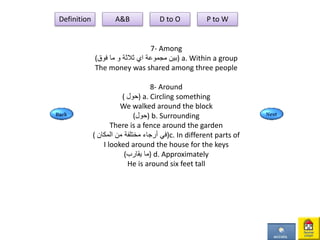
7- Among
( ‫مجموعة‬ ‫بين‬‫اي‬‫ثالثة‬‫و‬‫فوق‬ ‫ما‬ ) a. Within a group
The money was shared among three people
8- Around
( ‫)حول‬ a. Circling something
We walked around the block
(‫)حول‬ b. Surrounding
There is a fence around the garden
( ‫المكان‬ ‫من‬ ‫مختلفة‬ ‫أرجاء‬ ‫)في‬c. In different parts of
I looked around the house for the keys
(‫يقارب‬ ‫)ما‬ d. Approximately
He is around six feet tall
Definition A&B D to O P to W
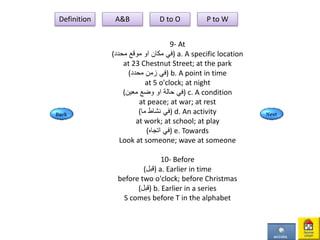
9- At
( ‫مكان‬ ‫في‬‫او‬‫محدد‬ ‫موقع‬ ) a. A specific location
at 23 Chestnut Street; at the park
(‫محدد‬ ‫زمن‬ ‫)في‬ b. A point in time
at 5 o'clock; at night
( ‫حالة‬ ‫في‬‫او‬‫معين‬ ‫وضع‬ ) c. A condition
at peace; at war; at rest
(‫ما‬ ‫نشاط‬ ‫)في‬ d. An activity
at work; at school; at play
(‫اتجاه‬ ‫)في‬ e. Towards
Look at someone; wave at someone
10- Before
(‫)قبل‬ a. Earlier in time
before two o'clock; before Christmas
(‫)قبل‬ b. Earlier in a series
S comes before T in the alphabet
Definition A&B D to O P to W
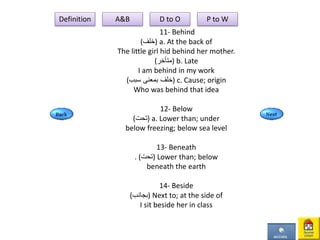
11- Behind
(‫)خلف‬ a. At the back of
The little girl hid behind her mother.
(‫)متأخر‬ b. Late
I am behind in my work
(‫سبب‬ ‫بمعنى‬ ‫)خلف‬ c. Cause; origin
Who was behind that idea
12- Below
(‫)تحت‬ a. Lower than; under
below freezing; below sea level
13- Beneath
. (‫)تحت‬ Lower than; below
beneath the earth
14- Beside
(‫)بجانب‬ Next to; at the side of
I sit beside her in class
Definition A&B D to O P to W
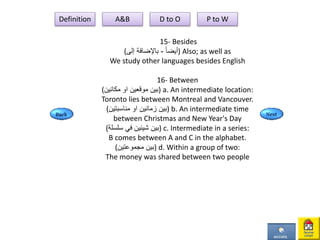
15- Besides
( ً‫ا‬‫أيض‬-‫إلى‬ ‫باإلضافة‬ ) Also; as well as
We study other languages besides English
16- Between
( ‫موقعين‬ ‫بين‬‫او‬‫مكانين‬ ) a. An intermediate location:
Toronto lies between Montreal and Vancouver.
( ‫بين‬‫زمانين‬‫او‬‫مناسبتين‬ ) b. An intermediate time
between Christmas and New Year's Day
(‫سلسلة‬ ‫في‬ ‫شيئين‬ ‫)بين‬ c. Intermediate in a series:
B comes between A and C in the alphabet.
(‫مجموعتين‬ ‫)بين‬ d. Within a group of two:
The money was shared between two people
Definition A&B D to O P to W
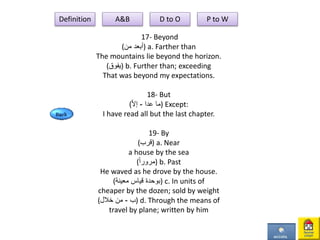
17- Beyond
(‫من‬ ‫)أبعد‬ a. Farther than
The mountains lie beyond the horizon.
(‫)يفوق‬ b. Further than; exceeding
That was beyond my expectations.
18- But
( ‫عدا‬ ‫ما‬-‫ا‬‫ل‬‫إ‬ ) Except:
I have read all but the last chapter.
19- By
(‫)قرب‬ a. Near
a house by the sea
(ً‫ا‬‫)مرور‬ b. Past
He waved as he drove by the house.
(‫معينة‬ ‫قياس‬ ‫)بوحدة‬ c. In units of
cheaper by the dozen; sold by weight
( ‫ب‬-‫خالل‬ ‫من‬ ) d. Through the means of
travel by plane; written by him
Definition A&B D to O P to W
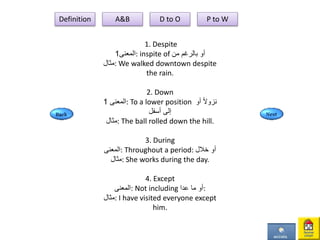
1. Despite
‫المعنى‬1 : inspite of ‫من‬ ‫بالرغم‬ ‫أو‬
‫:مثال‬ We walked downtown despite
the rain.
2. Down
‫المعنى‬1 : To a lower position ‫أو‬ ً‫ل‬‫نزو‬
‫أسفل‬ ‫إلى‬
‫:مثال‬ The ball rolled down the hill.
3. During
‫:المعنى‬ Throughout a period: ‫خالل‬ ‫أو‬
‫:مثال‬ She works during the day.
4. Except
‫:المعنى‬ Not including ‫عدا‬ ‫ما‬ ‫:أو‬
‫:مثال‬ I have visited everyone except
him.
Definition A&B D to O P to W
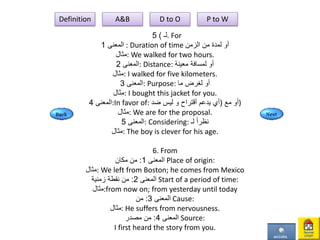
‫لـ‬)5 . For
‫المعنى‬1 : Duration of time ‫الزمن‬ ‫من‬ ‫لمدة‬ ‫أو‬
‫:مثال‬ We walked for two hours.
‫المعنى‬2 : Distance: ‫معينة‬ ‫لمسافة‬ ‫أو‬
‫:مثال‬ I walked for five kilometers.
‫المعنى‬3 : Purpose: ‫ما‬ ‫لغرض‬ ‫أو‬
‫:مثال‬ I bought this jacket for you.
‫المعنى‬4 :In favor of: ‫مع‬ ‫أو‬(‫يدعم‬ ‫أي‬‫أقتراح‬‫ضد‬ ‫ليس‬ ‫و‬ )
‫:مثال‬ We are for the proposal.
‫المعنى‬5 : Considering: ‫لـ‬ ً‫ا‬‫نظر‬
‫:مثال‬ The boy is clever for his age.
6. From
‫المعنى‬1:‫مكان‬ ‫من‬ Place of origin:
‫:مثال‬ We left from Boston; he comes from Mexico
‫المعنى‬2:‫زمنية‬ ‫نقطة‬ ‫من‬ Start of a period of time:
‫:مثال‬from now on; from yesterday until today
‫المعنى‬3:‫من‬ Cause:
‫:مثال‬ He suffers from nervousness.
‫المعنى‬4:‫مصدر‬ ‫من‬ Source:
I first heard the story from you.
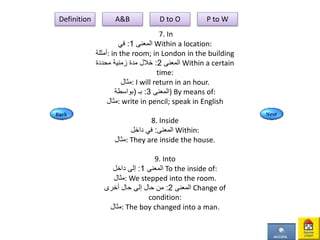
Definition A&B D to O P to W
7. In
‫المعنى‬1:‫في‬ Within a location:
‫:أمثلة‬ in the room; in London in the building
‫المعنى‬2:‫محددة‬ ‫زمنية‬ ‫مدة‬ ‫خالل‬ Within a certain
time:
‫:مثال‬ I will return in an hour.
‫المعنى‬3:‫بـ‬(‫بواسطة‬ ) By means of:
‫:مثال‬ write in pencil; speak in English
8. Inside
‫المعنى‬:‫داخل‬ ‫في‬ Within:
‫:مثال‬ They are inside the house.
9. Into
‫المعنى‬1:‫داخل‬ ‫إلى‬ To the inside of:
‫:مثال‬ We stepped into the room.
‫المعنى‬2:‫أخرى‬ ‫حال‬ ‫إلى‬ ‫حال‬ ‫من‬ Change of
condition:
‫:مثال‬ The boy changed into a man.
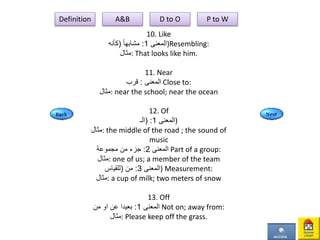
Definition A&B D to O P to W
10. Like
‫المعنى‬1:ً‫ا‬‫مشابه‬(‫كأنه‬ )Resembling:
‫:مثال‬ That looks like him.
11. Near
‫المعنى‬:‫قرب‬ Close to:
‫:مثال‬ near the school; near the ocean
12. Of
‫المعنى‬1( :‫الـ‬ )
‫:مثال‬ the middle of the road ; the sound of
music
‫المعنى‬2:‫مجموعة‬ ‫من‬ ‫جزء‬ Part of a group:
‫:مثال‬ one of us; a member of the team
‫المعنى‬3:‫من‬(‫للقياس‬ ) Measurement:
‫:مثال‬ a cup of milk; two meters of snow
13. Off
‫المعنى‬1:‫عن‬ ‫بعيدا‬‫او‬‫من‬ Not on; away from:
‫:مثال‬ Please keep off the grass.
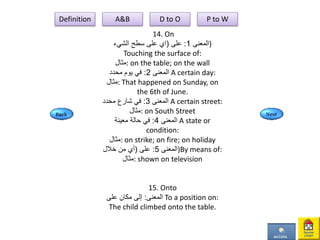
Definition A&B D to O P to W
14. On
‫المعنى‬1:‫على‬(‫اي‬‫الشيء‬ ‫سطح‬ ‫على‬ )
Touching the surface of:
‫:مثال‬ on the table; on the wall
‫المعنى‬2:‫محدد‬ ‫يوم‬ ‫في‬ A certain day:
‫:مثال‬ That happened on Sunday, on
the 6th of June.
‫المعنى‬3:‫محدد‬ ‫شارع‬ ‫في‬ A certain street:
‫:مثال‬ on South Street
‫المعنى‬4:‫معينة‬ ‫حالة‬ ‫في‬ A state or
condition:
‫:مثال‬ on strike; on fire; on holiday
‫المعنى‬5:‫على‬(‫خالل‬ ‫من‬ ‫أي‬ )By means of:
‫:مثال‬ shown on television
15. Onto
‫المعنى‬:‫على‬ ‫مكان‬ ‫إلى‬ To a position on:
The child climbed onto the table.
Definition A&B D to O P to W
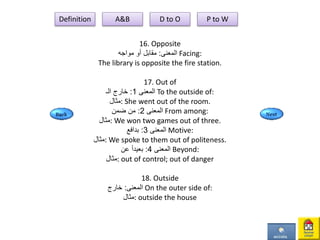
16. Opposite
‫المعنى‬:‫مواجه‬ ‫أو‬ ‫مقابل‬ Facing:
The library is opposite the fire station.
17. Out of
‫المعنى‬1:‫خارج‬‫الـ‬ To the outside of:
‫:مثال‬ She went out of the room.
‫المعنى‬2:‫ضمن‬ ‫من‬ From among:
‫:مثال‬ We won two games out of three.
‫المعنى‬3:‫بدافع‬ Motive:
‫:مثال‬ We spoke to them out of politeness.
‫المعنى‬4:‫بعيدأ‬‫عن‬ Beyond:
‫:مثال‬ out of control; out of danger
18. Outside
‫المعنى‬:‫خارج‬ On the outer side of:
‫:مثال‬ outside the house
Definition A&B D to O P to W
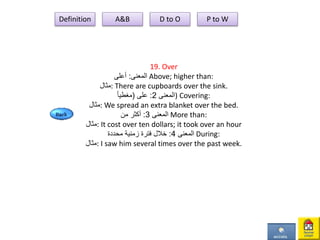
19. Over
‫المعنى‬:‫أعلى‬ Above; higher than:
‫:مثال‬ There are cupboards over the sink.
‫المعنى‬2:‫على‬(ً‫ا‬‫مغطي‬ ) Covering:
‫:مثال‬ We spread an extra blanket over the bed.
‫المعنى‬3:‫من‬ ‫أكثر‬ More than:
‫:مثال‬ It cost over ten dollars; it took over an hour
‫المعنى‬4:‫محددة‬ ‫زمنية‬ ‫فترة‬ ‫خالل‬ During:
‫:مثال‬ I saw him several times over the past week.
Definition A&B D to O P to W
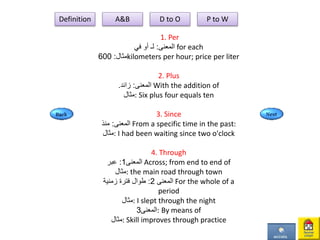
1. Per
‫المعنى‬:‫في‬ ‫أو‬ ‫لـ‬ for each
‫مثال‬:600 kilometers per hour; price per liter
2. Plus
. ‫المعنى‬:‫زائد‬ With the addition of
‫:مثال‬ Six plus four equals ten
3. Since
‫المعنى‬:‫منذ‬ From a specific time in the past:
‫:مثال‬ I had been waiting since two o'clock
4. Through
‫المعنى‬1:‫عبر‬ Across; from end to end of
‫:مثال‬ the main road through town
‫المعنى‬2:‫زمنية‬ ‫فترة‬ ‫طوال‬ For the whole of a
period
‫:مثال‬ I slept through the night
‫المعنى‬3 : By means of
‫:مثال‬ Skill improves through practice
Definition A&B D to O P to W
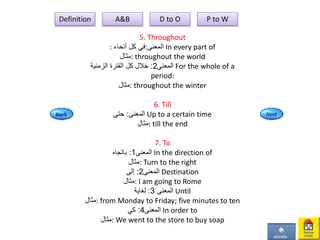
5. Throughout
: ‫المعنى‬:‫أنحاء‬ ‫كل‬ ‫في‬ In every part of
‫:مثال‬ throughout the world
‫المعنى‬2:‫الزمنية‬ ‫الفترة‬ ‫كل‬ ‫خالل‬ For the whole of a
period:
‫:مثال‬ throughout the winter
6. Till
‫المعنى‬:‫حتى‬ Up to a certain time
‫:مثال‬ till the end
7. To
‫المعنى‬1:‫باتجاه‬ In the direction of
‫:مثال‬ Turn to the right
‫المعنى‬2:‫إلى‬ Destination
‫:مثال‬ I am going to Rome
‫المعنى‬3:‫لغاية‬ Until
‫:مثال‬ from Monday to Friday; five minutes to ten
‫المعنى‬4:‫كي‬ In order to
‫:مثال‬ We went to the store to buy soap
Definition A&B D to O P to W
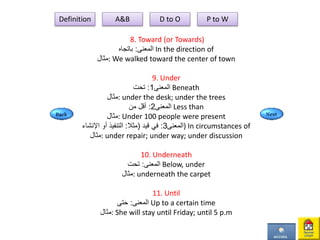
8. Toward (or Towards)
‫المعنى‬:‫باتجاه‬ In the direction of
‫:مثال‬ We walked toward the center of town
9. Under
‫المعنى‬1:‫تحت‬ Beneath
‫:مثال‬ under the desk; under the trees
‫المعنى‬2:‫من‬ ‫أقل‬ Less than
‫:مثال‬ Under 100 people were present
‫المعنى‬3:‫قيد‬ ‫في‬(‫مثال‬:‫اإلنشاء‬ ‫أو‬ ‫التنفيذ‬ ) In circumstances of
‫:مثال‬ under repair; under way; under discussion
10. Underneath
‫المعنى‬:‫تحت‬ Below, under
‫:مثال‬ underneath the carpet
11. Until
‫المعنى‬:‫حتى‬ Up to a certain time
‫:مثال‬ She will stay until Friday; until 5 p.m
Definition A&B D to O P to W
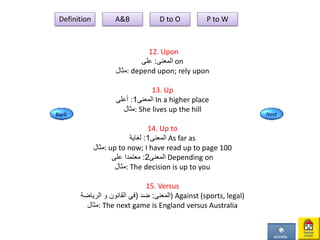
12. Upon
‫المعنى‬:‫على‬ on
‫:مثال‬ depend upon; rely upon
13. Up
‫المعنى‬1:‫أعلى‬ In a higher place
‫:مثال‬ She lives up the hill
14. Up to
‫المعنى‬1:‫لغاية‬ As far as
‫:مثال‬ up to now; I have read up to page 100
‫المعنى‬2:‫على‬ ‫معتمدا‬ Depending on
‫:مثال‬ The decision is up to you
15. Versus
‫المعنى‬:‫ضد‬(‫القانون‬ ‫في‬‫و‬‫الرياضة‬ ) Against (sports, legal)
‫:مثال‬ The next game is England versus Australia
Definition A&B D to O P to W
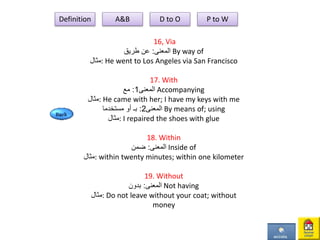
16, Via
‫المعنى‬:‫طريق‬ ‫عن‬ By way of
‫:مثال‬ He went to Los Angeles via San Francisco
17. With
‫المعنى‬1:‫مع‬ Accompanying
‫:مثال‬ He came with her; I have my keys with me
‫المعنى‬2:‫بـ‬‫مستخدما‬ ‫أو‬ By means of; using
‫:مثال‬ I repaired the shoes with glue
18. Within
‫المعنى‬:‫ضمن‬ Inside of
‫:مثال‬ within twenty minutes; within one kilometer
19. Without
‫المعنى‬:‫بدون‬ Not having
‫:مثال‬ Do not leave without your coat; without
money
Definition A&B D to O P to W
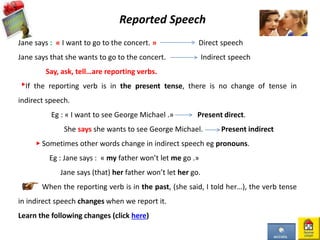
Jane says : « I want to go to the concert. » Direct speech
Jane says that she wants to go to the concert. Indirect speech
Say, ask, tell…are reporting verbs.
If the reporting verb is in the present tense, there is no change of tense in
indirect speech.
Eg : « I want to see George Michael .» Present direct.
She says she wants to see George Michael. Present indirect
Sometimes other words change in indirect speech eg pronouns.
Eg : Jane says : « my father won’t let me go .»
Jane says (that) her father won’t let her go.
When the reporting verb is in the past, (she said, I told her…), the verb tense
in indirect speech changes when we report it.
Learn the following changes (click here)
Reported Speech
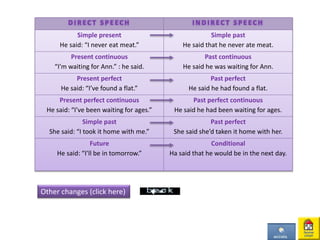
D I R E C T S P E E C H I N D I R E C T S P E E C H
Simple present
He said: “I never eat meat.”
Simple past
He said that he never ate meat.
Present continuous
“I’m waiting for Ann.” : he said.
Past continuous
He said he was waiting for Ann.
Present perfect
He said: “I’ve found a flat.”
Past perfect
He said he had found a flat.
Present perfect continuous
He said: “I’ve been waiting for ages.”
Past perfect continuous
He said he had been waiting for ages.
Simple past
She said: “I took it home with me.”
Past perfect
She said she’d taken it home with her.
Future
He said: “I’ll be in tomorrow.”
Conditional
Ha said that he would be in the next day.
Other changes (click here)
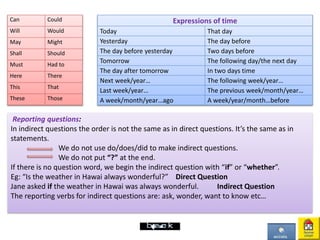
Can Could
Will Would
May Might
Shall Should
Must Had to
Here There
This That
These Those
Expressions of time
Today That day
Yesterday The day before
The day before yesterday Two days before
Tomorrow The following day/the next day
The day after tomorrow In two days time
Next week/year… The following week/year…
Last week/year… The previous week/month/year…
A week/month/year…ago A week/year/month…before
Reporting questions:
In indirect questions the order is not the same as in direct questions. It’s the same as in
statements.
We do not use do/does/did to make indirect questions.
We do not put “?” at the end.
If there is no question word, we begin the indirect question with “if” or “whether”.
Eg: “Is the weather in Hawai always wonderful?” Direct Question
Jane asked if the weather in Hawai was always wonderful. Indirect Question
The reporting verbs for indirect questions are: ask, wonder, want to know etc…
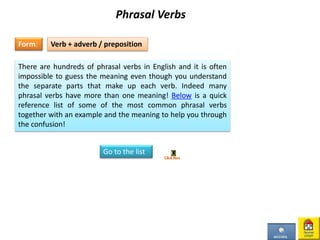
Phrasal Verbs
Form:
There are hundreds of phrasal verbs in English and it is often
impossible to guess the meaning even though you understand
the separate parts that make up each verb. Indeed many
phrasal verbs have more than one meaning! Below is a quick
reference list of some of the most common phrasal verbs
together with an example and the meaning to help you through
the confusion!
Verb + adverb / preposition
Go to the list
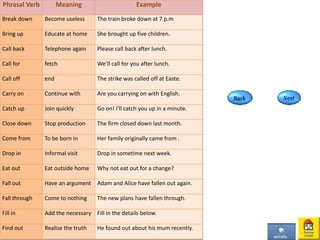
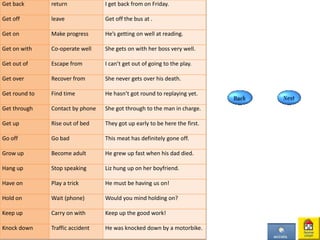
Phrasal Verb Meaning Example
Break down Become useless The train broke down at 7 p.m
Bring up Educate at home She brought up five children.
Call back Telephone again Please call back after lunch.
Call for fetch We’ll call for you after lunch.
Call off end The strike was called off at Easte.
Carry on Continue with Are you carrying on with English.
Catch up Join quickly Go on! I’ll catch you up in a minute.
Close down Stop production The firm closed down last month.
Come from To be born in Her family originally came from .
Drop in Informal visit Drop in sometime next week.
Eat out Eat outside home Why not eat out for a change?
Fall out Have an argument Adam and Alice have fallen out again.
Fall through Come to nothing The new plans have fallen through.
Fill in Add the necessary Fill in the details below.
Find out Realize the truth He found out about his mum recently.
Get back return I get back from on Friday.
Get off leave Get off the bus at .
Get on Make progress He’s getting on well at reading.
Get on with Co-operate well She gets on with her boss very well.
Get out of Escape from I can’t get out of going to the play.
Get over Recover from She never gets over his death.
Get round to Find time He hasn’t got round to replaying yet.
Get through Contact by phone She got through to the man in charge.
Get up Rise out of bed They got up early to be here the first.
Go off Go bad This meat has definitely gone off.
Grow up Become adult He grew up fast when his dad died.
Hang up Stop speaking Liz hung up on her boyfriend.
Have on Play a trick He must be having us on!
Hold on Wait (phone) Would you mind holding on?
Keep up Carry on with Keep up the good work!
Knock down Traffic accident He was knocked down by a motorbike.
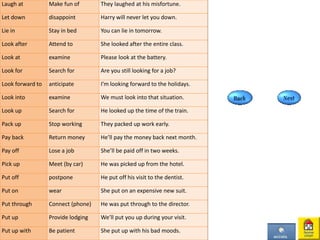
Laugh at Make fun of They laughed at his misfortune.
Let down disappoint Harry will never let you down.
Lie in Stay in bed You can lie in tomorrow.
Look after Attend to She looked after the entire class.
Look at examine Please look at the battery.
Look for Search for Are you still looking for a job?
Look forward to anticipate I’m looking forward to the holidays.
Look into examine We must look into that situation.
Look up Search for He looked up the time of the train.
Pack up Stop working They packed up work early.
Pay back Return money He’ll pay the money back next month.
Pay off Lose a job She’ll be paid off in two weeks.
Pick up Meet (by car) He was picked up from the hotel.
Put off postpone He put off his visit to the dentist.
Put on wear She put on an expensive new suit.
Put through Connect (phone) He was put through to the director.
Put up Provide lodging We’ll put you up during your visit.
Put up with Be patient She put up with his bad moods.
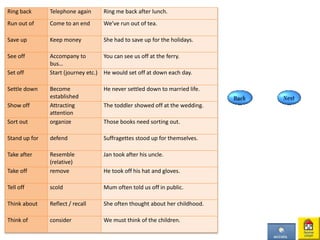
Ring back Telephone again Ring me back after lunch.
Run out of Come to an end We’ve run out of tea.
Save up Keep money She had to save up for the holidays.
See off Accompany to
bus…
You can see us off at the ferry.
Set off Start (journey etc.) He would set off at down each day.
Settle down Become
established
He never settled down to married life.
Show off Attracting
attention
The toddler showed off at the wedding.
Sort out organize Those books need sorting out.
Stand up for defend Suffragettes stood up for themselves.
Take after Resemble
(relative)
Jan took after his uncle.
Take off remove He took off his hat and gloves.
Tell off scold Mum often told us off in public.
Think about Reflect / recall She often thought about her childhood.
Think of consider We must think of the children.
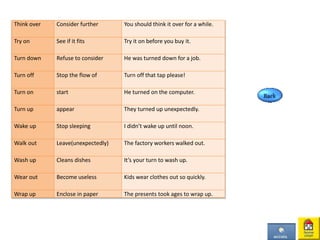
Think over Consider further You should think it over for a while.
Try on See if it fits Try it on before you buy it.
Turn down Refuse to consider He was turned down for a job.
Turn off Stop the flow of Turn off that tap please!
Turn on start He turned on the computer.
Turn up appear They turned up unexpectedly.
Wake up Stop sleeping I didn’t wake up until noon.
Walk out Leave(unexpectedly) The factory workers walked out.
Wash up Cleans dishes It’s your turn to wash up.
Wear out Become useless Kids wear clothes out so quickly.
Wrap up Enclose in paper The presents took ages to wrap up.
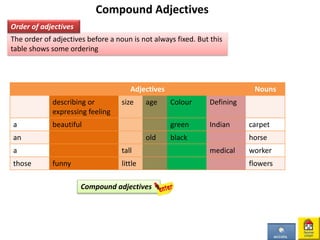
The order of adjectives before a noun is not always fixed. But this
table shows some ordering
Compound Adjectives
Order of adjectives
Adjectives Nouns
describing or
expressing feeling
size age Colour Defining
a beautiful green Indian carpet
an old black horse
a tall medical worker
those funny little flowers
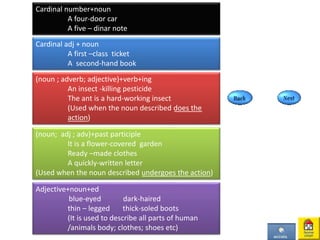
Compound adjectives
Cardinal number+noun
A four-door car
A five – dinar note
Cardinal adj + noun
A first –class ticket
A second-hand book
(noun ; adverb; adjective)+verb+ing
An insect -killing pesticide
The ant is a hard-working insect
(Used when the noun described does the
action)
(noun; adj ; adv)+past participle
It is a flower-covered garden
Ready –made clothes
A quickly-written letter
(Used when the noun described undergoes the action)
Adjective+noun+ed
blue-eyed dark-haired
thin – legged thick-soled boots
(It is used to describe all parts of human
/animals body; clothes; shoes etc)
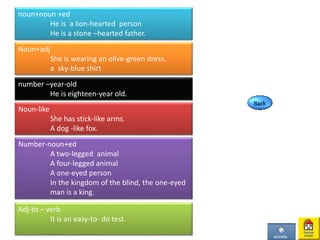
noun+noun +ed
He is a lion-hearted person
He is a stone –hearted father.
Noun+adj
She is wearing an olive-green dress.
a sky-blue shirt
number –year-old
He is eighteen-year old.
Noun-like
She has stick-like arms.
A dog -like fox.
Number-noun+ed
A two-legged animal
A four-legged animal
A one-eyed person
In the kingdom of the blind, the one-eyed
man is a king.
Adj-to – verb
It is an easy-to- do test.
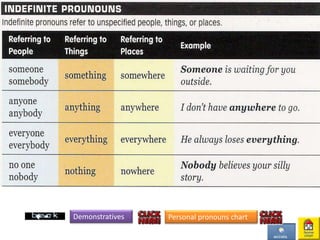
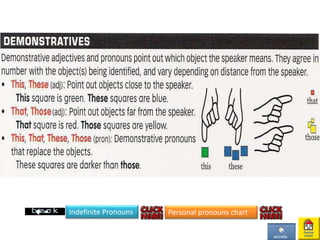
Pronouns
Pronouns replace nouns or phrases
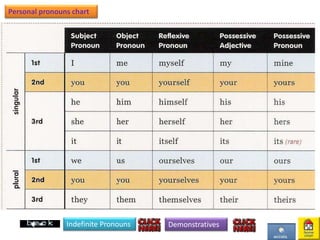
Personal pronouns and adjectives
Personal pronouns substitute for specific people, things, or ideas. They agree in gender
and number with the noun they replace. Eg jack smith ---- he / the actress---she /
my room----it / crocodiles-----they
Subject pronouns replace nouns that perform the action of the verb.
My wife and I live in Boston. We live in Boston.
Object pronouns replace nouns that receive the action of the verb.
The teacher gave John a puppy. The teacher gave him a puppet.
They also replace nouns in prepositional phrases. Eg This story is about us.
Reflexive pronouns refer back to th esubject of the verb.
She washes her hands by herself.
Possessive adjectives come before a noun and show ownership.
This is your book.
Possessive pronouns stan d alone and show ownership.
That is my chair.----- That chair is mine.
Personal pronouns and adjectives chart
Indefinite Pronouns Demonstratives
Personal pronouns chart
Demonstratives Personal pronouns chart
Indefinite Pronouns Personal pronouns chart
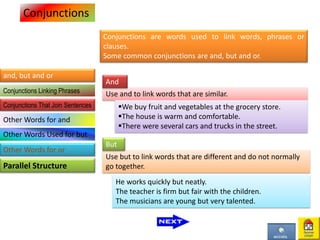
Conjunctions
and, but and or
Parallel Structure
Conjunctions are words used to link words, phrases or
clauses.
Some common conjunctions are and, but and or.
Use and to link words that are similar.
We buy fruit and vegetables at the grocery store.
The house is warm and comfortable.
There were several cars and trucks in the street.
And
Use but to link words that are different and do not normally
go together.
He works quickly but neatly.
The teacher is firm but fair with the children.
The musicians are young but very talented.
But
Conjunctions Linking Phrases
Conjunctions That Join Sentences
Other Words for and
Other Words Used for but
Other Words for or
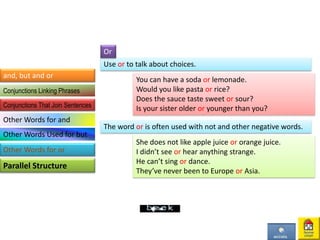
Use or to talk about choices.
You can have a soda or lemonade.
Would you like pasta or rice?
Does the sauce taste sweet or sour?
Is your sister older or younger than you?
Or
The word or is often used with not and other negative words.
She does not like apple juice or orange juice.
I didn’t see or hear anything strange.
He can’t sing or dance.
They’ve never been to Europe or Asia.
and, but and or
Parallel Structure
Conjunctions Linking Phrases
Conjunctions That Join Sentences
Other Words for and
Other Words Used for but
Other Words for or
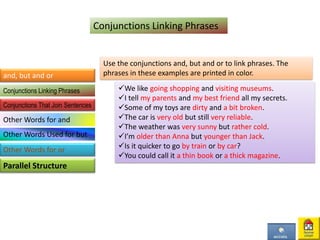
Conjunctions Linking Phrases
Use the conjunctions and, but and or to link phrases. The
phrases in these examples are printed in color.
We like going shopping and visiting museums.
I tell my parents and my best friend all my secrets.
Some of my toys are dirty and a bit broken.
The car is very old but still very reliable.
The weather was very sunny but rather cold.
I’m older than Anna but younger than Jack.
Is it quicker to go by train or by car?
You could call it a thin book or a thick magazine.
and, but and or
Parallel Structure
Conjunctions Linking Phrases
Conjunctions That Join Sentences
Other Words for and
Other Words Used for but
Other Words for or
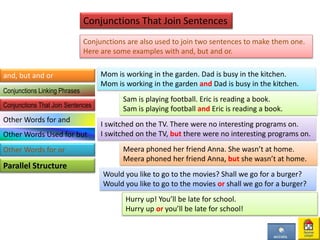
Conjunctions That Join Sentences
Conjunctions are also used to join two sentences to make them one.
Here are some examples with and, but and or.
Mom is working in the garden. Dad is busy in the kitchen.
Mom is working in the garden and Dad is busy in the kitchen.
Sam is playing football. Eric is reading a book.
Sam is playing football and Eric is reading a book.
I switched on the TV. There were no interesting programs on.
I switched on the TV, but there were no interesting programs on.
Meera phoned her friend Anna. She wasn’t at home.
Meera phoned her friend Anna, but she wasn’t at home.
Would you like to go to the movies? Shall we go for a burger?
Would you like to go to the movies or shall we go for a burger?
Hurry up! You’ll be late for school.
Hurry up or you’ll be late for school!
and, but and or
Parallel Structure
Conjunctions Linking Phrases
Conjunctions That Join Sentences
Other Words for and
Other Words Used for but
Other Words for or
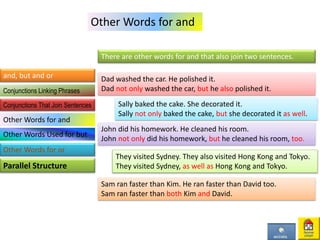
Other Words for and
There are other words for and that also join two sentences.
Dad washed the car. He polished it.
Dad not only washed the car, but he also polished it.
Sally baked the cake. She decorated it.
Sally not only baked the cake, but she decorated it as well.
John did his homework. He cleaned his room.
John not only did his homework, but he cleaned his room, too.
They visited Sydney. They also visited Hong Kong and Tokyo.
They visited Sydney, as well as Hong Kong and Tokyo.
Sam ran faster than Kim. He ran faster than David too.
Sam ran faster than both Kim and David.
and, but and or
Parallel Structure
Conjunctions Linking Phrases
Conjunctions That Join Sentences
Other Words for and
Other Words Used for but
Other Words for or
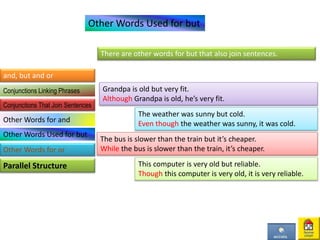
Other Words Used for but
There are other words for but that also join sentences.
Grandpa is old but very fit.
Although Grandpa is old, he’s very fit.
The weather was sunny but cold.
Even though the weather was sunny, it was cold.
The bus is slower than the train but it’s cheaper.
While the bus is slower than the train, it’s cheaper.
This computer is very old but reliable.
Though this computer is very old, it is very reliable.
and, but and or
Parallel Structure
Conjunctions Linking Phrases
Conjunctions That Join Sentences
Other Words for and
Other Words Used for but
Other Words for or
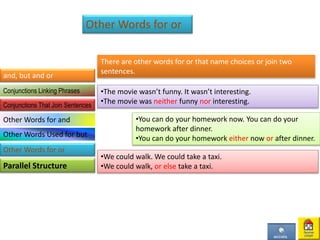
Other Words for or
There are other words for or that name choices or join two
sentences.
•The movie wasn’t funny. It wasn’t interesting.
•The movie was neither funny nor interesting.
•You can do your homework now. You can do your
homework after dinner.
•You can do your homework either now or after dinner.
•We could walk. We could take a taxi.
•We could walk, or else take a taxi.
and, but and or
Parallel Structure
Conjunctions Linking Phrases
Conjunctions That Join Sentences
Other Words for and
Other Words Used for but
Other Words for or
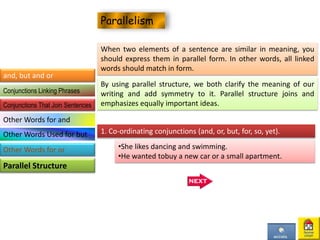
Parallelism
When two elements of a sentence are similar in meaning, you
should express them in parallel form. In other words, all linked
words should match in form.
By using parallel structure, we both clarify the meaning of our
writing and add symmetry to it. Parallel structure joins and
emphasizes equally important ideas.
1. Co-ordinating conjunctions (and, or, but, for, so, yet).
•She likes dancing and swimming.
•He wanted tobuy a new car or a small apartment.
and, but and or
Parallel Structure
Conjunctions Linking Phrases
Conjunctions That Join Sentences
Other Words for and
Other Words Used for but
Other Words for or
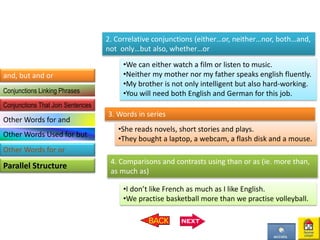
2. Correlative conjunctions (either…or, neither…nor, both…and,
not only…but also, whether…or
•We can either watch a film or listen to music.
•Neither my mother nor my father speaks english fluently.
•My brother is not only intelligent but also hard-working.
•You will need both English and German for this job.
3. Words in series
•She reads novels, short stories and plays.
•They bought a laptop, a webcam, a flash disk and a mouse.
4. Comparisons and contrasts using than or as (ie. more than,
as much as)
•I don’t like French as much as I like English.
•We practise basketball more than we practise volleyball.
and, but and or
Parallel Structure
Conjunctions Linking Phrases
Conjunctions That Join Sentences
Other Words for and
Other Words Used for but
Other Words for or
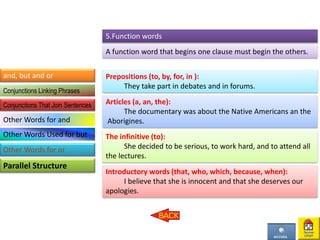
5.Function words
A function word that begins one clause must begin the others.
Prepositions (to, by, for, in ):
They take part in debates and in forums.
Articles (a, an, the):
The documentary was about the Native Americans an the
Aborigines.
The infinitive (to):
She decided to be serious, to work hard, and to attend all
the lectures.
Introductory words (that, who, which, because, when):
I believe that she is innocent and that she deserves our
apologies.
and, but and or
Parallel Structure
Conjunctions Linking Phrases
Conjunctions That Join Sentences
Other Words for and
Other Words Used for but
Other Words for or
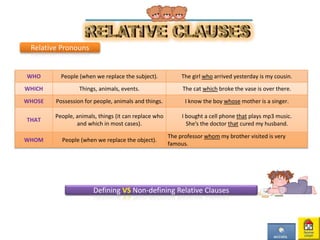
Relative Pronouns
Defining VS Non-defining Relative Clauses
WHO People (when we replace the subject). The girl who arrived yesterday is my cousin.
WHICH Things, animals, events. The cat which broke the vase is over there.
WHOSE Possession for people, animals and things. I know the boy whose mother is a singer.
THAT
People, animals, things (it can replace who
and which in most cases).
I bought a cell phone that plays mp3 music.
She’s the doctor that cured my husband.
WHOM People (when we replace the object).
The professor whom my brother visited is very
famous.
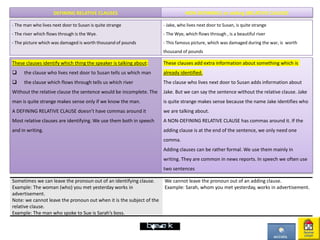
DEFINING RELATIVE CLAUSES NON-DEFINING ( or adding )RELATIVE CLAUSES
- The man who lives next door to Susan is quite strange
- The river which flows through is the Wye.
- The picture which was damaged is worth thousand of pounds
- Jake, who lives next door to Susan, is quite strange
- The Wye, which flows through , is a beautiful river
- This famous picture, which was damaged during the war, is worth
thousand of pounds
These clauses identify which thing the speaker is talking about:
 the clause who lives next door to Susan tells us which man
 the clause which flows through tells us which river
Without the relative clause the sentence would be incomplete. The
man is quite strange makes sense only if we know the man.
A DEFINING RELATIVE CLAUSE doesn’t have commas around it
Most relative clauses are identifying. We use them both in speech
and in writing.
These clauses add extra information about something which is
already identified.
The clause who lives next door to Susan adds information about
Jake. But we can say the sentence without the relative clause. Jake
is quite strange makes sense because the name Jake identifies who
we are talking about.
A NON-DEFINING RELATIVE CLAUSE has commas around it. If the
adding clause is at the end of the sentence, we only need one
comma.
Adding clauses can be rather formal. We use them mainly in
writing. They are common in news reports. In speech we often use
two sentences
Sometimes we can leave the pronoun out of an identifying clause.
Example: The woman (who) you met yesterday works in
advertisement.
Note: we cannot leave the pronoun out when it is the subject of the
relative clause.
Example: The man who spoke to Sue is Sarah’s boss.
We cannot leave the pronoun out of an adding clause.
Example: Sarah, whom you met yesterday, works in advertisement.
English grammar overview

English grammar overview

  • 2.
    English Grammar …the fun way to learn English! Subjuntive Compound Adjectives English Tenses Modals Passive Voice Pronouns Conjunctions Phrasal Verbs Prepositions Inversion Reported Speech Conditional Sentenses Parallel Structure Relative Clauses
  • 3.
    Graphic Comparison Simple Present PresentProgressive Simple Past Past Progressive Present Perfect Simpl Present Perfect Progr Past Perfect Simple Past Perfect Progress Future Conditionals English Grammar … the fun way to learn English!
  • 4.
    Problems with theEnglish tenses? Have a look at the time line, it might help you understand when to use which tense. As there is a similarity between past, present and future tenses, there are just a few rules to keep in mind. If you know how to use the present progressive correctly to express present actions, you will as well be able to use the past progressive correctly to express past actions. Graphic Comparison
  • 5.
    action that takesplace once, never or several times actions that happen one after another actions that suddenly take place action that started before a certain moment and lasts beyond that moment actions taking place at the same time action taking place before a certain moment in time puts emphasis on the result action taking place before a certain moment in time puts emphasis on the course or duration of the action moment in time period of time Result Course / Duration English Tenses
  • 6.
    Simple present isalso called present simple. The simple present expresses an action in the present taking place once, never or several times. It is also used for actions that take place one after another and for actions that are set by a timetable or schedule. The simple present also expresses facts in the present. FormIntroduction Use Signal WordsExceptions Graphic Comparison Simple Present Present Progressive Simple Past Past Progressive Present Perfect Simpl Present Perfect Progr Past Perfect Simple Past Perfect Progress Future Conditionals
  • 7.
    affirmative negative question II am. I am not. Am I? he/she/it He is. He is not. Is he? you/we/they You are. You are not. Are you? have have with the personal pronouns I, you, we und they (or with the plural form of nouns) has with the personal pronouns he, she, it (or with the singular form of nouns) All other verbs the infinite verb (play) with the personal pronouns I, you, we and they (or with the plural form of nouns) the verb + s (plays) with the personal pronouns he, she, it (or with the singular form of nouns) Introduction Form Exceptions Use Signal Words Graphic Comparison Simple Present Present Progressive Simple Past Past Progressive Present Perfect Simpl Present Perfect Progr Past Perfect Simple Past Perfect Progress Future Conditionals
  • 8.
    The 3rd personsingular is usually formed by adding s. But there are a few exceptions to the rule: The verbs can, may, might, must remain the same in all forms. So don't add s. example: he can, she may, it must Verbs ending in o or a sibilant (ch, sh, s, x) add es instead of s. example: do - he does, wash - she washes A final y after a consonant becomes ie before s. example: worry - he worries But: A final y after a vowel (a, e, i, o, u) is not modified. example: play - he plays FormIntroduction Exceptions Use Signal Words Graphic Comparison Simple Present Present Progressive Simple Past Past Progressive Present Perfect Simpl Present Perfect Progr Past Perfect Simple Past Perfect Progress Future Conditionals
  • 9.
    1. facts (somethingis generally known to be true) The sun never sets in the east or south or north, but always in the west. 2. action in the present taking place once, never or several times Colin plays football regularly - every Tuesday. In English, signal words are often used, e.g.: always, never, seldom, often, regularly, every Monday. FormIntroduction Exceptions Signal WordsUse Graphic Comparison Simple Present Present Progressive Simple Past Past Progressive Present Perfect Simpl Present Perfect Progr Past Perfect Simple Past Perfect Progress Future Conditionals
  • 10.
    3. action setby a time table or schedule Although the action takes place in the future, it takes place regularly and is set by a time table. FormIntroduction Exceptions Signal WordsUse Graphic Comparison Simple Present Present Progressive Simple Past Past Progressive Present Perfect Simpl Present Perfect Progr Past Perfect Simple Past Perfect Progress Future Conditionals
  • 11.
    4. verbs expressingstates, possession, senses, emotions and mental activity When you love someone, that's a state, a fact or emotion, but not an action (like running for example). Whenever you want to express a state, possession, sense or emotions, use the simple form (not the progressive). The following words all belong to this group: •be (state) •believe (mental activity) •belong (possession) •hate (feeling and emotion) •hear (senses) •like (feeling and emotion) FormIntroduction Exceptions Signal WordsUse Graphic Comparison Simple Present Present Progressive Simple Past Past Progressive Present Perfect Simpl Present Perfect Progr Past Perfect Simple Past Perfect Progress Future Conditionals
  • 12.
    •love (feeling andemotion) •mean (mental activity) •prefer (mental activity) •remain (state) •realize (mental activity) •see (senses) •seem (feeling and emotion) •smell (senses) •think (mental activity) •understand (mental activity) •want (feeling and emotion) •wish (feeling and emotion) FormIntroduction Exceptions Use Signal Words Graphic Comparison Simple Present Present Progressive Simple Past Past Progressive Present Perfect Simpl Present Perfect Progr Past Perfect Simple Past Perfect Progress Future Conditionals
  • 13.
    Signal Words always every ... often normally usually sometimes seldom never FormIntroductionExceptions Use Signal Words Graphic Comparison Simple Present Present Progressive Simple Past Past Progressive Present Perfect Simpl Present Perfect Progr Past Perfect Simple Past Perfect Progress Future Conditionals
  • 14.
    The present progressiveputs emphasis on the course or duration of an action. The present progressive is used for actions going on in the moment of speaking and for actions taking place only for a short period of time. It is also used to express development and actions that are arranged for the near future. Present progressive is also known as present continuous. FormIntroduction Exceptions Use Signal Words Graphic Comparison Simple Present Present Progressive Simple Past Past Progressive Present Perfect Simpl Present Perfect Progr Past Perfect Simple Past Perfect Progress Future Conditionals
  • 15.
    Use a formof to be and the infinite verb plus -ing. am with the personal pronoun I is with the personal pronouns he, she or it (or the singular form of nouns) are with the personal pronouns you, we, they (or the plural form of nouns) affirmative negative question I I am playing. I am not playing. Am I playing? he, she, it He is playing. He is not playing. Is he playing? you, we, they You are playing. You are not playing. Are you playing? FormIntroduction Exceptions Use Signal Words Graphic Comparison Simple Present Present Progressive Simple Past Past Progressive Present Perfect Simpl Present Perfect Progr Past Perfect Simple Past Perfect Progress Future Conditionals
  • 16.
    A single, silente at the end of the word is dropped before ing. example: come - coming I am coming home. You are coming home. He is coming home. But: ee at the end of the word is not changed example: agree - agreeing  The final consonant after a short, stressed vowel is doubled before ing. example: sit - sitting FormIntroduction Exceptions Use Signal Words Graphic Comparison Simple Present Present Progressive Simple Past Past Progressive Present Perfect Simpl Present Perfect Progr Past Perfect Simple Past Perfect Progress Future Conditionals
  • 17.
    The letter las final consonant after a vowel is always doubled before ing. example: travel - travelling I am travelling around. You are travelling around. He is travelling around. Mind: This applies only for British English; in American English there is usually only one l. An ie at the end of a word becomes y before ing. example: lie - lying I am lying in bed. You are lying in bed. He is lying in bed. FormIntroduction Exceptions Use Signal Words Graphic Comparison Simple Present Present Progressive Simple Past Past Progressive Present Perfect Simpl Present Perfect Progr Past Perfect Simple Past Perfect Progress Future Conditionals
  • 18.
    1.Actions taking placeat the moment of speaking (now) The action is going on now. Signal words like now, at the moment are often used to emphasise that the action is taking place at the moment of speaking. Signal words are not really necessary, however, as this is already expressed by the tense itself. He is playing football. FormIntroduction Exceptions Signal WordsUse Graphic Comparison Simple Present Present Progressive Simple Past Past Progressive Present Perfect Simpl Present Perfect Progr Past Perfect Simple Past Perfect Progress Future Conditionals
  • 19.
    In the exampleyou can see that the tickets are already bought. So we are talking about an arrangement for the near future. I'm going to the theatre tonight. 2. Arrangements for the near future To make clear that the action is not going on now, we usually use signal words like tonight, tomorrow, next Friday, at noon. FormIntroduction Exceptions Signal WordsUse Graphic Comparison Simple Present Present Progressive Simple Past Past Progressive Present Perfect Simpl Present Perfect Progr Past Perfect Simple Past Perfect Progress Future Conditionals
  • 20.
    Here we aretalking about a time limit. Jim does not usually work in the firm, he is still at school and wants to earn some extra money during his holidays. 3. Actions taking place only for a limited period of time Jim is helping in his brother's farm this week. To make clear that there is a time limit, we usually use signal words, e.g. this week/month/year. FormIntroduction Exceptions Signal WordsUse Graphic Comparison Simple Present Present Progressive Simple Past Past Progressive Present Perfect Simpl Present Perfect Progr Past Perfect Simple Past Perfect Progress Future Conditionals
  • 21.
    This action takesplace around now and only for a limited period of time, but not at the moment of speaking. We don't have to use signal words here, but we often find signal words in such sentences, e.g. now, at the moment. 4. Actions taking place around now (but not at the moment of speaking) I'm studying for my exams. FormIntroduction Exceptions Signal WordsUse Graphic Comparison Simple Present Present Progressive Simple Past Past Progressive Present Perfect Simpl Present Perfect Progr Past Perfect Simple Past Perfect Progress Future Conditionals
  • 22.
    The sentence describesa development from one situation to another. Signal words are not that common here, only sometimes the change of situation is emphasised by using for example more and more. 5. Development, changing situations The population of China is rising very fast. FormIntroduction Exceptions Use Signal Words Graphic Comparison Simple Present Present Progressive Simple Past Past Progressive Present Perfect Simpl Present Perfect Progr Past Perfect Simplev Past Perfect Progress Future Conditionals
  • 23.
    FormIntroduction Exceptions UseSignal Words Actions taking place at the moment of speaking (now) at the moment now / just now / right now Listen! Look! Arrangements for the near future •in the morning / in the afternoon / in the evening •at noon / tonight •tomorrow •next ... Graphic Comparison Simple Present Present Progressive Simple Past Past Progressive Present Perfect Simpl Present Perfect Progr Past Perfect Simple Past Perfect Progress Future Conditionals
  • 24.
    Actions taking placeonly for a limited period of time othis week / this month / this year Actions taking place around now (but not at the moment of speaking) at the moment now / just now / right now Development, changing situations more and more FormIntroduction Exceptions Use Signal Words Graphic Comparison Simple Present Present Progressive Simple Past Past Progressive Present Perfect Simpl Present Perfect Progr Past Perfect Simple Past Perfect Progress Future Conditionals
  • 25.
    Graphic Comparison Simple Present PresentProgressive The simple past expresses an action in the past taking place once, never, several times. It can also be used for actions taking place one after another or in the middle of another action. For irregular verbs, use the past form (see list of irregular verbs, 2nd column). For regular verbs, just add “ed”. Form of Simple Past Positive Negative Question I spoke. I did not speak. Did I speak? Simple Past UseExceptions Signal words Past Progressive Present Perfect Simpl Present Perfect Progr Past Perfect Simple Past Perfect Progress Future Conditionals
  • 26.
    Graphic Comparison Simple Present PresentProgressive Simple Past Exceptions in Spelling when Adding ‘ed’ Exceptions in spelling when adding ed Example after a final e only add d love – loved final consonant after a short, stressed vowel or i as final consonant after a vowel is doubled admit – admitted travel – travelled final y after a consonant becomes i hurry – hurried UseExceptions Signal words Past Progressive Present Perfect Simpl Present Perfect Progr Past Perfect Simple Past Perfect Progress Future Conditionals
  • 27.
    action in thepast taking place once, never or several times He visited his parents every weekend. actions in the past taking place one after the other He came in, took off his coat and sat down. action in the past taking place in the middle of another action When I was having breakfast, the phone suddenly rang. if sentences type II (If I talked, …) If I had a lot of money, I would share it with you. Example: UseExceptions Signal words Graphic Comparison Simple Present Present Progressive Simple Past Example: Example: Example: Past Progressive Present Perfect Simpl Present Perfect Progr Past Perfect Simple Past Perfect Progress Future Conditionals
  • 28.
    Graphic Comparison Simple Present PresentProgressive Simple Past UseExceptions Signal words yesterday, 2 minutes ago, in 1990, the other day, last Friday If-Satz Typ II (If I talked, …) Past Progressive Present Perfect Simpl Present Perfect Progr Past Perfect Simple Past Perfect Progress Future Conditionals
  • 29.
    Graphic Comparison Simple Present PresentProgressive Simple Past The past progressive puts emphasis on the course of an action in the past. Positive Negative Question I / he / she / it I was speaking. I was not speaking. Was I speaking? you / we / they You were speaking You were not speaking. Were you speaking? Use of Past Progressive puts emphasis on the course of an action in the past Example: He was playing football. two actions happening at the same time (in the past) Ex: While she was preparing dinner, he was washing the dishes. action going on at a certain time in the past Example: When I was having breakfast, the phone suddenly rang. Signal Words of Past Progressive when, while, as long as Past Progressive Present Perfect Simpl Present Perfect Progr Past Perfect Simple Past Perfect Progress Future Conditionals
  • 30.
    [has/have + pastparticiple] The present perfect simple expresses an action that is still going on or that stopped recently, but has an influence on the present. It puts emphasis on the result. Graphic Comparison Simple Present Present Progressive Simple Past Past Progressive You CANNOT use the Present Perfect with specific time expressions such as: yesterday, one year ago, last week, when I was a child, when I lived in Japan, at that moment, that day, one day, etc. We CAN use the Present Perfect with unspecific expressions such as: ever, never, once, many times, several times, before, so far, already, yet, etc. Form Present Perfect Simpl Present Perfect Progr Form Use Past Perfect Simple Past Perfect Progress Future Conditionals
  • 31.
    Unspecified Time BeforeNow Graphic Comparison Simple Present Present Progressive Simple Past Past Progressive We use the Present Perfect to say that an action happened at an unspecified time before now. The exact time is not important. I have seen that movie twenty times. I think I have met him once before. Have you read the book yet? Examples: Use 1 Present Perfect Simpl Present Perfect Progr Form Use use1 use2 use3 use4 Past Perfect Simple Past Perfect Progress Future Conditionals
  • 32.
    Graphic Comparison Simple Present PresentProgressive Simple Past Past Progressive Duration From the Past Until Now We use the Present Perfect to show that something started in the past and has continued up until now. "For five minutes," "for two weeks," and "since Tuesday" are all durations which can be used with the Present Perfect. Examples: I have had a cold for two weeks. She has been in England for six months. Mary has loved chocolate since she was a little girl. USE 2 Present Perfect Simpl Present Perfect Progr Form Use use1 use2 use3 use4 Past Perfect Simple Past Perfect Progress Future Conditionals
  • 33.
    Action has justfinished: (stopped recently, still closely connected to now) What have they just done? Why are these little bunnies laughing? they have just heard a funny story! Graphic Comparison Simple Present Present Progressive Simple Past Past Progressive USE 3 Present Perfect Simpl Present Perfect Progr Form Use use1 use2 use3 use4 Past Perfect Simple Past Perfect Progress Future Conditionals
  • 34.
    Graphic Comparison Simple Present PresentProgressive Simple Past Past Progressive USE 4 Puts emphasis on the result: past action which influence or consequence is felt in the present. He is in the hospital because he has had an accident. I have lost my wallet, I can go nowhere. Present Perfect Simpl Present Perfect Progr Form Use use1 use2 use3 use4 Past Perfect Simple Past Perfect Progress Future Conditionals
  • 35.
    Graphic Comparison Simple Present PresentProgressive Simple Past Past Progressive Present Perfect Simpl [has/have + been + present participle] FORM Use of Present Perfect Progressive puts emphasis on the duration or course of an action (not the result) Example: She has been writing for two hours. action that recently stopped or is still going on Example: I have been living here since 2001. finished action that influenced the present Example: I have been working all afternoon. Present Perfect Simple vs Present Perfect Progressive Present Perfect Progr Past Perfect Simple Past Perfect Progress Future Conditionals
  • 36.
    Present Perfect Simplevs Present Perfect Progressive Graphic Comparison Simple Present Present Progressive Simple Past Past Progressive Present Perfect Simpl Present Perfect Progr Both tenses are used to express that an action began in the past and is still going on or has just finished. In many cases, both forms are correct, but there is often a difference in meaning: We use the Present Perfect Simple mainly to express that an action is completed or to emphasise the result. We use the Present Perfect Progressive to emphasise the duration or continuous course of an action. Past Perfect Simple Past Perfect Progress Future Conditionals
  • 37.
    Graphic Comparison Simple Present PresentProgressive Simple Past Past Progressive Present Perfect Simpl Present Perfect Progr Result or duration? Do you want to express what has happened so far or how long an action has been going on yet? Present Perfect Simple Present Perfect Progressive Result (what / how much / how often) I have written 5 letters. I have been to London twice. Duration (how long) I have been writing for an hour. Emphasis on completion or duration? Do you want to emphasise the completion of an action or its continuous course (how has somebody spent his time)? Present Perfect Simple Present Perfect Progressive Emphasis on completion I have done my homework. (Meaning: My homework is completed now.) Emphasis on duration I have been doing my homework. (Meaning: That's how I have spent my time. It does not matter whether the homework is completed now.) Past Perfect Simple Past Perfect Progress Future Conditionals
  • 38.
    Graphic Comparison Simple Present PresentProgressive Simple Past Past Progressive Present Perfect Simpl Present Perfect Progr Result or side effect? Do you want to express that a completed action led to a desired result or that the action had an unwanted side effect? Present Perfect Simple Present Perfect Progressive desired result I have washed the car. (Result: The car is clean now.) unwanted side effect Why are you so wet? - I have been washing the car. (side effect: I became wet when I was washing the car. It does not matter whether the car is clean now.) Past Perfect Simple Past Perfect Progress Future Conditionals
  • 39.
    Graphic Comparison Simple Present PresentProgressive Simple Past Past Progressive Present Perfect Simpl Present Perfect Progr Time + negation: last time or beginning of an action? In negative sentences: Do you want to express how much time has past since the last time the action took place or since the beginning of the action? Present Perfect Simple Present Perfect Progressive since the last time I haven't played that game for years. (Meaning: It's years ago that I last played that game.) since the beginning I haven't been playing that game for an hour, only for 10 minutes. (Meaning: It's not even an hour ago that I started to play that game.) Past Perfect Simple Past Perfect Progress Future Conditionals
  • 40.
    Graphic Comparison Simple Present PresentProgressive Simple Past Past Progressive Present Perfect Simpl Present Perfect Progr Permanent or temporary? If an action is still going on and we want to express that it is a permanent situation, we would usually use the Present Perfect Simple. For temporary situations, we would prefer the Present Perfect Progressive. This is not a rule, however, only a tendency. Present Perfect Simple Present Perfect Progressive permanent James has lived in this town for 10 years. (Meaning: He is a permanent resident of this town.) temporary James has been living here for a year. (Meaning: This situation is only temporary. Maybe he is an exchange student and only here for one or two years.) Past Perfect Simple Past Perfect Progress Future Conditionals
  • 41.
    Graphic Comparison Simple Present PresentProgressive Simple Past Past Progressive Present Perfect Simpl Present Perfect Progr [had + past participle] FORM You had studied English before you moved to New York. Had you studied English before you moved to New York? You had not studied English before you moved to New York. The Past Perfect expresses the idea that something occurred before another action in the past. It can also show that something happened before a specific time in the past. (putting emphasis only on the fact, not the duration) already, just, never, not yet, once, until that day (with reference to the past, not the present) If-Satz Typ III (If I had talked, …) Signal Words Examples: Past Perfect Simple Past Perfect Progress Future Conditionals
  • 42.
    Graphic Comparison Simple Present PresentProgressive Simple Past Past Progressive Present Perfect Simpl Present Perfect Progr Past Perfect Simple [had been + present participle] FORM You had been waiting there for more than two hours when she finally arrived. Had you been waiting there for more than two hours when she finally arrived? You had not been waiting there for more than two hours when she finally arrived. Examples: We use the Past Perfect Continuous to show that something started in the past and continued up until another time in the past. (puts emphasis on the course or duration of an action) for, since, the whole day, all day signal words Past Perfect Progress Future Conditionals
  • 43.
    Graphic Comparison Simple Present PresentProgressive Simple Past Past Progressive Present Perfect Simpl Present Perfect Progr Past Perfect Simple Past Perfect Progress Simple Future has two different forms in English: "will" and "be going to." Although the two forms can sometimes be used interchangeably, they often express two very different meanings. These different meanings might seem too abstract at first, but with time and practice, the differences will become clear. Both "will" and "be going to" refer to a specific time in the future. Simple Future Will Be going to Future Conditionals
  • 44.
    Signal Words: ina year, next …, tomorrow, I think, probably, perhaps Graphic Comparison Simple Present Present Progressive Simple Past Past Progressive Present Perfect Simpl Present Perfect Progr Past Perfect Simple Past Perfect Progress Future Simple Future Will Be going to a spontaneous decision example: Wait, I will help you. Use of will Future an opinion, hope, uncertainty or assumption regarding the future example: He will probably come back tomorrow. a promise example: I will not watch TV tonight. an action in the future that cannot be influenced example: It will rain tomorrow. conditional clauses type I example: If I arrive late, I will call you. Conditionals
  • 45.
    Signal Words in oneyear, next week, tomorrow Graphic Comparison Simple Present Present Progressive Simple Past Past Progressive Present Perfect Simpl Present Perfect Progr Past Perfect Simple Past Perfect Progress Future Simple Future Will Be going to Going to future expresses a conclusion regarding the immediate future or an action in the near future that has already been planned or prepared. Use of going to Future an action in the near future that has already been planned or prepared example: I am going to study harder next year. a conclusion regarding the immediate future (based on a present situation). example: The sky is absolutely dark. It is going to rain. Conditionals
  • 46.
    Conditional Sentences /If-Clauses Graphic Comparison Simple Present Present Progressive Simple Past Past Progressive Present Perfect Simpl Present Perfect Progr Past Perfect Simple Past Perfect Progress Future Type I Type II Type III Conditionals Conditional Sentences are also known as Conditional Clauses or If Clauses. They are used to express that the action in the main clause (without if) can only take place if a certain condition (in the clause with if) is fulfilled. There are three types of Conditional Sentences. If clause + main clause If clause, main clause. The main clause can also be at the beginning of the sentence. In this case, don't use a comma. Main clause if clause.
  • 47.
    Conditional Sentences /If-Clauses Graphic Comparison Simple Present Present Progressive Simple Past Past Progressive Present Perfect Simpl Present Perfect Progr Past Perfect Simple Past Perfect Progress Future Type I Type II Type III Conditionals if + Simple Present, will-Future Form Example: If I find her address, I will send her an invitation. Conditional Sentences Type I refer to the future. An action in the future will only happen if a certain condition is fulfilled by that time. We don't know for sure whether the condition actually will be fulfilled or not, but the condition seems rather realistic – so we think it is likely to happen. Use Example: If John has the money, he will buy a Ferrari. I know John very well and I know that he earns a lot of money and that he loves Ferraris. So I think it is very likely that sooner or later he will have the money to buy a Ferrari. Present Real Conditional
  • 48.
    Conditional Sentences /If-Clauses Graphic Comparison Simple Present Present Progressive Simple Past Past Progressive Present Perfect Simpl Present Perfect Progr Past Perfect Simple Past Perfect Progress Future Type I Type II Type III Conditionals Form if + Simple Past + would + Infinitive. Example: If I found her address, I would send her an invitation. Were instead of Was In Type II, we usually use ‚were‘ –even if the pronoun is I, he, she or it Example: If I were you, I would not do this. Refers to situations in the present. An action could happen if the present situation were different. I don't really expect the situation to change, however. I just imagine „what would happen if …“ Use Example: If John had the money, he would buy a Ferrari. I know John very well and I know that he doesn't have much money, but he loves Ferraris. He would like to own a Ferrari (in his dreams). But I think it is very unlikely that he will have the money to buy one in the near future. Present Unreal Conditional
  • 49.
    I knew Johnvery well and I know that he never had much money, but he loved Ferraris. He would have loved to own a Ferrari, but he never had the money to buy one. Conditional Sentences / If-Clauses Graphic Comparison Simple Present Present Progressive Simple Past Past Progressive Present Perfect Simpl Present Perfect Progr Past Perfect Simple Past Perfect Progress Future Type I Type II Type III Conditionals Past Unreal Conditional FORM [If ... Past Perfect ..., ... would have + past participle ... ] [... would have + past participle ... if ... Past Perfect ...] USE The Past Unreal Conditional is used to talk about imaginary situations in the past. You can describe what you would have done differently or how something could have happened differently if circumstances had been different. We just imagine, what would have happened if the situation had been fulfilled. Eg: If I had found her address, I would have sent her an invitation. Eg: If John had had the money, he would have bought a Ferrari.
  • 50.
    Subjunctive Use the simpleform of the verb. The simple form is the infinitive without the "to." The simple form of the verb "to go" is "go." The Subjunctive is only noticeable in certain forms and tenses. FORM The Subjunctive is used to emphasize urgency or importance. It is used after certain expressions (see below). USE Example Jake insisted that Susan be hired immediately. The doctor recommended that she see a specialist about the problem. Example
  • 51.
    Examples: Dr. Smith askedthat Mark submit his research paper before the end of the month. Donna requested Frank come to the party. The teacher insists that her students be on time. to propose (that) to recommend (that) to request (that) to suggest (that) to urge (that) to advise (that) to ask (that) to command (that) to demand (that) to desire (that) to insist (that) Verbs Followed by the Subjunctive The Subjunctive is used after the following verbs: Expressions Followed by the Subjunctive (see below)
  • 52.
    Expressions Followed bythe Subjunctive The Subjunctive is used after the following expressions: It is best (that) It is crucial (that) It is desirable (that) It is essential (that) It is imperative (that) It is important (that) It is recommended (that) It is urgent (that) It is vital (that) It is a good idea (that) It is a bad idea (that) It is crucial that you be there before Tom arrives. It is important she attend the meeting. It is recommended that he take a gallon of water with him if he wants to hike to the bottom of the Grand Canyon. Examples: Negative, Continuous and Passive Forms of Subjunctive (see below)
  • 53.
    Negative, Continuous andPassive Forms of Subjunctive Negative Examples: The boss insisted that Sam not be at the meeting. The company asked that employees not smoke while working. I suggest that you not take the job without renegotiating the salary. Passive Examples: Jake recommended that Susan be hired immediately. Christine demanded that I be allowed to take part in the negotiations. We suggested that you be admitted to the organization. Continuous Examples: It is important that you be standing there when he gets off the plane. It is crucial that a car be waiting for the boss when the meeting is over. I propose that we all be waiting in Tim's apartment when he gets home.
  • 54.
    Passive voice Forms ofthe passive Forms Uses
  • 55.
    Forms Uses Uses of thepassive Passive voice
  • 56.
    Inversion Inversion is usedto give emphasis or to be rhetorical in more formal situations, in political speeches, on the news, and also in literature. Some native speakers may also use them occasionally in day-to-day conversation. Look at these examples, Rarely/Seldom/Never These are most commonly used with the present perfect or past perfect, & with modals such as can and could. The present simple can also be used. Seldom have I seen him looking so miserable. Never in her life had she experienced this exhilarating emotion. Not only.....but also "Not only has McDonalds played a huge role in pioneering low standards now equated with the word "McJobs", but it has also decided to restrict our ability to have a public discussion about the impact of the McJobs phenomenon", Naomi Klein, "No Logo: Taking Aim at Brand Bullies" (Toronto: Vintage Canada, 2000)
  • 57.
    Modal Nature OppositeExamples be able to possibility cannot or be unable to I was able to prevent the theft but I was unable to arrest the thief. can possibility, capacity cannot Birds can fly; monkeys cannot. permission cannot or may not Can I watch TV? No, you can't. could possibility, capactiy could not Could there be a virus in this file? No, there couldn't; I ran the anti-virus. possibility (past) could not Could dodo birds fly? No, they couldn't. permission cannot or may not Could I open the window? No, you may not. had better advice had better not You had better get moving, if you don't want to be late. You had better not be late. have to, have got to obligation (external origin) must not I have to pay my taxes before the end of March. External origin: laws of the nation. must necessity, strong probability cannot A is bigger than B which is bigger than C, so A must be bigger than C. C cannot be bigger than A. obligation (internal origin) must not Teacher to pupil: "You must come to school on time; you must not be late". Internal origin: the teacher who speaks decides may possibility cannot It may rain. It can't possibly be 8 PM, I'm only half ready. permission, request cannot May I speak to Mrs X, please? No, you can't, she's not in. might possibility (weak) cannot I might come to your party if I can get off work on time. permission may not Might I borrow your laptop? ought to duty, advice ought not to You ought to apologize to your sister for having hurt her feelings. logical deduction cannot, could not That ought to be enough petrol to last us until we get to . should advice should not You should spend more time on your homework. logical deduction cannot, could not €5 should be enough to leave as a tip.
  • 58.
    Prepositions = ‫الجر‬‫أحرف‬ Prepositions are words that are usually followed by nouns or pronouns. A noun or pronoun that comes after a preposition is calles the object of the preposition. Below there are some of the most common prepositions, their meanings and examples on each one of them Definition A&B D to O P to W
  • 59.
    1- About (‫)عن‬ a.On the subject of This is a story about elephants (‫يقارب‬ ‫)ما‬ b. Approximately He is about ten years old 2- Above ( ‫من‬ ‫أعلى‬-‫فوق‬ ) a. Higher than; over The plane flew above the clouds 3- Across (‫)عبر‬ a. From one side to the other We walked across the field (‫المقابلة‬ ‫الجهة‬ ‫)في‬ b. On the other side of There is a store across the street Definition A&B D to O P to W
  • 60.
    4- After ( ‫بعد‬{‫زمان‬}) a. Later in time after ten o'clock; after lunch ( ‫وراء‬{‫مكان‬ }) b. In pursuit of The dog ran after the cat 5- Against (‫)ضد‬ a. In opposition to Theft is against the law (‫آخر‬ ‫شيء‬ ‫بمحاذاة‬ ‫الشيء‬ ‫يسند‬ ‫بمعنى‬ ‫)على‬ b. Touching; supported by I leaned my bicycle against the wall 6- Along ( ‫الطريق‬ ‫مثال‬ ‫طول‬ ‫على‬-‫الشارع‬ ) a. Following the length of We walked along the road Definition A&B D to O P to W
  • 61.
    7- Among ( ‫مجموعة‬‫بين‬‫اي‬‫ثالثة‬‫و‬‫فوق‬ ‫ما‬ ) a. Within a group The money was shared among three people 8- Around ( ‫)حول‬ a. Circling something We walked around the block (‫)حول‬ b. Surrounding There is a fence around the garden ( ‫المكان‬ ‫من‬ ‫مختلفة‬ ‫أرجاء‬ ‫)في‬c. In different parts of I looked around the house for the keys (‫يقارب‬ ‫)ما‬ d. Approximately He is around six feet tall Definition A&B D to O P to W
  • 62.
    9- At ( ‫مكان‬‫في‬‫او‬‫محدد‬ ‫موقع‬ ) a. A specific location at 23 Chestnut Street; at the park (‫محدد‬ ‫زمن‬ ‫)في‬ b. A point in time at 5 o'clock; at night ( ‫حالة‬ ‫في‬‫او‬‫معين‬ ‫وضع‬ ) c. A condition at peace; at war; at rest (‫ما‬ ‫نشاط‬ ‫)في‬ d. An activity at work; at school; at play (‫اتجاه‬ ‫)في‬ e. Towards Look at someone; wave at someone 10- Before (‫)قبل‬ a. Earlier in time before two o'clock; before Christmas (‫)قبل‬ b. Earlier in a series S comes before T in the alphabet Definition A&B D to O P to W
  • 63.
    11- Behind (‫)خلف‬ a.At the back of The little girl hid behind her mother. (‫)متأخر‬ b. Late I am behind in my work (‫سبب‬ ‫بمعنى‬ ‫)خلف‬ c. Cause; origin Who was behind that idea 12- Below (‫)تحت‬ a. Lower than; under below freezing; below sea level 13- Beneath . (‫)تحت‬ Lower than; below beneath the earth 14- Beside (‫)بجانب‬ Next to; at the side of I sit beside her in class Definition A&B D to O P to W
  • 64.
    15- Besides ( ً‫ا‬‫أيض‬-‫إلى‬‫باإلضافة‬ ) Also; as well as We study other languages besides English 16- Between ( ‫موقعين‬ ‫بين‬‫او‬‫مكانين‬ ) a. An intermediate location: Toronto lies between Montreal and Vancouver. ( ‫بين‬‫زمانين‬‫او‬‫مناسبتين‬ ) b. An intermediate time between Christmas and New Year's Day (‫سلسلة‬ ‫في‬ ‫شيئين‬ ‫)بين‬ c. Intermediate in a series: B comes between A and C in the alphabet. (‫مجموعتين‬ ‫)بين‬ d. Within a group of two: The money was shared between two people Definition A&B D to O P to W
  • 65.
    17- Beyond (‫من‬ ‫)أبعد‬a. Farther than The mountains lie beyond the horizon. (‫)يفوق‬ b. Further than; exceeding That was beyond my expectations. 18- But ( ‫عدا‬ ‫ما‬-‫ا‬‫ل‬‫إ‬ ) Except: I have read all but the last chapter. 19- By (‫)قرب‬ a. Near a house by the sea (ً‫ا‬‫)مرور‬ b. Past He waved as he drove by the house. (‫معينة‬ ‫قياس‬ ‫)بوحدة‬ c. In units of cheaper by the dozen; sold by weight ( ‫ب‬-‫خالل‬ ‫من‬ ) d. Through the means of travel by plane; written by him Definition A&B D to O P to W
  • 66.
    1. Despite ‫المعنى‬1 :inspite of ‫من‬ ‫بالرغم‬ ‫أو‬ ‫:مثال‬ We walked downtown despite the rain. 2. Down ‫المعنى‬1 : To a lower position ‫أو‬ ً‫ل‬‫نزو‬ ‫أسفل‬ ‫إلى‬ ‫:مثال‬ The ball rolled down the hill. 3. During ‫:المعنى‬ Throughout a period: ‫خالل‬ ‫أو‬ ‫:مثال‬ She works during the day. 4. Except ‫:المعنى‬ Not including ‫عدا‬ ‫ما‬ ‫:أو‬ ‫:مثال‬ I have visited everyone except him. Definition A&B D to O P to W
  • 67.
    ‫لـ‬)5 . For ‫المعنى‬1: Duration of time ‫الزمن‬ ‫من‬ ‫لمدة‬ ‫أو‬ ‫:مثال‬ We walked for two hours. ‫المعنى‬2 : Distance: ‫معينة‬ ‫لمسافة‬ ‫أو‬ ‫:مثال‬ I walked for five kilometers. ‫المعنى‬3 : Purpose: ‫ما‬ ‫لغرض‬ ‫أو‬ ‫:مثال‬ I bought this jacket for you. ‫المعنى‬4 :In favor of: ‫مع‬ ‫أو‬(‫يدعم‬ ‫أي‬‫أقتراح‬‫ضد‬ ‫ليس‬ ‫و‬ ) ‫:مثال‬ We are for the proposal. ‫المعنى‬5 : Considering: ‫لـ‬ ً‫ا‬‫نظر‬ ‫:مثال‬ The boy is clever for his age. 6. From ‫المعنى‬1:‫مكان‬ ‫من‬ Place of origin: ‫:مثال‬ We left from Boston; he comes from Mexico ‫المعنى‬2:‫زمنية‬ ‫نقطة‬ ‫من‬ Start of a period of time: ‫:مثال‬from now on; from yesterday until today ‫المعنى‬3:‫من‬ Cause: ‫:مثال‬ He suffers from nervousness. ‫المعنى‬4:‫مصدر‬ ‫من‬ Source: I first heard the story from you. Definition A&B D to O P to W
  • 68.
    7. In ‫المعنى‬1:‫في‬ Withina location: ‫:أمثلة‬ in the room; in London in the building ‫المعنى‬2:‫محددة‬ ‫زمنية‬ ‫مدة‬ ‫خالل‬ Within a certain time: ‫:مثال‬ I will return in an hour. ‫المعنى‬3:‫بـ‬(‫بواسطة‬ ) By means of: ‫:مثال‬ write in pencil; speak in English 8. Inside ‫المعنى‬:‫داخل‬ ‫في‬ Within: ‫:مثال‬ They are inside the house. 9. Into ‫المعنى‬1:‫داخل‬ ‫إلى‬ To the inside of: ‫:مثال‬ We stepped into the room. ‫المعنى‬2:‫أخرى‬ ‫حال‬ ‫إلى‬ ‫حال‬ ‫من‬ Change of condition: ‫:مثال‬ The boy changed into a man. Definition A&B D to O P to W
  • 69.
    10. Like ‫المعنى‬1:ً‫ا‬‫مشابه‬(‫كأنه‬ )Resembling: ‫:مثال‬That looks like him. 11. Near ‫المعنى‬:‫قرب‬ Close to: ‫:مثال‬ near the school; near the ocean 12. Of ‫المعنى‬1( :‫الـ‬ ) ‫:مثال‬ the middle of the road ; the sound of music ‫المعنى‬2:‫مجموعة‬ ‫من‬ ‫جزء‬ Part of a group: ‫:مثال‬ one of us; a member of the team ‫المعنى‬3:‫من‬(‫للقياس‬ ) Measurement: ‫:مثال‬ a cup of milk; two meters of snow 13. Off ‫المعنى‬1:‫عن‬ ‫بعيدا‬‫او‬‫من‬ Not on; away from: ‫:مثال‬ Please keep off the grass. Definition A&B D to O P to W
  • 70.
    14. On ‫المعنى‬1:‫على‬(‫اي‬‫الشيء‬ ‫سطح‬‫على‬ ) Touching the surface of: ‫:مثال‬ on the table; on the wall ‫المعنى‬2:‫محدد‬ ‫يوم‬ ‫في‬ A certain day: ‫:مثال‬ That happened on Sunday, on the 6th of June. ‫المعنى‬3:‫محدد‬ ‫شارع‬ ‫في‬ A certain street: ‫:مثال‬ on South Street ‫المعنى‬4:‫معينة‬ ‫حالة‬ ‫في‬ A state or condition: ‫:مثال‬ on strike; on fire; on holiday ‫المعنى‬5:‫على‬(‫خالل‬ ‫من‬ ‫أي‬ )By means of: ‫:مثال‬ shown on television 15. Onto ‫المعنى‬:‫على‬ ‫مكان‬ ‫إلى‬ To a position on: The child climbed onto the table. Definition A&B D to O P to W
  • 71.
    16. Opposite ‫المعنى‬:‫مواجه‬ ‫أو‬‫مقابل‬ Facing: The library is opposite the fire station. 17. Out of ‫المعنى‬1:‫خارج‬‫الـ‬ To the outside of: ‫:مثال‬ She went out of the room. ‫المعنى‬2:‫ضمن‬ ‫من‬ From among: ‫:مثال‬ We won two games out of three. ‫المعنى‬3:‫بدافع‬ Motive: ‫:مثال‬ We spoke to them out of politeness. ‫المعنى‬4:‫بعيدأ‬‫عن‬ Beyond: ‫:مثال‬ out of control; out of danger 18. Outside ‫المعنى‬:‫خارج‬ On the outer side of: ‫:مثال‬ outside the house Definition A&B D to O P to W
  • 72.
    19. Over ‫المعنى‬:‫أعلى‬ Above;higher than: ‫:مثال‬ There are cupboards over the sink. ‫المعنى‬2:‫على‬(ً‫ا‬‫مغطي‬ ) Covering: ‫:مثال‬ We spread an extra blanket over the bed. ‫المعنى‬3:‫من‬ ‫أكثر‬ More than: ‫:مثال‬ It cost over ten dollars; it took over an hour ‫المعنى‬4:‫محددة‬ ‫زمنية‬ ‫فترة‬ ‫خالل‬ During: ‫:مثال‬ I saw him several times over the past week. Definition A&B D to O P to W
  • 73.
    1. Per ‫المعنى‬:‫في‬ ‫أو‬‫لـ‬ for each ‫مثال‬:600 kilometers per hour; price per liter 2. Plus . ‫المعنى‬:‫زائد‬ With the addition of ‫:مثال‬ Six plus four equals ten 3. Since ‫المعنى‬:‫منذ‬ From a specific time in the past: ‫:مثال‬ I had been waiting since two o'clock 4. Through ‫المعنى‬1:‫عبر‬ Across; from end to end of ‫:مثال‬ the main road through town ‫المعنى‬2:‫زمنية‬ ‫فترة‬ ‫طوال‬ For the whole of a period ‫:مثال‬ I slept through the night ‫المعنى‬3 : By means of ‫:مثال‬ Skill improves through practice Definition A&B D to O P to W
  • 74.
    5. Throughout : ‫المعنى‬:‫أنحاء‬‫كل‬ ‫في‬ In every part of ‫:مثال‬ throughout the world ‫المعنى‬2:‫الزمنية‬ ‫الفترة‬ ‫كل‬ ‫خالل‬ For the whole of a period: ‫:مثال‬ throughout the winter 6. Till ‫المعنى‬:‫حتى‬ Up to a certain time ‫:مثال‬ till the end 7. To ‫المعنى‬1:‫باتجاه‬ In the direction of ‫:مثال‬ Turn to the right ‫المعنى‬2:‫إلى‬ Destination ‫:مثال‬ I am going to Rome ‫المعنى‬3:‫لغاية‬ Until ‫:مثال‬ from Monday to Friday; five minutes to ten ‫المعنى‬4:‫كي‬ In order to ‫:مثال‬ We went to the store to buy soap Definition A&B D to O P to W
  • 75.
    8. Toward (orTowards) ‫المعنى‬:‫باتجاه‬ In the direction of ‫:مثال‬ We walked toward the center of town 9. Under ‫المعنى‬1:‫تحت‬ Beneath ‫:مثال‬ under the desk; under the trees ‫المعنى‬2:‫من‬ ‫أقل‬ Less than ‫:مثال‬ Under 100 people were present ‫المعنى‬3:‫قيد‬ ‫في‬(‫مثال‬:‫اإلنشاء‬ ‫أو‬ ‫التنفيذ‬ ) In circumstances of ‫:مثال‬ under repair; under way; under discussion 10. Underneath ‫المعنى‬:‫تحت‬ Below, under ‫:مثال‬ underneath the carpet 11. Until ‫المعنى‬:‫حتى‬ Up to a certain time ‫:مثال‬ She will stay until Friday; until 5 p.m Definition A&B D to O P to W
  • 76.
    12. Upon ‫المعنى‬:‫على‬ on ‫:مثال‬depend upon; rely upon 13. Up ‫المعنى‬1:‫أعلى‬ In a higher place ‫:مثال‬ She lives up the hill 14. Up to ‫المعنى‬1:‫لغاية‬ As far as ‫:مثال‬ up to now; I have read up to page 100 ‫المعنى‬2:‫على‬ ‫معتمدا‬ Depending on ‫:مثال‬ The decision is up to you 15. Versus ‫المعنى‬:‫ضد‬(‫القانون‬ ‫في‬‫و‬‫الرياضة‬ ) Against (sports, legal) ‫:مثال‬ The next game is England versus Australia Definition A&B D to O P to W
  • 77.
    16, Via ‫المعنى‬:‫طريق‬ ‫عن‬By way of ‫:مثال‬ He went to Los Angeles via San Francisco 17. With ‫المعنى‬1:‫مع‬ Accompanying ‫:مثال‬ He came with her; I have my keys with me ‫المعنى‬2:‫بـ‬‫مستخدما‬ ‫أو‬ By means of; using ‫:مثال‬ I repaired the shoes with glue 18. Within ‫المعنى‬:‫ضمن‬ Inside of ‫:مثال‬ within twenty minutes; within one kilometer 19. Without ‫المعنى‬:‫بدون‬ Not having ‫:مثال‬ Do not leave without your coat; without money Definition A&B D to O P to W
  • 78.
    Jane says :« I want to go to the concert. » Direct speech Jane says that she wants to go to the concert. Indirect speech Say, ask, tell…are reporting verbs. If the reporting verb is in the present tense, there is no change of tense in indirect speech. Eg : « I want to see George Michael .» Present direct. She says she wants to see George Michael. Present indirect Sometimes other words change in indirect speech eg pronouns. Eg : Jane says : « my father won’t let me go .» Jane says (that) her father won’t let her go. When the reporting verb is in the past, (she said, I told her…), the verb tense in indirect speech changes when we report it. Learn the following changes (click here) Reported Speech
  • 79.
    D I RE C T S P E E C H I N D I R E C T S P E E C H Simple present He said: “I never eat meat.” Simple past He said that he never ate meat. Present continuous “I’m waiting for Ann.” : he said. Past continuous He said he was waiting for Ann. Present perfect He said: “I’ve found a flat.” Past perfect He said he had found a flat. Present perfect continuous He said: “I’ve been waiting for ages.” Past perfect continuous He said he had been waiting for ages. Simple past She said: “I took it home with me.” Past perfect She said she’d taken it home with her. Future He said: “I’ll be in tomorrow.” Conditional Ha said that he would be in the next day. Other changes (click here)
  • 80.
    Can Could Will Would MayMight Shall Should Must Had to Here There This That These Those Expressions of time Today That day Yesterday The day before The day before yesterday Two days before Tomorrow The following day/the next day The day after tomorrow In two days time Next week/year… The following week/year… Last week/year… The previous week/month/year… A week/month/year…ago A week/year/month…before Reporting questions: In indirect questions the order is not the same as in direct questions. It’s the same as in statements. We do not use do/does/did to make indirect questions. We do not put “?” at the end. If there is no question word, we begin the indirect question with “if” or “whether”. Eg: “Is the weather in Hawai always wonderful?” Direct Question Jane asked if the weather in Hawai was always wonderful. Indirect Question The reporting verbs for indirect questions are: ask, wonder, want to know etc…
  • 81.
    Phrasal Verbs Form: There arehundreds of phrasal verbs in English and it is often impossible to guess the meaning even though you understand the separate parts that make up each verb. Indeed many phrasal verbs have more than one meaning! Below is a quick reference list of some of the most common phrasal verbs together with an example and the meaning to help you through the confusion! Verb + adverb / preposition Go to the list
  • 82.
    Phrasal Verb MeaningExample Break down Become useless The train broke down at 7 p.m Bring up Educate at home She brought up five children. Call back Telephone again Please call back after lunch. Call for fetch We’ll call for you after lunch. Call off end The strike was called off at Easte. Carry on Continue with Are you carrying on with English. Catch up Join quickly Go on! I’ll catch you up in a minute. Close down Stop production The firm closed down last month. Come from To be born in Her family originally came from . Drop in Informal visit Drop in sometime next week. Eat out Eat outside home Why not eat out for a change? Fall out Have an argument Adam and Alice have fallen out again. Fall through Come to nothing The new plans have fallen through. Fill in Add the necessary Fill in the details below. Find out Realize the truth He found out about his mum recently.
  • 83.
    Get back returnI get back from on Friday. Get off leave Get off the bus at . Get on Make progress He’s getting on well at reading. Get on with Co-operate well She gets on with her boss very well. Get out of Escape from I can’t get out of going to the play. Get over Recover from She never gets over his death. Get round to Find time He hasn’t got round to replaying yet. Get through Contact by phone She got through to the man in charge. Get up Rise out of bed They got up early to be here the first. Go off Go bad This meat has definitely gone off. Grow up Become adult He grew up fast when his dad died. Hang up Stop speaking Liz hung up on her boyfriend. Have on Play a trick He must be having us on! Hold on Wait (phone) Would you mind holding on? Keep up Carry on with Keep up the good work! Knock down Traffic accident He was knocked down by a motorbike.
  • 84.
    Laugh at Makefun of They laughed at his misfortune. Let down disappoint Harry will never let you down. Lie in Stay in bed You can lie in tomorrow. Look after Attend to She looked after the entire class. Look at examine Please look at the battery. Look for Search for Are you still looking for a job? Look forward to anticipate I’m looking forward to the holidays. Look into examine We must look into that situation. Look up Search for He looked up the time of the train. Pack up Stop working They packed up work early. Pay back Return money He’ll pay the money back next month. Pay off Lose a job She’ll be paid off in two weeks. Pick up Meet (by car) He was picked up from the hotel. Put off postpone He put off his visit to the dentist. Put on wear She put on an expensive new suit. Put through Connect (phone) He was put through to the director. Put up Provide lodging We’ll put you up during your visit. Put up with Be patient She put up with his bad moods.
  • 85.
    Ring back Telephoneagain Ring me back after lunch. Run out of Come to an end We’ve run out of tea. Save up Keep money She had to save up for the holidays. See off Accompany to bus… You can see us off at the ferry. Set off Start (journey etc.) He would set off at down each day. Settle down Become established He never settled down to married life. Show off Attracting attention The toddler showed off at the wedding. Sort out organize Those books need sorting out. Stand up for defend Suffragettes stood up for themselves. Take after Resemble (relative) Jan took after his uncle. Take off remove He took off his hat and gloves. Tell off scold Mum often told us off in public. Think about Reflect / recall She often thought about her childhood. Think of consider We must think of the children.
  • 86.
    Think over Considerfurther You should think it over for a while. Try on See if it fits Try it on before you buy it. Turn down Refuse to consider He was turned down for a job. Turn off Stop the flow of Turn off that tap please! Turn on start He turned on the computer. Turn up appear They turned up unexpectedly. Wake up Stop sleeping I didn’t wake up until noon. Walk out Leave(unexpectedly) The factory workers walked out. Wash up Cleans dishes It’s your turn to wash up. Wear out Become useless Kids wear clothes out so quickly. Wrap up Enclose in paper The presents took ages to wrap up.
  • 87.
    The order ofadjectives before a noun is not always fixed. But this table shows some ordering Compound Adjectives Order of adjectives Adjectives Nouns describing or expressing feeling size age Colour Defining a beautiful green Indian carpet an old black horse a tall medical worker those funny little flowers Compound adjectives
  • 88.
    Cardinal number+noun A four-doorcar A five – dinar note Cardinal adj + noun A first –class ticket A second-hand book (noun ; adverb; adjective)+verb+ing An insect -killing pesticide The ant is a hard-working insect (Used when the noun described does the action) (noun; adj ; adv)+past participle It is a flower-covered garden Ready –made clothes A quickly-written letter (Used when the noun described undergoes the action) Adjective+noun+ed blue-eyed dark-haired thin – legged thick-soled boots (It is used to describe all parts of human /animals body; clothes; shoes etc)
  • 89.
    noun+noun +ed He isa lion-hearted person He is a stone –hearted father. Noun+adj She is wearing an olive-green dress. a sky-blue shirt number –year-old He is eighteen-year old. Noun-like She has stick-like arms. A dog -like fox. Number-noun+ed A two-legged animal A four-legged animal A one-eyed person In the kingdom of the blind, the one-eyed man is a king. Adj-to – verb It is an easy-to- do test.
  • 90.
    Pronouns Pronouns replace nounsor phrases Personal pronouns and adjectives Personal pronouns substitute for specific people, things, or ideas. They agree in gender and number with the noun they replace. Eg jack smith ---- he / the actress---she / my room----it / crocodiles-----they Subject pronouns replace nouns that perform the action of the verb. My wife and I live in Boston. We live in Boston. Object pronouns replace nouns that receive the action of the verb. The teacher gave John a puppy. The teacher gave him a puppet. They also replace nouns in prepositional phrases. Eg This story is about us. Reflexive pronouns refer back to th esubject of the verb. She washes her hands by herself. Possessive adjectives come before a noun and show ownership. This is your book. Possessive pronouns stan d alone and show ownership. That is my chair.----- That chair is mine. Personal pronouns and adjectives chart
  • 91.
  • 92.
  • 93.
  • 94.
    Conjunctions and, but andor Parallel Structure Conjunctions are words used to link words, phrases or clauses. Some common conjunctions are and, but and or. Use and to link words that are similar. We buy fruit and vegetables at the grocery store. The house is warm and comfortable. There were several cars and trucks in the street. And Use but to link words that are different and do not normally go together. He works quickly but neatly. The teacher is firm but fair with the children. The musicians are young but very talented. But Conjunctions Linking Phrases Conjunctions That Join Sentences Other Words for and Other Words Used for but Other Words for or
  • 95.
    Use or totalk about choices. You can have a soda or lemonade. Would you like pasta or rice? Does the sauce taste sweet or sour? Is your sister older or younger than you? Or The word or is often used with not and other negative words. She does not like apple juice or orange juice. I didn’t see or hear anything strange. He can’t sing or dance. They’ve never been to Europe or Asia. and, but and or Parallel Structure Conjunctions Linking Phrases Conjunctions That Join Sentences Other Words for and Other Words Used for but Other Words for or
  • 96.
    Conjunctions Linking Phrases Usethe conjunctions and, but and or to link phrases. The phrases in these examples are printed in color. We like going shopping and visiting museums. I tell my parents and my best friend all my secrets. Some of my toys are dirty and a bit broken. The car is very old but still very reliable. The weather was very sunny but rather cold. I’m older than Anna but younger than Jack. Is it quicker to go by train or by car? You could call it a thin book or a thick magazine. and, but and or Parallel Structure Conjunctions Linking Phrases Conjunctions That Join Sentences Other Words for and Other Words Used for but Other Words for or
  • 97.
    Conjunctions That JoinSentences Conjunctions are also used to join two sentences to make them one. Here are some examples with and, but and or. Mom is working in the garden. Dad is busy in the kitchen. Mom is working in the garden and Dad is busy in the kitchen. Sam is playing football. Eric is reading a book. Sam is playing football and Eric is reading a book. I switched on the TV. There were no interesting programs on. I switched on the TV, but there were no interesting programs on. Meera phoned her friend Anna. She wasn’t at home. Meera phoned her friend Anna, but she wasn’t at home. Would you like to go to the movies? Shall we go for a burger? Would you like to go to the movies or shall we go for a burger? Hurry up! You’ll be late for school. Hurry up or you’ll be late for school! and, but and or Parallel Structure Conjunctions Linking Phrases Conjunctions That Join Sentences Other Words for and Other Words Used for but Other Words for or
  • 98.
    Other Words forand There are other words for and that also join two sentences. Dad washed the car. He polished it. Dad not only washed the car, but he also polished it. Sally baked the cake. She decorated it. Sally not only baked the cake, but she decorated it as well. John did his homework. He cleaned his room. John not only did his homework, but he cleaned his room, too. They visited Sydney. They also visited Hong Kong and Tokyo. They visited Sydney, as well as Hong Kong and Tokyo. Sam ran faster than Kim. He ran faster than David too. Sam ran faster than both Kim and David. and, but and or Parallel Structure Conjunctions Linking Phrases Conjunctions That Join Sentences Other Words for and Other Words Used for but Other Words for or
  • 99.
    Other Words Usedfor but There are other words for but that also join sentences. Grandpa is old but very fit. Although Grandpa is old, he’s very fit. The weather was sunny but cold. Even though the weather was sunny, it was cold. The bus is slower than the train but it’s cheaper. While the bus is slower than the train, it’s cheaper. This computer is very old but reliable. Though this computer is very old, it is very reliable. and, but and or Parallel Structure Conjunctions Linking Phrases Conjunctions That Join Sentences Other Words for and Other Words Used for but Other Words for or
  • 100.
    Other Words foror There are other words for or that name choices or join two sentences. •The movie wasn’t funny. It wasn’t interesting. •The movie was neither funny nor interesting. •You can do your homework now. You can do your homework after dinner. •You can do your homework either now or after dinner. •We could walk. We could take a taxi. •We could walk, or else take a taxi. and, but and or Parallel Structure Conjunctions Linking Phrases Conjunctions That Join Sentences Other Words for and Other Words Used for but Other Words for or
  • 101.
    Parallelism When two elementsof a sentence are similar in meaning, you should express them in parallel form. In other words, all linked words should match in form. By using parallel structure, we both clarify the meaning of our writing and add symmetry to it. Parallel structure joins and emphasizes equally important ideas. 1. Co-ordinating conjunctions (and, or, but, for, so, yet). •She likes dancing and swimming. •He wanted tobuy a new car or a small apartment. and, but and or Parallel Structure Conjunctions Linking Phrases Conjunctions That Join Sentences Other Words for and Other Words Used for but Other Words for or
  • 102.
    2. Correlative conjunctions(either…or, neither…nor, both…and, not only…but also, whether…or •We can either watch a film or listen to music. •Neither my mother nor my father speaks english fluently. •My brother is not only intelligent but also hard-working. •You will need both English and German for this job. 3. Words in series •She reads novels, short stories and plays. •They bought a laptop, a webcam, a flash disk and a mouse. 4. Comparisons and contrasts using than or as (ie. more than, as much as) •I don’t like French as much as I like English. •We practise basketball more than we practise volleyball. and, but and or Parallel Structure Conjunctions Linking Phrases Conjunctions That Join Sentences Other Words for and Other Words Used for but Other Words for or
  • 103.
    5.Function words A functionword that begins one clause must begin the others. Prepositions (to, by, for, in ): They take part in debates and in forums. Articles (a, an, the): The documentary was about the Native Americans an the Aborigines. The infinitive (to): She decided to be serious, to work hard, and to attend all the lectures. Introductory words (that, who, which, because, when): I believe that she is innocent and that she deserves our apologies. and, but and or Parallel Structure Conjunctions Linking Phrases Conjunctions That Join Sentences Other Words for and Other Words Used for but Other Words for or
  • 104.
    Relative Pronouns Defining VSNon-defining Relative Clauses WHO People (when we replace the subject). The girl who arrived yesterday is my cousin. WHICH Things, animals, events. The cat which broke the vase is over there. WHOSE Possession for people, animals and things. I know the boy whose mother is a singer. THAT People, animals, things (it can replace who and which in most cases). I bought a cell phone that plays mp3 music. She’s the doctor that cured my husband. WHOM People (when we replace the object). The professor whom my brother visited is very famous.
  • 105.
    DEFINING RELATIVE CLAUSESNON-DEFINING ( or adding )RELATIVE CLAUSES - The man who lives next door to Susan is quite strange - The river which flows through is the Wye. - The picture which was damaged is worth thousand of pounds - Jake, who lives next door to Susan, is quite strange - The Wye, which flows through , is a beautiful river - This famous picture, which was damaged during the war, is worth thousand of pounds These clauses identify which thing the speaker is talking about:  the clause who lives next door to Susan tells us which man  the clause which flows through tells us which river Without the relative clause the sentence would be incomplete. The man is quite strange makes sense only if we know the man. A DEFINING RELATIVE CLAUSE doesn’t have commas around it Most relative clauses are identifying. We use them both in speech and in writing. These clauses add extra information about something which is already identified. The clause who lives next door to Susan adds information about Jake. But we can say the sentence without the relative clause. Jake is quite strange makes sense because the name Jake identifies who we are talking about. A NON-DEFINING RELATIVE CLAUSE has commas around it. If the adding clause is at the end of the sentence, we only need one comma. Adding clauses can be rather formal. We use them mainly in writing. They are common in news reports. In speech we often use two sentences Sometimes we can leave the pronoun out of an identifying clause. Example: The woman (who) you met yesterday works in advertisement. Note: we cannot leave the pronoun out when it is the subject of the relative clause. Example: The man who spoke to Sue is Sarah’s boss. We cannot leave the pronoun out of an adding clause. Example: Sarah, whom you met yesterday, works in advertisement.