"The Impossible Dream""The Impossible Dream"
To dream the impossible dream
To fight the unbeatable foe
To bear with unbearable sorrow
To run where the brave dare not goTo right the
unrightable wrong
To love pure and chaste from afar
To try when your arms are too weary
To reach the unreachable star
This is my quest
To follow that star
No matter how hopeless
No matter how far
InfinitivesInfinitives
 are verbals which means they are verbs thatare verbals which means they are verbs that
act as other parts of speech.act as other parts of speech.
 Remember the other verbals?Remember the other verbals?
– Participles act as ADJECTIVES.Participles act as ADJECTIVES.
– Gerunds act as NOUNS, which in turn act asGerunds act as NOUNS, which in turn act as
subjects, direct objects, indirect objects,subjects, direct objects, indirect objects,
predicate nominatives, objects of prepositions,predicate nominatives, objects of prepositions,
and appositives.and appositives.
InfinitivesInfinitives
 act as nouns, adjectives,act as nouns, adjectives,
and adverbsand adverbs
 An infinitive is the TOAn infinitive is the TO
form of a verbform of a verb
 The infinitive of run… is TOThe infinitive of run… is TO
RUNRUN
 The infinitive of scream… isThe infinitive of scream… is
TO SCREAMTO SCREAM
 The infinitive of eat… is TOThe infinitive of eat… is TO
EATEAT
WARNINGWARNING
 Please note the difference between the following!Please note the difference between the following!
To THE MALLTo THE MALL AndAnd To swiMTo swiM
 One is an infinitive, and the other is a prepositionalOne is an infinitive, and the other is a prepositional
phrase. Do NOT get these confused.phrase. Do NOT get these confused.
 IfIf ““toto”” is followed by a noun or pronoun, then it is ais followed by a noun or pronoun, then it is a
prepositional phrase. VERBALS ARE ABOUTprepositional phrase. VERBALS ARE ABOUT
VERBS!VERBS! 
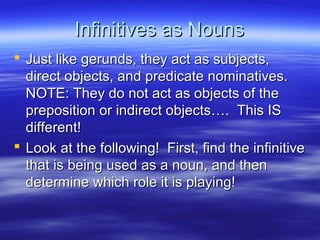
Infinitives as NounsInfinitives as Nouns
 Just like gerunds, they act as subjects,Just like gerunds, they act as subjects,
direct objects, and predicate nominatives.direct objects, and predicate nominatives.
NOTE: They do not act as objects of theNOTE: They do not act as objects of the
preposition or indirect objects…. This ISpreposition or indirect objects…. This IS
different!different!
 Look at the following! First, find the infinitiveLook at the following! First, find the infinitive
that is being used as a noun, and thenthat is being used as a noun, and then
determine which role it is playing!determine which role it is playing!
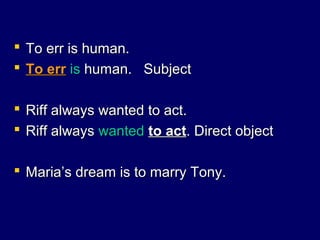
 To err is human.To err is human.
 To errTo err isis human. Subjecthuman. Subject
 Riff always wanted to act.Riff always wanted to act.
 Riff alwaysRiff always wantedwanted to actto act. Direct object. Direct object
 Maria’s dream is to marry Tony.Maria’s dream is to marry Tony.
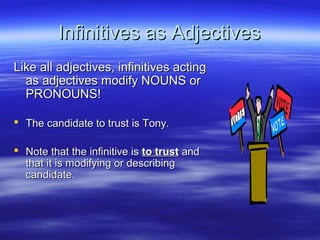
Infinitives as AdjectivesInfinitives as Adjectives
Like all adjectives, infinitives actingLike all adjectives, infinitives acting
as adjectives modify NOUNS oras adjectives modify NOUNS or
PRONOUNS!PRONOUNS!
 The candidate to trust is Tony.The candidate to trust is Tony.
 Note that the infinitive isNote that the infinitive is to trustto trust andand
that it is modifying or describingthat it is modifying or describing
candidate.candidate.
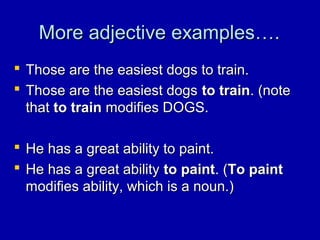
More adjective examples….More adjective examples….
 Those are the easiest dogs to train.Those are the easiest dogs to train.
 Those are the easiest dogsThose are the easiest dogs to trainto train. (note. (note
thatthat to trainto train modifies DOGS.modifies DOGS.
 He has a great ability to paint.He has a great ability to paint.
 He has a great abilityHe has a great ability to paintto paint. (. (To paintTo paint
modifies ability, which is a noun.)modifies ability, which is a noun.)
Infinitives as AdverbsInfinitives as Adverbs
 Infinitives also act as adverbs; they mustInfinitives also act as adverbs; they must
modify VERBS, ADJECTIVES, or othermodify VERBS, ADJECTIVES, or other
ADVERBS.ADVERBS.
 They act like adverb prepositional phrases.They act like adverb prepositional phrases.
Infinitives as AdverbsInfinitives as Adverbs
 Consider these examples….Consider these examples….
 The team was slow to score.The team was slow to score.
 To score modifies the word “slow.” Slow isTo score modifies the word “slow.” Slow is
an adjective.an adjective.
 My grandmother has come to stay.My grandmother has come to stay.
 To stay modifies the verb, come.To stay modifies the verb, come.
Verbs that take infinitivesVerbs that take infinitives
Verb + infinitivesVerb + infinitives –– agree, appear, decideagree, appear, decide
hope, intend, learn, offer, plan, seem, tend,hope, intend, learn, offer, plan, seem, tend,
wait, can affordwait, can afford
Verb + Noun phrase + infinitiveVerb + Noun phrase + infinitive –– cause,cause,
convince, force, invite, order, persuade,convince, force, invite, order, persuade,
remind, tell, trust, warn, advise, encourageremind, tell, trust, warn, advise, encourage
Verbs that come directly after the infinitive orVerbs that come directly after the infinitive or
have a noun phrasehave a noun phrase –– ask, beg, choose,ask, beg, choose,
expect, need, want, would like, promiseexpect, need, want, would like, promise
Adjectives followed byAdjectives followed by
infinitivesinfinitives
Afraid, amazed, anxious, ashamed,Afraid, amazed, anxious, ashamed,
careful, delighted, eager, fortunate,careful, delighted, eager, fortunate,
glad, happy, lucky, pleased, ready, sad,glad, happy, lucky, pleased, ready, sad,
sorrysorry,,
Infinitive of purposeInfinitive of purpose
In order toIn order to
I came hereI came here in order toin order to learn.learn.
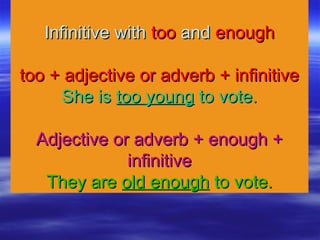
Infinitive withInfinitive with tootoo andand enoughenough
too + adjective or adverb + infinitivetoo + adjective or adverb + infinitive
She isShe is too youngtoo young to vote.to vote.
Adjective or adverb + enough +Adjective or adverb + enough +
infinitiveinfinitive
They areThey are old enoughold enough to vote.to vote.
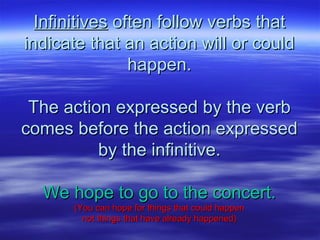
InfinitivesInfinitives often follow verbs thatoften follow verbs that
indicate that an action will or couldindicate that an action will or could
happen.happen.
The action expressed by the verbThe action expressed by the verb
comes before the action expressedcomes before the action expressed
by the infinitive.by the infinitive.
We hope to go to the concert.We hope to go to the concert.
(You can hope for things that could happen(You can hope for things that could happen
not things that have already happened)not things that have already happened)
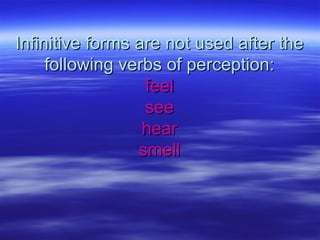
Infinitive forms are not used after theInfinitive forms are not used after the
following verbs of perception:following verbs of perception:
feelfeel
seesee
hearhear
smellsmell
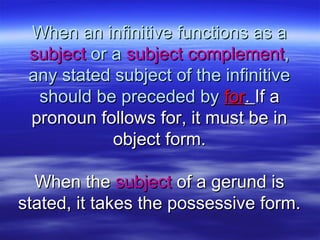
When an infinitive functions as aWhen an infinitive functions as a
subjectsubject or aor a subject complementsubject complement,,
any stated subject of the infinitiveany stated subject of the infinitive
should be preceded byshould be preceded by forfor.. If aIf a
pronoun follows for, it must be inpronoun follows for, it must be in
object form.object form.
When theWhen the subjectsubject of a gerund isof a gerund is
stated, it takes the possessive form.stated, it takes the possessive form.
For peopleFor people to see is a wonderful gift.to see is a wonderful gift.
Her desire wasHer desire was for themfor them to take ato take a
trip around the worldtrip around the world
They hopedThey hoped for herfor her to be able toto be able to
attend the concert.attend the concert.
Infinitives can occur in theInfinitives can occur in the
progressive.progressive.
To be doingTo be doing
It is used to indicate an activity inIt is used to indicate an activity in
progress or ongoingprogress or ongoing
She had hoped to be workingShe had hoped to be working
IInfinitivesnfinitives can occur in the perfectcan occur in the perfect
formform
to have doneto have done
It is used to indicate that the activityIt is used to indicate that the activity
is in the pastis in the past
We’re fortunate to have heard herWe’re fortunate to have heard her
singsing
HaveHave
makemake
letlet
are causative verbs. They causeare causative verbs. They cause
someone to do something.someone to do something.
They are always followed by a nounThey are always followed by a noun
phrase + base form of verb.phrase + base form of verb.
Do not use an infinitive after theseDo not use an infinitive after these
verbs.verbs.
She madeShe made meme fallfall..
SheShe mademade her daughterher daughter gogo to theto the
party.party.
SheShe letlet himhim taketake the camera.the camera.
SheShe hadhad meme prepareprepare breakfastbreakfast
yesterday.yesterday.
AfterAfter causativecausative verbs:verbs:
getget
convinceconvince
persuadepersuade
use the infinitiveuse the infinitive
SheShe gotgot meme to workto work..
SheShe convincedconvinced meme to workto work..
HelpHelp
can take an infinitive or base form.can take an infinitive or base form.
It can occurIt can occur withwith oror withoutwithout a nouna noun
phrase.phrase.
I helpedI helped them carrythem carry the boxes.the boxes.
I helpedI helped them to clean upthem to clean up after theafter the
party.party.
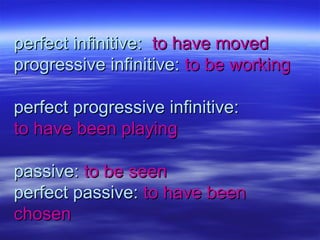
perfect infinitive:perfect infinitive: to have movedto have moved
progressive infinitive:progressive infinitive: to be workingto be working
perfect progressive infinitive:perfect progressive infinitive:
to have been playingto have been playing
passive:passive: to be seento be seen
perfect passive:perfect passive: to have beento have been
chosenchosen
Now…. YOU TRY!!!
First, find the infinitive and then
determine how it is functioning in the
sentence!
 Our assignment was to read that book.
 Our assignment was to read that book. PN
 We were asked to memorize this poem.
DO
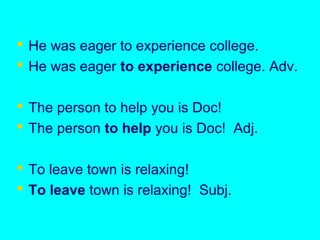
 He was eager to experience college.
 He was eager to experience college. Adv.
 The person to help you is Doc!
 The person to help you is Doc! Adj.
 To leave town is relaxing!
 To leave town is relaxing! Subj.
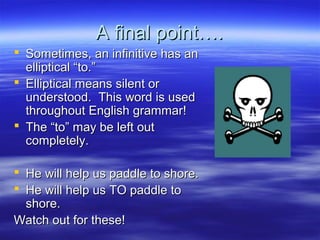
A final point….A final point….
 Sometimes, an infinitive has anSometimes, an infinitive has an
elliptical “to.”elliptical “to.”
 Elliptical means silent orElliptical means silent or
understood. This word is usedunderstood. This word is used
throughout English grammar!throughout English grammar!
 The “to” may be left outThe “to” may be left out
completely.completely.
 He will help us paddle to shore.He will help us paddle to shore.
 He will help us TO paddle toHe will help us TO paddle to
shore.shore.
Watch out for these!Watch out for these!

Infinitives

  • 1.
    "The Impossible Dream""TheImpossible Dream" To dream the impossible dream To fight the unbeatable foe To bear with unbearable sorrow To run where the brave dare not goTo right the unrightable wrong To love pure and chaste from afar To try when your arms are too weary To reach the unreachable star This is my quest To follow that star No matter how hopeless No matter how far
  • 2.
  • 3.
    InfinitivesInfinitives  are verbalswhich means they are verbs thatare verbals which means they are verbs that act as other parts of speech.act as other parts of speech.  Remember the other verbals?Remember the other verbals? – Participles act as ADJECTIVES.Participles act as ADJECTIVES. – Gerunds act as NOUNS, which in turn act asGerunds act as NOUNS, which in turn act as subjects, direct objects, indirect objects,subjects, direct objects, indirect objects, predicate nominatives, objects of prepositions,predicate nominatives, objects of prepositions, and appositives.and appositives.
  • 4.
    InfinitivesInfinitives  act asnouns, adjectives,act as nouns, adjectives, and adverbsand adverbs  An infinitive is the TOAn infinitive is the TO form of a verbform of a verb  The infinitive of run… is TOThe infinitive of run… is TO RUNRUN  The infinitive of scream… isThe infinitive of scream… is TO SCREAMTO SCREAM  The infinitive of eat… is TOThe infinitive of eat… is TO EATEAT
  • 5.
    WARNINGWARNING  Please notethe difference between the following!Please note the difference between the following! To THE MALLTo THE MALL AndAnd To swiMTo swiM  One is an infinitive, and the other is a prepositionalOne is an infinitive, and the other is a prepositional phrase. Do NOT get these confused.phrase. Do NOT get these confused.  IfIf ““toto”” is followed by a noun or pronoun, then it is ais followed by a noun or pronoun, then it is a prepositional phrase. VERBALS ARE ABOUTprepositional phrase. VERBALS ARE ABOUT VERBS!VERBS! 
  • 6.
    Infinitives as NounsInfinitivesas Nouns  Just like gerunds, they act as subjects,Just like gerunds, they act as subjects, direct objects, and predicate nominatives.direct objects, and predicate nominatives. NOTE: They do not act as objects of theNOTE: They do not act as objects of the preposition or indirect objects…. This ISpreposition or indirect objects…. This IS different!different!  Look at the following! First, find the infinitiveLook at the following! First, find the infinitive that is being used as a noun, and thenthat is being used as a noun, and then determine which role it is playing!determine which role it is playing!
  • 7.
     To erris human.To err is human.  To errTo err isis human. Subjecthuman. Subject  Riff always wanted to act.Riff always wanted to act.  Riff alwaysRiff always wantedwanted to actto act. Direct object. Direct object  Maria’s dream is to marry Tony.Maria’s dream is to marry Tony.
  • 8.
    Infinitives as AdjectivesInfinitivesas Adjectives Like all adjectives, infinitives actingLike all adjectives, infinitives acting as adjectives modify NOUNS oras adjectives modify NOUNS or PRONOUNS!PRONOUNS!  The candidate to trust is Tony.The candidate to trust is Tony.  Note that the infinitive isNote that the infinitive is to trustto trust andand that it is modifying or describingthat it is modifying or describing candidate.candidate.
  • 9.
    More adjective examples….Moreadjective examples….  Those are the easiest dogs to train.Those are the easiest dogs to train.  Those are the easiest dogsThose are the easiest dogs to trainto train. (note. (note thatthat to trainto train modifies DOGS.modifies DOGS.  He has a great ability to paint.He has a great ability to paint.  He has a great abilityHe has a great ability to paintto paint. (. (To paintTo paint modifies ability, which is a noun.)modifies ability, which is a noun.)
  • 10.
    Infinitives as AdverbsInfinitivesas Adverbs  Infinitives also act as adverbs; they mustInfinitives also act as adverbs; they must modify VERBS, ADJECTIVES, or othermodify VERBS, ADJECTIVES, or other ADVERBS.ADVERBS.  They act like adverb prepositional phrases.They act like adverb prepositional phrases.
  • 11.
    Infinitives as AdverbsInfinitivesas Adverbs  Consider these examples….Consider these examples….  The team was slow to score.The team was slow to score.  To score modifies the word “slow.” Slow isTo score modifies the word “slow.” Slow is an adjective.an adjective.  My grandmother has come to stay.My grandmother has come to stay.  To stay modifies the verb, come.To stay modifies the verb, come.
  • 13.
    Verbs that takeinfinitivesVerbs that take infinitives Verb + infinitivesVerb + infinitives –– agree, appear, decideagree, appear, decide hope, intend, learn, offer, plan, seem, tend,hope, intend, learn, offer, plan, seem, tend, wait, can affordwait, can afford Verb + Noun phrase + infinitiveVerb + Noun phrase + infinitive –– cause,cause, convince, force, invite, order, persuade,convince, force, invite, order, persuade, remind, tell, trust, warn, advise, encourageremind, tell, trust, warn, advise, encourage Verbs that come directly after the infinitive orVerbs that come directly after the infinitive or have a noun phrasehave a noun phrase –– ask, beg, choose,ask, beg, choose, expect, need, want, would like, promiseexpect, need, want, would like, promise
  • 15.
    Adjectives followed byAdjectivesfollowed by infinitivesinfinitives Afraid, amazed, anxious, ashamed,Afraid, amazed, anxious, ashamed, careful, delighted, eager, fortunate,careful, delighted, eager, fortunate, glad, happy, lucky, pleased, ready, sad,glad, happy, lucky, pleased, ready, sad, sorrysorry,,
  • 17.
    Infinitive of purposeInfinitiveof purpose In order toIn order to I came hereI came here in order toin order to learn.learn.
  • 18.
    Infinitive withInfinitive withtootoo andand enoughenough too + adjective or adverb + infinitivetoo + adjective or adverb + infinitive She isShe is too youngtoo young to vote.to vote. Adjective or adverb + enough +Adjective or adverb + enough + infinitiveinfinitive They areThey are old enoughold enough to vote.to vote.
  • 19.
    InfinitivesInfinitives often followverbs thatoften follow verbs that indicate that an action will or couldindicate that an action will or could happen.happen. The action expressed by the verbThe action expressed by the verb comes before the action expressedcomes before the action expressed by the infinitive.by the infinitive. We hope to go to the concert.We hope to go to the concert. (You can hope for things that could happen(You can hope for things that could happen not things that have already happened)not things that have already happened)
  • 20.
    Infinitive forms arenot used after theInfinitive forms are not used after the following verbs of perception:following verbs of perception: feelfeel seesee hearhear smellsmell
  • 21.
    When an infinitivefunctions as aWhen an infinitive functions as a subjectsubject or aor a subject complementsubject complement,, any stated subject of the infinitiveany stated subject of the infinitive should be preceded byshould be preceded by forfor.. If aIf a pronoun follows for, it must be inpronoun follows for, it must be in object form.object form. When theWhen the subjectsubject of a gerund isof a gerund is stated, it takes the possessive form.stated, it takes the possessive form.
  • 22.
    For peopleFor peopleto see is a wonderful gift.to see is a wonderful gift. Her desire wasHer desire was for themfor them to take ato take a trip around the worldtrip around the world They hopedThey hoped for herfor her to be able toto be able to attend the concert.attend the concert.
  • 23.
    Infinitives can occurin theInfinitives can occur in the progressive.progressive. To be doingTo be doing It is used to indicate an activity inIt is used to indicate an activity in progress or ongoingprogress or ongoing She had hoped to be workingShe had hoped to be working
  • 24.
    IInfinitivesnfinitives can occurin the perfectcan occur in the perfect formform to have doneto have done It is used to indicate that the activityIt is used to indicate that the activity is in the pastis in the past We’re fortunate to have heard herWe’re fortunate to have heard her singsing
  • 25.
    HaveHave makemake letlet are causative verbs.They causeare causative verbs. They cause someone to do something.someone to do something. They are always followed by a nounThey are always followed by a noun phrase + base form of verb.phrase + base form of verb. Do not use an infinitive after theseDo not use an infinitive after these verbs.verbs. She madeShe made meme fallfall..
  • 26.
    SheShe mademade herdaughterher daughter gogo to theto the party.party. SheShe letlet himhim taketake the camera.the camera. SheShe hadhad meme prepareprepare breakfastbreakfast yesterday.yesterday.
  • 27.
    AfterAfter causativecausative verbs:verbs: getget convinceconvince persuadepersuade usethe infinitiveuse the infinitive SheShe gotgot meme to workto work.. SheShe convincedconvinced meme to workto work..
  • 28.
    HelpHelp can take aninfinitive or base form.can take an infinitive or base form. It can occurIt can occur withwith oror withoutwithout a nouna noun phrase.phrase. I helpedI helped them carrythem carry the boxes.the boxes. I helpedI helped them to clean upthem to clean up after theafter the party.party.
  • 29.
    perfect infinitive:perfect infinitive:to have movedto have moved progressive infinitive:progressive infinitive: to be workingto be working perfect progressive infinitive:perfect progressive infinitive: to have been playingto have been playing passive:passive: to be seento be seen perfect passive:perfect passive: to have beento have been chosenchosen
  • 30.
    Now…. YOU TRY!!! First,find the infinitive and then determine how it is functioning in the sentence!  Our assignment was to read that book.  Our assignment was to read that book. PN  We were asked to memorize this poem.  We were asked to memorize this poem. DO
  • 31.
     He waseager to experience college.  He was eager to experience college. Adv.  The person to help you is Doc!  The person to help you is Doc! Adj.  To leave town is relaxing!  To leave town is relaxing! Subj.
  • 32.
    A final point….Afinal point….  Sometimes, an infinitive has anSometimes, an infinitive has an elliptical “to.”elliptical “to.”  Elliptical means silent orElliptical means silent or understood. This word is usedunderstood. This word is used throughout English grammar!throughout English grammar!  The “to” may be left outThe “to” may be left out completely.completely.  He will help us paddle to shore.He will help us paddle to shore.  He will help us TO paddle toHe will help us TO paddle to shore.shore. Watch out for these!Watch out for these!