Verbs being used as adjectives
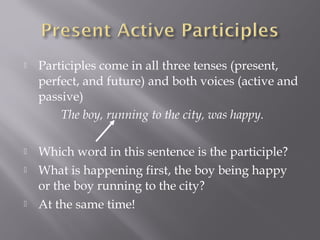
 Participles come in all three tenses (present,
perfect, and future) and both voices (active and
passive)
The boy, running to the city, was happy.
 Which word in this sentence is the participle?
 What is happening first, the boy being happy
or the boy running to the city?
 At the same time!
How to identify, form, and translate
 The connecting vowels for the present
participles are the same as the imperfect tense:
laud + a  lauda
mon + e  mone
reg + e  rege
aud + ie  audie
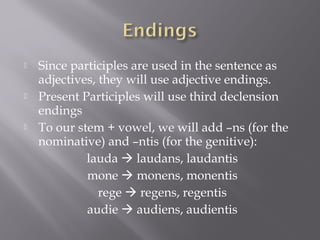
 Since participles are used in the sentence as
adjectives, they will use adjective endings.
 Present Participles will use third declension
endings
 To our stem + vowel, we will add –ns (for the
nominative) and –ntis (for the genitive):
lauda  laudans, laudantis
mone  monens, monentis
rege  regens, regentis
audie  audiens, audientis
 You can add any ending from the third
declension in any gender to the stem of a
present participle
 The stem is the genitive without the –is . . . we
will add to whatever is left (let’s try –es):
laudantis  laudant + es  laudantes
monentis  monent + es  monentes
regentis  regent + es  regentes
audientis  audient + es  audientes
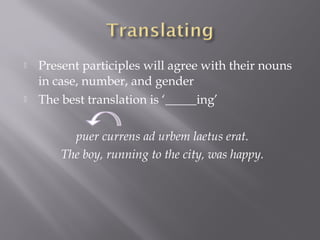
 Present participles will agree with their nouns
in case, number, and gender
 The best translation is ‘_____ing’
puer currens ad urbem laetus erat.
The boy, running to the city, was happy.
 Present participles happen the same time as the
main verb
 Their stem comes from the second principal
part
 They use only third declension endings
 They agree with their noun in case, number,
and gender
 They are best translated as ‘_____ing’
 Present participles happen the same time as the
main verb
 Their stem comes from the second principal
part
 They use only third declension endings
 They agree with their noun in case, number,
and gender
 They are best translated as ‘_____ing’

Unit Four Present Active Participles

  • 1.
    Verbs being usedas adjectives
  • 2.
     Participles comein all three tenses (present, perfect, and future) and both voices (active and passive) The boy, running to the city, was happy.  Which word in this sentence is the participle?  What is happening first, the boy being happy or the boy running to the city?  At the same time!
  • 3.
    How to identify,form, and translate
  • 5.
     The connectingvowels for the present participles are the same as the imperfect tense: laud + a  lauda mon + e  mone reg + e  rege aud + ie  audie
  • 6.
     Since participlesare used in the sentence as adjectives, they will use adjective endings.  Present Participles will use third declension endings  To our stem + vowel, we will add –ns (for the nominative) and –ntis (for the genitive): lauda  laudans, laudantis mone  monens, monentis rege  regens, regentis audie  audiens, audientis
  • 7.
     You canadd any ending from the third declension in any gender to the stem of a present participle  The stem is the genitive without the –is . . . we will add to whatever is left (let’s try –es): laudantis  laudant + es  laudantes monentis  monent + es  monentes regentis  regent + es  regentes audientis  audient + es  audientes
  • 8.
     Present participleswill agree with their nouns in case, number, and gender  The best translation is ‘_____ing’ puer currens ad urbem laetus erat. The boy, running to the city, was happy.
  • 9.
     Present participleshappen the same time as the main verb  Their stem comes from the second principal part  They use only third declension endings  They agree with their noun in case, number, and gender  They are best translated as ‘_____ing’
  • 10.
     Present participleshappen the same time as the main verb  Their stem comes from the second principal part  They use only third declension endings  They agree with their noun in case, number, and gender  They are best translated as ‘_____ing’