Grammar Book

  By: Zacarias Smart
Table of Contents
   1-Nationalities
   2-Stem changer
   3-Para
   4-IOP
   5-Pronoun Placement
   6-Gustar
   7-Affirmative and Negative words
   8-Superlatives
   9-Reflexives
   10-Affirmative tu commands / irregulars / pronoun
    placement
   11-Negative tu commands / irregulars / pronoun placement
   12-Sequencing words
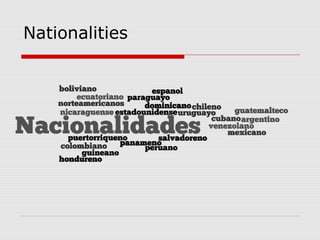
Nationalities
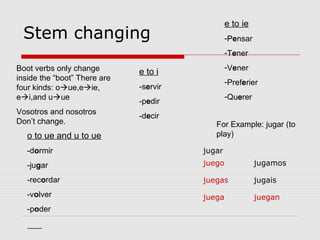
e to ie
 Stem changing                                  -Pensar
                                                -Tener
Boot verbs only change                          -Vener
                              e to i
inside the “boot” There are
                                                -Preferier
four kinds: oue,eie,        -servir
ei,and uue                                    -Querer
                              -pedir
Vosotros and nosotros
                              -decir
Don’t change.                              For Example: jugar (to
   o to ue and u to ue                     play)

   -dormir                              jugar
   -jugar                               juego             jugamos

   -recordar                            juegas            jugais
   -volver                              juega             juegan
   -poder
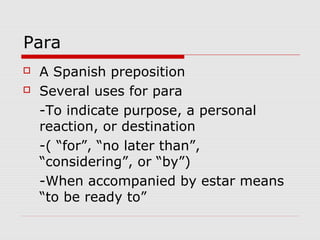
Para
   A Spanish preposition
   Several uses for para
    -To indicate purpose, a personal
    reaction, or destination
    -( “for”, “no later than”,
    “considering”, or “by”)
    -When accompanied by estar means
    “to be ready to”
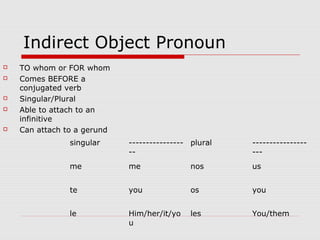
Indirect Object Pronoun
   TO whom or FOR whom
   Comes BEFORE a
    conjugated verb
   Singular/Plural
   Able to attach to an
    infinitive
   Can attach to a gerund
                singular     ---------------- plural   ----------------
                             --                        ---
                me           me               nos      us


                te           you              os       you


                le           Him/her/it/yo    les      You/them
                             u
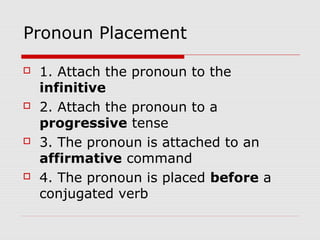
Pronoun Placement

   1. Attach the pronoun to the
    infinitive
   2. Attach the pronoun to a
    progressive tense
   3. The pronoun is attached to an
    affirmative command
   4. The pronoun is placed before a
    conjugated verb
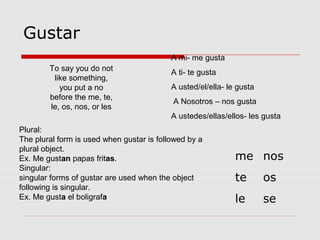
Gustar
                                           A mi- me gusta
        To say you do not                  A ti- te gusta
         like something,
           you put a no                    A usted/el/ella- le gusta
        before the me, te,
                                           A Nosotros – nos gusta
        le, os, nos, or les
                                           A ustedes/ellas/ellos- les gusta
Plural:
The plural form is used when gustar is followed by a
plural object.
Ex. Me gustan papas fritas.                                   me nos
Singular:
singular forms of gustar are used when the object             te       os
following is singular.
Ex. Me gusta el boligrafa                                     le       se
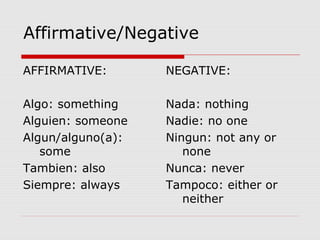
Affirmative/Negative

AFFIRMATIVE:       NEGATIVE:

Algo: something    Nada: nothing
Alguien: someone   Nadie: no one
Algun/alguno(a):   Ningun: not any or
   some               none
Tambien: also      Nunca: never
Siempre: always    Tampoco: either or
                      neither
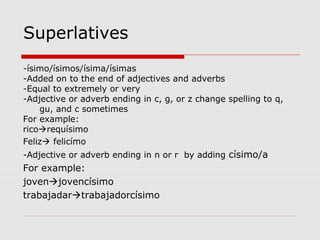
Superlatives
-ísimo/ísimos/ísima/ísimas
-Added on to the end of adjectives and adverbs
-Equal to extremely or very
-Adjective or adverb ending in c, g, or z change spelling to q,
    gu, and c sometimes
For example:
ricorequísimo
Feliz felicímo
-Adjective or adverb ending in n or r by adding císimo/a
For example:
jovenjovencísimo
trabajadartrabajadorcísimo
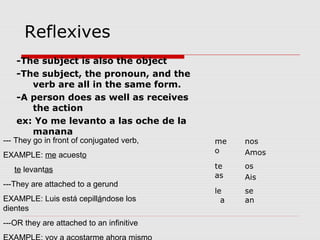
Reflexives
   -The subject is also the object
   -The subject, the pronoun, and the
      verb are all in the same form.
   -A person does as well as receives
      the action
   ex: Yo me levanto a las oche de la
      manana
--- They go in front of conjugated verb,   me    nos
                                           o     Amos
EXAMPLE: me acuesto
   te levantas                             te    os
                                           as    Ais
---They are attached to a gerund
                                           le    se
EXAMPLE: Luis está cepillándose los          a   an
dientes
---OR they are attached to an infinitive
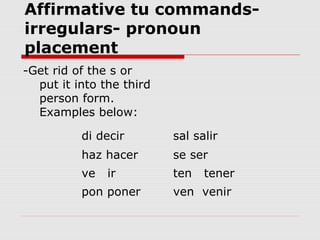
Affirmative tu commands-
irregulars- pronoun
placement
-Get rid of the s or
  put it into the third
  person form.
  Examples below:

          di decir        sal salir
          haz hacer       se ser
          ve   ir         ten   tener
          pon poner       ven venir
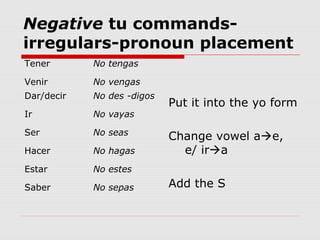
Negative tu commands-
irregulars-pronoun placement
Tener       No tengas

Venir       No vengas
Dar/decir   No des -digos
                            Put it into the yo form
Ir          No vayas

Ser         No seas
                            Change vowel ae,
Hacer       No hagas          e/ ira
Estar       No estes

Saber       No sepas        Add the S
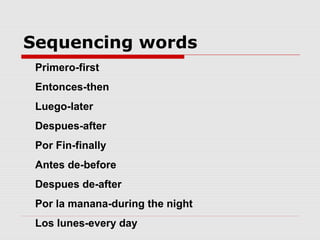
Sequencing words
 Primero-first
 Entonces-then
 Luego-later
 Despues-after
 Por Fin-finally
 Antes de-before
 Despues de-after
 Por la manana-during the night
 Los lunes-every day
THE END

Grammer book sean smart

  • 1.
    Grammar Book By: Zacarias Smart
  • 2.
    Table of Contents  1-Nationalities  2-Stem changer  3-Para  4-IOP  5-Pronoun Placement  6-Gustar  7-Affirmative and Negative words  8-Superlatives  9-Reflexives  10-Affirmative tu commands / irregulars / pronoun placement  11-Negative tu commands / irregulars / pronoun placement  12-Sequencing words
  • 3.
  • 4.
    e to ie Stem changing -Pensar -Tener Boot verbs only change -Vener e to i inside the “boot” There are -Preferier four kinds: oue,eie, -servir ei,and uue -Querer -pedir Vosotros and nosotros -decir Don’t change. For Example: jugar (to o to ue and u to ue play) -dormir jugar -jugar juego jugamos -recordar juegas jugais -volver juega juegan -poder
  • 5.
    Para  A Spanish preposition  Several uses for para -To indicate purpose, a personal reaction, or destination -( “for”, “no later than”, “considering”, or “by”) -When accompanied by estar means “to be ready to”
  • 6.
    Indirect Object Pronoun  TO whom or FOR whom  Comes BEFORE a conjugated verb  Singular/Plural  Able to attach to an infinitive  Can attach to a gerund singular ---------------- plural ---------------- -- --- me me nos us te you os you le Him/her/it/yo les You/them u
  • 7.
    Pronoun Placement  1. Attach the pronoun to the infinitive  2. Attach the pronoun to a progressive tense  3. The pronoun is attached to an affirmative command  4. The pronoun is placed before a conjugated verb
  • 8.
    Gustar A mi- me gusta To say you do not A ti- te gusta like something, you put a no A usted/el/ella- le gusta before the me, te, A Nosotros – nos gusta le, os, nos, or les A ustedes/ellas/ellos- les gusta Plural: The plural form is used when gustar is followed by a plural object. Ex. Me gustan papas fritas. me nos Singular: singular forms of gustar are used when the object te os following is singular. Ex. Me gusta el boligrafa le se
  • 9.
    Affirmative/Negative AFFIRMATIVE: NEGATIVE: Algo: something Nada: nothing Alguien: someone Nadie: no one Algun/alguno(a): Ningun: not any or some none Tambien: also Nunca: never Siempre: always Tampoco: either or neither
  • 10.
    Superlatives -ísimo/ísimos/ísima/ísimas -Added on tothe end of adjectives and adverbs -Equal to extremely or very -Adjective or adverb ending in c, g, or z change spelling to q, gu, and c sometimes For example: ricorequísimo Feliz felicímo -Adjective or adverb ending in n or r by adding císimo/a For example: jovenjovencísimo trabajadartrabajadorcísimo
  • 11.
    Reflexives -The subject is also the object -The subject, the pronoun, and the verb are all in the same form. -A person does as well as receives the action ex: Yo me levanto a las oche de la manana --- They go in front of conjugated verb, me nos o Amos EXAMPLE: me acuesto te levantas te os as Ais ---They are attached to a gerund le se EXAMPLE: Luis está cepillándose los a an dientes ---OR they are attached to an infinitive
  • 12.
    Affirmative tu commands- irregulars-pronoun placement -Get rid of the s or put it into the third person form. Examples below: di decir sal salir haz hacer se ser ve ir ten tener pon poner ven venir
  • 13.
    Negative tu commands- irregulars-pronounplacement Tener No tengas Venir No vengas Dar/decir No des -digos Put it into the yo form Ir No vayas Ser No seas Change vowel ae, Hacer No hagas e/ ira Estar No estes Saber No sepas Add the S
  • 14.
    Sequencing words Primero-first Entonces-then Luego-later Despues-after Por Fin-finally Antes de-before Despues de-after Por la manana-during the night Los lunes-every day
  • 15.