Passive Voice
Perfect, Pluperfect, and Future Perfect
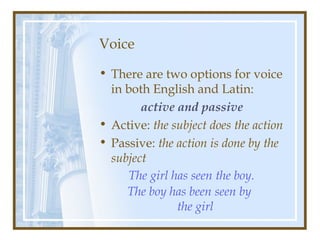
Voice
• There are two options for voice
in both English and Latin:
active and passive
• Active: the subject does the action
• Passive: the action is done by the
subject
The girl has seen the boy.
The boy has been seen by
the girl
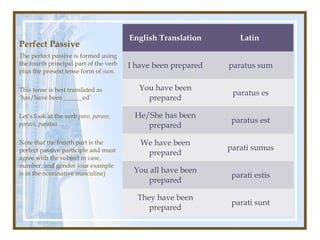
Perfect Passive
English Translation Latin
I have been prepared paratus sum
You have been
prepared
paratus es
He/She has been
prepared
paratus est
We have been
prepared
parati sumus
You all have been
prepared
parati estis
They have been
prepared
parati sunt
The perfect passive is formed using
the fourth principal part of the verb
plus the present tense form of sum.
This tense is best translated as
‘has/have been ______ed’
Let’s look at the verb paro, parare,
paravi, paratus . . .
Note that the fourth part is the
perfect passive participle and must
agree with the subject in case,
number, and gender (our example
is in the nominative masculine)
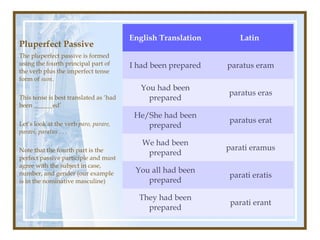
Pluperfect Passive
English Translation Latin
I had been prepared paratus eram
You had been
prepared
paratus eras
He/She had been
prepared
paratus erat
We had been
prepared
parati eramus
You all had been
prepared
parati eratis
They had been
prepared
parati erant
The pluperfect passive is formed
using the fourth principal part of
the verb plus the imperfect tense
form of sum.
This tense is best translated as ‘had
been ______ed’
Let’s look at the verb paro, parare,
paravi, paratus . . .
Note that the fourth part is the
perfect passive participle and must
agree with the subject in case,
number, and gender (our example
is in the nominative masculine)
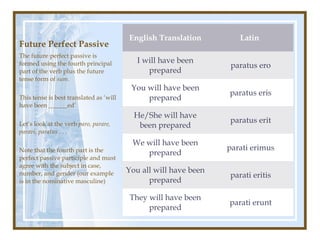
Future Perfect Passive
English Translation Latin
I will have been
prepared
paratus ero
You will have been
prepared
paratus eris
He/She will have
been prepared
paratus erit
We will have been
prepared
parati erimus
You all will have been
prepared
parati eritis
They will have been
prepared
parati erunt
The future perfect passive is
formed using the fourth principal
part of the verb plus the future
tense form of sum.
This tense is best translated as ‘will
have been ______ed’
Let’s look at the verb paro, parare,
paravi, paratus . . .
Note that the fourth part is the
perfect passive participle and must
agree with the subject in case,
number, and gender (our example
is in the nominative masculine)
Summary
• These tenses all use the fourth
principal part plus a form of
sum
• The fourth part is part
adjective, so it must agree with
the subject of the verb
Summary
• These tenses all use the fourth
principal part plus a form of
sum
• The fourth part is part
adjective, so it must agree with
the subject of the verb

Unit three perfect passive system

  • 1.
  • 2.
    Voice • There aretwo options for voice in both English and Latin: active and passive • Active: the subject does the action • Passive: the action is done by the subject The girl has seen the boy. The boy has been seen by the girl
  • 3.
    Perfect Passive English TranslationLatin I have been prepared paratus sum You have been prepared paratus es He/She has been prepared paratus est We have been prepared parati sumus You all have been prepared parati estis They have been prepared parati sunt The perfect passive is formed using the fourth principal part of the verb plus the present tense form of sum. This tense is best translated as ‘has/have been ______ed’ Let’s look at the verb paro, parare, paravi, paratus . . . Note that the fourth part is the perfect passive participle and must agree with the subject in case, number, and gender (our example is in the nominative masculine)
  • 4.
    Pluperfect Passive English TranslationLatin I had been prepared paratus eram You had been prepared paratus eras He/She had been prepared paratus erat We had been prepared parati eramus You all had been prepared parati eratis They had been prepared parati erant The pluperfect passive is formed using the fourth principal part of the verb plus the imperfect tense form of sum. This tense is best translated as ‘had been ______ed’ Let’s look at the verb paro, parare, paravi, paratus . . . Note that the fourth part is the perfect passive participle and must agree with the subject in case, number, and gender (our example is in the nominative masculine)
  • 5.
    Future Perfect Passive EnglishTranslation Latin I will have been prepared paratus ero You will have been prepared paratus eris He/She will have been prepared paratus erit We will have been prepared parati erimus You all will have been prepared parati eritis They will have been prepared parati erunt The future perfect passive is formed using the fourth principal part of the verb plus the future tense form of sum. This tense is best translated as ‘will have been ______ed’ Let’s look at the verb paro, parare, paravi, paratus . . . Note that the fourth part is the perfect passive participle and must agree with the subject in case, number, and gender (our example is in the nominative masculine)
  • 6.
    Summary • These tensesall use the fourth principal part plus a form of sum • The fourth part is part adjective, so it must agree with the subject of the verb
  • 7.
    Summary • These tensesall use the fourth principal part plus a form of sum • The fourth part is part adjective, so it must agree with the subject of the verb