Grammar 
• Paper:- 12 English language Teaching- I 
• Roll No:- 26 
• M.A. Part ii Sem iii 
• Year:- 2013- 15 
• Submitted to:- Smt. S.B.Gardi. 
Department of English 
M.K.Bhavnagar University. 
Prepared By :- Sejal Chauhan 
Date: 4/10/2014
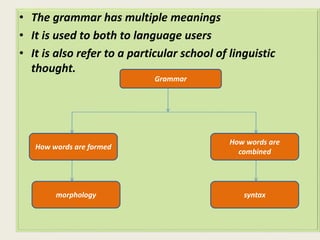
• The grammar has multiple meanings 
• It is used to both to language users 
• It is also refer to a particular school of linguistic 
thought. 
Grammar 
How words are formed 
How words are 
combined 
morphology syntax
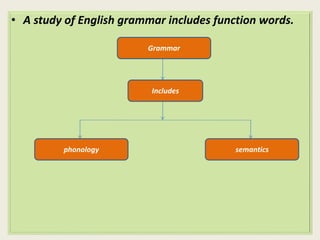
• A study of English grammar includes function words. 
Grammar 
Includes 
phonology semantics
Two types of descriptive grammars 
Formal grammars Functional grammars 
Starting point the form Social interaction 
Structure of language 
Explain why one linguistic form is 
more appropriate than another 
Communicative purpose in a 
particular context 
No attention given to meaning
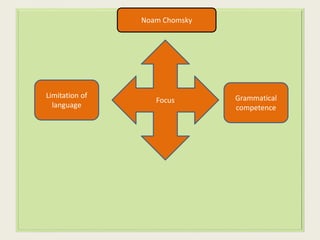
Noam Chomsky 
Focus 
Limitation of 
language 
Grammatical 
competence
Describe 
Grammatical system 
What speaker say or 
understand someone 
else to say 
Speaker’s competence Their competence 
• Realized the phonetic form of sentences 
• Aim of formal grammars to explain syntactic facts 
without recourse to pragmatics
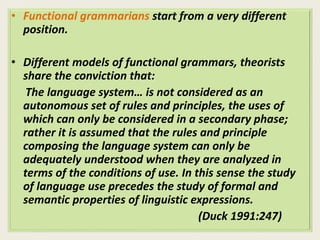
• Functional grammarians start from a very different 
position. 
• Different models of functional grammars, theorists 
share the conviction that: 
The language system… is not considered as an 
autonomous set of rules and principles, the uses of 
which can only be considered in a secondary phase; 
rather it is assumed that the rules and principle 
composing the language system can only be 
adequately understood when they are analyzed in 
terms of the conditions of use. In this sense the study 
of language use precedes the study of formal and 
semantic properties of linguistic expressions. 
(Duck 1991:247)
• Thus where a formal grammarian might accept the challenge to 
explain how sentence is derived from. 
• Functional grammarian is more interested in explain the difference in 
use between these two according to the notion ‘perspective’. 
• (1) Mark McGuire and Sammy Sasa broke the home run record. 
• (2) The home run record was broken by Mark McGuire and Sammy 
Sasa. 
• both sentence describe the same events. 
• But that this event is presented from the participant’s view point in 
and from the view point of the result in. 
• He or she is then interested in determining what contextual features 
influenced the speakers choosing one version over the other. 
• functional grammarians see meaning as central.
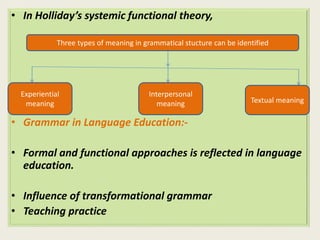
• In Holliday’s systemic functional theory, 
Three types of meaning in grammatical stucture can be identified 
Experiential 
meaning 
Interpersonal 
meaning Textual meaning 
• Grammar in Language Education:- 
• Formal and functional approaches is reflected in language 
education. 
• Influence of transformational grammar 
• Teaching practice
• Grammatical structure learned in class to communicative 
context outside 
• Communicative competence 
• Communicative approach like role play, information gap 
activities 
• Target language used for communicative purposes 
• SLA researchers who sought to account for grammatical 
development by examining how meaning was negotiated in 
learner interactions. 
• SLA researcher Hatch commented: 
‘ One learns how to do conversation, one learns how to interact 
verbally and, out of this interaction, syntactic structure are 
developed’.
• Research:- 
• Focus on form:- 
• SLA researcher follow Long (1991) in proposing focus on form 
• They work within a meaning based or communicative approach 
• Aim what form- focused practices are most effective, when they are 
best used and with which forms. 
• Benefits:- 
• Help students ‘notice the gap’ between new features in a target 
language’s structure 
• How they differ from the learners interlanguage. 
• Help students generalize their knowledge to new structure.
• Sociocultural theory:- 
• Vygotsky’s sociocultural theory 
• Donato studies what he termed “collective scaffolding” to see how 
language development was brought about through social interaction. 
• Donato found evidence that participating in collaborative dialogue, 
through which learners could provide support for each other, spurred 
development of learners interlanguage. 
• Discourse grammar:- 
• Investigations of grammar at this level 
• For example:- the present perfect operates at this level to frame a 
habitual present tense narrative. 
• The place of grammar in social interaction.
• Corpus Linguistics:- 
• This is another area with important implications for 
understanding and teaching grammar 
• With technological changes, concordance programs can 
search massive databases of spoken and written language 
to identify example of particular grammatical patterns. 
• Example:- using the 320-millions word COBUILD corpus of 
British, American and Australian English researchers have 
found that insist typically occur in the following 
combination: 
insist (that) 
He insisted that he hadn’t done it.
insist on 
He insisted on his innocence. 
insist on verb + ing 
He insisted on testifying. 
insist + quote 
He insisted, ‘I haven’t done it’. 
• what is noteworthy is that not every possible combination of 
words and grammatical structures occur 
• It seems that words are not freely substituted into grammatical 
patterns: once one word is selected, the likelihood of a particular 
word or phrase following is increased. 
• Teachers of grammar should pay more attention to 
conventionalized lexicogrammatical units.
• Thus at the end we can say that, there is a little 
disagreement that L2 learners need to learn to 
communicative grammatically. 
• How to characterize the grammar and help L2 
learners acquire it is more controversial. 
• It should be noted that, as a consequence of the 
renewed attention grammar has recently received, 
the complexity of the challenge faced by teachers 
and researchers is more fully appreciated.
• List of some Grammar books:- 
1. How English Works : A Grammar Practice Book by 
Michael Swan 
2. A communicative Grammar of English by Geoffrey 
N. Leech 
3. An Introduction to English Grammar( Longman 
Grammar, syntax and phonology) by Sidney 
Greenbaum 
4. A Practical English Grammar by Audrey Jean 
Thomson 
5. Oxford Modern English Grammar by Bas Aarts 
6. Fundamental of English Grammar by Batty 
Schrampfer Azar
Thank you
• Reference:- 
• The Cambridge Guide to Teaching English to 
Speaker of Other Languages/Chapter 5/ 
Grammar/Diane Larsen Freeman

Grammar

  • 1.
    Grammar • Paper:-12 English language Teaching- I • Roll No:- 26 • M.A. Part ii Sem iii • Year:- 2013- 15 • Submitted to:- Smt. S.B.Gardi. Department of English M.K.Bhavnagar University. Prepared By :- Sejal Chauhan Date: 4/10/2014
  • 2.
    • The grammarhas multiple meanings • It is used to both to language users • It is also refer to a particular school of linguistic thought. Grammar How words are formed How words are combined morphology syntax
  • 3.
    • A studyof English grammar includes function words. Grammar Includes phonology semantics
  • 4.
    Two types ofdescriptive grammars Formal grammars Functional grammars Starting point the form Social interaction Structure of language Explain why one linguistic form is more appropriate than another Communicative purpose in a particular context No attention given to meaning
  • 5.
    Noam Chomsky Focus Limitation of language Grammatical competence
  • 6.
    Describe Grammatical system What speaker say or understand someone else to say Speaker’s competence Their competence • Realized the phonetic form of sentences • Aim of formal grammars to explain syntactic facts without recourse to pragmatics
  • 7.
    • Functional grammariansstart from a very different position. • Different models of functional grammars, theorists share the conviction that: The language system… is not considered as an autonomous set of rules and principles, the uses of which can only be considered in a secondary phase; rather it is assumed that the rules and principle composing the language system can only be adequately understood when they are analyzed in terms of the conditions of use. In this sense the study of language use precedes the study of formal and semantic properties of linguistic expressions. (Duck 1991:247)
  • 8.
    • Thus wherea formal grammarian might accept the challenge to explain how sentence is derived from. • Functional grammarian is more interested in explain the difference in use between these two according to the notion ‘perspective’. • (1) Mark McGuire and Sammy Sasa broke the home run record. • (2) The home run record was broken by Mark McGuire and Sammy Sasa. • both sentence describe the same events. • But that this event is presented from the participant’s view point in and from the view point of the result in. • He or she is then interested in determining what contextual features influenced the speakers choosing one version over the other. • functional grammarians see meaning as central.
  • 9.
    • In Holliday’ssystemic functional theory, Three types of meaning in grammatical stucture can be identified Experiential meaning Interpersonal meaning Textual meaning • Grammar in Language Education:- • Formal and functional approaches is reflected in language education. • Influence of transformational grammar • Teaching practice
  • 10.
    • Grammatical structurelearned in class to communicative context outside • Communicative competence • Communicative approach like role play, information gap activities • Target language used for communicative purposes • SLA researchers who sought to account for grammatical development by examining how meaning was negotiated in learner interactions. • SLA researcher Hatch commented: ‘ One learns how to do conversation, one learns how to interact verbally and, out of this interaction, syntactic structure are developed’.
  • 11.
    • Research:- •Focus on form:- • SLA researcher follow Long (1991) in proposing focus on form • They work within a meaning based or communicative approach • Aim what form- focused practices are most effective, when they are best used and with which forms. • Benefits:- • Help students ‘notice the gap’ between new features in a target language’s structure • How they differ from the learners interlanguage. • Help students generalize their knowledge to new structure.
  • 12.
    • Sociocultural theory:- • Vygotsky’s sociocultural theory • Donato studies what he termed “collective scaffolding” to see how language development was brought about through social interaction. • Donato found evidence that participating in collaborative dialogue, through which learners could provide support for each other, spurred development of learners interlanguage. • Discourse grammar:- • Investigations of grammar at this level • For example:- the present perfect operates at this level to frame a habitual present tense narrative. • The place of grammar in social interaction.
  • 13.
    • Corpus Linguistics:- • This is another area with important implications for understanding and teaching grammar • With technological changes, concordance programs can search massive databases of spoken and written language to identify example of particular grammatical patterns. • Example:- using the 320-millions word COBUILD corpus of British, American and Australian English researchers have found that insist typically occur in the following combination: insist (that) He insisted that he hadn’t done it.
  • 14.
    insist on Heinsisted on his innocence. insist on verb + ing He insisted on testifying. insist + quote He insisted, ‘I haven’t done it’. • what is noteworthy is that not every possible combination of words and grammatical structures occur • It seems that words are not freely substituted into grammatical patterns: once one word is selected, the likelihood of a particular word or phrase following is increased. • Teachers of grammar should pay more attention to conventionalized lexicogrammatical units.
  • 15.
    • Thus atthe end we can say that, there is a little disagreement that L2 learners need to learn to communicative grammatically. • How to characterize the grammar and help L2 learners acquire it is more controversial. • It should be noted that, as a consequence of the renewed attention grammar has recently received, the complexity of the challenge faced by teachers and researchers is more fully appreciated.
  • 16.
    • List ofsome Grammar books:- 1. How English Works : A Grammar Practice Book by Michael Swan 2. A communicative Grammar of English by Geoffrey N. Leech 3. An Introduction to English Grammar( Longman Grammar, syntax and phonology) by Sidney Greenbaum 4. A Practical English Grammar by Audrey Jean Thomson 5. Oxford Modern English Grammar by Bas Aarts 6. Fundamental of English Grammar by Batty Schrampfer Azar
  • 17.
  • 18.
    • Reference:- •The Cambridge Guide to Teaching English to Speaker of Other Languages/Chapter 5/ Grammar/Diane Larsen Freeman