Techniques in grammar
      instruction

  Making grammar accessible to ELLs


       University of Alberta: EDPY 413
Presented by: Chelsea Androschuk, Nicole Mackay,
               and Robyn Ferguson
Historically, grammar has been considered to
          be (Hinkel & Fotos 2002):


    -nouns            -pronouns
    -verbs            -prepositions
    -participles      -adverbs
    -articles         -conjunctions
The advent of other approaches:


-Direct approaches (audio-lingualism)

-Functional approaches

-Communicative approaches
The Audiolingual Method


-The audiolingual method focuses on the
  comprehension of language at a largely mechanical
  level (Davidson, 1978).
-Examples of mechanically structured activities might
  include repetition or substitution. The teacher is in
  control of the lesson, and students can often
  successfully participate without any understanding of
  meaning (Davidson, 1978).
Functional Approaches


-These are usually based on situational language needs
   (Hinkel & Fotos, 2002).
- According to Skehan, these activities often follow a
   “presentation, practice, and production” protocol
   (cited in Hinkel & Fotos, 2002).
Communicative/Humanistic Approaches


-These methods mimic a natural acquisition of
  language, for example, how a child acquires L1
  (Hinkel & Fotos, 2002).
-Language is acquired using meaningful input, with no
  formal grammatical instruction. It is assumed that
  ELLs will naturally acquire the forms of language
  when this approach is used (Hinkel & Fotos, 2002).
Myth: Grammar structures are meaningless
      forms (Larsen-Freeman, 1995)


- Learning a structure in grammar, is not complete
   unless its function is explored at the same time
   (Wagner-Gough, 1975).
- There are 3 dimensions to grammar instruction:
   form, meaning and function/use (Larsen-Freeman,
   1995).
- Grammar instruction should include the answers to
   when and why to use any given structure (Larsen-
   Freeman, 1995).
Myth: Grammar acquisition consists of
  arbitrary rules (Larsen-Freeman, 1995)


-Interlanguages (ILs) appear to follow rules, and are
  systematic (Larsen-Freeman, 1995).
  This does not mean that an ELL would be using a
  grammatical structure as a NS would from first
  exposure, but that they are still moving toward its
  proper use while forming rules in his/her IL.
-Though systematic, this development through an IL
  may not be linear (Larsen-Freeman, 1995).
Myth: Grammar structures are learned one
     at a time (Larsen-Freeman, 1995)


-The acquisition of some structures may depend on the
  acquisition of others. A simple accumulation of
  structures, one at time, can lead to a phenomenon
  known as backsliding. When backsliding occurs, it is
  because certain elements become omitted in order to
  make room for new elements (Larsen-Freeman,
  1995).
Myth: Grammar is acquired naturally, and
doesn’t have to be taught (Larsen-Freeman,
                    1995)

- In French immersion programs, where the focus is on
   meaning alone, students have demonstrated a less
   than expected understanding of grammar in the
   language (Harley & Swain, 1984).
- Students may develop the ability to convey meaning,
   without developing proper grammar. Selective form-
   focused instruction may therefore be necessary to
   ensure that as language develops, so does grammar
   (Larsen-Freeman, 1995).
Lightbrown and Spada (1990)research
         (cited in Larsen-Freeman, 1995):


-This study looked at 4 (primarily communicative) French
   immersion classes, each of which incorporated a varying
   level of form-based instruction in grammar.
-Their results demonstrated that the class that never
   focused on grammatical form performed the worst
   according to the assessment used.
- Part of the reason for this, according to Larsen-Freeman
   (1995), is that focusing student attention may facilitate
   learning.
Myth: Error correction and negative evidence
  might be unnecessary when instructing
    grammar (Larsen-Freeman, 1995)


-If errors are not corrected, then overgeneralizations
   in language tend to occur (Larsen-Freeman, 1995).
-Negative evidence might be part of the input that
   ELLs need, though they may not have needed it to
   the same extent for their L1 (Larsen-Freeman,
   1995).
Myth: All grammatical structures are learned
 in the same way (Larsen-Freeman, 1995)


“Any claim to the effect that all acquisition is the
  product of habit formation or of rule formation, or
  today, of setting/resetting parameters or the
  strengthening of connections in complex neural
  networks, is an obvious oversimplification of a
  complex process” (Larsen-Freeman, 1995, p. 141).
3 options in language teaching:


Focus on Forms


Focus on meaning


Focus on form
Focus on Forms:


“Parts of the language are taught separately and step
 by step so that the acquisition is a process of gradual
 accumulation of parts until the whole structure of
 language has been built up…At any one time the
 learner is being exposed to a deliberate limited
 sample of language” (Wilkins, 1976, p. 2).
Focus on Meaning:

The essential claim is that people of all ages learn
 language best, inside or outside the classroom, not
 by treating the languages as the object of study, but
 by experiencing them as a medium of
 communication… “language is organized in terms of
 the purpose for which people are learning language
 and the kinds of language performance that are
 necessary to meet those purposes” (Wilkins, 1976, p.
 13).
Focus on Form:

“Overtly draws students’ attention to linguistic
 elements as they arise incidentally in lessons whose
 overriding focus is on meaning or communication”
  (Long, 1991, pp. 45-46).
“Often consists of an occasional shift of attention to
 linguistic code features– by the teacher and/or one
 or more of the students– triggered by perceived
 problems with comprehension or production”
 (Long & Robinson, 1999, p. 23).
Advantage of Focus on Form:

“The learner’s attention is drawn precisely to a
 linguistic feature as necessitated by a communicative
 demand” (Doughty & Williams, 1999, p. 3).
Arguments against Grammar Instruction:

The study of grammar promotes knowledge about
 language not how to use the language (Krashen,
 1983, p. 10).
We acquire our first language without any explicit
 knowledge of grammar (Krashen, 1983, p. 10).
The natural order (Krashen, 1983, pp. 12-36) in
 which languages are learned precludes the influence
 of instruction.
If communicative competence is the goal, then
 classroom time is better spent engaging in language
 use (Krashen, 1983, p. 37).
Arguments for Grammar Instruction:

 Without explicit instruction learners’ interlanguage often
  fossilizes.
 Grammar instruction may act as an advanced organizer
  helping learners to notice features of language when they
  are ready.
 Learning finite rules can help to simplify an otherwise
  daunting and complex task by organizing it into neat
  categories.
 Older students’ expectation about language learning often
  includes grammar instruction.
 Learning grammar structures allows for more creative
  applications of language.

                    (Lightbown & Spada, 1990, pp. 429-448)
Teaching Grammar:


Teachers need to consider how to present grammar
 to their students (approach), what options for
 dealing with the grammar should be used, and which
 area they will focus on during practice (accuracy,
 fluency, or restructuring).
Approaches

Deductive– teaching through rules (the rule is
 provided followed by the provision of examples in
 which the rule is applied).
Inductive– teaching through examples (students are
 provided with several examples from which a rule is
 inferred).
Sources of inductive instruction:


   Realia / Actions
   Worksheets (can often be structured to
    inductively lead students to a grammar rule)
   Authentic texts (after listening to a dialogue or
    reading a text, students can answer questions to
    highlight certain grammatical structures– these
    may then be used to derive rules)
   Dialogues
   Recorded Conversations
Options:

Teaching through practice:
  Drills:
         activities that are structured to allow only
   one correct answer
  Exercises: Open-ended grammar activities


 Practice leads to the creation of a continuum ranging
  from text manipulation activities to text creation
  activities.
Practice:


Text manipulation activities: Provide students with
 sentences that they will be required to operate on in
 some limited manner such as: fill-in-the blank, make
 a choice from items provided, substitute another
 item, or transform into another pattern.
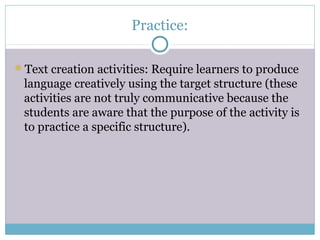
Practice:

Text creation activities: Require learners to produce
 language creatively using the target structure (these
 activities are not truly communicative because the
 students are aware that the purpose of the activity is
 to practice a specific structure).
Communicative grammar tasks:

Provide students with genuine opportunities to
 communicate using language that is known.
These tasks differ from text creation activities in that
 the students are not restricted in the language that is
 used.
As a result, because students are not focused on the
 use of a particular structure, tasks must be designed
 to ensure that the desired structure is utilized.
Refer to Penny Ur’s Grammar Practice Activities,
 1988.
            (Lightbown & Spada, 1993)
Integrative Grammar Teaching

Combines a form-based with a meaning-based focus.
 “form focused instruction and corrective feedback
 provided within the context of communicative
 interaction can contribute positively to a second
 language development in both the short and long
 term” (Lightbown & Spada, 1993, p. 205).
Students should be able to learn explicit grammar
 rules as well as have a chance to practice them in
 communication in the authentic or simulated tasks
 (Musumeci, 1997).
PPP
     Presentation / Practice/ Production

based on the Grammar-Translation Method in which
 grammar explanations are followed by exercises.
follows the premise that knowledge becomes skill
 through successive practice and that language is
 learned in small chunks leading to the whole.
views accuracy as a precursor to fluency.
PPP- Stage 1

In the first stage of the sequence the teacher
 introduces the language and forms to be studied.
PPP- Stage 2

 In the second stage students practice using the
 language and grammar introduced by the teacher.
 This stage is often characterized by decontextualized
 drills.
The focus of this stage is the accurate use of
 language.
PPP- Stage 3

After students have demonstrated that they can
 accurately use the language and forms introduced,
 fluency is developed by providing opportunities for
 students to use what they have learned in a less
 controlled environment.
Criticism of PPP:

SLA research demonstrates that practice does not
 lead to perfection (Lightbown, 1985).
Language learning does not occur in a linear fashion
 influenced directly by the instruction that takes place
 (Ellis 1993; Skehan, 1996).
Relies heavily on the use of decontextualized and
 meaningless drills (Wong & Van Pattten, 2003).
Task Based Language Teaching

Accuracy and fluency are addressed in TBLT with a
 linguistic focus supporting the task or emerging out
 of difficulties experienced during the task.
This maintains the focus on communication rather
 than learning particular forms and promotes the
 relevancy of grammatical instruction.
Willis’ (1996) Model

Pre-Task: lexicon is introduced and learners are
 engaged in brief activities to activate their schemata
 about a particular topic or to equip them to
 participate in the main task.
Task: learners are actively engaged in completing a
 communicative task.
Language Focus: learners’ errors are highlighted and
 specific activities are utilized to allow them to
 practice using the correct language forms.
Accuracy Addressed Through Focused Tasks


Focused tasks are tasks that are likely to require the
 use of a particular form.
For example, writing a recipe will require the use of
 the imperative and decorating a room will require
 the use of prepositions.
Willis’ TBLT Framework

Willis (1996) advocated addressing accuracy through
 the structure of lessons:
            a) Pre-task
            b) Task
            c) Post-task (language focus)
Pre-task Phase

In this phase the teacher will:
1) Introduce and define the topic
2) Use activities to help students recall or learn
    vocabulary and phrases
3) Provide examples of how the task may be
    completed
4) Provide instructions for completing the task
Task Phase

 During this stage the students complete the central
  task of the cycle individually (in pairs or groups).
 While the students work, the teacher ensures
  students understand the task and are being
  productive.
 The teacher monitors time closely and observes how
  groups are functioning. This information may be
  relayed to students to promote effective group
  functioning or may be used in formulating future
  groups.
Language focus phase

In this phase students move from a focus on
 meaning to a focus on form.
The purpose of this phase is to develop accuracy by
 directing students’ attention to particular language
 forms and usage.
Tasks to Promote Negotiation

Negotiation contributes to language acquisition by
 making input more comprehensible (Long, 1985)
 and by providing opportunities to attend to form
 (Pica, 1994).
Types of Tasks – Willis (1996)

1)   Listing – brainstorming, fact-finding
2)   Ordering and Sorting – sequencing, ranking,
     categorizing, classifying
3)   Comparing – matching, finding differences and
     similarities
4)   Problem Solving
5)   Sharing Personal Experiences
6)   Creative Tasks
Types of Tasks – Pica, Kanagy, Falodun (1993)

1)   Jigsaw – learners combine different pieces of
     information to create a whole
2)   Information-Gap – learners have different information.
     They negotiate to find the other individual’s information
3)   Problem-Solving – students must find a solution for a
     problem (typically there is one resolution)
4)   Decision-Making – students solve an open-ended
     problem by discussing multiple options and choosing the
     best
5)   Opinion Exchange – learners exchange ideas without
     needing to come to a consensus
Some benefits of TBLT

Current educational research outlines that learners
 engage in the learning process using a variety of
 styles and intelligences.
TBLT provides an inductive approach to instruction
 and addresses different learning styles than PPP.
TBLT encourages more meaningful learning
 experiences that are relevant to students.
Some benefits of TBLT (Willis, 1996)


PPP is a form of the “banking model” of education
 whereas TBLT is a student-centered approach that
 provides a voice to students (content and language
 usage).
Principles of democracy are more reflective of a
 TBLT classroom.
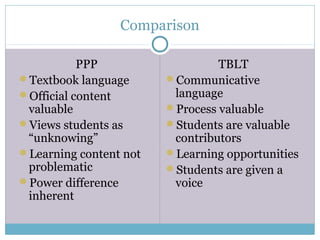
Comparison

           PPP                   TBLT
Textbook language      Communicative
Official content        language
 valuable               Process valuable
Views students as      Students are valuable
 “unknowing”             contributors
Learning content not   Learning opportunities
 problematic            Students are given a
Power difference        voice
 inherent
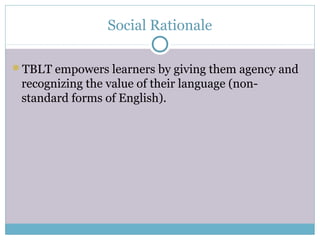
Social Rationale

TBLT empowers learners by giving them agency and
 recognizing the value of their language (non-
 standard forms of English).
References

Brown, H. Douglas. (2001). Teaching by principles: An interactive approach to language pedagogy. San Francisco
     University: Longman.
Davidson, D.M. (1978). Current approaches to the teaching of grammar in ESL. Language in education theory and
     practice, 5, 1-23.
Doughty, C. & Williams, J. (1999). Focus on form in classroom second language acquisition. New York: Cambridge
     University Press.
Ellis, R. (2003). Task-based language learning and teaching. Oxford: Oxford University Press.
Harley, B. & Swain, M. (1984). The interlanguage of immersion students and its implications for second language teaching.
     In A. Davies, C. Criper & A. Howatt (Eds.), Interlanguage (pp. 291-311). Edinburgh: Edinburgh University Press.
Harmer, Jeremy. (1998). How to teach English. Longman.
Hinkel, E. & Fotos, S. (2002). From theory to practice: A teacher’s view. In Hinkel, E. & Fotos, S. (Eds.), New perspectives
     on grammar teaching in second language classrooms (1-12). Mahweh, New Jersey: Lawrence Erlbaum Associates, Inc.
Larsen-Freeman, D. (1995). On the teaching and learning of grammar. In F.R. Eckman, D. Highland, P.W. Lee, J. Mileham
     & R. Rutkowski Weber (Eds.), Second language acquisition theory and pedagogy (131-148). Mahweh, New Jersey:
     Lawrence Erlbaum Associates, Inc.
Lightbown, P. (1985). ‘Great expectations: second-language acquisition research and classroom teaching’. Applied
     Linguistics 6: 173-89.
Lightbown, P. & Spada, N. (1990). Focus-on-form and corrective feedback in communicative language teaching: effects in
     second language learning. SSLA, 12(4), 429-448.
Lightbown, P. & Spada, N. (1993). How languages are learned. Oxford: Oxford University Press.
Lightbown, P. & Spada, N. (1999). ‘Instruction, first language influence, and developmental readiness in second language
     acquisition’. The modem Language Journal 83, 1, 1-22.
References

Long, M. (1991). ‘Focus on form: a design feature in language teaching methodology’. Applied Linguistics 14: 225-49.
Long, M. & Robinson, M. (1999). Intervention points in second language classroom processes. Edinburgh: Edinburg
    University Press.
Musumeci, D. (1997). Breaking the tradition: an exploration of the historical relaationship between theory and practice in
    second language teaching. New York: McGraw-Hill.
Nunan, D. (2004). Task-based language teaching. Cambridge: Cambridge University Press.
Pica, T. (1992). The textual outsomes of native speakers– non-native speaker negotiation: what do they reveal about
    second language learning in Kramsch and Mcconnell-Ginet (eds.) 1992.
Pica, T., R. Kanagy, & J. Falodun (1993). Choosing and using communication tasks for second language research and
    instruction. In. Glass and Crookes (eds.).
Skehan, P. (1998). A cognitive approach to language learning. Oxford: Oxford University Press.
Wagner-Gough, J. (1975). Comparative studies in second language learning. Va: Arlington.
Wilkins, D. (1976). Notional Syllabuses. Oxford: Oxford University Press.
Willis, D. (1996). A framework for task-based learning. Harlow: Addison Wesley Longman.
Willis, D. (1993). ‘Comments on Michael H. Long and Graham Crookes: Three approaches to task-based syllabus design’.
    Tesol Quarterly, 27(4), 726-729.
Wong, H. & Van Patten. (2003). ‘The best English: a claim for the superiority of received standard English’. Society for Pure
    English 39: 603-21.

Grammar instruction (1)

  • 1.
    Techniques in grammar instruction Making grammar accessible to ELLs University of Alberta: EDPY 413 Presented by: Chelsea Androschuk, Nicole Mackay, and Robyn Ferguson
  • 3.
    Historically, grammar hasbeen considered to be (Hinkel & Fotos 2002): -nouns -pronouns -verbs -prepositions -participles -adverbs -articles -conjunctions
  • 4.
    The advent ofother approaches: -Direct approaches (audio-lingualism) -Functional approaches -Communicative approaches
  • 5.
    The Audiolingual Method -Theaudiolingual method focuses on the comprehension of language at a largely mechanical level (Davidson, 1978). -Examples of mechanically structured activities might include repetition or substitution. The teacher is in control of the lesson, and students can often successfully participate without any understanding of meaning (Davidson, 1978).
  • 6.
    Functional Approaches -These areusually based on situational language needs (Hinkel & Fotos, 2002). - According to Skehan, these activities often follow a “presentation, practice, and production” protocol (cited in Hinkel & Fotos, 2002).
  • 7.
    Communicative/Humanistic Approaches -These methodsmimic a natural acquisition of language, for example, how a child acquires L1 (Hinkel & Fotos, 2002). -Language is acquired using meaningful input, with no formal grammatical instruction. It is assumed that ELLs will naturally acquire the forms of language when this approach is used (Hinkel & Fotos, 2002).
  • 8.
    Myth: Grammar structuresare meaningless forms (Larsen-Freeman, 1995) - Learning a structure in grammar, is not complete unless its function is explored at the same time (Wagner-Gough, 1975). - There are 3 dimensions to grammar instruction: form, meaning and function/use (Larsen-Freeman, 1995). - Grammar instruction should include the answers to when and why to use any given structure (Larsen- Freeman, 1995).
  • 9.
    Myth: Grammar acquisitionconsists of arbitrary rules (Larsen-Freeman, 1995) -Interlanguages (ILs) appear to follow rules, and are systematic (Larsen-Freeman, 1995). This does not mean that an ELL would be using a grammatical structure as a NS would from first exposure, but that they are still moving toward its proper use while forming rules in his/her IL. -Though systematic, this development through an IL may not be linear (Larsen-Freeman, 1995).
  • 10.
    Myth: Grammar structuresare learned one at a time (Larsen-Freeman, 1995) -The acquisition of some structures may depend on the acquisition of others. A simple accumulation of structures, one at time, can lead to a phenomenon known as backsliding. When backsliding occurs, it is because certain elements become omitted in order to make room for new elements (Larsen-Freeman, 1995).
  • 11.
    Myth: Grammar isacquired naturally, and doesn’t have to be taught (Larsen-Freeman, 1995) - In French immersion programs, where the focus is on meaning alone, students have demonstrated a less than expected understanding of grammar in the language (Harley & Swain, 1984). - Students may develop the ability to convey meaning, without developing proper grammar. Selective form- focused instruction may therefore be necessary to ensure that as language develops, so does grammar (Larsen-Freeman, 1995).
  • 12.
    Lightbrown and Spada(1990)research (cited in Larsen-Freeman, 1995): -This study looked at 4 (primarily communicative) French immersion classes, each of which incorporated a varying level of form-based instruction in grammar. -Their results demonstrated that the class that never focused on grammatical form performed the worst according to the assessment used. - Part of the reason for this, according to Larsen-Freeman (1995), is that focusing student attention may facilitate learning.
  • 13.
    Myth: Error correctionand negative evidence might be unnecessary when instructing grammar (Larsen-Freeman, 1995) -If errors are not corrected, then overgeneralizations in language tend to occur (Larsen-Freeman, 1995). -Negative evidence might be part of the input that ELLs need, though they may not have needed it to the same extent for their L1 (Larsen-Freeman, 1995).
  • 14.
    Myth: All grammaticalstructures are learned in the same way (Larsen-Freeman, 1995) “Any claim to the effect that all acquisition is the product of habit formation or of rule formation, or today, of setting/resetting parameters or the strengthening of connections in complex neural networks, is an obvious oversimplification of a complex process” (Larsen-Freeman, 1995, p. 141).
  • 15.
    3 options inlanguage teaching: Focus on Forms Focus on meaning Focus on form
  • 16.
    Focus on Forms: “Partsof the language are taught separately and step by step so that the acquisition is a process of gradual accumulation of parts until the whole structure of language has been built up…At any one time the learner is being exposed to a deliberate limited sample of language” (Wilkins, 1976, p. 2).
  • 17.
    Focus on Meaning: Theessential claim is that people of all ages learn language best, inside or outside the classroom, not by treating the languages as the object of study, but by experiencing them as a medium of communication… “language is organized in terms of the purpose for which people are learning language and the kinds of language performance that are necessary to meet those purposes” (Wilkins, 1976, p. 13).
  • 18.
    Focus on Form: “Overtlydraws students’ attention to linguistic elements as they arise incidentally in lessons whose overriding focus is on meaning or communication” (Long, 1991, pp. 45-46). “Often consists of an occasional shift of attention to linguistic code features– by the teacher and/or one or more of the students– triggered by perceived problems with comprehension or production” (Long & Robinson, 1999, p. 23).
  • 19.
    Advantage of Focuson Form: “The learner’s attention is drawn precisely to a linguistic feature as necessitated by a communicative demand” (Doughty & Williams, 1999, p. 3).
  • 20.
    Arguments against GrammarInstruction: The study of grammar promotes knowledge about language not how to use the language (Krashen, 1983, p. 10). We acquire our first language without any explicit knowledge of grammar (Krashen, 1983, p. 10). The natural order (Krashen, 1983, pp. 12-36) in which languages are learned precludes the influence of instruction. If communicative competence is the goal, then classroom time is better spent engaging in language use (Krashen, 1983, p. 37).
  • 21.
    Arguments for GrammarInstruction:  Without explicit instruction learners’ interlanguage often fossilizes.  Grammar instruction may act as an advanced organizer helping learners to notice features of language when they are ready.  Learning finite rules can help to simplify an otherwise daunting and complex task by organizing it into neat categories.  Older students’ expectation about language learning often includes grammar instruction.  Learning grammar structures allows for more creative applications of language. (Lightbown & Spada, 1990, pp. 429-448)
  • 22.
    Teaching Grammar: Teachers needto consider how to present grammar to their students (approach), what options for dealing with the grammar should be used, and which area they will focus on during practice (accuracy, fluency, or restructuring).
  • 23.
    Approaches Deductive– teaching throughrules (the rule is provided followed by the provision of examples in which the rule is applied). Inductive– teaching through examples (students are provided with several examples from which a rule is inferred).
  • 24.
    Sources of inductiveinstruction:  Realia / Actions  Worksheets (can often be structured to inductively lead students to a grammar rule)  Authentic texts (after listening to a dialogue or reading a text, students can answer questions to highlight certain grammatical structures– these may then be used to derive rules)  Dialogues  Recorded Conversations
  • 25.
    Options: Teaching through practice:  Drills: activities that are structured to allow only one correct answer  Exercises: Open-ended grammar activities Practice leads to the creation of a continuum ranging from text manipulation activities to text creation activities.
  • 26.
    Practice: Text manipulation activities:Provide students with sentences that they will be required to operate on in some limited manner such as: fill-in-the blank, make a choice from items provided, substitute another item, or transform into another pattern.
  • 27.
    Practice: Text creation activities:Require learners to produce language creatively using the target structure (these activities are not truly communicative because the students are aware that the purpose of the activity is to practice a specific structure).
  • 28.
    Communicative grammar tasks: Providestudents with genuine opportunities to communicate using language that is known. These tasks differ from text creation activities in that the students are not restricted in the language that is used. As a result, because students are not focused on the use of a particular structure, tasks must be designed to ensure that the desired structure is utilized. Refer to Penny Ur’s Grammar Practice Activities, 1988. (Lightbown & Spada, 1993)
  • 29.
    Integrative Grammar Teaching Combinesa form-based with a meaning-based focus.  “form focused instruction and corrective feedback provided within the context of communicative interaction can contribute positively to a second language development in both the short and long term” (Lightbown & Spada, 1993, p. 205). Students should be able to learn explicit grammar rules as well as have a chance to practice them in communication in the authentic or simulated tasks (Musumeci, 1997).
  • 30.
    PPP Presentation / Practice/ Production based on the Grammar-Translation Method in which grammar explanations are followed by exercises. follows the premise that knowledge becomes skill through successive practice and that language is learned in small chunks leading to the whole. views accuracy as a precursor to fluency.
  • 31.
    PPP- Stage 1 Inthe first stage of the sequence the teacher introduces the language and forms to be studied.
  • 32.
    PPP- Stage 2 In the second stage students practice using the language and grammar introduced by the teacher. This stage is often characterized by decontextualized drills. The focus of this stage is the accurate use of language.
  • 33.
    PPP- Stage 3 Afterstudents have demonstrated that they can accurately use the language and forms introduced, fluency is developed by providing opportunities for students to use what they have learned in a less controlled environment.
  • 34.
    Criticism of PPP: SLAresearch demonstrates that practice does not lead to perfection (Lightbown, 1985). Language learning does not occur in a linear fashion influenced directly by the instruction that takes place (Ellis 1993; Skehan, 1996). Relies heavily on the use of decontextualized and meaningless drills (Wong & Van Pattten, 2003).
  • 35.
    Task Based LanguageTeaching Accuracy and fluency are addressed in TBLT with a linguistic focus supporting the task or emerging out of difficulties experienced during the task. This maintains the focus on communication rather than learning particular forms and promotes the relevancy of grammatical instruction.
  • 36.
    Willis’ (1996) Model Pre-Task:lexicon is introduced and learners are engaged in brief activities to activate their schemata about a particular topic or to equip them to participate in the main task. Task: learners are actively engaged in completing a communicative task. Language Focus: learners’ errors are highlighted and specific activities are utilized to allow them to practice using the correct language forms.
  • 37.
    Accuracy Addressed ThroughFocused Tasks Focused tasks are tasks that are likely to require the use of a particular form. For example, writing a recipe will require the use of the imperative and decorating a room will require the use of prepositions.
  • 38.
    Willis’ TBLT Framework Willis(1996) advocated addressing accuracy through the structure of lessons: a) Pre-task b) Task c) Post-task (language focus)
  • 39.
    Pre-task Phase In thisphase the teacher will: 1) Introduce and define the topic 2) Use activities to help students recall or learn vocabulary and phrases 3) Provide examples of how the task may be completed 4) Provide instructions for completing the task
  • 40.
    Task Phase  Duringthis stage the students complete the central task of the cycle individually (in pairs or groups).  While the students work, the teacher ensures students understand the task and are being productive.  The teacher monitors time closely and observes how groups are functioning. This information may be relayed to students to promote effective group functioning or may be used in formulating future groups.
  • 41.
    Language focus phase Inthis phase students move from a focus on meaning to a focus on form. The purpose of this phase is to develop accuracy by directing students’ attention to particular language forms and usage.
  • 42.
    Tasks to PromoteNegotiation Negotiation contributes to language acquisition by making input more comprehensible (Long, 1985) and by providing opportunities to attend to form (Pica, 1994).
  • 43.
    Types of Tasks– Willis (1996) 1) Listing – brainstorming, fact-finding 2) Ordering and Sorting – sequencing, ranking, categorizing, classifying 3) Comparing – matching, finding differences and similarities 4) Problem Solving 5) Sharing Personal Experiences 6) Creative Tasks
  • 44.
    Types of Tasks– Pica, Kanagy, Falodun (1993) 1) Jigsaw – learners combine different pieces of information to create a whole 2) Information-Gap – learners have different information. They negotiate to find the other individual’s information 3) Problem-Solving – students must find a solution for a problem (typically there is one resolution) 4) Decision-Making – students solve an open-ended problem by discussing multiple options and choosing the best 5) Opinion Exchange – learners exchange ideas without needing to come to a consensus
  • 45.
    Some benefits ofTBLT Current educational research outlines that learners engage in the learning process using a variety of styles and intelligences. TBLT provides an inductive approach to instruction and addresses different learning styles than PPP. TBLT encourages more meaningful learning experiences that are relevant to students.
  • 46.
    Some benefits ofTBLT (Willis, 1996) PPP is a form of the “banking model” of education whereas TBLT is a student-centered approach that provides a voice to students (content and language usage). Principles of democracy are more reflective of a TBLT classroom.
  • 47.
    Comparison PPP TBLT Textbook language Communicative Official content language valuable Process valuable Views students as Students are valuable “unknowing” contributors Learning content not Learning opportunities problematic Students are given a Power difference voice inherent
  • 48.
    Social Rationale TBLT empowerslearners by giving them agency and recognizing the value of their language (non- standard forms of English).
  • 49.
    References Brown, H. Douglas.(2001). Teaching by principles: An interactive approach to language pedagogy. San Francisco University: Longman. Davidson, D.M. (1978). Current approaches to the teaching of grammar in ESL. Language in education theory and practice, 5, 1-23. Doughty, C. & Williams, J. (1999). Focus on form in classroom second language acquisition. New York: Cambridge University Press. Ellis, R. (2003). Task-based language learning and teaching. Oxford: Oxford University Press. Harley, B. & Swain, M. (1984). The interlanguage of immersion students and its implications for second language teaching. In A. Davies, C. Criper & A. Howatt (Eds.), Interlanguage (pp. 291-311). Edinburgh: Edinburgh University Press. Harmer, Jeremy. (1998). How to teach English. Longman. Hinkel, E. & Fotos, S. (2002). From theory to practice: A teacher’s view. In Hinkel, E. & Fotos, S. (Eds.), New perspectives on grammar teaching in second language classrooms (1-12). Mahweh, New Jersey: Lawrence Erlbaum Associates, Inc. Larsen-Freeman, D. (1995). On the teaching and learning of grammar. In F.R. Eckman, D. Highland, P.W. Lee, J. Mileham & R. Rutkowski Weber (Eds.), Second language acquisition theory and pedagogy (131-148). Mahweh, New Jersey: Lawrence Erlbaum Associates, Inc. Lightbown, P. (1985). ‘Great expectations: second-language acquisition research and classroom teaching’. Applied Linguistics 6: 173-89. Lightbown, P. & Spada, N. (1990). Focus-on-form and corrective feedback in communicative language teaching: effects in second language learning. SSLA, 12(4), 429-448. Lightbown, P. & Spada, N. (1993). How languages are learned. Oxford: Oxford University Press. Lightbown, P. & Spada, N. (1999). ‘Instruction, first language influence, and developmental readiness in second language acquisition’. The modem Language Journal 83, 1, 1-22.
  • 50.
    References Long, M. (1991).‘Focus on form: a design feature in language teaching methodology’. Applied Linguistics 14: 225-49. Long, M. & Robinson, M. (1999). Intervention points in second language classroom processes. Edinburgh: Edinburg University Press. Musumeci, D. (1997). Breaking the tradition: an exploration of the historical relaationship between theory and practice in second language teaching. New York: McGraw-Hill. Nunan, D. (2004). Task-based language teaching. Cambridge: Cambridge University Press. Pica, T. (1992). The textual outsomes of native speakers– non-native speaker negotiation: what do they reveal about second language learning in Kramsch and Mcconnell-Ginet (eds.) 1992. Pica, T., R. Kanagy, & J. Falodun (1993). Choosing and using communication tasks for second language research and instruction. In. Glass and Crookes (eds.). Skehan, P. (1998). A cognitive approach to language learning. Oxford: Oxford University Press. Wagner-Gough, J. (1975). Comparative studies in second language learning. Va: Arlington. Wilkins, D. (1976). Notional Syllabuses. Oxford: Oxford University Press. Willis, D. (1996). A framework for task-based learning. Harlow: Addison Wesley Longman. Willis, D. (1993). ‘Comments on Michael H. Long and Graham Crookes: Three approaches to task-based syllabus design’. Tesol Quarterly, 27(4), 726-729. Wong, H. & Van Patten. (2003). ‘The best English: a claim for the superiority of received standard English’. Society for Pure English 39: 603-21.

Editor's Notes

  • #4 For more than 2000 years, people used these categories to describe the rules of any language studied (usually greek and roman languages)
  • #5 -found that the 8 categories not sufficient for language instruction- esp in English where there are so many exceptions
  • #6 -direct approach – AL happening around WW2, due to the large scale need for language learning –still see many elements of this technique in the classroom
  • #7 Around the 1960s- developed based on communicative needs of a language learner, often ordered in terms of priority An example would be “how to order in a restaurant”
  • #8 -This emerged in the 70s/80s- result of an influx of ESL learners into the US.
  • #9 - Larsen-Freeman example of passive-active voice activities that are usually taught using worsheets
  • #10 -arbitrary- as in by chance – goes from right to wrong -we should encourage development through stages in IL- not just right or wrong -this might not always be linear: a learner might use no go and don’t go within a brief time frame -but this still lends credence to the idea of contextualized grammar learning as their may be an ordered process for incorporating grammatical elements
  • #11 When one element is focused on, to the neglect of other learned elements, the formerly understood elements may be forgotten
  • #12 We should be asking ourselves, according to Larsen-Freeman, not how to emulate what could happen naturally in the untutored environment, but how we can maximize learning if we are to mediate it. -Not instructing any grammar may lead to the development of an IL that has a lack of form, but that still works to convey meaning for the ELL.
  • #13 -so one class almost never looked at grammatical form, two were moderate, and one did complement their communicative approach to grammar instruction with form-focused activities. -used a “modified COLT” Communicative Orientation to Language Teaching through oral observation
  • #14 -Example offered by Larsen-Freeman: -John drank his coffee slowly -Slowly, John drank his coffee -John slowly drank his coffee -John drank slowly his coffee. -Not needed in L1, because there aren’t as many sources for overgeneralizations- all you are exposed to are the correct way of doing things. Ie- keep in mind that these learners come through an IL, in which elements of L1 are present.

  • #15 On expressing the concern that second language acquisition will become explicable by a unique and bounded process. Too complicated to be accounted for by a single process. -back to the example of passive voice vs. active voice. A learner might discover form in one way, but that way of learning might not suffice to instruct this in a way that suggests how and why each version would be used. Ie- teaching in only one way may result in the omission of the semantics or pragmatics associated with the structure in question.