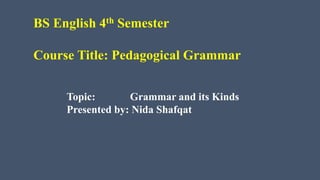
BS English 4th Semester
Course Title: Pedagogical Grammar
Topic: Grammar and its Kinds
Presented by: Nida Shafqat
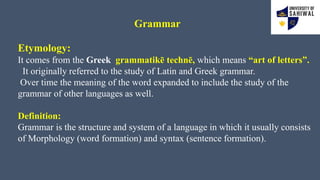
Grammar
Etymology:
It comes from the Greek grammatikē technē, which means “art of letters”.
It originally referred to the study of Latin and Greek grammar.
Over time the meaning of the word expanded to include the study of the
grammar of other languages as well.
Definition:
Grammar is the structure and system of a language in which it usually consists
of Morphology (word formation) and syntax (sentence formation).
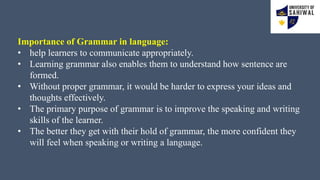
Importance of Grammar in language:
• help learners to communicate appropriately.
• Learning grammar also enables them to understand how sentence are
formed.
• Without proper grammar, it would be harder to express your ideas and
thoughts effectively.
• The primary purpose of grammar is to improve the speaking and writing
skills of the learner.
• The better they get with their hold of grammar, the more confident they
will feel when speaking or writing a language.
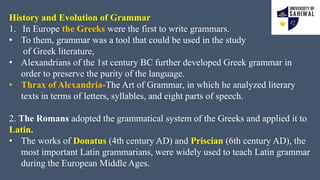
History and Evolution of Grammar
1. In Europe the Greeks were the first to write grammars.
• To them, grammar was a tool that could be used in the study
of Greek literature,
• Alexandrians of the 1st century BC further developed Greek grammar in
order to preserve the purity of the language.
• Thrax of Alexandria-The Art of Grammar, in which he analyzed literary
texts in terms of letters, syllables, and eight parts of speech.
2. The Romans adopted the grammatical system of the Greeks and applied it to
Latin.
• The works of Donatus (4th century AD) and Priscian (6th century AD), the
most important Latin grammarians, were widely used to teach Latin grammar
during the European Middle Ages.
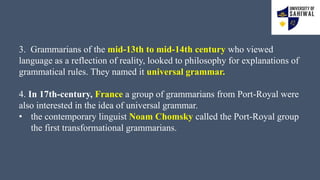
3. Grammarians of the mid-13th to mid-14th century who viewed
language as a reflection of reality, looked to philosophy for explanations of
grammatical rules. They named it universal grammar.
4. In 17th-century, France a group of grammarians from Port-Royal were
also interested in the idea of universal grammar.
• the contemporary linguist Noam Chomsky called the Port-Royal group
the first transformational grammarians.
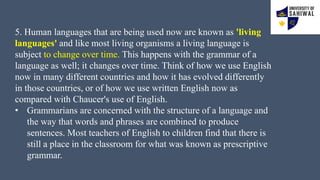
5. Human languages that are being used now are known as 'living
languages' and like most living organisms a living language is
subject to change over time. This happens with the grammar of a
language as well; it changes over time. Think of how we use English
now in many different countries and how it has evolved differently
in those countries, or of how we use written English now as
compared with Chaucer's use of English.
• Grammarians are concerned with the structure of a language and
the way that words and phrases are combined to produce
sentences. Most teachers of English to children find that there is
still a place in the classroom for what was known as prescriptive
grammar.
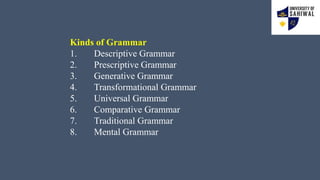
Kinds of Grammar
1. Descriptive Grammar
2. Prescriptive Grammar
3. Generative Grammar
4. Transformational Grammar
5. Universal Grammar
6. Comparative Grammar
7. Traditional Grammar
8. Mental Grammar
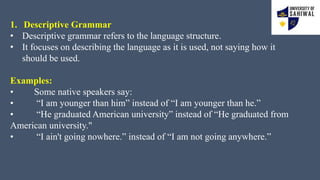
1. Descriptive Grammar
• Descriptive grammar refers to the language structure.
• It focuses on describing the language as it is used, not saying how it
should be used.
Examples:
• Some native speakers say:
• “I am younger than him” instead of “I am younger than he.”
• “He graduated American university” instead of “He graduated from
American university."
• “I ain't going nowhere.” instead of “I am not going anywhere.”
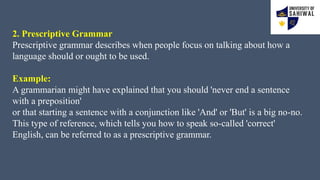
2. Prescriptive Grammar
Prescriptive grammar describes when people focus on talking about how a
language should or ought to be used.
Example:
A grammarian might have explained that you should 'never end a sentence
with a preposition'
or that starting a sentence with a conjunction like 'And' or 'But' is a big no-no.
This type of reference, which tells you how to speak so-called 'correct'
English, can be referred to as a prescriptive grammar.
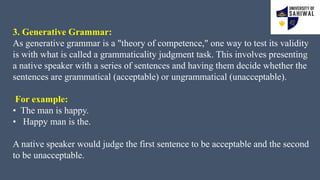
3. Generative Grammar:
As generative grammar is a "theory of competence," one way to test its validity
is with what is called a grammaticality judgment task. This involves presenting
a native speaker with a series of sentences and having them decide whether the
sentences are grammatical (acceptable) or ungrammatical (unacceptable).
For example:
• The man is happy.
• Happy man is the.
A native speaker would judge the first sentence to be acceptable and the second
to be unacceptable.
4. Transformational Grammar/ Transformational
Generative Grammar:
• proposed by U.S. linguist Noam Chomsky in 1957.
transformationalists studied the underlying structure of a language.
• It recognizes the relationship among the various elements of a
sentence and among the possible sentences of a language and uses
processes or rules (some of which are called transformations) to
express these relationships.
Example:
• .” The statement “George saw Mary” is related to the corresponding
questions, “Whom [or who] did George see?” and “Who saw
Mary?”
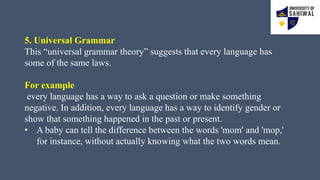
5. Universal Grammar
This “universal grammar theory” suggests that every language has
some of the same laws.
For example
every language has a way to ask a question or make something
negative. In addition, every language has a way to identify gender or
show that something happened in the past or present.
• A baby can tell the difference between the words 'mom' and 'mop,'
for instance, without actually knowing what the two words mean.
6. Comparative Grammar
• Comparative grammar is defined as a branch of linguistics in which
the comparison and analysis of grammar structures of the language
are considered.
• Comparative grammar is also known as Comparative Philology (the
branch of knowledge that deals with the structure, historical
development and relationships of a language).
• Deal with the study of the relationships or correspondences between
two or more languages and the techniques used to discover whether
the languages have a common ancestor.
7. Traditional Grammar
• (also known as classical grammar) is a framework for the
description of the structure of a language. The roots of traditional
grammar are in the work of classical Greek and Latin
philologists. grammar refers to the collection of prescriptive rules
and the structure of language that is commonly taught in schools.
Levels of traditional grammar
i. Parts of Speech
ii. Diction. Diction is the proper use of words
iii. Sentence Structure
iv. Proper Punctuation
v. Phrases
vi. Clauses
8. Mental Grammar
Mental grammar (also called as competence grammar and linguistic
competence) is the generative grammar which is stored in human
brain, that allows the person (speaker) to produce the language which
can be understand by other person.
One of the feature of mental or competence grammar is this incredible
sense of correctness and the ability to hear something that ‘sounds odd’
in a language.
Grammar & its Kinds.pptx

Grammar & its Kinds.pptx

  • 2.
    BS English 4thSemester Course Title: Pedagogical Grammar Topic: Grammar and its Kinds Presented by: Nida Shafqat
  • 3.
    Grammar Etymology: It comes fromthe Greek grammatikē technē, which means “art of letters”. It originally referred to the study of Latin and Greek grammar. Over time the meaning of the word expanded to include the study of the grammar of other languages as well. Definition: Grammar is the structure and system of a language in which it usually consists of Morphology (word formation) and syntax (sentence formation).
  • 4.
    Importance of Grammarin language: • help learners to communicate appropriately. • Learning grammar also enables them to understand how sentence are formed. • Without proper grammar, it would be harder to express your ideas and thoughts effectively. • The primary purpose of grammar is to improve the speaking and writing skills of the learner. • The better they get with their hold of grammar, the more confident they will feel when speaking or writing a language.
  • 5.
    History and Evolutionof Grammar 1. In Europe the Greeks were the first to write grammars. • To them, grammar was a tool that could be used in the study of Greek literature, • Alexandrians of the 1st century BC further developed Greek grammar in order to preserve the purity of the language. • Thrax of Alexandria-The Art of Grammar, in which he analyzed literary texts in terms of letters, syllables, and eight parts of speech. 2. The Romans adopted the grammatical system of the Greeks and applied it to Latin. • The works of Donatus (4th century AD) and Priscian (6th century AD), the most important Latin grammarians, were widely used to teach Latin grammar during the European Middle Ages.
  • 6.
    3. Grammarians ofthe mid-13th to mid-14th century who viewed language as a reflection of reality, looked to philosophy for explanations of grammatical rules. They named it universal grammar. 4. In 17th-century, France a group of grammarians from Port-Royal were also interested in the idea of universal grammar. • the contemporary linguist Noam Chomsky called the Port-Royal group the first transformational grammarians.
  • 7.
    5. Human languagesthat are being used now are known as 'living languages' and like most living organisms a living language is subject to change over time. This happens with the grammar of a language as well; it changes over time. Think of how we use English now in many different countries and how it has evolved differently in those countries, or of how we use written English now as compared with Chaucer's use of English. • Grammarians are concerned with the structure of a language and the way that words and phrases are combined to produce sentences. Most teachers of English to children find that there is still a place in the classroom for what was known as prescriptive grammar.
  • 8.
    Kinds of Grammar 1.Descriptive Grammar 2. Prescriptive Grammar 3. Generative Grammar 4. Transformational Grammar 5. Universal Grammar 6. Comparative Grammar 7. Traditional Grammar 8. Mental Grammar
  • 9.
    1. Descriptive Grammar •Descriptive grammar refers to the language structure. • It focuses on describing the language as it is used, not saying how it should be used. Examples: • Some native speakers say: • “I am younger than him” instead of “I am younger than he.” • “He graduated American university” instead of “He graduated from American university." • “I ain't going nowhere.” instead of “I am not going anywhere.”
  • 10.
    2. Prescriptive Grammar Prescriptivegrammar describes when people focus on talking about how a language should or ought to be used. Example: A grammarian might have explained that you should 'never end a sentence with a preposition' or that starting a sentence with a conjunction like 'And' or 'But' is a big no-no. This type of reference, which tells you how to speak so-called 'correct' English, can be referred to as a prescriptive grammar.
  • 11.
    3. Generative Grammar: Asgenerative grammar is a "theory of competence," one way to test its validity is with what is called a grammaticality judgment task. This involves presenting a native speaker with a series of sentences and having them decide whether the sentences are grammatical (acceptable) or ungrammatical (unacceptable). For example: • The man is happy. • Happy man is the. A native speaker would judge the first sentence to be acceptable and the second to be unacceptable.
  • 12.
    4. Transformational Grammar/Transformational Generative Grammar: • proposed by U.S. linguist Noam Chomsky in 1957. transformationalists studied the underlying structure of a language. • It recognizes the relationship among the various elements of a sentence and among the possible sentences of a language and uses processes or rules (some of which are called transformations) to express these relationships. Example: • .” The statement “George saw Mary” is related to the corresponding questions, “Whom [or who] did George see?” and “Who saw Mary?”
  • 13.
    5. Universal Grammar This“universal grammar theory” suggests that every language has some of the same laws. For example every language has a way to ask a question or make something negative. In addition, every language has a way to identify gender or show that something happened in the past or present. • A baby can tell the difference between the words 'mom' and 'mop,' for instance, without actually knowing what the two words mean.
  • 14.
    6. Comparative Grammar •Comparative grammar is defined as a branch of linguistics in which the comparison and analysis of grammar structures of the language are considered. • Comparative grammar is also known as Comparative Philology (the branch of knowledge that deals with the structure, historical development and relationships of a language). • Deal with the study of the relationships or correspondences between two or more languages and the techniques used to discover whether the languages have a common ancestor.
  • 15.
    7. Traditional Grammar •(also known as classical grammar) is a framework for the description of the structure of a language. The roots of traditional grammar are in the work of classical Greek and Latin philologists. grammar refers to the collection of prescriptive rules and the structure of language that is commonly taught in schools. Levels of traditional grammar i. Parts of Speech ii. Diction. Diction is the proper use of words iii. Sentence Structure iv. Proper Punctuation v. Phrases vi. Clauses
  • 16.
    8. Mental Grammar Mentalgrammar (also called as competence grammar and linguistic competence) is the generative grammar which is stored in human brain, that allows the person (speaker) to produce the language which can be understand by other person. One of the feature of mental or competence grammar is this incredible sense of correctness and the ability to hear something that ‘sounds odd’ in a language.