Week 8
*Grammar (from Greek. Gramma – letter,
spelling) is a branch of linguistics that studies
the structure of the language, that is, a system
of morphological categories and forms,
syntactic constructions, ways of word
production. Recently, the text has also become
the subject of grammar.
*The term grammar is derived from
the Greek word grammatikē, where
gram meant something written. The
part tikē derives from technē and
meant art.
*Hence grammatikē is the art of
writing.
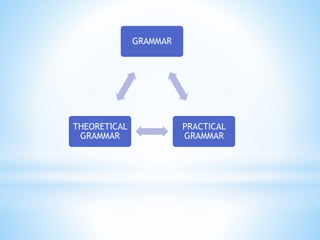
GRAMMAR
PRACTICAL
GRAMMAR
THEORETICAL
GRAMMAR
*The difference between theoretical grammar
and a practical grammar course is that
practical grammar prescribes certain rules of
use, teaches how to speak (write), while
theoretical grammar, analyzing the facts of
language, expounds them without giving any
prescriptions.
Any course of theoretical grammar
today serves to describe the
grammatical structure of language as
a system where all parts are
interconnected.
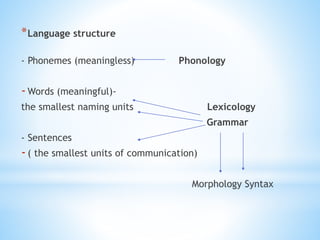
*Language structure
- Phonemes (meaningless) Phonology
-Words (meaningful)-
the smallest naming units Lexicology
Grammar
- Sentences
-( the smallest units of communication)
Morphology Syntax
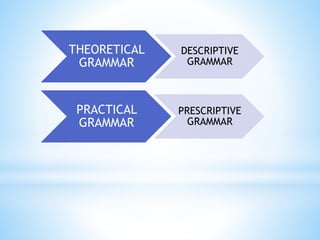
THEORETICAL
GRAMMAR
DESCRIPTIVE
GRAMMAR
PRACTICAL
GRAMMAR
PRESCRIPTIVE
GRAMMAR
Practical grammar prescribes certain rules of usage and
teaches to speak or write correctly.
Theoretical grammar presents facts of language while
analyzing them and gives no prescriptions.
To a prescriptive grammarian, grammar is rules of correct
usage; its aim is to prescribe what is judged to be correct
rather than to describe actual usage.
To a descriptive grammarian (descriptivist), grammar is a
systematic description of the structure of a language.
*Prescriptive grammar describes when people focus on
talking about how a language should or ought to be used. One
way to remember this association is to think of going to a
doctor’s office. When a doctor gives you a prescription for
medication, it often includes directions about how you should
take your medication as well as what you should not do when
taking your medication. In a similar way, a prescriptive
grammar tells you how you should speak, and what type of
language to avoid. This is commonly found in English classes
as well as other language classes, where the aim is to teach
people how to use language in a very particular (typically
described as ‘proper’ or ‘correct’) way.
*Descriptive grammar, on the other hand, focuses on
describing the language as it is used, not saying how it should
be used. For example, think about a prescriptive rule
like Don’t split infinitives. A descriptive grammarian would
see a sentence like “To boldly go where no man has gone
before” and would try to describe how the mental grammar
can cause that ordering of words, rather than saying that the
surface form is faulty due to prescriptive rules (which would
require the sentence “To go boldly where no man has gone
before”). Linguistics takes this approach to language.
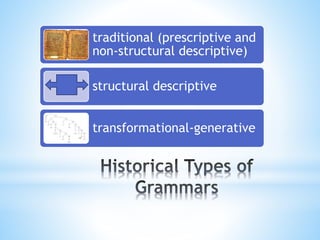
traditional (prescriptive and
non-structural descriptive)
structural descriptive
transformational-generative
*Pāṇini (4th century BCE) is known for his
Sanskrit grammar, particularly for his
formulation of the 3,959 rules of Sanskrit
morphology, syntax and semantics, in the
grammar known as Aṣṭādhyāyī, meaning "eight
chapters".
*His theory of morphological analysis was more
advanced than any equivalent Western theory
before the mid 20th century.
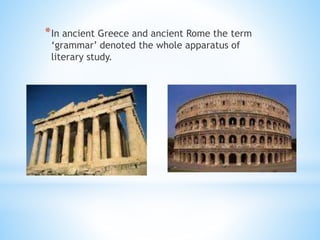
*In ancient Greece and ancient Rome the term
‘grammar’ denoted the whole apparatus of
literary study.
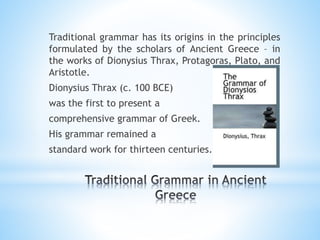
Traditional grammar has its origins in the principles
formulated by the scholars of Ancient Greece – in
the works of Dionysius Thrax, Protagoras, Plato, and
Aristotle.
Dionysius Thrax (c. 100 BCE)
was the first to present a
comprehensive grammar of Greek.
His grammar remained a
standard work for thirteen centuries.
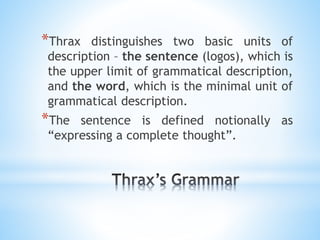
*Thrax distinguishes two basic units of
description – the sentence (logos), which is
the upper limit of grammatical description,
and the word, which is the minimal unit of
grammatical description.
*The sentence is defined notionally as
“expressing a complete thought”.
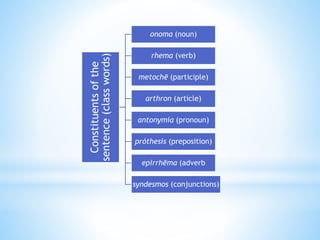
Constituents
of
the
sentence
(class
words)
onoma (noun)
rhema (verb)
metochē (participle)
arthron (article)
antonymia (pronoun)
próthesis (preposition)
epirrhēma (adverb
syndesmos (conjunctions)
*
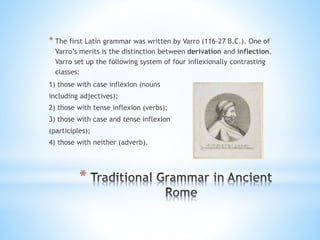
* The first Latin grammar was written by Varro (116–27 B.C.). One of
Varro’s merits is the distinction between derivation and inflection.
Varro set up the following system of four inflexionally contrasting
classes:
1) those with case inflexion (nouns
including adjectives);
2) those with tense inflexion (verbs);
3) those with case and tense inflexion
(participles);
4) those with neither (adverb).
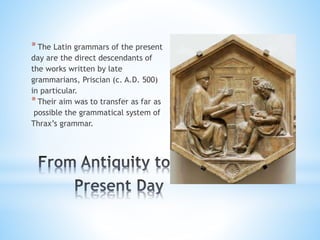
*The Latin grammars of the present
day are the direct descendants of
the works written by late
grammarians, Priscian (c. A.D. 500)
in particular.
*Their aim was to transfer as far as
possible the grammatical system of
Thrax’s grammar.
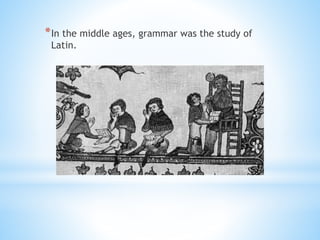
*In the middle ages, grammar was the study of
Latin.
Until the end of the sixteenth century, the
only grammars used in English schools
were Latin grammars.
The aim was to teach the English to read,
write and sometimes converse in this
lingua franca of Western Europe.
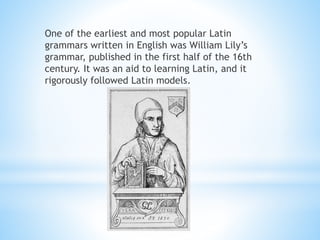
One of the earliest and most popular Latin
grammars written in English was William Lily’s
grammar, published in the first half of the 16th
century. It was an aid to learning Latin, and it
rigorously followed Latin models.
*The Renaissance widened linguistic horizons. Scholars
turned their attention to the living languages of Europe.
*Although the study of Greek and Latin grammar continued,
they were not the only languages scholars became
interested in.
*The first grammars of English were closely related to Latin,
which scholars had treated as an ideal language.
*English, which replaced Latin, had to appear as perfect as
Latin. As a result, some English scholars were greatly
concerned with refining their language. Through the use of
logic they hoped to improve English.
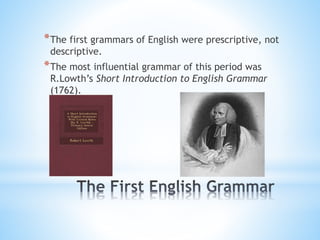
*The first grammars of English were prescriptive, not
descriptive.
*The most influential grammar of this period was
R.Lowth’s Short Introduction to English Grammar
(1762).
*The aim of this grammar was “to teach us to express ourselves
with propriety ... and to enable us to judge of every phrase and
form of construction, whether it be right or not”.
*The criterion for the discrimination between right and wrong
constructions was Latin.
*As Latin appeared to conform best to their concept of ideal
grammar, English was described in terms of Latin forms and the
same grammatical constraints were imposed.
E.g,, a noun was presented in the form of the Latin noun paradigm:
*Nominative: the house Genitive: of the house Dative: to the
house Accusative: the house Ablative: in, at, from the house
Vocative: house
To sum up, early prescriptive grammar could be
characterized by the following features:
1) patterning after Latin in classifying words into word
classes and establishing grammatical categories;
2) reliance on meaning and function in definitions;
3) approach to correctness: the standards of
correctness are logic, which was identified with Latin
past;
4) emphasis on writing rather than speech.
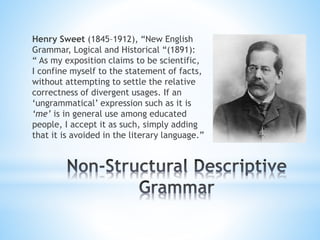
Henry Sweet (1845–1912), “New English
Grammar, Logical and Historical “(1891):
“ As my exposition claims to be scientific,
I confine myself to the statement of facts,
without attempting to settle the relative
correctness of divergent usages. If an
‘ungrammatical’ expression such as it is
‘me’ is in general use among educated
people, I accept it as such, simply adding
that it is avoided in the literary language.”
Unlike prescriptivists, descriptivists focus
their attention on actual usage without trying
“to settle the relative correctness of divergent
usages.”
Similar to prescriptivists, descriptivists use
meaning and function in their definition of
parts of speech.
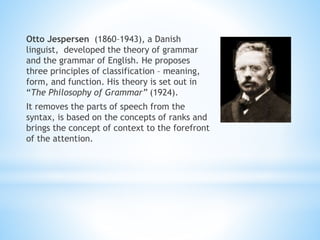
Otto Jespersen (1860–1943), a Danish
linguist, developed the theory of grammar
and the grammar of English. He proposes
three principles of classification – meaning,
form, and function. His theory is set out in
“The Philosophy of Grammar” (1924).
It removes the parts of speech from the
syntax, is based on the concepts of ranks and
brings the concept of context to the forefront
of the attention.
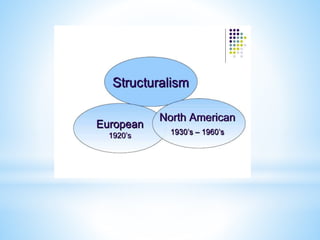
The Emergence of
Structuralism
As a reaction to the atomistic approach to
language a new theory appeared that was
seeking to grasp linguistic events in their
mutual interconnection and
interdependence, to understand and to
describe language as a system.
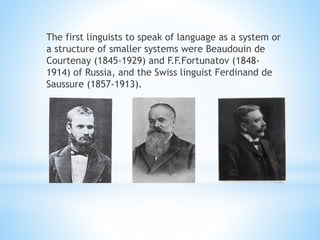
The first linguists to speak of language as a system or
a structure of smaller systems were Beaudouin de
Courtenay (1845-1929) and F.F.Fortunatov (1848-
1914) of Russia, and the Swiss linguist Ferdinand de
Saussure (1857-1913).
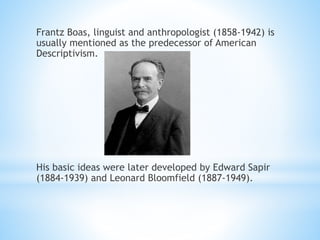
Frantz Boas, linguist and anthropologist (1858-1942) is
usually mentioned as the predecessor of American
Descriptivism.
His basic ideas were later developed by Edward Sapir
(1884-1939) and Leonard Bloomfield (1887-1949).
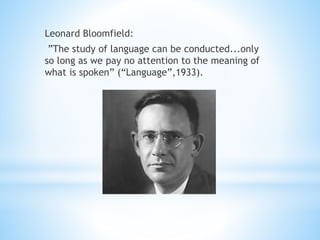
Leonard Bloomfield:
”The study of language can be conducted...only
so long as we pay no attention to the meaning of
what is spoken” (“Language”,1933).
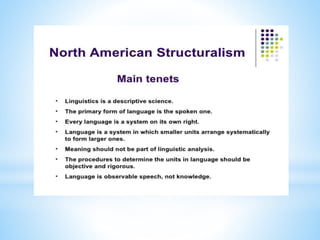
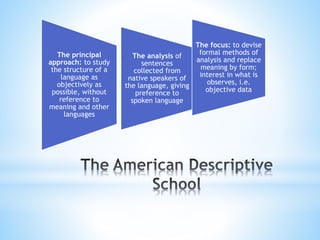
The principal
approach: to study
the structure of a
language as
objectively as
possible, without
reference to
meaning and other
languages
The analysis of
sentences
collected from
native speakers of
the language, giving
preference to
spoken language
The focus: to devise
formal methods of
analysis and replace
meaning by form;
interest in what is
observes, i.e.
objective data
The chief contribution of the
American Descriptive School to
modern linguistics is the
elaboration of the techniques of
linguistic analysis.
The main methods are
(1) the Distributional Method and
(2) the Method of Immediate
Constituents.
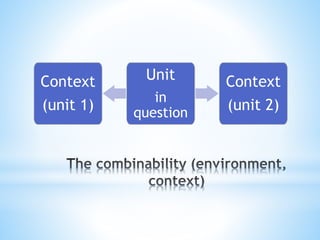
(1)The Distributional Analysis
is a method of linguistic research in which the
classification of linguistic units and the study of their
features are carried out on the basis of the distribution
of the units in question in the spoken chain, i.e. on the
basis of their combinability.
Context
(unit 1)
Unit
in
question
Context
(unit 2)
Linguistic units with
similar distributions have
similar meanings.
2. The Method of Immediate
Constituents
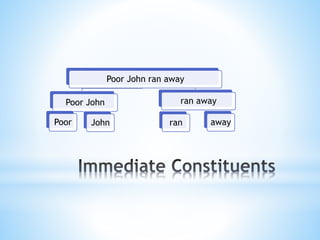
The term immediate constituents (IC) was introduced by L.
Bloomfield as follows: “Any English-speaking person who
concerns himself with this matter is sure to tell us that the
immediate constituents of
Poor John ran away
are the two forms Poor John and ran away; that
each of these is, in turn, a complex form; that the
immediate constituents of ran away are ran and away, and
that the constituents of Poor John are poor and John”.
Poor John ran away
Poor John
Poor John
ran away
ran away
2. The Method of Immediate Constituents
*This method is based on the binary principle, i.e.
each stage of the procedure involves two
components the unit immediately breaks into.
*The analysis is completed when we arrive at
constituents incapable of further division.
DEFINITIONS for the
Method of Immediate
Constituents
An immediate constituent is a word or a group of words
that functions as a single unit within a hierarchical
structure.
The ultimate constituents are the smallest meaningful
units which any given construction can be broken down
to, consisting of a morpheme at the morphological level
and a word at the syntactic level.
The linguistics procedure which divides sentences into
their component parts or constituents in this way is
known as constituent analysis.
The segmentation of the sentence into its immediate
constituents by using binary cuttings until its ultimate
constituents are obtained is called Immediate Constituent
Analysis (IC Analysis).
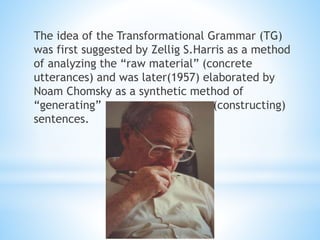
The idea of the Transformational Grammar (TG)
was first suggested by Zellig S.Harris as a method
of analyzing the “raw material” (concrete
utterances) and was later(1957) elaborated by
Noam Chomsky as a synthetic method of
“generating” (constructing)
sentences.
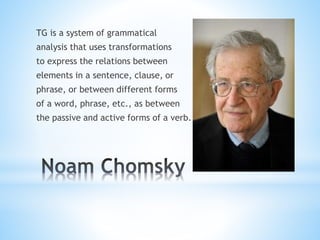
TG is a system of grammatical
analysis that uses transformations
to express the relations between
elements in a sentence, clause, or
phrase, or between different forms
of a word, phrase, etc., as between
the passive and active forms of a verb.
TG refers to syntax and presupposes the
recognition (identification) of such linguistic
units as phonemes, morphemes and form-
classes, the latter being stated according to
the distributional and the IC-analysis or
otherwise.
According to Chomsky, the central goal of
linguistic theory is to determine what it is
that people know if they know a particular
language.
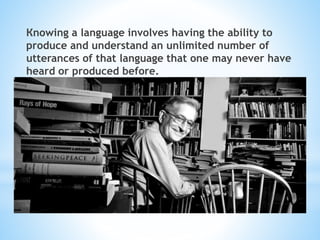
Кnowing a language involves having the ability to
produce and understand an unlimited number of
utterances of that language that one may never have
heard or produced before.
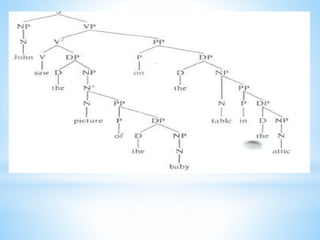
А GM is a system of explicit rules that may apply
recursively to generate an indefinite number of
sentences that can be as long as you want them to
be.
John saw the picture of the baby on
the table in the attic.
S-sentence, N-noun, NP-noun phrase, V-verb, VP-
verb phrase, P-preposition, PP-prepositional phrase,
DP-determiner phrase, DET-determiner.
*In generative linguistics 'grammar' refers to the
implicit, totally unarticulated knowledge of rules and
principles of the language that people have in their
heads.
*This tacit knowledge enables them to distinguish
between well-formed and ill-formed words and
utterances in their language, e.g. it’s correct to say a
grain but 'incorrect' to say *a oat.
*In generative linguistics the term 'grammar' covers
not only morphology and syntax but also semantics,
the lexicon and phonology.
*Phonological rules, morphological rules, syntactic
rules and semantic rules are all regarded as rules of
grammar.
*Chomsky has shifted the focus of linguistic theory
from the study of observed behaviour to the
investigation of the knowledge that underlies that
behaviour.
* In generative linguistics, rules are intended to go
beyond accounting for patterns in the data to a
characterisation of speakers' linguistic knowledge.
* The primary objective of generative grammar is
to model a speaker's linguistic knowledge.
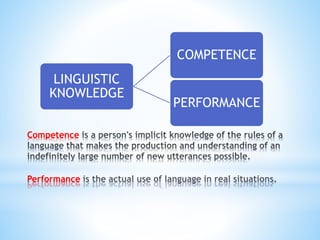
Chomsky characterises linguistic knowledge using the
concepts of competence and performance.
Competence
Performance
LINGUISTIC
KNOWLEDGE
COMPETENCE
PERFORMANCE
Chomsky proposes that competence,
rather than performance, is the
primary object of linguistic inquiry.
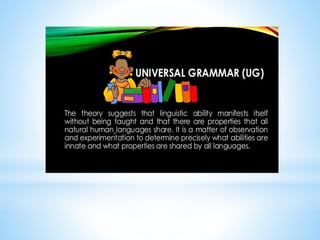
*Chomsky contends that the linguistic capacity of
humans is innate. The general character of linguistic
knowledge is determined by the nature of the mind,
which has a specialized language faculty.
*This faculty is determined in turn by the biology of
the brain. The human child is born with a blueprint
of language that is called Universal Grammar.
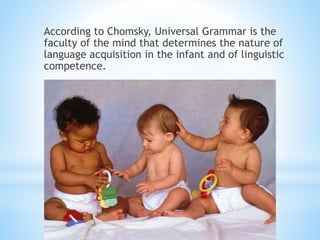
According to Chomsky, Universal Grammar is the
faculty of the mind that determines the nature of
language acquisition in the infant and of linguistic
competence.
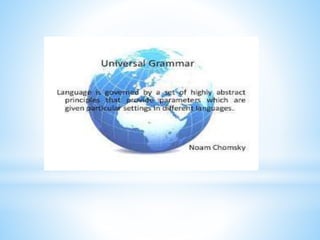
The properties that lie behind the
competence of speakers of various
languages are governed by restricted
and unified elementary principles
rooted in Universal Grammar.
This explains the striking similarity
between languages in their essential
structural properties. The structural
differences between languages occur
within the range sanctioned by
Universal Grammar.
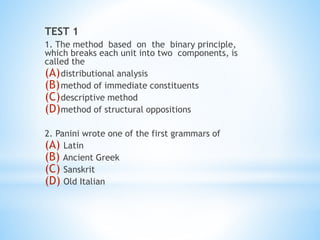
TEST 1
1. The method based on the binary principle,
which breaks each unit into two components, is
called the
(A)distributional analysis
(B)method of immediate constituents
(C)descriptive method
(D)method of structural oppositions
2. Panini wrote one of the first grammars of
(A) Latin
(B) Ancient Greek
(C) Sanskrit
(D) Old Italian
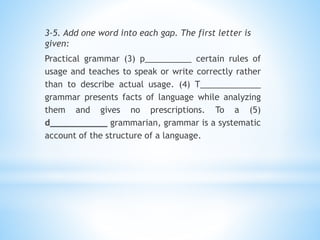
3-5. Add one word into each gap. The first letter is
given:
Practical grammar (3) p__________ certain rules of
usage and teaches to speak or write correctly rather
than to describe actual usage. (4) T_____________
grammar presents facts of language while analyzing
them and gives no prescriptions. To a (5)
d___________ grammarian, grammar is a systematic
account of the structure of a language.
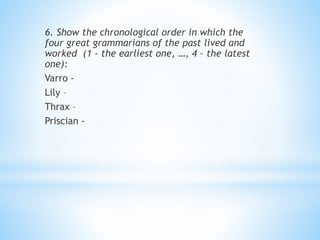
6. Show the chronological order in which the
four great grammarians of the past lived and
worked (1 - the earliest one, …, 4 – the latest
one):
Varro -
Lily –
Thrax –
Priscian -
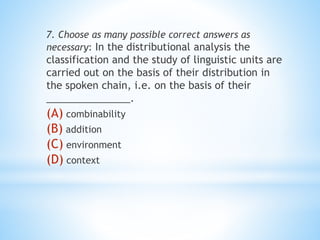
7. Choose as many possible correct answers as
necessary: In the distributional analysis the
classification and the study of linguistic units are
carried out on the basis of their distribution in
the spoken chain, i.e. on the basis of their
_______________.
(A) combinability
(B) addition
(C) environment
(D) context
8. According to Chomsky, the central goal of
linguistic theory is to determine
(A) what the difference between competence is
performance is.
(B) what it is that people know if they know a
particular language.
(C) how languages differ from one another.
(D) what methods are used in linguistic
research.
9. According to Chomsky, the linguistic capacity of
humans is
(A) innate.
(B) determined by the nature of the mind, which has
a specialized language faculty.
(C) called Universal Grammar.
(D) dependent on the grammar of the specific
language the child is exposed to.

Theoretical grammar .pptx

  • 1.
  • 2.
    *Grammar (from Greek.Gramma – letter, spelling) is a branch of linguistics that studies the structure of the language, that is, a system of morphological categories and forms, syntactic constructions, ways of word production. Recently, the text has also become the subject of grammar.
  • 3.
    *The term grammaris derived from the Greek word grammatikē, where gram meant something written. The part tikē derives from technē and meant art. *Hence grammatikē is the art of writing.
  • 4.
  • 5.
    *The difference betweentheoretical grammar and a practical grammar course is that practical grammar prescribes certain rules of use, teaches how to speak (write), while theoretical grammar, analyzing the facts of language, expounds them without giving any prescriptions.
  • 6.
    Any course oftheoretical grammar today serves to describe the grammatical structure of language as a system where all parts are interconnected.
  • 7.
    *Language structure - Phonemes(meaningless) Phonology -Words (meaningful)- the smallest naming units Lexicology Grammar - Sentences -( the smallest units of communication) Morphology Syntax
  • 8.
  • 9.
    Practical grammar prescribescertain rules of usage and teaches to speak or write correctly. Theoretical grammar presents facts of language while analyzing them and gives no prescriptions. To a prescriptive grammarian, grammar is rules of correct usage; its aim is to prescribe what is judged to be correct rather than to describe actual usage. To a descriptive grammarian (descriptivist), grammar is a systematic description of the structure of a language.
  • 10.
    *Prescriptive grammar describeswhen people focus on talking about how a language should or ought to be used. One way to remember this association is to think of going to a doctor’s office. When a doctor gives you a prescription for medication, it often includes directions about how you should take your medication as well as what you should not do when taking your medication. In a similar way, a prescriptive grammar tells you how you should speak, and what type of language to avoid. This is commonly found in English classes as well as other language classes, where the aim is to teach people how to use language in a very particular (typically described as ‘proper’ or ‘correct’) way.
  • 11.
    *Descriptive grammar, onthe other hand, focuses on describing the language as it is used, not saying how it should be used. For example, think about a prescriptive rule like Don’t split infinitives. A descriptive grammarian would see a sentence like “To boldly go where no man has gone before” and would try to describe how the mental grammar can cause that ordering of words, rather than saying that the surface form is faulty due to prescriptive rules (which would require the sentence “To go boldly where no man has gone before”). Linguistics takes this approach to language.
  • 12.
    traditional (prescriptive and non-structuraldescriptive) structural descriptive transformational-generative
  • 13.
    *Pāṇini (4th centuryBCE) is known for his Sanskrit grammar, particularly for his formulation of the 3,959 rules of Sanskrit morphology, syntax and semantics, in the grammar known as Aṣṭādhyāyī, meaning "eight chapters". *His theory of morphological analysis was more advanced than any equivalent Western theory before the mid 20th century.
  • 15.
    *In ancient Greeceand ancient Rome the term ‘grammar’ denoted the whole apparatus of literary study.
  • 16.
    Traditional grammar hasits origins in the principles formulated by the scholars of Ancient Greece – in the works of Dionysius Thrax, Protagoras, Plato, and Aristotle. Dionysius Thrax (c. 100 BCE) was the first to present a comprehensive grammar of Greek. His grammar remained a standard work for thirteen centuries.
  • 17.
    *Thrax distinguishes twobasic units of description – the sentence (logos), which is the upper limit of grammatical description, and the word, which is the minimal unit of grammatical description. *The sentence is defined notionally as “expressing a complete thought”.
  • 18.
    Constituents of the sentence (class words) onoma (noun) rhema (verb) metochē(participle) arthron (article) antonymia (pronoun) próthesis (preposition) epirrhēma (adverb syndesmos (conjunctions)
  • 19.
    * * The firstLatin grammar was written by Varro (116–27 B.C.). One of Varro’s merits is the distinction between derivation and inflection. Varro set up the following system of four inflexionally contrasting classes: 1) those with case inflexion (nouns including adjectives); 2) those with tense inflexion (verbs); 3) those with case and tense inflexion (participles); 4) those with neither (adverb).
  • 20.
    *The Latin grammarsof the present day are the direct descendants of the works written by late grammarians, Priscian (c. A.D. 500) in particular. *Their aim was to transfer as far as possible the grammatical system of Thrax’s grammar.
  • 21.
    *In the middleages, grammar was the study of Latin.
  • 22.
    Until the endof the sixteenth century, the only grammars used in English schools were Latin grammars. The aim was to teach the English to read, write and sometimes converse in this lingua franca of Western Europe.
  • 23.
    One of theearliest and most popular Latin grammars written in English was William Lily’s grammar, published in the first half of the 16th century. It was an aid to learning Latin, and it rigorously followed Latin models.
  • 24.
    *The Renaissance widenedlinguistic horizons. Scholars turned their attention to the living languages of Europe. *Although the study of Greek and Latin grammar continued, they were not the only languages scholars became interested in. *The first grammars of English were closely related to Latin, which scholars had treated as an ideal language. *English, which replaced Latin, had to appear as perfect as Latin. As a result, some English scholars were greatly concerned with refining their language. Through the use of logic they hoped to improve English.
  • 25.
    *The first grammarsof English were prescriptive, not descriptive. *The most influential grammar of this period was R.Lowth’s Short Introduction to English Grammar (1762).
  • 26.
    *The aim ofthis grammar was “to teach us to express ourselves with propriety ... and to enable us to judge of every phrase and form of construction, whether it be right or not”. *The criterion for the discrimination between right and wrong constructions was Latin. *As Latin appeared to conform best to their concept of ideal grammar, English was described in terms of Latin forms and the same grammatical constraints were imposed. E.g,, a noun was presented in the form of the Latin noun paradigm: *Nominative: the house Genitive: of the house Dative: to the house Accusative: the house Ablative: in, at, from the house Vocative: house
  • 27.
    To sum up,early prescriptive grammar could be characterized by the following features: 1) patterning after Latin in classifying words into word classes and establishing grammatical categories; 2) reliance on meaning and function in definitions; 3) approach to correctness: the standards of correctness are logic, which was identified with Latin past; 4) emphasis on writing rather than speech.
  • 29.
    Henry Sweet (1845–1912),“New English Grammar, Logical and Historical “(1891): “ As my exposition claims to be scientific, I confine myself to the statement of facts, without attempting to settle the relative correctness of divergent usages. If an ‘ungrammatical’ expression such as it is ‘me’ is in general use among educated people, I accept it as such, simply adding that it is avoided in the literary language.”
  • 30.
    Unlike prescriptivists, descriptivistsfocus their attention on actual usage without trying “to settle the relative correctness of divergent usages.” Similar to prescriptivists, descriptivists use meaning and function in their definition of parts of speech.
  • 31.
    Otto Jespersen (1860–1943),a Danish linguist, developed the theory of grammar and the grammar of English. He proposes three principles of classification – meaning, form, and function. His theory is set out in “The Philosophy of Grammar” (1924). It removes the parts of speech from the syntax, is based on the concepts of ranks and brings the concept of context to the forefront of the attention.
  • 32.
  • 34.
    As a reactionto the atomistic approach to language a new theory appeared that was seeking to grasp linguistic events in their mutual interconnection and interdependence, to understand and to describe language as a system.
  • 35.
    The first linguiststo speak of language as a system or a structure of smaller systems were Beaudouin de Courtenay (1845-1929) and F.F.Fortunatov (1848- 1914) of Russia, and the Swiss linguist Ferdinand de Saussure (1857-1913).
  • 37.
    Frantz Boas, linguistand anthropologist (1858-1942) is usually mentioned as the predecessor of American Descriptivism. His basic ideas were later developed by Edward Sapir (1884-1939) and Leonard Bloomfield (1887-1949).
  • 38.
    Leonard Bloomfield: ”The studyof language can be conducted...only so long as we pay no attention to the meaning of what is spoken” (“Language”,1933).
  • 39.
    The principal approach: tostudy the structure of a language as objectively as possible, without reference to meaning and other languages The analysis of sentences collected from native speakers of the language, giving preference to spoken language The focus: to devise formal methods of analysis and replace meaning by form; interest in what is observes, i.e. objective data
  • 41.
    The chief contributionof the American Descriptive School to modern linguistics is the elaboration of the techniques of linguistic analysis.
  • 42.
    The main methodsare (1) the Distributional Method and (2) the Method of Immediate Constituents.
  • 43.
    (1)The Distributional Analysis isa method of linguistic research in which the classification of linguistic units and the study of their features are carried out on the basis of the distribution of the units in question in the spoken chain, i.e. on the basis of their combinability.
  • 44.
  • 45.
    Linguistic units with similardistributions have similar meanings.
  • 46.
    2. The Methodof Immediate Constituents The term immediate constituents (IC) was introduced by L. Bloomfield as follows: “Any English-speaking person who concerns himself with this matter is sure to tell us that the immediate constituents of Poor John ran away are the two forms Poor John and ran away; that each of these is, in turn, a complex form; that the immediate constituents of ran away are ran and away, and that the constituents of Poor John are poor and John”.
  • 47.
    Poor John ranaway Poor John Poor John ran away ran away
  • 48.
    2. The Methodof Immediate Constituents *This method is based on the binary principle, i.e. each stage of the procedure involves two components the unit immediately breaks into. *The analysis is completed when we arrive at constituents incapable of further division.
  • 49.
    DEFINITIONS for the Methodof Immediate Constituents
  • 50.
    An immediate constituentis a word or a group of words that functions as a single unit within a hierarchical structure.
  • 51.
    The ultimate constituentsare the smallest meaningful units which any given construction can be broken down to, consisting of a morpheme at the morphological level and a word at the syntactic level.
  • 52.
    The linguistics procedurewhich divides sentences into their component parts or constituents in this way is known as constituent analysis.
  • 53.
    The segmentation ofthe sentence into its immediate constituents by using binary cuttings until its ultimate constituents are obtained is called Immediate Constituent Analysis (IC Analysis).
  • 55.
    The idea ofthe Transformational Grammar (TG) was first suggested by Zellig S.Harris as a method of analyzing the “raw material” (concrete utterances) and was later(1957) elaborated by Noam Chomsky as a synthetic method of “generating” (constructing) sentences.
  • 56.
    TG is asystem of grammatical analysis that uses transformations to express the relations between elements in a sentence, clause, or phrase, or between different forms of a word, phrase, etc., as between the passive and active forms of a verb.
  • 57.
    TG refers tosyntax and presupposes the recognition (identification) of such linguistic units as phonemes, morphemes and form- classes, the latter being stated according to the distributional and the IC-analysis or otherwise.
  • 58.
    According to Chomsky,the central goal of linguistic theory is to determine what it is that people know if they know a particular language.
  • 59.
    Кnowing a languageinvolves having the ability to produce and understand an unlimited number of utterances of that language that one may never have heard or produced before.
  • 60.
    А GM isa system of explicit rules that may apply recursively to generate an indefinite number of sentences that can be as long as you want them to be. John saw the picture of the baby on the table in the attic. S-sentence, N-noun, NP-noun phrase, V-verb, VP- verb phrase, P-preposition, PP-prepositional phrase, DP-determiner phrase, DET-determiner.
  • 62.
    *In generative linguistics'grammar' refers to the implicit, totally unarticulated knowledge of rules and principles of the language that people have in their heads. *This tacit knowledge enables them to distinguish between well-formed and ill-formed words and utterances in their language, e.g. it’s correct to say a grain but 'incorrect' to say *a oat.
  • 63.
    *In generative linguisticsthe term 'grammar' covers not only morphology and syntax but also semantics, the lexicon and phonology. *Phonological rules, morphological rules, syntactic rules and semantic rules are all regarded as rules of grammar.
  • 64.
    *Chomsky has shiftedthe focus of linguistic theory from the study of observed behaviour to the investigation of the knowledge that underlies that behaviour. * In generative linguistics, rules are intended to go beyond accounting for patterns in the data to a characterisation of speakers' linguistic knowledge. * The primary objective of generative grammar is to model a speaker's linguistic knowledge.
  • 65.
    Chomsky characterises linguisticknowledge using the concepts of competence and performance.
  • 66.
  • 67.
    Chomsky proposes thatcompetence, rather than performance, is the primary object of linguistic inquiry.
  • 68.
    *Chomsky contends thatthe linguistic capacity of humans is innate. The general character of linguistic knowledge is determined by the nature of the mind, which has a specialized language faculty. *This faculty is determined in turn by the biology of the brain. The human child is born with a blueprint of language that is called Universal Grammar.
  • 70.
    According to Chomsky,Universal Grammar is the faculty of the mind that determines the nature of language acquisition in the infant and of linguistic competence.
  • 72.
    The properties thatlie behind the competence of speakers of various languages are governed by restricted and unified elementary principles rooted in Universal Grammar.
  • 74.
    This explains thestriking similarity between languages in their essential structural properties. The structural differences between languages occur within the range sanctioned by Universal Grammar.
  • 76.
    TEST 1 1. Themethod based on the binary principle, which breaks each unit into two components, is called the (A)distributional analysis (B)method of immediate constituents (C)descriptive method (D)method of structural oppositions 2. Panini wrote one of the first grammars of (A) Latin (B) Ancient Greek (C) Sanskrit (D) Old Italian
  • 77.
    3-5. Add oneword into each gap. The first letter is given: Practical grammar (3) p__________ certain rules of usage and teaches to speak or write correctly rather than to describe actual usage. (4) T_____________ grammar presents facts of language while analyzing them and gives no prescriptions. To a (5) d___________ grammarian, grammar is a systematic account of the structure of a language.
  • 78.
    6. Show thechronological order in which the four great grammarians of the past lived and worked (1 - the earliest one, …, 4 – the latest one): Varro - Lily – Thrax – Priscian -
  • 79.
    7. Choose asmany possible correct answers as necessary: In the distributional analysis the classification and the study of linguistic units are carried out on the basis of their distribution in the spoken chain, i.e. on the basis of their _______________. (A) combinability (B) addition (C) environment (D) context
  • 80.
    8. According toChomsky, the central goal of linguistic theory is to determine (A) what the difference between competence is performance is. (B) what it is that people know if they know a particular language. (C) how languages differ from one another. (D) what methods are used in linguistic research.
  • 81.
    9. According toChomsky, the linguistic capacity of humans is (A) innate. (B) determined by the nature of the mind, which has a specialized language faculty. (C) called Universal Grammar. (D) dependent on the grammar of the specific language the child is exposed to.