ENG. 206
GRAMMATICAL THEORIES
LANGUAGE
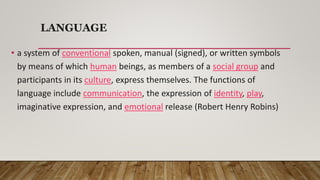
• a system of conventional spoken, manual (signed), or written symbols
by means of which human beings, as members of a social group and
participants in its culture, express themselves. The functions of
language include communication, the expression of identity, play,
imaginative expression, and emotional release (Robert Henry Robins)
LANGUAGE
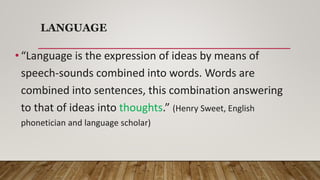
• “Language is the expression of ideas by means of
speech-sounds combined into words. Words are
combined into sentences, this combination answering
to that of ideas into thoughts.” (Henry Sweet, English
phonetician and language scholar)
LANGUAGE
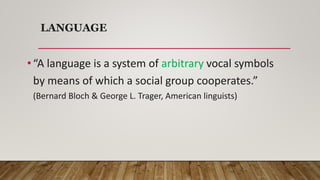
• “A language is a system of arbitrary vocal symbols
by means of which a social group cooperates.”
(Bernard Bloch & George L. Trager, American linguists)
• Every physiologically and mentally typical person acquires in
childhood the ability to make use, as both sender and receiver, of a
system of communication that comprises a circumscribed set of
symbols (e.g., sounds, gestures, or written or typed characters).
• spoken language
noises resulting from movements of certain organs within the
throat and mouth
• signed languages
hand or body movements, gestures, or facial expressions
BY MEANS OF THESE SYMBOLS, PEOPLE ARE ABLE TO
• impart information
• to express feelings and emotions
• to influence the activities of others
• to behave with varying degrees of friendliness or hostility toward
persons who make use of substantially the same set of symbols
LANGUAGE IS SPECIES-SPECIFIC TO HUMAN
BEINGS.
• other members of the animal kingdom
able to communicate, thru vocal noises or other means
• most important single feature characterizing human language
against every known mode of animal communication
its infinite productivity and creativity
• human beings
 unrestricted in what they can communicate
no area of experience is accepted as necessarily
 *necessity of adapting one’s language in order to cope
discoveries/new modes of thought
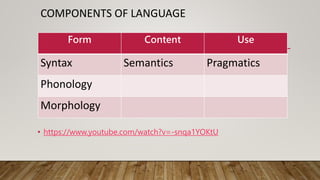
COMPONENTS OF LANGUAGE
• https://www.youtube.com/watch?v=-snqa1YOKtU
Form Content Use
Syntax Semantics Pragmatics
Phonology
Morphology
GRAMMAR
• set of rules that dictates how a language
works, making it easy to comprehend (21K
School)
• set of structural rules which influences the
composition of clauses, phrases, and words in any
given language (Saidvaliyevna, 2018)
• the systematic study and description of a language
DEPENDING ON ITS USE AND FOCUS, GRAMMAR
CAN BE:
1.a way of telling people what they ought to say, rather than
reporting what they do say (prescriptive grammar);
2.a system for describing sentence structure used in English
schools for centuries, based on grammars of classical
languages such as Latin (traditional grammar);
3. a system for describing sentences based on the idea of smaller
structures built up into larger structures (structural grammar);
4. the knowledge of the structural irregularities of language in the
minds of speakers (linguistic/grammatical competence); &
5. EFL grammar combining elements of 2 & 3.
Cook (2016)
EARLY ACQUISITION OF GRAMMAR
• “Learning the grammar of a second language is not so
much learning completely new structures, rules, and so on,
as discovering how to set the parameters for the new
language – for example, whether you have to use a
subject, what the word order is within the phrase – and
acquiring new vocabulary.” (Cook, 2016)
• While it is true that content and structure words differ in
many ways (including the ways they are used in
sentences), there is a common notion that L2 learners
acquire the same basic grammar regardless of the first
and second languages involved.
• grammatical morphemes (structure
words and grammatical inflections)
 learned in a particular sequence in L2
acquisition
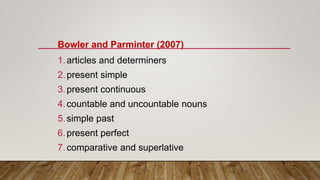
Bowler and Parminter (2007)
1.articles and determiners
2.present simple
3.present continuous
4.countable and uncountable nouns
5.simple past
6.present perfect
7.comparative and superlative
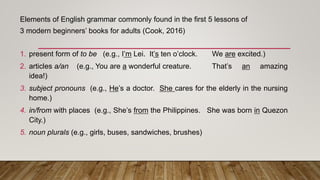
Elements of English grammar commonly found in the first 5 lessons of
3 modern beginners’ books for adults (Cook, 2016)
1. present form of to be (e.g., I’m Lei. It’s ten o’clock. We are excited.)
2. articles a/an (e.g., You are a wonderful creature. That’s an amazing
idea!)
3. subject pronouns (e.g., He’s a doctor. She cares for the elderly in the nursing
home.)
4. in/from with places (e.g., She’s from the Philippines. She was born in Quezon
City.)
5. noun plurals (e.g., girls, buses, sandwiches, brushes)
• Grammar includes both morphosyntactic structures and patterned
sequences; it is about form, what forms mean and when and why they
are used.
• While some educators feel that teaching grammar is not necessary,
most believe that a combination of awareness raising (devoted to
form, meaning, and use) with practice that is meaningful and
psychologically authentic and provides for appropriate corrective is
powerful.
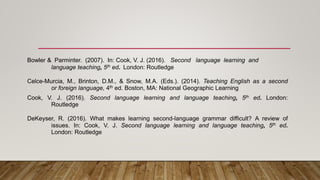
Bowler & Parminter. (2007). In: Cook, V. J. (2016). Second language learning and
language teaching, 5th ed. London: Routledge
Celce-Murcia, M., Brinton, D.M., & Snow, M.A. (Eds.). (2014). Teaching English as a second
or foreign language, 4th ed. Boston, MA: National Geographic Learning
Cook, V. J. (2016). Second language learning and language teaching, 5th ed. London:
Routledge
DeKeyser, R. (2016). What makes learning second-language grammar difficult? A review of
issues. In: Cook, V. J. Second language learning and language teaching, 5th ed.
London: Routledge

Eng.-206-intro.pptx

  • 1.
  • 2.
    LANGUAGE • a systemof conventional spoken, manual (signed), or written symbols by means of which human beings, as members of a social group and participants in its culture, express themselves. The functions of language include communication, the expression of identity, play, imaginative expression, and emotional release (Robert Henry Robins)
  • 3.
    LANGUAGE • “Language isthe expression of ideas by means of speech-sounds combined into words. Words are combined into sentences, this combination answering to that of ideas into thoughts.” (Henry Sweet, English phonetician and language scholar)
  • 4.
    LANGUAGE • “A languageis a system of arbitrary vocal symbols by means of which a social group cooperates.” (Bernard Bloch & George L. Trager, American linguists)
  • 5.
    • Every physiologicallyand mentally typical person acquires in childhood the ability to make use, as both sender and receiver, of a system of communication that comprises a circumscribed set of symbols (e.g., sounds, gestures, or written or typed characters).
  • 6.
    • spoken language noisesresulting from movements of certain organs within the throat and mouth • signed languages hand or body movements, gestures, or facial expressions
  • 7.
    BY MEANS OFTHESE SYMBOLS, PEOPLE ARE ABLE TO • impart information • to express feelings and emotions • to influence the activities of others • to behave with varying degrees of friendliness or hostility toward persons who make use of substantially the same set of symbols
  • 8.
    LANGUAGE IS SPECIES-SPECIFICTO HUMAN BEINGS. • other members of the animal kingdom able to communicate, thru vocal noises or other means • most important single feature characterizing human language against every known mode of animal communication its infinite productivity and creativity
  • 9.
    • human beings unrestricted in what they can communicate no area of experience is accepted as necessarily  *necessity of adapting one’s language in order to cope discoveries/new modes of thought
  • 10.
    COMPONENTS OF LANGUAGE •https://www.youtube.com/watch?v=-snqa1YOKtU Form Content Use Syntax Semantics Pragmatics Phonology Morphology
  • 11.
    GRAMMAR • set ofrules that dictates how a language works, making it easy to comprehend (21K School)
  • 12.
    • set ofstructural rules which influences the composition of clauses, phrases, and words in any given language (Saidvaliyevna, 2018) • the systematic study and description of a language
  • 13.
    DEPENDING ON ITSUSE AND FOCUS, GRAMMAR CAN BE: 1.a way of telling people what they ought to say, rather than reporting what they do say (prescriptive grammar); 2.a system for describing sentence structure used in English schools for centuries, based on grammars of classical languages such as Latin (traditional grammar);
  • 14.
    3. a systemfor describing sentences based on the idea of smaller structures built up into larger structures (structural grammar); 4. the knowledge of the structural irregularities of language in the minds of speakers (linguistic/grammatical competence); & 5. EFL grammar combining elements of 2 & 3. Cook (2016)
  • 15.
    EARLY ACQUISITION OFGRAMMAR • “Learning the grammar of a second language is not so much learning completely new structures, rules, and so on, as discovering how to set the parameters for the new language – for example, whether you have to use a subject, what the word order is within the phrase – and acquiring new vocabulary.” (Cook, 2016)
  • 16.
    • While itis true that content and structure words differ in many ways (including the ways they are used in sentences), there is a common notion that L2 learners acquire the same basic grammar regardless of the first and second languages involved.
  • 17.
    • grammatical morphemes(structure words and grammatical inflections)  learned in a particular sequence in L2 acquisition
  • 18.
    Bowler and Parminter(2007) 1.articles and determiners 2.present simple 3.present continuous 4.countable and uncountable nouns 5.simple past 6.present perfect 7.comparative and superlative
  • 19.
    Elements of Englishgrammar commonly found in the first 5 lessons of 3 modern beginners’ books for adults (Cook, 2016) 1. present form of to be (e.g., I’m Lei. It’s ten o’clock. We are excited.) 2. articles a/an (e.g., You are a wonderful creature. That’s an amazing idea!) 3. subject pronouns (e.g., He’s a doctor. She cares for the elderly in the nursing home.) 4. in/from with places (e.g., She’s from the Philippines. She was born in Quezon City.) 5. noun plurals (e.g., girls, buses, sandwiches, brushes)
  • 20.
    • Grammar includesboth morphosyntactic structures and patterned sequences; it is about form, what forms mean and when and why they are used. • While some educators feel that teaching grammar is not necessary, most believe that a combination of awareness raising (devoted to form, meaning, and use) with practice that is meaningful and psychologically authentic and provides for appropriate corrective is powerful.
  • 21.
    Bowler & Parminter.(2007). In: Cook, V. J. (2016). Second language learning and language teaching, 5th ed. London: Routledge Celce-Murcia, M., Brinton, D.M., & Snow, M.A. (Eds.). (2014). Teaching English as a second or foreign language, 4th ed. Boston, MA: National Geographic Learning Cook, V. J. (2016). Second language learning and language teaching, 5th ed. London: Routledge DeKeyser, R. (2016). What makes learning second-language grammar difficult? A review of issues. In: Cook, V. J. Second language learning and language teaching, 5th ed. London: Routledge