Comparison of Shakespeare’s “The Tempest” and 
Cesaire’s “A Tempest” 
• Paper:- 11 The Postcolonial Literature 
• Roll No:- 26 
• M.A. Part ii Sem iii 
• Year:- 2013-15 
• Submitted to:- Smt. S.B.Gardi 
Department of English 
M.K.Bhavnagar University. 
Prepared by: Sejal Chauhan 
• Date: 3/10/2014
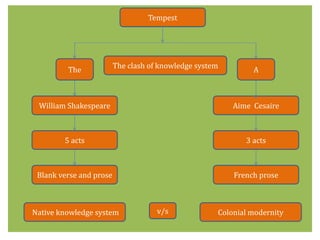
Tempest 
The clash of knowledge system 
The A 
William Shakespeare Aime Cesaire 
5 acts 3 acts 
Blank verse and prose French prose 
Native knowledge system Colonial v/s modernity
• Mediterranean island 
The Tempest 
• Twelve years ago Prospero lost the dukedom of Milan to 
his scheming brother Antonio 
• Was put out to sea with his 3 years daughter 
• They live on an isolated island 
• Two slaves, the spirit Ariel and the brutish Caliban 
• Using his magic power 
• Prospero causes the ship in which Antonio is travelling 
with the king of Naples and his son to be wretched on the 
island.
• The kings son Ferdinand encounters Prospero and falls in 
love with Miranda 
• Prospero orders him to commit menial tasks 
• The king himself is about to be murdered by the 
treacherous Antonio 
• When Ariel intervenes and drives all the courtiers to 
distraction 
• Caliban meets with two sailors and together they plot the 
downfall of Prospero 
• Miranda and Ferdinand are entertained by a masque and 
are reminded to remain chaste
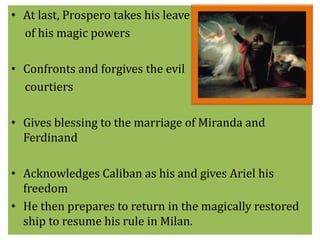
• At last, Prospero takes his leave 
of his magic powers 
• Confronts and forgives the evil 
courtiers 
• Gives blessing to the marriage of Miranda and 
Ferdinand 
• Acknowledges Caliban as his and gives Ariel his 
freedom 
• He then prepares to return in the magically restored 
ship to resume his rule in Milan.
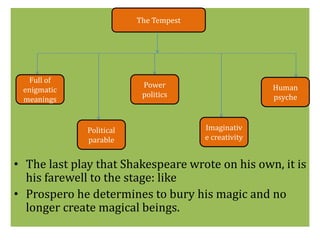
The Tempest 
Full of 
enigmatic 
meanings 
Political 
parable 
Power 
politics 
Imaginativ 
e creativity 
Human 
psyche 
• The last play that Shakespeare wrote on his own, it is 
his farewell to the stage: like 
• Prospero he determines to bury his magic and no 
longer create magical beings.
A Tempest 
• It is really a “post colonial response to The Tempest” 
• As such deals with the story from the point of view of 
Caliban and Ariel 
• This adaptation for a black theatre follows the main 
lines of Shakespeare’s plot 
• But there are significant changes 
• The translation simplifies and shortens the original
A Tempest 
Caliban Ariel 
black mullatto 
Close to Earth Airy intellect
• The dialogue on Caliban’s part is much more harsh and more 
frequent. 
• In saying, 
“ I’ll impale you! And on a 
stake that you’ve sharpened 
yourself” You’ll have impaled 
yourself!” 
• Caliban’s aggression and hate towards prospero is a bit more 
evident 
• Specially written scene, 
• Ariel and Caliban argue about modes of resistance: 
• Ariel pleads for non-violence 
• Caliban calls him an Uncle Tom and demands ‘ Freedom now!’ 
• Instead of Ariel appearing as the avenging Fury,
• He criticizes Prospero for using the courtiers hunger as a 
means of punishing them 
• In the Masque, the figure of Eshu, appears ‘ a god to his 
friends, a devil to his enemies ‘ and sings an obscene song 
• Despite Ariel’s warning, Prospero orders the arrest of 
Caliban and his fellow conspirators 
• Gonzalo attempts to convert Caliban to Christianity but 
fails 
• Caliban delivers an eloquent speech rejecting Prospero’s 
colonialist domination and threatening revenge
• Prospero decides that his duty is to remain on the island 
not to be master but ‘ the leader of the orchestra’ and to 
counter Caliban’s violence with violence. 
• At last, 
• Prospero is a futile old man , ruler over a population of 
one 
• And fragments of Caliban’s song are heard in the distance 
• Shakespeare’s The Tempest in order to debate colonial 
politics 
• Introducing the figure of Eshu and making Prospero’s 
oppression more obviously racial
• The major change in the plot, that Prospero regards 
it as his duty to remain behind on the island 
• Suggest that however futile his gesture, whites and 
blacks will have to develop some form of mutually 
supportive relationship rather than remain 
antagonists.
•Thank 
you
• Reference:- 
• ‘Oxford Guide to Plays’ By Michael Patterson 
• Tempest A and Tempest The

Comparison of Shakespeare's "The Tempest" and Cesaire's "A Tempest"

  • 1.
    Comparison of Shakespeare’s“The Tempest” and Cesaire’s “A Tempest” • Paper:- 11 The Postcolonial Literature • Roll No:- 26 • M.A. Part ii Sem iii • Year:- 2013-15 • Submitted to:- Smt. S.B.Gardi Department of English M.K.Bhavnagar University. Prepared by: Sejal Chauhan • Date: 3/10/2014
  • 2.
    Tempest The clashof knowledge system The A William Shakespeare Aime Cesaire 5 acts 3 acts Blank verse and prose French prose Native knowledge system Colonial v/s modernity
  • 3.
    • Mediterranean island The Tempest • Twelve years ago Prospero lost the dukedom of Milan to his scheming brother Antonio • Was put out to sea with his 3 years daughter • They live on an isolated island • Two slaves, the spirit Ariel and the brutish Caliban • Using his magic power • Prospero causes the ship in which Antonio is travelling with the king of Naples and his son to be wretched on the island.
  • 4.
    • The kingsson Ferdinand encounters Prospero and falls in love with Miranda • Prospero orders him to commit menial tasks • The king himself is about to be murdered by the treacherous Antonio • When Ariel intervenes and drives all the courtiers to distraction • Caliban meets with two sailors and together they plot the downfall of Prospero • Miranda and Ferdinand are entertained by a masque and are reminded to remain chaste
  • 5.
    • At last,Prospero takes his leave of his magic powers • Confronts and forgives the evil courtiers • Gives blessing to the marriage of Miranda and Ferdinand • Acknowledges Caliban as his and gives Ariel his freedom • He then prepares to return in the magically restored ship to resume his rule in Milan.
  • 6.
    The Tempest Fullof enigmatic meanings Political parable Power politics Imaginativ e creativity Human psyche • The last play that Shakespeare wrote on his own, it is his farewell to the stage: like • Prospero he determines to bury his magic and no longer create magical beings.
  • 7.
    A Tempest •It is really a “post colonial response to The Tempest” • As such deals with the story from the point of view of Caliban and Ariel • This adaptation for a black theatre follows the main lines of Shakespeare’s plot • But there are significant changes • The translation simplifies and shortens the original
  • 8.
    A Tempest CalibanAriel black mullatto Close to Earth Airy intellect
  • 9.
    • The dialogueon Caliban’s part is much more harsh and more frequent. • In saying, “ I’ll impale you! And on a stake that you’ve sharpened yourself” You’ll have impaled yourself!” • Caliban’s aggression and hate towards prospero is a bit more evident • Specially written scene, • Ariel and Caliban argue about modes of resistance: • Ariel pleads for non-violence • Caliban calls him an Uncle Tom and demands ‘ Freedom now!’ • Instead of Ariel appearing as the avenging Fury,
  • 10.
    • He criticizesProspero for using the courtiers hunger as a means of punishing them • In the Masque, the figure of Eshu, appears ‘ a god to his friends, a devil to his enemies ‘ and sings an obscene song • Despite Ariel’s warning, Prospero orders the arrest of Caliban and his fellow conspirators • Gonzalo attempts to convert Caliban to Christianity but fails • Caliban delivers an eloquent speech rejecting Prospero’s colonialist domination and threatening revenge
  • 11.
    • Prospero decidesthat his duty is to remain on the island not to be master but ‘ the leader of the orchestra’ and to counter Caliban’s violence with violence. • At last, • Prospero is a futile old man , ruler over a population of one • And fragments of Caliban’s song are heard in the distance • Shakespeare’s The Tempest in order to debate colonial politics • Introducing the figure of Eshu and making Prospero’s oppression more obviously racial
  • 12.
    • The majorchange in the plot, that Prospero regards it as his duty to remain behind on the island • Suggest that however futile his gesture, whites and blacks will have to develop some form of mutually supportive relationship rather than remain antagonists.
  • 13.
  • 14.
    • Reference:- •‘Oxford Guide to Plays’ By Michael Patterson • Tempest A and Tempest The