COMPARISON OF PRESENT PERFECT AND PRESENT PERFECT PROGRESSIVE
Continuation vs. completion
Both the present perfect tenses (simple and progressive) can be used to talk about recent
actions and situations that have present results. There is an important difference. The
present perfect progressive focuses on the action / situation itself, looking at it as a
continuous, extended activity (not necessarily finished). The simple present perfect, on
the other hand, looks more at the ideas of completion and present result. Compare:
− I must have a bath. I’ve been gardening all afternoon. (focus on continuous activity)
    I’ve planted a lot of new rose bushes. (focus on result)
− I’ve been reading your book. (focus on continuous activity)
    I’ve read your book. (focus on completion)
− I’ve been learning irregular verbs all afternoon. (focus on continuous activity)
    I’ve learnt all my irregular verbs. (focus on completion)
− Sorry about the mess - I’ve been painting the house. (focus on continuous activity)
    I’ve painted two rooms since lunchtime. (focus on completion)
− Who’s been sleeping in my bed? (emphasis on continuous activity - makes the action
    sound longer and more annoying)
    I think she’s slept enough -I’ll wake her up.

Repeated actions
We can use the present perfect progressive to talk about repeated actions and events, but
not if we say how often they have happened (because this stresses the idea of completion
- see above). Compare:
    I’ve been playing a lot of tennis recently.
    I’ve played tennis three times this week.

Temporary and permanent
We often prefer the present perfect progressive to talk about more temporary actions and
situations; when we talk about longer-lasting or permanent situations we often prefer the
simple present perfect. Compare:
− That man has been standing on the corner all day.
    For 900 years the castle has stood on the hill above the village.
− I haven’t been working very well recently.
    He hasn’t worked for years.
− I’ve been living in Sue’s flat for the last month.
    My parents have lived in Bristol all their lives.

Generally, however, both progressive and simple tenses are possible in cases like these,
with a slight difference of emphasis.
   It’s been raining/ It’s rained steadily since last Saturday.
   Harry has been working/has worked in the same job for thirty years.
We generally use the progressive to talk about continuous change or development, even if
this is permanent.
Scientists believe that the universe has been expanding steadily since the beginning of
time.


Non-progressive verbs
Some verbs are not used in progressive forms, even if the meaning is one for which a
progressive form is more suitable.
I’ve only known her for two days. (NOT I’ve only been knowing her …)
She’s had cold since Monday. (NOT She’s been having a cold ...)

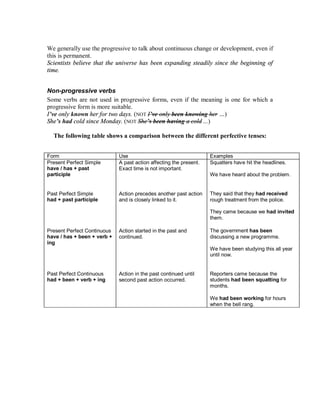
  The following table shows a comparison between the different perfective tenses:


Form                         Use                                    Examples
Present Perfect Simple       A past action affecting the present.   Squatters have hit the headlines.
have / has + past            Exact time is not important.
participle                                                          We have heard about the problem.


Past Perfect Simple          Action precedes another past action    They said that they had received
had + past participle        and is closely linked to it.           rough treatment from the police.

                                                                    They came because we had invited
                                                                    them.

Present Perfect Continuous   Action started in the past and         The government has been
have / has + been + verb +   continued.                             discussing a new programme.
ing
                                                                    We have been studying this all year
                                                                    until now.


Past Perfect Continuous      Action in the past continued until     Reporters came because the
had + been + verb + ing      second past action occurred.           students had been squatting for
                                                                    months.

                                                                    We had been working for hours
                                                                    when the bell rang.

Perfective Tenses

  • 1.
    COMPARISON OF PRESENTPERFECT AND PRESENT PERFECT PROGRESSIVE Continuation vs. completion Both the present perfect tenses (simple and progressive) can be used to talk about recent actions and situations that have present results. There is an important difference. The present perfect progressive focuses on the action / situation itself, looking at it as a continuous, extended activity (not necessarily finished). The simple present perfect, on the other hand, looks more at the ideas of completion and present result. Compare: − I must have a bath. I’ve been gardening all afternoon. (focus on continuous activity) I’ve planted a lot of new rose bushes. (focus on result) − I’ve been reading your book. (focus on continuous activity) I’ve read your book. (focus on completion) − I’ve been learning irregular verbs all afternoon. (focus on continuous activity) I’ve learnt all my irregular verbs. (focus on completion) − Sorry about the mess - I’ve been painting the house. (focus on continuous activity) I’ve painted two rooms since lunchtime. (focus on completion) − Who’s been sleeping in my bed? (emphasis on continuous activity - makes the action sound longer and more annoying) I think she’s slept enough -I’ll wake her up. Repeated actions We can use the present perfect progressive to talk about repeated actions and events, but not if we say how often they have happened (because this stresses the idea of completion - see above). Compare: I’ve been playing a lot of tennis recently. I’ve played tennis three times this week. Temporary and permanent We often prefer the present perfect progressive to talk about more temporary actions and situations; when we talk about longer-lasting or permanent situations we often prefer the simple present perfect. Compare: − That man has been standing on the corner all day. For 900 years the castle has stood on the hill above the village. − I haven’t been working very well recently. He hasn’t worked for years. − I’ve been living in Sue’s flat for the last month. My parents have lived in Bristol all their lives. Generally, however, both progressive and simple tenses are possible in cases like these, with a slight difference of emphasis. It’s been raining/ It’s rained steadily since last Saturday. Harry has been working/has worked in the same job for thirty years.
  • 2.
    We generally usethe progressive to talk about continuous change or development, even if this is permanent. Scientists believe that the universe has been expanding steadily since the beginning of time. Non-progressive verbs Some verbs are not used in progressive forms, even if the meaning is one for which a progressive form is more suitable. I’ve only known her for two days. (NOT I’ve only been knowing her …) She’s had cold since Monday. (NOT She’s been having a cold ...) The following table shows a comparison between the different perfective tenses: Form Use Examples Present Perfect Simple A past action affecting the present. Squatters have hit the headlines. have / has + past Exact time is not important. participle We have heard about the problem. Past Perfect Simple Action precedes another past action They said that they had received had + past participle and is closely linked to it. rough treatment from the police. They came because we had invited them. Present Perfect Continuous Action started in the past and The government has been have / has + been + verb + continued. discussing a new programme. ing We have been studying this all year until now. Past Perfect Continuous Action in the past continued until Reporters came because the had + been + verb + ing second past action occurred. students had been squatting for months. We had been working for hours when the bell rang.