Introduction:
Hans Christian Gram (1884)
A technique discriminate between two types of
bacteria
 Streptococcus pneumoniae (also known as the
pneumococcus) and Klebsiella pneumoniae bacteria
Applications of Gram staining:
1) Differentiation of bacteria into Gram positive and Gram negative
2) First step towards identification of bacteria in cultures
3) Provides a vital clue in the diagnosis of infectious diseases
4) Total count of bacteria
Materials recquired:
Tissue sample
Glass slides
Pipette
A source of flame
Distilled water
Crystal violet
Iodine
Decolorising agent (alcohol or acetone)
Safranin(counter stain)
Prepare for laboratory work.
Put on gloves
Tie back long hair to prevent
Check the bunsen burner and microscope are
functional before you begin.
Step 1:
Transferring the specimen
Spread the specimen
Step 2:
Fix the specimen by heating
Not to hold the slide over the flame too long
Step 3:
 Drop a crystal violet stain (enough to cover the
specimen)
Stand for 20 seconds
Pour off the crystal violet stain and rinse the excess
stain with distilled water
Objective:
 Crystal violet stain to bind to the peptidoglycan
molecules
 Crystal violet stain to bind to the lipopolysaccharide
molecules
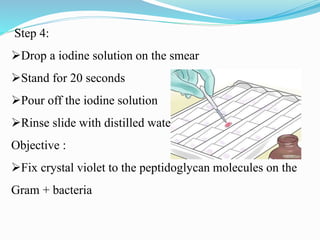
Step 4:
Drop a iodine solution on the smear
Stand for 20 seconds
Pour off the iodine solution
Rinse slide with distilled water
Objective :
Fix crystal violet to the peptidoglycan molecules on the
Gram + bacteria
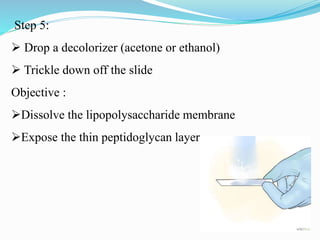
Step 5:
 Drop a decolorizer (acetone or ethanol)
 Trickle down off the slide
Objective :
Dissolve the lipopolysaccharide membrane
Expose the thin peptidoglycan layer
Immediately rinse the slide off
Pouring too much decolorizer will cause the
decolorization of the Gram + bacterial cells
If decoloriser ran too long,
see false negative results
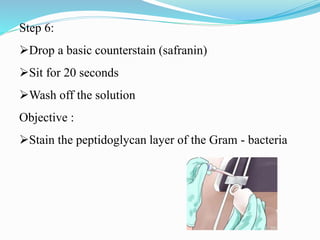
Step 6:
Drop a basic counterstain (safranin)
Sit for 20 seconds
Wash off the solution
Objective :
Stain the peptidoglycan layer of the Gram - bacteria
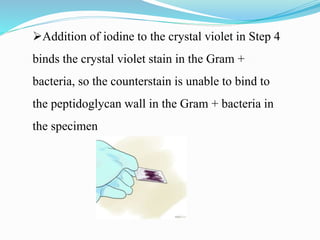
Addition of iodine to the crystal violet in Step 4
binds the crystal violet stain in the Gram +
bacteria, so the counterstain is unable to bind to
the peptidoglycan wall in the Gram + bacteria in
the specimen
Prepare the light microscope
Place the slide under light microscope
Use magnification vary from 400x to 1000x
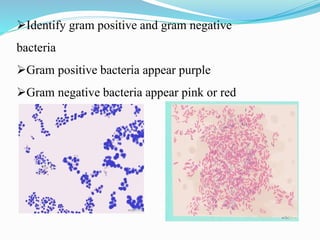
Identify gram positive and gram negative
bacteria
Gram positive bacteria appear purple
Gram negative bacteria appear pink or red
Gram positive cocci are either Staphylococci (meaning
cocci in clusters) or Streptococci (meaning cocci in
chains)
Gram positive rods include Bacillus, Clostridium,
Corynebacterium, and Listeria
Gram negative (pink-stained) bacteria are into three groups.
Cocci are spherical bacteria, rods are long, thin bacteria, and
coccoid rods
Gram negative rods include E. coli, Enterobacter, Klebsiella,
Citrobacter, Serratia, Proteus, Salmonella, Pseudomonas
THANK YOU…….

Gram staining

  • 2.
    Introduction: Hans Christian Gram(1884) A technique discriminate between two types of bacteria  Streptococcus pneumoniae (also known as the pneumococcus) and Klebsiella pneumoniae bacteria
  • 3.
    Applications of Gramstaining: 1) Differentiation of bacteria into Gram positive and Gram negative 2) First step towards identification of bacteria in cultures 3) Provides a vital clue in the diagnosis of infectious diseases 4) Total count of bacteria
  • 4.
    Materials recquired: Tissue sample Glassslides Pipette A source of flame Distilled water Crystal violet Iodine Decolorising agent (alcohol or acetone) Safranin(counter stain)
  • 7.
    Prepare for laboratorywork. Put on gloves Tie back long hair to prevent Check the bunsen burner and microscope are functional before you begin.
  • 8.
    Step 1: Transferring thespecimen Spread the specimen Step 2: Fix the specimen by heating Not to hold the slide over the flame too long
  • 9.
    Step 3:  Dropa crystal violet stain (enough to cover the specimen) Stand for 20 seconds Pour off the crystal violet stain and rinse the excess stain with distilled water
  • 10.
    Objective:  Crystal violetstain to bind to the peptidoglycan molecules  Crystal violet stain to bind to the lipopolysaccharide molecules
  • 13.
    Step 4: Drop aiodine solution on the smear Stand for 20 seconds Pour off the iodine solution Rinse slide with distilled water Objective : Fix crystal violet to the peptidoglycan molecules on the Gram + bacteria
  • 14.
    Step 5:  Dropa decolorizer (acetone or ethanol)  Trickle down off the slide Objective : Dissolve the lipopolysaccharide membrane Expose the thin peptidoglycan layer
  • 15.
    Immediately rinse theslide off Pouring too much decolorizer will cause the decolorization of the Gram + bacterial cells If decoloriser ran too long, see false negative results
  • 16.
    Step 6: Drop abasic counterstain (safranin) Sit for 20 seconds Wash off the solution Objective : Stain the peptidoglycan layer of the Gram - bacteria
  • 17.
    Addition of iodineto the crystal violet in Step 4 binds the crystal violet stain in the Gram + bacteria, so the counterstain is unable to bind to the peptidoglycan wall in the Gram + bacteria in the specimen
  • 18.
    Prepare the lightmicroscope Place the slide under light microscope Use magnification vary from 400x to 1000x
  • 19.
    Identify gram positiveand gram negative bacteria Gram positive bacteria appear purple Gram negative bacteria appear pink or red
  • 20.
    Gram positive cocciare either Staphylococci (meaning cocci in clusters) or Streptococci (meaning cocci in chains) Gram positive rods include Bacillus, Clostridium, Corynebacterium, and Listeria Gram negative (pink-stained) bacteria are into three groups. Cocci are spherical bacteria, rods are long, thin bacteria, and coccoid rods Gram negative rods include E. coli, Enterobacter, Klebsiella, Citrobacter, Serratia, Proteus, Salmonella, Pseudomonas
  • 21.