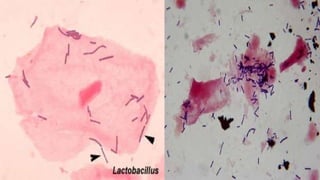
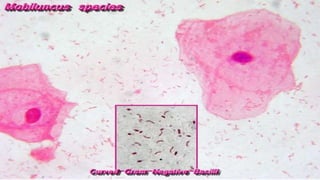
Gram staining
(technique and applications)
Dr. Sanjay Singh
Hans Christian Joachim Gram
Danish Bacteriologist
Gram staining
• A staining technique used to classify bacteria
• Those that retain the gentian violet are Gram-positive and those that
do not retain it are Gram-negative
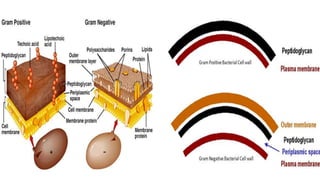
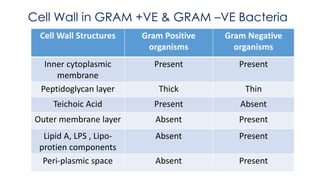
Cell Wall in GRAM +VE & GRAM –VE Bacteria
Cell Wall Structures Gram Positive
organisms
Gram Negative
organisms
Inner cytoplasmic
membrane
Present Present
Peptidoglycan layer Thick Thin
Teichoic Acid Present Absent
Outer membrane layer Absent Present
Lipid A, LPS , Lipo-
protien components
Absent Present
Peri-plasmic space Absent Present
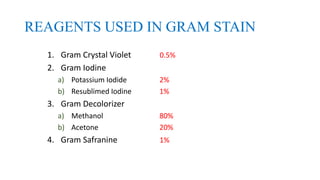
REAGENTS USED IN GRAM STAIN
1. Gram Crystal Violet 0.5%
2. Gram Iodine
a) Potassium Iodide 2%
b) Resublimed Iodine 1%
3. Gram Decolorizer
a) Methanol 80%
b) Acetone 20%
4. Gram Safranine 1%
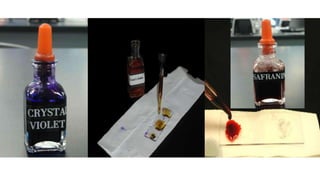
1. CRYSTAL VIOLET
• Primary stain
• Violet colored, stains all micro-organism
2. GRAM IODINE
• Mordant
• Forms Crystal violet iodine complexes
3. DECOLORIZER
• Acetone + Methanol
• Removes Crystal violet iodine complex from thin peptidoglycan layers
• Dissolves outer layer of Gram negative org
4. GRAM SAFRANINE
• Counter stain
• Red colored
• Stains thin walled Gram neg organism
• Pus cells cytoplasm & lobes of nuclei also stain red
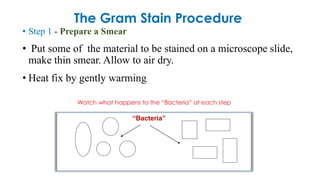
• Step 1 - Prepare a Smear
• Put some of the material to be stained on a microscope slide,
make thin smear. Allow to air dry.
• Heat fix by gently warming
The Gram Stain Procedure
Watch what happens to the “Bacteria” at each step
“Bacteria”
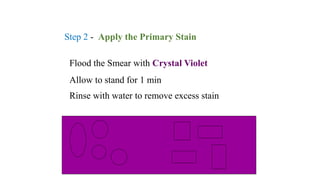
Step 2 - Apply the Primary Stain
Flood the Smear with Crystal Violet
Allow to stand for 1 min
Rinse with water to remove excess stain
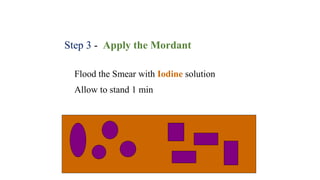
Step 3 - Apply the Mordant
Flood the Smear with Iodine solution
Allow to stand 1 min
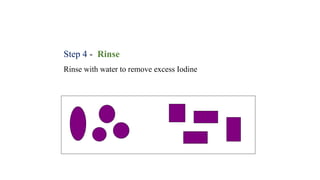
Step 4 - Rinse
Rinse with water to remove excess Iodine
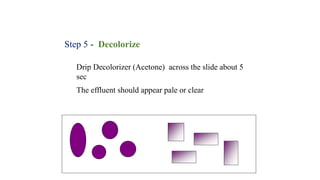
Step 5 - Decolorize
Drip Decolorizer (Acetone) across the slide about 5
sec
The effluent should appear pale or clear
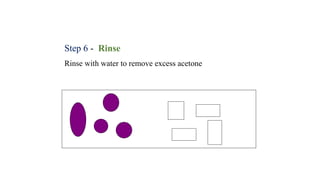
Step 6 - Rinse
Rinse with water to remove excess acetone
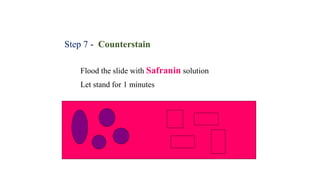
Step 7 - Counterstain
Flood the slide with Safranin solution
Let stand for 1 minutes
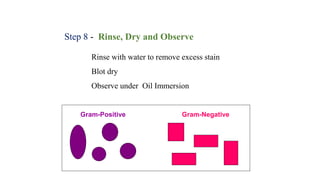
Step 8 - Rinse, Dry and Observe
Gram-Positive Gram-Negative
Rinse with water to remove excess stain
Blot dry
Observe under Oil Immersion
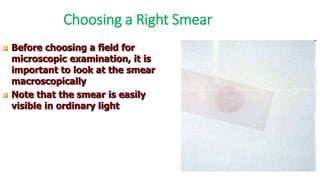
Choosing a Right Smear
 Before choosing a field for
microscopic examination, it is
important to look at the smear
macroscopically
 Note that the smear is easily
visible in ordinary light
Correct preparation
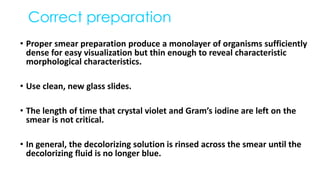
• Proper smear preparation produce a monolayer of organisms sufficiently
dense for easy visualization but thin enough to reveal characteristic
morphological characteristics.
• Use clean, new glass slides.
• The length of time that crystal violet and Gram’s iodine are left on the
smear is not critical.
• In general, the decolorizing solution is rinsed across the smear until the
decolorizing fluid is no longer blue.
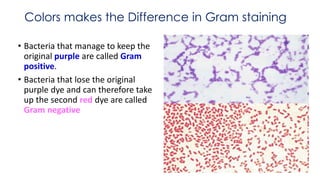
Colors makes the Difference in Gram staining
• Bacteria that manage to keep the
original purple are called Gram
positive.
• Bacteria that lose the original
purple dye and can therefore take
up the second red dye are called
Gram negative
Report as follows
 If no microorganisms are seen in a smear of a clinical
specimen, report “No microorganisms seen.”
 If microorganisms are seen, report relative numbers
and describe morphology.
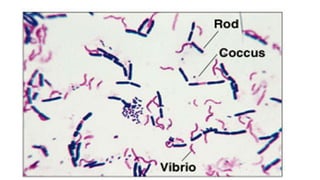
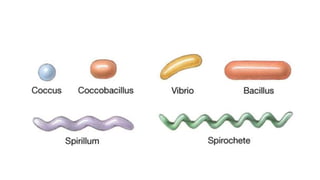
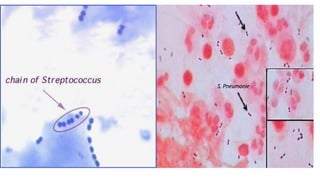
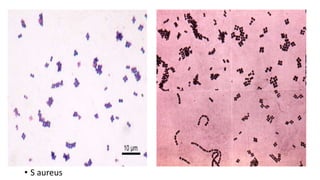
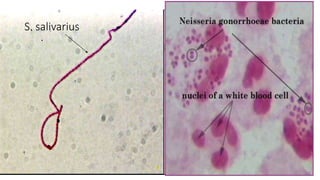
 Observe predominant shapes of microorganisms
S. Pneumonie
• S aureus
S. salivarius
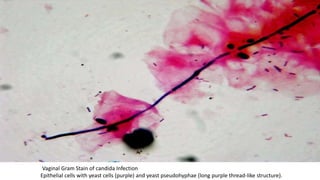
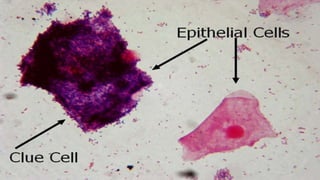
Vaginal Gram Stain of candida Infection
Epithelial cells with yeast cells (purple) and yeast pseudohyphae (long purple thread-like structure).
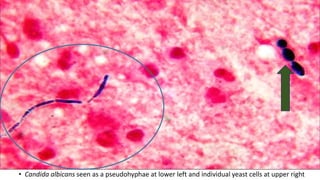
• Candida albicans seen as a pseudohyphae at lower left and individual yeast cells at upper right
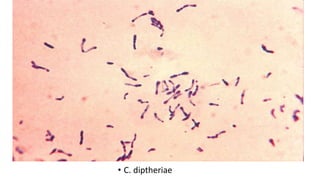
• C. diptheriae
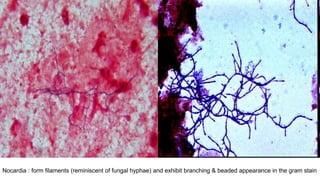
Nocardia : form filaments (reminiscent of fungal hyphae) and exhibit branching & beaded appearance in the gram stain
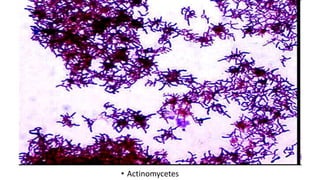
• Actinomycetes
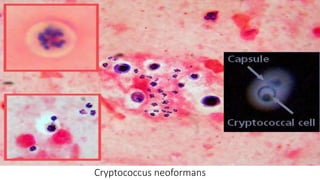
Cryptococcus neoformans
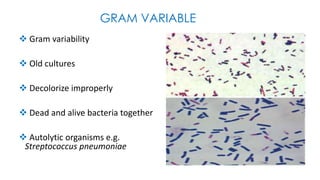
GRAM VARIABLE
 Gram variability
 Old cultures
 Decolorize improperly
 Dead and alive bacteria together
 Autolytic organisms e.g.
Streptococcus pneumoniae
• Thank You

Gram stain demonstration

  • 1.
    Gram staining (technique andapplications) Dr. Sanjay Singh
  • 2.
    Hans Christian JoachimGram Danish Bacteriologist
  • 3.
    Gram staining • Astaining technique used to classify bacteria • Those that retain the gentian violet are Gram-positive and those that do not retain it are Gram-negative
  • 5.
    Cell Wall inGRAM +VE & GRAM –VE Bacteria Cell Wall Structures Gram Positive organisms Gram Negative organisms Inner cytoplasmic membrane Present Present Peptidoglycan layer Thick Thin Teichoic Acid Present Absent Outer membrane layer Absent Present Lipid A, LPS , Lipo- protien components Absent Present Peri-plasmic space Absent Present
  • 6.
    REAGENTS USED INGRAM STAIN 1. Gram Crystal Violet 0.5% 2. Gram Iodine a) Potassium Iodide 2% b) Resublimed Iodine 1% 3. Gram Decolorizer a) Methanol 80% b) Acetone 20% 4. Gram Safranine 1%
  • 8.
    1. CRYSTAL VIOLET •Primary stain • Violet colored, stains all micro-organism 2. GRAM IODINE • Mordant • Forms Crystal violet iodine complexes 3. DECOLORIZER • Acetone + Methanol • Removes Crystal violet iodine complex from thin peptidoglycan layers • Dissolves outer layer of Gram negative org
  • 9.
    4. GRAM SAFRANINE •Counter stain • Red colored • Stains thin walled Gram neg organism • Pus cells cytoplasm & lobes of nuclei also stain red
  • 10.
    • Step 1- Prepare a Smear • Put some of the material to be stained on a microscope slide, make thin smear. Allow to air dry. • Heat fix by gently warming The Gram Stain Procedure Watch what happens to the “Bacteria” at each step “Bacteria”
  • 11.
    Step 2 -Apply the Primary Stain Flood the Smear with Crystal Violet Allow to stand for 1 min Rinse with water to remove excess stain
  • 12.
    Step 3 -Apply the Mordant Flood the Smear with Iodine solution Allow to stand 1 min
  • 13.
    Step 4 -Rinse Rinse with water to remove excess Iodine
  • 14.
    Step 5 -Decolorize Drip Decolorizer (Acetone) across the slide about 5 sec The effluent should appear pale or clear
  • 15.
    Step 6 -Rinse Rinse with water to remove excess acetone
  • 16.
    Step 7 -Counterstain Flood the slide with Safranin solution Let stand for 1 minutes
  • 17.
    Step 8 -Rinse, Dry and Observe Gram-Positive Gram-Negative Rinse with water to remove excess stain Blot dry Observe under Oil Immersion
  • 18.
    Choosing a RightSmear  Before choosing a field for microscopic examination, it is important to look at the smear macroscopically  Note that the smear is easily visible in ordinary light
  • 19.
    Correct preparation • Propersmear preparation produce a monolayer of organisms sufficiently dense for easy visualization but thin enough to reveal characteristic morphological characteristics. • Use clean, new glass slides. • The length of time that crystal violet and Gram’s iodine are left on the smear is not critical. • In general, the decolorizing solution is rinsed across the smear until the decolorizing fluid is no longer blue.
  • 20.
    Colors makes theDifference in Gram staining • Bacteria that manage to keep the original purple are called Gram positive. • Bacteria that lose the original purple dye and can therefore take up the second red dye are called Gram negative
  • 21.
    Report as follows If no microorganisms are seen in a smear of a clinical specimen, report “No microorganisms seen.”  If microorganisms are seen, report relative numbers and describe morphology.  Observe predominant shapes of microorganisms
  • 24.
  • 25.
  • 26.
  • 29.
    Vaginal Gram Stainof candida Infection Epithelial cells with yeast cells (purple) and yeast pseudohyphae (long purple thread-like structure).
  • 30.
    • Candida albicansseen as a pseudohyphae at lower left and individual yeast cells at upper right
  • 33.
  • 34.
    Nocardia : formfilaments (reminiscent of fungal hyphae) and exhibit branching & beaded appearance in the gram stain
  • 35.
  • 36.
  • 37.
    GRAM VARIABLE  Gramvariability  Old cultures  Decolorize improperly  Dead and alive bacteria together  Autolytic organisms e.g. Streptococcus pneumoniae
  • 38.

Editor's Notes

  • #20 The smear should be air dried. It should not be heated to speed up drying, because the heat distorts the morphology of bacteria and cells. It should not be placed in front of a fan or waved around the room, because such maneuvers aerosolize material on the slides, including potential pathogens such as Mycobacterium tuberculosis.