
PATHOGENESIS
(Disease (or) Infection Cycle)
The action of the pathogen and whole array of
host reactions and disease development occurring
in host
Definition:
The diseases development may be continuous or
intermittent
The series of more or less distinct events
occurring in sequence and leading to disease
development and perpetuation of the disease
and pathogen
Types of Disease Cycle
Pathogens may complete one or more disease
cycles per year or takes more than one year to
complete a disease
1. Monocyclic or single cycle pathogens
2. Polycyclic or multi cycle pathogens
3. Polyetic pathogens
1. Monocyclic or single cycle pathogens
Complete one disease cycle in one year
No secondary inoculum and secondary infection
These pathogens are mostly responsible for
slow epidemics
e.g. Smuts, Root rots and Wilts
Graphically these pathogens represents a
saturation curve
More than one disease cycle per
growing season
e.g. Rust, Powdery mildew, Leaf
spot, Leaf Blight, Anthracnose etc.
2. Polycyclic or multi cycle pathogens
Amount of inoculum increased many fold
Primary inoculum initiates the disease and numerous
secondary inocula are produced at each infection site
Graphically these pathogens represents a Sigmoid curve
Mostly cause Rapid epidemics in field
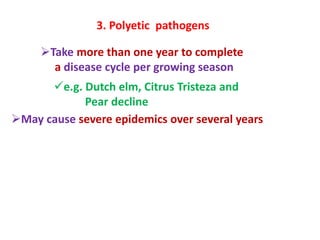
3. Polyetic pathogens
Take more than one year to complete
a disease cycle per growing season
e.g. Dutch elm, Citrus Tristeza and
Pear decline
May cause severe epidemics over several years
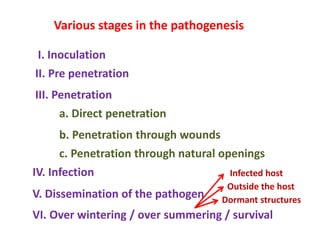
Various stages in the pathogenesis
I. Inoculation
II. Pre penetration
III. Penetration
IV. Infection
V. Dissemination of the pathogen
VI. Over wintering / over summering / survival
a. Direct penetration
b. Penetration through wounds
c. Penetration through natural openings
Infected host
Dormant structures
Outside the host
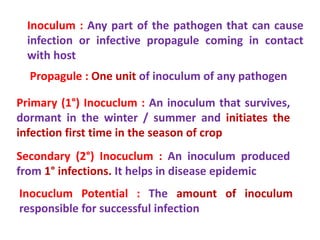
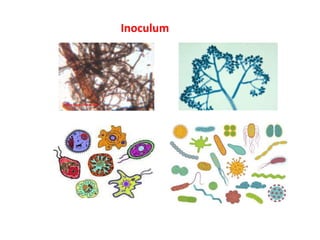
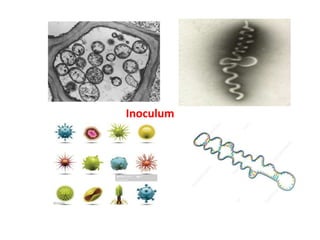
Inoculum : Any part of the pathogen that can cause
infection or infective propagule coming in contact
with host
Propagule : One unit of inoculum of any pathogen
Primary (1°) Inocuclum : An inoculum that survives,
dormant in the winter / summer and initiates the
infection first time in the season of crop
Secondary (2°) Inocuclum : An inoculum produced
from 1° infections. It helps in disease epidemic
Inocuclum Potential : The amount of inoculum
responsible for successful infection
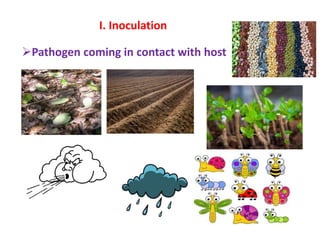
I. Inoculation
Pathogen coming in contact with host
Inoculum
Inoculum
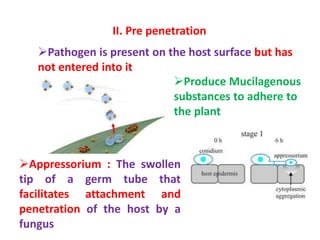
II. Pre penetration
Pathogen is present on the host surface but has
not entered into it
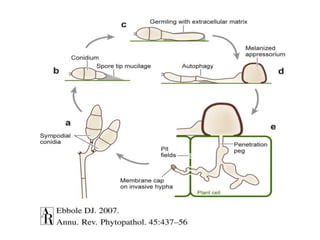
Produce Mucilagenous
substances to adhere to
the plant
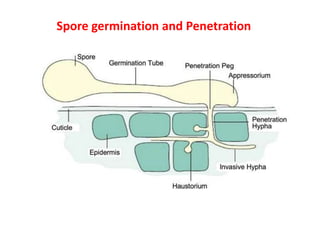
Appressorium : The swollen
tip of a germ tube that
facilitates attachment and
penetration of the host by a
fungus
III. Penetration
Passive invaders : Pathogen which do not have any
capacity to enter the host cell
e.g. Virus, Viroid, Protozoa, Fastidious bacteria
Actual entry of pathogen into the host plant
Based on their capacity of make enter themselves
into host cells, pathogens are classified as:
Active invaders : Pathogens which make an
aggressive effort to gain entry into intact host cells
and do not require help of any external agency
e.g. Fungi
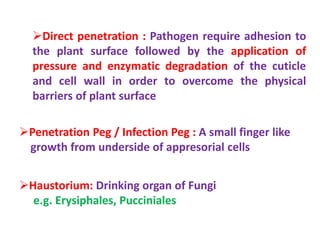
Direct penetration : Pathogen require adhesion to
the plant surface followed by the application of
pressure and enzymatic degradation of the cuticle
and cell wall in order to overcome the physical
barriers of plant surface
Penetration Peg / Infection Peg : A small finger like
growth from underside of appresorial cells
Haustorium: Drinking organ of Fungi
e.g. Erysiphales, Pucciniales
III. Penetration
Spore germination and Penetration
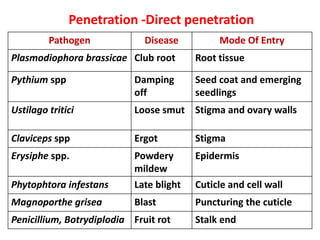
Penetration -Direct penetration
Pathogen Disease Mode Of Entry
Plasmodiophora brassicae Club root Root tissue
Pythium spp Damping
off
Seed coat and emerging
seedlings
Ustilago tritici Loose smut Stigma and ovary walls
Claviceps spp Ergot Stigma
Erysiphe spp. Powdery
mildew
Epidermis
Phytophtora infestans Late blight Cuticle and cell wall
Magnoporthe grisea Blast Puncturing the cuticle
Penicillium, Botrydiplodia Fruit rot Stalk end
Methods of penetration and invasion by fungi
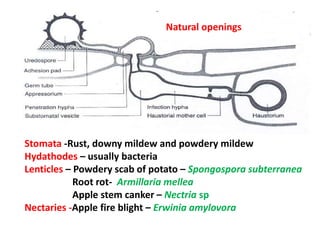
Stomata -Rust, downy mildew and powdery mildew
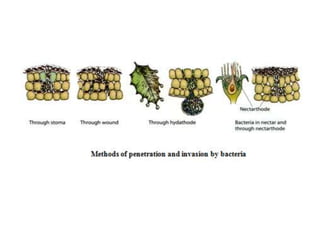
Hydathodes – usually bacteria
Lenticles – Powdery scab of potato – Spongospora subterranea
Root rot- Armillaria mellea
Apple stem canker – Nectria sp
Nectaries -Apple fire blight – Erwinia amylovora
Natural openings
IV. Infection
The process of establishment of pathogen
within susceptible cells or tissues of the
host and starts to procure nutrient from
them
Infection period : Time elapsing between
spore germination and established infection
Invasion: Pathogens spread into all the tissues
of the plant organs
Fungi and Bacteria : Inter / Intracellularly
Virus, Viroid and FVB : Intravascularly
Systemic Infection : Single infection point to hole
plant or plant organ
e.g. Virus, Viroid, FVB, Candidatus Phytoplasma
and Protozoa
Colonization: Invaded pathogen grows and starts to
multiply
Fructification period: Time gap between infection and
first reproduction
Local Infection : Affecting limited part of a plant
e.g. Fungi (Except smut and few downy mildew
fungi), Bacteria and Phanerogamic Parasites
Successful infection results in appearance of
symptoms
Incubation period: Time between Inoculation and
symptom expression
V. Dissemination of the pathogen : transport of
inoculum from the source of production to an area
where a susceptible host is growing
VI. Over wintering / Over summering / Survival of the
pathogen:
Inoculum survives in debris, soil, seed etc. in the
absence of its host
Obligate parasites survives in living plant tissues
Thank you…

Lecture 6 Pathogenesis.pptx

  • 1.
  • 2.
    The action ofthe pathogen and whole array of host reactions and disease development occurring in host Definition: The diseases development may be continuous or intermittent The series of more or less distinct events occurring in sequence and leading to disease development and perpetuation of the disease and pathogen
  • 3.
    Types of DiseaseCycle Pathogens may complete one or more disease cycles per year or takes more than one year to complete a disease 1. Monocyclic or single cycle pathogens 2. Polycyclic or multi cycle pathogens 3. Polyetic pathogens
  • 4.
    1. Monocyclic orsingle cycle pathogens Complete one disease cycle in one year No secondary inoculum and secondary infection These pathogens are mostly responsible for slow epidemics e.g. Smuts, Root rots and Wilts Graphically these pathogens represents a saturation curve
  • 5.
    More than onedisease cycle per growing season e.g. Rust, Powdery mildew, Leaf spot, Leaf Blight, Anthracnose etc. 2. Polycyclic or multi cycle pathogens Amount of inoculum increased many fold Primary inoculum initiates the disease and numerous secondary inocula are produced at each infection site Graphically these pathogens represents a Sigmoid curve Mostly cause Rapid epidemics in field
  • 6.
    3. Polyetic pathogens Takemore than one year to complete a disease cycle per growing season e.g. Dutch elm, Citrus Tristeza and Pear decline May cause severe epidemics over several years
  • 7.
    Various stages inthe pathogenesis I. Inoculation II. Pre penetration III. Penetration IV. Infection V. Dissemination of the pathogen VI. Over wintering / over summering / survival a. Direct penetration b. Penetration through wounds c. Penetration through natural openings Infected host Dormant structures Outside the host
  • 8.
    Inoculum : Anypart of the pathogen that can cause infection or infective propagule coming in contact with host Propagule : One unit of inoculum of any pathogen Primary (1°) Inocuclum : An inoculum that survives, dormant in the winter / summer and initiates the infection first time in the season of crop Secondary (2°) Inocuclum : An inoculum produced from 1° infections. It helps in disease epidemic Inocuclum Potential : The amount of inoculum responsible for successful infection
  • 9.
  • 10.
  • 11.
  • 12.
    II. Pre penetration Pathogenis present on the host surface but has not entered into it Produce Mucilagenous substances to adhere to the plant Appressorium : The swollen tip of a germ tube that facilitates attachment and penetration of the host by a fungus
  • 13.
    III. Penetration Passive invaders: Pathogen which do not have any capacity to enter the host cell e.g. Virus, Viroid, Protozoa, Fastidious bacteria Actual entry of pathogen into the host plant Based on their capacity of make enter themselves into host cells, pathogens are classified as: Active invaders : Pathogens which make an aggressive effort to gain entry into intact host cells and do not require help of any external agency e.g. Fungi
  • 14.
    Direct penetration :Pathogen require adhesion to the plant surface followed by the application of pressure and enzymatic degradation of the cuticle and cell wall in order to overcome the physical barriers of plant surface Penetration Peg / Infection Peg : A small finger like growth from underside of appresorial cells Haustorium: Drinking organ of Fungi e.g. Erysiphales, Pucciniales
  • 15.
  • 16.
  • 17.
  • 19.
    Penetration -Direct penetration PathogenDisease Mode Of Entry Plasmodiophora brassicae Club root Root tissue Pythium spp Damping off Seed coat and emerging seedlings Ustilago tritici Loose smut Stigma and ovary walls Claviceps spp Ergot Stigma Erysiphe spp. Powdery mildew Epidermis Phytophtora infestans Late blight Cuticle and cell wall Magnoporthe grisea Blast Puncturing the cuticle Penicillium, Botrydiplodia Fruit rot Stalk end
  • 20.
    Methods of penetrationand invasion by fungi
  • 21.
    Stomata -Rust, downymildew and powdery mildew Hydathodes – usually bacteria Lenticles – Powdery scab of potato – Spongospora subterranea Root rot- Armillaria mellea Apple stem canker – Nectria sp Nectaries -Apple fire blight – Erwinia amylovora Natural openings
  • 23.
    IV. Infection The processof establishment of pathogen within susceptible cells or tissues of the host and starts to procure nutrient from them Infection period : Time elapsing between spore germination and established infection Invasion: Pathogens spread into all the tissues of the plant organs Fungi and Bacteria : Inter / Intracellularly Virus, Viroid and FVB : Intravascularly
  • 24.
    Systemic Infection :Single infection point to hole plant or plant organ e.g. Virus, Viroid, FVB, Candidatus Phytoplasma and Protozoa Colonization: Invaded pathogen grows and starts to multiply Fructification period: Time gap between infection and first reproduction Local Infection : Affecting limited part of a plant e.g. Fungi (Except smut and few downy mildew fungi), Bacteria and Phanerogamic Parasites
  • 25.
    Successful infection resultsin appearance of symptoms Incubation period: Time between Inoculation and symptom expression V. Dissemination of the pathogen : transport of inoculum from the source of production to an area where a susceptible host is growing VI. Over wintering / Over summering / Survival of the pathogen: Inoculum survives in debris, soil, seed etc. in the absence of its host Obligate parasites survives in living plant tissues
  • 26.