How can I plan my lessons using the Backwards Approach?


Identify the outcomes to be learned

Cut and paste your outcome(s) here.

N2.1 Demonstrate understanding of whole numbers to 100 (concretely, pictorially, physically, orally,
in writing, and symbolically) by:
• representing (including place value)
• describing
• skip counting
• differentiating between odd and even numbers
• estimating with referents
• comparing two numbers
• ordering three or more numbers.


Now that I have listed my outcome:

Determine how the learning will be observed
What will the children do to know that the learning has occurred?
What should children do to demonstrate the understanding of the mathematical
concepts, skills, and big ideas?
What assessment tools will be the most suitable to provide evidence of student
understanding?
How can I document the children’s learning?

Create your assessment tools before you create your lesson task.

I am going to co-construct criteria with the students. Credit:


                  http://annedavies.com/
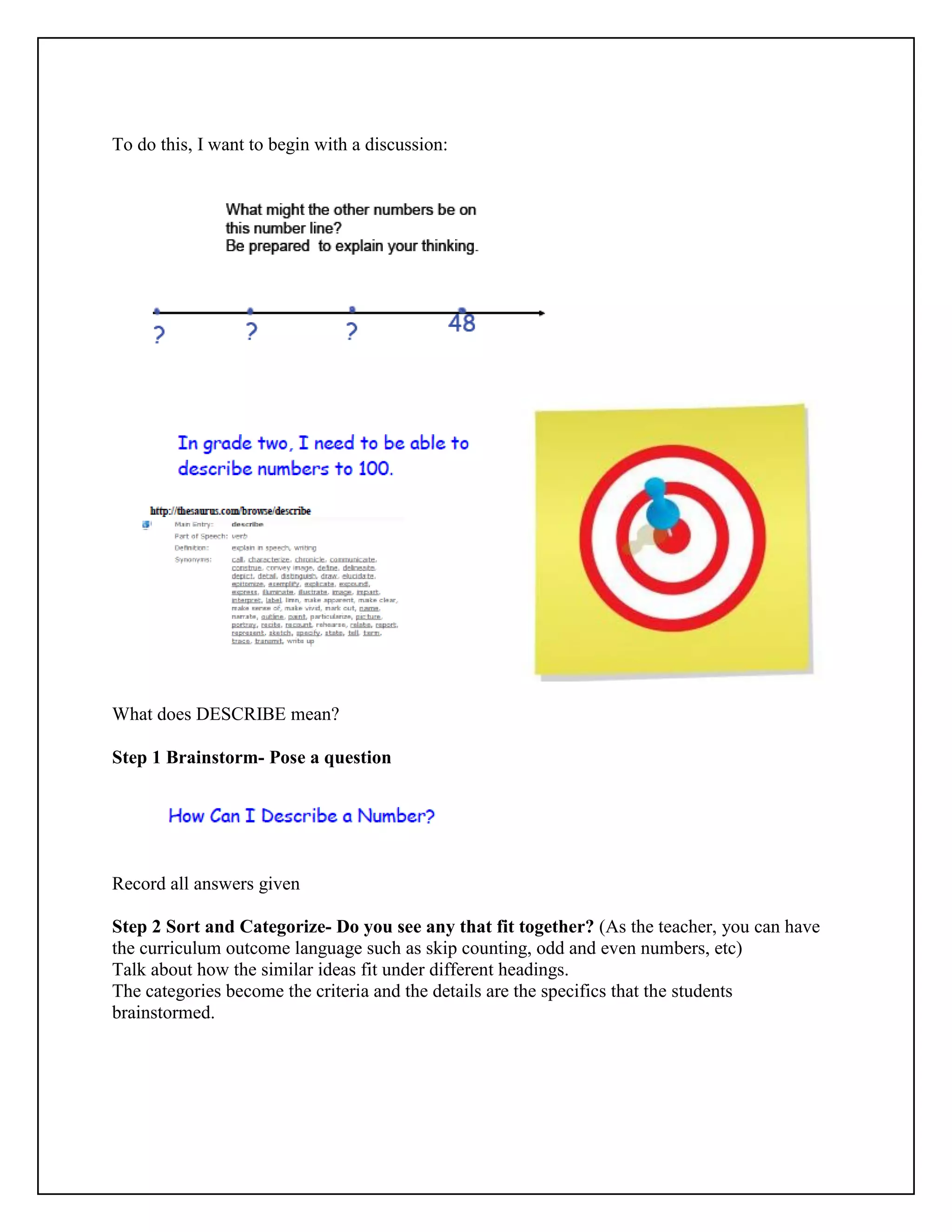
To do this, I want to begin with a discussion:


What does DESCRIBE mean?

Step 1 Brainstorm- Pose a question


Record all answers given

Step 2 Sort and Categorize- Do you see any that fit together? (As the teacher, you can have
the curriculum outcome language such as skip counting, odd and even numbers, etc)
Talk about how the similar ideas fit under different headings.
The categories become the criteria and the details are the specifics that the students
brainstormed.
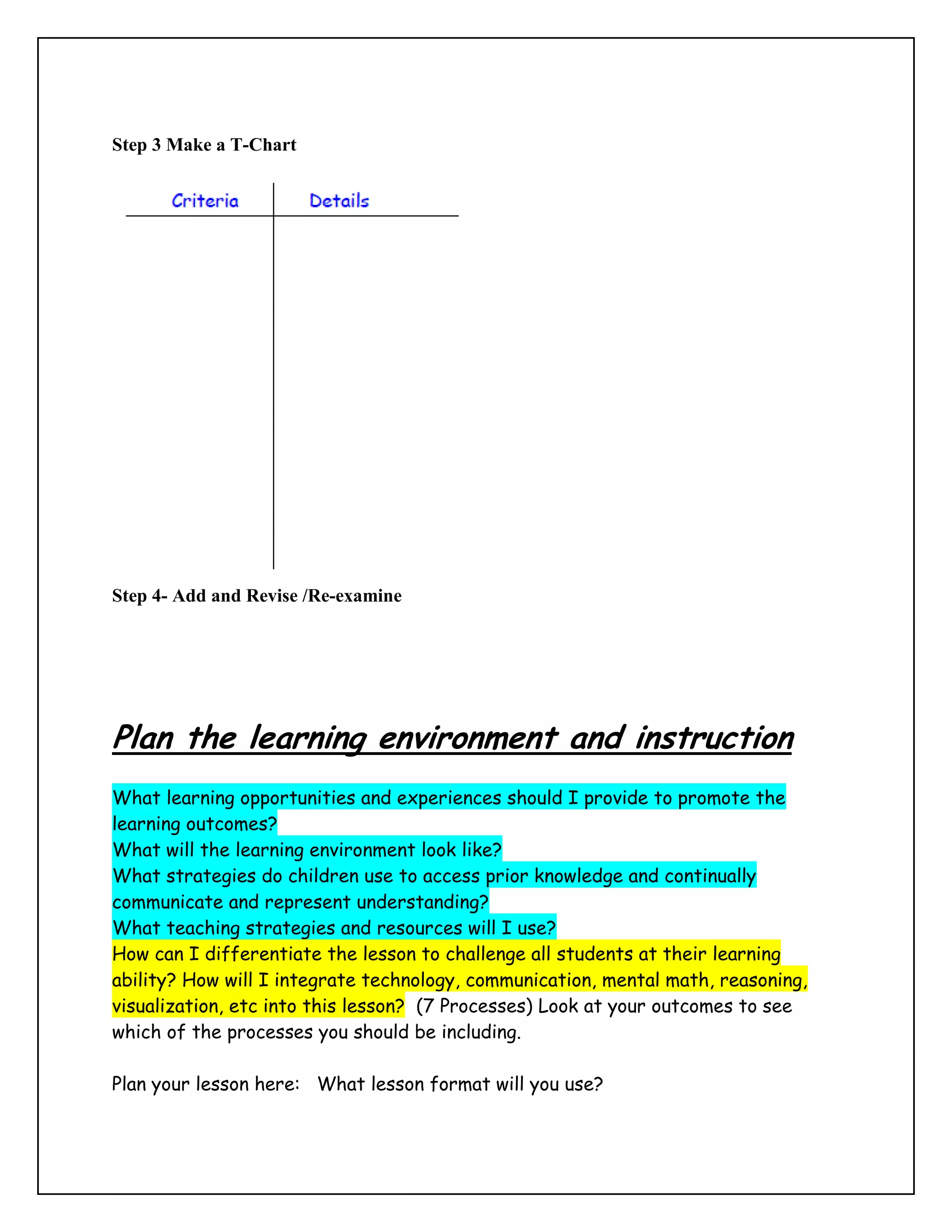
Step 3 Make a T-Chart


Step 4- Add and Revise /Re-examine


Plan the learning environment and instruction
What learning opportunities and experiences should I provide to promote the
learning outcomes?
What will the learning environment look like?
What strategies do children use to access prior knowledge and continually
communicate and represent understanding?
What teaching strategies and resources will I use?
How can I differentiate the lesson to challenge all students at their learning
ability? How will I integrate technology, communication, mental math, reasoning,
visualization, etc into this lesson? (7 Processes) Look at your outcomes to see
which of the processes you should be including.

Plan your lesson here: What lesson format will you use?
BEFORE-DURING-AFTER? Math PODS?                        ETC.


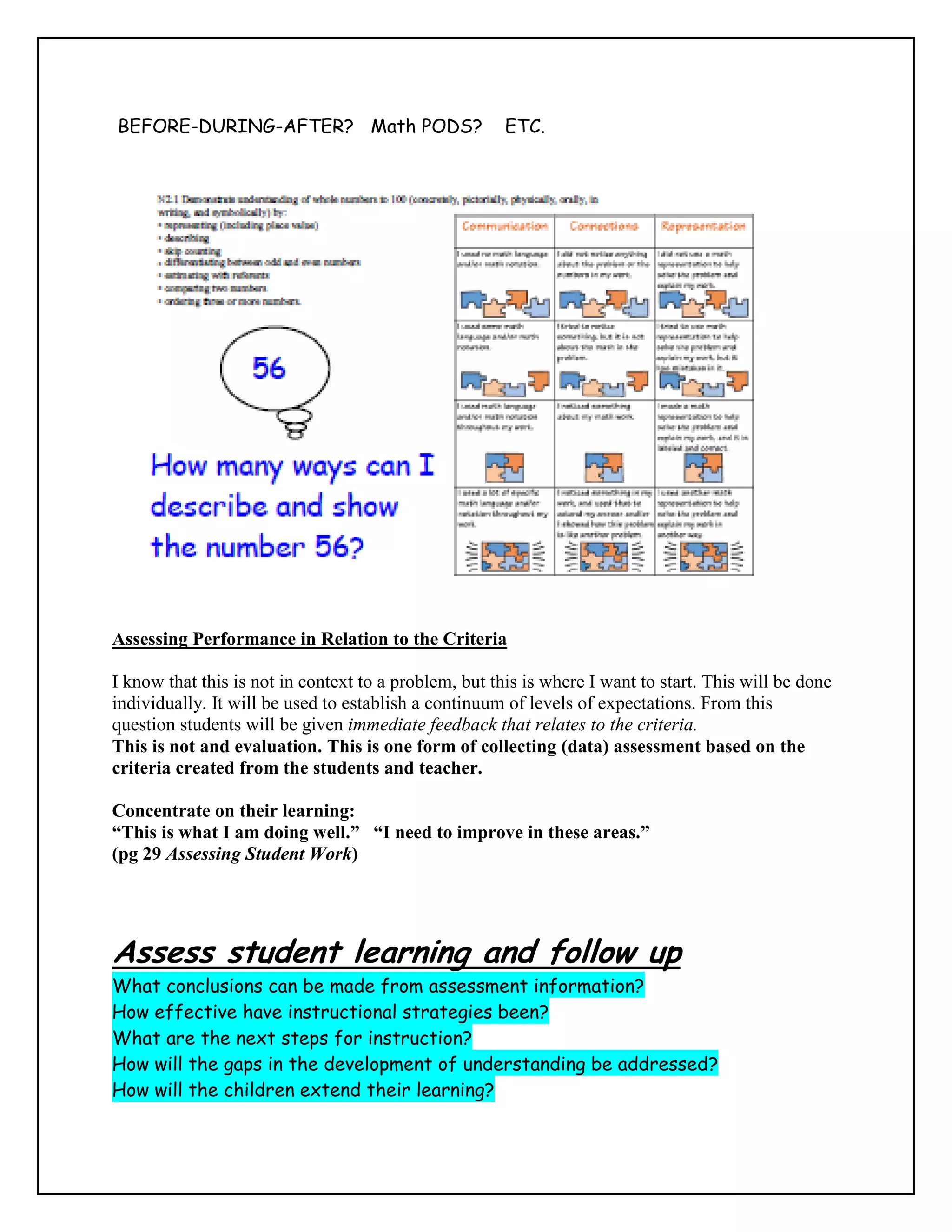
Assessing Performance in Relation to the Criteria

I know that this is not in context to a problem, but this is where I want to start. This will be done
individually. It will be used to establish a continuum of levels of expectations. From this
question students will be given immediate feedback that relates to the criteria.
This is not and evaluation. This is one form of collecting (data) assessment based on the
criteria created from the students and teacher.

Concentrate on their learning:
“This is what I am doing well.” “I need to improve in these areas.”
(pg 29 Assessing Student Work)


Assess student learning and follow up
What conclusions can be made from assessment information?
How effective have instructional strategies been?
What are the next steps for instruction?
How will the gaps in the development of understanding be addressed?
How will the children extend their learning?
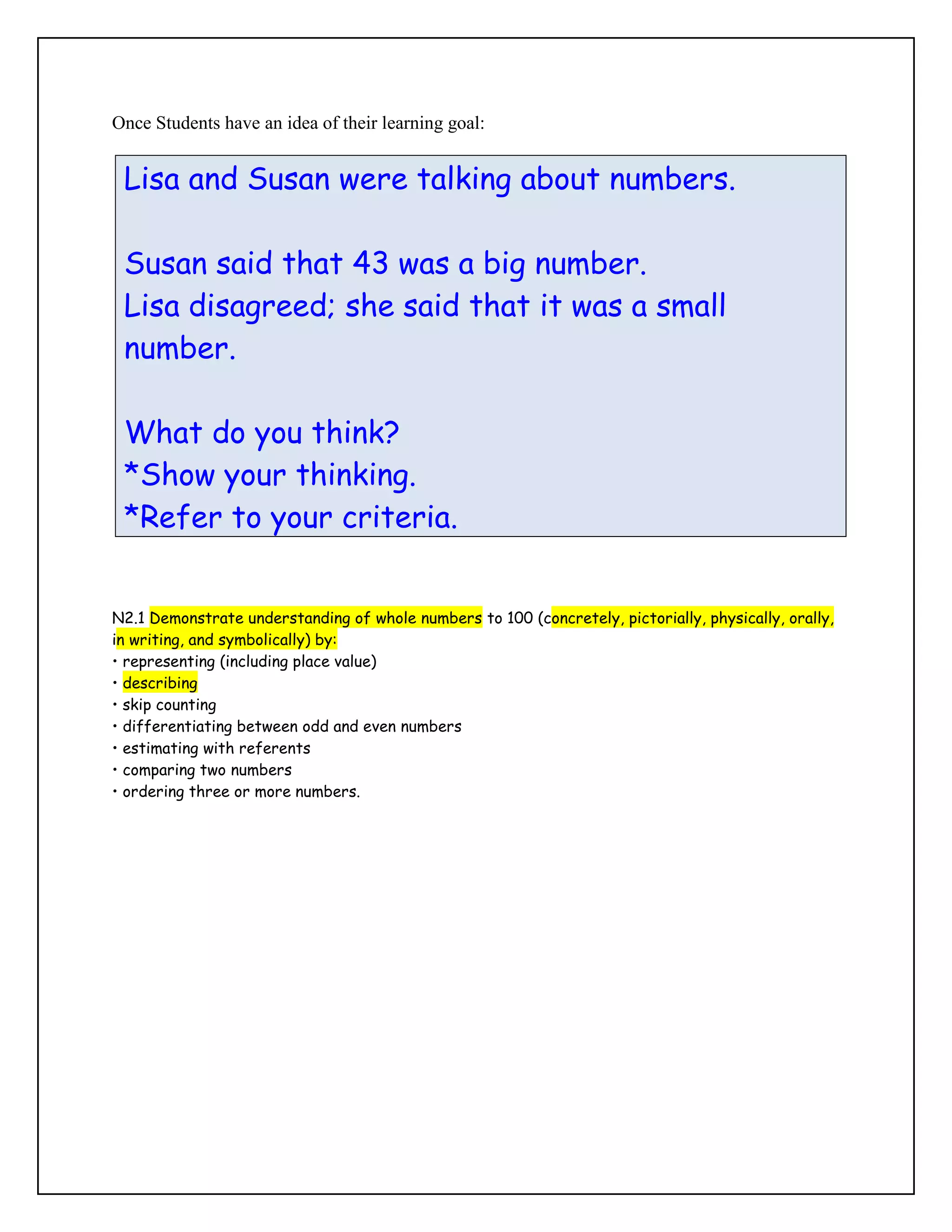
Once Students have an idea of their learning goal:


 Lisa and Susan were talking about numbers.

 Susan said that 43 was a big number.
 Lisa disagreed; she said that it was a small
 number.

 What do you think?
 *Show your thinking.
 *Refer to your criteria.


N2.1 Demonstrate understanding of whole numbers to 100 (concretely, pictorially, physically, orally,
in writing, and symbolically) by:
• representing (including place value)
• describing
• skip counting
• differentiating between odd and even numbers
• estimating with referents
• comparing two numbers
• ordering three or more numbers.

Grade 2 co constructing criteria lesson on number

  • 1.
    How can Iplan my lessons using the Backwards Approach? Identify the outcomes to be learned Cut and paste your outcome(s) here. N2.1 Demonstrate understanding of whole numbers to 100 (concretely, pictorially, physically, orally, in writing, and symbolically) by: • representing (including place value) • describing • skip counting • differentiating between odd and even numbers • estimating with referents • comparing two numbers • ordering three or more numbers. Now that I have listed my outcome: Determine how the learning will be observed What will the children do to know that the learning has occurred? What should children do to demonstrate the understanding of the mathematical concepts, skills, and big ideas? What assessment tools will be the most suitable to provide evidence of student understanding? How can I document the children’s learning? Create your assessment tools before you create your lesson task. I am going to co-construct criteria with the students. Credit: http://annedavies.com/
  • 2.
    To do this,I want to begin with a discussion: What does DESCRIBE mean? Step 1 Brainstorm- Pose a question Record all answers given Step 2 Sort and Categorize- Do you see any that fit together? (As the teacher, you can have the curriculum outcome language such as skip counting, odd and even numbers, etc) Talk about how the similar ideas fit under different headings. The categories become the criteria and the details are the specifics that the students brainstormed.
  • 3.
    Step 3 Makea T-Chart Step 4- Add and Revise /Re-examine Plan the learning environment and instruction What learning opportunities and experiences should I provide to promote the learning outcomes? What will the learning environment look like? What strategies do children use to access prior knowledge and continually communicate and represent understanding? What teaching strategies and resources will I use? How can I differentiate the lesson to challenge all students at their learning ability? How will I integrate technology, communication, mental math, reasoning, visualization, etc into this lesson? (7 Processes) Look at your outcomes to see which of the processes you should be including. Plan your lesson here: What lesson format will you use?
  • 4.
    BEFORE-DURING-AFTER? Math PODS? ETC. Assessing Performance in Relation to the Criteria I know that this is not in context to a problem, but this is where I want to start. This will be done individually. It will be used to establish a continuum of levels of expectations. From this question students will be given immediate feedback that relates to the criteria. This is not and evaluation. This is one form of collecting (data) assessment based on the criteria created from the students and teacher. Concentrate on their learning: “This is what I am doing well.” “I need to improve in these areas.” (pg 29 Assessing Student Work) Assess student learning and follow up What conclusions can be made from assessment information? How effective have instructional strategies been? What are the next steps for instruction? How will the gaps in the development of understanding be addressed? How will the children extend their learning?
  • 5.
    Once Students havean idea of their learning goal: Lisa and Susan were talking about numbers. Susan said that 43 was a big number. Lisa disagreed; she said that it was a small number. What do you think? *Show your thinking. *Refer to your criteria. N2.1 Demonstrate understanding of whole numbers to 100 (concretely, pictorially, physically, orally, in writing, and symbolically) by: • representing (including place value) • describing • skip counting • differentiating between odd and even numbers • estimating with referents • comparing two numbers • ordering three or more numbers.