Differentiation
Logos International School
October 2012
Pam Sephton
Differentiation
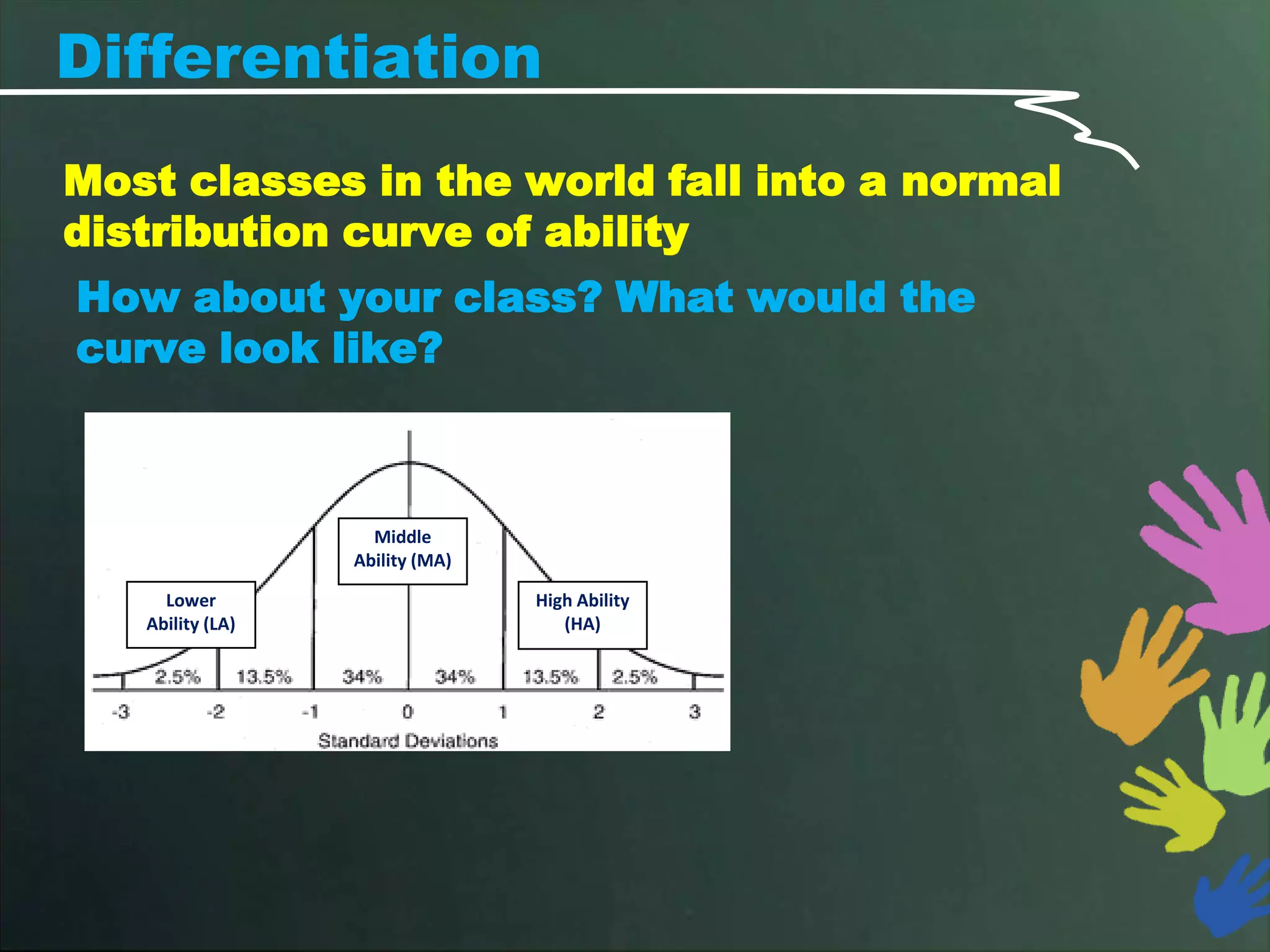
Most classes in the world fall into a normal
distribution curve of ability
How about your class? What would the
curve look like?


                    Middle
                  Ability (MA)

     Lower                       High Ability
   Ability (LA)                     (HA)
Differentiation
So how can we teach them all ensuring
that they learn and make progress?
   One way is through differentiation… so
   what is it?

Write down what you think it means?
Talk to the person next to you and share
your ideas…
Share any ideas with us all…
Differentiation
Differentiation is an approach to teaching
that attempts to ensure that all students
learn well despite their many differences.


We can differentiate in 2 main ways through:
1. The process

2. The content
Differentiation
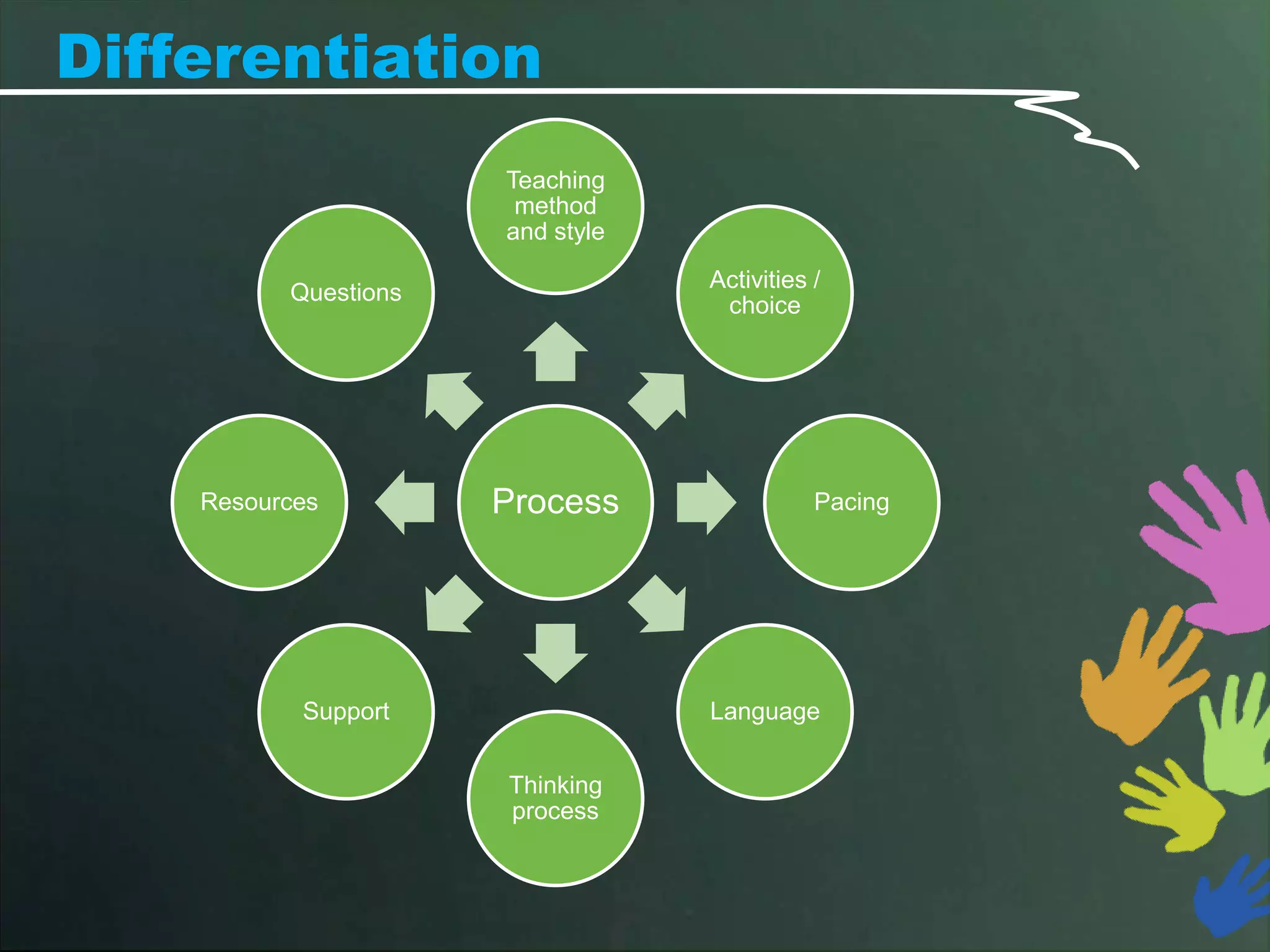
                      Teaching
                       method
                      and style
                                  Activities /
          Questions
                                   choice


    Resources         Process                Pacing


           Support                Language

                      Thinking
                      process
Differentiation

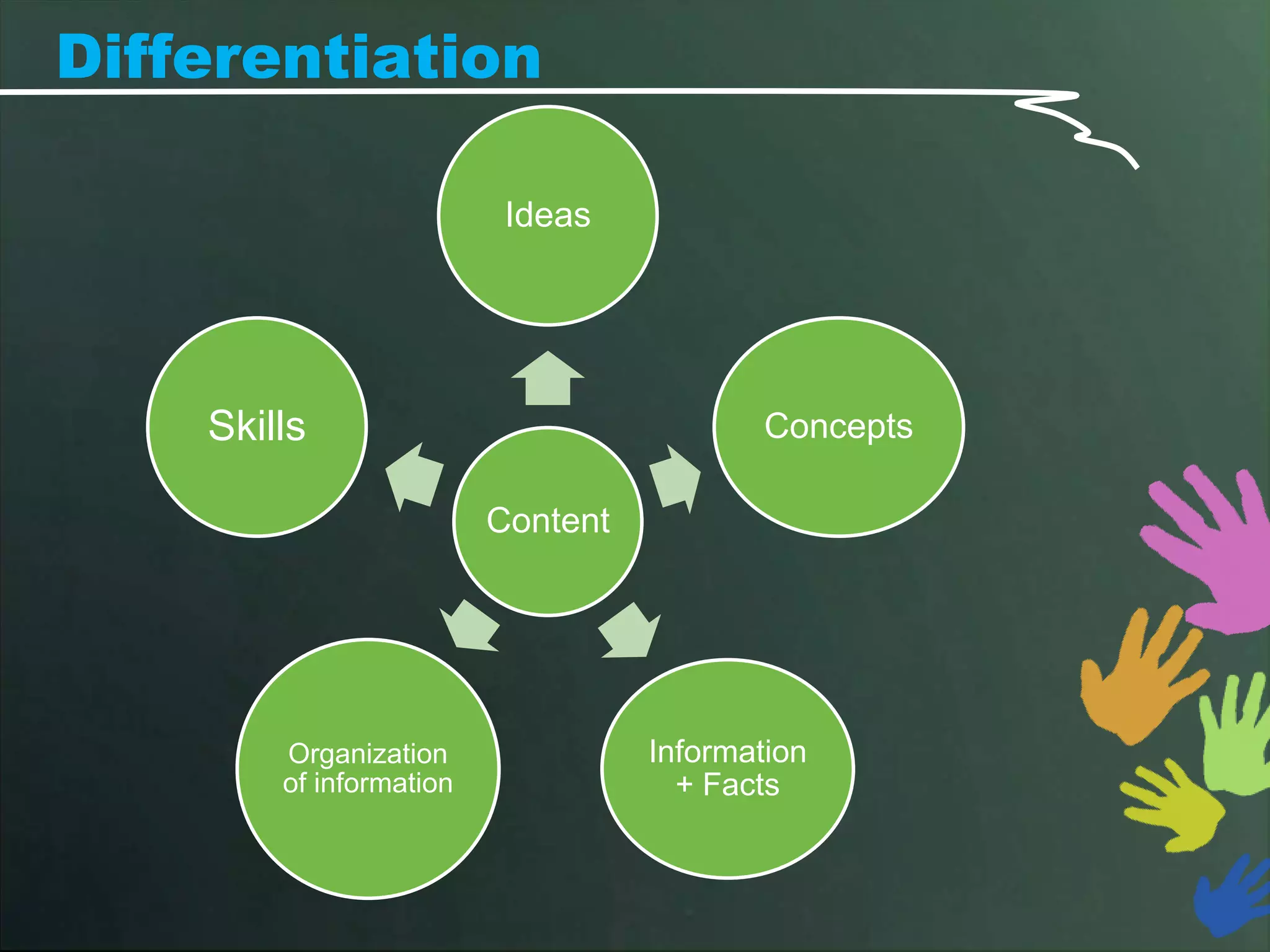
                          Ideas


    Skills                                 Concepts

                         Content


        Organization               Information
        of information               + Facts
Differentiation

Let’s focus on the process…

    Step 1: know your class
        think of the 3 main groups
        who is in which group


First consider ability groups then you can
change the groupings for different content
or skill areas. They can include gender,
friendship, ability or a mix depending on the
activity.
Differentiation
Let’s focus on the process…

  Step 2: be clear about the objective for the
          lesson
       What do you want the children to
        have learned by the end of the
        lesson?
       What do they need to do to succeed –
         success criteria


The objective may be the same but the
activity and outcome may be different for
different groups – remember to extend and
challenge the HA chn
Differentiation
Let’s focus on the process…

Step 3: decide what each group needs and make
        a plan
     How will you differentiate the whole class
      teacher input? (questioning, expectation,
      compacting, support, paired talk)
     How will you differentiate the group
      activities? (outcome, support, change content,
      collaboration, other strategies)


Look at the various grouping strategies:
cascade, envoy, goldfish, carousel,
snowball, jigsaw, pair swapping
Differentiation
 Grouping for learning / different expectations


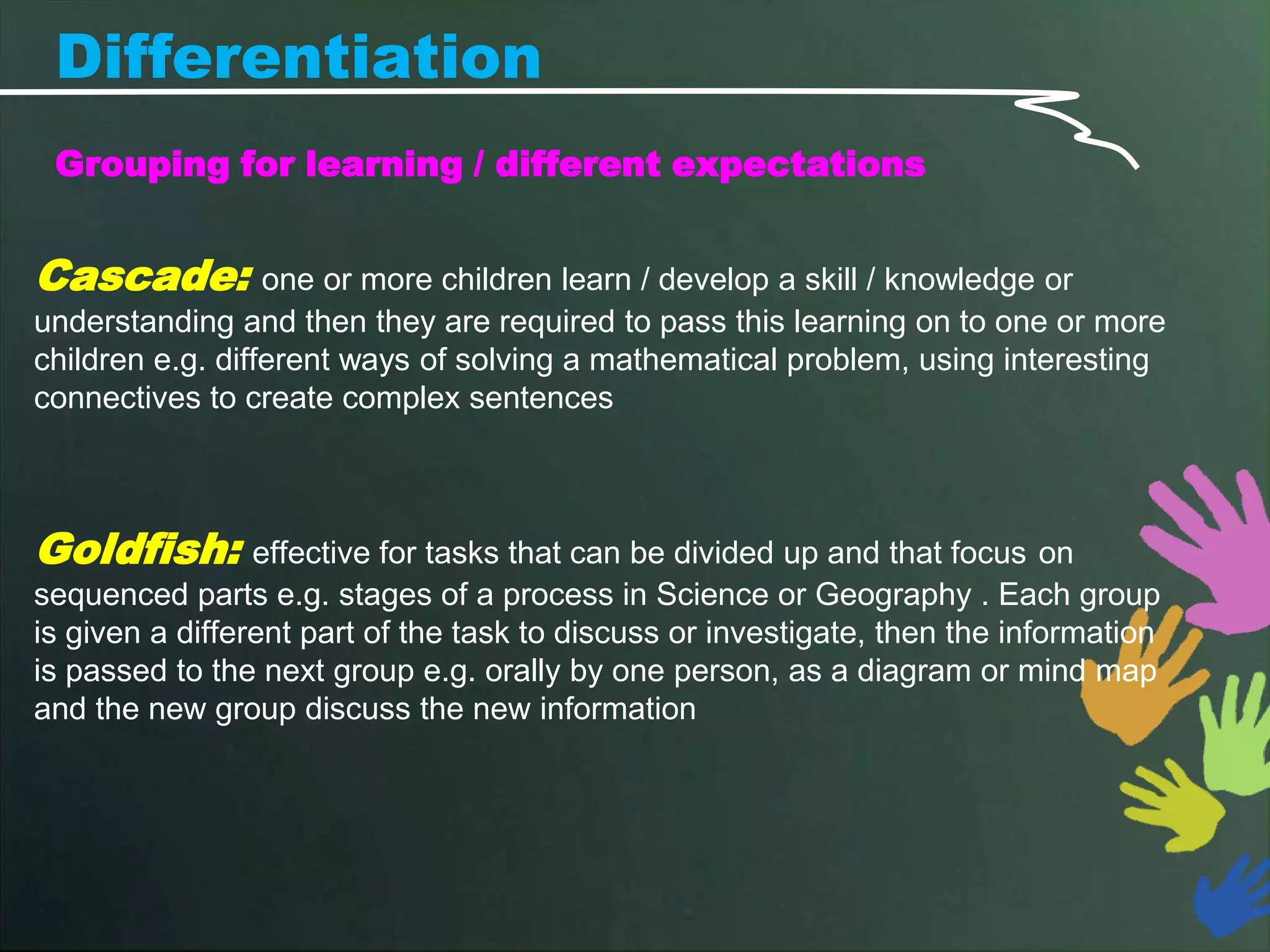
Cascade:          one or more children learn / develop a skill / knowledge or
understanding and then they are required to pass this learning on to one or more
children e.g. different ways of solving a mathematical problem, using interesting
connectives to create complex sentences


Goldfish: effective for tasks that can be divided up and that focus on
sequenced parts e.g. stages of a process in Science or Geography . Each group
is given a different part of the task to discuss or investigate, then the information
is passed to the next group e.g. orally by one person, as a diagram or mind map
and the new group discuss the new information
Differentiation
Grouping for learning / different expectations


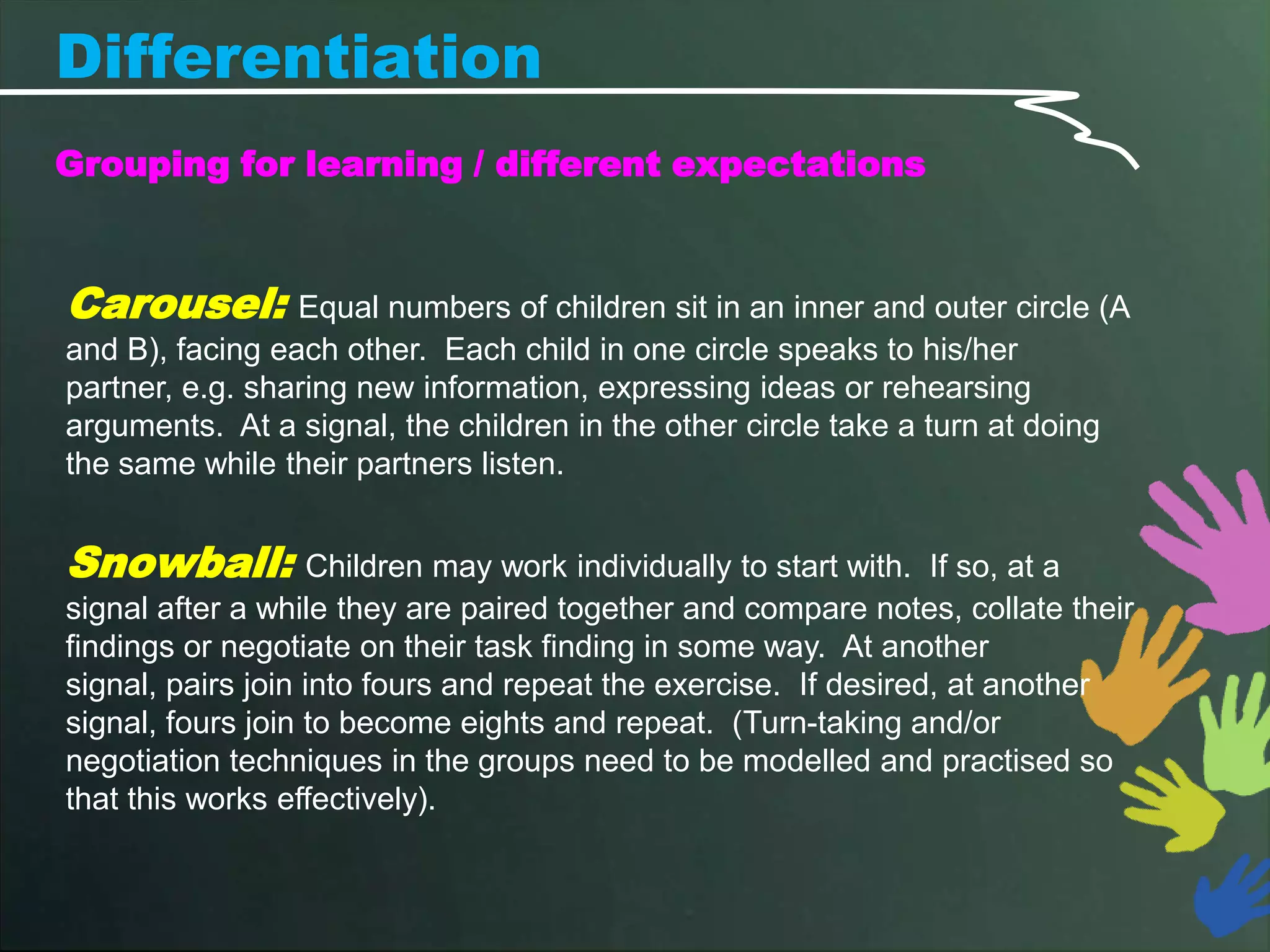
Carousel: Equal numbers of children sit in an inner and outer circle (A
and B), facing each other. Each child in one circle speaks to his/her
partner, e.g. sharing new information, expressing ideas or rehearsing
arguments. At a signal, the children in the other circle take a turn at doing
the same while their partners listen.


Snowball: Children may work individually to start with.          If so, at a
signal after a while they are paired together and compare notes, collate their
findings or negotiate on their task finding in some way. At another
signal, pairs join into fours and repeat the exercise. If desired, at another
signal, fours join to become eights and repeat. (Turn-taking and/or
negotiation techniques in the groups need to be modelled and practised so
that this works effectively).
Differentiation
Grouping for learning / different expectations
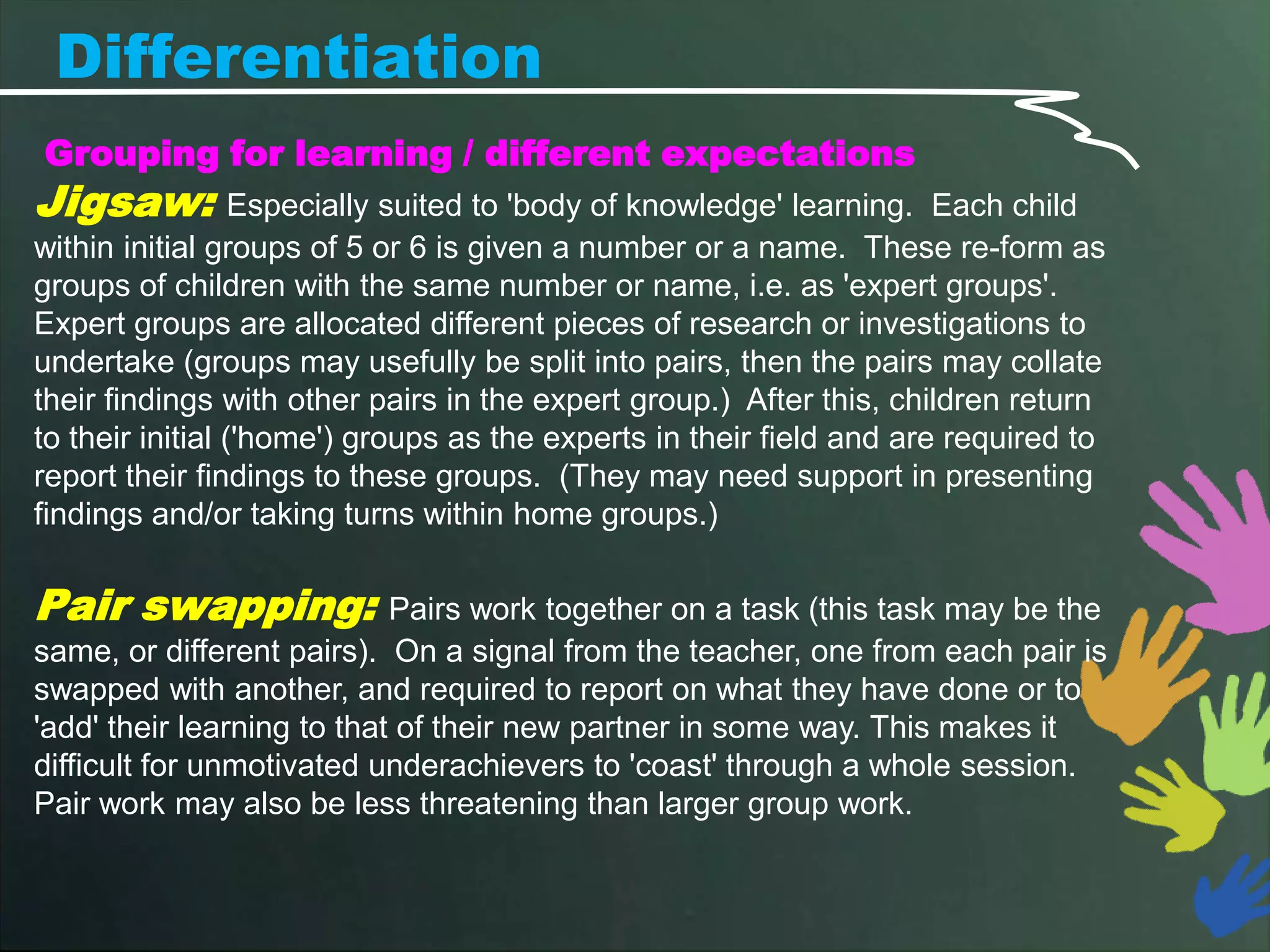
Jigsaw:           Especially suited to 'body of knowledge' learning. Each child
within initial groups of 5 or 6 is given a number or a name. These re-form as
groups of children with the same number or name, i.e. as 'expert groups'.
Expert groups are allocated different pieces of research or investigations to
undertake (groups may usefully be split into pairs, then the pairs may collate
their findings with other pairs in the expert group.) After this, children return
to their initial ('home') groups as the experts in their field and are required to
report their findings to these groups. (They may need support in presenting
findings and/or taking turns within home groups.)

Pair swapping:              Pairs work together on a task (this task may be the
same, or different pairs). On a signal from the teacher, one from each pair is
swapped with another, and required to report on what they have done or to
'add' their learning to that of their new partner in some way. This makes it
difficult for unmotivated underachievers to 'coast' through a whole session.
Pair work may also be less threatening than larger group work.
Differentiation
         Different expectations + different outcomes

Give children options and choices about
presentation – the outcome
       Mind map or flow chart or diagram
       PowerPoint presentation
       Movie
       Speech / talk with props
       Artwork
       Essay
       Leaflet / pamphlet (written or word processed)
       Rap / musical presentation
       Role play

  This links to multiple intelligences and learning styles
Differentiation
         Different expectations + different outcomes

Give children criteria for success
     A rubric
     A checklist
     What a grade A, B or C would look like…if you have xyz you will
      get C etc.
     Create the success criteria with the students – what do they think
      should be included?
     Consider the grades for each level – do all LA children always
      get C or can they get a higher grade by completing a task at their
      level very well using some of their other strengths
     Set high challenges for the HA students


  This links to multiple intelligences and learning styles
Differentiation
Let’s focus on the process…

 Step 4: Assess how the groups did
    by looking at their presentation / outcome
    talking to the children – ask them if they think they
      have achieved the objective
    Give them a specific task to complete that will show
      their learning – see differentiating the plenary


It is important for children to learn to evaluate their
own learning and to be willing to evaluate others too
(peer assessment and marking / feedback)
Differentiation
Let’s focus on the process…


 Step 5: Evaluate the lesson
    Make notes on your plan about how each group did
     and what they need to do next
    Make notes about what worked well and what didn’t
    Consider tasks for consolidation or extension for
     homework


This information will inform future planning as it gives
information about children’s prior learning and areas
for development or next steps
Differentiation
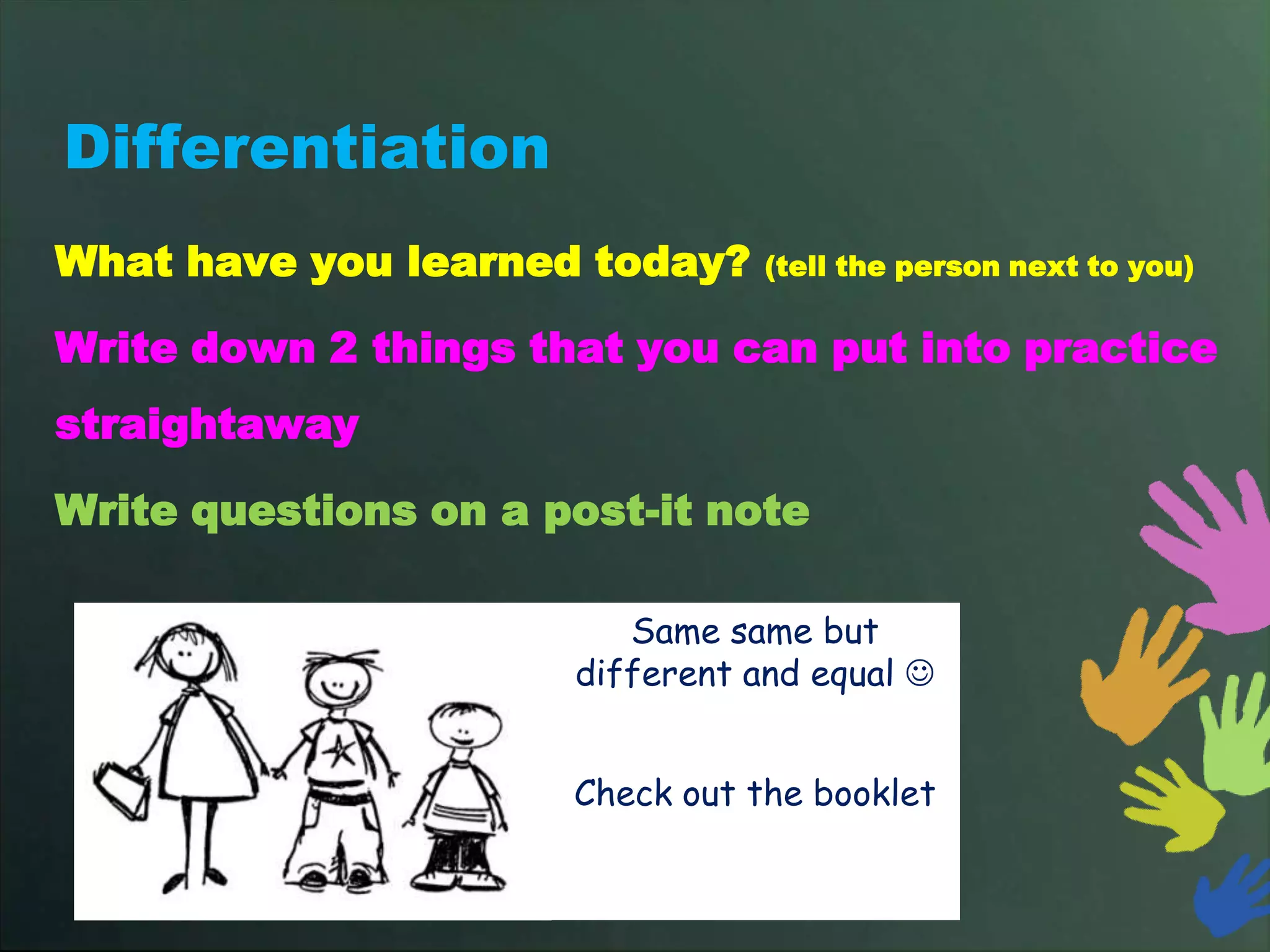
What have you learned today?     (tell the person next to you)


Write down 2 things that you can put into practice
straightaway

Write questions on a post-it note

                         Same same but
                      different and equal 


                      Check out the booklet

Differentiation for ms+hs

  • 1.
  • 2.
    Differentiation Most classes inthe world fall into a normal distribution curve of ability How about your class? What would the curve look like? Middle Ability (MA) Lower High Ability Ability (LA) (HA)
  • 3.
    Differentiation So how canwe teach them all ensuring that they learn and make progress? One way is through differentiation… so what is it? Write down what you think it means? Talk to the person next to you and share your ideas… Share any ideas with us all…
  • 4.
    Differentiation Differentiation is anapproach to teaching that attempts to ensure that all students learn well despite their many differences. We can differentiate in 2 main ways through: 1. The process 2. The content
  • 5.
    Differentiation Teaching method and style Activities / Questions choice Resources Process Pacing Support Language Thinking process
  • 6.
    Differentiation Ideas Skills Concepts Content Organization Information of information + Facts
  • 7.
    Differentiation Let’s focus onthe process… Step 1: know your class think of the 3 main groups who is in which group First consider ability groups then you can change the groupings for different content or skill areas. They can include gender, friendship, ability or a mix depending on the activity.
  • 8.
    Differentiation Let’s focus onthe process… Step 2: be clear about the objective for the lesson  What do you want the children to have learned by the end of the lesson?  What do they need to do to succeed – success criteria The objective may be the same but the activity and outcome may be different for different groups – remember to extend and challenge the HA chn
  • 9.
    Differentiation Let’s focus onthe process… Step 3: decide what each group needs and make a plan  How will you differentiate the whole class teacher input? (questioning, expectation, compacting, support, paired talk)  How will you differentiate the group activities? (outcome, support, change content, collaboration, other strategies) Look at the various grouping strategies: cascade, envoy, goldfish, carousel, snowball, jigsaw, pair swapping
  • 10.
    Differentiation Grouping forlearning / different expectations Cascade: one or more children learn / develop a skill / knowledge or understanding and then they are required to pass this learning on to one or more children e.g. different ways of solving a mathematical problem, using interesting connectives to create complex sentences Goldfish: effective for tasks that can be divided up and that focus on sequenced parts e.g. stages of a process in Science or Geography . Each group is given a different part of the task to discuss or investigate, then the information is passed to the next group e.g. orally by one person, as a diagram or mind map and the new group discuss the new information
  • 11.
    Differentiation Grouping for learning/ different expectations Carousel: Equal numbers of children sit in an inner and outer circle (A and B), facing each other. Each child in one circle speaks to his/her partner, e.g. sharing new information, expressing ideas or rehearsing arguments. At a signal, the children in the other circle take a turn at doing the same while their partners listen. Snowball: Children may work individually to start with. If so, at a signal after a while they are paired together and compare notes, collate their findings or negotiate on their task finding in some way. At another signal, pairs join into fours and repeat the exercise. If desired, at another signal, fours join to become eights and repeat. (Turn-taking and/or negotiation techniques in the groups need to be modelled and practised so that this works effectively).
  • 12.
    Differentiation Grouping for learning/ different expectations Jigsaw: Especially suited to 'body of knowledge' learning. Each child within initial groups of 5 or 6 is given a number or a name. These re-form as groups of children with the same number or name, i.e. as 'expert groups'. Expert groups are allocated different pieces of research or investigations to undertake (groups may usefully be split into pairs, then the pairs may collate their findings with other pairs in the expert group.) After this, children return to their initial ('home') groups as the experts in their field and are required to report their findings to these groups. (They may need support in presenting findings and/or taking turns within home groups.) Pair swapping: Pairs work together on a task (this task may be the same, or different pairs). On a signal from the teacher, one from each pair is swapped with another, and required to report on what they have done or to 'add' their learning to that of their new partner in some way. This makes it difficult for unmotivated underachievers to 'coast' through a whole session. Pair work may also be less threatening than larger group work.
  • 13.
    Differentiation Different expectations + different outcomes Give children options and choices about presentation – the outcome  Mind map or flow chart or diagram  PowerPoint presentation  Movie  Speech / talk with props  Artwork  Essay  Leaflet / pamphlet (written or word processed)  Rap / musical presentation  Role play This links to multiple intelligences and learning styles
  • 14.
    Differentiation Different expectations + different outcomes Give children criteria for success  A rubric  A checklist  What a grade A, B or C would look like…if you have xyz you will get C etc.  Create the success criteria with the students – what do they think should be included?  Consider the grades for each level – do all LA children always get C or can they get a higher grade by completing a task at their level very well using some of their other strengths  Set high challenges for the HA students This links to multiple intelligences and learning styles
  • 15.
    Differentiation Let’s focus onthe process… Step 4: Assess how the groups did  by looking at their presentation / outcome  talking to the children – ask them if they think they have achieved the objective  Give them a specific task to complete that will show their learning – see differentiating the plenary It is important for children to learn to evaluate their own learning and to be willing to evaluate others too (peer assessment and marking / feedback)
  • 16.
    Differentiation Let’s focus onthe process… Step 5: Evaluate the lesson  Make notes on your plan about how each group did and what they need to do next  Make notes about what worked well and what didn’t  Consider tasks for consolidation or extension for homework This information will inform future planning as it gives information about children’s prior learning and areas for development or next steps
  • 17.
    Differentiation What have youlearned today? (tell the person next to you) Write down 2 things that you can put into practice straightaway Write questions on a post-it note Same same but different and equal  Check out the booklet